PCCA To Build Kansas Warehouse

Plains Cotton Cooperative Association (PCCA), Lubbock, Texas, plans to build a warehouse in
Liberal, Kan., to serve Kansas cotton producers. The seven-acre covered facility will store 65,000
bales of cotton, and is expected to be filled to capacity by Kansas growers.

“Cotton is rapidly becoming an important industry in southern sections of Kansas,” said Steve
Kelly, deputy secretary, Kansas Department of Commerce. “We are pleased to help develop this
growing industry by offering assistance to [PCCA] to encourage its location of a warehouse in
Seward County.”

According to PCCA, cotton production in Kansas has grown steadily over the last 10 years. In
2003, Kansas and northern Oklahoma growers planted 92,900 acres and produced 111,500 bales. By the
end of the decade, that production is expected to increase to 500,000 bales.

“[N]early 100 percent of the cotton produced in [Kansas and Oklahoma] is warehoused and
marketed through the cooperative,” said Dick Cooper, director of business development for Kansas
and northern Oklahoma, PCCA. “The new warehouse facility will save approximately $5 per bale in
transportation, and it will put more money in the pockets of Kansas cotton producers.”

November 2004

WIX Filters Enter The Industrial Hydraulic Market


V
isit Wix Filtration Products’ Gastonia, N.C.-based Allen Plant and you’ll find 600,000
square feet of manufacturing floor space dedicated to merging nonwovens filter media and metal
fabrication into state-of-the-art filtration technology. The plant, WIX’s largest, employs between
900 and 1,000 workers and is the largest consumer of filtration media in the United States. The
Allen Plant also consumes 1.7 million pounds of steel every seven days. Since opening in 1966, the
air-conditioned plant has expanded twice. Current capacity allows the plant to churn out 3,800
different parts, typically adding 200 new parts per year to the product line.

The manufacturing process blends automation and manufacturing cells to deliver a broad range
of filtration solutions. The process moves from virgin flat steel to can drawing, where the
filter’s steel pressure vessels are formed through progressive drawing and stamping – forming the
ubiquitous seamless steel pressure vessel that houses the filter media. At another cell, metal
stamping is used to form components with some parts running through automated threading mills that
cut threads into filter bottom plates. Filter media with various specifications are pleated – some
layered with wire screen at the pleater or with additional filter media based on filter design –
and cut to size for the final assembly process.

Final assembly brings together media, engineered internal components and the pressure
vessel. The manufacturing line continues with exterior painting and labeling. Seals are inserted on
the exterior of the mounting plate, and the finished units are tested prior to automated packing of
the canister-style spin-on filters for delivery.

The Allen Plant also manufactures various cartridge-style filters that utilize specialized
plastisol-based processing for seamless affixing of the media to the end-rings in manufacturing – a
unique attribute of WIX technology. Other mounting chemistry can be used to meet specifications for
a particular filter cartridge end-use.

wixopen
Chris Greeson, senior technical service manager, WIX Filtration Products


Industrial Hydraulics

WIX, with a long history in mobile hydraulics filtration, sees industrial hydraulic
applications as an opportunity to expand current mobile offerings, as well as to offer appropriate
technology to a new market. According to the company, contaminated hydraulic fluid is the root
cause of more than 70 percent of all hydraulic system failures. WIX entered the industrial
hydraulics market last year and its line continues to grow.

“The hydraulics arena provides WIX with a good growth area,”said Bruce Johnston, brand
manager, WIX Filtration Products. The company will use its broad distribution network of auto parts
suppliers to service and make industrial hydraulic filtration products available to manufacturing
plant locations.

“We entered the hydraulic filter market because, frankly, we have a lot to offer,” said
Chris Greeson, senior technical service manager, WIX Filtration Products. “As a company, we have
made terrific engineering advances in our heavy-duty filter line – many of which have been
incorporated into our industrial hydraulic filters.” When asked about his dream filter media,
Greeson said: “It’s about media development and compositions that meet customers’ needs.
Multi-layer, waterproof – with the ability to run 4 to 5 microns with 30- to 40-gallon-per-minute
flow and less than 1-psi [pound per square inch] drop – but we need faster development without
nonwovens suppliers being nervous.”

The industrial hydraulic products will focus on return side applications, typically running
to 300 psi, with the largest filter measuring 39 inches tall by 6 inches in diameter. WIX is fully
equipped to meet beta ratios specified by plant engineers for their applications, and also offers
fluid analysis.

filters
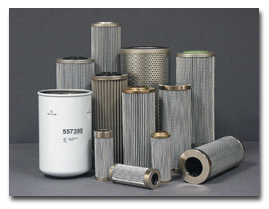
WIX has expanded its current mobile offerings by adding industrial hydraulic filters to its
product line.


Separating Water From Compressed Air

In a separate industrial application, WIX’s AquaChek product is making inroads in the
compressed air filtration market, where moisture is a problem – often causing corrosion and valve
failure.

The product is based on filter media technology that captures water molecules present in
compressed air. Polymers in the filter media react with the water molecules, encapsulating them and
making the moisture semi-solid. The trapped water cannot re-release into the compressed air stream,
and the filter can retain up to 50 times its weight in water – from 10 to 90 ounces depending on
filter size.

AquaChek is reported to operate at from 15 to 200 cubic feet per minute at a maximum
pressure ranging from 125 to 250 psi. At full saturation, the filter will create no more than a
0.5-psi drop in pressure and has a useful life not to exceed six months, depending on system and
environmental conditions. As WIX reports, “In real world applications, users have reported as much
as a four-fold increase in tool and equipment life and a dramatic reduction in corrosion-related
maintenance and repair.”


wixlogoWIX
Goes Racing

Few sports have the notoriety and marketing advantages that the National Association of
Stock Car Auto Racing (NASCAR) enjoys. WIX’s involvement with racing started in 1968, and in 1996,
WIX became the officially licensed filter of NASCAR. In recent years, WIX has put filtration
technology to work, teaming up with Joe Gibbs Racing to protect drivers from the harmful effects of
carbon monoxide, soot and debris encountered while racing. The company reports that WIX and Joe
Gibbs Racing are making the patented technology available to all drivers and teams in NASCAR.

“Our commitment to research and development combined with our focus on manufacturing the
most technologically advanced filters on the market not only give  NASCAR drivers and teams a
competitive edge, but they also give our heavy-duty and hydraulic customers an edge as well,” said
Johnston. “Because our filters stand up to the most rigorous race conditions, you can rest assured
that WIX filters will provide optimum filtration performance and protection for any piece of
machinery or equipment.”


November 2004

MicroCool® Humidification Now Available For Textiles

Thousand Palms, Calif.-based MicroCool® – a division of AxAir Nortec Inc. – has modified its
high-pressure water humidification process to design a system suitable for use in the textile
industry.

The new system filters clean city water, pressurizes it in a pump unit to more than 1,000
pounds per square inch, and delivers it through flexible tubing to nozzles aligned in the
production area. The brass and stainless steel nozzles atomize the water into small particles that
evaporate quickly and raise relative humidity to levels as high as 95 percent. MicroCool
custom-designs each system according to specifications of the particular factory or warehouse. The
company says the system is much less expensive than conventional humidity-raising methods, citing
lower costs of both operation and maintenance.

November 2004

American Floorcovering Alliance Celebrates 25 Years

At its annual meeting held recently at the Dalton Golf & Country Club, the Dalton-based
American Floorcovering Alliance (AFA) celebrated 25 years of leadership and promotion in the
flooring industry
(See ”
AFA
Sets Sights On FloorTek 2005
,”
TW, this issue)
.

AFA elected the following officers for the 2004-05 term: Lamar Brown, Lessco Inc., president;
H. Greely Joiner, H. Greely Joiner LLC, vice president; and David Pope, BB&T,
secretary/treasurer.

Directors elected for the 2004-05 term include: Fred Almy, Blue Ridge Industries; Thomas
Poston, Daikin International; and Becky Kafka, Wilcom America.

The following companies were recognized as 25-year members: BB&T; Brown Industries;
Caraustar; Carpet Crafts; Global Textile; Grass-Tex; Northwest Carpets; Rogers Finishing; and
Shaheen Carpet Mills. Manry & Heston and The Sample Works were recognized as 10-year members;
while Burtco Enterprises Inc. was honored by AFA as Member of the Year.

November 2004

JJI Offers Non-Halogen Flame Retarded Materials

JJI LLC, a Newtown, Pa.-based developer of non-halogen flame retarded material technologies, has
introduced the JZH platform of non-halogen flame retarded plastic materials for fiber applications.
The compounds, which contain no heavy metals, are available in environmentally friendly grades
including JZHPP polypropylene (PP) compound, JZHPLA polylactic acid (PLA) compound and JZHPA nylon
6 (PA) compound.

The company says the compounds offer excellent flow, high tensile properties, outstanding
toughness and up to 30- to 40-percent lighter weight compared with other flame retarded plastic
compounds. Advantages of these features include improved efficiency and fiber properties, as well
as cost savings.

November 2004

Beeshop Unveils Conditioning System

Textile consultant Beeshop S.A., Argentina, says its recently patented loom and weaving room
conditioning system will increase loom productivity, reduce air contamination and save energy.

The system is appropriate for use related to products made from hydrophilic fibers such as
cotton or wool, and blends of such fibers with man-made fibers.

The company says an automatic warp yarn moistening device reduces yarn breaks, lint and dust
by adding moisture directly to the yarn and providing uniform warp moistening. A lint and dust
removal device placed on the loom reduces air contamination and eliminates the need to use
traveling cleaners. A loom heat removal device extracts heat from the oil sinks using oil/water
heat exchangers, removing 50 to 60 percent of the heat generated. The cooling water may be cooled
for recycling or used untreated for other operations. A plant’s central air-conditioning system can
be replaced with fan and coil units above the roof. These units direct cool, clean air on the
operator aisles and remove warm contaminated air over the looms. Beeshop says this configuration
combined with the lint and dust removal device reduces solids concentration in the air by 60 to 70
percent.

November 2004

ACIMIT Looks To Asia


A
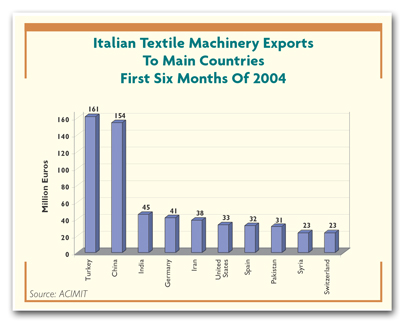
report released recently by the Italian Association of Textile Machinery Manufacturers
(ACIMIT) states that Italian textile machinery exports – valued at 998 million euros – were down 14
percent for the first half of 2004 compared to the same period in 2003. The report also relates
that, when compared with activity in the first few months of this year, the export trend is
improving, mainly due to growth in Asian markets. Forty percent of Italian textile machinery
exports currently go to Asia. Turkey and China – the main markets – imported Italian machinery
worth a total of 315 million euros. Italian textile machinery producers, not seeing signs of
improvement in the US and European markets, look to Asia with optimism.

p48_Copy_8

“The European situation is still difficult,” said Alberto Sacchi, Ph.D., chairman, ACIMIT.
“In the main European markets and in the United States, there are no signs of recovery in
investments in the textile sector, which is going through a tough period, as we can see from the
Italian situation.”

Compared to the first half of 2003, Italian sales in Iran have risen by 290 percent, in
Pakistan by 26 percent and in Syria by 25 percent. Sales in India also have risen.

“In the Asian area, the textile industry continues to grow, albeit with highs and lows and
the self-evident differences between the various countries,” Sacchi said. “This is a comforting
sign, especially when we consider the start of 2004, and leads us to hope for a more widespread
recovery from as early as next year.”

November 2004

Shaw Living: Branding Soft Floor Coverings


O
maha, Neb.-based Berkshire Hathaway Inc.’s subsidiary Shaw Industries Inc., Dalton, Ga.,
continues to expand its presence in the branded marketplace through its Shaw Living division, with
an emphasis on comfortable style backed by designer names and the latest in manufacturing
technology. The well-known Shaw Rugs division was expanded and renamed Shaw Living in late 2003. At
that time, Jeff Meadows, vice president, Shaw Living, proposed a five-part brand strategy centering
on design, color, quality, service and innovation. The division focuses on sales through
independent outlets and mass-market multi-store chains. The two channels are handled by separate,
independent sales teams within the division.

When Shaw Living was established, Meadows said the target for mass-market sales would reach
70 percent of the division’s revenue, and by mid-2004, he updated his projection to say mass-market
sales would be above 50 percent by next year.

John McLeod joined Shaw Living in August 2004 as vice president of sales and marketing, with
responsibility for the mass-merchant distribution channel. Industry observers have commented that
his appointment signaled Shaw Living’s reinforced attention to the home textiles and mass-market
channels.
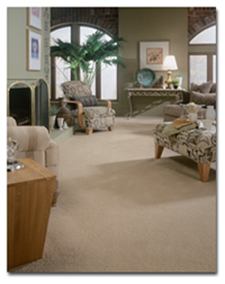
shawopen
Shaw Living offers a variety of carpet designs that appeal to a broad range of
consumers.


Brand Portfolio

Building a brand portfolio with names such as Kathy Ireland, Mary-Kate & Ashley, Jack
Nicklaus, Phillip Crowe and William E. Poole, Shaw Living offers a breadth of rug designs that
appeal to a broad cross section of consumers. Kathy Ireland’s collection is described as offering
value and being family-friendly, durable and fresh. Within her collection, lines such as Young
Attitudes extend design solutions for youth and family.

The trendy Mary-Kate & Ashley line is directed to young women. Designs are characterized
as “funky florals, bold geometrics and stunning motifs” in vivid colors.

Golf legend Jack Nicklaus’ line features 23 designs in high-end wool and a “dedication to
traditional excellence and perfection.” Eighteenth-century Persian- and European-inspired designs
offer a look of timeless antique quality. Nicklaus also has established home accent and furniture
designs with Drexel Heritage.

The work of wildlife artist Phillip Crowe inspired a line that realistically illustrates
popular outdoor subjects. “Ducks flying above a foggy marsh, retrievers awaiting their master’s
call, and a deer running through snow-covered fields” are descriptions from Crowe’s promotional
material. In addition, the Phillip Crowe-Estate collection reflects other outdoor activity. Images
inspired by Native American art and European hunting scenes round out a collection marked by names
such as English Estate, Kennett Square and Foxglove.

A home designer with a Southern flair, William E. Poole is creator of New Classics, a line
said to reflect Poole’s “classic style that brings stately elegance to any era and any setting.”
The line features patterns with location names (such as Essex, Richmond and Williamsburg), and
reflects design that blends “culture past and present” with an ever-present sense of home.

Regardless of one’s design sense, it isn’t difficult to see that the collections, taken as a
whole and extended even further with an array of other Shaw Living offerings, present a range of
products for the consumer that spans masculine to feminine, young to old, country to urban, and
classic to contemporary tastes. Shaw Living’s branding strategy establishes quick preference
opportunities through the star value of the designers, as well as through solid product execution
for delivery through independent outlets and mass-market multi-store chains.

From a technology standpoint, Shaw appears to be adding woven rug capacity and has a
continued focus on high-quality products made with increased manufacturing productivity.
Flexibility, from design to execution; and the ability to handle color, texture and cut loop are
just part of the picture. One industry expert noted that today’s jacquard technology has been a
great success, particularly in that it makes the end product look more and more handmade.

With estimated sales of $300 million by the end of 2005 versus Shaw Industries’ estimated $4
billion total, one would think Shaw Living is of minor interest, but, as an industry executive
said, “It’s not about the total revenue, it’s all about the margins.”


Van de Wiele: New Generation In Carpet Weaving

Introduced at ITMA 2003, Belgium-based Van de Wiele’s Carpet & Rug eXplorer CRX has
drawn the attention of the US floor covering industry. The CRX is a face-to-face carpet weaving
system that makes two carpets simultaneously, woven face-to-face, and cuts them apart through the
middle. 

The new weaving machine is designed for high-production output obtained by high weaving
speed and high weaving efficiency. In comparison to the previous generation of face-to-face carpet
weaving machines, Van de Wiele estimates the CRX has increased production by 15 to 20 percent.

The CRX is equipped with an air-cushioned rapier guiding system. According to the company,
the conjugated cams, which drive the rapier, knife and reed motions, are optimized to allow more
stable operation. The beam let-off on the CRX is of the continuous type, permanently adapting the
rotational speed of the beams to the quantity of yarn that remains on the beams.

A user-friendly Human Machine Interface (HMI) features a touch screen with graphical menus
to control the weaving machine.

The pile yarns are controlled by a new-generation MJ electronic jacquard machine that has a
compact selector with a reliable and full electronic selection principle that uses no springs,
levers or pivots. Power is supplied to the solenoids by current drive technology, ensuring solenoid
selection at all temperatures and reducing heat generation in the jacquard.

A further Van de Wiele development is a new type of harness spring.  The springs are
covered to protect against infiltrating dust. According to the company, this makes them very
suitable for weaving woolen pile yarns. The advantages, compared to using lingos for the harness
return, are higher speeds and a smoother-running machine.
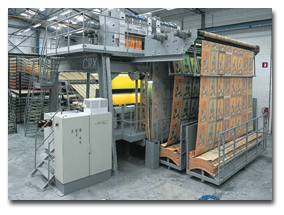
vandewiele_Copy_6
Van de Wiele’s Carpet & Rug eXplorer CRX face-to-face carpet-weaving system

The CRX82 is a double-rapier carpet-weaving machine that enables weaving of double- and
single-rapier weave structures.

The CRX82 also is equipped with an electronic jacquard machine featuring MJ technology. One
CRX82-420 can have a jacquard capacity with up to 24,192 solenoids, enabling weaving of new
qualities such as reed 700, 8 colors; and reed 500, 10 colors.

The CRX83 three-rapier carpet-weaving machine is the most flexible, according to the
company. It has the ability to weave triple-, double- and single-rapier weave structures. With a
triple-rapier weave structure, the CRX83 enables 50 percent more production than the old three-shot
double-rapier weave structure.

Van de Wiele also reports that demand from the carpet market has propelled industrial carpet
weavers to offer a broad range of qualities. The carpet woven on the three-rapier Universal Cut and
Loop UCL83, with a weaving width of up to 4.20 meters, can have simultaneously cut pile, short
loops, long loops and flat weave effects. The carpet is woven according to the face-to-face
technique. The top and bottom rapiers insert the fillings for the ground structures of the carpet.
The middle rapier inserts “dummy” fillings in between lancets to hold the loops. These dummy
fillings are automatically removed again from the carpet during the weaving process.

According to Van de Wiele, the production output on the Universal Cut and Loop UCL83 reaches
up to six times the production output of a conventional Wilton wire weaving machine. The UCL83 also
is extremely flexible, because at each pile selection point, the designer may choose between cut,
loop and flat weave. On the other hand, typical one-, two- and three-shot structures are possible.
The UCL83 can even weave sisal-look carpets with or without cut pile.

Van de Wiele’s new Master in Axminster MAX63 Axminster weaving machine accommodates numerous
designs in up to 16 colors. This robust machine and electronic jacquard offer the flexibility to
produce multicolor carpets without incorporated pile. The Master in Axminster MAX63 is not only
suited to the contract market, but also can be used for such applications as carpets with thicker
yarns and high pile height.


November 2004

Bureau Veritas To Install GretagMacbeth Solutions

Brockton, Mass.-based Bureau Veritas Consumer Products Services (BVCPS) will implement New Windsor,
N.Y.-based GretagMacbeth LLC’s Enterprise Color Management (ECM) program at its Brockton-based
ColorMat Division and at a facility in Turkey. The ECM program includes GretagMacbeth’s
NetProfiler, which will network with Bureau Veritas’ color-matching systems via the Internet,
allowing central, remote management of color data; and ensuring color accuracy, according to
GretagMacbeth. Also included in the program are NetPalette, which allows instant communication of
electronic color samples via the Internet, and the Color iMatch system for further automation of
the dyeing process. Bureau Veritas expects to fully implement the program by the end of the year.

November 2004

NCSU Duo Develops Super-Strong Nylon

Two researchers at the North Carolina State University (NCSU) College of Textiles, Raleigh, N.C.,
have created the strongest aliphatic nylon fibers known. Their goal is to develop economic
alternatives to high-strength fibers such as aramids for use in ropes, parachutes or tires, among
other products; or in composite materials used in high-temperature applications.

Alan Tonelli, Ph.D., KoSa Professor of Polymer Science; and Richard Kotek, Ph.D., assistant
professor of textile engineering, chemistry and science, are using nylon 6,6 thermoplastic polymer,
which is easier to work with than aramid; but it is difficult to stretch and align the fiber, and
to remove the elasticity. Tonelli and Kotek dissolved the nylon 6,6 in a solution of gallium
trichloride in order to dissolve the hydrogen bonds and stretch the polymer chains. “Once the fiber
is created, it is soaked in water to wash away the gallium trichloride, allowing the hydrogen bonds
to re-establish,” Tonelli said.

“It looks promising,” Kotek said. “Just on the first try, were getting strong fibers.”

Tonelli said the fibers are as much as 10 times stronger than typical aliphatic nylons. He
and Kotek also are looking at alternative solutions using nylon 6,6.

November 2004

Sponsors