Some Cautious Optimism


T
he first quarter – after a moderately impressive holiday season – seems to be getting off
to a reasonably good start. In any event,

TW
does not see any meaningful near-term erosion in overall textile activity, despite continuing
trade questions. Indeed, preliminary reports suggest domestic mill production over the current
January-March period should remain pretty much unchanged when compared to year-ago levels. That’s
not all that bad considering the flood of Chinese textile and apparel imports that came into the
country over the past year.

Look at dollar shipments of textile mill products, and it’s pretty much the same story – with
a sizable year-to-year gain in more highly fabricated textile products such as home furnishings,
rugs, and industrial products helping to offset a modest decline in basic mill items like yarns and
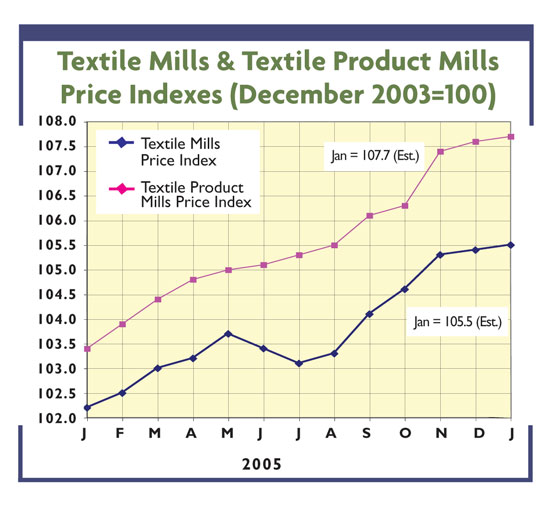
fabrics. Mill prices for the most part also have remained tolerably firm. For example, quotes in
the basic mill and mill product categories were running 3 and 4 percent, respectively, above a year
ago, according to the latest figures. Zero in on a few more detailed areas, and some of the price
advances are equally impressive -6 percent in the case of floor coverings and 4 percent in the more
basic greige goods area.
Febbusinessgraph


Another Plus: Trim Inventories

Equally encouraging are recent inventory trends. Generally speaking, mill holdings are quite
trim, with few if any disturbing stock overhangs. Credit this to a combination of much improved
market forecasting techniques and the pressing need to keep inventory carrying costs down.

New government figures tell the story. Stocks at the basic mill level now represent only
about a 1.25-months’ supply of shipments. Two years ago the average stock/shipment ratio was up in
the 1.5-months’ range. This keep-’em-lean approach is also noted for more highly fabricated textile
products – with the current 1.31-months’ supply again significantly under the nearly 1.7-months
reading of two years ago.

The current close-to-the-vest inventory strategy may also, to some extent, reflect the
industry’s need to keep up with today’s increasingly volatile markets – ready to meet any sudden
shift in buyers’ demand at virtually a moment’s notice. Other things being equal, this calls for a
lot more flexibility and opting for smaller production runs – and by implication, keeping less
unsold merchandise on warehouse shelves. This same trend toward slimmer stocks, incidentally, is
also noted for most other domestic industries as they struggle to stay afloat in today’s
competitive global markets.


The Economy Helps, Too

Further industry optimism is being engendered by the continuing general business uptrend. Gross
domestic product (GDP) – the broadest measure of how the economy is doing – racked up a solid
3.5-percent annual rate of growth over the last three months of 2005. And while some deceleration
is anticipated, gains through spring and early summer should still be fairly impressive, with
consensus GDP forecasts calling for gains in the 3-percent range.

Behind this optimism are rising employment, a further inching-up in spendable incomes, low
inflation and still-relatively-low interest rates. All these, in turn, are being reflected in
continuing consumer confidence, which at last report was hovering near its highest level in years.
Put all these into the forecasting equation, and it suggests continuing solid demand for apparel,
home furnishings and other textile products. To be sure, imports will continue to take an
increasingly large bite out of this still-rising 2006 textile demand. But early trends indicate
these import gains aren’t likely to run any higher than last year, when incoming shipments on a
square-meters-equivalent basis rose by about 9.5 percent. 


Current Profit Trends

Bottom line performance – given all the above – hasn’t been all that bad either. Indeed, new
numbers show surprising buoyancy. Latest government figures – third quarter 2005, for example, put
the industry’s after-tax earnings at $516 million. That’s significantly above the $288 million
reading of one year earlier. Compare the first three quarters of 2005 to the first three quarters
of 2004, and improvement is just as impressive, with the year-to-year after-tax advance put at
nearly 65 percent.

The news is equally upbeat in terms of margins, with mills on average earning 4.1 cents for
each dollar of sales. That’s again well above the 2.3-cent figure of 12 months earlier. This leads
to the conclusion that the American textile establishment is alive and well, at least as far as
overall performance is concerned. And – as pointed out in

TW
s 2006 textile industry forecast last month
(See “Surviving the Game Of Textiles,”
TW, January/February 2006)
– economic forecasting firm Global Insight sees
this profit trend continuing, especially in the more highly fabricated mill product sector.


February 2006
A Year Of Watersheds – Yarn Mills Rode A Roller Coaster In 2005


T
he year 2005 was one of the most dynamic years ever for the US textile and fiber
industries and spinners certainly had a front-row seat. The year kicked off with the January 1
expiration of quotas on textile and apparel products.

In March, trade figures for January become available. Imports from China in major apparel
products doubled when compared to January 2004. Some products, such as cotton trousers, saw import
increases of as much as 1,000 percent. China took a 35-percent share of the US import market for
textiles, and a 22 percent share for apparel. The total Chinese share of the US import market was
29 percent – the highest share of any single country in history.

“The quota phaseout was a landmark, watershed event,” said Gary A. Raines III, manager, fiber
economics, Cotton Incorporated, Cary, N.C. “It completely changed the playing field and was a shift
in paradigm. We began to see a dramatic increase in textile shipments coming into the United States
from China. Basically what everyone was afraid would happen ended up happening. Not only did the
Chinese volume come in much faster than expected, but we also saw that the cost per unit (kilogram
or square meter equivalent) was dramatically lower on the Chinese product in the absence of
quotas.”

In July, the House of Representatives passed the Dominican Republic-Central American Free
Trade Agreement (DR-CAFTA). Two of the industry’s major trade groups – The National Council of
Textile Organizations (NCTO) and The American Manufacturing Trade Action Coalition (AMTAC) – took
opposing views on the trade measure. NCTO strongly backed DR-CAFTA and said, “The passage of
DR-CAFTA means that the jobs of US textile workers are more secure today than they were yesterday.”

AMTAC described the agreement as a “job killer” and voiced concerns it could cost an
estimated $1 billion in US textile and apparel exports. Most spinners sided with NCTO, seeing
DR-CAFTA as essential to the industry’s future.

“DR-CAFTA was really a matter of saving the industry,” said one spinner just after the
agreement’s passage. “Critics said we would lose jobs, and I don’t disagree. But I think it was a
matter of losing jobs or losing the industry. Some of the more labor-intensive work, which has been
going out of the United States for many years, will continue to move out. But there will be a base
left that might not have been possible without DR-CAFTA.”

“We view DR-CAFTA as necessary legislation to enable continued opportunity for the Central
American apparel industry,” said one specialty ring spinner. “We must have a healthy apparel
industry in Central America.”

In September, Hurricanes Katrina and Rita hit the gulf coast. Oil and man-made fiber prices
spiked. The fallout from these natural disasters also set some spinners scrambling to find
transportation to get their yarn to customers domestically and in Central America.

In November, the United States and China reached a comprehensive 3-year bilateral textile
trade agreement, which cut China’s market access in 14 core apparel categories during 2006 by 2.5
percent, compared to what the US industry could have expected under a safeguard reapplication
process. In addition, the agreement placed 20 new textile and apparel categories under three-year
quota control including combed cotton yarn, knit fabric, swimwear, sweaters, fiberglass fabrics,
ramie trousers, industrial fabrics and textile blinds.


2006: Eyes On China


As mill executives survey the issues confronting them in 2006 — including implementation of
DR-CAFTA, continued industry consolidation, man-made fiber prices, retail trends and future trade
agreements — China will continue to demand the lion’s share of their attention.

“China is not the only story, but it is a big story that only continues to get bigger,” said
Raines. “Estimates for Chinese cotton mill use continue to grow and are now roughly 43 million
bales for this marketing year. This has more than doubled in the last seven or eight years. And I
believe that the 43 million-bale estimate is too low.”

According United States Department of Agriculture estimates, China will import 16.5 million
bales of cotton this year, compared to 8.8 million bales last year. About half of China’s cotton
imports will come from the United States, according to Raines. In other words, roughly one in three
bales grown in the Unites States this year will be used in a Chinese mill. China also has become
the world’s largest importer of cotton yarns.

“This year for the first time since Reconstruction [after the Civil War], a foreign country
will use more US cotton than the United States does,” Raines said.


January/February 2006

DAK Americas To Increase Polyester Fiber Prices

Citing rising global costs of raw
materials and energy, Charlotte-based DAK Americas LLC will increase its polyester staple fiber
prices by 3 cents per pound on February 15, and again on March 15 by 2 cents per pound.

Both price increases will affect products sold to home furnishings, apparel, industrial,
carpet and fiberfill markets.


February 1, 2006

United States And South Korea Studying Trade Pact

The United States and South Korea
appear to be close to starting negotiations on a free trade agreement (FTA) that could be one of
the largest with a single country — second only to the three-nations in the North American Free
Trade Agreement. Two-way trade between the United States and South Korea amounts to more than $70
billion, making South Korea the United States’ seventh largest trading partner. The United States
currently imports $1.7 billion in textiles and apparel and exports $1.5 billion worth fo goods.

While the Bush administration has negotiated 13 free trade agreements and has at least
another half a dozen in various stages of negotiation, most of them involve small countries. An FTA
with South Korea would be a major development for US international trade.

In a recent meeting with reporters, US Trade Representative Rob Portman cited South Korea as
an example of how trade can be a significant factor in helping a country become a booming economy.
Portman said: “After the Korean War, the North Korean economy was stronger than South Korea. In the
interim, North Korea has closed down to trade, taken a self-sufficiency point of view as South
Korea has done just the opposite, They’ve opened up to trade. The beneficiaries have been the
citizens of the Republic of Korea. It’s an amazing story to go from a truly poor developing country
to a country which is now one of the stronger economies in the world.”

A South Korean FTA could be in for some rough sledding. South Korean farmers do not like the
idea, and the latest US FTA — the Central American Free Trade Agreement —barely squeaked through
Congress.

January 31, 2006


Anver Vacuum Lifters Handle Tall Boxes, Curved Goods

Anver Corp., Hudson, Mass., has
introduced two new attachments as part of its VT-Series vacuum tube lifting systems.

The company reports its stainless steel curved pad attachment can lift rolls measuring up to
5 feet long and weighing up to 200 pounds, and features a manual tilt mechanism that enables
vertical stacking of rolls and loading of mandrels.

Another new attachment allows one person to load and unload pallets of tall, narrow boxes
weighing up to 200 pounds without bending or stretching, the company claims. Features include a
guide handle, two pivoting vacuum suction pads and quick-connect coupling.

VT attachments are custom-designed and interchangeable. The systems also feature a conical
flow valve to allow smooth vacuum operation and unlimited starts/stops per minute with instant
attach/release mechanism, and an extended ergonomically designed handlebar.


January 31, 2006

Peru Free Trade Agreement Before Congress

A US/Peru free trade agreement (FTA)
is now before Congress, and it has the strong support of textile manufacturers. Cass Johnson,
president of the Washington-based National Council of Textile Organizations, said its members like
the agreement and hope it will serve as a “template” for agreements with the other Andean nations —
Colombia, Bolivia and Ecuador. The agreement has a yarn-forward rule of origin; no tariff
preference levels allowing use of inputs from nonparticipating countries and calls for strong US
Customs enforcement — all provisions the US textile industry has sought in other free trade
agreements. Calling the Peruvian FTA a “very good agreement,” US Trade Representative Rob Portman
said “it is a very important part of our Andean Pact free trade strategy.”

January 26, 2006


Somelos Expands With Benninger Machinery

In an effort to increase capacity at its Portugal plant, Somelos Group, Portugal, has ordered a
Bensizetec sizing system and four Ergotec sectional warpers from Switzerland-based Benninger Co.
Ltd.

The international textile group expects the Ben-sizetec system will provide a controlled and
reproducible sizing process, leading to improved quality and efficiency in weaving. The Ergotec
installations are expected to improve warp quality and increase productivity. Somelos already owns
several Benninger warpers, sectional warpers and sizing ranges.

January/February 2006

Avery Dennison RIS Obtains Heat-Transfer Technology

Philadelphia-based Avery Dennison Retail Information Services (RIS) and Subli Impresos, Murr
S.A. de C.V. (SIMSA), Mexico, have signed an agreement that provides Avery Dennison RIS with SIMSA’s
advanced heat-transfer technology for tag-free labeling of apparel and footwear. The technology
may be used to create text, security characters, images and bar codes.

Custom heat-transfer producer SIMSA was looking for — and found in Avery Dennison RIS — an
international company capable of distributing the technology and providing customers with service
and support, according to Rodolpho Murra, president, SIMSA.

“Our agreement with SIMSA will benefit quality-conscious apparel and footwear manufacturers
worldwide,” added Kevin Young, vice president and general manager, Avery Dennison RIS.

January/February 2006

Covercraft Upgrades Eton 4000 System At Texas Plant

Covercraft Industries Inc., Pauls Valley, Okla., is adding to its computerized, ceiling-mounted
Eton 4000 conveyor system from Eton Systems Inc., Alpharetta, Ga. — a subsidiary of Eton Systems
AB, Sweden — at its manufacturing facility in Wichita Falls, Texas.

supplier
The Eton 4000 conveyor in use at Covercraft Industries

The Eton upgrade will enable the custom vehicle cover manufacturer to add more loading,
sewing and packing stations to its existing system. Additionally, Covercraft is automating its
silk-screen printing process by installing a new sorting and handling system as part of the Eton
4000.

“With Eton, we have been able to double our operators’ productive needle time,” said Marty
Lichtmann, president, Covercraft. “This translates into an average increase in overall productivity
of 50 percent to 60 percent.”

January/February 2006

DSM Adds Dyneema® Production Capacity

DSM, The Netherlands, has begun
construction on a new Dyneema® high-performance polyethylene fiber production line at its
Greenville, N.C., plant. The new line, which will cost tens of millions of dollars, is expected to
be fully functional by mid-2007.


dyneema


DSM is adding another production line at its Greenville, N.C., plant for Dyneema® fiber,
which may be used in mooring ropes for large vessels.


The plant’s expansion to four lines is the third such recent increase, bringing DSM’s total
fiber lines to nine. Strong demand coupled with a focus on supplying the US Army and law
enforcement agencies led to the decision, according to DSM.


“This additional investment fully
supports our growth and innovation strategy while contributing to improving the balance between our
sales by origin and by destination,” said Jan Zuidam, deputy chairman, DSM Managing
Board.


January/February 2006

Sponsors