
No Near-Term Pickup


A
still-sliding economy continues to take its toll on textiles and other major US
industries. Especially disturbing: The reluctance on the part of consumers to spend the money they
do have. Personal savings (the percent of disposable income not spent), for example, is now running
near 5 percent. That’s the highest level for this key business indicator in some four years – and a
significant shift from just a year or two ago, when a negative savings rate prevailed, with people
spending more than they earned. Much of this penny pinching, of course, can be attributed to the
huge drop in net worth occasioned by the housing and stock market meltdowns. In any case, consumer
spending has slipped significantly – falling at about a 4-percent annual rate since last summer,
after more than a quarter century of steady growth. About the only consolation – if you can call it
that – is that declines in big-ticket consumer durables like cars, personal computers and TVs have
been far more precipitous than those reported by the textile and apparel industries. Year-to-date
figures, for example, show auto sales trailing comparable 2008 figures by 40 percent (and by close
to 50 percent in the case of Detroit’s “Big Three”). That’s far more than the modest slippage noted
by both apparel and home furnishing retailers. Nor is any dramatic change in this pattern expected
anytime soon. Most business analysts see further, though decelerating, gross domestic product (GDP)
declines through summer. And the picture seems to be much the same as far as textiles and apparel
are concerned.
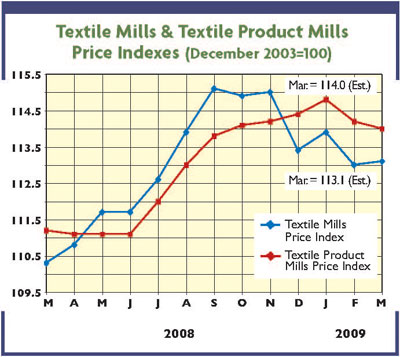
april09bfchart


The Impact On Profits


The above near-term outlook can also be expected to keep industry earnings and margins under
downward pressure. Net profit for basic textile products like yarns and fabrics, for example, are
projected to show another decline this year – with totals for the year dropping 5 to 6 percent
below 2008 levels. And a similar picture is seen for more highly fabricated mill products like
carpets and home furnishings, where the earning slippage is put somewhere around the same
magnitude. Apparel companies won’t escape unscathed either – though the latest estimates here
suggest a bit more modest 3-percent drop-off in the industry’s 2009 after-tax earnings. In all
cases, these declines are larger than those projected as recently as last fall before the extent of
the current business meltdown became apparent. On a somewhat rosy note, however, all these
textile/apparel subgroups should remain profitable – at least on an overall industry-wide basis.
And clearly, there will be no repeat of the negative numbers that were reported as recently as
2000. Also worth noting: These new 2009 profit projections are also a lot better than those being
made for many other consumer-oriented durable goods industries. This absence of any really big
drop-off in mill and apparel manufacturers profits can probably be attributed to three factors: The
above-mentioned more moderate fall-offs in consumer demand; reduced raw materials production costs;
and rising worker productivity – which, when combined with only very modest hourly pay raises, has
helped keep unit labor costs on a relatively even keel.


A Longer Look Ahead


The really big question mark, however, is what happens next year when things hopefully begin
to turn around. Unfortunately, any quick bounceback seems highly unlikely. Right now, most
economists and business analysts are betting on only a very modest 1- to 2-percent increase in the
nation’s GDP for 2010. The problem is that this won’ t be nearly sufficient to generate enough
purchasing power for any textile and apparel gains. Global Insight, for example, anticipates
further domestic sales deterioration for these industries in 2010 – with declines that year put at
3.5 percent, 6.5 percent and 7.5 percent for basic textiles, textile mill products, and apparel,
respectively. If any positive spin can be put on these numbers, it’s the fact that analysts at this
prestigious economic consulting and forecasting firm feel these shipment declines will be far less
than the 15-percent-or-so drops anticipated for all three of these categories over the current
year. Global Insight’s profit forecasts also provide some reassurance of better days ahead. The
firm’s rough approximation of this key indicator representing sales less labor and material costs
should actually begin to move up again next year in the textile sectors. If correct, it would
follow four consecutive years of textile earnings shrinkage. Bottom line: The industry, while
clearly a lot less smaller than it was a few years back, will still be a major world player as we
move into the second decade of the 21st century.

April 14, 2009

Organic Exchange Report Shows Global Organic Cotton Market Hits New High

According to the Organic Cotton Market Report 2007-2008 released by Lubbock, Texas-based non-profit
organization Organic Exchange (OE), global retail sales of organic cotton apparel and home textile
products reached an estimated $3.2 billion in 2008, a 63-percent increase over the $1.9-billion
market in 2007. Organic production is based on a farming system that maintains and replenishes soil
fertility without using toxic and persistent pesticides and fertilizers or genetically modified
seeds.

The top 10 organic cotton-using brands and retailers globally were: Bentonville, Ark.-based
Wal-Mart Stores Inc.; Belgium-based C&A; Beaverton, Ore.-based Nike Inc.; England-based
H&M; Spain-based Zara; New York City-based Anvil Knitwear Inc.; Switzerland-based Coop Group;
San Francisco-based Pottery Barn; Renton, Wash.-based Greensource Organic; and Germany-based Hess
Natur.

Despite the current economic downturn, most brands and retailers selling organic cotton
products are continuing their sustainability measures, with plans to expand product lines 24
percent and 33 percent in 2009 and 2010, respectively, to create an estimated $4 billion market in
2009 and a $5.3 billion market in 2010.

“It is a sign of the times that despite ominous financial forecasts, brands and retailers
are standing fast to their commitment to making their product lines more sustainable by ever
increasing their use of organic cotton and other organic fibers such as wool, linen, and silk,”
said LaRhea Pepper, senior director, OE.

According to OE’s Organic Cotton Farm and Fiber Report 2008, the amount of organic cotton
grown by farmers globally in 2007/08 increased by 152 percent. The organization also noted that
during 2008, certified organic cotton fiber suppliers increased by 95 percent – compared with
annual growth rates of 45 percent in 2006 and 53 percent in 2007.


April 7, 2009

Gneuss Launches Measurement Technology In North America

Matthews, N.C.-based Gneuss Inc. – the North American subsidiary of Germany-based Gneuss
Kunststofftechnik GmbH, a manufacturer of filtration, measurement and processing technologies for
plastic melts – is now offering Gneuss measurement technology in North America. The technology
consists of a complete line of melt pressure and temperature sensors, including instrumentation,
for plastics extrusion applications. 

Gneuss’ latest technological development is the NTX™ non-mercury series of melt pressure
transducers and transmitters, which, according to the company, offers premium performance and
increased life compared to conventional mercury, sodium potassium and other alternative
fill-mediums. The NTX sensors are environmentally safe and rated for temperatures up to 930ºF.
Sensor enhancements include the new DAP series heated-tip option, which reduces the risk of
diaphragm damage during installation and removal; a special membrane design that enhances
longer-tip diaphragm life; and a flexible capillary design.

April 7, 2009

SpinExpo To Hold New York Show

The organizers of SpinExpo Shanghai – a trade fair focusing on the fiber, spinning, flat bed and
circular knitting sectors – have announced the inaugural SpinExpo New York, to be held July 20-22,
2009, at the Metropolitan Pavilion/Altman Building in New York City.

The show will feature exhibits from more than 70 companies worldwide including fiber
manufacturers; textile software producers; spinners for knitwear, circular knit and weaving
apparel; home textiles, hosiery, lacework and embroidery, fake fur and technical products;
producers of computer-aided design and manufacturing as well as common information models; office
designers and stylers; and trade publications.

Other features include complimentary consultations with SpinExpo partner Stoll USA’s
stylists and technicians about knitting complex yarns on the company’s machines; presentations and
seminars on emerging trends and upcoming market developments, offered by the Australian Wool
Innovation; a trend forum highlighting key directions in color, knitwear, development and styling
for the Spring/Summer 2010 and Autumn/Winter 2020/11 seasons; and a series of fashion shows
featuring the latest creations in knitwear styling, with collections from Germany-based Stoll,
Italy-based G. Cavagna for SpinExpo and Hong Kong Polytechnic University. 

For more information, contact Cynthia at
spinexpo-newyork@earthlink.net or visit
www.spinexpo.com.

April 7, 2009

Bloomsburg Mills To Close

Bloomsburg Mills Inc. — a Bloomsburg, Pa.-based fabric manufacturer that has been in business since
1889 — will shutter its manufacturing plants and cease operations by May 31. The closings will
affect 134 employees at its Bloomsburg weaving facility and 92 employees at its dyeing and
finishing facility in Monroe, N.C.

According to President and CEO James P. Marion III, the ongoing influx of low-cost imported
textiles and the current economic downturn have brought on the closings. “Bloomsburg Mills has lost
more than 60 percent of its sales volume during the past decade, and, as a result, we have
undergone numerous downsizings to adjust for this loss,” Marion said. “We have made considerable
progress in our efforts to restore ourselves to profitability and continue as a domestic
manufacturer, but the dramatic drop in business that we experienced at the end of calendar 2008 has
worsened, resulting in severe curtailment of our operations. The results of the first three months
of 2009 have been very poor, and, based on the current economic outlook, we cannot envision any
scenario in the foreseeable future that would enable us to return to being a profitable company on
an ongoing basis.”

The 120-year-old company was founded as a silk weaver, opening its yarn processing and
weaving mill in 1889 and the dyeing and finishing plant in 1979. Bloomsburg initially was known as
a manufacturer of high-fashion dress fabrics and later evolved into a producer of specialized
fabrics used for home furnishing, industrial, napery, medical, military, filtration and other
end-uses.

“The people who work for Bloomsburg Mills have always been second to none in their dedication
to, and excellence in, manufacturing the highest quality fabric, and it is truly sad that we have
had to reach a decision to exit this industry after so many years and cause hardship for such good
people and the communities we operate in,” Marion said. “However, like many domestic manufacturers,
we have seen most of our markets exported to lower cost foreign manufacturers, and our customer
base has finally eroded to the point where our business no longer remains viable.”

Bloomsburg Carpet Industries Inc., a woven carpet manufacturer that has been operating in
Bloomsburg for more than 30 years, is not affected by the closure of Bloomsburg Mills.

April 7, 2009

Batson Partners With Fleissner, Represents National Wire

Greenville-based Batson Group Inc. now offers Germany-based Fleissner GmbH’s spunlace and chemical
bonding systems as well as its belt and perforated drum ovens. Batson will market and sell
Flessner’s products in the United States and Canada through its representation of Charlotte-based
American Truetzschler Inc. Fleissner’s products include the AquaJet, Jumbo AquaJet, LeanJet and
MiniJet spunlace systems; a line of belt ovens for thermobonding processing; and a line of
perforated drum systems for thermobonding, drying processes, and heatsetting with or without needle
rings.

Batson also has partnered with Star City, Ark.-based National Wire Fabric Inc. to offer
metallic and man-made wires and fabrics. National Wire manufactures wires and belts featuring a
one-piece, non-welded cable construction that allows the wire to run at high speeds. Products are
constructed from combinations of stainless steel, carbon steel and bronze and include caul screens,
forming and dryer fabrics, backing wires, press screens and oven wires.

April 7, 2009

Unifi Closes On Joint Venture Sale, Focuses On UTSC Subsidiary

Greensboro, N.C.-based textured yarn manufacturer Unifi Inc. has sold its 50-percent interest in
Yihua Unifi Fibre Industry Co. Ltd., the company’s joint venture with Sinopec Yizheng Chemical
Fiber Co. Ltd. Unifi will continue providing service to its customers in Asia through China-based
subsidiary Unifi Textiles Suzhou Co. Ltd. (UTSC). UTSC develops, sells and provides technical
service for premium value-added (PVA) yarns.

“Succeeding in today’s global economic climate requires an even greater focus on supply chain
management and the development of innovative specialty yarns, and UTSC provides Unifi with the
flexibility and speed-to-market required to respond to the needs of our customers in Asia,” said
Roger Berrier, executive vice president, Unifi. “And now with the sale of our joint venture, UTSC
will continue to expand the sales and promotion of the company’s specialty and PVA products, while
aggressively focusing on global product commercialization of new and existing products.”

Unifi plans to commercialize newly developed, enhanced textile technologies in China through
UTSC. Technologies include next-generation Sorbtek® moisture-management technology, which is more
competitively priced for China, and the company’s Repreve® brand of sustainable textiles, including
Repreve polyester staple fibers for use in spun yarns. Unifi also will begin to expand its
recycling efforts in China.   

April 7, 2009

Itema And Lamiflex Strengthen Partnership

Itema Weaving – a weaving machines and accessories manufacturer, and a division of the Italy-based
International Technology & Machinery Group (Itema) – and Lamiflex S.p.A., an Italy-based
producer of technical composite materials – have signed an agreement to develop new products and
processes, and to share intellectual property rights through mutual protection strategies.

Itema and Lamiflex will distribute machinery spare parts to the international market, using
their existing commercial channels and sales networks to market and sell the products. The two
groups plan eventually to cross-license their trademarks and patented technologies. According to
the companies, this collaboration will provide improved service to their customers, including
efficiencies in response times and procedures.

“Consolidating and intensifying a collaboration with a partner such as Itema Weaving is an
opportunity to be taken,” said Francesco Corsi, manager and coordinator of the agreement, Lamiflex.
“Being present on the market in a coordinated way enhances the capability and opportunities of both
companies to face challenges, while developing new solutions at the same time.”

April 7, 2009

Maine And CARE Sign Agreement

The state of Maine has signed an agreement with the Carpet America Recovery Effort™ (CARE) – a
national carpet recycling group – to increase post-consumer carpet recycling by not sending used
carpet to landfills and through promoting the use of products containing post-consumer carpet
content.

CARE is a voluntary effort established as a result of a Memorandum of Understanding for
Carpet Stewardship, a national agreement signed by members of the carpet industry, representatives
of government agencies at the federal, state and local levels, and certain non-governmental
organizations. Approximately five billion pounds of used carpet is sent to landfills each year.
Since 2002, CARE and its network of Reclamation Partners have helped to divert more than one
billion pounds of carpet from that waste stream.

“Used carpet is a bulky waste that is difficult and expensive to manage,” said Maine
Department of Environmental Protection Commissioner David P. Littell. “Maine looks forward to
adding the recycling of carpet to our efforts in developing alternatives to disposal in landfills.”

Maine will encourage carpet recycling by looking for opportunities to reclaim post-consumer
carpet removed from government buildings and by using environmentally friendly carpet pad made from
recycled carpet fiber under new carpet installations.

“CARE welcomes Maine into the growing fold of states willing to support CARE’s voluntary
efforts to find market-based solutions for the diversion of post-consumer carpet from landfills.”
said Frank Hurd, chairman of CARE’s Board of Directors.

April 7, 2009

Consumer Safety Agency Calls For Children’s Products Labeling

The Consumer Product Safety Commission (CPSC) has asked for comments on a proposed rule that would
require manufacturers of children’s products to place permanent labels on products and packaging
that would help facilitate recalls of unsafe products. Comments will be received until April 27 on
the regulation, which is scheduled to go into effect Aug. 14, 2009.

Under the proposed rule, labels would provide information about the date and place where a
product is made. In issuing the proposal, CPSC said that to the extent a uniform approach to
labeling can be developed, consumers would be better informed in the event of a product recall.

CPSC is seeking guidance from manufactures with respect to the practicability of labeling
and other business considerations, including suggestions as to how the rule can be implemented.

The text of the proposal is in the February, 2009, Federal Register Vol. 74 No. 37. For
further information, contact CPSC +301-504-7923.

March 31, 2009

Sponsors


