Universal Fibers Extends Industrial Fibers Color Pallet

Bristol, Va.-based Universal Fibers Inc., a manufacturer of solution-dyed man-made-fiber yarn for
carpet, transportation, interior, industrial and medical applications has added colors to its range
of industrial fibers. There are now more than 120 core color choices and millions of possible color
combinations, according to the company.

“Our color story is one of the things that sets us apart,” said Bill Goodman, vice president
of sales and marketing, Universal Fibers. “We’re changing the mind-set in the industrial fibers
market that colors have to be limited. We want to provide our customers with a wide range of
possibilities in strength and color for their products and through our customization process we’ll
work with them to provide the perfect fiber to fill their need.”

Universal Fibers’ industrial fibers – including nylon 6, nylon 6,6, polyester and
polypropylene – are available in a denier count of 420 or greater. The fibers can be manufactured
to product specifications to include features such as ultraviolet stability; antimicrobial
characteristics; high-modulus and low-shrinkage capabilities; and flame and stain resistance.
Customers may order color sample swatches from Universal’s newly designed website:
www.universalfibers.com.

August 18, 2009

AATCC Launches Student Competition

The Research Triangle Park, N.C.-based American Association of Textile Chemists and Colorists
(AATCC) and its Materials Interest Group have launched the fifth annual Materials Competition for
undergraduate and graduate students. The competition is designed to encourage new product
development based on materials design. This year’s focus areas are Industrial/Technical and Sports
Materials; Medical and Biomedical/Protective Materials and Devices; and
Smart/Electronic/Optoelectronic and Nano-fibrous materials.

Feb. 15, 2010, is the deadline for preliminary design proposals. Final material products or
device designs, including a text proposal and digital poster on CD, are due April 20. In each
competition area, winning entries will receive $1,000 for first place and $500 for second place.
Winners will be announced by June 1.

AATCC also has announced its annual textile and product design competition, sponsored by its
Concept 2 Consumer® (C2C) interest group and open to all AATCC student members. The theme of this
year’s contest is “Summer Bling.” Students should submit pool and beachwear designs for swimwear,
cover-ups, totes, hats and other articles that include 3-D embellishments using a color palette
from the Pantone® View Colour Planner Summer 2010 ‘magic.’ Entries must be received on CD by Dec.
15, 2009. The first-place winners in each category will recieve $1,000 and a copy of Pantone’s
Cotton Passport; second-place winners will receive $500. Winners will be announced March 18, 2010.

To view complete guidelines for both competitions, along with entry forms and student
membership applications, visit
www.aatcc.org/members/students/competitions.cfm.


August 18, 2009

Elastic Textile Europe Earns Oeko-Tex® Standard 100plus Certification

Germany-based Elastic Textile Europe GmbH (Elastic) – a manufacturer of knitted elastic fabrics for
sportwear and elastic lace for lingerie – has earned Oeko-Tex® Standard 100plus certification for
its products. To receive the certification, a company’s product must be free of harmful substances
according to Oeko-Tex Standard 100 and must be manufactured in environmentally-friendly facilities
that apply socially responsible policies according to Oeko-Tex Standard 1000. The Hohenstein
Research Institute, Germany, performed third-party testing of Elastic’s facility and products.
Elastic’s plant in Neukirchen was certified according to Oeko-Tex Standard 1000 in December 2008.

Founded in 1958, Elastic has an annual turnover of 22 million euros and produces
approximately 300,000 meters of fabric per month using circular, warp and raschel knitting
machines, as well as weftloc, rascheltronic and computer-controlled raschel lace machines. The
company supplies its elastic fabrics and lace to brand names including Triumph, Felina, Chantelle,
Aubade and Lejaby. It recently launched Triumph’s Pure Origin® lingerie line, featuring organic
cotton with 20-percent elastane content. Elastic also produces technical textiles for medical,
automobile, exhibition display, and other applications.


August 18, 2009

French Nonwovens And Technical Textiles Machinery


I
n view of the ongoing success of the nonwovens and technical textiles sectors and the
feedback from the first report, Textile World is publishing another country report with the support
of the national machinery association about suppliers of machinery for nonwovens and technical
textiles. France is the focus of this report. Though a traditional manufacturer of textile
machinery, France also plays an important role as a supplier of special machinery and equipment for
the promising nonwovens and technical textiles sectors, and ranks among the top five supplier
countries.

This report has been compiled with the kind help of the French Textile Machinery Association
(UCMTF). TW prepared a questionnaire for UCMTF member companies, 14 of which responded. A link to a
summary of those participating companies is found at the end of this story. 

FrenchAmeline

UCMTF President Bruno Ameline


The Interview


Bruno Ameline, president, and Evelyne Cholet, secretary general, UCMTF, presented their
association to TW and analyzed the current economic crisis. Ameline’s answers to some questions
from TW are presented below:


TW
: What is the UCMTF?

Ameline: We are grouping, in France, 35 textile machinery manufacturers. The total
turnover of our members is slightly over 1 billion euros [$1.3 billion], most of it being exported
all over the world.


TW
: What are the main goals?

Ameline: Our main goals are to help our members promote their expertise; organize
French pavilions at the major machinery shows and technical seminars in the countries we select;
represent our industry with the national, European and international authorities; and, more
generally, provide to our members the services they may expect from a trade organization. As a
member of CEMATEX [the European Committee of Textile Machinery Manufacturers], the European
organization which owns the major international brand ITMA, we are part of the decision-making
process on these shows.


TW
: How active are your members in technical textiles and nonwovens?

Ameline: Very active. Our members are specialized manufacturers, often world
leaders in their specialties. Their strategy is to offer tailor-made solutions to solve customers’
needs and be their long-term partners. This strategy is particularly fitted to the nonwovens and
technical textiles sectors in which the machinery manufacturers are really integrated. This is how
new markets for technical textiles can be opened. At the recent Techtextil, one could see again
that the machinery manufacturers are considered as part of the technical textiles industry, not as
off-the-shelf machinery vendors. Many of our members were present, close to their customers, to
understand their needs, listen to them, and better evaluate how they can create value for them.


Current Market Situation


TW
: How do you see the current market situation?

Ameline: Right now, it is very difficult to really grasp the market environment.
Every day we receive contradictory information. The financial crisis which originated in the United
States has developed worldwide and spread into the real economy. The textile industry in general
and the technical textile sectors in particular — except for those selling to such devastated
industries as automotive — are not immune, but certainly less hurt than many sectors.

In fact, the most important impact of the crisis on the textile industry is probably the
collapse of the credit system, which is essential to organize, secure and finance international
trade. Banks are highly risk-averse, and credit insurance companies are more and more conservative.
Therefore, international contracts are difficult to finalize, and delays may occur.

The global technical textiles consumption does not seem to decline. For our business, in
periods when the markets for end-products such as apparel, home textiles, and technical textiles
grow only slightly above their long-term rates, investments in machinery are very active. This is
what happened during the last few years.

On the contrary, small contractions on the final markets have a significant negative effect
on the investments. We, as machinery manufacturers, have known for many years this essential
characteristic of our industry, and we have adapted our structures — we have struggled to become
more flexible and to lower our break-even points. The total turnover of our members was flat in
2008, the first part of the year being good and all advances we had secured being lost in the last
months.

We started 2009 with very low order backlogs and experience chaotic order intakes, with low
visibility but sometimes unexpected customers’ projects. It seems that governmental economic
recovery packages are starting to bring positive effects. This is the case in China for civil
engineering investments, for example. But, as I said, we are much better prepared than before to
adapt to such an unpredictable situation. Even if the recovery road is rocky, the crisis we face
will come to an end, and then our customers who have taken the good investment decisions will
emerge even stronger.


Targets For 2009


TW
: What are the UCMTF’s main tasks for 2009?

Ameline: In 2009, our task is to convince our members to continue to work for the
future, to bolster R&D [research and development], to work with their clients as partners. As
an association, we will continue our worldwide promotion efforts including toward the trade press
and prepare the next important trade shows. The UCMTF has a clear strategy. We think it fits the
markets and will work very well once the crisis is over. Let me summarize it again:

•    to be a specialized manufacturer, often world leaders in niche markets,
with tailor-made solutions to address our customers’ needs; and

•    to help our customers analyze the market trends [and] choose their
strategies and implement them; [and] be their long-term technology partners.

Thanks to this strategy, France is the fifth[-ranking] machinery exporter. We are
particularly strong in weaving preparation, nonwovens, spinning, and finishing machinery.

We are proud to promote the latest technology and improvements in production for tomorrow. We
think that only the companies increasing their efforts on R&D and market presence will survive.
We want to be part of these. We and customers must always remember that, particularly in times of
an insecure economic environment, the choice is between “do” or “die.”


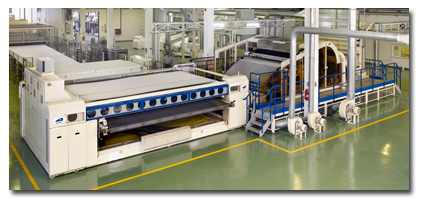
FrenchNSC

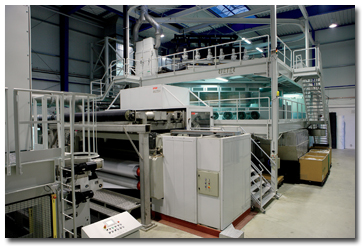
NSC Nonwoven line

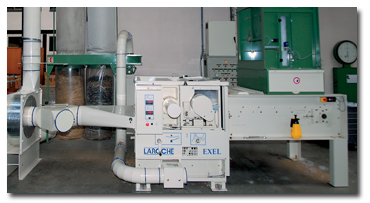
FrenchLaroche

Laroche Exel horizontal fine opener

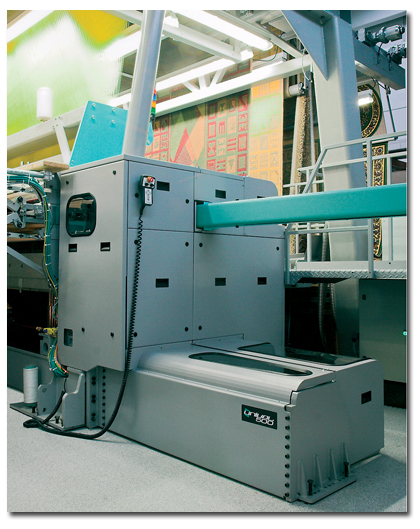
FrenchStaubli

Stäubli Unival 500 electronic shedding mechanism

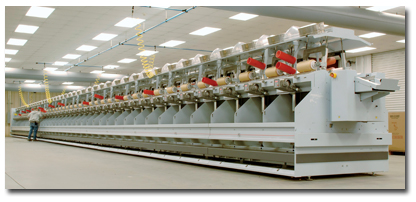
FrenchRITM

RITM glass yarn installation
 
FrenchCalemard

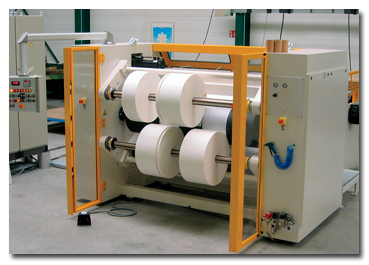
Calemard slitter-rewinder

FrenchSuperba

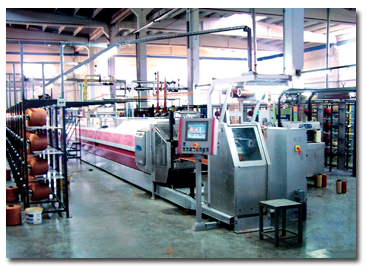
Superba TV3P-K

FrenchRieter

Rieter Perfojet Spunjet system

July/August 2009

Few New Products At IMB


I
MB 2009 — World of Textile Processing took place recently in Cologne, Germany. Reflecting
the current economic situation, there were some one-third fewer visitors than in previous years.
However, IMB has been the world’s most important trade fair for all kinds of apparel and textile
processes. Some European and US exhibitors with high-quality equipment were satisfied with the show
and had a lot of visitors, but Far Eastern exhibitors mainly had fewer visitors than in previous
shows.


Trends


The trend toward verticalization is more prominent than ever. Knitters have been 100-percent
verticalized for a long time. Technical textiles producers are doing the same for three reasons:
quality; generation of added value in-house; and protection of production secrets. And the trend is
seen also in other industry sectors.

Approximately one-third of all IMB exhibitors are focusing on technical textiles in all
forms, and many also participated at Messe Frankfurt’s Techtextil exhibition in June. The
confirmation for this trend came just a few days after IMB closed: The German Engineering
Federation (VDMA) Garment and Leather Technology Association, IMB’s conceptual sponsor, announced
the end of its cooperation with show organizer Koelnmesse GmbH and together with Messe Frankfurt
GmbH will launch a new show, Texprocess, in Frankfurt. Messe Frankfurt officials stated they want
to emphasize to all markets the message of one marketplace for the whole production chain.

IMBKoelnmesse

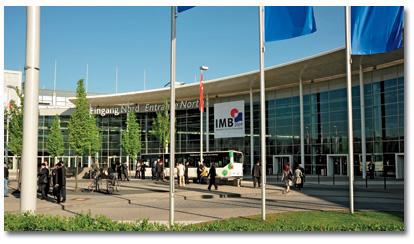
IMB — World of Textile Processing was held

at Koelnmesse in Cologne, Germany


Product Highlights


There were just a few new products at IMB, including Brother International’s ink-jet printer
followed directly by embroidery, Avery Dennison’s labeling technology, a new sewing thread from
Gütermann, a vertical plotter from Audaces and new cutter and software applications from Lectra.

Brazil-based Audaces Automations’ vertical plotter has reduced space requirements. The
company states the model is very successful worldwide. It has a unique format, measuring 60
centimeters (cm) wide, 100 cm deep and 230 cm high. It has many speed options and can print in
widths from 143 to 183 cm. Paper rolls up to 250 meters (m) are possible. The plotter uses
Hewlett-Packard’s ink-jet technology to print an array of patterns in order to provide the best
fabric yield.

Lectra, Paris, presented its VectorTechTex FX Extended for cutting very long pieces — up to
4.2 m long and 2.5 cm thick — of composite materials for wind turbine blades and helicopter rotors
and such. The FX Extended is said to offer up to 20-percent increased production compared with
standard VectorTechTex cutters and can be fitted with an ink-jet printer to ensure the traceability
of cut pieces.

DesignConcept Auto and DesignConcept TechTex for 3-D/2-D design and product development —
Lectra’s flagship solutions for textile-based product design and development — enable users to
create virtual models, run feasibility analyses, develop templates and estimate costs, reducing
time-to-market of finished products. DesignConcept TechTex is designed for industrial fabrics
processors. DesignConcept TechTex (V4R1) for large-scale composite product design creates more
products at lower cost, and reduces finished product weight while maintaining good mechanical
properties, the company reports.

Groz-Beckert KG, a Germany-based manufacturer of needles, weaving machine parts and knitting
cylinders, showed its Loop Position Control technology. Featuring an improved shank and groove
geometry, the needles ensure improved thread protection and reduced thread load during thread
run-in over the edges of the longitudinal groove. The result is improved loop formation in critical
applications, and reduced skipped stitches and thread breakage.

Groz-Beckert’s SAN® 5 Gebedur® needle features a new blade design to prevent problems — such
as skipped stitches, point or material damage, thread splicing and breaking, as well as needle
breakage — that can occur when sewing industrial fabrics. The target was high needle stability and
optimum penetration. The special design significantly improves bending resistance. The deep scarf
and special eye design enable a regular stitch pattern and improved seam durability.

Gütermann AG, Germany, a producer of threads, yarns and twisted yarns, offered a sewing
thread using Micro Core Technology® (MCT) — the first microfilament polyester-based core spun
technology. MCT is standardized for every application field, offering threads with uniform,
high-quality appearance and improved brilliance and softness.

Avery Dennison Corp., Pasadena, Calif., showed its Pathfinder® Ultra® Platinum 6039™, said
to be the only portable printer that scans, processes data, prints and applies a label on the spot.
The reduced procedure time and ease of terminal use on store shelves mean a company can relabel
products without having to close the store.

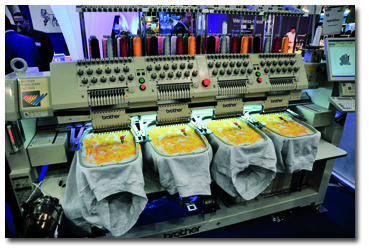
Bridgewater, N.J.-based Brother International Corp. exhibited an ink-jet printer based on a
new printing and ink technology, providing new options for production of T-shirts and fashion
articles. Immediately after drying on a conveyor belt dryer, the article can be embroidered. All
production stages are in-house.

IMBBrother

Brother International’s ink-jet printer using

new printing and ink technology is followed

directly by an embroidery machine, shown above

applying a design on printed articles.


Looking Ahead


Koelnmesse CEO Gerald Böse said many companies were irritated with the VDMA Garment and
Leather Technology Association’s decision to end its partnership with IMB. However, Koelnmesse
wants to maintain IMB and “will continue to provide the textile sector with an internationally
important trade fair for the textile and clothing industry in Cologne in the future,” Böse said.
IMB Forum will take place in May 2010.

The first Texprocess will take place May 24-27, 2011, together with Techtextil, in direct
competition with IMB. On one hand, it is quite astonishing that the long-term cooperation between
Koelnmesse and VDMA has ended. On the other, as noted above, technical textiles are totally
verticalized and the production process is under one roof. One could say the new show reflects this
state of affairs: From yarn to finished products, all machinery will be seen under one roof.

July/August 2009

Pratt Honors Ralph Rucci


A
t New York City-based Pratt Institute’s annual fashion show, designer Ralph Rucci
received the Pratt Institute Fashion Icon Award, presented annually to a recognized designer. Rucci
is the fourth designer to receive the award. Three senior students were named winners in an
eveningwear and bridal design competition funded through a competitive grant presented to Pratt by
the Importer Support Program of the Cotton Board and Cary, N.C.-based Cotton Incorporated, which
also were sponsors of the fashion show.

Introducing the show, Pratt Institute President Thomas F. Schutte noted that Pratt was the
first school in the United States to offer a degree in fashion. “Our seniors will soon depart for
the exhilarating world of fashion, but we are sure to see their names again as they progress in
their careers,” he said.  

Rucci, a native of Philadelphia, started his business, Chado Ralph Rucci, in 1994. In 2002,
he became the first American designer in 60 years to be invited by the Chambre Syndicale de la
Haute Couture to present his collection at the official showings in Paris. In accepting the Pratt
award, Rucci said clothes are an outward expression of the inner self.

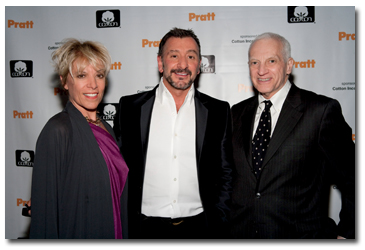
PrattPeople

Left to right: Pratt Fashion Design Department Chair

Rosie DePasquale, 2009 Pratt Fashion Icon Award

Recipient Ralph Rucci, and Pratt President

Thomas F. Schutte share a moment at Pratt’s annual

fashion show. Both photos by René Perez


Student Collections Shown On The Runway


Rosie DePasquale, chair of Pratt’s Department of Fashion Design, commented: “This year’s
student collections are at extremes. Some chose to reflect the economic times with layered,
multi-seasonal looks, while others designed with a more experimental, avant-garde approach.”

Fashions created by more than 16 fashion design students went down the runway. All designs
were preselected by a jury of fashion industry professionals. Collections ranged from sportswear
and eveningwear to children’s wear and costume design. The show ended traditionally with
bridal. 

The design competition, now in its third year, challenges students to think beyond
traditional boundaries. Requirements were to create evening or bridal fashions – designs usually
created in silk or viscose chiffons, organzas, taffetas and satins – in fabrics containing at least
98-percent cotton. 

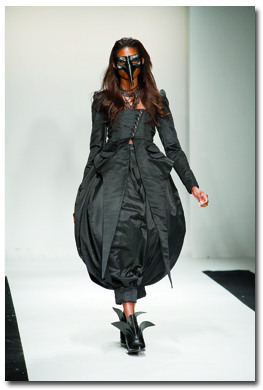
The First Prize winner, John Renaud of Midland, Texas, was awarded $5,000. He created a black
sateen cocktail ensemble with a low-cut, long, tucked and fitted jacket and matching ball-shaped
pants.  Second-place winner Sarah Friedlander of Akron, Ohio, was awarded $1,500. She used
cotton organdy for a cream-colored empire-waist bridal gown with pleated bust and hem detail.
Ashley Piacenza of Hope Valley, R.I., received a prize of $1,000 for her flower petal-like peach
organdy short bridal gown.

PrattFirstPrize

This black sateen cocktail ensemble

by 2009 Pratt graduate John Renaud

won First Prize in the eveningwear

and bridal design competition.


July/August 2009

New Commissioners Named To Consumer Agency

The Senate has confirmed two of President Barack Obama’s appointees to the Consumer Product Safety
Commission (CPSC), bringing the commission up to full strength for the first time since the 1980s
The new makeup of the commission comprises: Chairman Inez Moore Tenenbaum, confirmed earlier by the
Senate;  the two new appointees, Anne Northup and Robert S. Alder; and two Bush administration
holdovers, Thomas Hill Moore and Nancy A. Nord.

In addition to having five commissioners on board, the CPSC has expanded funding and
authority as a result of enactment of the Consumer Product Safety Improvement Act (CPSIA) last
year, and each of the new appointees has expressed a commitment to strict enforcement of the new
act, particularly where products are  intended for use by children. Tenenbaum set the tone for
the reconstituted agency recently when she told an international safety audience in Singapore: “My
regulatory philosophy embraces open dialogue, information sharing with all stakeholders and a
commitment to finding mutual interests. When a law has been passed, I will ensure that our
requirements are vigorously enforced.”

One of the new appointees, Adler, has been involved  with consumer safety issues for 36
years including service as a staffer at the CPSC, where he worked for former commissioners David
Pittle and Sam Zagoria; and on the staff of the House Energy and Commerce Committee, where some of
his responsibilities involved oversight of the CPSC.

At his Senate confirmation hearing, Adler said he believes enactment of the CPSIA is a
“monumental achievement in promoting product safety.” He also noted a significant change in the
commission’s responsibilities since his earlier work with it as a result of the growth of imported
products, which he said account for 85 percent of the commission’s current recalls. He also said
that in spite of the new funding under the CPSIA, the commission staff remains 40-percent below the
level of 30 years ago.

Northup, a former Republican member of Congress from Kentucky, also underscored the
importance of the new CPSIA in providing new resources  to protect consumers, noting that its
implementation will require new rules, new standards, new testing laboratories and new procedures
for dealing with imports. She said she will work with Chairman Tenenbaum to build a “collaborative
effort” to address the current challenges of the commission.

At some point, the commission is expected to address pending issues involving flammability of
upholstered furniture and a CPSIA-mandated study of the formaldehyde content of textile and
clothing products.

August 11, 2009

ARmark, Smiths Detection Launch IntelliMark

ARmark Authentication Technologies LLC — a Glen Rock, Pa.-based provider of custom-designed
marking systems — and England-based Smiths Detection — a supplier of advanced technology security
solutions for a range of civil and military markets — have partnered to introduce IntelliMark, a
product identification system for apparel, consumer goods, food and secure documents.

The IntelliMark system utilizes ARmark’s microscopic ®mark® covert markers, which contain
multiple layers of information in a particle smaller than the diameter of a human hair and are
incorporated into products and then viewed using Smiths Detection’s IdentifyIR® and IlluminatIR™
instruments.

“The IntelliMark system allows for an extension of detection capabilities beyond our optical
detection,” said Jeff Robertson, general manager, ARmark. “Combined with the capability of Smiths
Touchback system, IntelliMark now brings a complete information service to brand owners regarding
their product supply chain.”

August 11, 2009

Polartec Launches FR Fabric System

Polartec LLC — the Lawrence, Mass.-based manufacturer of Polartec® performance fabrics for
consumer and military apparel — has introduced its Polartec flame resistant (FR) total layering
system, offered as an alternative to what the company describes as typically bulky, uncomfortable
FR apparel. According to Polartec, the system is durable, lightweight and breathable; dries
quickly; and does not interfere with range of motion.

“After many years of development work with the US military and work-wear markets, we are
proud to deliver a truly innovative collection of flame resistant fabrics,” said Andy Vecchione,
president, Polartec. “We have added flame resistance without sacrificing the comfort and
performance Polartec fabrics are known for.”

The system comprises a Power Dry® FR base-layer fabric that wicks moisture from the body and
dries quickly; a Power Stretch® FR mid layer; a Thermal FR® lightweight thermal-insulation layer;
and a Wind Pro® FR weather-protective outer layer. The fabrics have undergone independent testing
and have passed relevant industry standards, the company reports.

August 11, 2009

SEAMS To Present USA Supply Chain Pavilion At SPESA Expo

Columbia, S.C.-based SEAMS, the National Association for the Sewn Products Industry, will set up a
“Made in USA Supply Chain” pavilion at The Sewn Products Equipment & Suppliers of the Americas
(SPESA) Expo 2010, to be held May 18-20 at the Georgia World Congress Center in Atlanta. The
pavilion is expected to cover more than 2,000 square feet and will feature products made by SEAMS
member companies, along with individual exhibits by US-based companies that provide manufacturing
and other services for the soft goods supply chain.

“The Made in USA Supply Chain pavilion will provide a unique opportunity for US-based
companies to show the world what we can do,” said Sarah Friedman, executive director, SEAMS. “We
expect that many of our brand, manufacturer, contractor and service provider members will
participate in the pavilion with their US-made products and services.”

The SEAMS pavilion is one of several special focus areas to be presented at the SPESA Expo.
Others include the “Cool Zone,” featuring exciting new technologies that are changing the industry;
an “IT Showcase” of innovative enterprise- and industry-specific software solutions; and “Supply
Chain of the Americas,” presenting opportunities and resources in the Western Hemisphere, among
others.

August 11, 2009

Sponsors