Unifi Invests In Repreve® Backward Integration, Establishes JV

Greensboro, N.C.-based Unifi Inc. — a producer of multifilament polyester and nylon textured yarns
and related materials — has announced it is investing in the backward integration of its Repreve®
recycled polyester yarn supply chain in an effort to improve the availability of recycled raw
materials and increase its product capabilities. Unifi will employ new state-of-the-art recycling
technology that will give it better control over the production of the recycled chip used to make
Repreve fibers, and also will enable the company to recycle post-consumer and post-industrial
fabric waste back into Repreve. According to Unifi, the new capabilities should come online in
February 2011.

“Bringing the extrusion process in-house is a natural step for us,” said Roger Berrier,
executive vice president, Unifi. “Being more vertically integrated will significantly increase our
product development capabilities and capacity.”

Unifi also has purchased a 40-percent interest in a biomass feedstock company to set up a
joint venture (JV) named Repreve™ Renewables that will directly sell Freedom™ Giant Miscanthus to
farmers, who will then supply the product to bioenergy and biofuel operations in the United States
and European Union.

Giant Miscanthus is a perennial hybrid C4 grass that converts sunlight to biomass energy. C4
plants have a special adaptation that allows them to photosynthesize and grow during extreme
environmental conditions including high drought, light and temperatures, and lack of nitrogen or
carbon dioxide. In addition, its cultivation requires only small amounts of pesticide and
fertilizers. Freedom Giant Miscanthus — developed by Mississippi State University (MSU) researcher
Brian Baldwin, MSU technology transfer specialist Chase Kasper and Georgia turf grass expert
Phillip Jennings — is branded as such because of its ability to free the United States from its
dependency on foreign oil. It is uniquely suited to the South, doesn’t require much land to grow
and costs less than other biofuel sources such as corn, switchgrass and timber. According to Unifi,
it is non-invasive and the highest-yielding crop available commercially.

“We are continually looking for innovative, sustainable initiatives, and we are very excited
about participating in this renewable energy opportunity,” said Bill Jasper, president and CEO,
Unifi. “Both of these initiatives will support our strategy to grow the Repreve brand and product
portfolio, and will add to our commitment in being a global leader in sustainability efforts.”


June 15, 2010
Invista To Shutter Östringen, Kerkrade Operations

As part of its European flooring business restructuring, Wichita, Kan.-based Invista — a global
integrated fibers and polymers manufacturer — will discontinue flooring operations at its
Östringen, Germany, site, and nylon processing operations at its Kerkrade site in the Netherlands.
The company plans to end production at the Östringen site by the end of 2010 and at the Kerkrade
site by the end of the first quarter 2011. Approximately 400 employees at Östringen and 60
employees at Kerkrade will be affected. Invista will continue apparel activities, which include
distribution activities, as well as Lycra® fiber beaming, rewinding and knitting at the Kerkrade
site.

“We understand that this announcement will come as a disappointment to the affected employees
and we recognize that our employees have made considerable contributions over the years,” said Dan
Stone, president, Performance Surfaces and Materials, Invista. “Invista has attempted to streamline
its European flooring business and to reduce costs, however, we continue to have a high cost
position compared to other producers and because of poor fibre and yarn demand in the European
flooring markets, our efforts and actions have not been enough to put us in a position of
profitability. Our vision is to create a healthy and successful business in Europe by sourcing
products from other sites around the world.”

Customers in other regions who purchase Invista’s European nylon 6,6 products will be offered
alternatives from the company’s North American manufacturing sites.

June 15, 2010

AATCC Presents 2010 Materials Competition Winners

The Research Triangle Park, N.C.-based American Association of Textile Chemists and Colorists
(AATCC) has announced the winners of its fifth annual Materials Competition, created by the
Materials Interest Group to promote innovative product development from a material structures
design perspective. Competition participants included both graduate and undergraduate students.

Entries were judged on criteria including concept originality, design element integration,
technical feasibility, clarity of supporting documentation, and technical and materials rationale.
The first place award, including a cash prize of $1,000, was presented to Garry Atkinson of North
Carolina State University (NCSU) for his Anti-Microbial Tactical Boot. The second place award,
including a $500 cash prize, was presented to Andrea Rivas, Lindsay Remington, Katie Voytko and
Anna Clark of NCSU for their ProTech-tive Apparel.

The winners also were awarded complimentary registrations for the 2011 AATCC International
Conference, which will be held March 22-24, 2011, in Charleston, S.C.

June 15, 2010

NanoHorizons Appoints SmartSilver™ Agent In Korea

Bellefonte, Pa.-based NanoHorizons Inc. — a developer of nanoscale performance additives for
textile, healthcare and industrial applications — has appointed Seoul, Korea-based J2LFA Co. Ltd.
— a manufacturer of a variety of natural and man-made performance yarns including organic cotton
— as an authorized distributor in Korea for its SmartSilver™ nanoscale antimicrobial additive.
J2LFA will market its SmartSilver enhanced yarns to the athletic performance apparel, workwear,
safety apparel and hosiery markets. The company also will develop SmartSilver textile applications
for medical wet wipes, feminine hygiene products and home furnishings.

“Collaborating with J2LFA will rapidly establish SmartSilver™ as the antimicrobial technology
of choice in Korea,” said Timothy Skedzuhn, vice president, Textile Business Unit, Nanohorizons.
“J2LFA’s proven technical expertise and reputation for manufacturing outstanding yarns will make
them a strong partner in the critical Korean market.”

June 15, 2010

EDANA 2009 Nonwoven Product Statistics Released

BRUSSELS — June 9, 2010 — EDANA, the international Association serving the nonwovens and related
industries today released its statistics on Nonwovens Production and Deliveries for 2009. The
figures for Greater Europe (Western, Central and Eastern Europe, Turkey and CIS) show that as a
result of the recent economic conditions, but also of the industry’s effort to provide
lighter-weight nonwovens (using less material) with the same function, the production of nonwovens
has contracted in weight by 6.3% since 2008, with 1,609,819 tonnes of nonwovens produced in 2009.
This compares with the growth in the industry for 2008 of 1.2%.

After several years of double digit growth, the weight of nonwovens sold to the personal care
wipes market declined in 2009, but sales remained stable in terms of surface area, with minimal
growth recorded.  While total production figures, by weight, have fallen, the level of
production in square metres did continue to grow (nearly 51,000 million in 2009).  According
to a comparison of a select group of companies in 2008 and 2009, the average price of nonwovens
remains nearly unchanged 2008 to 2009.  The total turnover of the industry is estimated at
around €4,790 million.

In announcing the topline results of the report at the EDANA International Nonwovens
Symposium in Baveno earlier today, Jacques Prigneaux, EDANA’s Market Analysis and Economic Affairs
Director stated that “While trade flows for both exports and imports slowed in 2009, the EU27 trade
balance of nonwovens roll goods was still highly positive, in both volume and in value. Moreover,
for each subcategory of nonwovens, EU27 is still a net exporter. This positive trade balance helped
contain the unfavourable trade balance of the overall European textile industry.”

The most significant decrease in tonnage has been recorded in polymer-based (spunmelt)
nonwovens.   In addition, despite a small decrease of nearly 2.0% of nonwoven deliveries
(in tonnes) to the hygiene business, this segment remains by far the largest outlet of the industry
and increased its market share both in weight and surface area in 2009.

After several years of double digit growth, the amount of nonwovens sold to the personal care
wipes market declined in 2009, but sales remained stable with minimal growth
recorded.   

While the largest contractions were observed in civil engineering, home furnishing,
industrial wipes and automotive, medical applications recorded notable positive development. 

Detailed data for the “2009 European Nonwovens Production and Deliveries” is only available
to EDANA member companies.

About EDANA

EDANA, serves the nonwovens and related industries, and has more than 210 member companies in
over 30 countries across the globe.  Its mission is to create the foundation for sustainable
growth of the nonwovens, absorbent hygiene products and related industries through active
promotion,education and dialogue.  Information about upcoming events can be found at
www.edana.org

Posted on June 15, 2010

Press Release Courtesy of EDANA

Jo-Mar Spinning To Set Up Operations In Belmont, NC

Jo-Mar Spinning will invest more than $1 million to establish manufacturing operations in a
shuttered yarn plant in Belmont, N.C., with plans to create some 100 jobs within the first year.

The newly established company will set up its yarn spinning and twisting operations as well
as its corporate offices in the former Helms Plant of sales yarn spinner R.L. Stowe Mills Inc.,
which closed its doors in 2009 after 108 years in business
(See ”
R.L.
Stowe To Close After 108 Years
,” January 6, 2009)
. Assistance from the Gaston County
Economic Development Commission and various other state and local entities bolstered the company’s
decision to locate in Belmont.

“Jo-Mar Spinning is excited to come to Belmont and Gaston County. This represents a new and
great beginning for our company,” said Joe Ludlum, the company’s location manager.

The hiring process has begun, and Phillips Staffing Co. in Gaffney, S.C., is handling
employment applications. 

June 2010

Quality Fabric Of The Month: Balancing Protection And Comfort For Optimal Performance

Dyneema® ultra-high-molecular-weight polyethylene gel-spun fiber is tagged by its producer, the Netherlands-based DSM Dyneema, as “Dyneema®, the world’s strongest fiber™.” The ultra-lightweight
fiber is 15 times stronger than steel and 40-percent stronger than aramids on a weight-by-weight basis; and is chemical-, ultraviolet- and moisture-resistant. Its uses in a host of marine, industrial, medical and protective applications are well-known.

Among the protective applications are protective layers and suits worn by athletes participating in fencing, ice skating and other sports in which cut and abrasion protection are paramount; as well as jeans and other apparel for motorcycling. In these applications, Dyneema is
used in combination with other fibers that enhance the ever-important functions of comfort and ease of mobility as well as garment aesthetics.

“We are blending our fine fiber with all kinds of different conventional fibers,” said Eelco van Oosterbosch, DSM Dyneema’s new business development manager. “Our partners for sports applications are blending Dyneema with acrylic, polyester, nylon, cotton, wool, spandex and other fibers. Also, closely linked to sports applications are motorcycle jeans, where they are blending Dyneema with, for example, cotton, or looking at adding liners to conventional constructions.”

“While Dyneema on the one hand offers better protection than other protective products, it’s the combination with comfort that really differentiates us from conventional materials,” said Nathali Donatz, the company’s brand manager. “That’s why our partners are developing different kinds of blends to see which one offers the needed benefit.”

juneqfom
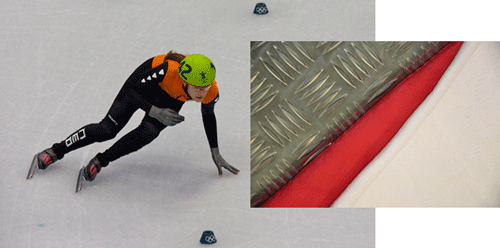
The skin suits worn by the 2010 Dutch Olympic short track team were made from a double
jersey fabric with Dyneema on the underside and nylon on the outer side.

The first sports application for which Dyneema was blended with another fiber was the suits worn by the 2004 Swiss Olympic fencing team. In 2007, Royal DSM N.V., parent of DSM Dyneema,
debuted Innovation is our Sport™ — an umbrella program under which sports, technology and innovation are linked to develop material and nutritional products. The Netherlands Olympic Committee is a partner in activities conducted under the program, and a number of innovations have been developed for the country’s Olympic teams.

As the 2010 Winter Olympics in Vancouver, Canada, approached, DSM partnered with the Royal Dutch Skating Association (KNSB) to develop a skin suit that would provide optimal comfort along with full-body protection for the Dutch Olympic short track team. Together, DSM and KNSB formed working groups to jointly develop technology for the solution, and KNSB facilitated workshops in which members of the skating team described what they would like to see in a suit. DSM then worked with Liechtenstein-based fabric developer Fuchschuber Techno-Tex GmbH, Sweden-based athletic apparel brand CRAFT’s Benelux office and the Netherlands-based athletic apparel maker Sportconfex B.V. to develop the fabric and the suits. The result of all this collaboration was a double-faced single-layer knit skin suit that is lighter-weight, closer-fitting and therefore more comfortable than the traditional two-layer skin suits; and also exceeds the International Skating Union’s protective performance requirements.

According to van Oosterbosch, while mandatory protective requirements ensure the athlete’s safety, wearability is key if the athlete is going to perform at top level. If a protective garment component interferes with an athlete’s comfort and agility, it is very tempting not to put it on
when it’s time to suit up for the competition. “This is what we saw after getting feedback from the Dutch skating team,” he said. “Because of the lack of comfort in other styles, some skaters didn’t want to wear the protective underlayer. The traditional skin suits are worn over that layer, and it tends to wrinkle and become very uncomfortable.” A similar issue also applies to motorcycle apparel and fencing suits, he said.

“Comfort is so important to the sports apparel industry that our partners are trying to find the right balance between comfort and protection,” he added. “What is really superior to this Dyneema technology is the combination of light weight, comfort and maximum protection.”

Commenting on the durability and comfort levels of Dyneema, van Oosterbosch said: “Unlike other high-performance fibers like aramids, Dyneema is chemically inert and hydrophobic. Because of its intrinsic chemical inertness, it withstands repeated washing and exposure to chemicals, thereby retaining its impact, cut and abrasion resistance. The hydrophobic property prevents water absorption, so Dyneema retains its light weight and comfortable product features.”

Depending on the application, Dyneema may comprise either the inside or the outside of the fabric, which may comprise a single layer or multiple layers. The blended fabrics may be woven or knitted, also depending on the application, and variations within the knits and weaves are possible as well. For example, the close-fitting short track racing suits are a knitted fabric, while the fabric for professional and even recreational urban-style motorcycle jeans is woven.

For more information about the use of Dyneema in sports apparel applications, contact Nathali
Donatz 31-46-476 6466; press.dyneema@dsm.com.

June 2010

June 2010

The Hohenstein Institute, Germany, has awarded
Christine Krautschneider the Hohenstein Award for Entrepreneurial Excellence in
Global Textile Services.

christinek
Krautschneider

Bunting Magnetics Co., Newton, Kan., has named
Gareth Meese export sales manager, Magnet Applications Ltd.

Bozeman, Mont.-based
TEXbase Inc. has appointed
Eric Rathbun vice president, global customer solutions.

The
Association of Italian Textile Machinery Manufacturers (ACIMIT), Milan, has
presented the ACIMIT Foundation Awards for textile machinery research to the following:
Sami Brahim Khouaja and
Nicola Badoni, Universita’ degli Studi di Bergamo;
Matteo Salamon, ISIS Newton — Varese;
Marialara Santangelo and
Davide Spanu, ITIS P. Carcano — Como; and
Alberto Vaccaro, ITIS Paleocapa — Bergamo.

Cranston, R.I.-based
Cranston Print Works Co. has named
Frederic L. Rockefeller Jr. president and CEO.

Princeton, N.J.-based
TRI/Princeton (TRI) has elected the following to its Board of Trustees for the
2010-11 term:
Dr. Robert Bianchini, Merck Consumer Care, chairman;
Dr. Kurt Adams, DuPont, vice chairman;
Paul Serbiak, Johnson and Johnson, general trustee; and
Fred Cervantes, L’Oreal, general trustee. TRI also has named
Dr. Joël Coret director, new business ventures.

Loves Park, Ill.-based
Zenith Cutter Co. has appointed
Thomas Parsons director of marketing.

tomparsons
Parsons

The
International Cotton Advisory Committee (ICAC), Washington, has named
Dr. Freddie M. Bourland, University of Arkansas, ICAC Cotton Researcher of the
Year 2010.

The
Narrow Fabrics Institute, Roseville, Minn., has presented the Narrow Fabrics
Industry Legacy Award posthumously to
Franklin A. Milnes, Wayne Industries, for his contributions to the narrow fabrics
industry and to the institute.

Japan-based
Teijin Group has named
Eiso Alberda van Ekenstein to manage the Aramid Fibers Business Group and has
promoted
Gert Frederiks CEO and president, Teijin Aramid, the Netherlands. In addition,
Teijin Aramid has appointed
Christoph Hahn marketing and sales director and
Peter Paping manager, business incubation and development.

Los Angeles-based
Guess? Inc. has appointed
Kitty Yung president, Guess? Asia.

Tefron Ltd., Israel, has named
Ilan Gilboa executive vice president, operations and customer support.

Arlington, Va.-based
Garnier-Thiebaut Inc. has named
Jean-Philippe Krukowicz president and CEO.

Victor Group Inc., Quebec, has appointed
Lisa Olson-Wong design director, Contract Division.

Dartmouth, Mass.-based
UMass Dartmouth has presented an honorary doctorate to
Gerald Mauretti, a director of The National Textile Association, Boston, and
president of EY Technologies, Fall River, Mass.

England-based
Mudpie Ltd. has appointed
John Gorman commercial director.

Summerville, S.C.-based
Thrace-linq has promoted
Daniel Selander to market development manager, geosynthetics; and has added
Brian Sparks to its sales and marketing team.

ajitweaverbhuluthermyers
From left to right: Moghe, Gupta and Myers

The Research Triangle Park, N.C.-based
American Association of Textile Chemists and Colorists (AATCC) has presented the
J. William Weaver Award to
Dr. Bhupender S. Gupta, North Carolina State University College of Textiles, and
Ajit Moghe, Covidien, for their significant contributions to textile science
literature; and the Technical Committee on Research Service Award to
Luther M. Myers, Test Materials Consulting LLC for his outstanding service in test
method development.


June 2010

The Rupp Report: Quo Vadis, Euro?

The euro is the official currency of the European Union (E.U.), used in 16 states of the EU and
five other countries. At first, it replaced the European Currency Unit (ECU) used for accounting,
but since January 2002 the euro is also a cash denomination, and is considered the
second-most-important currency after the U.S. dollar.

The EU is based on a treaty with some regulations. In the first years, the euro gained
strength and became a very strong currency. After the financial crisis in 2008 and 2009, new fears
appeared on the horizon. In recent months, the euro has been under constant pressure, and its
dropping value against the US dollar and the Swiss franc is alarming. It all started in Greece, but
Greece is definitely not the key issue in the crisis. Probably, it was just a coincidence.

Europe — An Artificial Power?

It seems that there are two main problems that occurred in Europe, bringing the euro in the
last few days to its present low value compared to the U.S. dollar and the Swiss franc. On the one
hand, it is more an institutional problem from bringing all the different countries under one E.U.
umbrella to speak the same language, at least from an economic point of view. The E.U. was built on
the concept that Europe is one of the strongest marketplaces, if not the strongest marketplace, in
the world. The so-called Lisbon Strategy from 2000 had the goal of making Europe the world’s most
competitive economic power. This aim has proven wrong. The textile industry in particular
demonstrates where the music is playing, mainly in Asia, and not in Europe anymore. Some experts
say that the competitive advantages of the Asian markets were also recognized by the international
finance markets in identifying the weak points and — as everybody knows today — gambling against
Greece in general and the euro in particular.

Devastating Results

The results have been devastating. Some days ago, the euro dropped below the exchange rate of
US$1.20, its lowest value against that currency in more that four years. On the other hand, the
Swiss franc is at a record-high against the euro, which is valued below 1.40 Swiss francs. But why
Greece, and not the United States and the dollar, where the whole financial crisis started? In the
United States, the national deficit is worse than that of the Eurozone countries. The national
economies of the G7 countries recorded an average annual deficit of 10 percent, and the Eurozone
countries, some 7 percent.

So what is the institutional problem of the E.U.? The fact is that Greece and other countries
did not publish the real statistics about their debts and the pressure increased on the euro.
Bluntly speaking, Greece is cheating its European partners by giving false statistics, counting on
some “first-aid” from the European Community.

Some people say it’s a colossal “constructional defect.” Maybe. But the E.U. is not the
political body that its founders had in mind. It’s the contrary: Since the current generation of
European leaders came into power, the E.U. has become more intergovernmental. The power is not in
the hands of the European Parliament, but in the hands of the chefs d’etat and the states
themselves. This leads to very long decision avenues, and they are not flexible in order to be
active in crisis.

Limited Power In Brussels

But the people of Europe can’t complain. That was exactly what they wanted in their elections
and European treaties. More power for the European Parliament was strictly opposed by most people
in the different countries. Hence, the decision-making process has become very slow. And now, the
euro is in crisis and the European governments are not capable of making fast decisions. This has
led to an even worse situation: Europe is a victim of its own circumstances, and today, it is
duller than ever.

The EU said it has learned the lesson and will now start the necessary reforms, but any
intervention to focus and integrate more power on Brussels is impossible. Even the
European-friendly Germans don’t agree to any further increase of the political power of the
European Parliament.

Vicious Circle

It is a vicious circle and the challenge of the century: In a few years, Europe will be more
over-aged than ever, which requires big money for retirement programs. Asia has more power than
ever; Europe’s old social structures must be reformed in order for it to become competitive again.
All this needs a lot of money.

On the other hand, the expenses should be limited and national debts, therefore, reduced,
which requires tough austerity programs. The Lisbon Strategy failed completely. Individual and
structural weaknesses are always the strength of the opponent. This is not the problem of Greece
but of Europe as such. And the international finance markets are very quick to find opportunities.
And this is never a coincidence.

June 8, 2010

Textile And Apparel Imports And Exports Show Gains

As the overall U.S. economy is showing signs of improving, both imports and exports of textiles and
apparel are on the rise.

Government trade data covering the first quarter of this year show that exports of yarn were
up by 23 percent over the comparable period of 2009, and fabric exports increased by 19 percent. At
the same time, apparel imports from all sources increased by 11 percent; and yarn imports were up
18 percent and fabric imports, up 19 percent.

China continued to dominate apparel trade, accounting for 80 percent of the increase in U.S.
imports, while trade from the Central America-Dominican Republic Free Trade Agreement (CAFTA-DR)
area was up 9 percent and imports from Mexico were up 9 percent. In the case of Mexico and
CAFTA-DR, apparel imports that enter the United States duty-free must contain yarn and fabric made
in the United States or the other participating countries.

Of major concern to U.S. textile manufacturers is the fact that much of the apparel import
trade with China was in the so-called “sensitive categories” of underwear, trousers and knit
shirts, for which import quotas were removed last January. While worldwide trade in these
categories was up just 7 percent, U.S. imports of those products from China were up 55 percent.

June 8, 2010

Sponsors