Oerlikon Neumag Announces Carpet Yarn Line Sales

Oerlikon Neumag, Germany — the nonwoven, bulk-continuous-filament (BCF) carpet yarn and man-made
staple fiber machinery business unit of Oerlikon Textile GmbH & Co. KG — reports that since
the start of 2010, it has completed more than 20 BCF carpet yarn line orders by major carpet
manufacturers in the United States, Brazil, Turkey, China and Russia. Polyester yarns account for
more than half the 100,000-plus tons of production capacity.

According to Oerlikon Neumag, polyester demand has grown because the yarns are more
cost-efficient to produce than other yarns, among other reasons; and it is expected that the growth
rate for polyester will outpace the rate for other carpet fibers.

July/August 2010

Dow To Shutter XLA Production

The Dow Chemical Co., Midland, Mich., will exit its Dow Fiber Solutions (DFS) business and shut
down production of DOW XLA™ stretch fiber over the next six to 18 months. The company said the
action is in line with its strategy to streamline and focus its business portfolio, and follows a
determination that DFS could not compete with Dow’s other performance businesses for further
investment and expansion.

Dow launched DFS and its core Dow XLA fiber technology in 2002, and apparel featuring the
olefin-based soft stretch fiber began appearing in retail markets in 2004. The fiber withstands
extreme chemicals and temperatures up to 220°C as well as harsh dyeing, bleaching, mercerizing and
garment-washing conditions; and is compatible with both natural and man-made fibers.

DFS’s XLA production facility, located in Tarragona, Spain, will continue to fill customers’
current and final orders for the fiber. After final shut-down of the XLA operation, the facility
will be considered for an alternative use within Dow. In the meantime, Dow also will be exploring
future alternatives for the business.

July/August 2010

Picanol Introduces Cordless Air-jet Weaving Feature

Picanol NV, Belgium, has launched a feature for air-jet weaving machines that enables weaving
without the filling catch cord. The fully automatic Cordless feature has a mechanical clamp at the
right-hand side of the machine that moves along with the reed. Picanol reports tests conducted on a
range of fabrics have indicated the Cordless design improves filling tension evenness, reduces air
consumption, improves selvage quality, enables increased speeds on delicate yarn and significantly
reduces filling waste when weaving with elastic yarns.

The Cordless feature is linked to a central microprocessor that processes data from sensors
and detectors on the weaving machine, enabling real-time calculations and adaptations to the
system’s valve timings. Picanol also reports the Cordless feature is compatible with all types of
reeds.

July/August 2010

Avery Dennison Celebrates 75 Years

Pasadena, Calif.-based Avery Dennison Corp. is celebrating its 75th anniversary. From its
establishment in 1935 by R. Stanton Avery — who developed the first self-adhesive label and
label-making machinery and received 18 patents for his pressure-sensitive materials and production
technologies — the company has grown into a $6 billion global enterprise.

July/August 2010

Trützschler Renames Its India Subsidiary

Trützschler GmbH & Co. KG, Germany, has renamed its India-based subsidiary from Trumac
Engineering Co. Pvt. to Truetzschler India Pvt. Ltd. The company is involved in Trützschler’s
spinning and card clothing segments, and will begin to support its nonwovens division in India.

Trützschler and A.T.E. Enterprises Pvt. Ltd. established Trumac as a joint venture in 1979.
The business began manufacturing blow room machines, and over the years, it added cards and draw
frames to its production line. In more recent years, Trumac has transitioned into making and
marketing Trützschler branded machinery in India. The company has expanded and updated its
manufacturing facilities to support the changes to its product line, and Trützschler decided the
name change would highlight “the transformation from production facility to fully integrated
producer and service provider.”

July/August 2010

Specialty Markets — Bicomponent Fibers


B
icomponent melt-spun fibers were first commercialized in the middle of the 20th century,
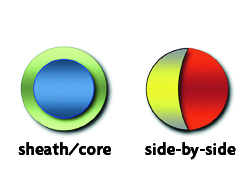
in the form of fibers with sheath/core and side-by-side cross sections
(See Figure 1). Very quickly, a primary application for the sheath/core bicomponent cross
section evolved: By employing a lower-melting-temperature (Tm) polymer in the sheath and a
higher-Tm polymer in the core, these fibers could be used in nonwoven webs to thermally bond the
webs together without losing the fiber shape of the binder fiber. This allowed more bond points,
which improved fabric strength and allowed for increased line speeds.

BicomponentFIT

Fiber Innovation Technology established its specialty fiber manufacturing operation in
Johnson City, Tenn., in 1996.

Since that time, sheath/core binder fibers have become widely accepted and have set the
stage for the introduction of bicomponent staple fibers, tows and filament yarns with a wide range
of enhanced performance features offered by more advanced bicomponent technologies. An important
step forward in the commercialization of some of the more advanced possibilities was the invention
by Melbourne, Fla.-based Hills Inc. of a process for producing spin pack parts using photochemical
etching. This advance increased the fineness and precision of control over polymer flow paths and
did so while simultaneously reducing the cost of the parts. Subsequently, Fiber Innovation
Technology, Inc. (FIT) was established in 1996 in Johnson City, Tenn., as a specialty fiber
producer not controlled by any polymer producer having a single-polymer, commodity focus. With
access to all available thermoplastic materials, and using the Hills technology, FIT has been able
to pioneer a large number of different bicomponent fiber types in a wide variety of applications in
a relatively short time. As a result, fiber consumers now have access to commercial supply of an
almost endless variety of bicomponent fibers, with an exponentially larger range of performance
features than when the simplest bicomponent fibers were first introduced.

BicomponentFig1

Figure 1: Fibers with sheath/core and side-by-side cross sections were the first bicomponent
melt-spun fibers to be commercialized.


Highly Tailored Fiber Properties


Today, the choice of polymers used in a bicomponent fiber is not restricted to a handful of
commodity polymers such as polyethylene terephthalate (PET), nylon, and polypropylene (PP).
Instead, the entire range of polyesters – including polycyclohexanedimethanol terephthalate,
polytrimethylene terephthalate, polybutylene terephthalate, PET glycol and a huge range of
copolyesters – is being augmented by aliphatic polyesters such as polylactic acid and
polyhydroxyalkanoates, which introduce the new environmental benefit of being derived from
renewable resources. Similar range extension is now available with polyamides and polyolefins
including nylon 6, 6,6, 11 and 12; copolyamides; high-density polyethylene (PE); linear low-density
PE; syndiotactic PP; and polymethylpentene. But perhaps the most intriguing new possibility is the
incorporation of engineering polymers, whose properties are typically exceptional but whose cost
has traditionally prevented any investigation of use in commodity fiber applications. The list of
these polymers is long, and includes polyphenylene sulfide, acetal, ionomers, polyvinyl alcohol,
polyetherimide, and thermoplastic polyurethanes, to name just a few.

Added to the newly-expanded polymer choices is a much greater variety of bicomponent cross
sections made possible by Hills technology and some pack-part innovations by FIT. Now it is
possible to put the polymers pretty much wherever desired in the fiber’s cross section
(See Figure 2).

bicomponentFig2

Figure 2: Bicomponent fibers can be manufactured in a wide range of polymer configurations,
such as those shown above, thanks to technology developed by Hills Inc. and some pack-part
innovations developed by FIT.


And it’s no longer necessary to limit the choice to round fibers.  Shaped-cross-section
fibers can also be coextruded using two polymers
(See Figure 3).

bicomponentfig3


Figure 3: Bicomponent fibers also can be extruded in a variety of shaped cross sections,
including those shown above.


Finally, the entire range of polymer additives that can be used in single-polymer fibers can
also be used in one or both of the polymers in a bicomponent fiber to achieve targeted performance
characteristics. These additives include such things as colorants, flame retardants,
antimicrobials, conductive materials and carbon nanotubes, among other additives.

With this very large matrix of material properties and ways of combining them into each
fiber, it will be apparent that bicomponent fibers are no longer a one-trick pony. Whereas in the
past, fabric design meant trying to optimize the fixed attributes of a commodity fiber into each
different application, bicomponent fibers now offer a way to engineer finely-tuned performance into
the fiber. Each application can now seek a fiber that is precisely tailored to fit the specific
needs of that application.


Exemplary Uses Of Bicomponent Fibers


There are far too many different end-uses for bicomponent fibers to cover in a brief
article, but a few illustrative examples are discussed below.

Even the basic sheath/core binder fiber has been updated since the early days. Today, there
is access to a range of copolymers of polyesters, polyamides, and polyolefins that allow precise
targeting of the desired thermal bonding behavior. The bonding temperature can be set from a low of
about 110°C to a high of about 180°C. It is even possible to select bonding polymers outside this
range, but these options can impose significant caveats. Beyond the bonding temperature, the
adhesive character of the bonding polymer can be adjusted to adhere better to polar surfaces or
nonpolar ones. And the crystalline nature of the polymer can be adjusted to give a broader or
narrower melt-temperature range. Binder fibers for high-loft nonwovens used as seat cushions in
place of polyurethane foam use a sheath polymer with elastic recovery, so that repeated stressing
of the bond points does not fracture the bond.

The fundamental sheath/core cross section is also useful in many applications demanding
engineering polymers. Typically, such an application depends entirely on the surface properties of
the more exotic, and more expensive, polymer. In these cases, the fiber’s core can be made with a
suitable lower-cost polymer to deliver all of the benefit of the more expensive polymer at a
materials cost well below that of a fiber made from the surface polymer alone.

Side-by-side bicomponent fibers typically rely on the difference in shrinkage between the
two polymers. At any point in the fabric formation process, if the fibers are not physically
constrained, shrinkage can be induced by the application of heat. Since the two polymers shrink at
different rates, the fiber resolves the resulting tension by curling into a helix. This behavior
allows a fabric to be made flat and then bulked when and where it suits the application.

The pie wedge cross sections typically are used to make microfibers. Direct spinning of
microfibers is difficult – and practically impossible below about 0.3 to 0.5 denier per filament
(dpf) – and expensive, as throughputs are low. But a 2- to 3-dpf pie-wedge fiber does not suffer
throughput limitations, and is robust through fiber and fabric production processes. Once a
nonwoven web is formed from these fibers, it can be subjected to mechanical agitation – typically,
a hydroentangling process – which will split the segments into microfibers – typically, about 16
segments per bicomponent fiber. The result is a microfiber fabric at significantly reduced cost
compared to one made using direct-spun microfibers.  The hollow and partial-wrap versions of
this cross section are refinements that allow adjustment of the fiber’s relative splittability.

The sea/islands cross section also generates microfibers. In this case, the sea polymer can
be easily removed by dissolution in a suitable solvent – typically, a light, hot caustic bath or
warm water. A fabric made of sea/islands fibers is passed through the solvent, and the result is a
microfiber fabric. This approach incurs a cost penalty because some of the fiber is washed down the
drain. But the smallest microfibers from sea/islands technology are much smaller than those
achievable using mechanical splitting technology.

The taggant cross section is one that FIT initially developed just to show off its
capabilities. But since then, the company has discovered that the inclusion of a logo or some other
complex shape in the fiber’s cross section can be of value in taggant fibers for applications in
which liability protection is desired. The logo can even be a two-dimensional barcode that can be
read by a machine vision system, thereby stealthily incorporating large amounts of information into
a product. The tagged product need not be a fibrous product, but can include electronics,
pharmaceuticals, gemstones, explosives, or virtually anything used in an application in which
forensic identification could be of value.


Future Directions


Of course, this is not the end of the story. Innovation will continue and build upon the
advances that have brought the technology to this stage. Already, tricomponent spinning systems are
being developed to coextrude three different polymers into each fiber rather than just two. And
some of the simpler bicomponent cross sections are appearing in spunbond fabrics, in which
filaments are extruded directly into a nonwoven web without forming fibers as an intermediate
product. The precision of polymer control to form the cross section also continues to advance. When
FIT was first formed, the state of the art was 37 islands in a sea/islands fiber, which could
produce microfibers as fine as 0.02 dpf. In recent years, Hills has produced spin packs capable of
stuffing hundreds of islands into each fiber cross section, which enables the production of
submicron microfibers. There is even one sea/islands cross section with close to 10,000 islands.
And before electrospinning technology even makes it out of the cradle, researchers are beginning to
experiment with bicomponent electrospun filaments, using polymer solutions rather than polymer
melts.

It will be necessary to wait for some of these advances to become widely available, but with
the state of bicomponent technology available today for commercial production, there may no longer
be any need to wait for a staple fiber or filament yarn that offers the exact performance a
particular application requires.


Editor’s Note: Jeffrey S. Dugan is vice president, research, of Fiber Innovation Technology
Inc.


July/August 2010

Building Better Apparel Brands


A
s in many manufacturing industries, relationships among suppliers within the supply chain
vary from being close collaborations to distant relationships with faceless merchants. But, for
better brands to succeed, close collaboration within the supply chain can ensure improved product
quality and delivery as well as provide valuable problem-solving capabilities.

Case in point: During a recent

Textile World
interview, David Sasso, vice president, sales, Jefferson, Ga-based Buhler Quality Yarns
Corp., explained how a major U.S. retailer requested the technical experience of Buhler’s staff to
help investigate a quality issue with a house-branded garment.

Buhler was engaged in a program supplying high-end Supima
® cotton yarn to a well-known knitting and finishing operation in Honduras. The
resultant women’s top, however, did not meet the brand’s expectations, notably regarding pilling
and stability.

“This was an unusual situation,” Sasso said. “We knew the yarn was up to specification and
performing well in similar applications. We knew the knitter and finisher was a solid supplier. But
the final product left room for improvement.

“What’s really important is that the retailer knew us and knew we have expertise in the
dyeing and finishing of garments made with Buhler yarns,” Sasso continued. “For a number of years
now, Victor Almeida has been with Buhler in technical service and sales and has brought additional
depth to the team. Developing close relationships with retailers and brands means we work hard to
make sure they know we bring more to the supply chain than a cone of yarn.”

“We were able to go through the knitting and finishing processes and get another set or two
of eyeballs on the product,” Almeida said. “The knitter does a great job, and we really came
together to save the program and perform for the retailer.

KA Brands

Left to right: Buhler Quality Yarns Corp.’s David Sasso and Victor Almeida worked with
supply chain partners to correct a quality problem in a major retailer’s house-branded
garment.


“As it turns out, the problem was in the dyehouse,” Almeida explained. “When the dyeing
machine was being loaded, the rope of Supima fabric was shorter than the ropes of other fabrics
being loaded into the same machine. So, during the dye cycle, the Supima rope was traveling through
the jet some three times the distance as the other fabric, and really taking a beating. We simply
equalized the length of the ropes running together in the dyeing process and the results were
great. Overall, the garment’s pilling was reduced and the product’s stability was corrected.”

“Everybody won,” Sasso added. “The retailer knew the chain was delivering. Our relationship
with the knitter was better than ever, and the product performed the way it was supposed to.

“I know this is a Buhler example, but I think it is broader than that,” Sasso said. “I’m not
convinced that the value of a collaborative supply chain is really understood. It is easy to
undervalue. There is a tremendous wealth of information along the supply chain. You’d be surprised
what logistics people know, what knitters and dyers know — often about things upstream or
downstream from their own operation. ”

Not every supply chain is capable of performing in a collaborative way. It takes an openness
and trust that is built over time. But, as with the Buhler case, the retailer was the key to
success. With the retailer requesting participation, members of the chain were that much more
willing and open to solving the brand’s problem.

“It was a big win,” Sasso said. “Both of our companies got that much closer to the retailer,
and I think we demonstrated real value to them. And, hopefully, that will lead to that much more
business. With a high-end product like this, if the retailer knows the full supply chain will
perform — knows that when problems come up, we’ll get to the bottom of it quickly rather than pass
the buck — there is a confidence in the chain and a real competitive advantage.”

July/August 2010

Manufacturers Chemicals Introduces Silicat Softeners

Specialty chemicals producer Manufacturers Chemicals LLC, Cleveland, Tenn., reports its Silicat
hybrid softeners impart a similar hand and drape to a fabric, but contain significantly less
silicone than a traditional silicone-based softener. According to Chuck Stieg, the company’s
president, customers have replaced silicones pound-for-pound by using the new technology.

“We have developed a new chemical/mechanical process whereby we make an emulsion of a new
class of non-silicone softener along with traditional amino functional silicones,” Stieg said.
“With this technology we can produce a high performance, highly stable hybrid softener. The
resulting product offers dramatic reductions in silicone content, dramatically lower cost, reduced
possibility of spots, greatly improved flammability, and zero yellowing. The environmental impact
of these softeners is far less than traditional silicone emulsions.”

Manufacturers Chemicals is producing the Silicat line commercially at its Cleveland facility.
The hybrid softeners are available in a variety of concentrations and in both hydrophobic and
hydrophilic versions.

July/August 2010

Fashion Futures


A
s two colleges of fashion design showcase their students’ creativity, they also honor
those who paved the way. New York City-based Pratt Institute’s annual senior class fashion show was
preceded by a slide presentation highlighting the dynamic career of designer Catherine Malandrino,
the school’s 2010 Fashion Icon. Student awards in several categories were announced during a runway
show of their work. 

RadiciSpandex Corp., Gastonia, N.C., sponsored a fashion competition for the junior class at
Kent, Ohio-based Kent State University’s Fashion School. This year, Jeffrey Chow, Poleci’s creative
director for contemporary womenswear, was selected as designer judge to receive the “Stretch to the
Future” Award. He also helped select student scholarship award winners for the best-designed
stretch eveningwear, swimwear, activewear and lingerie.


Pratt Institute


Malandrino is the fifth designer to receive Pratt’s Fashion Icon award, established in 2006
to honor outstanding talent in the fashion industry. Previous recipients are Ralph Rucci, Carmen
Marc Valvo, Narcisco Rodriguez and Diane von Furstenberg.

Malandrino, who was born in the French Alps and educated in Paris, worked at the couture
houses of Dorothée Bis, Louis Féraud and Emanuel Ungaro before she moved to New York City. In 2002,
her SoHo boutique was featured in the hit cable television series “Sex and the City.” Currently,
she designs two collections: Catherine Malandrino, a line of contemporary apparel; and Malandrino,
a runway line that includes accessories. Her company operates 11 boutiques globally, and her
collections are sold in more than 400 stores worldwide.

Women’s sportswear, eveningwear and bridal fashions, menswear and costume designs appeared
on the runway to showcase the work of 22 Pratt seniors. In addition to designing and making each
garment, several students embellished fabrics with their own prints, hand painting or other
decoration. Other students pieced and patched different fabrics to create dramatic effects.

KA1

Pratt senior Kasia Wisniewski, winner of the Debi Jones Bridalwear Award, designed this gown
featuring laser-cut satin and paillettes. Photographed by Rene Perez


In the sportswear category, Kathleen Su created a shaggy short jacket featuring
red/green/black stars and stripes, and worn over short shorts and a scoop-neck top in green and
black.  Julie Ann Mollo, who interned with Betsey Johnson, dazzled the audience with a liquid
gold jacket that had black and white bullseyes at the elbows and read, “with the band.” It was worn
over a short, ruffled, black and gold skirt.  

Jennifer Damm worked as a student curatorial intern at the Museum of the City of New York
and London’s Victoria and Albert Museum. Her collection was called Try Angles. A body-skimming
dress was made of pieces of triangular-cut sateen in different shades of red. Another featured
overlapping green triangles connected with metal studs.

Three students, Nina Zilka, Jeff Dodd and David J. Krause, have formed their own company,
the twentyten, and are making casual sportswear. They showed a lot of layered pieces in black and
white. Knitted leggings, cutout tops, paneled jackets, and body-skimming knit dresses are some of
the components.    

A lot of the menswear was loose and fluid. Kristen Steinman, who won honorable mention,
showed side-draped jackets. K. Paige Regan, who said her aim is to bridge the gap between high
fashion and New York street style, showed a side-buttoned long jacket in black and white checks
that had inserts of black and white zigzags.

In the costume segment, Alessandra Hammet, who interned with the Boston Ballet costume
department, designed a collection called [M] Alice: Nightmare in Wonderland. Alice was sweetly
dressed in layers of softly colored chiffon; other costumes were bold and dramatic. The Queen was
clad in black and white tight britches and flounces of black and red sheer fabrics cascading at the
back from a tight, bare bodice and a jaunty feathered crown. 

Rayneese V. Primrose, winner of the Martin Izquierdo Costume Design Award, called her
collection, Thriller: Death to the Homecoming Queen. Her “prom?” queen was clad in a black,
low-cut, nail-studded top; tight leather shorts; and layers of black tulle.

Evening- and bridalwear was innovative and pretty. Devin Cole stated her goal is to fuse
fine arts with fashion. She painted and printed cotton gauze for her wedding party including four
bridal attendants. Her prints were soft and romantic. 

Christine Brown, honorable mention winner in eveningwear, spray-painted satin and overlaid
it with lace for her collection of strapless short gowns. 

Laser-cut satin and paillettes decorated one of Kasia Wisniewski’s gowns. Another, in tucked
chiffon, had touches of sequins. Wisniewski won the Debi Jones Bridalwear Award. 

Timothy Kuzmeski, who interned with Chado Ralph Rucci, was recipient of the Rene Hunter
Eveningwear Award. His gowns, in black or white taffeta or tulle, were designed with layers and
layers of ruffled fabrics. Some of the models looked as if they were wrapped in masses of flower
petals.


RadiciSpandex “Stretch To The Future” Awards At Kent State


Chow was this year’s honoree judge at the RadiciSpandex “Stretch to the Future” student
design competition held at Kent State’s Fashion School.  Fifty-one juniors entered the
competition. The Underfashion Club was sponsor of the lingerie award. Other award categories were
swimwear, activewear, eveningwear and a Grand Prize Overall. 

Chow began his career in the early 1990s as a sportswear designer for Marc Jacobs at Perry
Ellis, and later worked at Esprit International and Tommy Hilfiger in the United States, and for
Pucci in Florence, Italy. He has been Poleci’s creative director for about a year. The Poleci label
is sold internationally through department and specialty stores including Neiman Marcus, Nordstrom
and Harvey Nichols; and at Poleci’s own stores in New York City, Los Angeles and Las Vegas. 

KA2

Left to right: Paula Dancie, Kent State University instructor; Bethany Clark, activewear
winner; Kim Hall, RadiciSpandex marketing manager; Jeffrey Chow, designer honoree judge; Samantha
Hawkins, eveningwear and Grand Prize winner; and Emily Aldredge, Kent State studio director, pose
with “Stretch to the Future” winning designs. 


Kim Hall, RadiciSpandex marketing manager, presented the “Stretch to the Future” award to
Chow. Previous honorees have included Betsey Johnson, Dana Buchman, Nicole Miller, Nanette Lepore,
Carmen Marc Valvo and Marc Bouwer. 

One of the objectives of the competition is to educate aspiring designers about how to
combine creativity and function using fashion fabrics that contain highly technical fibers. All of
the fabrics selected by the students were circular or warp knits, and all contain RadElast®
spandex.

Fabrics for the competition were donated by ABC Elastic Corp., Brooklyn, N.Y.; Contempora
Fabrics Inc., Lumberton, N.C.; Cyberknit Fabrics, New York City; Darlington Fabrics, Westerly,
R.I.; Guilford Performance Textiles, Wilmington, N.C.; McMurray Fabrics, Aberdeen, N.C.; Monte
Textil S.A., Guatemala; Polartec, Lawrence, Mass.; Rentex Mills, Quebec, Canada; Sextet Fabrics,
East Rockaway, N.Y.; and TDB Tecidos, Brazil.

Samantha Hawkins won the eveningwear and the Grand Prize Scholarship awards totaling
$5,000.  Her winning design was a black satin halter-neck gown with a tucked top in stretch
fabrics from Guilford Performance Textiles and McMurray Fabrics. Bethany Clark was the activewear
winner, receiving $2,000 for her body-hugging exercise suit in yellow stretch fabrics from McMurray
and Polartec.

The $2,000 swimwear prize went to Ashley Gerber for a navy and red two-piece high
corset-like suit made in fabrics from Guilford and McMurray. Phillip Fry won the lingerie award,
also $2,000, for his bra and panty set in fabrics by Polartec and TDB Tecidos.

July/August 2010

Atlanta Textile Shows Exceed Expectations


F
rom Tuesday, May 18, through Thursday, May 20, 2010, the East Coast edition of Techtextil
North America and its concurrent Symposium; the triennial SPESA Expo and its concurrent seminars;
and the quadrennial ATME-I
® Megatex — American Textile Machinery Exhibition-International
® — colocated in Atlanta at the Georgia World Congress Center (GWCC) for Textile and
Sewn Products Industry Week (TASPIW). The event — which brought together machinery and technology
suppliers for the technical textile and nonwovens as well as traditional textile sectors, in
addition to sewn products equipment and services suppliers — was a great success: Taking into
account crossover visitors from the three shows, total attendance reportedly exceeded 8,000.

Both exhibitors and attendees agreed the colocation of the shows made for a convenient,
cost-effective and productive event.
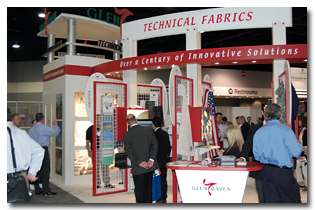
TASPIWGlenRaven

Glen Raven Inc. presented its range of technical fabrics at Techtextil North
America


“The colocation did exactly what we had hoped — it created a bigger and better event for
our attendees and exhibitors,” said Stephanie Everett, group show director of textile shows, Messe
Frankfurt Inc., Atlanta — producer of Techtextil North America and the U.S. subsidiary of
Frankfurt-based trade show organizer Messe Frankfurt GmbH.

“The opportunity to bring the industry together under one roof – multiple events in one
location with a crossover of some audiences – provided value for both the exhibitor and the
attendee, almost one-stop shopping,” said Clay Tyeryar, president, Falls Church, Va.-based American
Textile Machinery Association (ATMA
®), which co-organized ATME-I Megatex with United Kingdom-based Mack Brooks
Exhibitions. 

“The changes we have witnessed in the global sewn products industry have convinced us more
than ever that all segments of the industry must work together to remain competitive,” said Dave
Gardner, managing director of Raleigh, N.C.-based Sewn Products Equipment & Suppliers of the
Americas (SPESA), producer of SPESA Expo. “The colocation of SPESA Expo, Techtextil North America,
and ATME-I Megatex provided a unique opportunity for visitors to see leading exhibitors that supply
the full spectrum of their production needs. Visitors gained the ‘under-one-roof’ convenience to
see first-hand all the products and services they need to successfully operate in this changing
world.”

TASPIWZimmer

Left to right: Horst Ros, Roland Zimmer and Dirk Leiber of ATME-I Megatex exhibitor Zimmer
America Corp. take a break to pose for a picture.


Excellent Traffic


Everyone reported high traffic at TASPIW. “Traffic was very good — there was always a buzz
on the show floor,” Everett said.

“Traffic has been much better here than it was four years ago,” said Mark A. Reese,
president, Greenville-based Measured Solutions Inc., a Techtextil North America exhibitor. “The
format and layout are very good. We saw customers we expected and some we haven’t seen in years
that showed up.”

High-quality traffic at the show meant serious interest and exhibitors leaving with
potential leads. “Traffic was really good, and it wasn’t just bodies milling about, it was
customers — current customers, prospects, our agents in South America — it was good-quality
traffic, with decision-makers, those seeking information,” said Kim Hall, marketing manager,
fashion apparel, for Gastonia, N.C.-based RadiciSpandex Corp., an ATME-I Megatex exhibitor. “I was
quoting prices, which is incredible — it’s usually not like that at a show, it’s usually just
information-gathering. We were even able to make customer referrals. We received a lot of inquiries
— there were very targeted, specific questions about products, prices and deliveries, and I found
that very encouraging.”

According to Hall, Spartanburg-based ITEMA America Inc., which shared a booth with
RadiciSpandex, saw a lot of its largest customers at the show.

“People were wanting to buy, rather than asking questions. A lot of decision-makers were in
the crowd,” said Gerald Schwartz, president, Tucker, Ga.-based G.S.I., a SPESA Expo exhibitor. “We
found it valuable with respect to conversing with current contacts as well as exploring business
opportunities with new ones.”

The colocation of the three shows also enabled a crossover of potential customers. “A lot of
the exhibiting companies are also customers of ours,” SPESA’s Gardner said. “There was a lot of
crossover of who’s a customer and who’s a supplier. An exhibitor in one booth was the customer of
the exhibitor in the next booth.”

TASPIWcontempora


Gerald Cauthen, Contempora Fabrics Inc. (right), visits with attendees at SPESA Expo.


A Positive Vibe


A new excitement seemed to fill the air at the event. “There was a positive mood, exhibitors
were upbeat, they were pleased with the attendance and the strong traffic — the overall feeling of
the show was very optimistic,” ATMA’s Tyeryar said.

“People on all fronts in the industry seem to have a more positive outlook, especially in
regard to new products,” said Rodney Gibson, executive vice president, operations, Enka, N.C.-based
Basofil Fibers LLC, a Techtextil North America exhibitor.

“There is an overall optimism here,” said Ronen Hagin, CEO, Alpharetta, Ga.-based Datatex
TIS Inc., an ATME-I Megatex exhibitor. “We’re still not getting quite the traffic we used to, but I
know it will come back.” Hagin also mentioned the countries that seem to be doing the best are
Pakistan, Bangladesh, India, Indonesia and China.

“Everyone’s been so down in the dumps for over a year now, and it was great to have that
positive energy — it wasn’t from just one individual or a few companies, but truly was across the
board,” RadiciSpandex’s Hall said. “Even the most conservative individuals in our booth saw how
positive the show was and the traffic that came through the booth, and made comments that they
couldn’t believe it; it’s almost like people came to the show not expecting it to be great.”


Expectations Exceeded


Though exhibitors were cautiously optimistic, many reported their expectations were
exceeded. “The show has been much better than we expected,” said Tim Beach, knitting machine parts
sales representative, Charlotte-based Groz Beckert USA Inc., a Techtextil North America exhibitor.
“People are leaving the show with a much better feel for the market than they came with.”

“The show was better than we expected – and I’ve been very happy with the blending of the
shows,” said Joseph A. Okey Jr., president, Charlotte-based American Monforts LLC, an ATME-I
Megatex exhibitor.

“So many people went into the show with low or no expectations because they don’t know
what’s going to happen out there right now,” Gardner said. “It was so much better than anybody
anticipated. That was the message across the board: People went in with low expectations, and we
beat them in almost every case.”

TASPIWMorrison

Left to right: Alan Robinson, Buddy Humphrey and Jay White, Morrison Textile Machinery Co.
exhibited at ATME-I Megatex.


An Improving Market


The market was evidently a topic of interest for all. “Everyone was very inquisitive
regarding the market going forward,” said Scott Malcolm, president, ITEMA America. “Some of the
first questions out of people’s mouths when they came up to us at the booth were ‘How’s business?’
and ‘What do you see going forward?’ Everyone’s a little reluctant to get too excited about the
upswing.”

“The textile industry in the United States was already extremely challenged before the
recession hit, so the last two years have seen our exhibitors and attendees struggling to survive
in the current climate,” Messe Frankfurt’s Everett said. “Our goal was to provide an event that
would help generate new business and create a spark again in the industry. And from the feedback we
have been receiving, that is exactly what we have accomplished.”

“We are seeing an uptick in the apparel market, with activewear and ready-to-wear the two
strongest categories right now,” Hall said. “And the nonwovens market is especially strong for us –
our spandex goes into incontinence pads, diapers, and more. RadiciSpandex made a decision four
years ago to focus on that market because it’s more stable and doesn’t have the ups and downs that
the apparel market does.”

There was a greater-than-expected turnout of U.S.-based companies, indicating that domestic
manufacturers are back in business. “The market — and North American companies in particular —
seems to be slowly recovering from the still challenging economic situation,” said Michael
Jaenecke, brand manager, Techtextil Worldwide.

Gardner said he sees business increasing in the United States, which is a very encouraging
sign. “Mel Berzack, a SPESA board member and president of Jefferson, Ga.-based Sewn Products
Equipment Co., reported that from the Miami show three years ago to the Atlanta show this year, it
went from 50-percent international/50-percent domestic to this year having over 70 percent of their
leads come from the United States,” he said.

Gardner believes the increased number of U.S. decision-makers for equipment and technology
at the show was a result of three things: location, business improvement and the colocation of
shows. “When we were in Miami, we were considered to be a Central America/Latin America show —
which was true at one time — but we could not get anyone from the automotive, shoe industries, any
of these, to go to Miami; but they did come to Atlanta this year, which showed us the move was not
only good from the geographic perspective, it opened the show up to other sectors of the sewn
products and textile industry such as leather, footwear, luggage, home furnishings and automotive.
We even had a lot of aerospace companies there because they wanted to see cutting composites and
new composite technologies. We found that the colocation, especially with Techtextil, really
increased our show turnout, and with the right people. We even had people at the SEAMS booth say
this was the best show they’d been to in 25 years. These are people who are manufacturing in our
country, which shows us that business is coming back slowly but surely. We are seeing more and more
companies bringing some of their manufacturing back to this region, so we’re very positive — more
so than we’ve been in years — about textile business coming back to the country.”

TASPIWMalcolm

Scott Malcolm, ATME-I Megatex exhibitor ITEMA America Inc., said participants were very
inquisitive about the market going forward.


Techtextil North America


Messe Frankfurt reports the seventh edition of Techtextil North America hosted 233
exhibitors from 22 countries and featured international pavilions from Belgium/France, Canada,
China, Italy, Germany, Portugal and Taiwan.

“We are extremely pleased with the results of Techtextil North America this year, and
especially pleased with the success of the colocation,” said David Audrain, president, Messe
Frankfurt Inc. “This has created a wonderful foundation for growth as we move forward with our
permanent colocation and partnership with SPESA,” he added, referring to a recently announced
partnership between Messe Frankfurt and SPESA to launch Texprocess Americas in 2012.

“Techtextil North America 2010 turned out to be one of the best Techtextil shows we ever had
in the USA,” Jaenecke said.

Attendees, likewise, expressed enthusiasm over the quality of this year’s show.

“There was a good cross section of suppliers represented,” said James Chesnutt, president,
National Spinning Co. Inc., Washington, N.C. “This is definitely the best show I’ve been to in
years. It was well organized and our company benefitted greatly.”

“This expo was a great way to see innovative products and equipment from all around the
world under one roof,” said Rick Ranhotra, process engineer, Atlanta-based Georgia Power Co. “As a
supplier to the industry, I found it helpful to gauge which other suppliers and countries were
committed to a presence in the technical textiles industry.”

A highlight of Techtextil was the Technology Showcase 2010, which featured 13 exhibitors
that have completed their latest developments, innovations or products within the last four years.
Technology displayed included protective textiles with high-visibility, reflective,
flame-retardant, antimicrobial, waterproof, abrasion-resistant, and temperature-regulating
features, among other technologies.

TASPIWMeasured

Mark Reese, Measured Solutions Inc. (right), speaks with a Techtextil North America
visitor


Techtextil North America Symposium


The concurrent Techtextil North America Symposium presented the latest developments in the
technical textiles/nonwovens sector in 13 sessions including 70 presentations by leading industry
experts. Attendees were free to move from session to session to hear what interested them.

“The symposium was the smoothest I’ve seen it,” said William C. “Bill” Smith, symposium
director.  “Overall, attendance was good; although registration numbers may have been a bit
down, it seemed to hold up very well in this recession year. Attendees were enthusiastic.”

In his technical textiles State of the Industry speech in the opening session, Smith began
by stating that the industry has bottomed out but is on its way back up. He noted that although the
economy is improving, the consumer has a lack of confidence in it, which impacts the technical
textile industry both directly and indirectly. He emphasized that the future of technical textiles
lies in innovation.

“The secret to prospering in the industry is to find the areas of opportunity and potential,
up and down the chain — and outward — and line extension, and exploit them,” Smith said. He also
pointed out that there are a lot of companies starting up in the United States.

According to Smith, the best-attended session was “Military – Developments to Impact the
Industry,” with topics including doing business with the Department of Defense; fibrous armor
materials; nonwovens in military applications including uniforms; and nanotechnology for military
applications. The “Medical & Biotechnology” and “New Product Development” sessions drew large
audiences as well.

“We are coming out of a ‘great recession’ – it will be a long process in many areas, and
people know they must be prepared,” Smith said. “Symposiums like ours provide a great learning
experience.”

TASPIWPourdeyhimi

Dr. Behnam Pourdeyhimi of the Nonwovens Institute at North Carolina State University was
session chair of the Techtextil North America Symposium’s “Filtration — Practical Opportunities in
Nonwovens” session.


SPESA Expo


SPESA reports that of the industry executives and professionals that attended SPESA Expo
2010, 85 percent were buying decision-makers or influencers, with more than 2,800 business owners,
presidents and top-level executives attending. The expo featured 224 exhibitors representing the
entire concept-to-delivery sewn products supply chain, including new exhibit categories such as
fabrics and trims, product development services, production and supply chain services, information
technology and software solutions. More than 80 percent of attendees were from North America-based
companies, many of which also have operations in Central America. Approximately 8 percent of
attendees came from South America and 6 percent from Asia. More than one-third were from apparel
companies. One thousand visitors participated in the 30 SPESA Expo Forum conference and seminar
events.

“We are pleased to see such an impressive industry response to our 2010 event,” said Benton
Gardner, president, SPESA. “The signs of economic and industry recovery were evident with the
greater-than-expected turnout of U.S.-based companies and the increased levels of top
decision-makers in attendance. Virtually all of our exhibitors reported that the show met or
exceeded their expectations.”

“The colocation approach to trade shows was a tremendous success,” said Frank Henderson,
SPESA chairman and president of Henderson Sewing Machine Co. Inc., Andalusia, Ala. “What the SPESA
Board of Directors and leadership envisioned truly came to fruition in Atlanta. In the global
economy today, companies’ ability to thrive will depend on their ability to cooperate and
collaborate.”


SEAMS


Columbia, S.C.-based SEAMS, the National Association for the Sewn Products Industry, debuted
the “Made in USA Supply Chain” pavilion at SPESA Expo. The 2,000-square-foot pavilion featured
products made by SEAMS member companies, as well as individual exhibits by U.S.-based companies
that provide manufacturing and other services for the soft goods supply chain.

“Our pavilion was extremely busy,” said SEAMS Director Sarah Friedman. “Many of our
exhibitors wrote orders at the show. We had major brand names and retailers come by to talk about
getting some of their products produced in the United States. Quite frankly, they were surprised to
find a complete USA supply chain available.”

Supply Chain pavilion exhibitors reported heavy traffic, with some saying they were busier
at this show than they had been in some 20 to 25 years. “This was non-stop traffic, and I’ve never
been to a show like that,” said DeeDee Harris, Tuscarora Yarns Inc., Mt. Pleasant, N.C. “Usually
there is a lot of downtime, and this time we had no downtime.”

“Everyone agreed that we’ve never seen such consistent high-quality traffic at a trade
show,” said Dr. Christine W. Cole, Clemson Apparel Research, Pendleton, S.C. “We’re really
optimistic about 2010.”

SEAMS exhibitors also seemed very happy with the cross traffic resulting from the shows’
colocation. “Many of the people that came to this show came to see the equipment at the other end
of the building,” said Gerald Cauthen, Contempora Fabrics Inc., Lumberton, N.C. “Of course, if they
need something to sew on, they also need something to sew. As a fabric company, we thought SPESA
Expo was a very, very successful show. We were able to get face-to-face time in a good, active
atmosphere. … It was busy all three days. We made some great contacts and solidified some
situations.”


Texprocess 2012


Messe Frankfurt and SPESA recently announced a partnership to co-operate, co-produce and
co-launch the new Texprocess Americas trade show, to debut April 24-26, 2012, in Atlanta at the
GWCC

(See “Messe Frankfurt, SPESA To Launch Texprocess Americas In 2012,” www.
TextileWorld.com, April 27, 2010)

. SPESA no longer will produce SPESA Expo, but instead will support Texprocess Americas, the
first U.S. edition of Texprocess – which will debut in Frankfurt May 24-27, 2011, as a biennial
exhibition presenting machinery, processing technology, information technology and services for the
making-up of textiles and other flexible materials. Texprocess Americas will be held in
even-numbered years alongside Techtextil North America to present the largest technical textiles,
nonwovens and sewn products industry event yet.

Messe Frankfurt also is gearing up to produce the next West Coast edition of Techtextil
North America and its concurrent symposium, to be held March 15-17, 2011, at the Mandalay Bay
Convention Center in Las Vegas.


ATME-I Megatex


According to the show organizers, ATME-I Megatex drew more than 3,500 visitors from 38
countries, with approximately 9 percent of visitors coming from outside the United States. The show
featured 154 exhibitors, 70 of which were from abroad — with 19 exhibiting from Germany, 15 from
Italy and eight from Switzerland — among other foreign exhibitors.

“Exhibitors were pleased with the participation and are optimistic about the future – they
see a light at the end of the tunnel of a challenging economy,” Tyeryar said. “The Western
Hemisphere still holds a lot of promise for the textile industry. We’re focused on the business
that’s here as well as what’s happening in Asia and other parts of the world. We’re very supportive
of our customer base here in the United States, so we were very pleased with the participation of
our U.S. partners.”

TASPIWMonforts

Joe Okey, American Monforts LLC (left), speaks with ATME-I Megatex attendees.


AATCC International Conference


The American Association of Textile Chemists and Colorists (AATCC) colocated its
International Conference with ATME-I Megatex. According to AATCC Executive Vice President John Y.
“Jack” Daniels, attendance was up over the prior year’s conference in Myrtle Beach, S.C. Daniels
reported there was excellent traffic at the booth on the show floor, while the organization
conducted its three simultaneous educational tracks on another floor in the hall. He also said
AATCC gained many new individual and corporate members.


Future of ATME-I Megatex


ATMA officials have reported future ATME-I Megatex shows will be delivered on a cycle and in
locations consistent with industry wants and needs. “Ideally, the show will be repeated in two to
three years with approaches similar to this year and those of 2006, when the exhibition was
presented side-by-side with that of Industrial Fabrics Association International,” said Will
Motchar, ATMA co-vice chairman, and president and CEO, Lexington, N.C.-based Navis Global. “ATMA
has been approached by a number of parties seeking to colocate with ATME-I Megatex, and it appears
that several strong options exist for the next event.”

Atlanta and Charlotte are the primary potential venues, but other locations also are being
considered, according to ATMA officials. “We will continue to seek venues and alliances to match
the wants and needs of our members with their customers,” said Udo Skarke, ATMA co-vice chairman,
and CEO of Duncan, S.C.-based Erhardt + Leimer Inc.

July/August 2010

Sponsors