Invista Introduces Newest Low-Melt, Sealing-Grade Polyester Polymer

WICHITA, Kan. — INVISTA, one of the world’s largest integrated polymers and fibers producers, has
added Polyclear® Seal PET 7001/7003 for low-melt applications to its sealing-grade PET polymers
portfolio.  Polyclear® Seal PET 7001 and 7003 were developed and further optimized on
INVISTA’s continuous polyester polycondensation pilot line in Gersthofen, Germany.

“Polyclear® Seal PET 7001 and 7003 addresses the market need for a low-melt, sealing grade
PET polymer.  Both polymers feature exceptional performance in use, with the primary
difference being Polyclear® Seal PET 7001 is produced with an alternative catalyst,” said Ottmar
Schmidt, INVISTA Polymer and Resins general manager for Europe.  “The continuous polyester
polycondensation pilot line was the cornerstone asset in the development of these polymers, as well
as other polyester polymers from INVISTA, including PolyShield® resin.”

The continuous pilot line is heavily utilized by INVISTA for testing and developing polyester
polymers, process improvements and modifications, and to support commercial scale production
trials.  Due to increased requests by customers, INVISTA has opened this asset to external
parties interested in material and process development or small scale production campaigns of
polyester for fiber, film, containers and engineering resins applications.

“The continuous pilot line is a unique resource for developing and testing innovative DMT- or
PTA-based polyester attributes, including new raw materials and additives; new process
technologies, process modifications and improvements; and support for commercial scale production
trials. This highly flexible asset is capable of producing  a wide-range of condensation
polymers ranging from standard PET to PBT, PETG, PEN and other specialties,” said Dr. Stephan
Kretschmer, Director, Quality and Research for INVISTA’s European Polymer & Resins business.

Kretschmer went on to say, “The experienced INVISTA Quality and Research team works with you
through the entire process, from consultatory trial planning through scientific trial
documentation, to ensure successful and reliable results.  This line offers customers the
flexibility to test and optimize materials on a small, and thus economically reasonable scale,
prior to commercial-scale production.”

The continuous pilot line has a nameplate capacity of 40 kg/h with a throughput ranging from
20 kg/h to 56 kg/h.  Dosing points for additives covering all stages of the process are
positioned throughout the line, including the capability of feeding liquid (molten) additives into
the post finisher transfer line.

Posted on August 10, 2010

Press Release Courtesy of Invista

Climashield® Stretches The Limits Of Insulation

SALT LAKE CITY — August 3, 2010 — Enhancing the performance capabilities of insulated outerwear
design, Climashield today unveiled CONTUR – a breakthough brand of insulation combining the
durability of continuous filament with a soft, slim framework for ultimate flexibility. 
Attendees at the Outdoor Retailer Summer Market Show (Booth #38055) can get a hands-on experience
of the unique four-way stretch, thin construction and plush feel of this industry-first insulation
innovation.

For weathering the great outdoors, Climashield CONTUR delivers supreme warmth in a
revolutionary thin package for pants, jackets, gloves and footwear that are both functional and
stylish.  With unsurpassed breathability, this insulation is quick to dry and features
AquaBanÔ technology, which enhances moisture transfer from the body and prevents a clammy feel
amidst wet conditions.  Climashield CONTUR is also 100 percent recyclable.

“Climashield’s advanced technologies and manufacturing accomplishments have made us the
preferred insulation provider for performance sleeping bags and we want to bring this expertise to
our customers in outerwear design,” said Matt Schrantz, Chief Operating Officer of HarVest Consumer
Insulation, Inc., Climashield’s parent company.  “With CONTUR, our customers can achieve
maximum levels of thermal efficiency without adding bulk or sacrificing comfort and style. 
The end result is outerwear that moves with the body and feels good next to the skin.”

During the Outdoor Retailer Summer Market Show, attendees can stop by Booth #38055 to find
out how to win gear on Facebook and experience the advantages of Climashield’s insulation at the
interactive zone.  The interactive space gives show attendees the opportunity to view the
expansive product portfolio, test the durability of the insulation in a hands-on test and see a
demonstration of AquaBan technology.

Attendees of the show can also put Climashield’s durability and stretch to the test in the
Climashield Tug of War challenge at the Rock & Ice Climbing Zone (Booth #2033).  The men’s
competition starts on Wednesday, August 4 at 4:00 p.m. and the women’s competition starts on
Thursday, August 5 at 4:00 p.m.

The Outdoor Retailer Summer Market Show takes place at the Salt Palace Convention Center in
Salt Lake City, Utah August 3-6, 2010.

ABOUT CLIMASHIELD

Headquartered in Clinton, Tennessee, Climashield is a total insulation supplier manufacturing
a broad portfolio of insulation products for the outdoor recreation, military and hospitality
industries.  Climashield has more than 25 years of experience in supplying continuous filament
insulation to customers worldwide and is noted for providing the most compressible, warmest,
softest, most durable, water resistant and hypoallergenic insulation products in the market. 
For more information about Climashield, please visit
www.climashield.com.

Posted on August 10, 2010

Press Release Courtesy of Climashield

The Rupp Report: Cotton Supply Challenges

For weeks and months, the whole cotton trade has been more or less upside down. Now it seems the
supply of cotton will remain tight until the start of the harvest of the new crop in the Northern
Hemisphere this month.

Cotton Offers Dropped

The latest reports from the Bremen Cotton Exchange and the International Cotton Advisory
Council state that offers for cotton from the 2009-10 crop dropped during June 2010 as a result of
the significant decline in stocks this season. The 2009-10 Cotlook A Index was quoted as “nominal”
between June 9 and June 22, as offers for some growths were in short supply, and it was not
published thereafter because there was a lack of quotations eligible for its calculation.

On the other hand, the 2009-10 Cotlook A Index averaged 78 cents per pound between August 1,
2009, and June 22, 2010. This is 28-percent higher than the 2008-09 season average and the highest
season-average Cotlook A Index since 1996-97.

Rebound In Global Mill Use

The 2010-11 Cotlook A Index (Forward Index) was introduced on May 16, 2010, and now is the
only Index published. The 2010-11 Forward Index increased steadily from 83 cents per pound in
mid-May 2010 to 88 cents per pound in mid-June and remained around that level until the end of
June. As a result of a continued decline in world production and a parallel rebound in global mill
use, 2009-10 global cotton ending stocks are projected at 9.6 million tons, 21-percent lower than
the previous season’s ending stocks, and are considered to be at the lowest level since 2003/04.

First Decline In Global Stocks

The experts say this is the first time global cotton stocks have shown a significant drop
since they jumped by 32 percent in 2004-05. The global stocks-to-use ratio also is dropping, from
52 percent in 2008-09 to 39 percent in 2009-10, down from a five-year average of 49 percent 
from 2004-05 to 2008-09, and the lowest ratio since 1993/94.

Stocks are expected to decline by 14 percent to 3.2 million tons in China — less sharply
than in the rest of the world, where they are expected to drop by 24 percent to 6.4 million tons —
thanks to a large increase in Chinese cotton imports in 2009-10.

Tight Cotton Supply

Cotton supplies will remain tight until the start of the harvest of the new crop in the
Northern Hemisphere this month. However, according to the reports, global 2010-11 cotton production
is expected to rebound by 14 percent to 25 million tons, reportedly the first global output
increase in four years. This rebound is explained mainly by an expansion in cotton plantings as
farmers are reacting to elevated 2009-10 cotton prices and declining grain and oilseed prices.

Increasing Growing Area

The cotton cultivation area has risen in most major producing countries, with more than half
of the projected global increase occurring in the United States and India. Many countries are
increasing their output: In the United States, production is forecast to grow by 44 percent to 3.8
million tons in 2010-11; in  India, by 8 percent to a record 5.5 million tons; and in
Pakistan, also by 8 percent to 2.2 million tons. Production also is expected to increase in Brazil,
Uzbekistan, Turkey, Australia, Greece, and the African Financial Community (CFA) Zone. Chinese
production is expected to increase slightly to 7.1 million tons.

China And India The Big Consumers

It is forecast that 2010-11 global cotton mill use will grow by 2 percent to 24.9 million
tons, pushed by continued global economic growth improvement but limited by high cotton prices and
a slowing kind of restocking effect. China and India are expected to account for 80 percent of that
increase. Their combined share of global cotton mill use will increase by 2 percent to 57 percent.
As global cotton output and mill use are forecast to nearly balance in 2010-11, world ending stocks
are expected to remain essentially unchanged at 9.6 million tons.

Ban On Cotton Exports To Be Lifted

However, one positive message is to be noted: The Cotton Association of India reports the
Commerce Secretary of the Government of India was quoted to have stated that raw cotton exports
will be on Open General License without any restrictions as of October 1. On May 21, the
Directorate General of Foreign Trade (DGFT) had moved cotton exports from “free” to the
“restricted” list and permitted shipments only against license. Even earlier, in July 2008, the
DGFT had required all export contracts to be registered with the Textile commissioner prior to
shipment. On April 19, 2010, the Textile commissioner announced registration of all export
contracts would be suspended “till further orders.”


August 3, 2010

Anvil Completes Fourth LCA In Two Years

New York City-based activewear manufacturer Anvil Knitwear Inc. has completed its fourth life cycle
assessment (LCA) in cooperation with Camco International, a global developer of greenhouse-gas
(GHG) emissions-reduction and clean-energy projects. Camco performed the GHG assessment on the
company’s AnvilSustainable™ T-shirts, which comprise recycled polyethylene terephthalate plastic
bottles and transitional cotton, a type of cotton grown on farms that are switching to organic
processes. The analysis, which uses a cradle-to-grave approach, revealed the T-shirt’s carbon
footprint to be 3.29 kilograms of carbon dioxide per T-shirt — a 15-percent-lower footprint than
Anvil’s conventional cotton T-shirt — with each AnvilSustainable T-shirt preventing approximately
three plastic bottles from being sent to landfills.

“At Anvil, one of our top priorities is ensuring that our products are made using the most
earth-friendly processes we know,” said Anthony Corsano, CEO, Anvil Knitwear. “The completion of
our fourth LCA is further evidence of this promise to our customers and of our larger commitment to
environmental stewardship and transparency.”

Prior LCAs were completed on the company’s Anvil® Basic, AnvilOrganic® and AnvilRecycled™
cotton T-shirts. Anvil has initiated several sustainability measures recently: Last year, the
company launched www.trackmyt.com, a website that informs consumers of their apparel’s carbon
footprint from cradle to grave. It recently received the first WRAPEe certification from Worldwide
Responsible Accredited Production (WRAP) for its textile mill in Honduras, and also elected to have
its entire product line certified according to Oeko-Tex® Standard 100.

August 3, 2010

Sawgrass Technologies, Glaser Mills Introduce MxF™ Digital Printing Solution

The Industrial Division of Mt. Pleasant, S.C.-based Sawgrass Technologies Inc. — a developer of
digital printing technologies — has entered into an executive partnership with Huntington,
N.Y.-based Glaser Mills Inc. — a supplier of woven and coated fabrics to the flags and banners
industry — to offer a complete digital solution for printing on both nylon and polyester fabrics.
Glaser Mills will supply its Made in the USA SolarMax™, Made in the USA Dacron™ and Made in the USA
Recycled Dacron flag and banner fabrics to be printed using Sawgrass Technologies’ MxF™ ink — a
state-of-the-art, environmentally-friendly, water-based digital pigment ink that can print on nylon
and polyester using one printer without the need for post-print steaming or washing.

According to Sawgrass, the MxF ink solution offers brighter color and better outdoor
ultraviolet performance than comparable flag and banner printing solutions, and also is
wear-resistant, waterproof and odor-free. The solution does not require extra equipment; offers
superior productivity, reduced maintenance costs and shortened turnaround time; requires little or
no cleanup; and consumes less energy than comparable solutions, the company reports.

“Together we have worked for over a year perfecting the coating and finishing process to
produce the quality print results necessary to our exacting standards,” said Mike Glaser, director
of research and development, Glaser Mills. “Glaser Mills stands ready, as always, to supply the
highest quality woven nylon and polyester, specifically designed for the outdoor flag and banner
market.”

August 3, 2010

Invista To Add Jobs At Waynesboro Plant

Wichita, Kan.-based integrated fibers and polymers manufacturer Invista has announced it will hire
approximately 20 to 25 spandex operating personnel at its Waynesboro, Va., manufacturing facility
as a result of improved competitiveness and better-than-expected demand in its spandex business.
The company expects the employees will begin working in August or September.

Nylon production at the plant, which Invista stopped in 2008 because of declining carpet
demand, remains idled
(See ”
Invista
To Halt Nylon Production at Waynesboro Plant
,” Dec. 16, 2008)
.

August 3, 2010

Levi Strauss, Brooks Brothers Launch Made In The USA Jeans Collection

Apparel companies Levi Strauss & Co., San Francisco, and Brooks Brothers, New York City, have
teamed to debut an exclusive collection of men’s jeanswear, branded Levi’s® Jeans, Made in the USA
for Brooks Brothers. The line — sold through Brooks Brothers’ retail stores, website and catalogs
— is manufactured in Los Angeles using imported fabric and includes Levi’s 501®, 505®, and 514™
Slim Straight jeans in a variety of finishes and washes.

Both Levi Strauss and Brooks Brothers have been collaborating with various brands in a
commitment to produce U.S.-made apparel.

“Levi’s jeans and Brooks Brothers suits have been staples of American menswear through world
wars and civil wars, booms and busts, and the continued transformation and redefinition of the
American frontier,” said Carl Chiara, director, men’s and women’s brand concepts and special
projects, Levi’s Brand, The Americas. “It may have taken us over 135 years, but we are finally
joining forces and are excited to be doing something together.”

August 3, 2010

Optimer Introduces Drirelease® Environmentally Correct Origins™ With Repreve®

Wilmington, Del.-based Optimer Brands has introduced drirelease® environmentally correct origins™
(e.c.o.) fabrics containing Repreve® recycled polyester fiber. The fabrics incorporate a blend of
drirelease fiber — featuring FreshGuard® moisture-management, odor-eliminating technology — with
Greensboro, N.C.-based Unifi Inc.’s Repreve® fibers — made from 100-percent post-consumer recycled
polyethylene terephthalate and featuring Fiberprint™ technology, which enables clothing to be
tested to verify Repreve content. The fabrics are available in either a blend of 85-percent
polyester/15-percent organic or recycled cotton; or a blend of 88-percent recycled
polyester/12-percent wool, bamboo or other natural fibers.

“Using Unifi’s Repreve fibers, which are certified to ensure recycled content, we can feel
confident that our customers can trust drirelease e.c.o. fabrics to deliver the same excellent
performance they know and expect from drirelease in a fabric that is verified to be environmentally
friendly,” said Chris Moore, general manager, Optimer Labs.

Optimer debuted drirelease e.c.o. fabrics in Europe at the Outdoor Show in Friedrichshafen,
Germany, in July, and is debuting them in the United States this week at the Outdoor Retailer
Summer Market in Salt Lake City.

August 3, 2010

Texmac India 2011 To Take Place March 16-19 In Mumbai

Co-organizers Germany-based Internationaler Messe- und Ausstellungsdienst GmbH (IMAG) and
India-based Fair Design India Pvt. Ltd. (FSI) recently announced the next edition of Texmac India
will be held March 16-19, 2011, at the Bombay Exhibition Center in Mumbai. The second edition of
the show originally was scheduled for 2009, but was postponed after an opinion poll indicated a
later show date was preferred because of the difficult economic climate
(See ”
Texmac
India Postponed Until After 2009
,” June 9, 2009)
. Organizers plan to return to a biennial
schedule going forward.

The premier edition of the show in 2007 hosted approximately 200 exhibitors and attracted
6,000 visitors. Organizers hope to improve these numbers to around 300 exhibitors and 12,000
professional visitors in 2011 and have planned a series of press conferences across India and
neighboring countries; will post advertisements in India, Pakistan, Sri Lanka and Bangladesh;
conduct extensive public relations work with key media partners; and extend invitations through
textile industry associations and the media.

Texmac India 2011 will run concurrently with the Asian Textile Conference (ATEXCON), which is
organized by IMAG’s India-based partner, Confederation of Indian Textile Industry (CITI). Texmac
exhibitors and ATEXCON delegates will be invited to a joint gala dinner, which will provide a
networking platform for members of the industry.

Exhibits, which organizers hope will fill at least 11,000 square meters (m
2) of space with an additional 9,000 m
2 available if needed, will cover the following textile categories: spinning
preparation, man-made fiber production and spinning; winding, texturing and twisting; web
formation, bonding and finishing of nonwovens, and felting; weaving preparation, weaving and
tufting; knitting and hosiery; braiding and embroidery; washing, bleaching, dyeing, printing,
drying, finishing, cutting, rolling and folding; dyestuffs and chemicals; making-up industry;
laboratory testing and measuring equipment; transport, handling, storing and packing equipment;
recycling, waste reduction and pollution prevention equipment; design, data-monitoring, processing
and integrated production software; associated equipment and products for the textile and making-up
industry; and services for the textile and making up industry.

In addition, show organizers anticipate international pavilions will be set up by the
following countries: China, Korea, Taiwan, Japan, Turkey, Germany, Italy, Spain, Switzerland, the
Czech Republic and the United States. 

U.S. companies interested in exhibiting at the show can contact Texmac India 2011 US
representative Avi Nevel, president, Nevel International LLC, +(401) 486-1152.

August 3, 2010

Mind Our Step – Bekaert Introduces SiroLock®: A New Worker And Doffer Wire For An Improved Fiber Control

ZWEVEGEM, Belgium – Bekaert is continuously investing in new technologies that advance our
customers’ competitive edge. One of our latest accomplishments that benefits the textile industry
is the production of the SiroLock® doffer and worker wire for non-woven and long staple roller
cards. This highly efficient card wire is provided with a unique step (figure 1) which brings fiber
control to a whole new level, improving both web quality and the productivity of the cards.

figure1
Figure 1: SiroLock® controls the fibers at the step at the front of the wire which enables
it to take more fibers than conventional wires.

A step up in fiber control

The concept of the SiroLock® wire was developed by Ken Atkinson of The Commonwealth
Scientific and Industrial Research Organisation of Australia (CSIRO) and executed by the technical
team of Bekaert .

SiroLock® performs best on workers and doffers of the breast section and of the main
cylinder. (As an example see roller 7, 5, 11, 13 and 15 of the card lay-out shown in figure 2). The
wire takes up to 50% more fibers compared to any conventional card wire (figure 3). As a results
there is less recycling of fibers on the cylinder, which leads to higher card productivity. Less
recycling causes less loading of the cylinder wire, meaning less cleaning time required of the
cylinder roller. In addition the improved fiber control leads to the reduction of fly, which
reduces the cost of the raw materials and leads to a more regular web. As SiroLock® wire also
creates higher carding spaces, it allows for wider settings and better blending which also
contributes to a higher web quality.

figure2
Figure 2: Example of a modern nonwoven card (Fiber flow from left to right hand side; 1:
feed roller, 2: lickerin, 3: breast roller, 4 & 10: fly stripper, 5: breast workers, 6: breast
strippers, 7: breast or intermediate doffer, 8: transfer roller, 9: main cylinder, 11: main
workers, 12: main strippers, 13 & 15: random rollers, 14 & 16: main doffers, 17 & 18:
condenser rollers, 19: take-off roller)
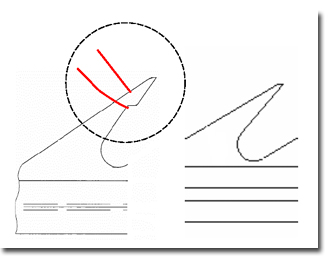
figure3
Figure 3: Sirolock® card wire (figure at the left) and conventional wire (figure at the
right)

Flexible processing of various fibers and blends

The first industrial results with SiroLock® in the non-woven industry have already shown very
positive improvements in both quality and productivity. This has also to do with the versatility of
the product: SiroLock® can be used to process a wide range of fibers and even special fibers and
blends like hollow fibers, siliconized fibers, aramid fibers (para- or meta-aramid), high
percentage of melt fibers and a broad range of fiber densities (dtex). One customer even uses
SiroLock® to card goat hairs in combination with 150 dtex uncrimped polypropylene. No other wire
was capable of handling coarse and uncrimped fibers, but SiroLock® managed the job perfectly.

SiroLock® in practice – crosslapping and direct way applications

• The benefits of SiroLock® in crosslapping applications – a few examples:

Sioen-Nordifa

Belgium

Application: technical needle felts, including filtration fabrics

Sioen-Nordifa is processing a wide range of fibers (polyester, viscose, acrylics, low melt
fibers…) and fiber densities (4 – 15 dtex). Sioen-Nordifa uses SiroLock® on workers and doffers
on a Thibeau Excelle card

Result:

•    Improved web regularity and web appearance

•    Even colors

•    Improved web tensile strength

•    Increased production of 20 to 40% (depending on fiber blends and final
product)

•    Elimination of dust formation in the card thanks to the improved fiber
control and reduced fiber recycling on the cylinder.

Domo

Belgium

Application: needled carpets

Domo uses Thibeau and Spinnbau cards to process 3.3 – 15 dtex fibers. SiroLock® is mounted on
the workers and doffers of the breaker and the finisher cards.

Result:

•    Increased production speeds of 20%

•    Less fibers load on the card ⇨ Less card cleaning⇨ Reduced downtime

Elco Solutions Pty Ltd

Australia

Application: Needle punching

Elco Solutions is a producer of geotextiles and geosynthetic products for a wide range of
applications like highways, railroads, coastal protection, waste containment, mining and sports
field applications. While looking for a way to upgrade both productivity and the quality of their
products, Elco Solutions decided to mount V20 SiroLock® wire on their doffers. These were their
findings:

“Soon after installing SiroLock® we noticed that our productivity rates went up
dramati¬cally. Furthermore the quality of our products exceeded all expectations. Calculations
showed that at this rate of production the investment pay back was just three months. The
performance of SiroLock® is exceptional and we will continue to use this technology.” – Mr. Brendan
Swifte, Chairman of Elco Solutions Pty Ltd

• The benefits of SiroLock® in direct way applications – a testimonial:

Textor Textile Technologies

Australia

Application: Spunlace production for wet wipes

“Initially we used the SiroLock® wire on the workers and over time this permitted a 30%
increase in capacity as well as an improvement in web picture. We have just installed a finer
version of the SiroLock® wire on a new card and the fiber pick up was so great that the stripper
wires now have to be upgraded. In our mill, we believe that SiroLock® will be a valuable tool to
increase productivity and web quality over the coming years. It is not a simple solution as there
is considerable card tuning necessary. It forces you to understand the science of carding. We are
producing web weights and qualities that are world class and at rates which increase each year.
Without SiroLock® we would not be in this position”. – Mr. Phillip Butler Director of Textor
Textile Technologies

About Bekaert

Bekaert (www.bekaert.com) is a global technological leader in its two
core competences: advanced metal transformation and advanced materials and coatings, and a market
leader in drawn wire products and applications. Bekaert (Euronext Brussels: BEKB) is a global
company with headquarters in Belgium, employing 23 000 people worldwide. Serving customers in 120
countries, Bekaert pursues sustainable profitable growth in all its activities and generates annual
combined sales of € 3.3 billion.

Bekaert: the reliable partner for your card wire needs

Bekaert reinforces its status of independent and recognized leader in the card clothing
business through partnerships with textile machine builders and customers world wide. Thanks to our
technical know-how, our in-house developed machinery, our careful wire rod selection and our
thorough understanding of the drawing, shaping, punching and heat treatment processes we can create
a card wire that meets your expectations.

Posted on August 3, 2010

©2010 NV Bekaert SA

Sponsors



