Lava USA Relocates To York, SC, Adds Jobs

Lava USA Inc. — the U.S. operation of Lava BVBA, a Belgium-based producer of knitted fabrics for
mattress covers — has invested more than $3.8 million to relocate its operations from Gastonia,
N.C., to a larger facility in York, S.C., with the expectation of adding 30 jobs over the next five
years. The company’s 100,000-square-foot textile production and warehouse facility is located in an
existing building. Operations already have begun, but Lava plans to acquire additional machinery
over the next few years. The company reports it plans to add at least 10 new positions this year,
with more becoming available as equipment is added.

“We are pleased to have our new plant up and running and look forward to adding more
production capacity over the next few years,” said Robert Jones, plant manager, Lava USA. “York
County had an excellent building available that suited our needs and provides us with ample space
to grow. South Carolina also has the positive business environment and strong workforce we need to
continue expanding our operations.”

“It is refreshing to see a globally-competitive manufacturing operation added to York
County’s rich textile history,” said Buddy Motz, York County council chairman. “We welcome the new
jobs and investment from Lava USA in western York County.”

September 14, 2010

Starlinger Celebrates 175 Years

Austria-based Starlinger & Co. GmbH — a manufacturer of machinery and complete lines for
producing woven plastic bags — is celebrating its 175th anniversary.


Starlinger began operating in 1835 under the name Franz Laubek and originally specialized in
stationary steam engines and drive elements. Franz Starlinger managed the company from the 1920s to
the 1940s, during which time it supplied winders and auxiliary machines such as lace and trimming
machines. In 1959, Erna and Franz Xaver Starlinger-Huemer assumed management responsibility.

Starlinger’s first export-oriented products were circular looms for weaving fabric from
plastic tapes. Subsequently, the company introduced tape extrusion lines in 1990, recycling lines
in 2000 and polyethylene terephthalate reprocessing lines in 2005.

The Starlinger Group was established after the company acquired companies from similar
sectors, including Austria-based MAPLAN in 1991; Austria-based SML in 1995; and Germany-based Georg
Sahm GmbH in 2002. Today Starlinger employs more than 920 people and has additional operations in
the United States, India, Russia, China and Brazil. Its annual turnover totals approximately 250
million euros.

“The year after the global financial and economic crisis is not only our anniversary year but
also the year with the highest turnover in the company’s 175 year long history,” said Angelika
Huemer, managing partner, Starlinger. “Our order books are full until well into the next year.
Already at the beginning of the fiscal year 2010/2011 we therefore introduced a second shift in the
factory in Austria and increased the product diversity for the Asian market in our factory in
Taicang, China.”

According to Huemer, the company will be debuting a range of new products this fall. “The
product life cycle of our machines and plants is often substantially longer than in comparable
branches,” she said. “Nevertheless, we will be able to introduce completely new or advanced
products in almost every field in autumn 2010. Also in this regard the year 2010 should become a
milestone in the company’s history.”

September 14, 2010

Newtex Receives Funding To Expand Production, Add Jobs

Victor, N.Y.-based Newtex Industries Inc. — a producer of heat- and fire-resistant (FR) textiles
for military, defense and homeland security; industrial heating and process equipment;
petrochemical and refinery; power generation; shipbuilding; and construction applications — has
received funding for a $720,000 equipment upgrade project in which the company will install new
coating and cutting machines to expand production of its new Z-Flex™ Aluminized textiles. The
investment is funded by a $350,000 loan from the Ontario County Economic Development Corp. (EDC); a
$200,000 loan from PathStone Rural Opportunities Inc.; and $110,000 from Empire State Development
Corp. Newtex is investing $60,000 in the project, and expects to add more than 10 jobs over the
next three years.

Newtex’s Z-Flex multilayered aluminized fabrics are used to make FR apparel and shields to
protect against exposure to hot works or radiant heat sources producing temperatures up to 3,000ºF.
The fabrics integrate the proprietary Z-Flex MLA™, or Multilayer Aluminization process, which
offers reflectivity of up to 95 percent of radiant heat, as well as good durability and flex-bond,
according to the company. Possible base fabrics include E-glass, aramids, oxidized
polyacrylonitrile/aramid blends, Lenzing FR® , Nomex® , polybenzimazole and others.

September 14, 2010

DRIFIRE® Unveils NAVAIR-approved Flight Suit

Columbus, Ga.-based Drifire Inc., manufacturer of DRIFIRE® Comfortable FR Wear™ for military and
commercial apparel applications and an Optimer Brands company, has introduced a two-piece flight
suit and combat shirt for the Naval Air Systems Command (NAVAIR), Patuxent River, Md. The garments,
designed by aircrew for their own use and approved by NAVAIR, are made with fabrics that provide
permanent no-melt, no-drip flame-resistance (FR) as well as Optimer’s drirelease® moisture
management with FreshGuard® antibacterial odor control; and are designed to provide enhanced
comfort and functionality, according to Drifire.

“As we tested our garments with end-users we identified some key issues,” said Rob Hines,
vice president of product development, Drifire. “First, heat stress is a top concern for military
aircrew. Second, even the smallest details, such as the design of a button, could have major
consequences if a pilot faces a flight emergency. Our new flight suits address these issues by
delivering the best moisture management in the market to minimize heat stress, as well as
incorporating design features that reduce issues such as snag hazards.”

According to Steven Scheyer, CEO, Optimer Brands, the new flight suit combined with other
pieces from Drifire’s existing product line provides a complete clothing system featuring maximized
comfort and safety. “Layering the flight suits with our short and long-sleeve shirts, boxer briefs
and long-johns, and combining them with our head protection gear, such as balaclavas and skull
caps, will ensure that warfighters will be protected while achieving maximum comfort,” he said.

September 14, 2010

Appleton Introduces Automatic Loading System

Neenah, Wis.-based Appleton Mfg. Division — a producer of core cutters, core handling and
finishing, roll and cart movers and other material handling solutions — has introduced an
automatic loading system that can be retrofitted onto an existing core cutting machine to enable
more cores to be cut in less time while also lowering labor costs. The basic solution features a
feeder system that stores parent cores and delivers them to the v-tray. From the v-tray, a loading
arm pushes the core into position to be cut, after which the core is reloaded onto the v-tray for
additional processing. According to Appleton, the automatic loading system’s modular design enables
it to accommodate a variety of parent core feeding systems, from low-volume, single-level delivery
table models to high-volume models that incorporate hoppers and elevator systems.

“The auto loading system components retrofit onto most pre-existing core cutting machines
making it a cost effective improvement during tough economic times,” said Mark Rasper, engineering
manager, Appleton. “Installation is straightforward so operators can experience increased
productivity in no time.”

September 14, 2010

Sustainable Manufacturing And Competitiveness In The Carpet Industry Highlighted By Department Of Commerce

DALTON, Ga. — September 9, 2010 — Deputy Assistant Secretary for Import Administration Ronald K.
Lorentzen today explained how implementing sustainable manufacturing best practices can improve
industry competitiveness and create a more stable environment for job growth during a Sustainable
American Regional Tour (SMART), in Dalton, Ga. More than 60 representatives from the domestic
carpet industry attended the event sponsored by the U.S. Department of Commerce’s Import
Administration (IA) and Shaw Industries Group, Inc.


“The U.S. carpet and floor covering industries are among the most progressive industries in
addressing environmental and sustainable manufacturing challenges,” Lorentzen said. “The
opportunities associated with these practices can be easily applied to most domestic manufacturing
sectors.”


Lorentzen and Kim Glas, IA’s deputy assistant secretary for textiles and apparel, highlighted
Commerce’s Sustainable Manufacturing Initiative and discussed the resources available from the
Federal government to address the issue of advancing competitiveness through sustainability.
Participants toured local manufacturing facilities and participated in round table discussions on
sustainable business practices.


Lorentzen and Glas joined Representative Tom Graves and Vance Bell, Chief Executive Officer
for Shaw Industries Group, Inc., for a round table discussion with industry representatives
discussing the leadership and competitiveness of the carpet industry.


“The carpet and flooring industries lead by example,” said Bell “Today’s presentations and
tours demonstrate the substantive positive impacts we are having with sustainable manufacturing.
This bodes well for the long-term success of the industry.”


According to the Carpet and Rug Institute, U.S. carpet mills have invested more than $400
million in new technology to improve sustainability.


For more information on the Sustainable Manufacturing Initiative and other regional tours,
please visit:
www.manufacturing.gov/sustainability.

Posted on September 14, 2010

Press Release Courtesy of the International Trade Administration

State Of The Industry Session Features Expert Panel At NETInc Opening Session

NORCROSS, Ga. — September 14, 2010 — Four industry experts will present a State of the Industry
panel discussion at the opening session of the Innovative Nonwovens Conference (NETInc) on
Wednesday, November 10, 2010, from 1 to 3 p.m. Moderated by TAPPI President and CEO Larry N.
Montague, the panel will include Pierre Wiertz, general manager of EDANA; Michael Jänecke, brand
manager of Techtextil; Rory Holmes, president of INDA; and Stephen Warner, CEO and president of
IFAI. The conference will take place in Raleigh, N.C. from November 10-12, 2010.

“Conference organizers have brought together industry experts and opinion leaders from the
leading technical textiles and nonwovens organizations to discuss the current markets and
applications, industry needs, and the future of the industries,” said Behnam Pourdeyhimi, Associate
Dean for Industry Research  Extension, William A. Klopman Distinguished Professor 
Executive Director of The Nonwovens Institute.  “These experts will also provide insight into
the research and emerging technologies ongoing in the academic and industry settings.”

About the Panelists

Pierre Wiertz is general manager of EDANA, the international association serving the
nonwovens and related industries (previously known as the European Disposables and Nonwovens
Association). Wiertz, who started at EDANA in Brussels, Belgium, in 1982, has held the position of
general manager since February 2004.  As head of the organization, he is responsible for the
association’s operations and has initiated a new business orientation for its activities and
membership benefits and has given impetus to the geographic expansion and leadership of the
association. Wiertz regularly speaks at European and international conferences on topics related to
nonwoven materials, hygiene and medical disposables.

Michael Jänecke, brand manager of Techtextil in Frankfurt, Germany, is a graduate in business
management and was trained in a production company. He has managed the export department of a
technical textile manufacturer and later held the position of department manager responsible for
order processing.  In October 1992 he became the director of the Techtextil Frankfurt fair at
Messe Frankfurt and since 1997 has been director of Techtextil worldwide. Since 2007 he has been
the brand manager of Techtextil. He is also responsible for Avantex (Innovative Apparel Textiles)
which since 2009 has been integrated in Techtextil in Frankfurt. Techtextil is the largest and most
successful trade fair for technical textiles and nonwovens throughout the world, representing the
entire value chain of the sector. Jänecke has helped to substantially develop the fair by
introducing and establishing a very successful new marketing system, with six locations worldwide
at present. In this function, he currently contributes to the EU-funded project Contex-T (Textile
Architecture). He has contributed to the EU-funded projects in the field of technical and
high-performance textiles, TensiNET (GROWTH Programme) and WEALTHY (Wearable Health Care System).

Rory A. Holmes is president of INDA, the Association of the Nonwoven Fabrics Industry,
located in Cary, N.C. INDA members represent the entire value chain of the Nonwovens Industry.
INDA’s main activities focus on conferences, expositions, training courses, industry statistics and
government outreach. Holmes pursued a 25-year career with Johnson & Johnson, where he had a
series of increasing responsibilities in operations, research, and sales and marketing. Holmes
received the Hoffmann Award for R&D and the Johnson Medal for development and commercialization
of the J line of Operating Room Gown  Drape fabrics. After leaving J in 1995, Holmes led the
sales and marketing efforts for Chicopee (Polymer Group Inc). At Chicopee/PGI, Holmes had direct
responsibility for the Medical, Industrial and APEX businesses. In 2002 after a successful
industrial career, he joined the Nonwovens Cooperative Research Center at NCSU as the Associate
Director for Technology Transfer.

Stephen M. Warner is chief executive officer (CEO) and president of the Industrial Fabrics
Association International (IFAI), based in Roseville, Minn. He has been active in the industry
since 1976 and became president of IFAI in 1986. Warner is also president of the Industrial Fabrics
Foundation, a non-profit organization dedicated to engage in research and education within the
industrial fabrics industry, and a member of the Investment Advisory Committee of the International
Geosynthetics Society (IGS).  He formerly served on the IGS Council of Management, the
University of Minnesota’s Advisory Board of the Department of Design, Housing and Apparel, and the
ISO working group on textile flammability.

About the Moderator

Larry N. Montague joined TAPPI, headquartered in Norcross, Ga., as President and CEO in 2006.
Before joining TAPPI, he spent nearly a decade with The Newark Group, an integrated global producer
of 100 percent recycled paperboard and paperboard products with manufacturing and marketing
operations in North America and Europe. Montague served as vice president, sales and marketing,
responsible for $185 million in sales.  After earning his B.B.A. in Marketing from the
University of Memphis (formerly Memphis State University) in 1977, Montague became an account
supervisor for the Armour Dial Company. He joined the pulp and paper industry in 1980 as a market
specialist in the Timber and Wood Products Division of Boise Cascade Corp. and later served as
sales representative for the Corrugated Container Division. Montague then joined Republic Group
Inc., where he first served as sales representative for Republic Gypsum (where he was named 1989
Sales Representative of the Year) and later as general manager of Republic’s Corrugated Container
Division. In 1991 he was named vice president sales and marketing, as well as general manager of
Republic Recycling, a post he held through 1997. Montague also served as point person for
Republic’s Acquisition Team.

About NETInc

Sponsored by TAPPI’s NET (Nonwovens Engineers  Technologists) Division and the Nonwovens
Institute (NWI), the Innovative Nonwovens Conference (NETInc), will take place November 10-12,
2010, in Raleigh, N.C. USA. It is the only technical conference developed by engineers and
technologists to help integrate the innovation behind the science and how it impacts the
market.  For more information and registration forms, visit
www.netincevent.org

Posted on September 14, 2010

Press Release Courtesy of NETInc

Teijin Again Selected For Dow Jones Sustainability World Index

TOKYO, Japan — September 14, 2010 — Teijin Limited announced today that it has been named,
following last year, to the Dow Jones Sustainability World Index (DJSI World), a global indicator
for Social Responsible Investment (SRI).

The new DJSI World list will be made effective on September 20, 2010. Of the 318 companies
selected this year, 36 are Japanese. Among the nine companies from the chemical sector, Teijin is
the only one from Japan.

The DJSI World, which was jointly developed by Dow Jones and Swiss-based SAM Group in 1999,
is the most important sustainability index and represents the top 10 percent of the largest 2,500
companies in each industry included in the Dow Jones Global Index. The index assesses the economic,
environmental and social performance of those companies every year to identify those that exemplify
leadership in sustainability.

Teijin has also been named to Dow Jones Sustainability Asia Pacific Index, also following
last year, and is being included in other international SRI indexes such as the FTSE4Good Index and
the Ethibel Sustainability Index.

Giichi Morita, CSRO (Chief Social Responsibility Officer) and Senior Executive Officer of
Teijin Limited said: “It is an honor to be named again to the Dow Jones Sustainability World Index.
The Teijin Group has a strong commitment to green products and the environment, and we will
continue efforts to evolve as an organization that meets high expectations for social and
environmental responsibility.”

About the Teijin Group

Based in Tokyo and Osaka, Japan, Teijin is a global technology-driven group operating in six
main fields: high-performance fibers (aramid fibers and carbon fibers); polyester fibers; films and
plastics; pharmaceuticals and home health care; trading and retail; and IT and new products. Teijin
Limited, the holding company for the Teijin Group, is listed on the Tokyo and Osaka stock
exchanges. The group had consolidated sales of USD 8.5 billion (JPY 765.8 billion, USD 1=JPY 90) in
fiscal 2009 and employs 18,778 people worldwide, with 156 companies around the world. Please visit
www.teijin.co.jp/english

Posted on September 14, 2010

Press Release Courtesy of Teijin Group

Frontier Spinning To Upgrade Mayodan Plant

Frontier Spinning Mills, Sanford, N.C., will invest $10.3 million to expand operations at its
Shakey Road plant in Mayodan, N.C., with the expectation of adding 27 jobs. The company plans to
invest in new machinery and building improvements by December 2010. The expansion is funded in part
by a $188,000 incentive package approved by Rockingham County.

“We are pleased to have this opportunity to grow our business and provide new jobs in a tough
economy,” said CEO John Bakane. “We are also encouraged by signs that more sourcing is being done
in this hemisphere.”

September/October 2010

Quality Fabric Of The Month: Conductive And Conformable

Technical yarn manufacturer EY Technologies, Fall River, Mass., over the past five years has been developing highly conductive, textile-grade microwire filaments for electrotextile applications. Working with the U.S. Army under a Small Business Innovation Research (SBIR) program, the company has reached Phase III of the program and is commercializing its iCON filaments to provide data and power transmission in wearable electronics, smart apparel and a broad range of technical textiles.

The filaments comprise a very fine metal alloy core and a polyester or nylon polymer insulating sheath that are coextruded using a patented process that differs from melt spinning to produce bicomponent filaments measuring from 25 to 100 microns in diameter. Dr. Rathnâ Perera, EY Technologies’ engineering director of new product development, said the most common alloy used in iCON contains silver and indium, and is designed to provide the highest possible conductivity and lowest possible melting temperature, all for a relatively low cost. Alternative alloys also can be used for specified purposes, including both low-temperature and high-temperature applications. The sheath is dyeable and washable, and the yarn can be processed on standard weaving or flat or circular knitting machinery.

QFOM1

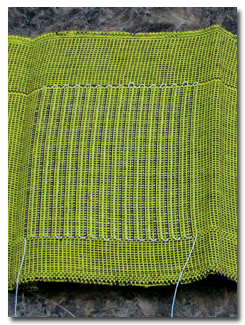
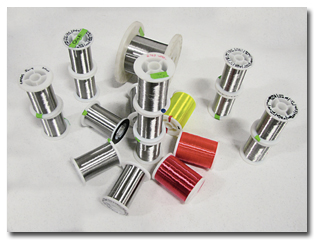
iCON microfilament, also shown below dyed and undyed on spools, is woven into a narrow fabric
that could be a flexible electronic component in a smart garment.  

As the filaments are very fine and flexible, their integration into apparel does not affect the garment’s comfort and drape, and their high conductivity and bandwidth provide improved electrical performance compared with conventional conductive yarns.

“This filament is designed for the textile industry,” Perera explained. “It is a flexible, textile-grade, conductive, insulated microfilament that does not reduce the conformability of the cloth. And, because of the nature of the polymer we are using, it is hidden in the fabric, so the wearer wouldn’t even know there is a wire there.”

iCON can be used as a single filament and, as such, it is strong enough to handle stress from standard textile and finishing equipment; but it more likely would be integrated into or run alongside a yarn.

QFOM2

“I picture this as one filament among others in a yarn that could be yarn-dyed or piece-dyed, and it would blend in nicely with the adjacent fibers,” said Gerald Mauretti, the company’s president, adding that it can be combined with textile fibers such as cotton, wool, nylon and
polyester.

The e-textile would be designed so that the conductive yarns connect with a power source and any electronic devices through a connection point on the fabric, and the devices could be disconnected to launder the textile. Perera said iCON has more than enough bandwidth to be used in data transfer applications, and because of its high conductivity, it uses minimal power, thereby enhancing battery life.


For more information about iCON technology, contact Dr. Rathnâ Perera 1-508-673-3307; rperera@eytech nologies.com.


September/October 2010

Sponsors