USIFI Challenges KORUS Trade Agreement

ROSEVILLE, Minn. — April 19, 2011 —  At a time when the U.S. is facing record unemployment, a
group of specialty fabrics manufacturers is engaging in everything short of a bake sale in
Washington, D.C. to draw attention to the latest fight for some of the last jobs still standing.

Their most recent free trade versus fair trade confrontation involves the Korea-U.S. Free
Trade Agreement (commonly known as KORUS) and the United States Industrial Fabrics Institute
(USIFI), a division of the Industrial Fabrics Association International, which represents nearly
2,000 member companies. USIFI is currently leading an educational campaign on the Hill to keep the
specialty fabrics industry’s U.S. factories open and save jobs which will be bartered away with the
terms of the KORUS agreement. Currently specialty fabrics represent a world market estimated at
$123 billion in 2010, $29 billion of that in the U.S.

Congressman Larry Kissell (NC-08), one of the specialty fabrics industry’s allies in
Washington, D.C., spoke with the USIFI group about putting a stop to KORUS. “No one feels the
effects of our nation’s trade policies more directly than American manufacturers, especially these
leaders of our textile industry,” said Kissell. “For far too long, bad trade deals and misguided
Washington policies have ravaged our economy, shipping jobs overseas and furthering our mounting
trade deficits.”

Specialty fabrics are a segment of the domestic textile manufacturing base that has not only
survived decades of bad trade policies and relentless import pressures but which now thrives. Also
known as industrial textiles or technical textiles, specialty fabrics keep first responders safe in
fire-resistant protection suits and anti-ballistic vests. The high-tech flexible materials also
protect the environment: They provide containment of toxic wastes, ensure quality drinking water
and prevent shoreline erosion. In addition, these multi-layered composite products are used in new
pavement technology to rebuild our nation’s vulnerable infrastructure, as well as in the
lightweight, ultra-strong fabrics deployed in life-saving airbags, and the shade provided in
playground structures that keep our children away from the harmful rays of the sun.

A group of 24 USIFI members met with Congressman Kissell and more than 45 other Congressional
offices on the Hill over several days to highlight the effects of U.S. trade policies on specialty
fabrics and on American manufacturing overall. These business and plant owners are doing the cold
call grunt work that is necessary to make the voice of the manufacturers (or “job providers”) heard
inside the Beltway. That voice is saying: “Stop signing free trade agreements that close our plants
and cause the loss of even more jobs.”

Kissell is unique in his keen understanding of what’s at stake: “No brand is better than Made
in the USA, and I will work to defeat any trade deal that offshores American jobs and hinders our
ability to better export our top-of-the-line goods. The Korea-U.S. Free Trade Agreement uses the
same flawed model of CAFTA and NAFTA, and simply isn’t right for the people of my district. I was
glad to hear directly from these industry leaders on what will best help them increase their
exports and create more American jobs.” 

Said Rich Lippert, a member of the group from Glen Raven Technical Fabrics, LLC: “Working
with USIFI to meet with the elected officials has helped our company convey the importance of
defeating the Free Trade Agreement. Ultimately KORUS is not ‘free’ and if passed as written, will
mean the loss of jobs, not the creation of jobs.”

The USIFI group’s secondary message to Congressional leaders concerned the erosion of parts
of the Berry Amendment. Work is being done to ensure that language will be inserted into the law
which defines components of military spec tents. This effort is similar to the 2006 Berry Amendment
change in which the military uniform industry succeeded in spelling out non-textile uniform
components, requiring that these components, too, be domestically sourced.

Several USIFI members had never come to Washington D.C. to advocate for issues, but most of
the group was familiar with the process. USIFI designated “rovers” (experienced Hill people) to
help the newcomers, and according to Ehmke Manufacturing CEO Bob Rosania, “USIFI’s Lobby Days gave
us the unique experience of interacting directly with the Members of Congress whose votes have a
direct impact on our industry and businesses.”

USIFI member companies also joined representatives from the American Manufacturing Trade
Action Coalition (AMTAC) for a meeting to discuss the pending legislation important to the textile
and manufacturing industries, including both groups’ opposition of the Korea-U.S. Free Trade
Agreement; as well as their support of H.R. 679, the Berry Amendment Extension Act, which Kissell
reintroduced in January. The bill would permanently require the Department of Homeland Security and
all of its agencies to purchase and procure textiles made entirely in America.

“We were happy to start the day off by meeting with Congressman Kissell, a champion of U.S.
manufacturing, especially on issues that impact the U.S. textile industry,” said Auggie Tantillo,
Executive Director of AMTAC. “He is leading the fight in Congress to stop these bad trade deals
from devastating our manufacturing sector, and understands the importance of protecting American
workers. This Korean Free Trade Agreement will further jeopardize jobs and harm American companies,
and we’ll continue to do all we can to stop this unfair deal.”

USIFI’s Executive Director Ruth Stephens stresses the important impact her group’s
face-to-face meetings have: “It continues to be apparent that USIFI is a strong voice for the
industrial fabrics industry in Washington and that more can be done to educate and update the
government about this market segment. USIFI encourages its member companies to meet regularly with
their congressional representation. Legislators are willing to listen and are very approachable.”

USIFI has also engaged in a petition-signing drive to alert legislators to the negative
impact of KORUS and Representatives Howard Coble and Larry Kissell have circulated a letter to
their colleagues in Congress.

Jean Lineberger, General Manager, Brawer Technical Yarns, explained why she was participating
in USIFI’s march up the Hill: “A genuine life lesson is that we should all always take a stand on
issues that are important to us. Being a part of Lobby Days was the best possible way to
proactively show support for our industry, U.S. manufacturing, and engaging in the political
process.”

Graniteville Specialty Fabrics President James Egan says that the specialty fabrics industry
has been a victim of Washington’s trade negotiations because of a lack of awareness and
understanding of what the American industrial fabrics and technical textiles companies manufacture.
“The specialty textile industry can compete with anyone provided we have a level playing field. It
is our responsibility as leaders of the industry to educate, communicate, and fight,” Egan said.

With luck Congress and the White House will get the message and read the fine print before
signing off on the KORUS trade agreement before more U.S. specialty fabrics industry jobs are
bartered away in yet another zero sum game in the name of free trade.

Posted on April 26, 2011

Source: Industrial Fabrics Association International/PRNewswire


Third ITMA ASIA + CITME Show Continues To Offer Leading Textile Machinery Makers A Cost-Effective International Platform In China

BEIJING — April 19, 2011 — The third edition of the combined ITMA ASIA + CITME show will be held
from 12 to 16 June 2012 at the Shanghai New International Expo Centre. It will continue to be the
unrivalled marketing platform for textile machinery manufacturers tapping into the vibrant China
market.

According to Global Industry Analysts, Inc. (GIA), the global market for textile machinery is
projected to reach US$20.75 billion by 2015. The Asia Pacific region is expected to dominate as the
single largest market, as local governments play a pivotal role in developing initiatives to boost
textile machinery trade and bolster sales and investments.

The Asian region is forecast to emerge by 2015 as one of the fastest growing markets, spurred
on by such initiatives. In China, for example, one of the priorities under the government’s 12th
Five-Year Plan period (2011-2015) is to raise the craftsmanship, techniques and equipment to reach
the international level for textile and other industry sectors.

Besides the development and application of high-technology fibres, energy-saving,
emission-reduction and environment-friendly technologies will also be the focus for China’s textile
industry in the coming years.

Mr Stephen Combes, President of CEMATEX which owns the ITMA and ITMA ASIA exhibitions, said,
“The opportunities presented by China’s huge market remain an attraction for machinery
manufacturers from around the world.

“Having held two successful presentations of the ITMA ASIA + CITME combined show in 2008 and
2010, we are confident that the upcoming exhibition will create enhanced and new marketing and
networking opportunities for both Chinese and international textile and textile machinery
manufacturers, especially those offering eco-friendly solutions.

“The successful track record of ITMA ASIA + CITME has helped garner huge support from major
players around the world, pointed out Mr Wang Shutian, President of China Textile Machinery
Association (CTMA).

He added, “The combined show has been highly recognised by leading textile and textile
machinery industry players as it offers them a cost-effective showcase for their products and
services in Asia. With the recovery of the world economy and the beginning of China’s 12th
Five-Year Plan, we are confident that the combined show will score another success.”

ITMA ASIA + CITME is owned by CEMATEX, CTMA and its two other Chinese partners — the
Sub-Council of Textile Industry, CCPIT (CCPIT-Tex) and China Exhibition Centre Group Corporation
(CIEC). JTMA (Japan Textile Machinery Association) is a special partner of the event.

The combined show has not only promoted textile machinery technology and machinery
effectively in Asia but, more importantly, it has strengthened cooperation between international
textile and textile machinery industries.

In addition, as a “one-stop shop” for the textile industry, the integration of the two shows
has reduced participation costs for exhibitors seeking opportunities in China’s booming textile
market.

Despite the global financial crisis, the last ITMA ASIA + CITME combined show in 2010
attracted 1,171 exhibiting companies. The exhibition covered 103,500 square metres, and the
five-day show received more than 82,000 professional visitors from 99 different countries and
regions.

ITMA ASIA + CITME 2012 is organised by Beijing Textile Machinery International Exhibition Co
Ltd and co-organised by MP International Pte Ltd.  Application for space is now open. The
deadline for registration is 15 October 2011. Those interested in exhibiting can obtain more
information from
www.itmaasia.com or
www.citme.com.cn.

Posted on April 26, 2011

Source: China Textile Machinery Association (CTMA)

April 2011

Miramar, Fla.-based
PrintLat LLC has named
Edgar Machado a member of the executive team, Latin America. 

Zepol Corp., Minneapolis, has appointed
Mark Segner vice president, sales.

Dr. Seshadri Ramkumar, manager of the Nonwoven and Advanced Materials Laboratory
and associate professor at The Institute of Environmental and Human Health, Texas Tech University,
Lubbock, Texas, has received the
Lubbock Chamber of Commerce‘s Innovation in Technology Award for his invention of
Fibertect® nonwoven decontamination wipe technology.


Visual 2000 International Inc.
, Montreal, has named
Tony Walker European sales director.

PTonyWalker 


Walker


Pratt Institute
, New York City, has presented the Fifth Annual Pratt and Goldsmith
Competition Awards to Pratt Institute fashion design students
Dana Hurwitz, who won $1,000 for her cocktail dress; and
Angel Ho, who won $500 for her fashion illustration.

Natick, Mass.-based
Cognex Corp. has promoted
Robert Willett to CEO.


Tarter Krinsky & Drogin LLP
, New York City, has named
Giuliano Iannaccone a partner.

Finland-based
Ahlstrom Corp. has appointed
Paul H. Stenson executive vice president, business development, and member of the
executive management team effective May 30, 2011.

The
U.S. Trade Representative (USTR) has named
Sharon Bomer assistant USTR for agricultural affairs and commodity policy,
effective May 2011.

England-based
Textiles Intelligence Ltd. has added
Shaheda Khanom and
Rachel Varughese to its editorial team.

Tefron Ltd., Israel, has appointed
Galit Wexler vice president, North America; and
Jeff Danzer and his team at BrandAxion to develop Tefron’s North American
marketing strategy.

The Changing Textile Scene


S
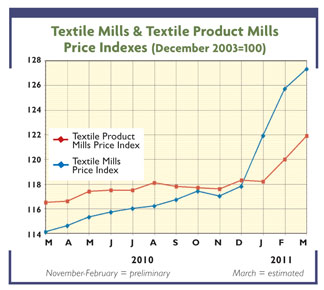
kyrocketing cotton — and to a lesser extent, polyester — tags are beginning to have a
significant impact on industry prices and profits. On the price score, for example, Uncle Sam’s
index for basic mill products like yarns and fabrics have moved up about 6 to 7 percent over the
last few reported months. And more advances in this key textile yardstick seem inevitable —
primarily because it takes considerable time for all the new price increases to percolate through
into this government index. As such, by mid-year, the increases here could well be near 10 percent
unless cotton costs take an unexpected tumble. Nor are basic mill products alone in posting big new
price increases. The picture is pretty much the same for both more highly fabricated mill products
and many apparel lines. Ditto, for textile imports, which are also running some 6 to 7 percent
ahead of a year ago. Other usually reliable sources are also pretty unanimous in confirming this
new across-the-board price surge. A spokesman for Cotton Incorporated is now on record, predicting
that price increases should eventually approach the 10-percent mark this year. And a projection by
the American Apparel and Footwear Association is only slightly lower — with mid- to
high-single-digit price increases anticipated for many items. And, last but not least, there are
the new numbers just released by Global Insight, a major U.S. economic consulting firm. Analysts
here see even heftier price increases — calling for 2011 textile and apparel tags to soar into the
double-digit range. Upshot: 2011 will be an unsettling year for industry prices — ending a period
of more than a decade of only fractional annual advances.

BFgraph


Profits Take A Hit


But, as big as 2011 projected price boosts are expected to be, competitive pressures will
prevent them from coming even close to offsetting spiraling fiber costs. As such, profit declines
now seem virtually inevitable. Global Insight, for one, feels the 2011 shrinkage could be quite
significant. Using its rough approximation of industry earnings — sales less material and labor
costs — the economic consulting firm now projects major bottom-line deterioration in all three
segments of the industry — basic mill products, more highly fabricated textile items and apparel.
Looking at basic textiles first, Global Insight analysts put the 2011 profit drop at more than 30
percent. That’s more than enough to erase last year’s solid gain. And the pattern is pretty much
the same for more highly fabricated mill products. This suggests that in both these sectors,
profits this year will fall to their lowest levels in more than a decade. On a somewhat less gloomy
note, the expected dip in apparel earnings will be in the somewhat lower 20-percent range — not
nearly enough to erase all of this past year’s big 50-plus-percent gain. Also on a bit more upbeat
note, virtually all mills and factories – despite the cost-price squeeze — will manage to stay in
the black. Another positive sign: Industry dollar shipments will continue to show advances this
year – thanks to all the new price increases now being superimposed on a relatively steady volume
of sales.


A Longer-term Bounceback


In short, the U.S. textile and apparel industries are going to survive this latest round of
problems. Indeed, by next year, things should begin to look a lot better. For one, the current
fiber cost runup isn’t going to last forever. Given expectations of a big 2011-12 marketing year
cotton crop, prices of the natural fiber are almost certain to fall back to more normal levels.
This, in turn, should result in gradually improving 2012 and 2013 bottom-line performance. In fact,
by the latter year, analysts at Global Insight see profits in all three textile/apparel categories
staging a strong recovery — with earnings at that time running near or even a bit above this past
year’s tolerably good, pre-cost-runup levels. A relatively bullish macroeconomic outlook should
also help this encouraging profit recovery along. Most economists, for example, now expect 3- to
3.5-percent annual growth over this extended period – enough to nudge overall U.S. consumer demand
for mill and clothing products above current levels. American firms will also be helped by some
slowdown in the rate of import gains. There are already signs, for example, that incoming shipments
from China are being hurt by that nation’s rising domestic inflation and a  slowly
appreciating yuan. The fact that foreign countries have already pretty much captured the United
States’ most vulnerable markets also suggests import deceleration. Together, these developments
point to a 2012-13 halving of last year’s near-19-percent import gain.

April 2011

Quality Fabric Of The Month: A Matter Of Balance

Switzerland-based Litrax AG, manufacturer of mechanically processed Litrax 1 (L1) bamboo fiber, also offers several man-made fibers and yarns that incorporate additives comprising pyrolized bamboo activated carbon particles and several minerals to provide specific performance
benefits.The additives include L2 for insulating/warming, L4 for ultraviolet (UV) protection, L5 for cooling, and L7 for heating and blood circulation enhancement. These additives can be incorporated into a range of man-made polymers including polyester, nylon, polypropylene and polyurethane, and the company can create customized masterbatches as well as fiber blends and yarns to combine various benefits. Litrax recently developed Dry-Balance® technology to combine L2 polyester and L5 nylon filament yarns to use in ultra-lightweight garments such as T-shirts and underwear worn by people involved in physically demanding work or other activities. The two-sided jersey fabric
weighs less than 100 grams per square meter (g/m2), and Litrax reports the L2 and L5 additives help balance the wearer’s body temperature, providing warming or cooling in relation to the degree of
activity; and wick moisture from the body to the outer side of the garment to keep the wearer dry. The L2 additive also provides UV protection. According to Litrax, in wear-testing by athletes and other individuals, the shirts have received very favorable performance assessments, and the company is continuing to conduct performance trials.

QFOMBlue

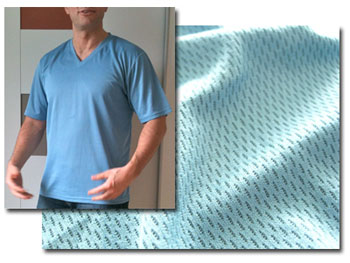
The originally launched Dry-Balance® fabric weighs less than 100 g/m2. The two-sided jersey
fabric features knitted structures that are fashion-related, while the L2 and L5 filaments provide
the temperature-balancing, moisture-wicking performance.

“I think our new Dry-Balance T-shirt will change the way people think about underwear,” said Felix Stutx, president, Litrax, describing it as being like a second skin and noting that the shirt is not just for athletes, but for people engaged in other physical, stressful activity as well,
“especially construction workers, medical personnel and such, to keep them completely dry during hard work — and not too cool, not too warm, but simply balanced.”

Pyrolized bamboo is the main ingredient in L2 and provides the insulating/warming function as well as the UV protection, Stutz said. L5 contains several minerals that contribute to the cooling function. Fiber geometry contributes to the moisture-wicking function and also is a factor in the cooling function. The shirt is constructed so that the L2 filament is placed next to the skin and the L5 filament is on the outer side, although Stutz noted that the shirt could be designed to be
reversible.

Stutz said France-based sports apparel and accessories retailer Decathlon is preparing to launch a Dry-Balance product and mentioned that Litrax is beginning to introduce the brand to targeted markets in the United States. He also noted that the technology has potential applications in woven apparel as well as knits, pointing out possibilities for outerwear and denim jeans.

QFOMwhite

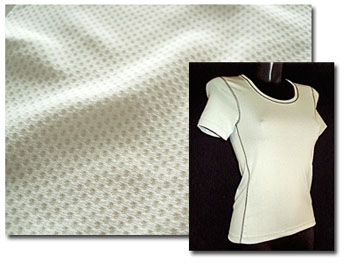
The shirt pictured here features a 130-g/m2 Dry-Balance fabric developed to meet a customer’s
specifications.

Dry-Balance fabrics can be dyed in a range of colors. However, as an activated carbon material, pyrolized bamboo imparts a grayish color to the L2 fiber or yarn, which normally would preclude its use for white fabrics, and Litrax has created an L2 XRB additive that can be
incorporated into fibers and textured yarns that could be fully white-dyed. “We embed the particles into another material that essentially creates a different refractive index,” Stutz said. “Basically, it’s an optical illusion — you don’t see the black anymore because it’s embedded with a neutralizer that changes the refractive index.” The company developed the XRB variant for a French retailer that wanted to be able to use L2 for white garments.

Stutz also mentioned that there is interest in using L2 fiber as part of a multi-component insulation for construction applications. “The product provides better insulation than glass fiber or stone wool, and the amount of L2 fibers used would be significantly less than the amount of
conventional insulation fibers,” he explained.


For more information about Dry-Balance and Litrax’s additive technologies, contact Felix Stutz +41-41-450-4944;
felix.stutz@litrax.com; or Jack Ganis +508-876-1070;
jack.ganis@litrax.comwww.litrax.com.


April 2011


April 2011

Camira Fabrics Ltd., United Kingdom, has introduced a line of sustainable fabrics
under the Second Nature™ label, including fabrics made from 100-percent wool, climate-neutral wool
and bast fibers.

London-based
Intertek Group Plc has launched the Textile Compliance Guide EU for iPad™
application, which may be downloaded free of charge at
http://bekm.intertek.com/mobile.

The International Working Group on Global Organic Textile Standard (GOTS-IWG),
Germany, has released Version 3.0 of its organic fiber processing standard. Companies wishing to be
GOTS-certified must fully comply with Version 3.0 by March 1, 2012. Information may be obtained at
www.global-standard.org.

The Wisconsin Entrepreneurs’ Network has selected
Aurizon Ultrasonics LLC, Kimberly, Wis., to participate in the Innovation 25 Pilot
Program, making it eligible to receive assistance in securing federal grants through the Small
Business Innovation Research program.

The Fairfax, Va.-based
Specialty Graphic Imaging Association (SGIA) has added to its website a Retail
Resources page — located at
www.sgia.org/retail/index.cfm. SGIA also has
launched an online Live Support service as part of its ASSIST member benefit program. Information
is available at
www.sgia.org, keyword ASSIST.

Ireland-based
Research and Markets Ltd. has published the 2011 U.S. Textile & Fabric
Finishing Mills Industry Report and the Sustainable Textiles Handbook.

United Kingdom-based
Textiles Intelligence Ltd. has released a report titled Trade and trade policy:
clothing imports, retail demand and trends in five key emerging markets.

Supercritical Fluid Technologies Inc. (SFT), Newark, Del., has debuted the
SFT-110XW Supercritical Fluid Extraction (SFE) processing system for performing extractions in
supercritical fluids and other materials. The 110XW SFE is suitable for research and process
development applications.

Wichita, Kan.-based
Invista‘s fiber processing plant in Monterrey, Mexico, has received Safe Company
Recognition from La Secretaria del Trabajo y Previsión Social. The recognition places Invista in
the “Re-validation Level 3 – Effective Management” category, the highest level issued by the
Mexican Labor Authority.

China-based Winner Medical Group Inc.’s wholly owned subsidiary,
Winner Industries (Shenzhen) Co. Ltd., has won a 2010 Circular Economy Project
Award for its patented 100-percent cotton spunlace nonwoven technology, which is used to produce
PurCotton® products.

Chicago-based
Cintas Corp. has won a 2011 UNIVATOR Award in the “Eco-Friendly Innovation”
category for its EcoGeneration by Cintas™ scrub collection. The company also has issued its 2011
Spring Fashion Trends Forecast for Hotels; and now offers 8 Commandments of Garment Care, a video
with quick tips and general best practices to help hoteliers extend the life of their apparel
programs.

BBCintas

Cintas Corp. recently won an award for its EcoGeneration by Cintas™ Scrubs

Montreal-based
Visual 2000 International Inc. has opened a European headquarters in Manchester,
England; and a satellite office in Shanghai focusing on software development and quality control.

New York City-based
CIT Trade Finance has released 2011 U.S. Factoring Overview as part of its
Executive Spotlight series. Written by Chief Sales Officer Jonathan Lucas, the publication offers
an overview of the U.S. factoring market and the role it plays in providing liquidity to small- and
mid-sized businesses.

Laconia, N.H.-based
Madeira USA has launched updated versions of its three websites:
www.madeirausa.com,
www.madeiramart.com and
www.ezeebacking.com. The company also has introduced
Madeira Mart Mobile, a mobile ecommerce web application that enables embroidery supplies to be
ordered via most smart phones.

Effective May 1, Los Angeles-based
Consolidated Laundry Machinery will relocate its headquarters to 211 Erie St.,
Ponoma, Calif., 91768-3378. Phone and fax numbers will remain the same.

Dalton, Ga.-based
Shaw Industries Group Inc.‘s Shaw Living division has debuted the Bob Timberlake
Area Rug Collection, inspired by realist painter and designer Bob Timberlake and featuring
machine-woven products made with Shaw’s EverTouch® nylon.

Berwyn, Pa.-based
Styron LLC will change its name to Trinseo effective late 2011.

Rolling Meadows, Ill.-based
Spartanics now offers translations of the 2011 edition of Spartanics Laser Die
Cutting Technical Guide in English, Chinese, French, Spanish and German. The translations may be
obtained by emailing
LaserCuttingGuide@spartanics.com.

BBSpartanics


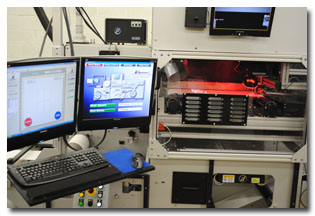
Spartanics manufactures laser die cutting machines and die cutting systems


Israel-based
OptiTex Ltd. has released Version 11 of its OptiTex signature software, which
includes improved 2D tools in Slash and Spread functionality, Walking capabilities, Variation
Grading, 3D algorithm and graphical user interface, a new network protection system, improvement in
its 3D capabilities, a new measurement chart, the ability to plot marker files from an OptiTex
Viewer option, and a choice of 25 languages.

New York City-based
Material ConneXion will open a facility in Istanbul, Turkey, in June 2011.
Material ConneXion Istanbul will offer the same global materials consultancy services as the
company’s other locations.

Texprocess 2011 Exhibitor Preview: WRAP

ARLINGTON, Va. — April 20, 2011 — WRAP announces to exhibit at Texprocess, a leading international
trade fair for the garment-manufacturing and textile-processing industry, in Frankfurt, Germany,
May 24-27, 2011. The international market leaders will present the latest machines, plant,
processes and services for the garment and textile processing industry at the event. 

WRAP will attend Texprocess as the world’s largest facility-based social and environmental
compliance certification and training program. The WRAP booth will be located in the Hall 6.0A at
the stand 66 in the Sourcing area. WRAP President and CEO Steve Jesseph, Compliance Certification
Manager Hong Mei, and Compliance Coordinator Anthony P. de Lima will represent the organization at
the exhibition. 

On May 26, WRAP President and CEO Steve Jesseph will also give a presentation titled
“Creating a Sustainable Supply Chain” at the Texprocess Forum. The Texprocess Forum will consist of
a series of presentations given by industry leaders with expertise in sourcing, sustainability and
social standards. As more and more buyers and consumers are interested in socially and
environmentally compliant products, it is necessary for manufacturers to understand the importance
of sustainable supply chain in the global context.

Posted on April 20, 2011

Source: WRAP

The Rupp Report: The Chinese Way To Economy And Ecology

For quite a long time, China has been accused of being one of the biggest polluters of the earth.
Even so, many Western countries haven’t cared enough about the environment. However, the situation
in China is critical; the country is still one of the top polluters in the world, and it ranks
first in the production of carbon emissions.

But attitudes have changed among the leaders in China. They’ve recognized that taking care of
the environment and the natural resources is first of all necessary for survival: The drinking
water supply is diminishing, the air is polluted, and energy costs are soaring.

The 12th Five-year Plan

Addressing the participants at the National People’s Congress last month in Beijing, China’s
President Hu Jintao mentioned the need to further strengthen the activities for a better
environment. Apart from other targets, Hu said, “China will make great efforts to participate in
global economic governance and regional cooperation.”

But even more important in this context was his comment related to the environment: “In the
next five years,” Hu said, “China will make great efforts to build a resource-conserving and
environment-friendly society. We will further implement the basic state policy of resource
conservation and environment protection, raise energy efficiency, cut the intensity of greenhouse
gas emissions, develop a circular economy, promote wider application of low-carbon technologies,
and actively respond to climate change. By doing so, we hope to balance economic and social
development with population, resources and the environment, and embark on a path of sustainable
development.”

Further to this statement, the Chinese government is committed to increasing green
technology. Premier Wen Jiabao stated openly in his annual address to the National People’s
Congress that China “will actively promote changes in the way energy is produced and used and raise
energy efficiency” by implementing the cleanest use of traditional energy sources but also by
developing clean energy.

Green Development

China’s five-year plan for economic and social development also calls for green development.
This is a clear sign that the country plans to be a world leader in this sector. A senior adviser
on climate and energy for the Natural Resources Defense Council in China said that the language of
the five-year plan is clear, requiring the Chinese people to improve their energy efficiency and
establish so-called “green development goals.”

Success for Andritz Perfojet

INDEX 2011, which took place April 12-15 at the Geneva Palexpo Exhibition & Congress
Centre in Switzerland, was organized under the slogan “Innovation and Sustainability.” In a few
words, one can say that the show was a success for visitors, but even more for the exhibitors. Many
exhibitors reported high numbers of highly qualified visitors. And among the visitors were people
from all over the world, including China.

The readers of the Rupp Report know that France-based Rieter Perfojet was acquired by the
Austrian holding company Andritz and is now named Andritz Perfojet S.a.s. And the close
collaboration with its sister company Andritz Küsters is starting to be successful: At INDEX, the
management from Andritz Perfojet announced sales of the largest spunlaced machinery ever built: a
660-centimeter-wide SPUNjet® system, sold to the BG Group from Shanghai for its BG Filter business.
For years, spunlace technology was used mainly for lightweight, 20-to-80-grams-per-square-meter
(g/m2) nonwovens. BG Group Board Chairman Liu Shuping told the Rupp Report that the main end
products to be manufactured are geotextiles, roofing substrates and filtration with a fabric weight
ranging from 200 to 300 g/m2.

This is no surprise. The BG Group is a large group of companies focusing on environmental
protection in general and on the research of solid, air and liquid separation in particular; but
also on air control and liquid filtration material including its production. The group has focused
on these targets now for more than 20 years, and its annual production totals more than 30 million
square meters, which makes it the largest manufacturer for filtration material and nonwovens in
China.

Combine Economy And Ecology

And what are the main reasons Liu gives for following this strategy? “We combine economy and
ecology for the benefit of the country and our company.” This is exactly in line with what China’s
President Hu Jintao said in his welcome address at the National People’s Congress: the need to
further strengthen activities to promote a better environment. What a good start for Andritz
Perfojet and the BG Group.

April 19, 2011

Huntsman Introduces TERASIL® FF Fluorescent Dyes

Singapore-based Huntsman Textile Effects has introduced the TERASIL® FF range of fluorescent
disperse dyes. Terasil Flavine 10GFF, Red GFF and Red 3BFF are designed to be used for personal
protective equipment and workwear, for which they fulfill EN 471 and ANSI/ISEA107-2010 safety
requirements; or to be combined with Terasil brilliant disperse dyes to achieve luminous fashion
shades for high-visibility sports and leisure wear, for which they meet the EN 1150 standard for
high visibility. Huntsman reports the Terasil FF dyes exhibit high lightfastness and washfastness
and are compatible with effects including stain- and moisture-management, flame-retardant,
antistatic, comfort with softness, and easy-care.

April 19, 2011

Ford Uses WellmanER’s EcoLon® For Cylinder Head Covers

Dearborn, Mich.-based Ford Motor Co. reports that during 2010, its use of EcoLon® material for
cylinder head covers in automobiles has kept more than 4.1 million pounds of carpet from being sent
to landfills and has reduced oil consumption by more than 430,000 gallons. EcoLon is a nylon resin
made from 100-percent post-consumer recycled carpet and manufactured by Wellman Engineering Resins
(WellmanER), Johnsonville, S.C.

WellmanER grinds used nylon carpeting into fiber and recaptures the material through a
patented, proprietary process to create EcoLon. Dana Holding Corp. — a Maumee, Ohio-based supplier
to global automotive, commercial, and off-highway vehicle customers — then molds it into cylinder
head covers using an injection-molding process. According to Ford, the cover, which is used in the
company’s Escape, Fusion, Mustang and F-150 vehicles, is the first automotive product of its kind
manufactured from post-consumer recycled nylon.

“We didn’t have to make compromises for this application,” said Roy Ford, Ford engine sealing
supervisor. “With a fixed raw material cost that delivers cost savings compared to oil, along with
the green benefit, this application adds to the ways Ford is minimizing our impact on the
environment.”

Ford recently has begun using more non-metal recycled and biobased materials in its vehicles,
including soy foam seat cushions, recycled resins for underbody systems, recycled yarns in seat
covers, recycled denim for sound-dampening material, and natural-fiber plastic for interior
components.

April 19, 2011

Sponsors