Eco-Friendly Absorbent Pads Provide Safer, Cleaner Workplace

STOKIE, Ill. — July 13, 2011 — Oil Eater Naturals is a new line of eco-friendly absorbent pads,
rolls and socks designed to provide a safer and cleaner workplace and help users meet OSHA and EPA
requirements.

Applications include plant and maintenance facility floors, loading docks, paint shop floors
and other areas. The  pad are made of natural plant by-products that feature woven
construction. Oil-Only Pads and Rolls soak up oil and repel water; Universal Pads and Rolls soak up
oil, water and other liquids; and Absorbent Socks control larger spills and protect drains. 

The pads will absorb up to 20% more than melt-blown polypropylene pads, yet cost less. All
are available in a variety of weights and finishes. Product sizes range from 16-inches x 18-inches
to 28-inches by 150-ft. rolls. Weights include light, medium and heavy. For information, visit
www.oileater.com or call 800-528-0334.

Posted on July 19, 2011

Source: Kafko International Ltd.

July 2011

George W. Shuster, Cranston Print Works, has been elected chairman of the
Boston-based
National Textile Association.

Karl Spilhaus, National Textile Association, has been elected chairman of the
Board of the
American Textile History Museum, Lowell, Mass.

Amsterdam-based
International Apparel Federation has named
Belinda Carp, Textiles Intelligence, to its Board of Directors.


Freudenberg Group
, Germany, has appointed
Leesa A. Smith, Freudenberg North America Limited Partnership (FNALP) to the
Global Executive Team; and
Dr. Mohsen Sohi to Speaker of the Management Board, effective July 2012.

Switzerland-based
Clariant International Ltd. has appointed
Dr. Hans-Joachim Müller a member of the Executive Committee.

Calhoun, Ga.-based
Mohawk Industries Inc. has named
Elise Demboski vice president, creative services.

demboski

Demboski

Wichita, Kan.-based
Invista has named
Maggie Niu end-use marketing manager, AP Cordura® brand; and
Paulo Pustiglione business manager, Invista’s Performance and Protective Fabrics
division, Brazil.

New York City-based
Pratt Institute‘s Fashion Design Department has named
Jennifer Minniti chair, effective Aug. 1, 2011.

France-based
Kermel S.a.s. has named
Jean Fournier managing director.

JeanFournier3

Fournier

The
Carpet America Recovery Effort (CARE), Dalton, Ga., has named
Anthony Cline operations manager.

Chattanooga, Tenn.-based
Propex Operating Co. LLC has named
Craig Martin vice president and business unit lead, Geotextile Systems.

The
Ecological and Toxicological Association of Dyes and Organic Pigments Manufacturers
(ETAD)
, Switzerland, has elected
Ravi Kapoor, Heubach Colour Pvt. Ltd, president; and the following officers of the
Board of Directors:
Dr. Clemens Grund, DyStar Colours Deutschland GmbH, vice president; and
Dr. Bernd Hochstein, BASF Schweiz AG, treasurer.
Peter Krummeck, Sun Chemical Pigments International;
Jürgen Schmiedl, Bezema AG;
Peter Scheibli, Huntsman (Switzerland) GmbH;
Dr. Akio Yoshida, Dainichiseika Color & Chemical Mfg.; and
Dr. Rüdiger Walz, Clariant International Ltd., have been elected members of the
Board.

Jamesburg, N.J.-based
Design Weave USA has appointed
Steve Hoffman vice president, new business development.

Carmel, Ind.-based
Top Value Fabrics has named
Lorna D’Alessio director, print media sales.

LornaDAlessio

D’Alessio

Israel-based
OptiTex Ltd. has appointed
Amnon Shalev vice president, sales and marketing, Europe.

The
Warrior Protection and Readiness Coalition (WPRC), Washington, D.C., has elected
the following officers to its Board of Directors:
David L. Costello, ADS Ventures, executive director;
Luke Hillier, ADS Inc., chairman;
Brent Finemore, Pelican Products, treasurer; and
David Bohannon, London Bridge Training Co., secretary.
Matthew Hemenez, SureFire LLC, and
Matt LeBretton, New Balance Athletic Shoe Co., have been named members of the
Board.

Beresford, S.D.-based
Sioux Corp. has promoted
Shelby Docken to customer service manager.

Erie, Pa.-based
Eriez Manufacturing Co. has promoted
Dave Heubel to director, North American sales.

Ottawa-based
TerraChoice Environmental Marketing Inc. has named
Libby Bernick vice president, consulting.

Bunting Magnetics Co., Newton, Kan., has named
Jana L. Davis CFO.

JanaDavis

Jana L. Davis


Quality Fabric Of The Month: Selective Filtration

Researchers at Ithaca, N.Y.-based Cornell University are using nanotechnology to develop fabrics incorporating metal-organic framework molecules (MOFs) that will selectively capture gases
such as chemical warfare agents and toxic industrial chemicals, providing a filtration system that can help protect military personnel, first responders and others at high risk for exposure to such
substances.MOFs — crystalline porous compounds that can be customized via nanolevel manipulation to trap specific gases — were developed in the late 1990s by Dr. Omar M. Yaghi, a professor in the Department of Chemistry & Biochemistry at the University of California, Los Angeles (UCLA). In 2008, with support from a grant funded by the U.S. Defense Threat Reduction Agency of the U.S. Department of Defense (DoD), Dr. Juan Hinestroza, associate professor of fiber science in the
Department of Fiber Science and Apparel, College of Human Ecology, and director of the Textiles Nanotechnology Laboratory at Cornell, initiated a collaboration with Yaghi’s research group at UCLA
to study how MOFs could be incorporated into polymeric nanofibers to trap noxious gases and break them down into less harmful substances and further decontaminate them. As part of the project, Fiber Science postdoctoral researcher Marcia Da Silva Pinto developed the first MOF fabrics in Hinestroza’s lab.

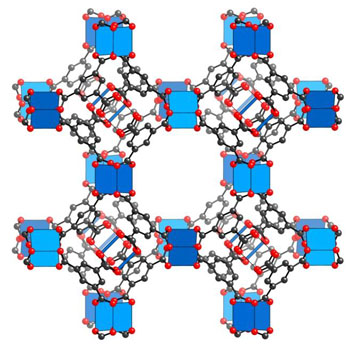
QFOMdiagram

Metal-organic framework molecules are crystalline porous compounds that can be customized via
nanolevel manipulation to trap specific gases. When incorporated into a fabric, they are covalently
bound onto the fiber, using the chemistry of the fiber surface as a support scaffold on which to
build the cages.

“DoD asked us to investigate and incorporate the MOF molecules onto a fiber because fibers are much easier to manufacture than other materials and can be deployed as filters and clothing,” Hinestroza said, noting that there were initial difficulties in anchoring the powder-like molecules onto the fiber. “Finally, working with UCLA, we were able to make the breakthrough using the fibers as scaffolds on which to build the MOF molecules. That breakthrough allowed us to grow all kinds of
MOFs to specifically target all kinds of gases. The beauty of these molecules is that you can control the size of the cage inside the molecule with angstrom precision (1 angstrom is 1/10 of a
nanometer), and the frameworks can be tuned to capture different gases. Now that we can anchor them onto a fiber, we can produce filtration media, respirators, clothing and many other fiber-based
items such as tents and uniforms. The MOFs we used are covalently bonded onto the fiber, and use the chemistry of the fiber surface as a supporting scaffold on which to build the molecular cages,” he added. Cornell has filed a patent disclosing the procedure in detail.

While at this time only a few specific MOFs are being incorporated into a particular fabric, Hinestroza said a method is under development to incorporate several different MOFs into a single fabric, which could be woven, knitted or nonwoven. “We are developing a method by which we put a mask on the fabric, coat the fabric with one MOF, then move the mask and coat with a second kind of MOF, and then mask again, and so on, with up to four different MOFs. So far we’ve done three. We
want to prove the concept first, and then it will be simply copy and paste, hence creating a fabric capable of capturing and decomposing several gases simultaneously,” he explained.

The research has been conducted using gases such as nitrogen, ammonia and methane, which are
relatively safe for experimental work, but behave similarly to more dangerous substances such as
mustard gas. The final work to determine the performance would be conducted by the military or the
organization that has possession of the toxic substances.

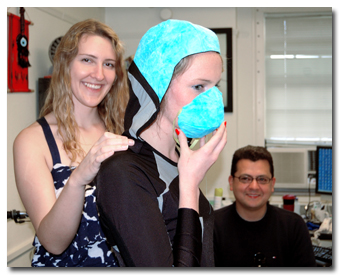
QFOMpic

Cornell student Allie Thiellens (center) models gas-trapping hood and mask designed by fiber
and apparel design major Jennifer Keane (left), while Fiber Science Associate Professor Dr. Juan
Hinestroza looks on.

The first fabrics to be developed were cotton, but polyamides and polyolefins have also been produced. “We work mostly with cellulose fibers because they have a lot of flexibility in terms of chemistry,” Hinestroza explained. “One student is also working with polyolefins, and we also can work with polyamide. After two years of trials, we have converted the surface of polyolefins and polyamides to something that would look like cellulose. We are using modified plasma technology to
modify only the top 5 nanometers of the fiber’s surface. We embedded the surface with chemical groups that would be amenable to the MOF scaffolding, while maintaining the mechanical stretch and reproducibility of polyolefin and polyamide manufacturing.”

Hinestroza noted that incorporating MOFs into a cotton fabric does not affect the natural characteristics of a fiber, except for the color. “It’s still 99.999-percent cotton and still feels, drapes and smells like cotton,” he said. However, the fabric does take on the color imparted
by the particular metal in the framework, as is seen in the photograph showing a turquoise gas-trapping hood and mask designed by Jennifer Keane, a Cornell fiber science and apparel design major who used a cotton MOF fabric colored by copper in the framework.

“We also have red and green colors produced by other metals. It all depends on the ion we use for the metal,” Hinestroza said, noting other possible metals including molybdenum, ruthenium, platinum, silver and gold. “Each has its own characteristic color. We can also do structural
coloration, using the colors of the different MOFs instead of dyes to create colors that do not fade as they are physical colors,” he added.


For more information about MOF fabrics and the research being conducted at Cornell, contact Dr. Juan Hinestroza +607-255-7600;
jh433@cornell.edu.


July 2011

FibeRio Wins R&D 100 Award For Cyclone™ L-1000, Launches Cyclone L-1000M/D

Edinburg, Texas-based FibeRio Technology Corp. — a company created to commercialize Forcespinning™
Technology, which uses centrifugal force to spin nanofibers, nanowires and nanorods — has won a
R&D 100 Award from R&D Magazine for its development and launch of the Cyclone™ L-1000
series of nanofiber production machinery. The annual R&D 100 Awards recognize the 100 most
technologically significant products introduced into the marketplace over the past year.

FibeRio introduced Cyclone L-1000 Forcespinning laboratory equipment in late 2010. The
technology produces nanofibers by using centrifugal force instead of electrostatic force, and is
the first technology capable of producing nanofibers via both solution and melt spinning processes.

“The pace and quality of development FibeRio has applied to Forcespinning technology and
Cyclone L-1000 nanofiber production systems is astonishing,” said Larry Thompson, chairman,
FibeRio’s Technical Advisory Board. “Nanofibers are one of the most cross-cutting technologies I
have seen and FibeRio has the core technology and capital equipment designs to provide the
versatile and cost-effective platform required to exploit their full potential.”

FibeRio recently launched the Cyclone L-1000M/D, which enables controlled and uniform
deposition of nanofibers onto a moving substrate; and will allow nonwovens, filtration and textile
companies to use the technology to design scalable nanofiber applications. The company reports it
will introduce commercial output nanofiber production equipment later this year.

“FibeRio is rapidly scaling up Forcespinning technology from the research laboratory to
industrial level production and the Cyclone L-1000M/D provides the perfect opportunity to begin
designing nanofiber enhanced media and developing the intellectual property that will provide
competitive advantage in the next era of innovation for the nonwovens, filtration and textiles
industries,” said Ellery Buchanan, CEO, FibeRio. “We are honored to be recognized by R&D
Magazine and we are committed to incorporating that same level of innovation and quality in our
industrial equipment.”

July 12, 2011

Precision Fabrics Introduces New Bedding Products

Greensboro, N.C.-based Precision Fabrics Group Inc. — a manufacturer of woven and nonwoven fabrics
for aerospace, military, medical, industrial and protective apparel, among other applications — has
introduced two new bedding products.

The company now offers allergen-barrier mattress and pillow encasements made using tightly
woven Pristine® fabric. The fabric has micro-pores that prevent penetration by dust particles, dust
mites and associated allergens but allow air and moisture vapor to pass through, thereby remaining
soft and breathable. The fabric is finished with an antimicrobial treatment, and retains its
protective properties even after frequent washing, Precision Fabrics reports. The mattress and
pillow encasements are especially suitable for students living in college dormitories.

Precision Fabrics also offers moisture-wicking Cool Sensations® sheets and pillowcases made
using DermaTherapy® therapeutic fabric containing state-of-the-art man-made-fiber yarn and treated
with an antimicrobial finish. The bedding is targeted to both men and women who experience
excessive nighttime perspiration.

Both Pristine and DermaTherapy fabrics have received Oeko-Tex® Standard 100 Class II product
certification from The International Oeko-Tex Association, Switzerland.

July 12, 2011

Teijin Fibers To Exhibit ELK Eco-Polyester Cushioning Material For Bra Cups At Interfiliere Paris 2011

TOKYO — July 5, 2011 — Teijin Fibers Limited, the core company of the Teijin Group’s polyester
fibers business, announced today that it will present its urethane-alternative environmentally
friendly high-performance polyester cushioning material for bra cups, called ELK, during
Interfiliere Paris 2011 from July 9 to 11.

ELK is lightweight, durable, cushiony, breathable and does not yellow easily, making it an
ideal cushioning material for bra cups. It also is environmentally friendly because it does not
generate cyanogen gas when incinerated. A growing number of innerwear international brands already
use ELK.

Visitors to the Teijin booth (stand B22) will be able to discuss customized solutions by
meeting with representatives from Teijin Fibers and its partners, including Aconic High-tech Fiber
(shenzen) Co., Ltd., a Chinese non-woven fabric maker; Yao I Fabric Co., Ltd., a Taiwanese molder;
and Toyota Tsusho Corporation, a major Japanese trading company.

Interfiliere Paris, which is held at Paris Expo Porte de Versailles in Paris, is the world’s
leading trade fair for lingerie and beachwear fabrics. Teijin Fibers will appear in the show for
the fifth time to further develop its international market for innerwear.

Posted on July 12, 2011

Source: Teijin Group

Solvay And Avantium To Jointly Develop Green Engineering Plastics

BRUSSELS and AMSTERDAM — July 7, 2011 — Solvay and Avantium announced today that they have entered
into a partnership to jointly develop a next generation of green high-performance polyamides for
engineering plastics. The partnership combines Solvay’s leading position in specialty polymers and
Avantium’s YXY technology for producing building blocks for green materials.

The companies will work together to explore the commercial potential of engineering plastics
on the basis of YXY building blocks. Through the partnership, new high-performance polyamides will
be developed that are produced using renewable, bio-based feedstock. Solvay and Avantium target a
next generation of polyamides with new properties that can serve a range of applications. Price and
performance of the polyamides will be key drivers for the success of the project.

The companies will make a range of compositions containing Avantium’s YXY building blocks.
Subsequently, Solvay Specialty Polymers will test these polyamides for engineering applications in
areas such as automotive and electronic materials. Solvay and Avantium have entered into a
multi-year, exclusive collaboration towards commercialization of the new polyamides. 

“We are very happy to be able to look at the potential of YXY building blocks in specialty
polyamides together with Avantium”, said Antoine Amory, in charge of renewable based chemistry
developments within the newly created Innovation Center of Solvay. “Avantium’s success in making
such building blocks available through a unique manufacturing route is an essential key step that
opens up new opportunities in the field of specialty polymers which we are impatient to explore.”

“We are excited about our collaboration with Solvay. The polyamides we will develop together
will become another novel and exciting outlet for our YXY building blocks,” said Tom van Aken, CEO
of Avantium. “Solvay’s expertise in the field of polyamides is very important to understand the
polyamides we will focus on and bring them closer to commercial applications. This agreement is
another important step to explore high-value added applications for our YXY building blocks, in
addition to work we are already doing in a complementary polyamide area.”

Solvay is a Group active in Chemistry since 1863, firmly committed to sustainable
development, and offering a broad range of products and solutions that contribute to improving
quality of life. It is a global leader in specialty polymers, vinyls, essential and specialty
chemicals. Avantium is a research and technology company that is unlocking a new generation of
biobased chemical building blocks, under the brand name YXY (~icksy).

Posted on July 12, 2011

Souce: Avantium

Zepol Corporation Enhances Trade Intelligence Product

MINNEAPOLIS — July 6, 2011 — Zepol Corporation, the leading trade intelligence company, today
announced another major enhancement to their product suite. Zepol’s improved Home Tab contains a
new look, more informational resources, and a Quick Search function. The Quick Search allows users
to access essential trade information even faster than before. The enhancement allows users to
search for a product or company from the Home Tab and directly download the results to PDF or
Excel.

“Zepol continuously strives to create and enhance the most efficient and innovative products
on the market, basing our improvements off customer requests,” stated Paul Rasmussen, CEO &
President of Zepol Corporation. “The Quick Search is yet another enhancement that significantly
improves efficiency for our users.” 

Zepol’s redesigned Home Tab helps customers stay up-to-date on the latest trade data uses and
allows subscribers to download results faster. The new functionality allows users to bypass the
TradeIQ interface to quickly search and download the last completed month of data.

Posted on July 12, 2011

Source: Zepol Corp.

Biomedical Structures Records Highest Growth Quarter Ever In Q2 2011

WARWICK, R.I. — June 12, 2011 — Biomedical Structures, LLC (BMS), a provider of biomedical textiles
for medical devices and other advanced clinical applications, today announced that it recently
completed the highest quarter of growth in company history.

Following its March 2011 acquisition of medical textile manufacturer Concordia Medical, BMS
has experienced a steady increase in demand for its textile development expertise for the next
generation of medical devices. Additionally, BMS has capitalized on its record-breaking capital
growth by further building out its textile processing capabilities for improved capacity to serve
its core and growing list of customers. These efforts, which include the doubling of knitting
capabilities, tripling of non-woven capacity, and quadrupling of weaving capacity for the
production of biomedical textiles, have enabled BMS to notch its highest investment quarter ever,
and are a continuation of the company’s planned path of growth initiated by a 2010 funding from
Ampersand Ventures.

With the addition of the former Concordia’s manufacturing and cleanroom facilities, BMS’
production has expanded in volume and scope, and will continue to widen to meet device OEM demands,
particularly in the development and application of felt scaffolds and other absorbable nonwoven
technologies designed for tissue engineering and regrowth applications in a variety of therapeutic
sectors. 

Biomedical Structures specializes in the advanced design and manufacturing of biomedical
textiles with expertise in knitting, braiding, weaving, and non-woven technology. The company
utilizes a growing variety of implantable-grade absorbable and non-absorbable biomaterials in
orthopedic, general surgery, tissue engineering, cardiovascular, bariatric, cosmetic surgery, and
veterinary applications, including implantable devices and drug delivery technologies.  

“2011 has been an exciting year for BMS,” said Biomedical Structures CEO and President John
Gray. “Our acquisition of Concordia Medical has enabled us to deliver at improved speed, volume,
and scope for our medical device customers, and this second quarter is a direct reflection of that
added ability. We are looking forward to continuing to build our scientific expertise by expanding
our engineering resources and bringing the unique and innovative properties of textiles to our
customers as they develop the next generation of medical devices.”

Posted on July 12, 2011

Source: Biomedical Structures LLC

TenCate And Pentair X-Flow Launch Drinking Water Management With Synthetic Turf Systems

ALMELO, The Netherlands — July 7, 2011 — On the occasion of the opening of the Open Innovation
Center for Advanced Materials (OICAM) in Nijverdal, the Netherlands, TenCate and Pentair X-Flow are
set to launch the first demonstrator project developed in open innovation, which is known as
GreenSource. In this project a synthetic turf system from TenCate has been combined with water
filtration technology from Pentair X-Flow). This combination will make it possible to use drinking
water and other water management worldwide for both sports complexes and landscaping with synthetic
turf, particularly in areas where water shortages prevail or where only polluted water is
available. 

At the opening of this Open Innovation Center for Advanced Materials, Mr L. de Vries,
President and CEO of Royal Ten Cate, pleads for the simultaneous establishment of an Advanced
Materials top-flight institution, which will enable the Province of Overijssel and the Netherlands
to further strengthen their national or international competitive position. 

The opening of OICAM represents an important step towards the creation of the right framework
conditions for practical innovations with advanced materials. A number of striking projects have
been initiated, such as GreenSource, the combination of synthetic turf and water treatment, as well
as Inkjet, nano-coating technology for textile substrates. On the basis of prevailing market demand
and the growing need of companies for cooperation, all these innovation projects should result in
specific new products and employment opportunities. 

GreenSource

There is an increasing demand from the international market for durable products, in
particular those that save water. The GreenSource project ensures this, by combining synthetic turf
systems for sports or landscaping with Pentair X-Flow technology for water treatment. The collected
and treated water can then be used both for spraying synthetic turf pitches for sports activities
and irrigating the terrain. Above all, the treated water can be used as drinking water for the
local population.

Inkjet

The Open Innovation Center for Advanced Materials will shortly start up projects
for demonstrators in the field of inkjet technology for trial production. It will harness
specifically the knowledge of the University of Twente and in particular the Academy of Life
Science, Engineering & Design of Saxion University in the Netherlands. The latter institution
cooperates closely with OICAM. As a result of the recent procurement by Saxion University of a
compact inkjet machine from Xennia Technology, professors and students in the field of open
innovation are now able to gain essential experience of the groundbreaking technology for the
nano-coating of various fluids on advanced materials, including smart textiles.


Posted on July 12, 2011

Source: Royal Ten Cate

Sponsors