TAAT Presses For TPP Textile Rules That Support Private Industry, Jobs, Exports

The Textile and Apparel Alliance for TPP (TAAT), a coalition of fiber, textile and apparel
organizations representing 30 countries in the Americas and Africa, has written a letter to United
States Trade Representative (USTR) Ron Kirk urging inclusion in the Trans-Pacific Partnership (TPP)
agreement of textile rules that support manufacturing jobs, private industry and exports from
free-market economies.

TAAT members include the American Fiber Manufacturers Association, American Manufacturing
Trade Action Coalition, National Cotton Council, National Council of Textile Organizations (NCTO),
National Textile Association and United States Industrial Fabrics Institute; as well as
associations from Mexico, Colombia, Ecuador, Peru, the Central America-Dominican Republic Free
Trade Agreement region, and 19 countries in the Africa and Middle East area. The alliance reports
exports from its members to the United States have grown by $2.7 billion over the past three years,
while U.S. exports to alliance members have grown by $2.9 billion over the same period.

In its letter to Kirk, the alliance notes that its textile and apparel supply chain, which
employs almost two million manufacturing workers and farmers, is threatened by TPP partner country
Vietnam’s request “for country-of-origin rules for textiles that would uniquely benefit Vietnam and
which are far weaker than the long standing origin rules in existing U.S. free trade agreements
(FTAs) and preference arrangements. These rules would provide Vietnam’s state-owned apparel
manufacturers with direct access to China’s massive state-run textile enterprises to create apparel
and other products that would then be duty-free into all other TPP countries.”

The letter continues: “We urge you to continue to press for textile rules that will grow
manufacturing jobs in the United States and in our countries. In particular, we support a yarn
forward rule coupled with strong customs enforcement rules and resources which will ensure that
third parties, such as China, do not take advantage of a final agreement. In addition, we feel it
is essential that the agreement include realistic market access rules and other mechanisms to help
counter-balance the government of Vietnam’s historic support for its textile and apparel sector.”

NCTO President Cass Johnson said the alliance’s makeup and position on the TPP textile rules
“demonstrate how important it is to get these negotiations right, both for us and for our trading
partners. These negotiations are our first priority, and it’s a high priority as well for other
groups that are not associated with the TPP. They will also be affected by it, and it is important
for the administration to realize this and to listen to all who will be affected when deciding what
the final rules will be.”

It is hoped the TPP agreement will be finalized this year. Kirk has reaffirmed the need for
strong textile rules in the TPP, Johnson noted.

March/April 2012
Picanol Reports Orders For OptiMax, Omniplus Summum

Picanol Group, Belgium, reports it has received a number of contracts to supply its OptiMax
flexible rapier weaving machine with positive grippers and its Omniplus Summum air-jet weaving
machine.

The company signed several contracts during ITMA 2011 in Barcelona, Spain, for
540-centimeter-wide OptiMax machines to be used to produce coating fabrics, conveyor belts and
carpet backing, and reported further subsequent success for the machine in both wide and narrower
widths. Picanol reports that the positive gripper OptiMax can accommodate stiff and bulky technical
yarns at maximum speeds without problems.

The Omniplus Summum features state-of-the-art electronics and a new insertion system that
offers complete electronic pressure regulation and a triple air tank to supply air to the relay
nozzles.

March/April 2012

Datacolor Unveils Ahiba® QuickDose

Datacolor Inc., Lawrenceville, N.J., now offers the Ahiba® QuickDose system for adding liquids and
powders to the dyebath in the Ahiba Infrared lab dyeing machine. The system — typically used in
exhaust dyeing processes that use reactive and acid dyes — features three separate color-coded
dosing capsules and enables all beakers to be actuated in less than one minute using either liquids
or powders. The company reports the 316L stainless-steel, easy-to-clean system provides greater
efficiency and safety compared with manual dosing systems, greater precision compared with
injection/syringe or powder dosing systems, and reduced maintenance costs and processing time.

March/April 2012

Sawgrass Technologies Debuts M-XTR™ Pigment Inks

The Industrial Division of Sawgrass Technologies Inc., Charleston, S.C., has introduced M-XTR™
pigment-based inks formulated specifically for high-speed digital textile printing systems.

The inks feature the company’s patented Rheological Modified Ink (RMI™) Technology — a
cylindrical jetting characteristic that creates a more consistent ink drop shape, thereby producing
sharper images with greater color accuracy than prior technologies. Sawgrass reports the technology
uses up to 40-percent less glycols than other ink products on the market, enabling higher pigment
concentrations for richer, higher-density colors and faster drying times.

M-XTR’s binderless formula generates good color vibrancy, good runability and maximum uptime,
even with uncoated fabrics, according to Sawgrass. The company notes, however, that the inks work
best with matched-component fabrics and M-coatings. The inks also eliminate the need for costly
steam and wash steps; pass American Association of Textile Chemists and Colorists (AATCC) crock and
wash tests; and provide three-year outdoor durability based on AATCC/International Organization for
Standardization tests.

March/April 2012

Thrace-LINQ Adds Markets For Needlepunch Products

Thrace-LINQ Inc., a Summerville, S.C.-based woven and nonwoven geosynthetics products manufacturer,
now offers its needlepunched nonwovens for several new applications including absorbent products,
automotive, bedding, building materials, furniture and industrial.

According to Thrace-LINQ, there is growing interest in needlepunched nonwovens owing to
their strength, durability and application flexibility. The company further notes that its
needlepunch production capabilities enable it to offer product efficiently in both large and small
quantities, and that it is able to process a range of fibers including polyester, polyethylene,
polypropylene, and polymer and color blends.

“Thrace-LINQ has always been known for technical expertise, quality and service,” said Brian
Sparks, the company’s market development manager, industrial and specialty products. “Our ongoing
product expansions are evidence of our commitment to using our technical capabilities and strong
industry relationships to better meet the needs of previously untapped and underserved markets.”

March/April 2012

TenCate Grass To Offer HR Technology On XP Blade™

TenCate Grass North America, Dayton, Tenn. — the U.S. operation of the Netherlands-based Royal Ten
Cate NV’s TenCate Grass division — now will provide Heat Reflective (HR) technology as a standard
feature on all TenCate XP Blade™ produced for the U.S. market. The company reports the decision was
prompted by increased demand for temperature-reducing synthetic turf products for sports,
recreation and landscape applications.

Warm, sunny weather can cause temperatures to rise on synthetic turf surfaces. TenCate
Grass’s HR technology reduces the amount of heat that XP Blade turf blades absorb, and in
laboratory tests, has been shown to lower temperatures by 17.5°F, according to the company.

Introduced in 2004, TenCate XP Blade is a polyethylene tape manufactured using TenCate’s
proprietary extrusion process that improves wear resistance and prevents splitting. When played on,
it twists rather than lying flat, retaining evenness and natural ball roll. TenCate reports it also
offers improved tuft bind; holds infill in place better than monofilament yarns; and lasts longer
than other tapes or monofilament yarns. The tape has been installed on more than 3,500 synthetic
turf projects globally, and every field is still in use, TenCate notes. The company offers a new XP
Blade 5-Year Durability Warranty for an additional cost.

March/April 2012

Quality Fabric Of The Month: Merino Wool: Performance For All Seasons

Wool is increasingly being touted as a performance fiber, and, indeed, it performs quite well as an inherently thermal-regulating, moisture-wicking, antimicrobial, insulating, water-repellent, breathable, comfortable, durable, biodegradable material. Soft, fine-micron Merino wool is used not only in fashion and corporate apparel, but also in sports and outdoor apparel, and for all seasons. Australia- and New Zealand-based Charles Parsons’ Merino State brand offers Merino and Merino-blend fabrics for all of these uses. Its newest performance and eco Merino fabrics recently were launched to the U.S. market at the 2012 Outdoor Retailer Winter Market in Salt Lake City.

QFOM

Merino State’s Bi-component Performance fabrics for extreme activities offer Merino wool’s
natural moisture management combined with an engineered fiber’s enhanced wicking properties.

“Wool is always important, but there definitely seems to be a trend throughout the market to look at wool and wool-blend materials, particularly in the performance arena,” said David Parkes, president, Concept III Textiles International, Red Bank, N.J., which represents Merino State in the United States and Canada. “With the economic changes over the last three to four years, people are shopping with far more discernment, and they recognize that wool does perform. You may pay more for it, but it’s an item that’s not going out of fashion, and can be in your wardrobe for several seasons and perform well and look good.”

Parkes added that because finer-micron Merino is being produced today, much nicer products are being offered. “It looks and feels differently than the Merino of 10 years ago,” he said.

Merino State’s new collection features several blends that combine wool’s performance attributes with those of other fibers, and also includes both plated and laminated fabrics. Generally, the wool is worn next to the skin, and the different fabrics, which can be engineered to
customer specifications, are targeted to a range of end-uses.

Softshell Merino for outerwear and extreme weather applications is a Merino fleece bonded to a membrane or technical outer fabric. A blend with Tencel®, targeted to women’s fashion athletic markets, offers enhanced hand and performance. BIOPHYLL™, a blend of Merino with corn sucrose-based Bio-PDO™, is soft, resilient and easy-care. Printed Merino may be either screen-printed 100-percent Merino or sublimation-printed plated Merino/polyester fabric. Bi-component Performance blends combine Merino to remove moisture vapor before it condenses and man-made fiber to wick away excess moisture caused by extreme exertion. There also are blends with PrimaLoft® man-made insulating fiber for enhanced thermal properties; and Thermo°Cool™ hybrid thermoregulating, moisture-managing fibers.


For more information about Merino State performance and eco Merino fabrics, contact David Parkes +732-530-1976 Ext. 228;
dparkes@conceptiii.comconceptiii.com


March/April 2012

CAFTA Sourcing Show Showcases Sourcing Opportunities

GUATEMALA CITY — March 19, 2012 — The Apparel Sourcing Show (APSS) returns to Guatemala City this
year with a special focus on how the CAFTA region can help apparel executives find sourcing
opportunities. Now in its twenty-first year, APSS is scheduled for May 22-24, 2012 at the Grand
Tikal Futura Hotel & Convention Center. The annual Apparel Sourcing Show is hosted by the
Guatemalan Textile and Apparel Industry Commission (VESTEX).

Last year’s Apparel Sourcing Show attracted more than 4,500 participants from 14 different
countries.

APSS is the ONLY sourcing show in the CAFTA-DR region to bring together the full range of
CAFTA suppliers all in one place. In 2012, APSS will include shoes and accessories for the first
time. The show is arranged to guide you through the CAFTA supply chain, including:

  • Textile mills
  • Full package services
  • Machinery
  • Services and trimmings
  • Footwear and accessories

This year’s show focuses on how CAFTA-DR can provide an integrated platform for sourcing
textiles, apparel, footwear, and accessories. The global economy may remain unpredictable for some
time, but Central American countries offer stable, duty-free access to the U.S. market. As we see
the economic recovery continue to keep the apparel industry guessing, new customers are taking
advantage of the CAFTA region’s close proximity to the U.S. market, while former customers hit by
the downturn are returning to the booming region. The CAFTA industry’s reputation for flexibility
in volume and designs offers the ideal solution for today’s market demands.

APSS also will feature panels of experts discussing the issues that affect apparel sourcing
in 2012 and into the future. Planned workshops will cover technical advances, new trends, labor and
regulatory compliance, market and commercial developments, as well as evolving trade policy.

The 2012 Apparel Sourcing Show, “CAFTA-DR: Thriving on Global Changes”

Additional information is available at the Apparel Sourcing Show website:
http://www.apparelexpo.com.

Endorsed by the United States Association of Importers of Textiles & Apparel (USA-ITA)


Posted on March 20, 2012

Source: VESTEX

A Brightening Outlook

There’s increasing evidence that 2012 may turn out to be better than first anticipated. Family debt
is down significantly from peaks of three years ago, in dollar terms and as a percentage of gross
domestic product (GDP). This is an important change, as a more manageable debt level gives
households more to spend on apparel, home furnishings and other goods. Higher weekly pay, up 2.5
percent over the past year, should also help bolster family purchases in coming months. And
relatively weak inflationary pressures aren’t enough to force consumer buying pullback or prevent
the Fed from pursuing its low-interest note strategy.

Still another economic fillip comes from extensions of last year’s payroll tax holiday,
which gives the average family about $1,000 a year, and more assistance to the long-term
unemployed. The fact that the nation’s biggest banks have agreed to provide relief to nearly two
million current and former homeowners hurt by the housing fiasco should also help.

It now appears that 2012 GDP gains should top the earlier projected 2-percent rate. A new
Wall Street Journal poll of 49 leading economists calls for a 2.5-percent advance, and some
respondents put the increase at close to 3 percent. And, these same people think the economy is
more likely to beat expectations than fall short. These projections also suggest that two million
jobs will be added to the economy over the year. That should be enough to drop the jobless rate to
under 8 percent by December — and to 7 to 7.5 percent by late 2013.

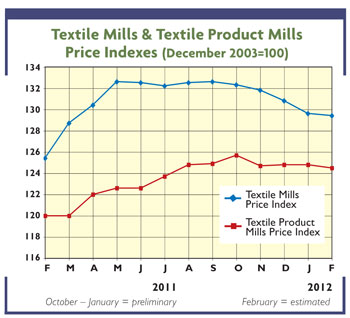
BFgraph


The Changing Import Picture


The flattening out of textile and apparel shipments from abroad also has to be regarded as a
major plus for U.S. producers. Final figures for 2011 show U.S. imports of these products down more
than 3 percent from a year ago in real or square-meters-equivalent terms. Moreover, the falloff
seems to be intensifying, with November/December off by 7.5 percent. Much of the decline can be
traced back to China, where bargains are becoming a lot harder to come by. Part of this is due to a
rising Chinese yuan, up 40 percent on an inflation-adjusted basis since 2009. And most financial
analysts see some additional creep-up this year, though it’s likely to be in the 2- to 4-percent
range. Nor are exchange rate shifts the only factor behind the recent import slowdown. Domestic
buyers have faced some serious supply chain problems in recent years. This was certainly true
during the recent business downturn, when demand tumbled, leaving some U.S. firms with heavy
inventories on slow boats from the Far East. Equally disturbing are global delivery interruptions
stemming from such natural disasters as last year’s tsunami in Japan and flooding in Thailand. To
be sure, all of the problems noted above are not going to bring back the United States’ old share
of global textile and apparel markets, but they do suggest that import penetration of these
products has pretty much run its course.


More Government Assistance


New Washington developments also should further improve the United States’ overall import
situation. In large part, they’re prompted by election year pressures, as both parties try to avoid
being painted as weak on China. The Obama administration, for example, has announced plans to
create a task force to monitor Beijing for possible trade and other commercial violations.

Also encouraging is a White House “insourcing” plan to bring jobs back to America. Steps
being contemplated include: cutting taxes for firms producing goods in the United States; taking
away tax breaks from businesses that move jobs offshore; providing a tax deduction for makers of
high-tech goods; expanding worker training programs; and closing loopholes that allow firms to
shift profits abroad. Actually, these proposals aren’t too different from policies pursued by many
U.S. competitors. Countries like Germany, Japan and China already offer large tax breaks and
financial support to their domestic industries. Also, even without any new U.S. moves, there are
indications of an improving trade climate. A recent survey by MFG.com, a site connecting
manufactures with suppliers, finds one in five firms are already bringing production back from a
low-cost country — up from one in 10 two years ago. And if some reports are true, this trend is
even spilling over into the textile/apparel sector. In short, the U.S. trade situation isn’t nearly
as bleak as it was a year or two ago.

March/April 2012

March Orders Up; Uncertainty Remains

With the yarn market in the United States — and around the world — in a general state of upheaval,
yarn spinners and brokers are uncertain about what the short-term future holds.

“We got off to a soft start for the year,” said one spinner. “I don’t know that anyone had
really high expectations for January, but I expected things to pick up in February. I really
expected February to be better than it was, but activity didn’t really kick in until the fourth
week of the month. But both orders and inquiries picked up significantly the last week of February
and the first week of March.”

Another spinner said: “Our order pipeline is not very long right now. We have numerous
inquiries from customers, but not a lot of sales activity. We had a spike earlier in the year that
gave us some hope that we would start 2012 off stronger than we expected, but that didn’t last very
long. February was very slow. However, we have noticed both inquiries and orders picking up over
the last week or two and are hopeful that business will improve over the next couple of months.”

Added a prominent yarn broker: “Ring-spun business for me is picking up again, and my
specialty business is good. Commodity open-end (OE) business is okay. In talking to my suppliers,
they tell me they are running pretty good, but that their order backlog is not very long. Many OE
spinners seem to still have some inventory, because they are aggressively quoting prices. I am
seeing the differential between cotton and OE yarn return closer to what is was pre-2010.”


Yarn Market Is Increasingly Global


Overall, however, spinners say they have less feel this year than in the past for how
business conditions are likely to play out. As one observer noted: “It’s hard for spinners to
figure out how to run their companies over the next six months when they have the visibility of
about 30 days. It is a lot more difficult now than it used to be. The yarn market is now truly a
global business, and spinners in the United States now have less control over their destiny than at
any time in the past.”

He added: “When you talk about yarn manufacturers with the capability to dominate the
market, you used to consider only a handful of U.S. companies. Now you are talking about Pakistan,
India, Korea, Egypt and other countries. Companies in those countries have different drivers than
what we are used to. In the United States, we used to know who and where our customers were, and we
knew the direction cotton prices were going. We knew if cotton was X, we could get Y for the yarn.
No longer does that have a lot to do with it. The global yarn market is driven by political
factors, the cost of fuel, the cost of freight and just a whole range of factors that used to not
come into play or, at least, not contribute significantly.”

For example, he said, if India is exporting yarn to Europe and demand suddenly decreases,
the yarn previously earmarked for Europe can be sold in the United States at reduced prices. “In
reality, it doesn’t even have to be sold here. Just the threat of it is enough to keep U.S. prices
in check.”

Evidence of this can be found in the export strategy of India in 2011. Early in the year,
when global cotton prices were at their peak and cotton was in short supply, India did not export
any yarn. Then, when it became apparent that the cotton supply crisis was over, India began
aggressively exporting cotton yarns to the United States. “The problem though, was that Indian
companies had lost their customer chain and the only way to get that back was to drop prices. They
began selling yarn for $2.00 when the price of raw cotton was $2.00. It was a huge disruption in
the market. There really wasn’t any way to compete with that,” this observer said.


Inventory Control Is Critical


With the increasingly global nature of the yarn business, the prevailing wisdom for yarn
spinners is to maintain tight inventory control, said one observer. “Sometimes it might be better
to stand down for a week than to flood the market in times of weak demand and drive prices down
even further. That’s a lesson I’m not sure we in the United States have learned very well.”

March/April 2012

Sponsors