CAFTA Sourcing Show Showcases Sourcing Opportunities

GUATEMALA CITY — March 19, 2012 — The Apparel Sourcing Show (APSS) returns to Guatemala City this
year with a special focus on how the CAFTA region can help apparel executives find sourcing
opportunities. Now in its twenty-first year, APSS is scheduled for May 22-24, 2012 at the Grand
Tikal Futura Hotel & Convention Center. The annual Apparel Sourcing Show is hosted by the
Guatemalan Textile and Apparel Industry Commission (VESTEX).

Last year’s Apparel Sourcing Show attracted more than 4,500 participants from 14 different
countries.

APSS is the ONLY sourcing show in the CAFTA-DR region to bring together the full range of
CAFTA suppliers all in one place. In 2012, APSS will include shoes and accessories for the first
time. The show is arranged to guide you through the CAFTA supply chain, including:

  • Textile mills
  • Full package services
  • Machinery
  • Services and trimmings
  • Footwear and accessories

This year’s show focuses on how CAFTA-DR can provide an integrated platform for sourcing
textiles, apparel, footwear, and accessories. The global economy may remain unpredictable for some
time, but Central American countries offer stable, duty-free access to the U.S. market. As we see
the economic recovery continue to keep the apparel industry guessing, new customers are taking
advantage of the CAFTA region’s close proximity to the U.S. market, while former customers hit by
the downturn are returning to the booming region. The CAFTA industry’s reputation for flexibility
in volume and designs offers the ideal solution for today’s market demands.

APSS also will feature panels of experts discussing the issues that affect apparel sourcing
in 2012 and into the future. Planned workshops will cover technical advances, new trends, labor and
regulatory compliance, market and commercial developments, as well as evolving trade policy.

The 2012 Apparel Sourcing Show, “CAFTA-DR: Thriving on Global Changes”

Additional information is available at the Apparel Sourcing Show website:
http://www.apparelexpo.com.

Endorsed by the United States Association of Importers of Textiles & Apparel (USA-ITA)


Posted on March 20, 2012

Source: VESTEX

A Brightening Outlook

There’s increasing evidence that 2012 may turn out to be better than first anticipated. Family debt
is down significantly from peaks of three years ago, in dollar terms and as a percentage of gross
domestic product (GDP). This is an important change, as a more manageable debt level gives
households more to spend on apparel, home furnishings and other goods. Higher weekly pay, up 2.5
percent over the past year, should also help bolster family purchases in coming months. And
relatively weak inflationary pressures aren’t enough to force consumer buying pullback or prevent
the Fed from pursuing its low-interest note strategy.

Still another economic fillip comes from extensions of last year’s payroll tax holiday,
which gives the average family about $1,000 a year, and more assistance to the long-term
unemployed. The fact that the nation’s biggest banks have agreed to provide relief to nearly two
million current and former homeowners hurt by the housing fiasco should also help.

It now appears that 2012 GDP gains should top the earlier projected 2-percent rate. A new
Wall Street Journal poll of 49 leading economists calls for a 2.5-percent advance, and some
respondents put the increase at close to 3 percent. And, these same people think the economy is
more likely to beat expectations than fall short. These projections also suggest that two million
jobs will be added to the economy over the year. That should be enough to drop the jobless rate to
under 8 percent by December — and to 7 to 7.5 percent by late 2013.

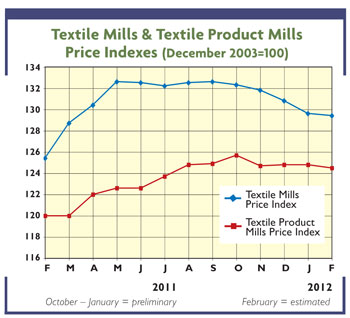
BFgraph


The Changing Import Picture


The flattening out of textile and apparel shipments from abroad also has to be regarded as a
major plus for U.S. producers. Final figures for 2011 show U.S. imports of these products down more
than 3 percent from a year ago in real or square-meters-equivalent terms. Moreover, the falloff
seems to be intensifying, with November/December off by 7.5 percent. Much of the decline can be
traced back to China, where bargains are becoming a lot harder to come by. Part of this is due to a
rising Chinese yuan, up 40 percent on an inflation-adjusted basis since 2009. And most financial
analysts see some additional creep-up this year, though it’s likely to be in the 2- to 4-percent
range. Nor are exchange rate shifts the only factor behind the recent import slowdown. Domestic
buyers have faced some serious supply chain problems in recent years. This was certainly true
during the recent business downturn, when demand tumbled, leaving some U.S. firms with heavy
inventories on slow boats from the Far East. Equally disturbing are global delivery interruptions
stemming from such natural disasters as last year’s tsunami in Japan and flooding in Thailand. To
be sure, all of the problems noted above are not going to bring back the United States’ old share
of global textile and apparel markets, but they do suggest that import penetration of these
products has pretty much run its course.


More Government Assistance


New Washington developments also should further improve the United States’ overall import
situation. In large part, they’re prompted by election year pressures, as both parties try to avoid
being painted as weak on China. The Obama administration, for example, has announced plans to
create a task force to monitor Beijing for possible trade and other commercial violations.

Also encouraging is a White House “insourcing” plan to bring jobs back to America. Steps
being contemplated include: cutting taxes for firms producing goods in the United States; taking
away tax breaks from businesses that move jobs offshore; providing a tax deduction for makers of
high-tech goods; expanding worker training programs; and closing loopholes that allow firms to
shift profits abroad. Actually, these proposals aren’t too different from policies pursued by many
U.S. competitors. Countries like Germany, Japan and China already offer large tax breaks and
financial support to their domestic industries. Also, even without any new U.S. moves, there are
indications of an improving trade climate. A recent survey by MFG.com, a site connecting
manufactures with suppliers, finds one in five firms are already bringing production back from a
low-cost country — up from one in 10 two years ago. And if some reports are true, this trend is
even spilling over into the textile/apparel sector. In short, the U.S. trade situation isn’t nearly
as bleak as it was a year or two ago.

March/April 2012

March Orders Up; Uncertainty Remains

With the yarn market in the United States — and around the world — in a general state of upheaval,
yarn spinners and brokers are uncertain about what the short-term future holds.

“We got off to a soft start for the year,” said one spinner. “I don’t know that anyone had
really high expectations for January, but I expected things to pick up in February. I really
expected February to be better than it was, but activity didn’t really kick in until the fourth
week of the month. But both orders and inquiries picked up significantly the last week of February
and the first week of March.”

Another spinner said: “Our order pipeline is not very long right now. We have numerous
inquiries from customers, but not a lot of sales activity. We had a spike earlier in the year that
gave us some hope that we would start 2012 off stronger than we expected, but that didn’t last very
long. February was very slow. However, we have noticed both inquiries and orders picking up over
the last week or two and are hopeful that business will improve over the next couple of months.”

Added a prominent yarn broker: “Ring-spun business for me is picking up again, and my
specialty business is good. Commodity open-end (OE) business is okay. In talking to my suppliers,
they tell me they are running pretty good, but that their order backlog is not very long. Many OE
spinners seem to still have some inventory, because they are aggressively quoting prices. I am
seeing the differential between cotton and OE yarn return closer to what is was pre-2010.”


Yarn Market Is Increasingly Global


Overall, however, spinners say they have less feel this year than in the past for how
business conditions are likely to play out. As one observer noted: “It’s hard for spinners to
figure out how to run their companies over the next six months when they have the visibility of
about 30 days. It is a lot more difficult now than it used to be. The yarn market is now truly a
global business, and spinners in the United States now have less control over their destiny than at
any time in the past.”

He added: “When you talk about yarn manufacturers with the capability to dominate the
market, you used to consider only a handful of U.S. companies. Now you are talking about Pakistan,
India, Korea, Egypt and other countries. Companies in those countries have different drivers than
what we are used to. In the United States, we used to know who and where our customers were, and we
knew the direction cotton prices were going. We knew if cotton was X, we could get Y for the yarn.
No longer does that have a lot to do with it. The global yarn market is driven by political
factors, the cost of fuel, the cost of freight and just a whole range of factors that used to not
come into play or, at least, not contribute significantly.”

For example, he said, if India is exporting yarn to Europe and demand suddenly decreases,
the yarn previously earmarked for Europe can be sold in the United States at reduced prices. “In
reality, it doesn’t even have to be sold here. Just the threat of it is enough to keep U.S. prices
in check.”

Evidence of this can be found in the export strategy of India in 2011. Early in the year,
when global cotton prices were at their peak and cotton was in short supply, India did not export
any yarn. Then, when it became apparent that the cotton supply crisis was over, India began
aggressively exporting cotton yarns to the United States. “The problem though, was that Indian
companies had lost their customer chain and the only way to get that back was to drop prices. They
began selling yarn for $2.00 when the price of raw cotton was $2.00. It was a huge disruption in
the market. There really wasn’t any way to compete with that,” this observer said.


Inventory Control Is Critical


With the increasingly global nature of the yarn business, the prevailing wisdom for yarn
spinners is to maintain tight inventory control, said one observer. “Sometimes it might be better
to stand down for a week than to flood the market in times of weak demand and drive prices down
even further. That’s a lesson I’m not sure we in the United States have learned very well.”

March/April 2012

Think Small

As the number of textile trade shows in New York City increases, show producers have fine-tuned
their productions to serve the needs of today’s changing markets. Recently, three new events took
place, all custom-tailored to specific segments of the apparel industry. Along with the look, touch
and performance of fabrics for Spring/Summer 2013, the environment, smaller minimums and production
sourcing were topics covered.

At Texworld USA, produced by Messe Frankfurt Inc., Atlanta, a recent addition is the Apparel
Sourcing Show. This event runs concurrently with Texworld and is a special help to retailers,
designers and small manufacturers who are looking for sources for apparel production.

Olah Inc., New York City, organizer of Kingpins, has added another show called Continuum.
Whereas the focus of Kingpins is denim, Continuum is about sustainability.

The newest event on the New York City textile stage is DG Expo, produced by DG Expo Corp.
Here, exhibitors showed fabrics with low minimums and flexible ordering opportunities, plus
in-stock items.
KA

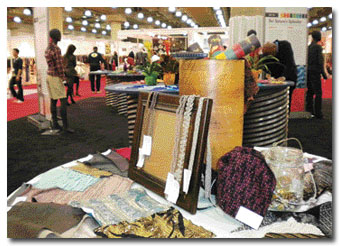
Spring ’13 fashion and fabric trends at Texworld USA were divided into four major
directions, each with its own color story.


Texworld USA


Exhibitors at Texworld USA include global fiber, yarn and fabric producers. Lenzing AG,
Austria, along with users of its cellulosic fibers, occupied a large section. The company
introduced Lenzing Modal® Edelweiss to the U.S. market. The fiber is sustainably produced from
beech wood and is oxygen-bleached. Recently, Tencel® and Lenzing FR® fibers were certified as
100-percent Biobased by the U.S. Department of Agriculture. Lenzing is expanding annual fiber
production from 770,000 tons to 1.1 million tons.

Buhler Quality Yarns Corp., Jefferson, Ga., pointed out a soft, lustrous unmercerized
MicroTencel®/Supima® cotton blend. Buhler also offers MicroModal® Edelweiss yarns (See “Edelweiss:
Eco Improvement For Modal® Fiber,” this issue). Coming soon are ultrafine ComforJet® spun yarns
that exhibit less pilling than other yarns.

Laguna Fabrics, Los Angeles, showed novelty knits. Among the best samplers are soft,
lustrous lace types in rayon/polyester blends, jacquards, pointelles and sweater knits. A
tissueweight jersey of MicroTencel/spandex, dot and stripe combos, heathers and French terries were
pointed out.

All of Mansfield Textiles Inc.’s production is done in Vernon, Calif. Spring 2013 favorites
include stripes and rib knits. Soft, warm-hand low-gauge knits have a sweaterknit look.

FesslerUSA, Orwigsburg, Pa., is selling flame-retardant (FR) knits containing Lenzing FR to
military and industrial users. Shirts have been adopted by the Columbus, Ohio, Fire Department and
are being weartested by the New York City Fire Department. The report is that as baselayers, the
shirts offer excellent comfort and performance. Sustainability is another success. Knits of
Repreve® — Greensboro, N.C.-based Unifi Inc.’s recycled polyester — blended with spandex are
selling. For Fall 2013, FesslerUSA will present an expanded wool knit line.

Burlington WorldWide, Greensboro, N.C., was a first-time exhibitor. Worsted wool and
functional fabrics were shown. New technologies include Easy Wool™ 100-percent washable wool
suiting fabrics. Performancewear fabrics include weaves in blends of wool with polyester and nylon,
and 100-percent man-made fiber. Some are woven of Repreve. Temperature, moisture and odor control,
ultraviolet protection, stain repellency and insect repellency are some of the technologies.

Miroglio Textile S.r.l., Italy, showed rotary prints and fabrics produced in Asia that are
less expensive than the Italian digital prints it showed earlier at Première Vision Preview (See “
From Mass To Class: Spring/Summer 2013 Apparel Fabrics,” Textile World, January/February 2012).

Highlighted at Textil Santanderina, Spain, also an exhibitor at Kingpins, were pantweight
fabrics in neon colors. Fancy denim was soft, light, flocked and available with a lot of stretch
and recovery.

Linen fabrics at the HLC Linen & Cotton Group, China, ranged from tissueweight to
pantweight. A lot of the styling is done in Italy. There are compact weaves, mesh fabrics, puckers,
crinkles, jacquards, prints and coated fabrics.

One popular exhibitor at the Apparel Sourcing Show was Panjiva, New York City, which
connects buyers to suppliers. With a database of 750,000 suppliers in 190 countries, the company
can provide information about capabilities, size, location, certification and other data to anyone
looking for reliable apparel sourcing.
KA2

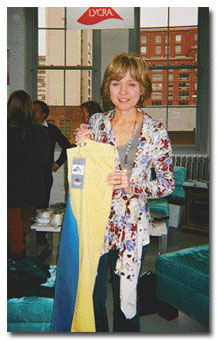
Jean Hegedus, global marketing director, bottoms, Invista, holds up a pair of super-stretch
jeans made with Lycra® dualFX™.


Kingpins And Continuum


Held in a space duplexed with parent show Kingpins, the small Continuum show was big in
impact. Global resources exhibiting at this show have developed eco-friendly products that are a
growing business. With denim the focus of Kingpins, there was overlapping.

Poole Co., Greenville, producer of EcoSure® recycled polyester fiber, displayed yarns,
fabrics and apparel from major global resources. Parkdale Mills Inc., Gastonia, N.C., and Carolina
Mills Inc., Maiden, N.C., are among the spinners. Products range from contract linens to rental
uniforms.

Genencor®, Palo Alto, Calif., presented PrimaGreen® enzyme solutions for finishing fabrics
and garments. The solutions eliminate the use of harsh chemicals; and reduce energy and water usage
as well as waste.

With booths at both events, FiberMax® cotton had strong transparency, technology and
sustainability stories. Developed by Bayer CropScience, with cotton headquarters based in Lubbock,
Texas, this extra-long-staple cotton, grown in Texas, goes into jeans sewn in American Denimatrix’s
plant in Guatemala. The entire process can be tracked. Fabrics and garments are ozone-treated,
which eliminates the use of harsh chemicals.

Kingpins exhibitor Cotton Incorporated, Cary, N.C., showed extensive fabric development
collections of both knitted and woven fabrics. One new denim fabric has the look and touch of
leather. Another has a paint-splattered appearance. Others are permanently crinkled, silky or oily
in feel. There are colored denims, enzyme-washed denims, printed denims that have a pearlescent
look, and washed and overprinted denims that have a blotchy appearance.

In focus at Supima, Phoenix, were quality and connection through the supply chain. Brands
and retailers showed interest in ultrafine and novelty yarns for jeans and silky-touch T-shirts.

Invista, Wichita, Kan., introduced Lycra® dualFX™, a combination of Lycra with Lycra T400®.
Both fibers can be corespun simultaneously into a single cotton-covered yarn with high stretch and
recovery. On display were super-stretch jeans that are comfortable to wear and retain their shape
and fit.

Colors at Cone Denim, Greensboro, are named Beer Bottle Brown, Water Cooler Blue and Soda
Pop Green. There are soft-hand fabrics woven with Tencel/cotton warp yarns and a cotton weft. Some
fabrics are prepared for garment dying, woven with heathered warp yarns, or coated.


DG Expo


There were close to 50 North American exhibitors at the first DG Expo, where specialty,
novelty and low yardage requirements attracted buyers.

D. Zinman Textiles Ltd., Montreal, reported meeting 50 new customers the first day of the
show. Cotton and blended fabrics for lingerie and casualwear were of special interest. Zinman, a
lining fabrics producer since 1938, has expanded into basic and novelty fabrics with stock service
and 25-yard minimums.

A specialty of Solid Stone Fabrics, Martinsville, Va., is fabrics for the performing arts.
Dancewear, and gymnastics and cheerleader apparel were mentioned. Knitted fabrics come from Italy,
and wovens, from the Carolinas. The company has in-house digital printing capacity totaling 4,000
yards per week. There are no minimums.

Jasco Fabrics Inc., White Plains, N.Y., produces knits of organic cotton, wool and viscose.
New this season is a viscose/spandex crepe satin. An activewear designer from California sampled a
fine, silky cotton jersey and midweight boiled wool.

Robert Kaufman Fabrics, Los Angeles, was pleased to find a New York venue that caters to
small and medium-sized buyers. His collection of woven fabrics ranges from twills, sateens, poplins
and stretch denims to crepes, chiffons, georgettes and prints.

March/April 2012

Shanghai Salutes The Global Textile Industry

The third edition of the biennial exhibition ITMA Asia + CITME will welcome the global textile
industry June 12-16, 2012, to the Shanghai New International Expo Centre (SNIEC) in Shanghai’s
Pudong district. Recognized as the largest international textile machinery showcase in Asia, the
show combines two previously independently produced events — the International Textile Machinery
Exhibition (ITMA) Asia and the China International Textile Machinery Exhibition (CITME) — in an
effort to more effectively promote textile machinery and technology in Asia and strengthen
cooperation between international textile and textile machinery industries.

The event’s owners — the European Committee of Textile Machinery Manufacturers (CEMATEX); the
Sub-Council of Textile Industry, China Council for the Promotion of International Trade
(CCPIT-TEX); China Textile Machinery Association (CTMA); and China International Exhibition Center
Group Corp. (CIEC) — have once again selected the Beijing Textile Machinery International
Exhibition Co. Ltd. (BJITME) and co-organizer MP International Pte Ltd to organize the event. The
Japan Textile Machinery Association (JTMA) also is a partner organization involved in the event.

ITMAAsiaCITME

ITMA Asia + CITME 2010 welcomed 82,000 visitors to see the products and services of 1,171
exhibitors.


“Having held two successful presentations of the ITMA Asia + CITME combined show in 2008 and
2010, we are confident that the upcoming exhibition will create enhanced and new marketing and
networking opportunities for both Chinese and international textile and textile machinery
manufacturers, especially those offering eco-friendly solutions,” said Stephen Combes, president,
CEMATEX. “The combined show has been highly recognised by leading textile and textile machinery
industry players as it offers them a cost-effective showcase for their products and services in
Asia. With the recovery of the world economy and the beginning of China’s 12th Five-Year Plan, we
are confident that the combined show will score another success.”


Exhibitors And Visitors


ITMA Asia + CITME 2010 saw 1,171 exhibitors from 28 countries and regions — the greatest
number of which came from China, Germany, Italy, Taiwan and Japan; and 82,000 visitors from 99
countries and regions. The greatest number of overseas visitors came from India, Japan, Taiwan,
Thailand and Korea. More than 20 percent of visitors were from overseas.

Show organizers expect more than 1,300 companies from approximately 30 economies will exhibit
at the 2012 edition, filling approximately 130,000 square meters of floor space in 11 halls at
SNIEC. As of Textile World’s press time, more than 100 prospective exhibitors are on the wait list.

Chinese companies have reserved nearly 50 percent of the available exhibit space. Companies
from Germany, Italy, Switzerland and Japan form the next-largest exhibitor group. Spinning will be
the most strongly represented sector at the show, followed by knitting, dyeing and finishing,
weaving, and winding.

ITMAAsiaCITME2

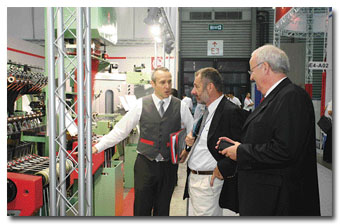
(left to right) ITMA Asia + CITME 2010 Supervisory Committee members Xu Yingxin, A.E.
Roberts, Wang Shutian and He Cailong


Show organizers expect nearly 100,000 visitors from all sectors of the global textile
industry to attend ITMA Asia + CITME 2012. To ensure high-quality visitors, guests will be required
to pay a small fee for an entry badge. Visitors may select a five-day pass for 100 renminbi or a
single-day pass for 50 renminbi. Both passes are available at a 40-percent discount if guests
register online prior to June 8. Visitors registering online also will be able to print a badge
prior to the show.

“The combined show is now well entrenched in the textile machinery exhibition calendar,” said
Maria Avery, secretary general, CEMATEX. “It draws leading textile machinery manufacturers and is a
must-attend showcase for the Asian market, offering plenty of business and networking
opportunities.”


Product Categories


Products will be arranged into 17 chapters as follows:

  • Chapter 1 – Machinery for spinning preparation, man-made fiber production and spinning; and
    auxiliary machinery and accessories;
  • Chapter 2 – Machinery for winding, texturing and twisting; and auxiliary machinery and
    accessories;
  • Chapter 3 – Machinery for web formation, bonding and finishing of nonwovens and felting; and
    auxiliary machinery and accessories;
  • Chapter 4 – Machinery for weaving preparation, weaving and tufting machinery; and auxiliary
    machinery and accessories;
  • Chapter 5 – Knitting and hosiery machinery, auxiliary machinery and accessories;
  • Chapter 6 – Embroidery machinery, auxiliary machinery and accessories;
  • Chapter 7 – Braiding machinery and accessories;
  • Chapter 8 – Machinery for washing, bleaching, dyeing, printing, drying, finishing, cutting,
    rolling and folding; and auxiliary machinery and accessories;
  • Chapter 9 – Garment-making machinery, other textile processing machinery, auxiliary machinery
    and accessories;
  • Chapter 10 – Laboratory testing and measuring equipment and accessories;
  • Chapter 11 – Transport, handling, logistics, storing and packing equipment and
    accessories;
  • Chapter 12 – Equipment for recycling, waste reduction, and pollution prevention; and
    accessories;
  • Chapter 13 – Software for design, data monitoring, processing and integrated production;
  • Chapter 14 – Dyestuffs and chemical products for the textile industry;
  • Chapter 15 – Equipment and products to ensure machinery and plant operations;
  • Chapter 16 – Services for the textile industry; and
  • Chapter 17 – Research and educational institutions.

ITMA Asia + CITME 2012 organizers affirm that intellectual property (IPR) infringements will
not be tolerated, and stringent regulations will be enforced. An active IPR office again will be
available onsite to assist exhibitors who have suspected patent issues. Exhibitors may photograph
and film their own stands but are prohibited from photographing and filming other exhibitor’s
stands.

ITMAAsiaCITME3

Blaise Godet, Switzerland’s ambassador to China (center), and Christian Kuoni, CEO, Jakob
Müller AG, and president, SWISSMEM Textile Machinery Division (right), at Jakob Müller’s booth at
ITMA Asia + CITME 2010


Growing Machinery Market


According to San Jose, Calif.-based market research firm Global Industry Analysts Inc., the
global textile machinery market is predicted to reach US$20.75 billion by 2015, with the Asia
Pacific region comprising the largest market.

The 2010 International Textile Machinery Shipment Statistics from The International Textile
Manufacturers Federation (ITMF), Switzerland, indicate that global machinery demand is on the
upswing, and that significant investments have been made in short-staple spindles, open-end rotors,
texturing spindles, shuttleless looms, circular knitting machines and electronic flat knitting
machines.

“Currently, the textile machinery industry report card is looking much better compared to the
previous two years,” said CEMATEX Board Member Fritz Mayer. “[ITMF’s statistics] show that
investments, which were reduced during the 2008 crisis, have picked up significantly. In fact, I’ve
been told that a number of machinery manufacturers have full order books, with delivery times, in
some cases, of up to two years.

“As the global economy continues to show strong signs of recovery, we expect our 2012 edition
to be even bigger than the previous showcase in 2010,” he added.


For more information about ITMA Asia + CITME 2012, visit
itmaasia.com.


March/April 2012

Spinning With An Air Jet

Since the invention of the spinning mule, or mule jenny, in 1779 by Samuel Crompton, the textile
machinery industry has worked to develop faster and more reliable and flexible spinning
technologies. Air-jet spinning is the latest answer in this endeavor.

Over decades and centuries, ring spinning became the cornerstone of spinning, accompanied by
open-end or rotor spinning. Both technologies have their own fields of end-uses, and ring spinning
has been boosted further with the development of compact spinning, resulting in much less yarn
hairiness thanks to its reduced, or compact, spinning triangle. In the 1990s, a new technology
appeared on the market: air-jet spinning, the so-called Vortex technology from Japan-based Murata
Machinery Ltd. In October 1997, Murata revealed its development of the Murata Vortex Spinner (MVS),
an air-vortex spinning frame for cotton.


Over time, Murata established a niche market for these special yarns and claimed success for
the technology. Modifications to the Vortex technology in the late 1990s resulted in significant
changes in yarn structure compared with first-generation yarn structures. These modifications
enabled twist to be imparted more effectively to the outer surface of the yarn, which,
consequently, increased yarn tenacity. They also made it possible for the first time to process
shorter staple lengths, such as 100-percent cotton, in addition to man-made fibers and blends. In
September 2008, Murata introduced Vortex yarns at the Expofil yarn fair in Paris. Murata
communicated that “the functionality and fashionable features of the Vortex yarns met the
expectations of the textile professions around the world.” Nevertheless, as spinning is a
conservative industry, the technology wasn’t, and isn’t yet, that successful compared to ring or
rotor spinning, but Vortex yarns maintain their place in a niche market.

Rieter1

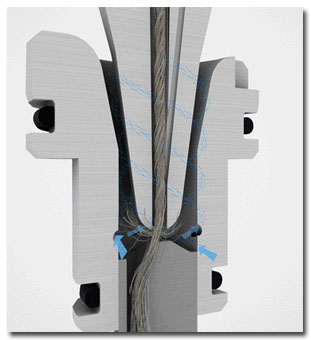
In ComforJet® spinning, the fiber is spun in the spinning nozzle.


Rieter Air-jet Spinning


In 2003, the Rieter Group, Switzerland, challenged the markets by introducing its own air-jet
spinning technology, beginning with the development of the J 10 air-jet spinning machine. The
technology’s market launch has continued since June 2008. The main development criteria included,
to name just a few: high productivity; flexible, simple machine settings; ease of operation; and
low downtimes for maintenance and lot changes. These criteria determined the machine concept and
the individual components.

At the heart of Rieter’s second-generation J 20 air-jet spinning machine is a spinning unit
driven by individual motors, without central gears and driving shaft, across the entire machine
length. Individual spinning positions can be switched off, and the rest of the machine continues
production. Such spinning unit settings as drafts, bobbin speed, winding tension, cross-angle and
spinning pressure are performed centrally via the machine operator panel. Also, in evaluating
machine data, flexibility is the top priority. Separate production and shift reports are available
for each article.

In Rieter’s air-jet spinning technology, a fiber arc is created by means of an air current,
and the yarn produced in this way is taken off via a fixed spindle. The twist factor in the
covering yarn corresponds more or less to that of a ring-spun yarn. The air-jet-spun yarn structure
consists of core fibers without significant twist and covering fibers with a genuine twist, which
ultimately produces the corresponding yarn tenacity. The specific yarn structure results in yarn
tenacity between that of a ring-spun yarn and that of a rotor-spun yarn. According to Rieter, the
very high yarn tenacity of a compact yarn cannot be achieved by any other spinning system. The
air-jet system virtually totally integrates the fibers into the yarn strand and into the
simultaneous, complete twisting of the fibers.

Due to their yarn structure, air-jet-spun yarns display good yarn elongation values equaling
those of ring-spun yarns, depending on yarn count and raw material. The elongation in air-jet-spun
yarns is also reflected in the yarns’ good processing behavior.

Rieter2

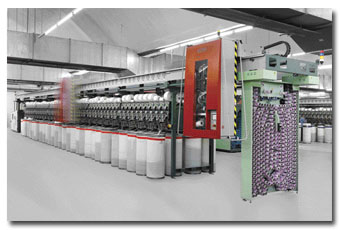
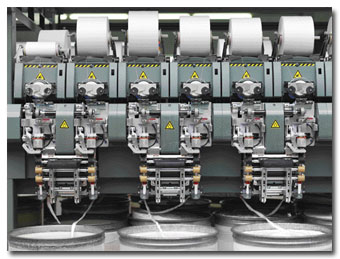
The J 20 air-jet spinning machine has 120 spinning units and is equipped with four robots,
with two on each side of the machine.


Hairiness, Abrasion And Wear Resistance


Compared to yarn spun using other spinning processes, air-jet-spun yarn displays the lowest
hairiness. The spinning process and the yarn structure obtained as a result create new,
complementary possibilities in downstream processing of the yarn. The advantages of low hairiness
range from cost savings in the knitting process to unique advantages in the textile product in
terms of abrasion, wear resistance, pilling and washfastness.

Yarn abrasion is directly related to yarn hairiness and the integration of the fibers in the
yarn strand. One advantage of air-jet-spun yarn is clearly apparent: Lower abrasion will result in
significantly less soiling and less fiber fly during downstream yarn processing, thereby extending
cleaning intervals on the machines. The abrasion resistance of the yarns is a further important
criterion in subsequent downstream yarn-processing stages and the yarn’s serviceability properties
in the textile fabric.

Rieter3


The spinning units on the J 20 air-jet spinning machine are configured in an open
duo-drafting arrangement that is suitable for spinning all fiber types.


A Second Generation


A number of innovations incorporated in the J 20 air-jet spinning machine allow it to achieve
delivery speeds of 450 meters per minute (m/min). By comparison, normal ring-spinning delivery
speeds are 15 to 27 m/min, and rotor spinning speeds are 130 to 250 m/min. The Rieter air-jet
spinning machine has a construction similar to that of a rotor spinning machine. Between the drive
frame and the end frame, there are six sections, each with 20 spinning positions, for a total of
120 positions, compared to five sections on the J 10 machine — making the J 20 the longest air-jet
spinning machine in the world, according to Rieter. In addition, there are four robots — two on
each side — in operation for the formation of yarn piecings, bobbin change and cleaning.

Yarn produced by the J 20’s spinning unit features high strength and a low number of
imperfections. The duo-spinning unit’s drafting arrangement can be precisely and reproducibly set.
Controlled fiber guiding results in good yarn quality and a low number of quality cuts and natural
thread breakages. Operator involvement is significantly reduced. Furthermore, bobbin tension can be
set over the entire bobbin, which, in tandem with the image interference device, ensures perfect
bobbin building, Rieter reports. The J 20 machines are equipped with the USTER® Quantum Clearer 2
yarn clearer that can include, per customer requirements, capacitive or optical sensor and optional
foreign fiber detection.


Automation


As mentioned above, the J 20 is equipped with four robots, with two on each side of the
machine. In addition to cleaning the spinning position and automatically piecing the yarn after a
thread break or a clearer cut, the robot changes full bobbins and threads up the empty tubes. It
also features a fan that cleans fiber-fly from the spinning positions. The robot is based on
rotor-spinning automation technology. The entire piecing process is electronically controlled. The
machine is designed so that both machine sides are optionally entirely independent of each other.


Blends


The duo-spinning unit expands the J 20’s field of application, and it can process viscose,
Modal® and blends of these fibers with cotton. Ideally, a somewhat coarser and shorter cotton fiber
can be chosen for raw material blends on economic grounds. A corresponding reduction in noil can be
achieved when combed cotton is used.

During development of the machine, care was taken to enable as many fiber materials as
possible to be processed using the same top roller cots.


Drafting


The drafting arrangement technology adopted for the air-jet spinning machine has been adapted
to high speeds. In order to achieve the extremely high drafts, the 3-over-3 drafting arrangement
was further developed to a 4-over-4 arrangement, allowing a gentle fiber drafting in three stages.
The robust arrangement features a unique, patented traversing system. The feed sliver and the yarn
produced as a result are laterally traversed — thus extending the lifecycle of the top rollers,
cots and aprons threefold, which considerably reduces long-term maintenance and spare parts costs
and ensures consistent yarn quality over time, Rieter reports.


Lower Energy, Space Needs


For most applications, Rieter claims that the air-jet spinning technology consumes less
energy per kilogram of produced yarn than other spinning processes. Shutdown of individual spinning
units thereby pays off. During development, the dimensions of the J 20 were also considered, to
ensure that the machine could be installed in existing spinning rooms.

Space needs for the J 20 are 25-percent less than for ring-spinning equipment producing the
same capacity, thereby reducing building costs. Also, the smaller area requires less climate
control, resulting in further substantial savings.


New Markets


The new air-jet spinning technology produces new yarns with new yarn characteristics, and
opens new market opportunities for spinning plants. Yarn formation is achieved by turbulence with
an airflow in a spinning nozzle, which creates a quite different yarn structure. Yarn produced by
the J 20 is marketed under the ComforJet® brand.

Since ITMA 2011, Rieter has begun marketing the J 20 worldwide. The company claims that “the
J 20 is a production miracle with smallest space requirements. With its high operating speed of up
to 450 m/min and 120 spinning units, the J 20 air-spinning machine heads the productivity scale.”

This technology is certainly an attractive alternative to all other existing spinning
processes. However, its market acceptance will show if this assessment is true.

March/April 2012

ITMA Technology: Quality Counts

Just as the machinery manufacturers that exhibited in Barcelona, Spain, at ITMA 2011 demonstrated
innovation and advances in automation, the suppliers of testing and quality control equipment also
presented improved products to the textile market.


Adaptive Control Solutions Ltd.
, United Kingdom, provides automated controls for the
entire textile wet process from preparation through coloration to finishing and inspection. The
company’s instrumentation provides a virtual image of the various process steps. One element of its
system is the use of Raleigh, N.C.-based Huemetrix Inc.’s technology to sample dye baths to measure
concentrations of individual dyes at any stage of dyeing. The ultimate goal is to have interactive
self-adjusting process controls at every step of wet processing to maximize productivity while
reducing energy, water and overall costs.

Datacolor, Lawrenceville, N.J., introduced the Viewport™, a light box outfitted
with a digital camera to provide high-precision digital images with a calibrated display. Included
software analyzes the images and computes color differences to allow approval and archiving of
sample data. This Web-based technology also allows suppliers and their customers to view the
samples simultaneously, which facilitates rapid decision making.


James Heal
, United Kingdom, formerly James H. Heal & Co. Ltd., has rebranded
itself simply as “James Heal” and developed a new brand identity along with redesigning products to
emphasize the new brand. At ITMA 2011, in addition to the newest Martindale 900 Series for abrasion
and pilling testing, the company showcased the TruBurst burst-strength tester, the Elmatear digital
tear-strength tester, the completely redesigned TruFade lightfastness tester and the Titan
universal strength tester. Heal’s well-known line of testing materials was also redesigned as part
of the rebranding.

Quality

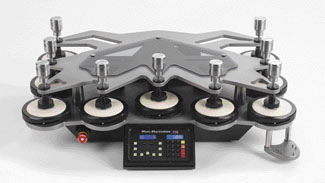
James Heal’s Martindale 909 abrasion and pilling tester features nine testing stations and
can be used to test specimens according to a number of international standards.


An innovation in light boxes was introduced by
Just Normlicht GmbH, Germany. The JUST LED Color Viewing Light provides adjustable
illumination through light-emitting diodes. The JUST LED colorControl system can simulate any
lighting environment and includes controlled ultraviolet content for viewing fluorescent samples.
Preprogrammed light sources can be stored and recalled when needed. A proprietary LED calibration
method provides consistent light quality.

Mahlo GmbH & Co. KG, Germany, exhibited a full range of online sensors to
provide real-time measurements of process parameters during continuous processes. Weight per unit
area can by determined with beta radiation by the Gravimat DFI or with X-rays by the Gravimat FMX.
Moisture content is measured using microwaves by the Aqualot AMF/HMF or using near-infrared
radiation by the Infralot IMF. Concentrations of specific organic compounds can also be determined
using the Infralot IMF unit. Web thickness can be determined using the Calipro DML non-contact unit
or the Calipro DMP air cushion contact device.

Pleva-Cintex, comprising
Pleva GmbH, Germany, and
Cintex AG, Switzerland, displayed a series of new and improved online sensors.
Fabric moisture levels can be determined with the traversing microwave heads of the AF120-Box and
RF110-Box systems. Online pick or course counts as well as width measurements can be made with the
Dual Structure Detector SD2C. Fabric temperature sensors TDS95 have been connected in a new
configuration to allow fast response times in measuring fabric temperatures online. The new RR-WB
device was designed to measure moisture levels in open-width goods.


Q-Lab Corp.
, Cleveland, presented its line of lightfastness and weathering testers.
The Q-Sun B02 Xenon Lightfastness Tester, designed to meet ISO 105 B02 test specifications,
features a rotating specimen rack and offers optional water spray; and measures spectrum,
irradiance, relative humidity, chamber temperature and black standard temperature. The Q-Sun light
stability and weathering testers offer affordable xenon arc testing, can operate around the clock,
and are completely automated and easy to install and use, Q-Lab reports.

SDL Atlas, Rock Hill, S.C., introduced a series of enhancements to its Ci series
Weather-Ometer line. The WXView data acquisition system allows remote access control of the unit.
An improved sealed lamp, temperature measurement system, and specimen holder all contribute to
improved efficiency and ease of operation.

X-
Rite, Grand Rapids, Mich., and its subsidiary
Pantone LLC, Carlstadt, N.J., exhibited several new developments in the color
measurement field. The CAPSURE™ portable spectrophotometer enables designers to capture that
“perfect” color anywhere and match it to one of 10,000 Pantone® colors. The NetProfiler 3 software
package allows online or local calibration of spectrophotometers as well as comprehensive report
generation. Newly designed calibration tiles are economical enough to be replaced once a year to
guarantee accurate calibrations over time. The ColorMunki is used to calibrate computer monitors to
ensure accurate color reproductions on screen.


Getting It Right In The Yarn

Uster Technologies AG, Switzerland, has been developing and manufacturing yarn testing
equipment since 1948, when it introduced its first yarn evenness testing instrument. The company
introduced its USTER® Statistics yarn and fiber benchmarks in 1957, and has revised them
continually to provide up-to-date standards for the measurement of yarn evenness.

The Uster Tester 5 is the company’s newest-generation yarn evenness tester, and, according to
Uster, is the fastest and most accurate instrument on the market. The tester is available in
several iterations for both staple and filament yarn.

For staple yarn, the Uster Tester 5 equipped with OH module to optically measure hairiness
can be used with the Uster Zweigle HL400 yarn hairiness tester, which operates at a speed of 400
meters per minute (m/min). Other modules and sensors are available to measure diameter variation,
determine unevenness and imperfections, measure temperature and humidity, and provide other
functions. The tester is available in two models for staple yarn: Uster Tester 5-S400, which runs
at a speed of 400 m/min; and Uster Tester 5-S800, which runs at 800 m/min. The results generated by
these testers can be checked against the Uster Statistics benchmarks.

Quality2

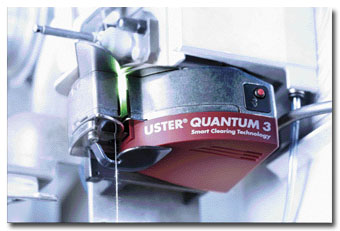
The USTER® Quantum 3 yarn clearer, installed on the winding unit, collects data on the
running yarn and recommends clearing limits to realize specified yarn quality.


The Uster Tester 5-C800 for filament yarn runs at a speed of 800 m/min and can be used with
the Uster Tensorapid tensile testing system, the latest version of which is the Uster Tensorapid
4-C featuring a purpose-designed software package.

The Uster Quantum 3 yarn clearer, the latest version of the company’s Quantum clearers,
offers what Uster calls “Smart Clearing Technology” including powerful capacitive, optical and
foreign matter sensors that together with the state-of-the-art processing electronics enable the
system to reveal the whole yarn body. The instrument collects data on the running yarn in two
minutes and recommends clearing limits to realize the specified yarn quality. The unit interfaces
with Uster Quantum Expert 3, a system that compares clearing settings at any winder and provides
synchronization across similar yarn lots.


March/April 2012

Techtextil North America 2012 Exhibitor Preview: HeiQ

ZURCHERSTRASSE, Switzerland — February 24, 2012 — Textiles are generally thought of as static and
passive. But what if they could respond to the environment around them? Imagine a fabric capable of
perceiving changing conditions and adapting its functionality accordingly. Now it’s reality —
thanks to Adaptive, a revolutionary textile effect by the Swiss company HeiQ.

This innovation marks a milestone in the evolution of smart fabrics. Textiles treated with
Adaptive can effectively read and respond to the wearer’s body temperature and moisture levels. As
a result, these garments offer dynamic moisture control and thermoregulation, leading to improved
comfort.


How it works: the functionality


This pioneering, patent-pending technology is based on a unique hydrofunctional polymer whose
moisture transport properties change in response to temperature. This enables Adaptive to transport
and release moisture at higher temperatures, offering enhanced cooling and keeping the skin dry. At
lower temperatures, the fabric absorbs moisture but the wicking effect is reduced, resulting in
increased insulation.


How it feels: the comfort factor


There is nothing new about running gear that offers passive moisture management when it comes
into contact with perspiration. But what if the same clothing can sense when the wearer’s body
temperature goes down and reduce its evaporation capacity in response? The benefits for the
consumer are clear. Better thermoregulation increases comfort and, as a result, performance
capacity. Specifically designed for skin-contact materials, Adaptive is ideal for sportswear,
underwear, socks and hosiery. However towels and bed linen can also benefit from this unique
functionality.


Test Adaptive at Techtextil


Why not try it for yourself? From April 24 until April 26, 2012, you can experience this
innovative textile effect first-hand at HeiQ’s and Bolger & O’Hearn’s booth (1446) at
Techtextil North America 2012 in Atlanta, GA. In addition, the Swiss company will also be
showcasing two other innovative product platforms: Pure and Barrier. Pure leverages the
antimicrobial properties of pure natural silver to provide textiles with long-lasting freshness.
Barrier makes fabric exceptionally water-repellent and dirt-resistant, thanks to its unique micro
structured surface.

Posted on March 12, 2012

Source: HeiQ Materials AG

TenCate Protective Fabrics Wins Order For Shropshire Fire & Rescue In U.K.

ALMELO, the Netherlands — March 6, 2012 — TenCate Protective Fabrics has won an important order
from the British producer FlamePro (UK) Ltd, for the delivery of inherently heat and flame
resistant materials for the structural fire fighter clothing for Shropshire Fire & Rescue
Service in the U.K. This seven-year contract employs a new lightweight system, the TenCate
Tecasystem™ Millenia 450, in the construction for more than 1200 fire service outfits. The first
300 outfits are expected to be handed over in June 2012.

The fire brigade in Shropshire, England, has been looking for new developments in the market
in order to improve the current personal protection systems. The specification required a durable
fire fighting suit with less maintenance costs and better protection against the risk of heat
stress. Heat stress is caused by the body’s inability to maintain its average core temperature in
arduous and stressful situations. Heat stress can cause fire fighters to lose consciousness or even
worse, suffer a heart attack.


Lightweight protection


Producer FlamePro has developed a new FlamePro® fire fighting suit based on advanced TenCate
materials. TenCate Tecasystem™ Millenia 450 is the lightest, strongest protection system available
in the market that meets the strict requirements of the European Norm EN 469/AC: 2005, level 2. It
consists of an outer fabric in combination with a thermal and moisture regulating intermediate
layer and a thermal liner. Each layer has been developed with its own functionality. As an
integrated system, the layers are fully compatible with each other.


Comfortable and durable


Kevan Whitehead, end-use market manager of TenCate Protective Fabrics, explains: ‘Shropshire
fire fighters will benefit from a light and comfortable fire fighting suit yet still be protected
in the extreme conditions experienced in a raging inferno. In addition to fighting fires, fire
fighters also turn out to a wide variety of other emergencies including road traffic collisions,
hazardous materials and terrorist incidents. These various situations require multifunctional
clothing that is lightweight, comfortable, strong and protective.’

The new fire suit has a unique design wherein any damaged parts — such as the fluorescent
visibility stripes — can be easily replaced. Conforming to the requirements of this English fire
brigade, the concept suits have been subjected to wearability and washing tests. In addition, some
members of the brigade visited TenCate Protective Fabrics in Nijverdal, the Netherlands. In the
laboratory they became acquainted with various types of material and their performance, including
availability in the market. They were also shown a comparison between the materials of the current
fire suit and the new lightweight protection system from TenCate.

Subsequently, Shropshire Fire & Rescue Service carried out a controlled programme of
testing designed to measure the amount of energy expended whilst carrying out a series of tests.
These tests were performed using five serving fire fighters (two female and three male) and the
tests and analysis of results were carried out by an experienced consultant. The tests were carried
out over two successive days to allow a comparison to be made between the existing fire suit and
the new protection system based on TenCate Tecasystem™ Millenia 450. The research demonstrated
that, compared with the existing garments, the new fire suit requires 25 per cent less body energy,
offers good protection against the danger of heat, and offers greater comfort and freedom of
movement.

Posted on March 16, 2012

Source: TenCate Protective Fabrics EMEA

NShield™ Antimicrobial Masterbatches Provide Superior Processing And Long-Lasting Effectiveness To Synthetic Fiber And Plastic Products

CUYAHOGA FALLS, Ohio — Feb. 28, 2012 — Americhem Inc., a global provider of custom color and
additive solutions, has introduced nShield™ antimicrobial masterbatches that inhibit the growth of
odor-causing bacteria in synthetic fiber and plastic products.

nShield antimicrobial masterbatches are highly effective at low levels against a wide range
of microorganisms in a variety of applications, including apparel, filtration, synthetic turf,
automotive interiors and other plastic products. The product can be customized in order to suit
each manufacturer’s specific requirements, including antimicrobial concentration, use rate and
other functionalities.

“Developed in response to hygiene concerns, antimicrobial agents have already proven
effective in enhancing the freshness of end products across a wide array of industries,” said Vaman
G. (VG) Kulkarni, Ph.D., director, business development, Americhem. “The success of our
antimicrobial agents in textiles throughout the past few years has led us to officially introduce
the technology and offer it to our customers as nShield.”

These masterbatches become an integral part of the fiber or plastic article and render
durable antimicrobial properties which restrain bacteria from proliferating and control odor.
Because it is engineered into the end product, nShield’s antimicrobial effect is non-migratory
resulting in premium durability. nShield antimicrobial agents also resist discoloration and
degradation caused by bacteria for long-lasting aesthetic appeal.

An extra value to manufacturers, nShield enhances performance throughout the manufacturing
process. It has excellent spinning and processing characteristics for higher yields and lowered
pack pressure because of the dispersion quality. nShield also provides higher thermal stability
that will not cause decomposition at nylon 6, nylon 6,6 or PET spinning temperatures, allowing for
superior processing and optimal manufacturing efficiency.


Posted on March 16, 2012

Source: Americhem Inc.

Sponsors