Hohenstein Develops Textile Acoustics Testing Technology

The Hohenstein Institute, Germany, has teamed with technical textiles manufacturer Rökona
Textil-werk GmbH and Reutlingen University, both based in Germany, to develop new methods for
measuring the acoustic properties of industrial, automotive and construction textiles as well as in
hunting and military gear and apparel.

The new testing procedures are expected to enable manufacturers to cost-effectively test
fabrics in a range of conditions to determine sound-absorption and noise-generating properties.
Testers and product designers may analyze the data obtained to specify the cause of undesired noise
and facilitate product design optimization prior to production.

September/October 2012

International Textile Trade Shows: Preview In New York

New York City has captured the first glance at what fabric companies have created for fashion
designers for Fall/Winter 2013-14. Première Vision Preview presented apparel fabric collections
from European and Asian firms. Texworld USA included apparel and home yarns and fabrics and
sourcing exhibitors. Kingpins and The Continuum focused on denim and sustainability.


Première Vision Preview


For exhibitors at Première Vision Preview, colors are dark with bright highlights. Fabrics
are light, soft, clean and bulky. Many lines are showing double-faced fabrics. Stretch is a given.
Woven patterns tend to be small and classic. Prints are digital, covered and very colorful.
Metallics, paisleys and animal skins are still offered, and don’t forget black-and-white.

In the woolen sector, Robert Noble, Scotland, is showing ultralight Merino suiting and coat
weights. Colors are dark olives, ochers and browns with bright touches of berry or rust. Patterns
are small herringbones, and glen and gun club checks. The touch is natural, and there is stretch.

At Nikke, Japan, there are meltons, gabardines, twills and double cloths that reverse from
check to twill or gauze to twill. A new chemical finish that gives fabrics a paper touch is
especially popular with wool denim.

Avelana S.N., France, has a modified polyester fiber called carbonium that can be dyed and
spun like wool and has a wool touch. Fabrics woven with carbonium can be wrinkle-free, and water-
and stain-resistant. Other fabrics include worsted wool flannel, bubble-textured wool stretch,
Donegal tweeds and wool-blend stretch glen checks and herringbones. Roudiere, Avelana’s menswear
counterpart, has a double-faced fabric that reverses from worsted to wool; tweeds with subtle
stretch; and small, clean designs.

At Gruppo GF S.r.l., Italy, woolen tweeds are thick, soft and fluffy. Italy-based Picchi
S.p.A. has woolen tweed bouclés; brushed Donegals; and bonded double cloths that reverse from plaid
to bright, black to colorful stripes, and herringbones to diagonal weaves.

BTD Tekstil, Turkey, is showing casual double cloths that reverse from piqué or check to
twill; power stretch twills and crepes; and wool-blend bouclés that resemble Chanel styles, some
containing Lurex®.

Velcorex since 1828, France, continues to reinterpret corduroy. For Fall 2013, it’s
ultralight, mini-rib or cordless, and jacquard-patterned. There is corduroy that looks like denim
and has been dyed using a new sustainable technique developed by Clariant. Philea, France, has new
jacquards with engineered patterns, tweeds, crepes, a lot of stretch and glitter.
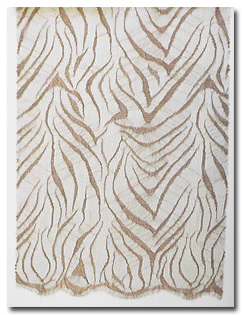

KASolstiss

Laces shown by Solstiss at Première Vision Preview included this copper metallic
lace.

Henitex International, France, has double cloths that reverse from fleece to small
black-and-white designs, or stripes to chevrons. There are open textured knits, variegated stripes,
ombréd jacquards, and a lot of large prints.

For outerwear, two Italian firms, Frizza S.p.A. and Olmetex S.p.A., are presenting
lightweight, bonded fabrics that are waterproof, stretchy and breathable. At Frizza, there are
sheer over shine over fleece, a fabric that looks like elephant skin bonded to wool, 3-D prints and
new transparencies. Olmetex is showing waterproof bonded fabrics that have a lot of stretch;
neoprene, Teflon® or waxed surfaces; heather wool flannels; and polyester furs.

For dress-up, there is opulence. Carlo Pozzi & C., Italy, has color-reverse stretch
satin, sheer/opaque wool/nylon with crinkle and glitter, and colorful jacquards. Solstiss S.A.,
France, has sheer, abstract-patterned laces, heavy corded laces and copper metallics. Denis et
Fils, France, is showing silk jacquards and lamé.

Digital prints not mass-produced are hot sellers at Sprintex S.a.s., France; KBC, Germany;
Miroglio Textile S.r.l., Italy; and Confetti Fabrics, Turkey. There is complete ground coverage,
with countless colors, and no repeat designs. Sprintex has oversized, dramatic graphics; KBC is
showing kaleidoscopic and photographic florals; and Miroglio has large, bold abstracts. Skins and
paisleys continue everywhere, and are newly done.


Texworld USA


At Texworld USA, Austria-based fiber producer Lenzing AG is a major player. Its section
included nearly 50 worldwide customers, including 10 from the United States.

U.S. textile production using Lenzing’s cellulosic fibers has increased 65 percent, with a
lot of Modal® and Tencel® going into sheeting and top-of-bed products. Beantown Bedding, Hingham,
Mass., is showing compostable and biodegradable bed sheets made using Tencel. Beantown is selling
to schools and universities. Camps and hotels are looking at its products.

Paramount Textile Mills (P) Ltd., India, showing at Home Textiles Sourcing, sells bedding
fabrics, including sheets and pillowcases woven with Modal and Tencel. Other exhibitors are selling
fabrics for curtains, upholstery, rugs, bedding, and kitchen.

Buhler Quality Yarns Corp., Jefferson, Ga., is selling yarns to sheet and towel producers.
For apparel, MicroModal® heather yarns are popular.

Tuscarora Yarns Inc., Mount Pleasant, N.C., reports its new nub yarns are selling well,
especially black with natural nubs.

Texollini Inc., Long Beach, Calif., has jersey with Outlast® phase change technology,
fabrics knitted with spider silk, burn-outs and new knitted fabrics containing cashmere and alpaca.

FesslerUSA, Orwigsburg, Pa., is working with both Lenzing and The Woolmark Company,
Australia. There are three new wool fabrics, including 17.5-micron 3.5-ounce Merino jersey.

Textil Santandrina S.A., Spain, showed at Texworld and Kingpins. High-end Tencel/Lycra®
denim sells to Gap Inc., Lands’ End and Coldwater Creek. Colored denim and jacquards are popular.

KATexworld

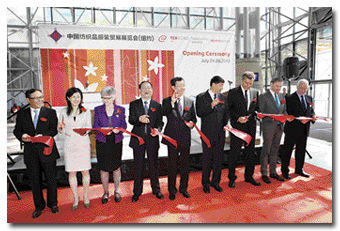
Texworld USA officials and sponsors marked the opening of the show with a ribbon-cutting
ceremony.


Miroglio also shows at Première Vision. At Texworld, it focused on fabrics styled in Italy
and made in China.

International Apparel Sourcing Show exhibitor Panjiva, New York City, connects buyers with
suppliers in the global supply chain. Another exhibitor, Sterlingwear of Boston Inc., started
making peacoats in 1968 and today makes women’s, men’s and children’s apparel, as well as peacoats
for the U.S. Navy.


Kingpins And The Continuum


Kingpins and The Continuum are two growing shows with international exhibitors. Several
companies showed at both events.

At The Continuum, ColorZen LLC, New York City, introduced eco-friendly cotton dyeing
technology that eliminates water pollution and decreases water consumption by 90 percent and energy
usage by 75 percent (See “ColorZen Launches Water-, Energy-, Chemical- And Time-Saving Cotton
Dyeing Technology,” Dyeing Printing & Finishing News, this issue).

Bayer CropScience Inc.’s FiberMax® cotton, a Kingpins sponsor, is produced sustainably in
Texas for world consumption. It is the largest variety of exported cotton in the world and offers
superior spinability, reduced breakage, excellent strength and a wonderful hand.

At Cary, N.C.-based Cotton Incorporated’s stand, buyers reacted enthusiastically to the
company’s collaboration and innovation efforts. Of special interest were 3-D effects, washdown
treatments and photo-realistic printed looks.

Invista, Wichita, Kan., also a Kingpins sponsor, reports special interest in color-flecked,
very stretchy and laser-printed denims. Eco-friendly is high on the list, and TOUGH MAX™ Lycra
products are cited for their comfort and performance.

Tavex Corp., Spain, said Levi’s is buying denim with 8-percent stretch for men and
35-percent stretch for women. Coated denim and lighter weights are selling.

American Denimatrix fabrics are made in Littlefield, Texas, and garments, in Guatemala. New
are tie-dyed jeans, leather-look coated garments, shiny laser prints, batiks, and bleach effects.

Cone Denim, Greensboro, N.C., uses EarthSpun® yarns from Patrick Yarn Mills Inc., Kings
Mountain, N.C., for a colored denim collection. These yarns, used as weft, come from recycled
brown, green and blue plastic containers, and no dye is needed. One garment made with Tencel and
dyed with iron oxide has a crisp hand. Other denims contain recycled cotton.

September/October 2012

People

Mount Vernon Mills Inc., Mauldin, S.C., has named
Melanie Sumner development manager, Protective Specialty Fabrics;
Ernie Terrell FR technical specialist; and
Craig Tutterow technical director, FR Fabrics.


Riegel-Mount Vernon Mills Inc.
, Johnston, S.C., has named
Kathy Detwiler inside sales specialist.

Jennifer Mendez, vice president for government relations, The Carpet and Rug
Institute (CRI), Dalton, Ga., has been elected treasurer of the
State Government Affairs Council.

The
American Apparel and Footwear Association (AAFA), Arlington, Va., has appointed
Paula Zusi, Ann Inc., to the Executive Committee; and the following to the Board
of Directors:
Tim Lyons, Haggar Clothing Co.;
Michael Schulze, SAP America Inc.; and
Karen Kyllo, SGS Consumer Testing Services. AAFA also has presented the Friend of
the Apparel and Footwear Industry Award to
Sens. Mitch McConnell, R-Ky., and
Charles E. Schumer, D-N.Y.


Optitex Ltd.
, Israel, has appointed
Nick Wei regional sales director, Hong Kong.


Victor Group
, Quebec, has named
Machell Apple director, new development initiatives.

PeopleApple

Apple

Yale Cordage, Saco, Maine, has appointed
Bill Putnam president.


Textiles Intelligence
, United Kingdom, has named
Jessica Farricker to its editorial team.

Xennia Technology Ltd., United Kingdom, has appointed
Dave Knight managing director.

ColorZen LLC, New York City, has contracted
Nick Hahn to oversee its efforts to educate the cotton and textiles industries
about the benefits of its cotton-dyeing technology.


Dash Multi-Corp. Inc.
, Maryland Hights, Mo., has named
Alan Prelutsky vice president, Textile Group.

PeoplePrelutsky

Prelutsky

Rooster Products International Inc., San Antonio, has named
Ralph L. Valadez program manager, Rooster Manufacturing Services Group.

September/October 2012

ColorZen Offers Water-, Energy-, Chemical- And Time-Saving Cotton Dyeing Technology

ColorZen LLC, New York City, has launched technology that eliminates the use of environmentally
detrimental chemicals and significantly reduces the amount of water, energy and time needed to dye
cotton. ColorZen™ technology involves the pretreatment of cotton using a process that renders the
fiber more receptive to dye uptake, uses no salt or other chemicals to fix the dye, and enables the
desired color to be achieved using half the amount of dye, with a 97-percent exhaustion rate,
compared to traditional cotton dyeing technologies. The company reports the treated cotton can be
dyed using traditional dyeing machinery, but the dyeing process uses 90-percent less water than is
needed for conventional cotton because fewer rinses are required and the water is recycled. The
process also consumes 75-percent less energy because color is applied at lower temperatures and the
entire process is completed in one-third the time needed for conventional dyeing.

The ColorZen process alters the cotton fiber’s molecular structure to attract the dye
naturally and has some basis in cationic chemistry, which offers similar environmental benefits.
However, according to Tony Leonard, the company’s technical director, cationic chemistry has not
been successful outside of a laboratory setting for reasons related to cost effectiveness,
complexity of the treatment and difficulty achieving consistent results, among other factors. By
contrast, said Michael Harari, president, “ColorZen cotton can be produced on a mass scale at a
cost that is effective, and most of the cost can be offset by savings in water, energy, chemicals
and time.”

ColorZen’s manufacturing facility is located in China. “China is the most prolific textile
export country, and most of the negative environmental effects of textile production have occurred
there,” Harari said. In the future, the company plans to expand its operations to other locations.

Harari anticipates cotton products bearing the ColorZen hangtag will be available in stores
as early as next year. “We will now be able to offer brands, retailers, and manufacturers a
sustainable choice for cotton dyeing that will protect the fresh waterways and reduce energy
consumption,” he said.

September/October 2012

BASF Ups PolyTHF® Capacity

BASF SE, Germany, has invested more than 60 million euros to increase its global PolyTHF®
polytetramethylene ether glycol production capacity by 65,000 metric tons to a total of 250,000
metric tons.

BASF produces PolyTHF in Germany, South Korea, China, and Geismar, La. The chemical
intermediate is used mainly in spandex fiber production. It also is a basis for thermoplastic
polyurethanes, polyetheresters, polyetheramides and cast elastomers.

September/October 2012

Park Valley Dyers Installs Thies Equipment

Park Valley Dyers Ltd., United Kingdom, a joint venture between contract fabrics weaver Camira
Fabrics Ltd. and Holmfirth Dyers Ltd., has installed 10 dyeing machines and a horizontal pressure
dryer manufactured by Germany-based Thies GmbH & Co. KG. Thies also designed the layout and
auxiliary equipment specifications at the plant, a former dyeing facility that has been
recommissioned after serving for some years as a storage facility. The operation is the first
dedicated dyeing plant to be installed in the UK in more than 20 years and represents an investment
of 2 million British pounds, Camira reports.

The machinery at Park Valley Dyers dyes 25 tons of yarn weekly and is operated by six
employees. The plant features an energy-efficient hot water boiler with a recovery unit, and
recycles and reuses all water used. The drying machinery uses hot air instead of radio frequency.
In addition, the plant recycles all yarn delivery pallets and packaging.

Machinery installed includes an eco-bloc quattro lab sampling unit, and seven horizontal and
two vertical eco-bloc yarn-dyeing machines — including two 840-kilogram-capacity units that can be
linked and operated using one control unit. Park Valley also installed a pharmaceutical standard
recipe preparation booth that enables the company to achieve a 98-percent right-first-time rate,
according to Philip Brearley, managing director, Camira Fabrics.

September/October 2012

Quick-Med’s Stay Fresh® Nets Expanded EPA Approval

Quick-Med Technologies Inc., Gainesville, Fla., has received an amended U.S. Environmental
Protection Agency (EPA) registration for its hydrogen peroxide-based Stay Fresh® Antimicrobial — a
nontoxic, durable, cost-effective technology that retains its efficacy on textiles and other
materials under a range of laundering conditions, according to the company.

The amendment expands approval for use of the technology to 30 new sites, enabling its use in
products such as adhesives, aprons, backpacks, incontinence pads, lumber, luggage, shoe liners and
inserts, shower curtains, superabsorbent polymers, and wound dressings. It also addresses treatment
application levels based on an article’s intended use and provides for “ultimate” durability,
“standard” application and warehouse “inventory protection” rates.

In addition to military uniform, apparel and other consumer textile applications, Stay Fresh
has potential applications for products such as medical devices. Quick-Med has filed a 510(k)
Premarket Notification with the U.S. Food and Drug Administration for its Stay Fresh Skin Fold
Management Textile, a medical absorbent product designed to provide moisture management and
antimicrobial protection in order to prevent damage to skin from abrasion within skin folds.

September/October 2012

Verdezyne Granted Patent For Biobased Adipic Acid Process

Verdezyne Inc., Carlsbad, Calif., has been granted U.S. Patent No. 8,241,879 for its biobased
adipic acid production process, which uses yeast fermentation to convert non-food plant-based oils
into adipic acid, used in the production of renewably sourced nylon 6,6 (N 6,6), thermoplastic
resins and coatings.

In addition to environmental benefits, biobased adipic acid is expected to offer economic
advantages over traditional petroleum-based adipic acid.

E. William Radany, Ph.D., president and CEO, said Verdezyne has teamed with another company
to polymerize N 6,6 made with biobased adipic acid to produce carpet yarn, and also plans apparel
yarn trials. He said several N 6,6 producers are interested in incorporating biobased adipic acid
into a 50-percent renewable fiber, and noted that Verdezyne is developing a pathway to manufacture
hexamethylenediamine, which would enable production of 100-percent biobased N 6,6.

September/October 2012

Sage Automotive Interiors: Global And Growing

Automotive interior fabrics including upholstery, headliners and door panels make up a significant
portion of the total textile utilization in an automobile. According to information compiled by
United Kingdom-based consultancy PCI Fibres, man-made-fiber upholstery fabrics, largely polyester,
comprise 70 percent of total upholstery materials, and — at the rate of 5 pounds per vehicle, with
an estimated 14.2 million vehicles produced in 2012 in North America — amount to 22,000 tons of
fabric. Headliners, weighing an average 1.5 pounds per vehicle, account for 9,700 tons of fabric.
Together, these two categories comprise nearly 14 percent by weight of the total 229,300 tons of
textile materials used in 2012 in the North American automotive industry. Subtracting the 30
percent of vehicles that do not have fabric seat upholstery, they comprise between 20 and 22
percent by weight of the total textile component per vehicle.

Other automotive textiles include some 38,500 tons of tufted and nonwoven carpet; some
10,000 tons of tufted floor mats; 50,070 tons of tire cord; 32,000 tons of molded parts and
insulation; 20,000 tons of seat belt fabric; 3,200 tons of polyester under-the-hood items; and
41,000 tons of air bag fabric; among other textile products.

AutoYES

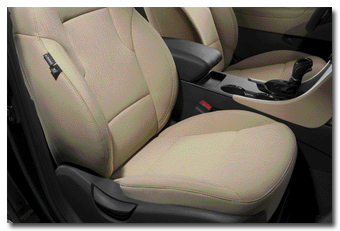
Sage’s YES Essentials® automotive seat fabrics feature repel-and-release stain resistance
as well as antistatic and odor-eliminating properties, and also reduce the amount of VOCs in the
cabin.


Sage At A Glance


Sage Automotive Interiors Inc. — a manufacturer of seating, headliner and door panel fabrics
— is one of several U.S. textile manufacturers serving the the automotive interior textiles market.
Its headquarters are located on the Clemson University International Center for Automotive Research
(CU-ICAR) campus in Greenville. The company operates five manufacturing plants in South Carolina
and Georgia, and a sales and design office in Detroit; a fabric formation and finishing operation
in Brazil; and design/engineering/sales offices in the United Kingdom, China, Japan and Korea.
Manufacturing partners are located in the Czech Republic, Poland, Sweden, Turkey, Egypt, South
Africa, China, India, Japan, Korea and Thailand. Its customer base comprises major global
automakers including Ford, General Motors, Chrysler/Fiat, Toyota, Honda, Mazda, Suzuki, Nissan,
Hyundai, Kia and Volkswagen.

Sage originated in 1948 as the Automotive Body Cloth Division of Milliken & Company,
Spartanburg, which sold it in 2009 to the division’s management team — including CEO Dirk Pieper
and COO Brian McSharry — and Azalea Capital LLC, Greenville. In 2011, Los Angeles-based private
equity firm The Gores Group LLC replaced Azalea in the partnership, and is helping Sage implement a
strategy to expand its global operations and its product portfolio. Over the last three years,
Sage’s employee base has grown from 900 to some 1,300 worldwide, including more than 1,100 in the
United States.

According to Pieper, Sage’s primary strengths are its global footprint, with world-class
manufacturing underpinning its operation and its design and engineering expertise; innovative
product offerings that have solved consumer issues; and leadership in the area of sustainability,
not only through its use of materials with recycled content, but also through the design and
engineering of its fabrics.

AutoSharonPlant

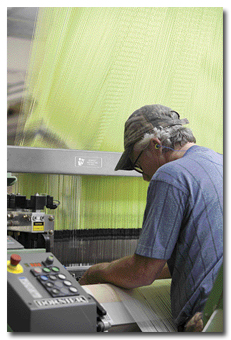
An associate reviews a weaving machine setup at Sage’s Sharon Plant, a state-of-the-art
facility poised for growth in the woven automotive textiles market.

“Since we spun out of Milliken, we have worked to improve upon the Milliken DNA in areas
like lean manufacturing, with a very heavy concentration of visual metrics, which drive our
processes,” Pieper said. “We have worked very diligently to become a global supplier, and we
continue to expand our global platform as we target investing in certain regions to support local
supply,” he added, noting that Sage aims to increase its presence in the European and Chinese
markets through such actions as having its own manufacturing operations in China and Eastern Europe
instead of commission manufacturing as it currently is doing.


Pieper also said the company is very close to making a decision as to what sorts of textiles
it will add to its portfolio.


Processes And Products


In the United States, Sage’s Avalon Plant in Toccoa, Ga., processes and textures raw yarn
and fiber sourced from companies such as Unifi Inc., Greensboro, N.C.; Nan Ya Plastics Corp. USA,
Lake City, S.C.; and other sources globally. The textured yarn is then sent to the company’s Sharon
weaving plant in Abbeville, S.C.; and its Gayley knitting, dyeing and finishing plant in Marietta,
S.C. Additional dyeing and finishing operations are located at its Abbeville Plant in Abbeville,
which processes both woven and knitted fabrics.

Current upholstery products include YES Essentials®, a repel-and-release stain-resistant,
antistatic, odor-eliminating fabric line that also reduces the amount of volatile organic compounds
(VOCs) in the cabin. Yes Essentials fabrics are covering the seats of more than 5 million
automobiles including Hyundai Santa Fe and Sonata models; Kia Sorrento; Toyota Highlander and
Sequoia models; and a number of Chrysler, Dodge and Jeep models.

AutoCottonBlossom

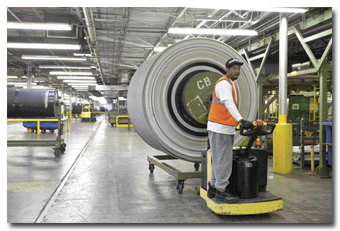
An associate transports a batch of fabric between processes at Sage’s Cotton Blossom
Plant.

Another innovative upholstery line, FXC® (fabric for extreme conditions), is a more rugged,
stain- and water-resistant, fast-drying, microbe-resistant fabric line designed for sport utility
vehicles and targeted to customers who love outdoor activities. It was developed partly because
Honda was designing a vehicle that would appeal to wind-surfing, mountain-biking, outdoor-active
customers who would want a textile product that could be completely hosed down and retain its
cleanliness. A next-generation FXC fabric is going into the Toyota Tacoma model.

Sage also has a portfolio of more conventional fabrics as well as a fabric made with Unifi’s
Repreve® 100-percent recycled polyester fiber. That fabric is featured in the Ford Focus EV and, as
of the 2013 model year, the Ford Fusion.

With regard to recycled-content fabrics, Pieper said: “We have been focused on adding
recycled content and sustainable products into cars. Unifi’s timing in developing Repreve gave us a
great opportunity with our channels to be able to source Repreve and open the door for Unifi.”
Unifi also supplies materials used in some Yes Essentials fabrics.

AutoPiper

Sage CEO Dirk Pieper began his career with the company more than 30 years ago, when it was
still the Automotive Body Cloth Division of Milliken & Company.


Sage sends finished fabrics to third-party tier 1 cut-and-sew locations, mostly in Mexico,
to have them made into seat covers.

Headliners and door panels are laminates of knitted fabrics and polyurethane foam. They are
processed at Sage’s Cotton Blossom laminating plant in Spartanburg and then sent to converters,
usually near the assembly plants, that have special molding operations.


People


Pieper spoke enthusiastically about the people working at Sage, from management to line
associates. “We’ve invested heavily in our people, and our people are heavily invested in Sage,” he
said. We operate very much like a family, and there’s not a lot of hierarchy. We can make decisions
quickly, and we value our people’s opinions.”

Sage’s top-line management has a total of 230 years of experience, which is one inspiration
for the company’s name. “We bring thought leadership and wisdom to the industry,” Pieper explained,
adding that another inspiration relates to sage as a natural, green plant and a consequent
association with the idea of sustainability.

The company’s design group includes 35 people globally, and they are brought together
several times a year to exchange ideas. “The amount of thought leadership that takes place within
that group is phenomenal, particularly when we focus on consumer research, trends, material trends
and their interaction with OEM [original equipment manufacturer] designers,” Pieper said.

Sage’s engineers work not only with the company’s products, but also with unrelated problems
a customer may have. “The problem may not even be with our material, but the customer may ask our
engineers to engage and solve functional problems through making adjustments to the textiles,”
Pieper said.

The company has been named one of the Best Places to Work in South Carolina for 2012.
Companies are chosen for the honor based on assessments of employer benefits and policies, and
employee engagement and satisfaction.

AutoSageHQ

Sage’s new headquarters on the CU-ICAR campus in Greenville give it access to research
facilities and opportunities to collaborate with other companies involved in the automotive
sector


CU-ICAR Campus: Innovation Central


In August 2011, Sage moved its headquarters from Spartanburg to the 250-acre CU-ICAR campus
in Greenville, where it has access to research facilities and ready opportunities for collaboration
with other companies involved in the automotive and motorsports sector.

“CU-ICAR is a real hub of automotive expertise, philosophy and technology,” Pieper said. “We
work very closely with Clemson on research, but also with students and professors here on their
projects, like Deep Orange [an electric concept car focused on providing a totally integrated
lifestyle experience and featuring elements such as electronic integration and Yes Essentials
seating fabric]. We also get exposure to projects like Innomobility, a forum for the exchange of
ideas and innovative concepts in the automotive industry, and we are participating actively in that
program. We have a whole module of very independent research on what’s the next cutting edge in
textile technology combined with other technology. By moving to CU-ICAR, we have had a lot of
interaction with BMW, Michelin and other industry leaders.”

Through its participation in Innomobility, Sage has opportunities to engage in what might be
called a “whole car” comprehensive transportation-oriented networking system that includes leading
thinkers and visionaries who are designing and engineering technologies and products not only for
the present, but also for the future, with consideration for all aspects -— from the user
experience to the supplier base and producers.


Quality Control: A Team Approach

Quality control is an important aspect of any manufacturing business, as quality problems
can impact production efficiencies, employee morale, customer satisfaction and profits. One way
Sage has tackled quality problems has been to utilize Knoxville, Tenn.-based QualPro Inc.’s
multivariable testing (MVT®) system, which recently helped the company bring a new headliner it had
developed beyond the accepted quality standards and also helped it achieve a significantly improved
throughput for the product.

According to Brian Gardze, then-plant manager at Cotton Blossom Plant and now project
manager for Sage, the process involved teamwork among all levels of employees at the plant, where
problems were encountered related to bond strength in a knit/polyurethane foam laminate. “Bond
strength is critical throughout the industry,” Gardze said. “We were seeing similar concerns in a
competitor’s product.”

In brainstorming sessions, employees contributed more than 100 ideas, which were whittled
down to 17 factors related to process, foam cure, line speed, temperature, tension and other
factors. Simultaneous testing carried out over three days, with no additional investment required,
resulted in an initial 464-percent bond strength improvement – with faster line speeds contributing
to that improvement – and, ultimately, a 751-percent improvement in foam tear performance.


The State Of The Industry

Sage Automotive Interiors CEO Dirk Pieper believes the U.S. automotive industry is in a
healthy state at present. “This year, we anticipate about 14.8 million vehicles will be produced in
the United States,” he said, noting that while the number isn’t as high as the 16 million produced
in 2007 before the Great Recession, it is much better than the low of 6.5 million in 2009.

“China continues to grow, although it has leveled off from 30-percent growth to 8-percent,
which is still good,” he continued.

Markets in other parts of the world are not as strong, Pieper said: “With the difficult
situation in the European Union, most of our customers there are struggling. India has a fantastic
growth percentage-wise, but vehicle growth is not so great. Japan is flat or declining because of
the exchange rate, and the market in Brazil is somewhat depressed.”


September/October 2012

IFAI Celebrates 100 Years At 2012 Expo

The Roseville, Minn.-based Industrial Fabrics Association International (IFAI) will mark its 100th
anniversary during IFAI Expo Americas 2012, which will be held Wednesday through Friday, November
7-9. This year, the expo, said to be the largest specialty fabrics show in the Americas, will
colocate with JEC Americas 2012 at the Boston Convention & Exhibition Center.

IFAI Expo Americas 2011, held in Baltimore, hosted 5,066 participants from 43 countries,
with 340 suppliers from 18 countries exhibiting their products and services to expo visitors. As of
Textile World’
s press time, IFAI had more than 400 exhibitors from 22 countries signed up for the 2012
edition, and projected 6,000 registered participants.

“This industry runs on innovation, enabling attendees to get a heads up on emerging markets
and products,” said Todd Lindemann, vice president of conference management, IFAI. “The scope and
depth of the specialty fabric markets represented at IFAI Expo enables connections to be made
throughout the industry’s value chain.”

IFAILindstrand

Lindstrand Technologies Ltd. won a 2011 IAA Award of Excellence for its work on the
22,000-cubic-meter Delhi Aerostat — deployed during the Opening and Closing Ceremonies of the 2010
Commonwealth Games in Delhi, India.


IFAI Expo Education


At this year’s show, IFAI will debut Business Power Programs with industry-specific
roundtables. The programs will be held each morning and will present expert advice on improving
business practices, products and marketing.

Three continuing education programs will be offered free of charge to architects, landscape
architects and students in those fields: “Green Roofs for Designers”; “Fabric Structures”; and “
From Building to Body: Current Research into Interactive + Technical Textiles,” presented by the
Massachusetts Institute of Technology.


On Thursday, November 8, two bonus sessions will be offered at no charge to full IFAI Expo
Americas 2012 registrants as well as to full Advanced Textiles & Safety Conference registrants:
“Understanding and Working with the Berry Amendment,” organized by the U.S. Industrial Fabrics
Institute, Roseville; and “Performance Textiles: Technologies and Testing,” organized by the
American Association of Textile Chemists and Colorists (AATCC), Research Triangle Park, N.C.


Advanced Textiles & Safety Conference


The 2012 Advanced Textiles & Safety Conference will be held Tuesday through Thursday,
November 6-8, in conjunction with IFAI Expo Americas 2012. The conference — supported by the Fiber
Society, Raleigh, N.C., Synthetic Yarn and Fiber Association, Clover, S.C., and AATCC — will
include technical presentations offering business insights into cutting-edge research and
developments and their application-based uses.

Technical sessions will cover topics including smart textiles; color-changing material;
silicon-based technologies; moisture management; decontamination wipes; wearable technologies;
DNA-based authentication of textiles; and a profile of an evolving business.

The conference also will include two keynote luncheons. On Tuesday, Eugene Wilusz, Ph.D.,
senior nuclear, biological, chemical scientist in the Warfighter Science, Technology, and Applied
Research Directorate at the U.S. Army Natick Soldier RD&E Center, will discuss “Perspectives in
Chemical Biological Protection.” On Wednesday, Blanton Godfrey, Ph.D., dean of the North Carolina
State University College of Textiles, will present “Building the New World of Textiles, Fibers,
Fabrics and Products.”


Expo Highlights


Special events and features to commemorate IFAI’s 100th anniversary and industry
achievements will take place throughout the three-day expo.

Festivities and highlights will include the pre-show Industrial Fabrics Foundation Indy
Fundraising Event supporting scholarships and industry research; a welcome reception; a 100-year
anniversary party; the IFAI History Museum featuring archival materials and photographs; and IFAI’s
annual meeting. The Fiber Society will hold its Fall Meeting and Technical Conference, themed “
Rediscovering Fibers in the 21st Century,” November 7-9 in conjunction with IFAI’s annual meeting.

This year, winners of the IFAI International Achievement Awards (IAA) competition will be
presented during a special event on the show floor. IFAI received 334 entries from 127 companies in
13 countries for the competition, which recognizes design excellence within the specialty fabrics
market.

IFAI also has launched the ShowStoppers awards competition, which is open to all expo
exhibitors and recognizes product innovation in six categories: fabrics, fibers and films;
chemicals, coatings and compounds; hardware, findings and accessories; equipment and tools;
services to manufacturers; and end products. Entries will be on view in a special ShowStoppers area
as well as on the show floor. Award winners will be selected by expo attendees.

Other show floor highlights include a fabric sourcing center offering samples of exhibitor
materials organized into application types; and the inaugural Advanced Textiles Pavilion featuring
exhibitors active in the global technical textiles market.

“2012 is the year not to be missed,” Lindemann said. “The combination of lively social
events to connect with peers, increased focus on new advancements and record attendance combined
with IFAI’s 100-year celebration will make this years’ Expo a very memorable event!”

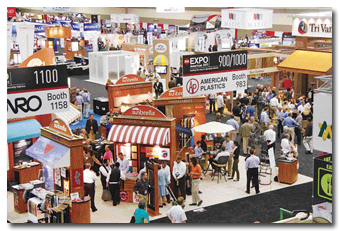
IFAIshowfloor

The show floor at IFAI Expo Americas 2011 featured 340 suppliers from 18 countries exhibiting
their products and services to more than 5,000 visitors from 43 countries.


Global Initiatives


The U.S. Department of Commerce has for the fifth time designated IFAI Expo Americas 2012 as
a participant in the International Buyer Program (IBP), which promotes U.S. exhibitions worldwide
via U.S. Commercial Service offices and diplomatic missions. IBP offers complimentary exhibitor
matchmaking services to connect exhibitors with international buyers; a show directory of U.S.
exporting exhibitors; and hands-on assistance for exhibitors.


JEC Americas 2012


JEC Americas 2012 — organized by France-based JEC Group, which provides networking and
information services for composite markets and is said to be the largest composites industry
organization worldwide — will make its American debut following shows in Europe and Asia earlier
this year.

JEC Group expects 300 exhibitors from the United States, Europe, the Middle East and Asia to
present their products and services. Composite sector fields include processing and technologies;
fibers and textiles; resins; fillers and additives; machines and equipment; software and services;
universities and research centers; and consulting firms. End-user markets include aeronautics,
automotive, wind energy, construction, marine, consumer goods, and medical, among other markets.
The show’s program will include the Innovative Composites Summit Forums and Conferences, technical
sales presentations, and the JEC Innovation Awards.

“We are pleased about the alliance with IFAI,” said Frédérique Mutel, president and CEO, JEC
Group. “Both organizations are trade organizations fully committed to their industries. Both are
experts of their sectors and produce high value information products. Together we will deliver a
strategic event and a unique platform combining composites and specialty fabrics.”

For more information about IFAI Expo Americas 2012 and JEC Americas 2012, visit ifaiexpo.com;
jeccomposites.com/events/jec-americas-2012


September/October 2012

Sponsors