
Knitting Focus On India

Warp-knitting machinery manufacturer Karl Mayer Textilmaschinenfabrik GmbH claims to have a global
market share of some 80 percent and is continuously expanding its position. To bolster this
position, the Germany-based company started an offensive strategy in India in the middle of last
year. Now, the first results are known. Textile World talked to Tim Wollnik, senior manager,
marketing and sales, Karl Mayer, to get a first insight into the efforts made in this evermore
promising country in Asia.

At the end of June 2012, company Chairman Fritz P. Mayer opened a new market initiative in
India by welcoming customers to an event presenting the third generation of its HKS 3-M tricot
knitting machine. At the same time, the Karl Mayer Academy India and a new customer service center
opened in Surat, on the west coast of India in the state of Gujarat.


Strong Growth


Karl Mayer’s India service branch was inaugurated in 2009 in Mumbai. In the last two years,
the company noticed a growing demand for warp- knitting machines in India. After carefully
examining the situation, the Indian branch further developed its supply of services, training
programs and new machines and made improvements in keeping the necessary spare parts available.

The site in Surat is home to the Karl Mayer Academy, which offers operator courses as well as
basic courses, with the target of increasing the level of know-how in India’s warp-knitting
Industry. At the same site, Karl Mayer is sharing the location with its local representative,
A.T.E., which has located in Surat to offer spare parts storage and sales support.

WeavingIndia

Figure 1: This pink and gold sari was produced on Karl Mayer’s FL 20/16 multibar raschel
machine.


India Focused On Warp-knitting Machines


At the June 2012 event, Karl Mayer presented the HKS 3-M with a special focus on the
different needs of the Indian textile manufacturers. The third-generation version is a versatile
and flexible high-performance machine. Thanks to the special knitting motion and knitting elements,
the model is said also to be suitable for very low stitch densities and coarse gauges. The
substantial lapping variety turns the HKS 3-M into a three-bar high-performance tricot machine with
highest versatility of products, according to the company.

The application range stretches from ground structures for embroidery, automotive textiles,
upholstery fabrics, sportswear, shoe fabrics, outerwear, ground fabrics for printing, billboards
and mosquito nets to coating substrates.


Fascination® Sari


India is the land of the sari, the beautiful dress for ladies. By creating a new range of
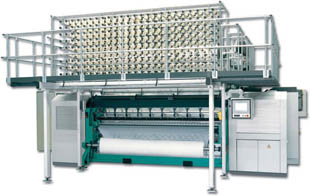
patterns on the Fascination® Lace FL 20/16 multibar raschel machine, that machine is said to offer
a new possibility to produce sari fabrics in a one-step process. Previously, a ground structure was
produced on a high-speed tricot machine such as the HKS 3-M, and the embroidery was made in a
separate step. With the FL 20/16, it is possible to produce a ground fabric and the embroidery-like
design directly in one process on the machine. The result is a ready-made sari fabric.

The FL 20/16 offers the following technical features:

  • Four ground guide bars and 16 pattern guide bars each feature Karl Mayer’s EL drive.
  • The Kamcos® computer platform features motion control/multi-speed facility. This advantage
    enables warp yarn delivery and fabric take-down speed to correspond to a pattern’s specific
    requirements.

When producing a complete sari measuring 5.5 meters long, the machine’s computer facilities
can handle the data sets to produce two matching saris next to each other.

Knittingtechfabric

WeavingMayer

Figure 2: Karl Mayer’s FL 20/16 multibar raschel machine is able to produce embroidery-like
designs for sari fabrics.


Embroidery-like Effects


The fabric in the sari shown in Figure 1 features a filigree, lattice-like ground with a
dense, allover pattern. The 16 pattern bars on the marquisette ground construction create the
ensemble. In order to produce the 3-D design, the pattern bars are placed in positions 1 to 16, in
front of the four ground guide bars.

Ground construction worked on the FL 20/16 can range from marquisette to tulle constructions.
Patterns also may be created by processing yarns with different-colored sequences. Bright,
iridescent yarns may be combined with monochromatic yarns to create other colored accents.


Changing Market Demands


In recent years, India has changed from a mainly second-hand-machine market to a new-machine
market. Indian warp-knitting companies have realized the advantages of modern equipment in order to
reach highly efficient production as well as higher quality targets. In that regard, TW asked
Wollnik why Karl Mayer has made such an investment in Surat.

“Well, the biggest number of new machines was being sold in the area of Surat,” Wollnik
answered. “Therefore, this location was chosen for the academy.”

When asked about the company’s first experiences with the new academy, and whether ideas and
plans are being realized, Wollnik replied: “Yes, we are happy with the development. The academy is
in full operation, increasing the range of participants from customers to working together with
textile universities. Our expectations are entirely fulfilled.”


High Expectations


What does Karl Mayer expect from the Indian market?

“We see great opportunities and prospects for Indian warp knitters, considering the huge
local market as well as the possibilities for export of ready-made garments,” Wollnik said. “On the
other hand, the strongest market in Asia for the time being is China, and it has been for quite
some years. Nevertheless, other Asian countries such as India, but also South Korea and Taiwan, are
on the rise again. So, our expectations for the future are quite high.”

March/April 2013

Techtextil North America 2013 Will Showcase The Latest Developments In Technical Textiles And Nonwovens

ATLANTA — March 13, 2013 — Leading technical textile and nonwovens companies from around the world
will showcase the latest products and advanced technologies in textiles, nonwovens and materials
during Techtextil North America 2013 this month in Anaheim, California.

We are pleased to announce the first German Pavilion at Techtextil North America on the West
Coast. The companies in the pavilion represent the wide range of textile technology, yarns, textile
materials as well as the German technical textile association.

Some of the highlights of the 2013 exhibit hall include:


BASF Corporation (Booth 312)


The Dispersions & Pigments Division In North America offers a comprehensive portfolio of
resins, binders, latex, pigments and effect pigments, colorants, and systems to meet specific
application needs for the coatings, construction, and printing and packaging markets. BASF’s
innovative products also help manufacturers in the adhesives, nonwovens and fiber bonding
industries meet functional and performance demands. The addition of key product areas such as
formulation additives, rheology modifiers, light stabilizers, photoinitiators, and antioxidants
significantly enhances the existing BASF product portfolio for these markets.


Fidlock GmbH (German Pavilion)


Fidlock magnetic fastener technology delivers unique solutions for the closing of helmets,
backpacks, cycle accessories, all manner of apparel and a wide variety of additional applications.
It features one-handed operation, high reliability and provides a strong feeling of security.
Following the successful launch of SNAP push closures, Fidlock focuses its presence at Techtextil
North America on demonstrating SNAP pull, a new technology which utilises a dragging function. A
new “invisible look” enables designers more fexibiliy in both product design and logo placement. An
updated range of the latest SNAP push, called the SNAP push glossy, featuring a new gloss finish
with round edging made from high quality polycarbonate suitable for 20mm wide ribbon will also be
shown at their booth. In addition, two new slim versions of the existing SNAP buckle, called SNAP
buckle flat 30 and SNAP buckle flat 40, ideal for belt buckles.


Kufner Textil GmbH (German Pavilion)


Kufner Textil GmbH, Germany, is one of the world’s leading textile companies in the field of
specialised textiles. Their products range from, woven, knits, nonwovens, chemical finishings,
adhesive bonding, glue fabrics, SmartTex, heating surfaces and stabilization/ reinforcement of
leather and textiles. Kufner’s THS material is a heated textile that has been developed for many
applications. At Techtextil North America Kufner presents the latest versions of their new and
innovative THS Textile Heating System produced on a ground breaking state of the art knitting
machine commissioned in January 2013.


Mainsite Technologies (German Pavilion)


Mainsite Technologies, the expert for renewable technical fiber and membrane fiber plants, is
gaining a foothold in the fiber market. Exhibiting at Techtextil North America will expand their
presence in the US market. Mainsite Technologies estimates a positive growth on the West Coast and
in North America.


Nextrusion GmbH (German Pavilion)


Nextrusion GmbH is the leading manufacturer of high quality monofilaments for paper machine
clothing (PMC) and a major supplier of high-performance monofilament for demanding technical end
uses in the areas of filtration (especially solid-liquid separation), conveyor belt fabric,
reinforcing yarns in textile constructions, cables, ropes and sporting goods. The monofilaments are
made of polyester (PET) or polyamide (PA6, PA6.6, PA6.10) or other polymers such as PBT, PPS, PEN,
PE, PP, PLA and TPE-E. The standard product range covers the diameter range from 0.055 to 2.00 mm
of round wire or flat wire, in various technologies, molecular weights and colors.


Schenk Vision (Booth 400)


Dr. Schenk continues to set new standards for the inspection of surfaces through the
utilization of the latest technical advances in optics and electronics. Matt Walsh, Sales Manager:

“We at Dr. Schenk are looking forward to expanding on past successes by exhibiting at
Techtextil North America in 2013, helping to forge new and exciting business relationships with top
decision makers. The exhibition will also be a great opportunity for us to showcase our latest
product advancements, the Multi-Image Defect Analysis (MIDA) camera technology, and our EasyMeasure
material monitoring technology, both pushing the technological boundaries of defect detection and
analysis.”


Zwick USA (Booth 111)


With innovative product development, a comprehensive range and worldwide service, Zwick
supplies tailor-made solutions for the most demanding research and development and quality
assurance requirements in over 20 industries. Bill Becker, Managing Director: “Techtextil North
America has proven to be a viable source of lead generation and an opportunity to connect with
customers on next generation applications in technical textiles. Techtextil North America presents
us with opportunities to showcase the materials testing systems and measurement and control
software that our customers in the textiles industry rely upon to optimize test throughput in
accordance with major testing standards.”


Posted on March 18, 2013

Source: Messe Frankfurt USA

NGOs And Businesses Launch Major Initiative For Cleaning Seas

ARCO, TILBURG, LEIDEN, OISTERWIJK — March 18 2013 — Aquafil, ECNC Land & Sea Group and Star
Sock have together established the “Healthy Seas, a Journey from Waste to Wear” Initiative.

The main objective of this Healthy Seas Initiative is to remove waste, in particular fishing
nets, and other marine litter from the seas and oceans for the purpose of creating healthier seas
and recycling marine litter.

Recovered fishing nets are still all too often dumped into landfills or burned, but as part
of the Healthy Seas Initiative they will be transformed and regenerated into ECONYL® yarn, a
high-quality raw material used to create beautiful new products, such as socks, swimwear,
underwear, carpets, etc.

The dumping of fishing nets is an open wound in our ecosystem. According to a joint report by
FAO and UNEP, there are approximately 640,000 tons of abandoned fishing nets in the oceans,
accounting for one-tenth of all marine litter. These nets remain in the marine ecosystem for
hundreds of years and are responsible for accidental capture of dolphins and other animals, such as
turtles and marine birds, which often die once trapped.

The Healthy Seas Initiative will be launched in three main phases and the detailed
description of the relevant action plan will be made public before the end of April.

In the first phase, the Healthy Seas approach will be implemented in three pilot regions in
Europe: the North Sea (Netherlands and Belgium), the Adriatic Sea (Italy, Slovenia and Croatia) and
the Mediterranean Sea (Spain). The completion of this pilot phase will allow the three partners to
identify the most efficient practice to adopt in the future expansion of the Initiative into other
much wider areas.

The second phase will identify effective procedures which will discourage the abandonment of
fishing nets at sea and will make available, encourage, and facilitate responsible handling of
fishing nets at the end of their life, allowing their recovery and regeneration into new products.
The expansion of the Initiative to other areas will be part of this second phase.

During the third phase constructive proposals will be developed concerning implementable
actions. These will be submitted to governments and legislators to ensure that the Healthy Seas
Initiative will deliver long-term results and that public awareness will be maximised.

A “Healthy Seas Fund” will be established, with a focus on awareness-raising about the
importance of healthy seas, the removal of abandoned fishing nets from oceans and seas, and the
financing of local coastal and marine projects that support the objectives of the Healthy Seas
Initiative.

In addition to the three original founders, the Initiative will be open to other business and
NGO partners. Local communities, experts and operators will be involved in order to create best
practices that will improve the recovery and regeneration of fishing nets. At the same time, events
and training courses will be held to promote and raise the awareness of people, including the
younger generation, about the preservation of our seas’ environment and health.


Posted on March 18, 2013

Source: Aquafil/ECNC Land & Sea Group/Star Sock

TPP Negotiations Shift Into Higher Gear At 16th Round

Singapore — March 13, 2013 — At the close of the 16th Round of Trans-Pacific Partnership (TPP)
negotiations today, chief negotiators reported that they had achieved the goal set for the round:
to put the negotiations on an accelerated track toward conclusion of a next-generation,
comprehensive agreement in the 2013 time frame envisioned by President Obama and the Leaders of the
ten other TPP countries.

Through the TPP, the United States is seeking to help establish a trade and investment
framework that supports U.S. job creation by addressing the issues faced by U.S. stakeholders in
the 21st-century, promoting U.S. competitiveness, and expanding U.S. trade in the dynamic
Asia-Pacific region. The United States also is seeking to advance core U.S. values in the
agreement, such as transparency, labor rights, and environmental protection.

U.S. Chief Negotiator and Assistant U.S. Trade Representative Barbara Weisel reports that
building on the consensus the TPP countries have already achieved on a significant number of the
issues under negotiation, during this round the 11 delegations intensified their drive to find
mutually-acceptable paths forward on the remaining issues in the legal texts of the agreement. As a
result of active intersessional engagement, and the pragmatism and flexibility shown by all
countries during this round, the delegations succeeded in finding solutions to many issues in a
wide range of areas such as customs, telecommunications, investment, services, technical barriers
to trade, sanitary and phytosanitary measures, intellectual property, regulatory coherence,
development, and other issues. With this progress, some negotiating groups, including customs,
telecommunications, regulatory coherence, and development will not meet again to discuss the legal
texts in future rounds and any remaining work in these areas will be taken up in late-stage rounds
as the agreement is finalized. This will allow the TPP countries to concentrate their efforts on
resolving the most challenging issues that remain, including related to intellectual property,
competition, and environment.

The 11 countries also made progress during this round in continuing to develop the
comprehensive packages that will provide market access for goods, services and investment, and
government procurement. Productive exchanges occurred on tariff packages on industrial goods,
agriculture, and textiles, as well as on rules of origin and how best to promote the development of
regional supply chains in order to benefit companies based in the United States and the other TPP
countries. In addition, negotiators discussed each country’s proposals to open services and
investment and government procurement markets. The 11 countries agreed on additional intersessional
work to build on market access advances made since the last round, to continue movement toward
outcomes consistent with the high level of ambition that Leaders agreed to seek.

On March 6, the TPP negotiations adjourned temporarily so that negotiators could engage with
the more than 300 stakeholders from TPP countries who registered to join the stakeholder events in
Singapore. In response to stakeholder requests, Singapore arranged both for direct stakeholder
engagement with negotiators and for 60 stakeholders to make presentations on a wide variety of
issues. Also that day, Weisel and fellow Chief Negotiators briefed stakeholders and took questions
on the substance and process of the TPP talks.

In mid-April, TPP Trade Ministers will meet on the margins of the APEC Trade Ministers
meeting in Surabaya, Indonesia to discuss progress to date and provide further guidance to
negotiators. As the negotiations draw to a close, high-level officials will be more actively
engaged with one another on ways to address the remaining sensitive issues.

The 17th round of TPP negotiations will be held in Lima, Peru, from May 15-24.

Posted on March 18, 2013

Source: Office of the United States Trade Representative

INDA Releases New Latin America Nonwovens Industry Report

CARY, N.C. — March 13, 2013 — A comprehensive new report, “Latin American Nonwoven Markets: Trends,
Forecasts, and Analysis 2012-2017” is now available from INDA, Association of the Nonwoven Fabrics
Industry. Written by industry consultant, Rick Jezzi, A.D. Jezzi and Associates, LLC, this report
offers an in-depth look into nonwoven consumption, demand and technologies in disposable and
durable nonwoven market segments across the entire Latin America region.   

“Latin America is one of the most dynamic and vibrant regions in the nonwovens industry,”
says author Rick Jezzi. This report highlights the key demographics and trends that will impact
growth throughout the region. It offers a detailed look into the hygiene category with analysis of
market size and penetration rates, growth by product type and nonwoven consumption.

“For companies who are operating in Latin America, or those contemplating doing so, this
report serves as an excellent resource on the players, the drivers and the outlook for the most
important market segments and product categories,” says INDA President Dave Rousse. 

In addition to the hygiene and wipes markets, this report also includes coverage of the key
durable nonwoven market segments. Durable segments include medical, automotive, filtration,
furniture and bedding, shoes, geotextiles, construction, apparel and packaging.  “Nonwoven
production in Latin America continues to grow to meet the demands of the durables segment with
automotive and filtration showing the fastest growth,” says Jezzi.  

This report is available for immediate purchase. Author Rick Jezzi will be presenting a
synopsis of his full report during the conference portion of the upcoming IDEA 2013, International
Engineered Fabrics Conference & Exposition, April 22-25, 2013, Miami Beach, Florida USA.

For more information or to order this new report, visit:
http://www.inda.org/store/store_categories/research-reports/
<http://www.inda.org/store/store_categories/research-reports/> 

Posted on March 18, 2013

Source: INDA

The Rupp Report: Wishful Thinking And Reality In The Jeans Business

Last week, the Rupp Report wrote about the initiative against rip-off artists, as it is called in
Switzerland, or against Fats Cats, as called misleadingly in some other countries
(See ”
The
Rupp Report: Is Enough Now Enough?

TextileWorld.com, March 5, 2013)
. Sometimes, it seems that the top managers
of financial institutions live in another world and are simply unaware of the opinion of the people
on Main Street. This ignorance can be recognized too in the global blue jeans manufacturing
industry. The growing consciousness about the ecological and social behavior of some big retailers
could lead — at least in the Western world — to some immense problems.

Evergreen Jeans

The whole world wears and buys jeans — it is a multi-billion-dollar business. When Levi
Strauss started his business in the early 1870s to transform denim fabrics into pants, reinforced
using copper rivets, he was proud to provide a product that was very durable. By the way, the word
“denim” comes from “de Nimes” — meaning from Nimes, a city in southern France. Initially, it was an
indigo-dyed fabric for sailcloth.

For decades, jeans were produced in countries like the United States, with leading brands
such as Levi’s® and Wrangler®. Then, the production of the finished jeans — the cutting and sewing
of the denim — moved to Central America. However, the main share of jeans production moved 10 years
ago – yes, to China, and particularly to Xintang in southern Guangdong Province. Xintang is called
“the secret capital city of blue jeans.” In some 3,000 mills, workers produce more than 800 million
pieces per year. Experts say that every third pair of jeans made on this planet comes from Xintang.

Downgrading

Over the years, the production of jeans has been turned on its ear. Quality is no longer the
prerequisite for success. It’s the price and the look of the product. The price depends on the
bargaining ability of the buyer. The average price is between 35 and 40 renminbi — less than 5
euros or about US$5.50 to $6.50 — for a pair of jeans. However, this is not the only problem. The
real problem is modern jeans fashion — in other words, the destruction of a product to make it
fashionable. Successful jeans for young customers must have a used look.

Finishing (?)

Years ago, the first finishing of denim garments had to do with stonewashing them using
pumice stones. Today, what the producers in Xintang call “finishing” is a harsh accumulation of
treatments such as bleaching, spraying, lasing, damaging, and even the globally banned
sandblasting. Nobody knows exactly what kinds of chemicals are applied. In particular, bleaching
agents are very problematic for the workers, their skin and the environment. Officially, more
rigorous environmental laws are established, but in certain jeans factories, nobody cares about
them.

No Protection

Bleaching and sandblasting are the big problems for the employees. Nobody is protected
against the smells and the dangerous chemicals. Moreover, sandblasting is executed in an open room,
where the particles are flying around. These young workers will suffer from a disease that mainly
occurred in the past in coal miners: pneumoconiosis, also called silicosis. The employees are
working under conditions that no one in the Western world would accept: 15 to 16 hours per day, 30
days in a row. Then they have one day off. Most of them live and sleep in a small room with a group
of colleagues. The workers are paid by the piece, so the pace in the workshop is extremely high.
Fibrous materials from the various treatments are blown off using high pressure in a very noisy
process. Some workers are said to become deaf after one year.

Not only the people, but also the environment is severely harmed. Wastewater is mostly
discharged without any cleaning into the Pearl River.

“Clean” Jeans (?)

The producers know exactly that Western laws demand that no harmful chemicals are allowed on
the textile products. So, for example, the jeans are washed very often to wash out any prohibited
chemicals. Two hundred liters of water are used to wash out 1 kilogram of jeans. Then they are
“clean” enough to be exported. There are some exceptions: It happens from time to time that
deliveries are stopped at the borders.

Traceability

This report was not written to accuse any one party in this game. It was written to open the
eyes of the parties in the game. Today, most consumers don’t know what they are doing when they buy
these products. Of course, they know where it comes from, but they have virtually no idea how it
was treated. However, with the rising consciousness of the younger population regarding
environmental and social components of textile production, it is just a matter of time before this
game has to start with new rules.

Today, every party in the game passes the buck to the next party and shrugs his/her
shoulders, claiming the other party is responsible. Big brands are still closing their eyes. As one
well-known retailer claims on its homepage: “Our vision is that all business operations shall be
run in a way that is economically, socially and environmentally sustainable.” Why, then, is it not
possible to get in contact with the retailer about this issue?

But many organizations that are concerned about the workers in these factories, and also
discerning companies are asking more questions about sustainability and demanding even more
traceability of the goods in question. And — the players should not forget — more and more, every
bad story to be published is being picked up in the social media and going around the world. Nobody
from the big labels is willing to talk about this issue. It’s not enough to fill the homepage with
nice words; you’ve got to live it. Of course, the first aim of business is to make money – however,
the issue also has to do with dignity and respect for every human being.

March 12, 2013

Maag Supplies Screen Changers For World’s Largest PET Production Line

Maag — a Switzerland-based provider of gear pumps, filtration systems and pelletizers for the
plastics, chemicals, petrochemical and food industries — reports its state-of-the-art screen change
filter technology is being utilized at the world’s largest polyethylene terephthalate (PET)
production line, operated by a customer in the Middle East.

The continuous screen changers were installed as part of the customer’s expansion project,
which was completed in 2012 and increased its manufacturing capacity of PET bottle-grade resin by
half a million tons annually. Maag previously had provided the plant’s production line with a
complete range of melt pump equipment based on the MTR® (Melt-To-Resin) process designed by
Germany-based Uhde Inventa-Fischer. For the expansion, Maag developed the customized filtration
unit in cooperation with Uhde Inventa-Fischer.

According to Maag, the screen changers have a small footprint and feature patent-pending
arched filters that offer a very low melt resistance time, particularly in high-viscosity resin
applications. In contrast to Maag’s supersized screen changers equipped with candle filters, the
arched filters utilize disposable one-way filters, eliminating the process of cleaning the candle
filter bundle to determine a filter’s usability.

“Though duplex and simplex filters are still widely used, piston-based screen-changers are a
natural, cost effective addition to Maag’s portfolio, and they meet the increasingly technical
demands of our customers,” said Ueli Thürig, CEO, Maag. “As for the adoption of arched screens it
allows manufacturers to dedicate 75 percent of the surface of the cylinder to filtration. Finally,
and contrary to traditional breaker plates facing each other, our very smart design also permits
straight pump connections that reduce the investment further with no need for additional pipe
work.”

Maag reports that changeovers take less than 10 minutes, require only one operator, and do
not require the use of cranes or complex tools. The screen changers may be constructed of woven
wire mesh or fiber metal mesh, depending on the melt contamination.

March 12, 2013

SSM, NSA Partner To Introduce PRO-CFR® 12 CAL

SSM Industries Inc., Spring City, Tenn. — a manufacturer of flame-resistant (FR), cut-resistant
and thermal fabrics for military, fire and rescue and industrial applications — and National
Safety Apparel (NSA), Cleveland — a manufacturer of protective apparel for industrial safety
applications — have partnered to introduce a lightweight, high-arc-rated FR cotton fabric for use
in protective apparel for the electrical and utility industries.

PRO-CFR® 12 CAL weighs 6.25 ounces per square yard and registers an arc thermal protection
value of 12 calories per square centimeter in a single garment layer. The knit fabric is produced
at SSM’s plant and made by NSA into garments in both T-shirt and Henley styles.

“SSM is proud to align with NSA. Both companies are innovative and dynamic,” said Steve
Smith, vice president, sales and marketing, SSM. “We are working together to bring PRO-CFR 12 CAL,
a cutting-edge fabric option, to the market. It is important for us to work with a garment
manufacturer like NSA who shares our vision in the safety industry. Safety protection and comfort
have been the goal in creating this flame resistant clothing option.”

March 12, 2013

Eriez Introduces Eriez® E-Z Tec® DSP Metal Detectors

Eriez — an Erie, Pa.-based manufacturer of magnetic, vibratory, inspection and flotation technology
for applications in textiles and other industries — has introduced the Eriez® line of E-Z Tec® DSP
metal detectors for detecting ferrous, nonferrous and stainless-steel contaminants.

Designed for use in the textile, food, pharmaceutical, rubber and chemical industries, the
metal detectors feature advanced signal processing to provide optimum performance and improved
product purity. The E-Z Tec DSP detectors offer simple product setup, monitoring and operation,
according to Eriez, and feature an easy-to-use, ¼ video graphics array touch-screen interface; a
4-inch-high-by-5-inch-wide angled control with backlit screen; and an on-screen keypad for entering
numeric data and values.

Other features include stainless-steel construction, consolidated electronics, calibration
verification, quick recovery after detection of large tramp metal, reject confirmation, and Spanish
and Quebec French as secondary language options.

March 12, 2013

JEC Group Unveils The 2013 Five New Trends That Will Change The European Composites Market

PARIS — March 6, 2013 — The composites market is booming with an average of +6% growth per year
since 2010. With a growing demand for better environmental impact reduction and costs savings,
composites are used more and more often to lighten structures, aircraft, and vehicles in general,
thus improving energy efficiency. JEC GROUP, the largest composites industry organization
worldwide, has identified five developments in the market that could grow even bigger by 2030.

“Indeed, the global composites market represents 81.6 billion euros (US$108.9 billion) in
value for 2012. This market is growing at an average of 6 percent per year. The composites industry
is growing in volume in correlation with the increase of gross domestic product by country. And
penetration continues in some sectors like Aeronautics. For instance, we expect the Composites
market for Aerospace to be 4 times bigger than today by 2030. Also new applications in high volume
markets continue to appear for instance in EEE, i.e. Electricity, Electronics & Consumer Goods,
especially in Asia. JEC Group has developed a Knowledge & Networking service package including
three platforms in Europe, Asia-Pacific, and the Americas to cover the whole composites market.
They enable the Group to detect main trends that contribute to the composites market growth. I can
foresee 5 new trends that could change and boost the market, therefore contributing to make it
bigger by the next five years. The forecast is 12 Millions of metric Tons by 2017 (compared to 9.2
million metric tons in 2012)” says Mrs. Frédérique Mutel, JEC Group President and CEO.


– Converting processes towards mass production


Over the past few years, the composites sector has developed its ability to convert
processes, including for large and complex-geometry parts. Large companies have invested heavily in
these new technologies, which lower the cost of composite parts (e.g.: thermal curing technology
enables mass production in the aerospace and the automotive sectors). “Innovation is mainly
directed towards manufacturing, and in particular, mass production notably in Europe” specifies
Mrs. Mutel. “For example, of all the patents granted for composites in Europe in 2011-2012, 52%
involved robotics and automated manufacturing processes.”


– Developing properties of thermoplastics


New resins, fibers and additive have been developed in order to improve mechanical, thermal
or conductivity properties. This will have a huge impact on the automotive sector notably thanks to
the revolutionizing thermoplastics resins. The automotive sector will be well represented on the
JEC Innovation Corner (stand X76) during JEC Europe 2013 as 80% of the pieces presented will be
cars or car parts.


– Turning materials into smart composites


Here is another revolution for the sector: smart composites with sensors which enable
companies to foresee the ageing process of the parts they create. They also enable the structures
to repair themselves.


– Conquering new application sectors


New sectors have started to turn to composites such as for instance, the energy sector
(transmission and distribution), electronics and consumer goods (cell phones, tablets…) etc.


– Using greener materials: recycling


Nowadays, finding a way to recycle has become one of the priorities. Recyclates are now used
to produce new composites and are at use in other industries such as cement work.


Posted on March 12, 2013

Source: JEC Group

Sponsors


