Oerlikon Neumag Delivers S+ BCF System To Chinese Firm

Germany-based Oerlikon Neumag reports that the first S+ three-end bulk continuous filament (BCF)
yarn system delivered to China is set to start up this spring at vertically integrated carpet
manufacturer Zhengzhou Yifa, which will use the system to produce polypropylene BCF carpet yarn.

According to Oerlikon Neumag, the S+ system enables increased productivity, with 99-percent
efficiency and low wastage, and also offers cost advantages. The system, which combines advantages
offered by the company’s S5 and Sytec One systems, has been available for processing polyester yarn
for the past year.

FWNeumag

Oerlikon Neumag’s S+ BCF yarn system

May/June 2013

From The Editor: Origin Might Just Matter

By Jim Borneman, Editor In Chief

Both the New York Times and the Wall Street Journal have seen fit to run multiple articles on
events changing the way textiles and apparel are produced — and as importantly — where they are
produced.

Tragedy struck Bangladesh apparel manufacturers again with a building collapse, which
reportedly killed more than 1,000 workers. A fire in November 2012 claimed 112 workers. And it
appears that unacceptable working conditions are making apparel brands scramble.

What is at risk? Carefully crafted reputations and vast investments in brand identity, all in
the hands of fickle consumers whose values can shift quickly.

For years, the conventional wisdom was that Made in USA was an arcane idea. The world is a
flat global marketplace. Standards, even ethics, are trumped by one thing — price.

When the recession hit in 2008 and 2009, and the job crises took hold, the tone started to
change among U.S. consumers. Consumers could feel good about supporting U.S. jobs with their
purchases. They started to become aware of where things are made, and some actively searched for
Made in USA products.

China is another factor in the scramble, with rising labor prices making the “China price”
no-brainer a little more complicated. It has been reported that sourcing companies are moving
beyond China in search of the cheap needle — to Vietnam, Myanmar and, yes, Bangladesh.

Some brands, like Disney, are banning licensees from manufacturing in certain countries.
Brand equity protection is entering the sourcing equations. Telling U.S. consumers that inspections
and certifications are in place will not protect a brand from the damage caused by an unforeseen
tragedy and losses of life.

Any cloak of social responsibility falls to the ground when factories collapse or burn and
unacceptable working conditions make headline news.

A key factor in covering these events in the news is uncovering which brands’ apparel is
strewn among the death and rubble. It is a compelling, unseemly story of exploitation and greed –
at least, that is the sound byte, that is the image, and that is everything that is the enemy of a
brand.

There are those who make a case that origin matters. Some link it to the recent rule changes
in the U.S. food industry. When you go to the grocery store fish counter, origin of the species is
clearly labeled — U.S. shrimp or Vietnamese shrimp? How about some fair-trade coffee? Some believe,
in branding circles, that this is conditioning consumers into considering origin more closely.

One consumer stated in a feedback post that it is a simple equation: If you consider the
price and then you consider the place of origin, it doesn’t take a rocket scientist to put two and
two together. That may be harsh, and the reality is that it may be much more complicated. Take the
case of luxury goods produced in horrible conditions; the high price may conceal a very low cost of
manufacturing. So, more movement in supply chain transparency will rule the marketing message.

Hopefully, it’s more than a marketing message. Hopefully, brands will act on new consumer
interests and priorities.

May/June 2013

The TPP – High Stakes For U.S. Textiles

The U.S. government is currently negotiating an international trade agreement that will
substantially impact every U.S. manufacturer of fibers, yarns, fabrics, apparel and home
furnishings. Whether the impact will be positive or negative will directly depend on the ability of
the U.S. textile industry to engage Washington policy makers with a strong, unified and persistent
voice.

The agreement in question is the Trans-Pacific Partnership (TPP), which would create a free
trade bloc among 12 Asian, North American and South American countries. The agreement would be
intended to remove all trade barriers among the various TPP countries, including the elimination of
import tariffs. The talks are critical from a textile standpoint in that the TPP includes Vietnam,
a low-cost and rapidly growing exporter of textiles and apparel to the United States. In fact,
Vietnam is second only to China in terms of textile/apparel exports to the U.S. It is also no
mystery that Vietnamese exports get a boost from the fact that their producers are often heavily
subsidized by their government.

The negotiations have been ongoing for two years, and while progress to date has been slow,
the Obama administration is targeting the end of 2013 for completion of the agreement. As such, the
critical and detailed component of the negotiations is getting underway. One of the first and most
important issues is to determine what qualifies as a product of the TPP region. The
country-of-origin requirements will determine how much processing must be done in the TPP region to
qualify for duty-free treatment.

ExecForumJasper

Bill Jasper has been elected to a third term as chairman of NCTO.


Holding Ground On Yarn-forward Rule


The U.S. textile industry has requested that the TPP adopt a yarn-forward origin requirement.
This is the same rule that has been adopted in virtually all U.S. free trade agreements (FTAs),
including the North American and Central America-Dominican Republic FTAs (NAFTA and CAFTA-DR). The
rule is fair and logical because it requires that important production steps, such as yarn spinning
and fabric formation, actually take place in the TPP region in order to get trade preferences.
Failure to insist on a yarn-forward rule would allow non-TPP countries like China to supply textile
components to Vietnam for simple assembly of products that are then shipped duty-free to the U.S.
In short, China would gain another lucrative and damaging back-door entry into the U.S. market.

To their credit, U.S. negotiators have proposed a yarn-forward rule under the TPP. Not
surprisingly, Vietnam is strongly opposing yarn-forward and is to date insisting on an origin rule
that would require nothing more than final assembly. In fact, Vietnam has blocked progress in other
areas under the talks, such as agriculture and financial services, to pressure the U.S. into
concessions on textiles.

To demonstrate the importance of the U.S. holding its ground on yarn-forward, NCTO
commissioned a study by O’Rourke Group Partners LLC to analyze the impact of various negotiating
outcomes of the TPP. The first scenario looked at the unlikely event of Vietnam dropping out of the
negotiations. This outcome was positive for the industry, which would see steady growth over the
next five years. The second outcome reviewed what would happen if the U.S. government’s proposal
prevailed — the agreement includes a yarn-forward rule and extended duty phase-outs for sensitive
items. O’Rourke concluded that while some parts of the industry would experience small losses
initially, the agreement would not deal a severely damaging blow to the U.S. industry.

The third outcome was that Vietnam would get the rules its wants and open that back door to
Chinese textiles. The results for the U.S. industry under this scenario would be catastrophic.
O’Rourke projects losses in the U.S. textile sector and its supply base of more than 500,000 jobs,
extending to virtually every portion of the industry over a 10-year period.

The reasons the numbers are so large and the damage is so widespread are twofold. First,
O’Rourke concludes that Vietnamese access to Chinese inputs under a duty-free scenario would close
many U.S. textile companies producing yarns and fabrics for the garment trade. The Western
Hemisphere trade platform — now nearly $25 billion strong in terms of two-way trade — would
virtually disappear. The losses in terms of jobs in the NAFTA and CAFTA-DR region would be
staggering — more than 1.4 million jobs. Many of these losses would occur in Central America, the
Dominican Republic and Haiti, and would be so large they have the potential of destabilizing these
economies. That is why every FTA partner in the Western Hemisphere and Africa has joined with the
U.S. industry to create the Textile and Apparel Alliance for TPP (TAAT). The alliance has created a
website that is located at taa-tpp.com.

This initial impact would so politically weaken the industry in Washington that it would
create even more damaging secondary impacts. Bills that NCTO and other trade associations have
blocked over the years to lower textile and apparel tariffs would almost certainly succeed. These
include efforts to give countries such as Bangladesh, Cambodia and Pakistan duty-free access for
their textile and apparel exports. Another big loss would be the Berry Amendment, which requires
U.S.-made textile products for the military — it would almost certainly be eliminated for the
simple reason that the industry would no longer have the capacity to supply the U.S. Department of
Defense.

U.S. automotive textiles would be threatened from an entirely different direction — the U.S.
has agreed to let Japan join the negotiations. The Big Three automakers are strongly opposed to
Japan’s entry, fearing that Japan would get duty-free access for its autos while keeping its own
market tightly closed.


Wake-up Call


The O’Rourke analysis is a wake-up call for the U.S. textile industry. The risks posed by a
bad agreement in the TPP extend beyond the usual suspects. If your company sources fibers, yarns or
fabrics from a U.S. textile company, then your supply chain could also be at risk.

To meet this threat, much of the industry has sprung into action.

On January 8, 122 textile leaders agreed to work on the most extensive outreach and education
campaign this industry has seen in decades. Textile companies are reaching out to vendors and
customers to encourage them to join in the fight.

On April 1, the National Textile Association (NTA) and the American Manufacturers Trade
Action Coalition (AMTAC) merged with NCTO to create a larger, stronger, single voice for the U.S.
textile industry in Washington. The primary impetus behind this merger was the TPP talks and the
need to maximize the industry’s influence in Washington. Because of the merger, NCTO now includes
149 textile companies that have facilities in 28 states.

On April 9, NCTO began to reach out to members of Congress, asking them to sign a letter to
the Obama administration demanding that Vietnam’s proposals be rejected and strong textile rules be
put in their place.

According to NCTO research, more than 300 congressional districts have at least one textile
facility, so the industry’s reach in Congress is potentially very broad. But while the united
membership of NCTO, AMTAC and NTA has extended its geographic reach significantly, more textile
companies need to get involved.

This situation necessitates full focus and engagement of the entire U.S. textile sector. If
you are not already, it is time to get involved! Participation is simple — simply email your name,
company and phone to TakeAction@ncto.org to receive details about how you and your company can
become active. Participation can be as simple as sending a letter to your congressman — and you
could very well be saving a textile job.

NCTO has also created a website, located at stopexportingamericanjobs .com, to help workers
and communities get involved. It has more details on the TPP negotiations and allows individuals to
contact Congress and support the U.S. industry during these negotiations.


A Bright Future


On a positive note: In 2012, U.S. textile exports hit all-time records, profits were the
highest since 2006, and earnings per net sale hit 4.0 percent — the highest since 1950. With prices
in Asia rising, and brands and retailers recognizing the value of local sourcing, the U.S. industry
is poised to grow steadily over the next several years. In fact, 23 new textile plants have been
built in this country over the last three years, a sign of renewed confidence. The U.S. textile
industry is experiencing new growth and expansion unlike anything seen in many years.

The future for the U.S. textile industry is bright. It is for that reason that its leaders
must be fully engaged in Washington to ensure that rational and fair policies are developed that
give the industry a chance to thrive. If everyone works together to secure sound trade agreements
and policies, U.S. companies can continue to grow and prosper in the years ahead.

May/June 2013

Looking Ahead To Spring/Summer ’14

The newest kid on the New York City trade show block, DG Expo, is growing rapidly. Indigo and
Printsource recently showed print ideas for Spring/Summer 2014.

Celebrating its second year, DG Expo now has about 80 exhibitors showing fabrics and trims
that have low minimums and flexible ordering options. Apparel fabrics dominated, but home fabrics,
buttons, beads, labels, appliqués, zippers, buckles and ribbons also were on display.

Hemp Traders, Carson, Calif., has knitted and woven fabrics of hemp, cotton and blends. At
the moment, hemp comes from China and Romania. It is hoped that growing hemp will soon be legal in
the United States. Some of the most popular apparel fabrics are jersey knits. Canvas is going into
apparel and selling to artists.

Premier Prints Inc., Sherman, Miss., has a 1,000-yard minimum. Its fabrics are going into
bedding, draperies and pillows. All are woven in North Carolina and printed in Mississippi. Cotton
twill printed pillows were on display. The outdoor line is woven of polyester.

KAPurplethum

Purplethum Design shows its fabrics to attendees at Printsource.

Warp knitter Darlington Fabrics, Westerly, R.I., a division of The Moore Company, sells to
athletic, swimwear and intimate apparel markets. Production is done in Rhode Island and El
Salvador. Most fabrics have performance finishes, including moisture-wicking, soil-release and
anti-odor; and are available solid or printed. Constructions include tricot, raschel, satin, power
net and mesh.

James Thompson & Co. Inc., New York City, sells custom-dyed and -finished woven fabrics,
shipped from its mill in Delaware. Most are basic solids in cotton and blends including burlap,
canvas, flannel, muslin, sheeting, ticking and 10-ounce denim.

Stylecrest Fabrics Ltd., Hoboken, N.J., is easing out of French laces and concentrating on
yarn-dyed woven cotton, linen, silk, wool, rayon and microfiber shirtings; and small ditsy prints,
and novelties. Today, half of its line comes from Europe.

Robert Kaufman Fabrics, Los Angeles, is bullish about stretch denim, cotton/spandex knits,
yarn dyes and prints. Prints include florals, abstracts, geometrics and conversationals. Most of
the fabrics are from Asia; prints are produced in Japan and Korea.

Philips-Boyne Corp., Farmingdale, N.Y., sells yarn-dyed shirtings, most of which are woven
in Japan. The collection is enormous, and minimums are low. The company also sells fabrics for
dresses, accessories, childrenswear and linings. With most fabrics warehoused on Long Island,
deliveries generally are fast.


Prints


While there is overlapping at the two surface design shows, Indigo’s strength is apparel
fabrics, while the majority of Printsource exhibitors concentrate on home fabrics. For apparel,
there are trends to smaller designs, clean looks, watercolor florals, and bright color plus
black-and-white.

At Tom Cody Design, New York City and London, simple abstract and geometric designs and
conversationals, especially bird patterns, caught customers’ eyes, along with smaller florals,
clean and crisp geometrics, tiny no-print designs and bright colors.

Owens & Kim pointed out small flowers, painted flowers, ethnics, skins and
black-and-white designs. Amanda Kelly had orientals, scrolly ornamentals, scenics and
Aztec-inspired designs. Gather No Moss showed nautical conversationals; black-and-white dot, stripe
and box combinations; and paisleys.


Bold black-and-white graphic designs were also popular at Whiston and Wright, along with
cleaner and smaller flowers, batiks, ikats and small conversationals. Small prints, black-and-white
designs or bright colors, flowers mixed with spots and vintage were selling at Chris Judge Design.

All of the above exhibitors showed at Indigo and are based in London.

At Printsource, Creativo Surface Design, New York City, showed small allover abstracts,
galaxy designs, marble patterns, tie-dyes, geometrics and ditsy flowers for apparel. There were
parrots and safari travel themes for girls, and nautical pirates for boys. For bed top, there were
birds with flowers or butterflies, medallions, ikats and large geometrics.

K. Jenny Tyas, United Kingdom, sells to fashion and home designers. Watercolor floral
coordinates have stripe complements, and fruits are popular for kitchens. Coordinating designs at
U.K.-based Simon Ashby Studios include travel, with the Statue of Liberty and Eiffel Tower in
evidence, along with watercolor flowers.

Happy, fresh and clean is how New York City-based Karma Prints and Artwork described its
line, with bright colors, hand-drawn simple designs and abstract tonals. Purplethum Design, also
based in New York City, pointed out simple, smaller and less textured looks, conversationals,
geometrics, photorealistic florals and galaxies for apparel.

Patricia Nugent Design and Textiles, Seattle, showed vintage prints from 1790 to 1970 on
cards, fabric pieces and garments. At the moment, she has a run on the 1920s and ’30s, with prairie
florals and small field botanicals as popular looks.

KADGexpo

DG Expo presented about 80 exhibitors showing fabrics and trims that have low minimums and
flexible order options.


Green T-Shirts Styled, Dyed, Printed & Shipped From New Hampshire


The Mountain Corp., Keene, N.H., has been styling, dyeing and printing cotton T-shirts since
1990. Select a design from its preprint line, and it will be on its way to you in 24 hours.

T-shirts, most made of U.S.-grown cotton, are purchased from Delta Apparel Inc. and Gildan
Activewear Inc. The Mountain sells about five million T-shirts a year. In the preprint line, custom
designs are available in more than 600 colors, tie-dyes and prints.

T-shirts are designed, dyed, screen-printed and finished in The Mountain’s Marlborough,
N.H., facility, using organic reactive dyes and water-based inks. Dye wastewater is oxidated
without the use of chemicals. The Dye Oxidation System, invented by The Mountain and installed in
2011, strips all traces of dye and heavy metals from the water, so it is cleaner going out of the
factory than when it came in. Oeko-Tex® Standard 100 certification guarantees the company’s shirts
are free of harmful chemicals.

What’s in the future? The Mountain is looking at other products and new ways of shipping.
Stay tuned.


Stoll: A New Machine For Better Solutions


The Stoll Fashion and Technology Center in New York City recently introduced a new knitting
machine to the American market and, at the same time, presented its new Denim Knits trend
collection, all made on Stoll’s new CMS ADF-3 machine.

The ADF-3 has 32 feeders. Not only does it enable increased production, but it also can
create intricate intarsia patterns, give more options for color and color changes, and provide
direct yarn feed and individually controlled yarn carriers. According to Jorg Hartmann, head of
Fashion & Technology, H. Stoll GmbH & Co. KG, Germany, the ADF-3 also revolutionizes
plating by making plating patterns reversible so patterns can be laid onto patterns.

Innovations on display for the denim industry included vintage, worn and distressed looks
whose destroyed applications are easily machine-created, and require no water to make and only one
machine washing. Other denim looks included normal, rib and drop-stitch effects. Some had the look
of woven jeans.

There is enormous interest in the new machine. Roger Markay, Yarn Sales Corp., and Howard
Ellis, Charles West Fashion — both based in New York City — see great potential.
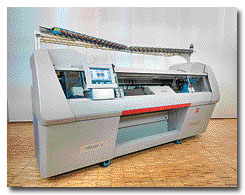
KAstoll

The CMS ADF-3 will be available in September.

May/June 2013

Quality Fabric Of The Month: Protection + Performance

By Janet Bealer Rodie, Contributing Editor

For ice hockey players, protecting the Achilles tendon from a slash by the blade of another player’s skate is a paramount concern that has been addressed by the incorporation of a cut-resistant yarn such as para-aramid into socks designed for that sport. However, most cut-resistant socks tend to be bulky and uncomfortable, and some players have risked possible injury because they prefer to wear non-protective performance-enhancing socks that offer attributes such as moisture management and compression.

Brentwood, Tenn.-based performance sock manufacturer Swiftwick’s Cut-Resistant Hockey Sock is a compression sock that provides cut- and impact-resistant protection where it is needed, wicks and channels sweat, and also prevents odor and fungal growth. The unique construction has been enthusiastically received by professional hockey players on several teams, and Swiftwick now is offering the sock to the consumer market.

According to Swiftwick CEO and Co-founder Mark Cleveland, the HG (Holy Grail) protective yarn in the Cut-Resistant Hockey Sock is a composite yarn featuring a blend of Twaron® para-aramid, Spectra® ultra-high-modulus polyethylene, and polyester wrapped around a glass fiber core. The HG yarn is plated with a hydrophobic olefin that lies next to the skin, and that plated yarn covers the back of the calf – and in one sock model, also a potentially vulnerable section of the front of the leg.

QFOMsocks

New Jersey Devils Forward Steve Sullivan says that with the Swiftwick Cut-Resistant Hockey
Sock, “I don’t sacrifice performance for my protection. I can feel the ice with great blade
control.”

“We’re trying to protect the player from an impact slice or slashing motion. If you wrap aramid around a glass fiber core, you get an impact resistance that no other product has attempted to address,” Cleveland said. “No other sock on the market has ever combined cut resistance,
moisture wicking and compression. In addition, these socks do not inhibit performance on the ice. We’re able to manage moisture while providing blood flow benefits and the performance enhancement
of compression, without compromising the overall feel of the sock.”

The sock’s 4-inch cuff puts olefin next to the skin. It has four levels of plating and acts as an “upper body sweat dam.” Much of the outside of the cuff and the sides of the sock contain hydrophilic trilobal nylon to channel sweat to the bottom of the foot to an Ejection Port™ above a
hole drilled in the skate that allows the moisture to exit. The front of the sock also is made with moisture-wicking olefin. “We’re trying not only to wick moisture, but also to attract moisture and keep it in that channel and let gravity force it to the bottom of the skate, where it is ejected,”
Cleveland explained.

In addition, a silver-ion-based antimicrobial to prevent odor and fungal growth is covalently bonded to the sock materials using a patented process.

Founded in 2008, Swiftwick manufactures all socks at its Brentwood facility.


For more information about Swiftwick’s Cut-Resistant Hockey Sock, contact Nikki Trojanowski +317-202-2280 Ext 25; nikki@dittoepr.com; swiftwick.com.


May/June 2013

The Value Of Human Capital

There are more ways to make a manufacturing operation smart than simply investing in the latest
state-of-the-art equipment — which, as well as requiring a good bit of investigation and planning
ahead, may turn out not to be the optimal solution by the time it is implemented.

Knoxville, Tenn.-based QualPro Inc.’s Multivariable Testing (MVT®) process is one smart tool
manufacturers can use to quickly and cost-effectively optimize plant operations without investing
in new, advanced equipment. The concept is relatively simple; it isn’t high-tech in the way that
smart manufacturing solutions typically are, but it can be used to optimize even the most advanced
manufacturing operation. The main components are ideas, which represent about 75 percent of the
input; and data, which account for about 25 percent. And the input of employees who are directly
involved with the processes being optimized adds another benefit because they have a stake in the
project’s success and will work hard to see that it succeeds.

MVT traces its roots back to the 1960s, when QualPro founder Charles Holland, Ph.D., was
working as a statistician specializing in process control and improvement at Union Carbide Corp.’s
Nuclear Weapons Manufacturing Division in Oak Ridge, Tenn. There, Holland began to develop the
process to help solve a problem at the plant.

Holland founded QualPro in 1982 and began to offer training seminars and consulting services
— originally to manufacturers wanting to improve processes at their plants, but eventually also to
other types of businesses including transportation, logistics, service, retail and others. Over the
years, QualPro has worked with more than 1,000 enterprises, including textile manufacturers such as
Milliken & Company, Beaulieu of America, DuPont, Unifi Inc. and Sage Automotive Interiors Inc.,
among others.

MVTplant

An associate transports fabric between processes at Sage Automotive Interiors’ Cotton
Blossom laminating plant, which used MVT to help it correct a quality problem.


MVT Methodology


The MVT process uses statistics to test ideas for improving an operation. It is a very
disciplined, multi-step process for testing multiple variables simultaneously, thereby reducing the
number of tests needed to find the best solution. From the beginning, the process has included
brainstorming among the employees who are closely involved with the operation in question, and who
are encouraged to bring all their observations and ideas to the table. The ideas are culled, and
those deemed practical, fast and cost-efficient are put into the test. As it turns out, in any
given project, about 25 percent of the ideas acted on are found to be beneficial, about half have
no effect, and the rest have a negative effect.

“MVT takes a lot of haphazard thoughts and quantitative data and rapidly tests them and
enables you to improve processes with the resources you already have, without having to invest in
big capital and new technology,” said Vice President and Principal Art Hammer, who has been with
QualPro since its beginnings. “And, if you were going to buy new smart technology, you could run a
MVT to figure out how to better use the technology and make it even smarter.”


People Power


The participation of people working directly with the targeted operation is key to MVT’s
success in any given situation. “That is absolutely core to our entire process and always will be,”
Hammer said. “Get a person from the third shift, someone from maintenance who knows the
idiosyncrasies of different machines and how they may not be operating to standard expectation. You
need to be in there elbows and elbows with all those from the different shifts.”

Data tools include a wide range of factors — for example, denier, online instrumentation,
machine speed, temperature, flow rate, tension or pressure as a polymer is extruded, the size of
the holes in the spinneret, or an additive being sprayed on a textile. There are also variables
among the people doing a given job, Hammer said. “Say the job is to correct breaks. All have been
trained, but no two people do it the same way.

“By looking at both historical and dynamic bases, you can see long-term trends as well as
what is happening at this moment,” Hammer said. “However, the data never replace what’s coming from
the local workforce. The integration of brainstorming and data tools brings better MVT results.”


Unifi: 14-step MVT Yields Improved Product Quality


Textured yarn manufacturer Unifi Inc., Greensboro, N.C., has used MVT to improve many
different operations over several years. At its REPREVE® Recycling Center, which opened in May
2011, the company had installed optimized, state-of-the-art processing equipment, but it wanted to
push the machine’s capabilities further. QualPro designed a 14-step process that helped Unifi
expand those capabilities.

“That process allowed us to look at the machine in more detail — to look at every different
knob and parameter, break it down into different sections and go to the upper and lower side of
every function,” said Todd Baker, plant manager at the recycling center. “We found that the
optimized processes the supplier gave us were not truly optimized. For example, we moved the needle
quite a bit on the color we were able to achieve.” In addition, improvements were achieved in
viscosity and other characteristics of the polymer itself.

Unifi also was concerned about variations in the quality of the polyethylene terephthalate
(PET) bottles and other PET waste it processes into Repreve fiber and yarn. It was able to refine
the filtration system to eliminate contamination in the raw material derived from the PET waste,
thus enabling improved, more consistent quality of the product it supplies to downstream customers
such as Patagonia, Nike, The North Face and many others.

Baker said the results enabled Unifi to develop a troubleshooting guide for use in the
plant. The company now is using MVT to test its lab formats and other practices.

“If you take the MVT tools and break out everything in a methodical way, you can really
identify ways to improve your business, costs and efficiencies,” Baker added. “It goes far beyond
just the machines.”

MVTrepreve

Unifi Inc.’s REPREVE® Recycling Center implemented QualPro’s MVT® process to help it push
the capabilities of its machinery as well as achieve consistent high quality in the Repreve fibers
it sends to its customers.


DuPont: Reduced Costs, Increased Productivity


DuPont, Wilmington, Del., also has utilized MVT to improve efficiencies in numerous
operations. In the 1990s, when it was producing polyester yarn and staple fiber in Wilmington,
N.C., it implemented the process to help it reduce costs and remain competitive with imports from
lower-labor-cost countries.

“At that time, capital was hard to come by, and returns on polyester weren’t large enough to
justify a lot of new capital,” said Ron Burger, former plant manager at the Wilmington facility.
“MVT offered us the best opportunity to remain competitive and get costs down, which we did through
a number of projects. We dropped maintenance costs because of our success in reducing the number of
equipment failures, dropped unit costs by 25 to 30 percent and got productivity increases of 25 to
35 percent.”

The plant’s workforce got heavily involved in the project. “We tapped into their ideas, and
that’s what made it so successful,” Burger said. “MVT is a very disciplined system of trying out
ideas and evaluating them using actual data. Not all of them work, and you begin to home in on the
good ideas right away, and that’s where all that productivity and quality improvement came from.”

Burger found MVT to be an excellent training tool for the employees. “It trains them to know
what’s important on their processes, and it will sort out myths and legends and throw out things we
all believe to be true that aren’t,” he said. “Some real leadership develops within your employees
once this process starts because it begins to tear down any barriers within your organization that
keep good employees from contributing fully.”

May/June 2013

Bulletin Board

The
Carpet America Recovery Effort (CARE), Dalton, Ga., has named Dalton-based
Columbia Recycling Corp. CARE Recycler of the Year.

Lawrenceville, N.J.-based
Datacolor‘s Datacolor Technology Suzhou, China, laboratory has received ISO/IEC
17025:2005 accredidation for calibration. The company also has revamped its website, located at
datacolor.com.

Visual Impressions Inc., Milwaukee, has become the 50th company to earn
Sustainable Green Printing Partnership certification.


Clariant AG
, Switzerland, has released ColorForward™ Interiors, a color and trend
forecasting guide for fibers and textiles.

BBClariant

Clariant’s ColorForward™ Interiors

The Boulder, Colo.-based
Outdoor Industry Association‘s Sustainability Working Group has launched a pilot
program for its Chemicals Management Framework tool, which helps companies assess their chemical
usage.

Chandler, Ariz.-based
Bonded Logic‘s UltraTouch™ Denim Insulation now is sold at six Home Depot stores
in Northern California.

Mount Holly, N.C.-based
American & Efird LLC‘s dye house in Dongmei, China, has received a Nike
Materials Sustainability Index (MSI) award.

Skins Compression Clothing has relocated its headquarters from Portland, Ore., to
364 Second St., Ste. 6, Encinitas, Calif., 92024; +760-203-3631.


Herculite Products Inc.
, Emigsville, Pa., has added Herculite Military 20696 to its
product line.


Aurora Specialty Textiles Group Inc.
, Aurora, Ill., received the Specialty Graphics
Imaging Association’s 2013 Sustainability Recognition Award for the third consecutive year.

Morgantown, W. Va.-based
SustainU has launched the Wear One, Share One program in which online customers
will receive a free 100-percent recycled-content T-shirt with each SustainU purchase.

May/June 2013

Encouraging Signs

Revised government production estimates based on updated benchmark data confirm that the U.S.
textile and apparel industries are pretty much holding their own in today’s relatively modest
economic recovery. At last report, domestic output of basic textile products like yarns and fabrics
were running 12-percent above the low point hit during the 2009 recession. That’s the equivalent of
a nearly 4-percent annual rate of increase — and not much different from the rate reported for
aggregate U.S. manufacturing activity over the same three-year period. True, the comparable 2009-12
annual rate of advance noted for more highly fabricated textile products like carpets and home
furnishings was smaller. Nevertheless, this other key mill sector managed to rack up a
close-to-1-percent annual rate of gain. Domestic apparel production over this same three-year
period showed some fractional losses, but here, too, there have been signs of leveling off over the
past 12 months or so. In any case, all of the above marks a significant change from the 10-year
period ending in 2007, the last year before the recent downturn began. During that extended earlier
period, production of basic textiles, more highly fabricated textile products and apparel tumbled
40 percent, 21 percent and 65 percent, respectively — reflecting for the most part the huge import
influx from China and other low-cost producers. But, things are beginning to change, with the shift
over the past three years clearly suggesting that U.S. mills and factories are becoming
increasingly competitive in today’s cutthroat global marketplace.


Other Positive Signs


Uncle Sam’s revised data also provide other indications of an improving industry climate.
For one, they show that the big capacity cutbacks of the past few decades are beginning to slow
down. Thus, production potential for all mills has declined only about 4 percent annually over the
past two years. That’s a fair-sized slowdown from the 5- to 6-percent attrition noted over earlier
years. Moreover, given the outlook for relatively steady demand, this upbeat trend should continue.
Also pointing to smaller capacity declines: U.S. mills still seem willing to invest hefty sums on
new facilities. The National Council of Textile Organizations finds that mills spent nearly $17
billion on new plant and equipment over the past decade. This spending is clearly paying off in
terms of impressive productivity gains. Indeed, a comparison of mill equipment and output numbers
suggests mill efficiency is rising at nearly a 3.5-percent annual rate — not that different from
the pace noted for all U.S. manufacturing. And it’s pretty much the same for the U.S. apparel
industry. Capacity shrinkage has dropped down to only a 3-percent annual rate — again, well under
the huge declines of the previous two decades, when more than two-thirds of the U.S. apparel
industry disappeared. And here, too, there’s been continuing capital investment, for both
modernization and improved efficiency.


Operating Rates Up


Finally, a few words on how the new output and capacity numbers are affecting mill and
apparel utilization rates: Here, too, the news is basically positive. More to the point: The new
government statistics show production increasing relative to available capacity. These ratios are
still nowhere near the levels at which U.S. industries would prefer to operate. Nevertheless, any
increases are welcome, as they help dampen competitive pressures. As for the actual numbers:
Domestic textile mills are currently producing at nearly 70 percent of their potential — 13-percent
above their 2009 low, though still far under the 85- to 90-percent levels prevailing through most
of the 1990s. Similar improvement is noted for the apparel sector — with a 70-percent reading
running some 10 percentage points above the 2009 low, though well under the 85-percent levels of
two decades ago. As suggested earlier, all the above has to some extent helped reduce the cutthroat
price-cutting of recent years. Indeed, it may well be why textile and apparel profits have climbed
back into modest positive territory. Moreover, factor in the likelihood of steady demand and the
absence of any cost pressures, and industry earnings could well inch up a bit more in 2013 and
2014.

May/June 2013

People

OC Oerlikon Management AG, Switzerland, has elected
Mikhail Lifshitz to the Board of Directors.

Invista, Wichita, Kan., has named
Hank Willis innovation manager, Invista Surfaces.

PeopleWillis

Willis

The
North Carolina State University (NCSU) College of Textiles, Raleigh, N.C., has
named
Barry Leonard, Welspun USA, the 2013 NCSU College of Textiles Leader of the Year.

Mount Vernon Mills Inc., Mauldin, S.C., has named
Carolyn Black FR Technical specialist.

Boulder, Colo.-based
Cocona Inc. has named
Jeff Bowman CEO.

PureCare
by Fabritech, Fairfield, N.J., has named
James A. Robb vice president and general manager.

PeopleRobb

Robb

The
Carpet America Recovery Effort (CARE), Dalton, Ga., has named
Sean Ragiel Person of the Year.

CIT Group Inc., New York City, has named
Todd Harrington Northeast regional sales manager, CIT Trade Finance.

PeopleHarrington

Harrington

Pawtucket, R.I.-based
Cooley Group has named
Steve Siener vice president and general manager, business development; and
David Lunati vice president and general manager, Cooley Engineered Membranes.


Oxford Industries Inc.
Atlanta, has appointed
Mark Maidment CEO, Ben Sherman Group.


Valdese Weavers LLC
, Valdese, N.C., has promoted
Blake Millinor to senior vice president and chief marketing officer;
Laura Levinson to senior vice president, design and merchandising;
Bob Walters to senior vice president, customer relations;
Leslie Brown to director of sales and marketing, residential brands; and
Jason Earles to director of sales and marketing, commercial residential markets.


Q-Lab Corp.
, Germany, has named
Andreas Giehl, Ph.D., European technical and standards director.

May/June 2013

The Rupp Report: Astonishing Investment Climate In The U.S.

From its beginning, the United States has played a major role within the global textile industry.
Cotton has long been a major export product from the U.S. South. Still today, cotton plays an
important role for the U.S. gross domestic product. Organizations such as Cotton Incorporated and
the National Cotton Council of America support the U.S. cotton industry up to the threshold of pain
— at least this is the opinion in other cotton growing countries. And, last, but not least, U.S.
cotton ranks among the top qualities when it comes to long-staple cotton. Pima cotton and the
Supima® brand are appreciated around the globe.

However, people, even so-called experts in the textile industry, often moan that today, it
is not possible any more to be successful in any textile market when there is such strong
competition from Asian markets in general, and the Chinese in particular. Of course, this
misconception also applies in the United States. Well, here is another story from the U.S — and it
is a successful textile industry story:

Strong Associations

Like every business sector, the U.S. textile industry is well organized. The National
Council of Textile Organizations (NCTO), based in Washington, with an office in Gastonia, N.C.,
represents the entire textile sector. The organization states it is domestically focused to ensure
a prosperous future for the U.S. textile sector, and globally positioned to work effectively with
its international allies.

According to NCTO, in 2012, the overall U.S. textile sector, ranging from fiber to apparel,
directly employed 499,000 workers — including 235,000 in textile companies alone — and indirectly
supported one million U.S. jobs.

One thing is astonishing, if one recalls the troubled economic situation in the years since
the big financial crash in 2008: NCTO says that U.S. textile companies have built 23 new plants and
invested more than US$3 billion in new plant and equipment over the last three years. These are
very impressive figures. New facilities include fiber and yarn manufacturing plants as well as
recycling plants to convert textile waste for new textile applications.

Third-largest Exporter

In 2012, U.S. textile shipments were worth more than US$53 billion. Textile product exports,
valued at more than US$17 billion in 2012, have grown by 36 percent, or more than US$4 billion,
since 2009. Net textile and apparel exports totaled US$23 billion in 2012. With these figures, it
is no wonder that the U.S. textile industry ranks third globally as an exporter of textile
products.

Two-thirds of U.S. textile exports were shipped to Western Hemisphere free trade partners
during 2012. The U.S. textile industry exported goods to more than 170 countries, including 24
countries that received goods worth more than US$100 million.

The army is in many countries of the world a strong purchasing power, and not only for
rifles and ammunition, but also for textiles. Many new developments, especially for protective
garments and high-performance fibers and fabrics, were targeted to military purposes. This is also
the case for the U.S.: NCTO says that the U.S. textile industry supplies more than 8,000 different
textile products per year to the U.S. military. In addition, the U.S. is among the global leaders
in textile research and development. New textile materials being developed by private textile
companies and universities include conductive fabric with antistatic properties, electronic
textiles that monitor heart rate and vital signs, antimicrobial fibers, antiballistic armor for
both personnel and vehicles, and temperature-regulating garments that adapt to the climate. These
are just a few examples how creative the U.S. textile industry still is.

Increased Productivity

In spite of all the troubles of the textile industry in the West, the U.S. textile industry
can present some astonishing facts and figures over the last 10 years: According to statistics
provided by NCTO, U.S. textile industry productivity has increased by 45 percent over the last
decade, and the industry is among the top three in productivity increases. And to dispel another
fairy tale about wages in textiles: In 2012, earnings for textile workers averaged 135 percent more
than apparel store workers, and they also received health care and pension benefits.

A troublesome economic situation is one thing. There are two ways to get out of it: either
accept it or fight against it. Imagination and experience have always been a splendid munition for
success. In textiles, they have brought an astonishing investment climate into the U.S.

May 14, 2013

Sponsors