Goulston Technologies Breaks Ground On $8 Million Expansion

Goulston Technologies Inc., Monroe, N.C. — a formulator and manufacturer of spin finishes and other
specialty chemicals for man-made fiber, nonwovens and downstream production; and a wholly owned
subsidiary of Japan-based Takemoto Oil & Fat Co. Ltd. — broke ground this week on an expansion
of its manufacturing facility in Monroe. The company is investing $8 million to expand the building
and install additional state-of-the-art highly automated processing equipment that will enable the
company to extend both its capacity and its capabilities, and create seven to ten additional
manufacturing jobs.

“This investment will ensure our competitiveness, and create future opportunity and jobs as
well as expand our overall manufacturing capacity and capability,” said Fred Edwards, Goulston’s
president and COO, in remarks during the groundbreaking ceremony to guests that included
representatives of the City of Monroe, Union County and local economic development interests.

According to Edwards, the expansion represents the first significant investment the company
has made at the Monroe site in more than 20 years. He noted parallels in the wider U.S. textile and
textile-related industries, as companies invest in bringing manufacturing back to the United States
in a reversal of the offshoring trends of a few years back. “It’s by no small chance that we’re
having our groundbreaking in October, which is also Manufacturing Appreciation Month,” he said.
“We’re completely committed to manufacturing in the United States.”

Goulston was established in 1937 in Monroe and was acquired by Takemoto in 1988. The Monroe
site, which currently comprises 250,000 square feet of manufacturing and warehouse space, is
Goulston’s only manufacturing location. The company exports some 50 percent of its product to
customers in 40 countries worldwide.

The expansion is expected to be completed in the third or fourth quarter of 2014, and
production in the expanded area is projected to begin no later than November 2014.

Goulston

Members of the Goulston management team and local government officials break ground on
Goulston’s $8 million expansion project (left to right): Goulston Maintenance & Engineering
Manager Bruce Robinson; Union County Commissioner Frank Aikmus; Goulston CEO Takahiko Yamashita;
Goulston President and CEO Fred Edwards; City of Monroe Mayor Bobby Kilgore; and Goulston Director
of Operations Dale Stoller.

October 15, 2013
X-Rite Introduces Ci6x Handheld Spectrophotometers

Grand Rapids, Mich.-based X-Rite Inc. has introduced the Ci6x line of handheld spectrophotometers
for color measurement of materials including textiles, automotive, packaging, plastics and paints.

The Ci6x spectrophotometers supply benchmark measurements that may be used at each step of a
production or assembly process. According to X-Rite, the tools provide improved color control for
materials, in-process parts and finished goods, along with an audit trail for facilities that
operate multiple sites.

The spectrophotometers are NetProfiler 3.0-enabled, ensuring that the instruments are
calibrated to a single centerline standard and that color measurements taken across the supply
chain are accurate and reliable. NetProfiler also allows users to share, validate and audit data
across multiple devices.

X-Rite reports other features of the Ci6x line include: a Spectralon sphere to provide
reliable color measurement over the long term; simultaneous specular included/excluded
measurements; USB and Bluetooth capability; Ci64 Graphical Jobs™, which provides visuals on a large
color screen; 4-, 8- and 14-millimeter-diameter aperture sizes for customized measurement;
compatibility with X-Rite SP6x handheld historical data for simple data transfer and sharing; and
the ability to be integrated with other X-Rite industrial software including Color iQC.

In addition, the Ci64UV model offers ultraviolet (UV) illumination and is suitable for
measuring textiles and other materials containing optical brightening agents.

October 15, 2013

EVS Debuts C-BELT Safety Belt Inspection System

Israel-based Elbit Vision Systems Ltd. (EVS) — a provider of vision solutions for surface
inspection and real-time quality monitoring — has introduced C-BELT, an inspection system for
narrow safety belts such as automotive seatbelts, safety harnessing for fire and rescue, and safety
tie-downs for transportation.

C-BELT detects, identifies and labels common manufacturing defects on both sides of a safety
belt. According to EVS, its multi-angle viewing lines are able to detect all visible defects
including ends out, broken picks, misspicks, loopy selvage, loose filament, spots, stains, holes,
mono-tails slubs, bulges, dip-ins and knots. The full color, automated inspection system works in
conjunction with EVS’s online Optimization & Cut control system.

“We have already installed the first system in some of the world’s largest manufacturers of
safety belts, and we are currently in negotiation with many other manufacturers who would like to
adopt our solution to install in their production processes,” said Sam Cohen, CEO, EVS. “We believe
that in the future, the C-BELT’s solution will revolutionize the way safety belts are produced and
inspected around the world.”

October 15, 2013

Talking Sustainability And Innovation In Denim During World Fashion Convention

Zeist, The Netherlands — October 10, 2013 — During the 2nd day of the World Fashion Convention,
jeans took center stage. More precisely, the global corporation to make jeans a more sustainable
product was explained. Mariette Hoitink of Amsterdam-based House of Denim; Andrew Olah, founder of
the renowned Kingpins tradeshow and Vincent Qin of the Chinese denim fabric supplier Prosperity
showed among them a large array of innovations that are aimed at reducing the environmental impact
of denim products. ‘Recycled’ water for jeans wet processing; laser and ozone in laundry; numerous
alternative raw materials and alternative sources of energy — which are more sustainable — are all
already available to reduce the impact on the environment of a pair of jeans.

And this is highly necessary because, especially in jeans, measures to improve sustainability
are crucial. Andrew Olah showed that denim is very taxing on the environment. If indigo was
invented today it would probably have been discarded because it consumes relatively so much water.
Added to this, cotton is a very water intensive fiber and 35% of the world’s cotton is used in the
manufacture of jeans.

The jeans case showed how buyer — supplier alliances have emerged to create the necessary
change. Innovations are often bought from upstream but they commonly require collaborative
development. Prosperity has collaborations with Tencel, Clariant, Olah Inc and with Jeanologia and
it has set up an innovation forum. House of Denim is an Amsterdam initiative bringing together
brands such as G-Star, Tommy Hilfiger, Levi’s, Denham and Scotch and Soda. Its ‘brighter blue’
initiative will center around a research lab in Amsterdam aimed at sustainability. Its Jeans School
is the first dedicated jeans school which also has sustainability featuring big in its curriculum.

But Andrew Olah made quite clear that the effect of all of this innovation and cooperation is
still too little. The sustainable innovations are simply put used in too small a percentage of
jeans. Connecting the efforts taking place in the centers of the jeans industry in the US, Europe
and China would certainly help. But for the jeans industry as a whole to make big steps towards
more sustainability the best way is setting common goals and an ambitious time path to get there.

Posted October 15, 2013

Source: World Fashion Convention

International Cotton Advisory Committee: 2013/14 World Cotton Production Down; Demand Stable

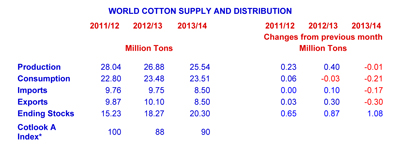
WASHINGTON — September 10, 2013 — During the 2013/14 season, world cotton production is projected
at 25.5 million tons, the lowest in four seasons, but world cotton mill use is expected to remain
around 23.5 million tons with consumption shifting from China to other countries, notably India,
Pakistan and Turkey. Production in both the United States and China are significantly less than
last season due to unfavorable weather conditions and a decrease in planted area. Cotton plantings
in the southern hemisphere start in large scale this month with approximately 2.7 million hectares
projected to be planted with cotton this season, similar to 2012/13. However, higher yields are
expected to result in an increase in South American

World cotton trade is projected at 8.5 million tons during 2013/14, approximately 1 million
tons less than last season, largely accounted for by a decrease in imports by China.

World cotton ending stocks for 2013/14 are forecast at 20.4 million tons, an increase of two
million tons from the previous season. In September, the Chinese government started buying cotton
for its national reserve, amounting to just over 100,000 tons at the end of September. In 2013/14,
China’s reserves are expected to increase to 11.4 million tons, up by almost 2 million tons from
last season. However, world ending stocks outside China will increase by less than 200,000 tons, so
that at the end of the current season, China will hold nearly 60 percent of world stocks.

ICACWorldCottonSupply
*The price projection for 2013-14 is based on the ratio of ending stocks to mill use in the
world-less-China in 2011-12 (estimate), 2012-13 (estimate) and 2013-14 (projection), and on the
ratio of Chinese net imports to world imports in 2012-13 (estimate) and 2013-14 (projection). The
price projection is the mid-point o the 95% confidence interval: 76 cts/lb to 106
cts/lb.

Click
here
to view the table in a new window.


Posted October 15, 2013

Source: ICAC

NSA Raises The Bar On High Tech Fleece Sweatshirts

CLEVELAND — October 7, 2013 — National Safety Apparel has raised the bar with their new DWR high
tech premium fleece. The modacrylic/cotton fabrics used in producing the navy blue crew neck,
pullover, half-zip, stand-up collar half-zip and full-zip fleece sweatshirts have been upgraded to
make water bead right off as if you were wearing a heavy outerwear coat.

The premium fleece also has a reliant soil release feature which aids in the release of hard
to remove stains during home laundering. All versions of the sweatshirt can be customized with lots
of incredible features best suited to the end users needs and applications.

“This product has been a pleasure to work with,” said Director of Technology, Jeff Martin,
“The modacrylic/cotton fabric has an impressive 34 cal/cm2 arc rating and complies with both NFPA
70E and NFPA 2112. The flash fire protection, outstanding DWR, soil release performance, and
comfort makes this line of sweatshirts one of my personal favorites at National Safety Apparel,”
Martin said.

This fleece combines breathability and water-resistance with exceptional warmth and comfort.
These sweatshirts will keep end users warm and dry, even in the rainiest conditions, and are sure
to be a hit as the weather starts to cool down in the months ahead.

Posted October 15, 2013

Source: National Safety Apparel

Huntsman Broadens Film & Sheet Portfolio

OSNABRUK, Germany — October 14, 2013 — Huntsman has expanded its extensive thermoplastic
polyurethane (TPU) film and sheet portfolio. The company has developed IROGRAN® CA117-200 – a high
performance, plasticizer-free, polyester-based TPU that enables the faster processing of films with
exceptional adhesive properties.

Suitable for use with plastic, fabric and / or wooden substrates, IROGRAN® CA117-200 is
taking the use of extruded TPUs in different directions – opening up film and sheet application
opportunities that previously did not exist because of processing or performance constraints.
Target markets for IROGRAN® CA117-200 include the automotive industry, the production of technical
textiles, and the manufacture of footwear and sports equipment.

Film adhesives based on IROGRAN® CA117-200 offer good chemical and heat resistance. They also
have a non-tacky surface, meaning they can be used without the need for a carrier or release liner
backing. For laminators, the low activation temperature and high green strength of IROGRAN®
CA117-200 will be an attractive proposition, while film manufacturers will appreciate its uniform
quality and ability to deliver more consistent throughput and better gauge control. 

Jaci Grote, Account Manager, USA at Huntsman, said: “Our range of film and sheet solutions is
already the broadest portfolio available. Adding IROGRAN® CA117-200 takes our offering to a new
dimension. The product was developed following discussions with a customer that needed a solution
with a far better melt index range. Competitor solutions just weren’t up to scratch. Using our
understanding and know-how we developed the product taking it from laboratory bench to application
in just three months.”

IROGRAN® CA117-200 is manufactured at Huntsman’s Osnabrück production plant in Germany but is
available globally. The product is one of a number of TPU solutions that will be on display at
Huntsman’s stand (F79 and Hall 8b) at K2013 when the show opens for business on 16 October 2013 in
Dusseldorf, Germany.


Posted October 15, 2013

Source: Huntsman

Teijin Introduces Sereebo Brand For Coming CFRTP Products

TOKYO — October 15, 2013 — Teijin Limited announced today the launch of Sereebo, a new brand for
carbon fiber reinforced thermoplastics (CFRTP) which the company envisions will be used in green
products that revolutionize manufacturing with enhanced production speed and recyclability.

The name Sereebo is an acronym for “Save the earth, revolutionary & evolutionary carbon.”
Teijin expects Sereebo to facilitate the development of lighter and smaller mass-produced products
such as automobiles.

Sereebo-branded CFRTP composites are made with three Teijin-developed intermediate materials
that the company produces by impregnating carbon fiber with thermoplastic resin. U Series is a
unidirectional intermediate offering directional strength on an ultrahigh level. I Series is an
isotropic intermediate offering a balance of shape, moldability and multidirectional strength. P
Series, which is a long-fiber thermoplastic pellet (LFT) made from high-strength carbon fiber, is
suitable for injection molding of complex parts, a promising material that will enable the
recycling of CFRTP composites.

Teijin is currently accelerating its development of applications for CFRTP composites in
promising industrial fields including automotive. In 2011, the company developed the three
intermediate materials and the world’s first technology for the high-volume production of CFRTP
components with a takt time of less than a minute, which overcomes one of the biggest challenges in
the automotive industry. This breakthrough is expected to lead to increased use of
high-performance, low-weight carbon fiber materials for automobiles and other products. Teijin is
currently working with General Motors and other automakers worldwide to develop advanced
carbon-fiber composite technologies for the mass production of reduced-weight vehicles.

Developments at Teijin are being spearheaded by a collaborative effort involving the Teijin
Composites Innovation Center, a Japan-based R&D hub for carbon fiber composites business, the
Teijin Composites Application Center, a technical facility opened in Michigan, USA in April 2012,
and a pilot plant opened in Matsuyama, Japan in December 2012 to test the fully integrated
production of CFRTP components.

The Teijin Group aims to become a global leader in the development of advanced solutions
incorporating carbon fiber composites, targeting annual sales of JPY 150 to 200 billion (USD 1.5 to
2.0 billion) by around 2020.

Posted October 15, 2013


Source: Teijin Ltd.

People

The Clover, S.C.-based
Synthetic Yarn and Fiber Association (SYFA) has named
Diane Bayatafshar managing director. Former managing director
Kim Pettit will focus on member recruitment and continue to represent SYFA at
industry trade shows.

The
German Engineering Federation (VDMA) Garment and Leather Technology Association,
Germany, has elected
Günter Veit, VEIT Group, chairman, and
Klaus Freese, Klöckner Desma Schuhmaschinen GmbH, deputy chairman.

Ventura, Calif.-based
Patagonia Inc. has named
Joy Howard vice president, marketing.

PeopleHoward

Howard (Photo courtesy PRNewsFoto/Patagonia Inc.)

Paris-based
Lectra has named
Charlie Xu vice president of sales, fashion for Greater China.

Wellford, S.C.-based
Leigh Fibers Inc. has appointed
Darrell J. Turner COO. Former COO
Keith Taylor has been named to the company’s Board of Directors.

Perkasie, Penn.-based
Secant Medical Inc. has appointed
Jeff Robertson president.

The
International Forum for Cotton Promotion (IFCP), Washington, has elected
Mark A. Messura, Cotton Incorporated, chairman;
Elke Hortmeyer, Bremen Cotton Exchange, vice chairman; and
Nayan C. Mirani, Cotton Association of India, treasurer.

Duquesne, Penn.-based
American Textile Company has appointed
John Burke, Armada Supply Chain Solutions, and
Charles Bitzer, Abarta Inc., to its Board of Directors.

The Alexandria, Va.-based
Textile Rental Services Association of America (TRSA) has given the 2013 TRSA
Operator Lifetime Achievement Award to
Richard J. L. Senior, Morgan Services, in recognition of his exceptional personal
service to the textile services industry and TRSA.

Marshall, Mich.-based
Distinguished Restaurants of North America has appointed
Anthony M. Cerone, Riegel/Mount Vernon Mills, to its Board of Directors.

Tuscaloosa, Ala.-based
Phifer Inc. has added
Monica Thornton and
Raymond Neuse to its fabric design team.


PeoplePhifer

Thornton and Neuse

Lang Ligon and Co. Inc., Greenville, has named
Stephen Charron technical services representative, responsible for sales, service
and installation of all Lang Ligon and Co. products.

PeopleCharron

Charron

Brian Shore has established a new company,
Hospitality Provisions & Co., Greensboro, N.C., to serve the hospitality and
contract markets.

PeopleShore

Shore

October 2013

Positive Trade Signs

There’s more good news on the U.S. international trade front — in the form of a new study that
quantifies the import-blunting impact on textiles, apparel and other industries stemming from the
continuing big pay hikes hitting many of the United States’ overseas suppliers; and the declining
cost of U.S. energy due to its new gas and oil fracking breakthroughs. Prepared by the prestigious
Boston Consulting Group, (BCG), one of the report’s key findings is that by 2015, the United States
will have pretty much closed the once-huge gap between American and Chinese production costs. Only
a miniscule 5-percent differential is anticipated by that time. Clearly, this should help speed up
the current reshoring trend discussed in the last month’s column
(See ”
Pessimism
Is Unwarranted
,”
TextileWorld.com, September/October 2013)
. Equally significant, BCG cost
comparisons with other countries should also bode well for U.S. trade. Analysts at the consulting
firm, for example, figure that by 2015, American production costs on average will actually be
running anywhere from 8 to 18 percent below costs of such major industrial competitors as Germany,
Japan, the United Kingdom, France and Italy.

Other things being equal, this should allow the U.S. to grab a larger percentage of global
manufacturing sales, thereby sparking additional gross domestic product growth and consumer
spending. Put another way, the overall U.S. export total should expand to the extent that some 2.5
million to 5 million additional jobs could well be created by the end of the decade — enough to
drop the currently still-high unemployment rate to below 5 percent.

BFgraph


Profits Also Look Better


Coming back closer to the present, textile mill earnings, despite only so-so demand, have
remained surprisingly buoyant. Uncle Sam’s second quarter 2013 numbers, for example, put the
industry’s after-tax profits at around $505 million — a significant 31-percent above the comparable
level of a year earlier. And it’s pretty much the same picture when the last available 12 months
are compared to the previous 12 months. The numbers for domestic apparel manufacturers are equally
upbeat, with second quarter 2013 results running a solid 14 percent ahead of a year earlier.
Equally impressive gains are noted when profits are considered as a percentage of sales. The latest
— again, second quarter 2013 — textile mill reading for this so-called margin measure is clocked in
at 4.9 percent. That’s well above the 3.9-percent reading of second quarter 2012. And the same
basic pattern is noted for apparel — a 9.3-percent margin at latest report versus the lower
8.2-percent figure noted a year earlier. And comparable improvement shows up in still another
widely monitored margin yardstick — profits per dollar of stockholders’ equity. Again, both U.S.
industries continue to show improvement, with latest mill and apparel numbers running slightly
above year-earlier readings. Still another encouraging note: All the above-noted mill and profit
numbers are in marked contrast to the essentially level or even slightly lower readings being
reported for “all U.S. manufacturing” over this same period.


The Trend Should Continue


More importantly, there’s little to suggest any important change in these industry profit
trends over the remainder of the year — and probably well into the future. For one, demand should
hold up tolerably well as the economy continues to slowly improve. Also, the import share of the
market, while remaining huge, should no longer be increasing. Equally significant, U.S. labor and
material costs both look to remain pretty much under control. In any event, the latest quarterly
profit projections by Global Insight — another top economic consulting firm — would certainly seem
to bear this upbeat outlook. Their analysts, using rough and dirty estimates of profits — shipments
less labor and material costs — indicate that this year’s earnings for basic textile mills will be
up a hefty 75 percent compared to last year’s levels. That more than recoups the big profit
declines suffered in 2011, when cotton costs went through the roof. Zero in on both more highly
fabricated textile product mills — carpets, home furnishings and other such products — and apparel
makers, and equally impressive 2013 earnings advances are anticipated. True, Global Insight
analysts feel that next year’s profit gains should be a lot more modest, running generally in the
2- to 7-percent range. But the key point to emphasize is that the dollar totals will still be
edging higher. More importantly, a similar positive earnings pattern is seen for both 2015 and 2016
— a pattern strong enough to assure that U.S. firms will remain world-class producers through the
foreseeable future.

October 2013

Sponsors