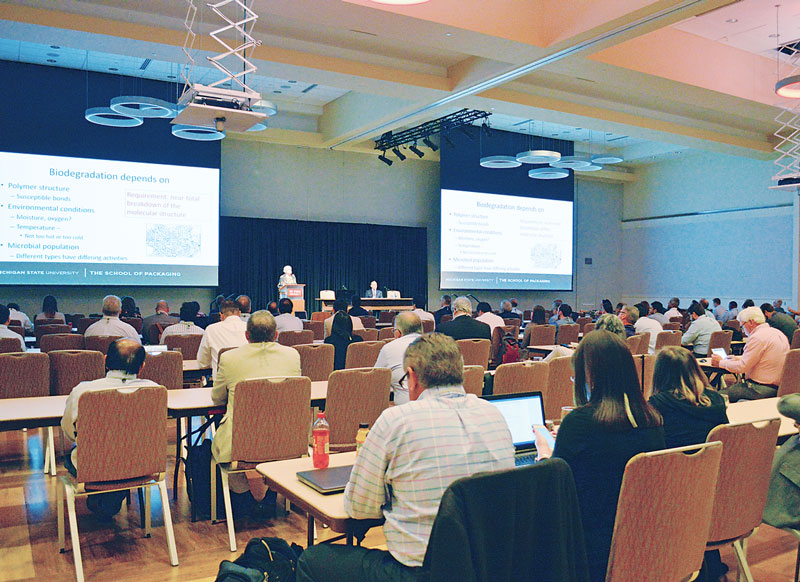
The Talley Student Union on the NC State campus was a great location for the recent RISE® conference.
The recent RISE® event facilitated learning as well as building connections for individuals in the nonwoven/engineered fabrics industry.
TW Special Report
The ninth RISE® — Research, Innovation & Science for Engineered Fabrics — conference, attracted more than 170 professionals to the Talley Student Union on the campus of North Carolina State University (NC State), Raleigh, N.C. The event was co-organized by the Association of the Nonwoven Fabrics Industry (INDA), NC State, and The Nonwovens Institute (NWI).
RISE focuses on emerging technologies and ideas with the aim of connecting innovations with real-world applications for professionals in the nonwoven/engineered fabrics industry.
At the 2019 edition, attendees gathered to hear presentations given on topics arranged in three major sessions — Sustainable Additives & Polymers; Circular Innovation; and Market Data & Intelligence Trends. Keynote presentations included “CiCLO Sustainable Textile Technology” by Andrea Ferris, CEO, Intrinsic Advanced Materials; “The U.S. Economic Outlook” by Dr. John Connaugton, Barings Professor of Financial Economics, UNC-Charlotte; and “Biodegradation-Promoting Additions for Plastics — Questions You Should Ask,” by Dr. Susan Selke, director and professor, School of Packaging at Michigan State University. RISE also featured a poster exhibition highlighting the work of graduate students presented by NWI.
During RISE, the Nonwovens Institute hosted a reception with guided tours of its facility on the NC State campus.
Conference attendees also had the opportunity to attend a reception and guided tour of the 40,000-square-foot NWI on the Centennial Campus of NC State.
“This conference provides valuable new nuggets of information and I always make six to eight strong connections,” said Darryl Fournier, vice president, North America, Fibertex Nonwovens.
Innovation Award
During the conference, attendees listened to presentations from each of the three RISE Innovation Award finalists about their products — Surfaceskins from the Nonwovens Innovation & Research Institute (NIRI), England; Reicofil 5 (RF5) Technology from Reifenhäuser Reicofil GmbH & Co. KG, Germany; and the Remodelling™ Compound Hernia Patch from Shanghai Pine & Power Biotech, China — and voted for their favorite innovation. NIRI took home the top honor for its Surfaceskins antibacterial door push pads and door handles, which are designed to kill deposited germs in just seconds between one user and the next one passing through a door to help limit the spread of healthcare associated infections.
“RISE 2019 on the North Carolina State University campus was an energizing event,” said INDA President Dave Rousse. “The venue of academia added to the sense of learning from the conference content. With great support from NC State and the Nonwovens Institute, this edition of RISE was described by many as the best RISE event yet. The combination of the campus environment, strong slate of speakers, condensed agenda with lunch on-site, and the Nonwovens Institute reception and tour made for a value-packed two full days. I think we have found the right formula, and we look forward to returning RISE to NC State again next year, with our partner, the Nonwovens Institute.”
RISE will return to the NC State campus in September 2020.
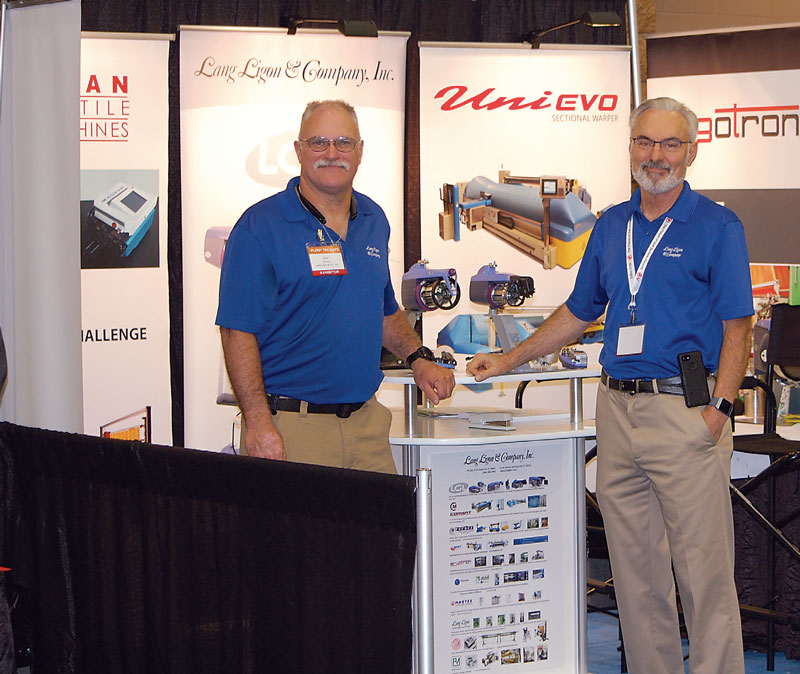
Lang Ligon & Co. Inc. was a first-time exhibitor at FloorTek.
TW Special Report
The American Floorcovering Alliance (AFA) recent hosted FloorTek 2019 at the Dalton Convention Center, Dalton, Ga. The exhibition featured 80 exhibitors with the addition of several new programs to the satisfaction of exhibitors and visitors alike.
Zach Monroe of Card-Monroe Corp. called FloorTek 2019 the “best yet,” saying, “It’s really good to see that, as we invest in the show, they invest back.”
His sentiments were echoed by Eltex U.S. Inc.’s President Jonathan Bell. “My overall impression was that FloorTek was a very well run show and seemed to be better attended this year than the last several shows,” Bell said. Eltex was showcasing its new sensor for tufting machines, the COMPACT II, which was first shown at the recent ITMA show in Barcelona.
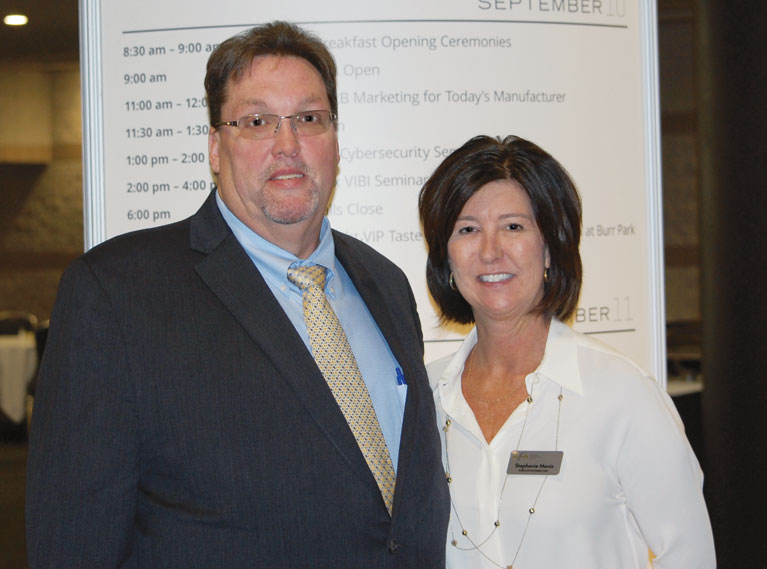
The Synthetic Yarn & Fabric Association’s Rodney Turner (left) with AFA’s Stephanie Manis
Focus On Future Connections
Future Connections was added to the FloorTek agenda as a way to network local, future talent with opportunities in the floorcovering industry.
Stephanie Manis, AFA executive director, stated: “FloorTek is the perfect opportunity to connect future leaders with the current industry. Partnering with local schools in an industry networking environment such as FloorTek is the perfect space to connect students and industry businesses to show what options are available in the industry.”
According to AFA, “The inaugural Future Connections drew the HR departments of Engineered Floors, Apache Mills, Qualified Staffing, American Carpet Wholesalers, and Express Employment professionals, and students from Dalton State, Chattanooga State, Cleveland State, Georgia Northwestern, and Belhaven.”
“Dr. Tremaine Powell, dean of Engineering and Information Technologies at Chattanooga State Community College, both staffed the Chatt State booth at FloorTek and participated in the Future Connections event,” AFA reported. “Some of his students participated, but Powell and other education professions who attended intend to make FloorTek’s Future Connections networking event a part of the curriculum for next year’s classes.”
Extending Networking In Dalton
The AFA also organized a new networking opportunity for FloorTek attendees and exhibitors with an opening night VIP reception titled “Taste of Dalton” held in Burr Park located in downtown Dalton. The event featured local fare, live music, drinks, and more, with the support of sponsors, participating Dalton restaurants and supporting members.
AFA To Make FloorTek An Annual Staple
The AFA announced at the exhibition’s conclusion that because of the success of the event, and a high satisfaction rating among exhibitors, it intends to make FloorTek an annual staple as opposed to holding the exhibition every other year.
The AFA defines itself as a “not for profit association created to promote and market the flooring industry.” It was mission success at this year’s FloorTek 2019 exhibition.
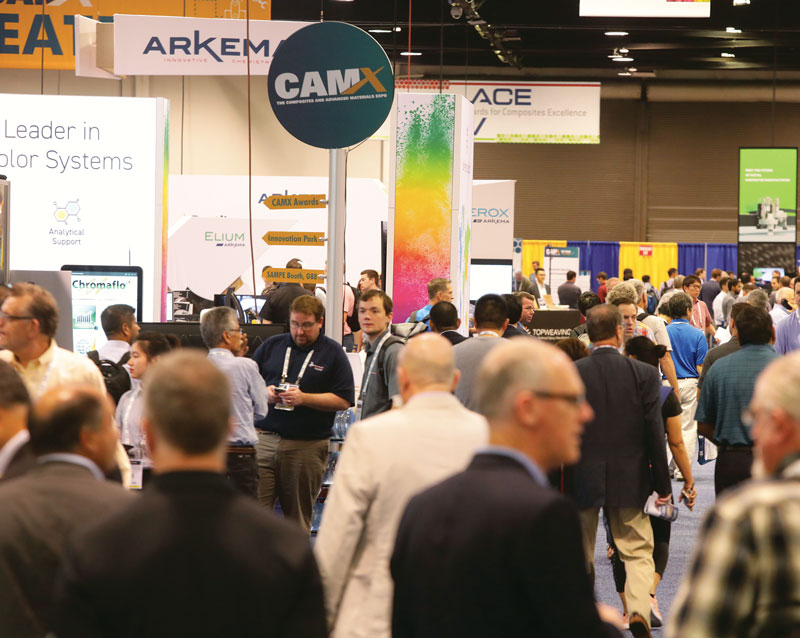
CAMX showcased the variety and depth of the composites industry, as well as hinted at future opportunities.
By Jim Kaufmann, Contributing Editor
CAMX — the Composites and Advanced Materials Expo produced by the American Composites Manufacturers Association (ACMA) and the Society for the Advancement of Material and Process Engineering (SAMPE) — held recently at the Convention Center in Anaheim, Calif., was the equivalent of walking into a big box superstore filled with virtually every aspect of the composites supply chain. The only real difference between the expo and a big box retailer was that one rarely, if ever, had to look for assistance because plenty of knowledgeable representatives, eager to address any questions, staffed each booth.
Numerous examples of molded composite parts and end products were on display in many booths showcasing how broad and varied the composites industry has become, while at the same time hinting at how much more opportunities lie ahead. The CAMX and ACE Awards display areas on the show floor also added to the potential of more new applications and unique opportunities created with composites.
Variety and product selection along with all the “hot topics” — such as Industry 4.0, improving processing speeds and market growth and expansion — were certainly present and lest we forget, there was a lot of business being conducted throughout. “It may not always look like it, but there are a lot of people having a lot of strategic meetings here at the show,” said Seth Carlin, key account manager for Saertex-USA, Huntersville, N.C. “I’ve been in so many meetings, I haven’t had a chance to walk the show floor and now doubt that I will.”
“It just makes good sense for me to attend these industry shows,” offered Lutz Heinig, sales manager, technical textiles business unit for Greensboro, N.C.-based Karl Mayer North America. “It would take me three to five days of travel alone just to see the number of our customers that I can see here in one day.”
“CAMX always does a good job with the show set up allowing us easy access to all aspects of the industry, including our suppliers and customers and it’s great to catch up with everyone,” added Dave Maas, business development manager, V2 Composites, Auburn, Ala.
One of the underlying themes at CAMX was the growing urgency to keep the current momentum in the industry going. As composites usage grows in acceptance, companies now have to show they belong and can match or better traditional manufacturing methodologies in performance, cost and efficiency. “The end users are the key and we all need to somehow get more of them attending these shows to broaden the lines of communications,” said Daryl Thompson, business development manager, Hypercomp Engineering, Brigham City, Utah. “I see suppliers talking to suppliers and there are customers here, but it’s really the end users who need to understand what each level of this supply chain is capable of.” Exhibitor Andreas Martsman, vice president of marketing and sales for Sweden-based TeXtreme, added: “We, as fabric suppliers, need to be taking a much larger part in design and engineering because the flexibility of this technology is huge. Many customers only talk to the pre-preggers, not the fabric manufacturers on infusion and fabric structures. We need to change that reality because we understand that small changes in the fabric’s features can greatly influence product performance. We can bring our experience to the table and show them how best to apply it.”
As the composites industry continues to evolve, shows like CAMX will keep providing the forum for allowing attendees to keep it moving in the right direction. The next edition of the show will be held September 21-24, 2020, in Orlando, Fla.
Sweden-based Södra reports it has developed a solution that will enable blended fiber fabrics to be recycled on a large scale. The company’s new technology can separate cotton from polyester in a poly/cotton blend. The cotton fibers may then be mixed in with the company’s wood-derived textile pulp in order to create new textiles. Viscose and lyocell textiles also may be processed using the technology. Currently, the company can only process white textiles, but is working on a decoloring solution to allow more textile waste to be recycled. Another goal is to investigate extracting “a stream of residual products from the polyester,” according to the company. In order to meet a goal of adding 25,000 metric tons of textiles to its pulp production, Södra is looking for partner companies to deliver large volumes of textiles for processing.
Eastman, Kingsport, Tenn., recently started up a commercial operation for its chemical recycling technology, which breaks down waste plastics into molecular building blocks that are indistinguishable from virgin including carbon, oxygen and hydrogen. This carbon renewal technology offers an end-of-life solution for a variety of plastics all from different sources — including single-use plastics, textiles and carpets — that are difficult to recycle using traditional mechanical recycling methods. The waste plastics may be recycled an infinite number of times with no quality degredation. Eastman reports it expects to consume up to 50 million pounds of waste plastic in the operation in 2020, and already has plans underway to expand that amount.
“The problem of waste plastics is not one that can be solved by a single company, but Eastman is taking definitive action to do our part,” said Mark Costa board chair and CEO, Eastman.
In related company news, Eastman has partnered with Circular Polymers, Lincoln, Calif., to secure a consistent source of feedstock for its carbon renewal technology. Circular Polymers will collect polyester carpet from homes and business and separate
the fiber from the backing before sending it to Eastman, which will recycle the fiber and convert it into new materials.
Brussels-based Solvay has opened two research and innovation (R&I) centers — one in Alpharetta, Ga., and one at its headquarters in Brussels — dedicated to thermoplastic composites. The complementary centers were created to speed up the company’s development of these materials. The Alpharetta location brings end-to-end polymer and carbon fiber expertise, while the Brussels location will focus on collaborating with customers to accelerate market adoption of thermoplastic composites.
“Solvay’s new R&I centers in the U.S. and Europe and our recent capacity expansions, complete our infrastructure to support the industrialization of our thermoplastic materials technology,” said Augusto Di Donfrancesco, member of Solvay’s executive committee. “The centers provide state-of-the-art assets and capabilities to accompany our customers in the design, prototyping and testing of parts and allowing for a dramatic acceleration of the time to market of our materials.”
Hexion Inc., Columbus, Ohio, reports the successful completion of its Application Development Center (ADC) in Shanghai. The 4,800-square- meter facility will support Hexion’s research and development efforts and customer collaborations with a focus on waterborne coatings and composite applications.
“The new ADC is another example of our ongoing commitment to strategically invest in our R&D footprint to increase opportunities for innovation and stimulate growth,” said Craig A. Rogerson, chairman, president and CEO. “… we expect the new ADC to strengthen our market leading position in China for wind energy applications by developing next generation solutions based on EPIKOTE™ and EPIKURE™ epoxy systems. The ADC will also support further innovation based on our EPIKOTE and EPONOL™ resin systems for automotive applications, such as lightweight auto composite components and other technologies that allow customers to build cars with better mileage, reducing air emissions without sacrificing performance, as well as enabling technologies that support production of electric-powered vehicles.”
In a global economy, the most effective companies are thinking globally while still acting locally
TW Special Report
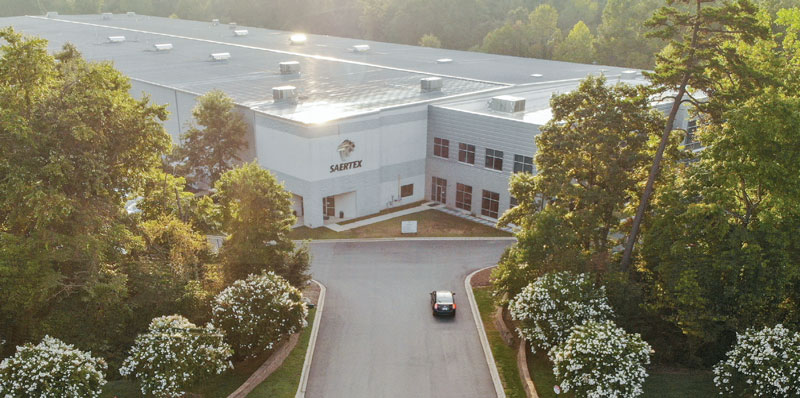
SAERTEX USA LLC, located in Huntersville, N.C., takes pride in being a global company, while still having the aptitude to act locally. A wholly-owned subsidiary of SAERTEX GmbH — a Germany-based manufacturer of non-crimp, multiaxial fabrics — SAERTEX USA focuses primarily on the North American markets.
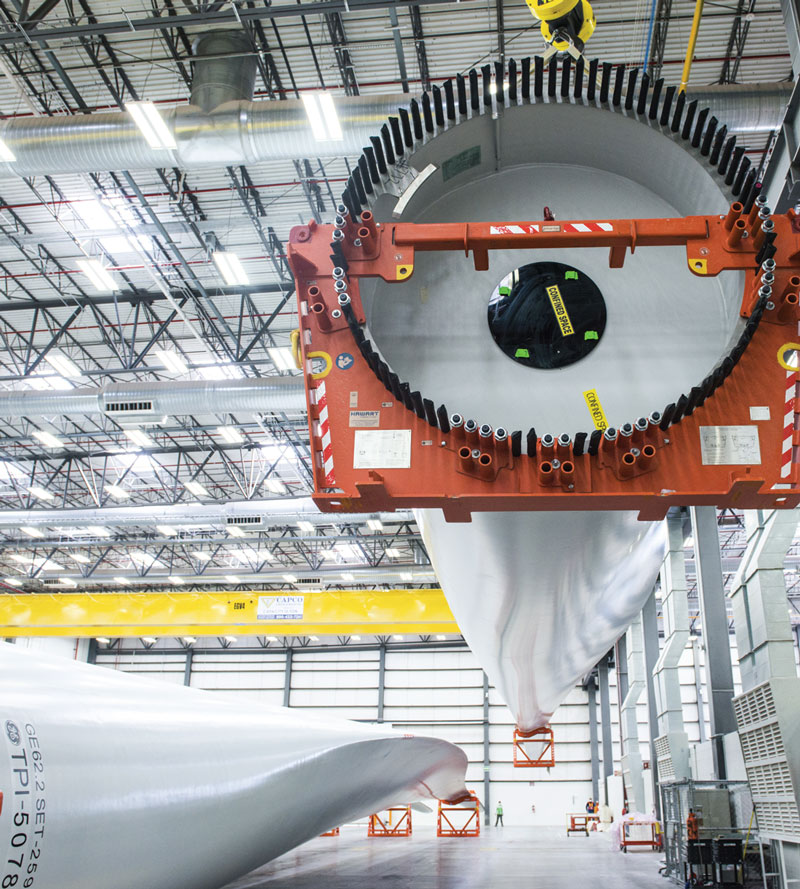
SAERTEX GmbH was founded in 1982 by Bruno Lammers and Gert Wagener in the small town of Saerbeck in northwest Germany. They started with one machine and the belief that lightweight fiberglass-reinforced composite solutions were going to find increasing opportunities as the composites industry took shape and began to grow and expand. It transpired that non-crimp, multiaxial fabrics made from fiberglass rovings were excellent reinforcing materials when used to make composite wind turbine blades where shape is critical to aerodynamics and the light weight of such composites compared to metals allows larger blade sizes to be constructed. Though Wagener left SAERTEX in 2007, the company, led by Bruno Lammers and his family, has grown into a global entity with 15 manufacturing locations in 10 different countries currently, including North and South America, and more in the planning phases to support the global growth of composites in the wind industry as well as other industrial and technical applications.
“The company’s strengths come not only from being a global entity, but also from having a local focus at each manufacturing location,” offered Wayne Merritt, SAERTEX USA’s senior vice president of operations. “Shipping costs keep rising throughout the world and the fabrics we produce are relatively heavy, so we try to maximize loads and ship in truckload or container quantities. Our manufacturing locations tend to be positioned strategically throughout the world to be near that area’s customer base minimizing the impacts of logistics and shipping costs. This also allows us to better service customers while at the same time improving our sustainability and reducing SAERTEX’s carbon footprint.”
Composite Advantage, Dayton, Ohio, constructed a shared-use bridge at Lake Tahoe, which features 32 prefabricated fiber reinforced composite sections on steep hillsides that could not accommodate ground paths.
North America Focus
SAERTEX USA was opened in 2001 to service the developing North American wind industry where fiberglass fabrics are used as reinforcing components in the composite wind blades. “Like SAERTEX originally, we basically started with one or two machines in a cramped space at the beginning of the wind industry’s prolific growth and have ridden that wave to where we are now” said Kyle Kraus, SAERTEX USA’s senior vice president of sales and marketing. “We are a dominant player in the wind industry with the global capacity to meet and support the industry’s needs.”
There are certainly numerous advantages to SAERTEX USA’s Huntersville, N.C., location. “SAERTEX USA benefits from the strong textile industry presence here in the southern United States which helps in finding experienced employees and provides easy access to the local offices of many raw material and equipment suppliers as well as other resources,” Merritt said. “In fact, our largest raw material supplier, Nippon Electric Glass (NEG) has three fiberglass manufacturing facilities within a 90-minute drive of our location. The relationships with our glass suppliers are very important since raw materials are so critical to the product’s performance, quality and manufacture ability” added Merritt.
Being located close to its suppliers in North America affords SAERTEX USA tremendous benefits. “The savings from being able to ship large quantities of fiberglass locally certainly adds up,” stated Mark Oliphant, supplier quality engineer. “And, if we encounter any issues, we can likely have someone in the plant to address the problem within an hour or two. This proximity also improves our general communications with the suppliers as well, which helps to ensure that we’re all working towards the same goals. It’s really a huge advantage for us, our suppliers and our customers.”
“Non-crimp, multiaxial fabrics, which are sometimes referred to as weft inserted warp knits or stitch bonded non-crimp fabrics, exhibit two unique primary characteristics or attributes,” offered Nick Ruane, project engineer. “The first is that the fabric-forming process incorporates individual sheets of roving — for us, typically fiberglass or carbon fiber — where the rovings are presented in straight lines so that there is no crimp or bending. The straight-line positioning of the fiberglass promotes an immediate reaction to directional loads when the fabric is stressed, which is different from crimped or bent rovings, like those found in most woven fabrics. This can result in a delay occurring during stress strain loading when the crimp has to first be straightened out for the roving to be fully engaged which could affect performance.”
The second primary characteristic of multiaxial fabrics is that the rovings can be oriented in a number of different directions — 0 degree or machine direction, 90 degree or cross-machine direction, plus and minus 45 degrees, and other directions depending on the machine configuration. “So, where a woven fabric will only have yarns or rovings in two directions — 0 and 90 degrees, or warp and weft — a multiaxial fabric can have rovings in 0, 90, +45 and -45 directions or other combinations,” Ruane added. “When each direction has the same relative amount of roving in it, the fabric exhibits near isotropic properties — meaning that if pulled in virtually any direction, it will react the same way.”
“Such characteristics are highly valued in many composite structures where it’s important to control the reactions to stress and strain forces that the composite structure may be exposed to,” stated Seth Carlin, SAERTEX USA’s key account manager for Wind Customers. “SAERTEX’s design engineers can balance the different axis’ characteristics as needed based on the customer’s specific product and application design needs.
“For example, wind turbine systems use SAERTEX’s non-crimp uni-directional and bi-axial fabrics to make the turbine blades lightweight and more efficient,” Carlin noted. “Having the ability to target specific areas with the fiber reinforcement provides designers with more latitude and flexibility in their composite designs. Wind blade requirements are changing as the industry transitions towards larger blade sizes to greatly increase their efficiency. As a result, wind blades are now as technologically advanced as jet plane wings, yet larger. And keep in mind that with multiple blades per wind turbine, each blade must be precisely balanced in both weight and the distribution of weight — moment of inertia — to maximize the system’s efficiency.”
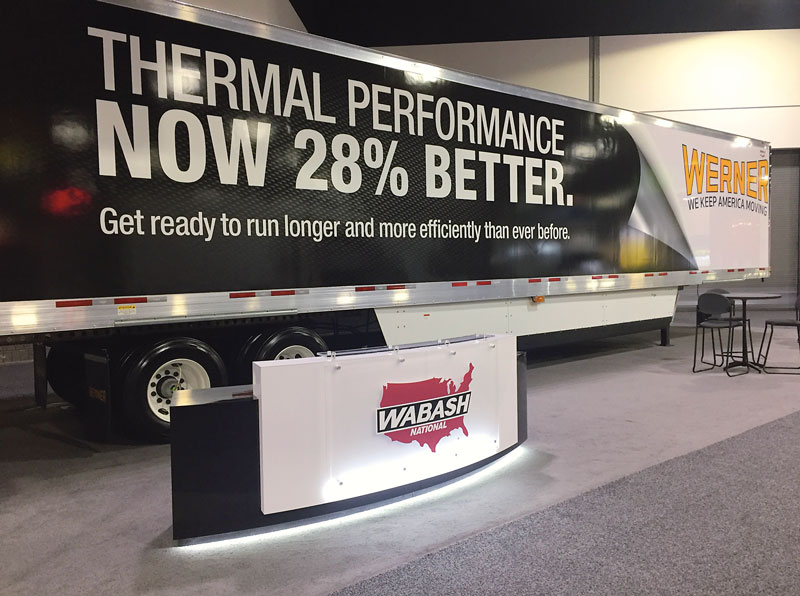
Wabash National’s new refrigerated trailer exhibits weight and efficiency savings through the use of SAERTEX fabrics.
Global Markets And Applications
“The wind markets have been one of SAERTEX’s main business segments for years, but we have been working hard to broaden and diversify our product offerings into other market segments,” Kraus said. “Today the distribution of market segments we service has seen important increases in industrial, technical and marine applications as we continue to broaden our product offerings here in North America.”
“Our location has certainly helped with the focus on diversifying our products,” Ruane commented. “NEG’s R&D center is an hour away and there are other technical labs and services nearby that are easily available to us, which can be very handy when evaluating new products and applications to support our customers.”
Several examples of SAERTEX’s diversification into other market segments reflect these development efforts.
Wabash National, Lafayette, Ind., a manufacturer of trailers for commercial transport applications, is using SAERTEX USA fabrics to improve refrigerated trailers, making them lighter in weight, more fuel efficient and aerodynamic. “We’ve been involved with Wabash from the beginning as they began investigating the benefits of fiber reinforced composites,” Kraus said. “Their refrigerated trailer was originally made using steel and aluminum. It’s now almost all composite. This change will allow Wabash to reduce the weight of their refrigerated trailer by more than 1,000 pounds and improve thermal efficiencies by 28 percent or more, which will effectively change the industry.”
Composite Advantage, Dayton, Ohio, designs and manufactures fiber-reinforced composite structures for infrastructure applications. These include items like pedestrian bridges, pylons and dock pieces, fender guide walls, submarine camels and other unique configurations for technical applications. According to Kraus: “Fiber reinforced composites offer several benefits over traditional steel, wood and concrete for these types of products including high strength to weight ratios, chemical and corrosion resistance, design flexibility, low maintenance costs and an extended lifespan. These attributes have allowed Composite Advantage to build a rather interesting portfolio of sustainable applications.”
The marine industry, including Taiwan-based Ocean Alexander, was one of the early adopters of fiber-reinforced composites .
The marine and boating industry was one of the first market segments to embrace fiber reinforced composite structures for boat hulls and structural components, which SAERTEX USA continues to supply. “We work through distributors or directly with the boat builders to supply a variety of products,” Kraus said. “Our SAERcore products are used to improve resin flow throughout the molding process while our biax and quad fabrics provide the structural integrity necessary for ocean going boats and larger yachts.”
SAERTEX USA is also broadening its capabilities to produce fabrics from a variety of other raw material inputs, including carbon fiber where usage in many market segments continues to grow. “We have a couple of machines specially modified to produce carbon fabrics that are being used in aerospace and other high-performance applications,” Ruane said. “We have worked with aramids, basalt and other high-performance yarns and rovings as well. We’re always looking for new opportunities.”
Local, Family, Community
Along with the renewed focus on customers and new markets, SAERTEX USA has also been working diligently to foster and create stronger bonds with its employees. “There have been a lot of changes here at SAERTEX, but the one constant has been our various efforts to retain our employees,” said Stephanie Barrow, director of human resources. “Along with the standard benefits package we offer, we’ve been working hard to build an inclusive community for our employees. With the local unemployment rate being under 4 percent, it’s difficult to find new people, so when someone comes to work at SAERTEX, we want to keep them here.”
With many of the workers coming from different parts of the world and different cultures, SAERTEX USA has created a variety of offerings and activities to bring people together. “We offer language classes and interpreters as necessary to make it easier to communicate when English isn’t an employee’s first language,” Barrow noted. “There are various team building and social activities including holiday and recognition meals. And a few weeks ago, we had our first Family Fun day where employees could bring their family to work. We had food trucks, games, raffles, plant tours and even a dunk tank. Everyone enjoyed it and we’re planning to make it an annual event.”
SAERTEX started out 37 years ago in a small town in Saerbeck, Germany, with one machine as a local family-owned business. It’s now grown into a global entity with a global customer base, that is still family owned and still maintains that local family feel at its manufacturing locations. SAERTEX USA is certainly following that model in North America — thinking globally and acting locally!
USFibers recycles post- industrial and post-consumer plastic into staple fibers for technical and industrial applications, keeping plastic waste out of landfills.
With a focus on meeting the U.S. textile supply chain’s increasing appetite for recycled and sustainable fiber solutions, USFibers eyes future growth.
TW Special Report
Whether for the automotive, filtration, nonwoven, furniture, or geotextile industry, USFibers is creating recycled polyester fiber to meet the specific needs of clients. Manufacturing in Trenton, S.C., for more than 25 years, this growing company has embraced “Recycling for a better planet” as part of its “Excellence Through Innovation” initiative.
USFibers is a minority-owned, ISO 9001:2015 registered company that is focused on post-consumer and post-industrial recycling. It specializes in manufacturing both recycled and virgin polyester staple fiber with an emphasis on various technical and industrial applications. The company is driven by a vision to provide innovative and sustainable fiber solutions — basic building links of the textile supply chain — to all sectors of the global market. Its commitment to this vision is best summarized below:
“USFibers is committed to fighting pollution by tackling the problem from the source by recycling plastic before it ends up in the landfills. It also lowers carbon footprints by helping companies reclaim their plastic rather than expend more energy and resources to manufacture the products from new material.”
Ted Oh, Vice President of Operations, USFibers
Staying Close To The Customer
“USFibers is a company that is constantly evolving,” said Ted Oh, vice president of operations. “We began in 1994 as a domestic polyester trading company. Our president and founder, Edward Oh, had the vision to establish distribution in the Southeast, since it was in close proximity to the end users. We installed our first staple fiber capacity in 2002 and have consistently expanded, increasing not only our fiber capacity, but improving our product line to meet more critical applications and markets as well. USFibers has even received an award for excellence by the Governor of South Carolina.”
Recycling — The Beginning And The End Of The Supply Chain
USFibers recycles approximately 135 million pounds of post-industrial and post-consumer waste each year.
USFibers’ products are used in a variety of end markets from filtration and geotextiles to home furnishings and automotive nonwovens.
The company has grown through a continued investment in technology and staff. “Our products are dependent on both art and science — art, in the ability to blend materials to meet product specifications, and science in developing and enhancing recycling techniques in order to produce a consistent product with the most positive environmental impact,” said Steve Zagorski, vice president of new business development. “For both these things, it is necessary to have a skilled and experienced workforce. This combination of artistic and scientific focus enables us to deliver value to our clients because we manufacture our fiber to meet precise customer requirements. We keep inventory to provide just-in-time delivery and have more than 100 years of combined technical expertise.”
Recycling, Traceability In The Mainstream
The business model that USFibers has adopted will continue to contribute to significant industry trends of sustainability and environmentally-friendly supply chain solutions.
“Recycling has changed tremendously and advanced technically due to multiple polymers mixed in the product stream,” Oh said. “USFibers has focused on new methods and technology. Because we recycle our own waste streams, sustainability is critical to our success. Additionally, we must be able to trace all of the fibers we produce back to the raw material blend that we use and each of its components.”
Steve Zagorski , Vice President of New Business Development, USFibers
“The demand for recycled products continues to increase over time,” Zagorski said. “We see growth in all market segments as the value proposition for using recycled materials continues to grow. Consumer recycling efforts have not kept pace with that demand in the United States, thus the need for more industrial recycling. We feel we offer the most cost-effective solution by providing our customers with one stop shopping.”
Committed To Recycling For A Sustainable Supply Chain
As a firm committed to fighting pollution at its source by recycling plastic before it ends up in the landfills, USFibers helps clients enable a reduction in the U.S. textile supply chain’s overall carbon footprint.
“The work itself motivates me,” Zagorski mentioned. “Helping our customers improve their bottom line, while minimizing the impact on our landfills itself is very rewarding.”
Editor’s Note: This article appears in Textile World courtesy of the National Council of Textile Organizations (NCTO) as part of the “American Textiles: We Make Amazing™” campaign. NCTO is a trade association representing U.S. textile manufacturing. Please visit ncto.org to learn more about NCTO, the industry and the campaign.
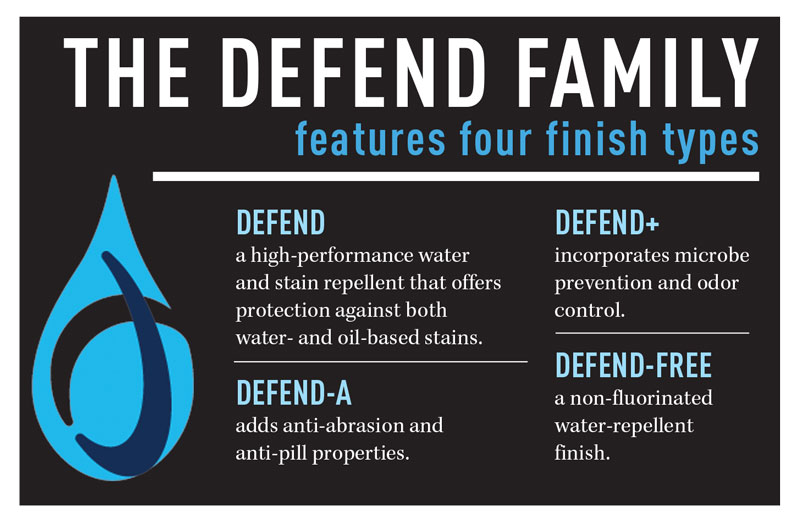
DEFEND®, TSG’s protective finish, repels water and stains when applied to a fabric.
TSG Finishing enhances feel and functionality of fabrics.
TW Special Report
Whether produced using knitting, weaving or nonwoven processes, fabric most often moves along the supply chain to be dyed, printed and/or finished. Dyeing and printing adds color and pattern to untreated fabric, transforming it into today’s most popular hues or eye-catching designs.
Finishing — through either mechanical or wet processing methods — adds further value to a fabric by imparting enhancements that can improve the look, feel, functionality and performance of a fabric. Finishes can impart properties such as brightness, softness, embossed patterning, wrinkle resistance, shrinkage control, soil and water repellency, moisture management, flame resistance or abrasion resistance, among other properties.
Hickory, N.C.-based TSG Finishing LLC is an example of a forward-thinking finishing company.
Founded in 1901 in Baltimore, Maryland, by Jacob Levy as “Levy’s International Water Shrinking and Drying,” the privately-held company is now run by fifth-generation descendants. The business first thrived on preshrinking, shrinking and softening wool fabrics under the motto “We expand from shrinking.” In the 1920s, Levy opened a facility in Philadelphia to be closer to New England’s growing textile business.
After World War II, the company developed a process for foaming latex backings used in vinyl seat covers. This launched TSG into the upholstery fabrics market and led the company down to High Point, N.C., a hub for U.S. furniture manufacturing. Today, TSG’s finishing plants still operate out of Hickory with additional locations in East Conover, N.C., as well as executive office space in Pennsylvania.
While finishing wool fabrics for military dress uniforms has been an important part of the company’s business for the past 118 years, TSG’s current mission is to expand its finishing capabilities and offerings.
Upholstery finishing — including woven fabrics for furniture and wallcoverings for residential and contract markets — now accounts for approximately 60 percent of the company’s business. Much of the remaining activity is focused on what TSG CEO Brian Rosenstein terms “industrial products,” which includes filtration materials, medical products, automotive, crafts, geotextiles, apparel and a variety of other technical products.
The company offers a broad range of finishing services including coating, fabric impregnation, mechanical finishing, toll coating, engraving, material handling, as well as warehousing and distribution. Coating and impregnation finishing provides antimicrobial, flame resistance, water and stain protection, among other treatments. “Being able to protect a fabric from both water- and oil-based stains is huge across multiple markets,” Rosenstein said. “In addition to upholstery, it’s also big in medical right now. Essential to producing medical nonwovens is providing a fabric that will keep doctors and surgeons protected. But it has to be breathable and have antistatic properties as well. We’re playing a critical role in that supply chain.”
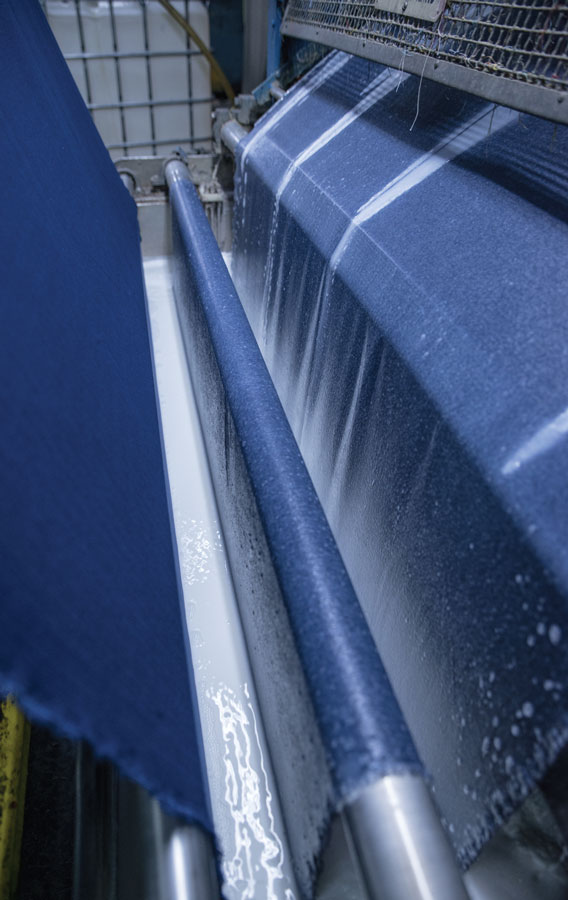
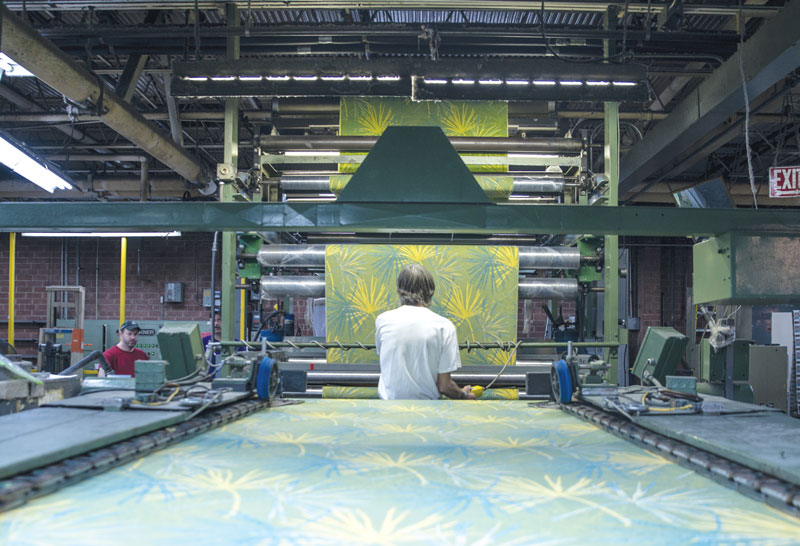
TSG regularly uses a basic tenter frame in creative and innovative ways to supply customers with the exact finish they are looking for.
Defend® — “Your Fabric + Our protection™”
TSG’s branded upholstery finish is known as DEFEND®, which the company relaunched in 2017 for its water- and stain-repellent technology. Still, as a historically technical company, incorporating a brand marketing strategy was a new path. “We redefined ourselves and shifted out of our comfort zone as we moved into marketing,” Rosenstein said. “Our previous mantra was we’re the guy behind the guy behind the guy. But for the most part today, the market demands a name and a story. You need to have a brand.” With that in mind, TSG also trademarked the tagline “Your fabric + Our protection™,” which simplistically, but effectively captures what the company does and helps to market the brand.
DEFEND was originally developed for the woven residential and contract business, but it’s starting to break into other markets as well, according to Rosenstein. For example, denim producers and the U.S. military have shown interest in DEFEND. “What makes DEFEND special is that we can apply it to any fabric,” Rosenstein said. “There are no limitations. You want to protect a high pile velvet? Fine. High-end linen — no problem. Embroidered silk — bring it on. A treatment for a military camouflage product that can only be treated on one side — done.”
“I can’t imagine that we would be unable to apply DEFEND to any product,” Rosenstein said.
Customer-Driven Products
TSG has a library of technologies that it draws from, but business is often customer-driven.
“On the one hand, we’ve really started to push and market the DEFEND brand, but people are knocking on our door more than ever to solve problems that don’t involve our core business of woven upholstery fabric,” Rosenstein mentioned.
The company fields phone calls from customers — including Fortune 500 companies — looking for a partner to help them achieve a certain look or set of properties in a finished fabric. Even in cases where production has yet to be attempted, TSG approaches each new proposal with a “not yet,” rather than a “no” attitude. “We have a saying around here that ‘the difficult we can do now, the impossible just takes a little longer,’” Rosenstein said.
Tackling Challenges With Innovative Thinking
According to Rosenstein, “One of the cool things about the job is seeing all the different, highly-innovative things that we are able to do with our existing equipment.”
The existing equipment Rosenstein is referring to is a tenter frame — a piece of equipment for drying fabric while it is stretched and held under tension between two parallel chains — which is central to most textile finishing operations. Options built into a tenter frame can differ, but the basic functions of the machine are the same. But according to Rosenstein, what can be done using that machine both before the fabric enters the machine and after it comes out is something that TSG has excelled at over recent decades.
“Our company is built on intellectual property and strong partnerships,” Rosenstein said. “Anyone can go out and buy a tenter frame, but it’s what we are able to do with that tenter frame that sets us apart. We will custom design and build our own chemical coating systems for a customer. We will stand behind and protect what we believe is rightfully ours, but we also recognize the benefit of partnering with both suppliers and customers. In today’s day and age, you cannot maintain a solid business if you don’t value those relationships.”
Brian Rosenstein CEO, TSG Finishing LLC
Future Growth
According to Rosenstein, innovations and staying ahead of design trends are key to remaining successful in the finishing industry. “Design trends really push the finishing industry,” Rosenstein mentioned. “The latest is this idea of Resimercial, where workspaces are created and designed to be more reflective of your living room. We now need to take woven fabrics that used to be relegated to the part of the home that was seldom used, fabrics like decorative velvets, and find ways to make them work in heavy traffic workspaces. TSG can definitely help prolong the life of those fabrics using DEFEND so they don’t have to be replaced every other year. And imagine what that could do for the environment?”
Other growing areas of TSG’s business include building and filtration products. When Mother Nature bears her teeth, the company is proud to help consumers get back on their feet. “When there are tornados or hurricanes and people lose their homes or the roofs, our fiberglass services provide durable solutions to people in need,” Rosenstein noted. “Business on the filtration side is also increasing because of the wildfires in California. The air quality out there is really bad so there is an increased demand for air filtration products.”
Rosenstein sees definite opportunities for TSG in the future. The diverse nature of the company’s business and involvement in many different markets allows for the technology crossover and product diversification in which TSG finds strength. “We’ve been spread out and diversified over the years, which might lead some to say we cannot focus on any particular area to give it the attention it deserves,” Rosenstein said. “But the fact that we were so diversified and involved in so many markets helped us through the recession. When one market is down, another one is up. That diversification, along with our inability to say ‘no,’ now exposes us to growth areas and sales opportunities.”
“I think if my great-great-grandfather were alive right now, he would be absolutely astonished to see some of the stuff we are running on those finishing machines,” Rosenstein mused. But Jacob Levy may be equally surprised to see the company also staying true to its roots finishing those military wool fabrics as it did back in 1901.
Editor’s Note: This article appears in Textile World courtesy of the National Council of Textile Organizations (NCTO) as part of the “American Textiles: We Make Amazing™” campaign. NCTO is a trade association representing U.S. textile manufacturing. Please visit ncto.org to learn more about NCTO, the industry and the campaign.