
J.Crew Appoints Jan Singer As CEO

NEW YORK CITY — January 28, 2020 — J.Crew Group Inc. today announced that after a thoughtful and extensive search, the board of directors appointed Jan Singer to serve as CEO, effective February 2, 2020. Singer, a veteran consumer and retail executive with more than 25 years of experience putting the customer at the center and positioning brands for long-term growth, most recently served as CEO of Victoria’s Secret Lingerie.

Singer will join the company’s board of directors and assume responsibility for all aspects of the J.Crew and J.Crew Factory brands and businesses. Michael J. Nicholson, who skillfully led the company as interim CEO, will return to his previous role as president and chief operating officer of J.Crew Group Inc. Libby Wadle will continue as president and CEO of Madewell, reporting separately to the board of directors of the company.

“Jan is a dynamic leader with significant experience growing and modernizing omnichannel brands,” said Chad Leat, director and chairman of the board of directors. “Over the past year, we have made great progress restoring profitability at the J.Crew brand, while further optimizing our operations, thereby establishing a strong foundation for long-term growth. Jan’s passion for our brand, focused vision of our potential and deep understanding of the modern consumer will be invaluable in rebuilding the strategic positioning and prestige of our iconic brand and company.”

“On behalf of the Board, we would like to sincerely thank Mike for his guidance and leadership during this critical interim period,” Leat continued. “He will continue as a valued and integral leader on the executive team, partnering closely with Jan to drive the business forward.”

At Victoria’s Secret, Singer led the company’s $4 billion intimates business across 1,000 stores and digital platforms. She strengthened operating performance by innovating across core categories and relaunching new high-growth businesses like sleep and exclusive collaborations. Singer joined Victoria’s Secret from her previous role as CEO of Spanx Inc. Prior to Spanx, she spent 10 years at Nike Inc., where she led both the global footwear and apparel teams. During her tenure at Nike footwear, she oversaw the successful launch of iconic products including Nike Flyknit, Nike Free and the reset of Nike Air. Singer was also responsible for apparel innovations including Nike Seamless, Nike AeroLoft and Nike Tech Fleece.

“I’m excited and honored to join this iconic brand and team at such an important time,” Singer said. “For me, J.Crew has led specialty retail by knowing what it takes to be a brand — putting the consumer first and at the center. My passion for developing product, brand experiences and teams feels very at home at J.Crew. It’s a beloved brand that has always been in my heart and, like millions of consumers, in my closet.”

President and COO Michael J. Nicholson added, “Jan’s appointment as CEO is an important milestone for our Company. I am proud of the way the teams came together in 2019 with a renewed focus on restoring profitability at the J.Crew brand, and our results reflected encouraging momentum led by strong gross margin performance and the accelerated benefits of our multi-year cost optimization program. With these key building blocks in place, it is an opportune time for J.Crew to bring on a leader with a proven track record in positioning brands for success.” Mr. Nicholson continued, “It has been an honor to lead this organization over the past year and I would like to extend my gratitude to each and every associate for their relentless support, passion and contributions towards rebuilding our Company. It is an exciting time for J.Crew, and I look forward to partnering with Jan as we further energize our businesses and teams.”

Posted January 29, 2020

Source:  J.Crew Group Inc.
Fashion Industry Veteran Aslaug Magnúsdóttir Launches Sustainable, Made-To-Order Womenswear Brand KATLA

SAN FRANCISCO — January 29, 2020 — Aslaug Magnúsdóttir, the co-founder and former CEO of leading fashion e-tailer Moda Operandi, today announced the launch of KATLA, a sustainable, made-to-order womenswear brand. KATLA injects a high-fashion aesthetic into ethically sourced and produced apparel with a collection of dresses, skirts, tops and pants. Items are priced from $90 to $900 and are available now at katla.com.

KATLA offers everyday pieces that are good for the environment and have timeless design and versatility. By weaving consumer data into its design process, the brand is able to create styles that meet the needs, wants and desires of today’s mindful fashion lover. KATLA has eliminated traditional seasonal collections and releases pieces on an ongoing basis.

“Many women consider sustainability to be important when shopping for clothing and yet fashionable options are limited,” stated Magnúsdóttir. “KATLA garments are beautiful and good to people, animals and the planet.”

KATLA’s debut collection features an assortment of items crafted from organic cotton, regenerated cellulose fabrics, cruelty-free wool and recycled synthetics. The brand does not use leathers, furs or silks.

All KATLA pieces are manufactured in the U.S. via made-to-order, or small production runs, in order to eliminate over production and waste. Further, KATLA has strategically partnered with innovative and mindful manufacturers across the U.S., including one in Alabama, that are pioneers in innovative production, prioritizing sustainable practices and positive working conditions.

KATLA offers full transparency into the effect of its clothing on the environment; each item includes a unique code so that customers can verify its impact on the world — from its conception to arrival at doorstep — with customers receiving orders in a few days or less.

“The impact of fashion on the environment is increasingly understood to be a big problem. KATLA wants to be part of the solution,” Magnúsdóttir said. “We believe clothing can be fashionable and environmentally-friendly. We are excited to help women be beautiful and responsible at once.”

Posted January 29, 2020

Source:  KATLA

TRSA Rebate Program Extends To Human Resources, Safety Summits

ALEXANDRIA, Va. — January 29, 2020 — TRSA members who are first-time attendees for either TRSA’s 4th Annual Human Resources Summit or 9th Annual Safety Summit in Atlanta May 12-13 are eligible for a 50 percent registration fee rebate, to be distributed following the event. To qualify, registrants must be:

  • Current TRSA members employed in either an HR or Safety-related position with a TRSA member company; and
  • Must participate in the entire event through 5 p.m. on May 12 or May 13, as applies; and
  • Must complete event registration in full by March. 27.

These two events feature dynamic keynotes, educational programs and networking breaks to provide attendees with opportunities to learn from peers. In addition to the registration rebate for first-time attendees, there is also a combined registration discount available for attendees who register for both events. Participation in these programs make a great return on investment in education for key managers, executives and owner/operators.

TRSA was recently recognized by the Society for Human Resource Management (SHRM) to offer SHRM-CP or SHRM-SCP professional-development credits (PDCs). This year the TRSA 4th Annual Human Resources Summit is valid for 6 PDCs. For more information about certification or recertification, please visit shrmcertification.org.

Posted January 29, 2020

Source:  TRSA

FiltXPO Speakers To Address Global Water Sustainability At Upcoming International Filtration/Separation Exhibition & Technical Conference This February In Chicago

CARY, N.C. — January 29, 2020 — “Engineering the Next Generation of Membrane Materials Needed to Achieve Global Water Sustainability Goals” will be the topic for the latest keynote presentation to join the robust program at the FiltXPO™ International Filtration/Separation Exhibition & Technical Conference, February 26-28, at Navy Pier in Chicago.

FiltXPO attendees will hear the latest research findings from Dr. Eric M.V. Hoek on uncharged organic transport through nanofiltration/reverse osmosis membranes. The compelling results may help solve one of the last unmet challenges in aquatic membrane separations and prove key to meeting long-term global water sustainability goals through indirect and direct potable water reuse.

The headliner by Hoek, Professor of the UCLA Samueli School of Engineering and Director of UCLA Sustainable LA Grand Challenge, is one of seven keynotes on key themes that will be presented at FiltXPO, North America’s only exhibition and technical conference dedicated exclusively to filtration and separation. For the latest program updates and to register, visit filtxpo.com

With the event less than a month away, anticipation is mounting among engineers, scientists, and industry professionals in the technical program. The program will feature 35 of the most forward-thinking filtration and separation pioneers speaking on air and gas filtration, biopharmaceutical, filter media modeling, membrane technologies, nanofiber, separation and manufacturing, and water filtration for new growth opportunities.

Attendees will dive deep into addressing challenges facing the industry with presentations such as “Current and Future Membrane Technologies to Solve Modern Water Worries” by Peter Waldron, senior vice president, sales and marketing, Toray Membrane USA Inc.

Waldron’s presentation will explore major technologies including reverse osmosis, ultrafiltration, and membrane bioreactors used around the globe to find new sources of water to address societal needs as well as provide a perspective on future technologies.

Completing the water filtration program at FiltXPO will be tech talks by Dr. Jayraj Joshi, Product Innovation Specialist, Purafil Filtration Group; and Hervé Buisson, vice president, Veolia Water and FiltXPO Water Filtration Session Chair.

Other FiltXPO highlights include the exhibition featuring 200 innovators and the Filter Media Training Course led by Chris Plotz, INDA’s director of Education & Technical Affairs, on February 25-26.

Posted January 29, 2020

Source:  FILTXPO™

NRF Welcomes Signing Of USMCA Legislation

WASHINGTON — January 29, 2020 — The National Retail Federation (NRF) welcomed today’s signing by President Trump of legislation to implement the United States-Mexico-Canada Agreement.

“We believe this agreement will bring continued decades of economic prosperity that will benefit American consumers and the millions of U.S. workers whose jobs depend on the free flow of trade with our nation’s two closest trading partners,” NRF President and CEO Matthew Shay said. “Goods and materials have easily crossed North American borders for more than a quarter-century, and this modernized agreement will do the same for the new digital economy and set the stage for innovations yet to be seen. We hope to see the Canadian Parliament ratify the USMCA as soon as possible so the benefits of free trade in North America can continue uninterrupted.”

NRF has been a leading supporter of the administration’s efforts to modernize the North American Free Trade Agreement, and Shay was at the White House today as Trump signed the legislation into law. Shay cited provisions on digital trade, customs procedures and trade facilitation as key improvements in the new agreement.

The USMCA bill was approved by the House in December and by the Senate earlier this month.

January 29, 2020

Source: National Retail Federation

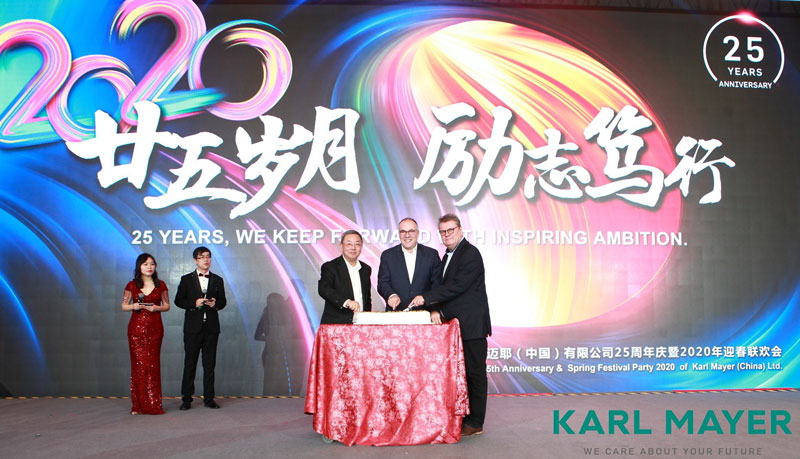
Karl Mayer Celebrates Its 25th Anniversary In Changzhou, China

(left to right): Yang Zengxing, General Manager of KARL MAYER (CHINA) as well as Arno Gärtner, CEO, and Roland Kohn, member of the extended KARL MAYER management team cut the birthday cake

OBERTSHAUSEN, Germany — January 29, 2020 — On January 17, KARL MAYER (CHINA) had reason to celebrate twice: the subsidiary of the renowned KARL MAYER Group celebrated both Chinese New Year and its 25th anniversary. A company-wide event was held in Changzhou. The entire workforce and management representatives from Germany, Hong Kong and Japan — including CEO Arno Gärtner — all took part in the festivities.

Way back when it all began, there was a vision: a belief that China would one day become the world’s most important market, Gärtner recalled when reminiscing about the early days. Building on this belief, WUJIN Textile Machinery Co Ltd was founded in 1995 as a joint venture with a Chinese partner. Just four years later, KARL MAYER acquired all of the shares in the joint venture. Together with NIPPON MAYER, the manufacturer set up KARL MAYER Textile Machinery Ltd as its own entity in Changzhou, and in 2005 formed KARL MAYER (CHINA) Ltd. A phase of continual expansion followed.

In 2008, the company moved to a new plant with a surface area of 170,000 square meters. In 2011, the production of knitting machines was expanded to include the manufacture of warp preparation equipment and in the following year, production was expanded again. The latest but no less important milestone in the company’s history was the establishment of KM.ON CHINA — a subsidiary of KARL MAYER’s software start-up KM.ON — in June 2019.

KARL MAYER (CHINA) currently employs around 800 people in Changzhou. Following a ten-year economic boom, the company achieved the best results in its history in 2018. With its proximity to the main market — around 70 percent of warp-knitted textiles are produced in China — it is an important member of the Group.“There is no doubt that KARL MAYER’s success over the last 15 years is largely down to KARL MAYER (CHINA),” said Arno Gärtner at the anniversary celebrations.

In order to operate at an even closer proximity to customers in the main Chinese market, the significance of the subsidiary in Changzhou will continue to grow. Over the past 10 years, an enormous capacity for textile production has been established in China. At the moment, however, China’s geopolitical situation has led to slow growth. KARL MAYER must be able to adapt flexibly to this situation. “As the market leader, we want to be the first to recognise market developments and respond with more innovative solutions offering maximum customer benefit based on buyers’ requirements”, said Arno Gärtner. In order to always be one step ahead, KARL MAYER (CHINA) will assume more responsibility for its customers and for solutions, and KM.ON’s activities will be further expanded.

Posted January 29, 2020

Source: Karl Mayer

Polartec® Releases 100-Percent Recyclable And Lighter Power Air™ Fabric

ANDOVER, Mass. — January 28, 2020 — Polartec®, the premium provider of innovative and sustainable textile solutions, announces the latest advancement of award-winning Polartec® Power Air™ fabric technology. The knit construction that encapsulates air to retain warmth and reduce fiber shedding is now made to be 100-percent recyclable and circular, and also 25-percent lighter than the initial product.

Polartec Power Air, launched last year with brands like Houdini, Adidas, Burton and NOBULL, is an innovative platform offering advanced thermal efficiency by encapsulating lofted fibers within a multilayer, continuous yarn fabric construction. Insulation that effectively regulates core body temperature has traditionally been achieved via lofted or high-pile knit structures that hold warm air. As the first fabric construction to encase air with a continuous yarn, initial versions of Polartec Power Air are proven to shed at least five times less than other premium mid-layer weight fabrics. The foundational technology platform will eventually provide shedding reduction to all existing apparel categories (including insulation, lightweight next to skin, and extreme weather protection).

“Polartec Power Air is a step forward in reducing the environmental impact of what we make and wear,” said Steve Layton, president of Polartec. “It’s a whole new experience with its distinctive aesthetics and drag-free, lively performance. We continue to tap into the potential of this new fabric construction, and we’re now able to make it fully recyclable and circular, while simultaneously making it lighter weight.”

The culmination of a multi-year development consisting of thousands of work hours and countless iterations, Power Air is a product of Polartec Eco-Engineering™. Polartec invented the process of knitting technical fleece from post-consumer plastic bottles in 1993, upcycling over one and a half billion bottles to date, and continues to lead the industry in offering durable fabric technologies made of recycled and recyclable content. Polartec introduced its 100-percent recycled Polartec Power Fill™ insulation in 2018, which eliminates the need for wasteful and non-recycled carrying agents used in other insulation options. Now fully recyclable and circular Power Air is the latest product of the Polartec Eco-Engineering mission to create fabrics that further reduce environmental impact.

Polartec Power Air has received numerous awards around the world for its breakthrough future fabric construction technology. A full list of recognitions is below.

  • ISPO Award 2020: Houdini Mono Air;
  • Outdoor Retailer Innovation Awards 2020;
  • Trail Magazine Ethical Choice;
  • ISPO TexTrends 2019 – BEST PRODUCT;
  • 2019 SKI Gear of the Year;
  • 2019 R&D 100 Award;
  • 2019 Sourcing Journal ‘Sustaining Voices’ Honoree;
  • EcoSport Awards;
  • Backpacker 2019 Editors’ Choice Awards – Green Award; and
  • World Textile Information Network ‘Future Textile Award for Best Innovation: Sustainable Textiles’.

Crafted from recycled polyester and elasterell-polyester, 100-percent recyclable Polartec Power Air fabric will become available to consumers in Fall 2020, when Swedish sportswear brand Houdini releases its Houdini Mono Air Half-Zip and Houdi products.

Posted January 29, 2020

Source: Polartec

Solvay: Composite Materials Prepare For Takeoff

BRUSSELS — January 23, 2020 — The automotive and aerospace industries are ready ramp up their production of composite parts, and Solvay has the material and technology to help them achieve that – namely fast-cure prepregs and Double Diaphragm Forming (DDF). The group’s Composite Materials team in the United Kingdom is showing them how it can be done, pioneering the way in the industrialisation of cost-effective composite parts.

Composite materials are set to represent an increasingly important proportion of what vehicles of all sorts are made of, as the trend towards emissions reduction through lightweighting is only going to accelerate. Certain niche markets like high-end automobiles and an increasing number of aircraft parts have already started paving the way towards replacing metal with composites for specific applications, but there are two major roadblocks keeping composites from moving into mass production: cost and complexity.

The fact is, making a part from composite materials is currently “an essentially manual process, which is fine for low volumes,” explains Rich Hollis,  Applications Engineering Operations Lead at Solvay’s Composite Materials facility in Heanor, England. “But we want to support the large-scale adoption of composite materials to help automotive and aerospace OEMs face higher build rates and cost pressure.” In effect, Solvay is actively anticipating market demand for increased manufacturing volumes of composite parts.

A unique solution to automate composite manufacturing

The answer of course is the automation of production lines. But that’s easier said than done. Because of their tack (stickiness), composites are tricky to manipulate for assembly robots. Moreover, a series of other issues such as debris on the parts and the pretreating and cleaning of tools mean the process remains a slow and expensive one, with many crucial steps necessarily carried out by hand, as Hollis mentioned.

But over the past few years, Solvay has been working on a solution to these problems: Double Diaphragm Forming (DDF). Combined with the chemistry of the composites that enables fast curing, this allows the automation of the entire process, thus significantly accelerating cycle time and reducing costs.

In fact, with DDF, the production time for a single piece, from raw material to finished and ready-to-use part, is brought down to three minutes, which amounts to over 100,000 parts per year, thanks to continuous production as the robots can work simultaneously. These are the sorts of figures that can open the way for the industrialization of composite part manufacturing. “DDF is a Solvay technology that was already used commercially by BMW a few years ago,” explained Hollis. “And we’ve seen a lot of interest over the last 12 months from OEMs in the automotive sector initially, but aerospace is definitely interested in applying new technologies and best practices to increase their build rates as well.”

A homemade proof of manufacturing concept

But coming up with great technologies is only useful if customers adopt them. And with long-established manufacturing practices using time-tested technologies, change can take time. Rich and his team therefore took matters into their own hands to explain to potential customers what DDF could do for them. “The feedback we got is that customers liked the technology but had a hard time imagining what the line may look like, so we took on the challenge of creating our own in order to show them,” he said. “The whole thing was designed and built by our team. We took a concept and turned it into reality.”

What they did is put together a fully automated composite production line at Solvay’s facility in Heanor, England by repurposing existing machines (three robots and a molding press). That being said, it remains a demonstration line: Solvay has no intention of moving into part manufacturing.

On January 16, 150 Solvay customers and partners from around the world — tier ones, OEMs, but also equipment manufacturers that can provide the machines to create the new production lines –—were invited to Heanor to see for themselves. “We wanted to show them the art of what is possible,” continued Hollis. “This production line is here to help us de-risk and validate the applicability of DDF technology for their specific needs.” By adopting Solvay’s technology and materials, these customers are all set to take the adoption of composites to the next step.

Posted January 28, 2020

Source:  Solvay

Teijin to Establish Teijin Automotive Center Europe to Expand Conceptual, Designing, Prototype and Evaluation Capabilities

TOKYO — January 27, 2020 — Teijin Ltd. announced today that it would establish Teijin Automotive Center Europe GmbH (TACE) in Wuppertal, Germany, in February as a new base for technical functions within the company’s automotive composite business. The company will handle concept, designing, prototyping, evaluations, marketing and technical research for next-generation automotive components, utilizing the Teijin Group’s capabilities to provide multi-material solutions for next-generation vehicles.

TACE will enable Teijin to strengthen and advance its solution capabilities by establishing a strong platform for collaboration within the Teijin Group’s European automotive composite bases. It is expected to speed up concept, designing, prototyping and the evaluation of technological proposals developed by each base. Later, TACE will develop marketing and research functions to explore opportunities for new technologies and M&A, aiming to accelerate joint development with European automakers and respond to demands for greater design freedom, productivity and cost efficiency as well as weight reduction and strength. At the same time, the company will pursue opportunities to establish bases for automotive composite technical functions in the USA and China to satisfy demands in these markets to strive to steadily strengthen its position as a global solution provider.

Backed by such initiatives, Teijin is targeting automotive composite business sales of approximately 1.7 billion euros ($2 billion) by 2030.

Amid the ongoing shift toward Connected, Autonomous, Shared, and Electric (CASE) automobiles, the automotive industry is urgently transforming its business models to realize more lightweight and multifunctional next-generation vehicles. Teijin acquired Continental Structural Plastics (CSP) in 2017 to become a Tier 1 supplier focused on multi-material automotive composite. In Europe, CSP’s French operation will open a new sheet molding compound plant and Teijin has acquired leading automotive-composite suppliers Inapal Plásticos of Portugal and Benet Automotive of Czech Republic.

To leverage these recent moves, Teijin has now decided to further strengthen its multi-material capabilities in Europe and organically link the development and marketing functions of its European automotive composite bases to satisfy automakers’ demands in the forthcoming CASE era.

Posted January 28, 2020

Source:  Teijin Group

Columbia Sportswear Company’s Board Of Directors Appoints CEO And President Tim Boyle As Chairman Of The Board; Andy Bryant Appointed As Lead Independent Director

PORTLAND, Ore — January 27, 2020 — Columbia Sportswear Co. today announced that at the company’s January 24, 2020, board of directors’ meeting, the board of directors appointed President and CEO Tim Boyle as chairman of the board. In connection with such election, the board of directors also acted to formalize a lead independent director role on the board and appointed long-time serving board member Andy Bryant to serve in such role.

Bryant served as chairman of the board of directors of Intel Corp. from May 2012 to January 2020, and, it has been announced, will be stepping down from Intel’s board of directors following Intel’s 2020 Annual Stockholders’ meeting. Bryant has served on the board of directors of the Columbia since 2005, and chairs the company’s Nominating and Corporate Governance Committee.

“We feel fortunate to have a seasoned leader like Andy as a strong independent voice on our Board. Andy’s wealth of experience at Intel has led him to be a source of tremendous insight for our Board and I look forward to working even closer with him as he serves as Lead Independent Director,” Boyle said.

Posted January 28, 2020

Source:  Columbia Sportswear Co.

Sponsors



