Brother International Corp. Supports Apparel Companies To Accelerate COVID-19 Mask Production

BRIDGEWATER, N.J. — April 15, 2020 — Brother International Corp. announces today that it is donating up to 100 industrial sewing machines to support the efforts to manufacture Personal Protective Equipment (PPE) to meet the growing demand. The first to receive donations, Los Angeles Apparel, Beverly Knits Inc. and SanMar, are part of a coalition of iconic American apparel brands and textile companies responding to the urgent call from the White House to fast-track the manufacturing of face masks in the fight against the spread of the COVID-19 virus.

Separate from the coalition, Brother will also be donating industrial sewing machines to Brooks Brothers to support their manufacturing efforts. The Brooks Brothers partnership developed in reply to a request on LinkedIn regarding factories reopening to produce PPE and the need to ramp up operations.

“Brother remains committed to aiding our communities during these challenging times,” said Don Cummins, president, Brother International Corp. USA. “Given the severe and growing shortage of personal protective equipment, Brother is proud to donate our products to support these stalwart manufacturers with their efforts in making masks for our frontline workers.”

The apparel companies are receiving Brother industrial sewing machines free of charge as a donation in support of their efforts to manufacture much-needed personal protective equipment. Brother’s industrial sewing machines will help increase the capacity of these companies to meet the growing demand for face masks and other PPE to help in the fight against the spread of COVID-19.

The Centers for Disease Control currently recommends all persons wear face masks in public to help slow the spread of COVID-19, and certain jurisdictions, such as Los Angeles, have mandated them as mandatory.

Posted April 15, 2020

Source: Brother International Corp.

ZF Partners With Detroit Sewn To Manufacture 100,000 Face Masks For Community

NORTHVILLE, Mich. — April 15, 2020 — ZF North America has partnered with Pontiac, Mich.-based manufacturer Detroit Sewn to help with the fight against the Covid-19 virus. A shipment of 100,000 face masks is expected to be delivered to Detroit Sewn by the end of April.

Developed for frontline healthcare workers and individuals in the community with high risk for infection, such as soup kitchens, nursing homes and other essential organizations, these masks will contribute to the fight against the contagion as ZF shifts production of some of its normal automotive safety products to this now critically needed item.

“The world is facing a situation unlike anything our generation has seen before and while the challenge may seem impossible, now more than ever, it’s the support of each and every individual and company working together that is truly making a difference,” said Martin Fischer, president of ZF North America and member of the board of management of the ZF Group. “It’s an honor for us to join in the fight to help protect frontline healthcare workers and everyone who is caring for others during this difficult time. We hope we can not only do our part to make a difference, but to encourage others to contribute as we get through this together.”

ZF’s Passive Safety Systems division operates 42 locations in 19 countries with nearly 40,000 employees including its joint ventures. The division specializes in occupant protection systems that help protect passengers in a crash. These include seat belt systems and airbag systems that work in conjunction and adapt to the characteristics of a crash. ZF has longstanding expertise in inflatable restraints including driver, passenger, side, curtain, knee and interaction airbags and designs, develops and supplies all aspects of an airbag system including specialized cut and sew capabilities to shape and produce air bag designs customized to the application.

Traditionally a full-service cut-and-sew manufacturer, Detroit Sewn recently restructured its operations to focus solely on the production of masks and gowns that protect healthcare workers and other essential service workers against Covid-19. The company employs 25 people on two shifts and is also supplying fabric to other manufacturing organizations like ZF that have industrial sewing expertise and who can assist with the fight against this disease.

“We are proud and grateful that seven manufacturing and sewing partners including ZF have joined with us to fulfill the urgent need for masks that meet CDC guidelines,” said Karen Buscemi, CEO of Detroit Sewn. “With our partners’ help along with support from G1 Impact, our nonprofit fiscal sponsor, we have the infrastructure in place to produce more than 300,000 masks in the short term — and the orders continue to roll in daily from health systems and nonprofits.

“ZF’s longstanding reputation for advanced cut-and-sew capabilities makes the company a valuable addition to our effort. And we are thrilled with their rapid onboarding.”

Detroit Sewn and the Glamorous Moms Foundation have also partnered to create the Michigan Mask Donation Center at 71 N. Saginaw in Pontiac. The center is distributing home-sewn donated masks to community groups in need. More details can be found at detroitsewn.com.

According to the CDC, fabric masks are a crisis response option when other supplies have been exhausted. These masks are NOT intended to replace N95 masks.

Posted April 15, 2020

Source: ZF North America Inc.

Felix Schoeller Group Responds To Corona Pandemic With Targeted Measures

OSNABRÜCK, Germany— April 15, 2020 — International company Felix Schoeller Group is responding to the weakening market demand caused by the novel coronavirus with a package of measures. The company has adjusted its capacities for the production of specialty papers. Short-time working is being implemented in all German plants following the Easter holidays. Approximately 2,100 of the 3,600 employees worldwide are affected. Positive signals are coming from the Chinese joint venture. Production is currently being restarted at the Chinese plants.

Order decline is cushioned

Having started 2020 on track, the Felix Schoeller Group is increasingly feeling the effects of the corona pandemic from the markets. The number of orders received is declining, which is having an impact on machine occupancy. The company is preparing for this by systematically shutting down paper machines and finishing units.

To react flexibly to the change in demand, short-time working was announced at the German plants.”Our current sales situation presents us with great challenges. We are reacting to this by flexibly adjusting our production volume to demand. In this way we are creating important conditions for the further economic stability of the company,” says Hans-Christoph Gallenkamp.

Extensive measures to protect employees

“The protection of our employees is our top priority. We took a number of measures early on to contain the risks of infection with Covid-19,” says Hans-Christoph Gallenkamp, CEO, Felix Schoeller Group. The company has adopted an activity plan for all its German sites, strengthened hygiene standards, expanded cleaning chains, and set rules for meetings and social interaction. A large number of employees work from home.

China gives first signals of recovery

The Felix Schoeller Group is optimistic about developments in China. “We are also seeing the first signs of a market recovery in our joint venture in China. After a two-month production cutback, our plants are picking up speed again,” reported Hans-Christoph Gallenkamp. All machines of the Chinese joint venture have been producing according to plan since March 2020.

Posted April 15, 2020

Source: Felix Schoeller Group

TRSA: EMI Helps Create Opportunity For Industry Rising Stars

ALEXANDRIA, Va. — April 15, 2020 — When attendees of TRSA’s 56th Annual Ehrlich-Stempler Executive Management Institute (EMI) gather this August in the Washington area, they’ll access unmatched educational, networking and professional-development opportunities through this unique course for leaders of the linen, uniform and facility services industry.

Enrolling a promising manager or two in EMI, set for Aug. 9-14, 2020 at the University of Maryland, Hyattsville, Md., drives home your willingness to invest in training that will create a greater opportunity for industry leadership success. Once a week for four years, attendees of EMI return to the University of Maryland to experience cumulative skill building over four days, taught by university-level instructors. Sessions are divided as follows (brochure details at www.trsa.org/emi):

  • Session I – Management Development
  • Session II – Advanced Management
  • Session III – Personal and Interpersonal Relationships
  • Session IV – Business Management in Linen, Uniform and Facility Services

EMI draws attendees from all segments of the linen, uniform and facility services industry, whether the company is a launderer or a supplier of equipment and services to laundries. EMI has a well-rounded attendance of independent companies’ owners, executives and next-generation leaders to chains’ headquarters (including HR/administration) and plant- and depot-based management (GMs, branch and department heads). Individuals who have achieved TRSA’s Certified Professional Laundry Manager (CPLM) certification typically receive 31 credit hours toward recertification by attending EMI.

EMI is hosted concurrently with TRSA’s Roger F. Cocivera Professional Management Institute (PMI). Now in its 31st year, PMI program participants spend free time, meals and evening social outings (this year’s currently planned outings include watching the MLB 2019 World Series Champion Washington Nationals at Nationals Park and an evening exploring National Harbor) with EMI attendees. These activities and events create unique opportunities for professional networking and camaraderie among leaders in the linen, uniform and facility services industry.

Early registration is now open at www.trsa.org/emi ; you’ll save a minimum of $400 when registrations are processed before June 26. An invitation to EMI participation is a smart decision as the institute provides a solid return on employee investment. It’s no secret that linen, uniform and facility services businesses traditionally experience a high annual turnover. EMI’s 56-year tradition of applying modern techniques to management issues aids those who attend in tackling high-priority tasks and long-term workplace challenges specific to the industry.

EMI is an all-inclusive program, with one fee covering all educational components, meals, lodging, and transportation to and from evening events

Posted April 15, 2020

Source: TRSA

Schwing Technologies: Thermal Cleaning Ensures Nonwoven Production For Respirators And Medical Protective Clothing

NEUKIRCHEN-VLUYN, Germany — April 14, 2020  — Production lines for nonwovens are running at full speed worldwide: In times of the coronavirus pandemic, the material is urgently needed for the production of medical textiles. There is a shortage of masks, surgical or protective gowns everywhere. In order to secure the production processes of nonwovens and supply of medical protective material, precise working machine parts are critical. It is therefore essential to reliably clean the polymer-contaminated toling and return them to the production process quickly.

SCHWING Technologies cleans machine parts in nonwovens production

“More than ever before, we have to use our know-how to reduce machine downtimes with short cleaning times and make tools available again quickly,” emphasizes Thomas Schwing, Managing Director of SCHWING Technologies. The equipment manufacturer specializes in thermal cleaning systems. Systems by the medium-sized, German company clean machine parts — for example, spin packs, spinnerets up to six meters long or melt-blown and spunbond dies. In addition to PET, PP and PE, other polymers are also removed. At the NRW headquarters in Neukirchen-Vluyn, SCHWING also cleans process components as a 24/7 service provider, supplementing its service with the corresponding logistics.

Optimized cleaning process with two-side sound

In order to accelerate the cleaning of machine components in nonwoven production, the SCHWING development team has optimized the ultrasonic cleaning process. Thanks to the new two-side sound, even large machine parts no longer have to be manually turned. This saves time and, above all, manpower. In addition to a thermal vacuum pyrolysis system, the company uses other post-treatment equipment, including ultrasonic cleaning systems. Previously, this process required two steps, explains Schwing: “What’s new is that with two-side sound, the time-consuming turning of machine parts is no longer necessary.” Savings in personnel costs, rapid use of tools and reduced machine downtime are the advantages, the expert knows. At the same time, the process minimizes the risk of damaging dies. The entire process, which takes about 8-12 hours, includes several cleaning steps: These imply thermal polymer removal as well as subsequent high-pressure and ultrasonic cleaning. The final drying phase is followed by a final inspection.

24/7 cleaning service and logistics

SCHWING offers its customers complete cleaning services at the company headquarters in Neukirchen-Vluyn: this includes disassembly, thermal cleaning and, depending on the component size, post-treatment and inspection. The systems run around the clock 24/7 at the location on the Lower Rhine. Seven specialists contribute their entire know-how and experience from many years of cleaning very sensitive parts reliably and without residue. In addition, four drivers work up to ten hours a day to collect contaminated tooling and return the clean components to customers throughout Germany and neighbouring countries.

Posted April 14, 2020

Source: Schwing

Sandler Group Invests In An Additional Production Line For Nonwovens For Respirator Masks

SCHWARZENBACH, Germany — April 9, 2020 — Sandler Group has decided to invest in a new high-tech nonwovens line for the production of nonwovens for respirator masks. The start of production is already scheduled for the middle of the third quarter. The annual production capacity of the line will enable Sandler to additionally produce nonwovens for the manufacture of up to 800 million masks. The investment totals a single-digit million Euro amount. Founded in 1879, Sandler Group is a high-tech manufacturer of nonwovens for use in construction/technical applications, filtration — including materials for respirator masks — home textiles, hygiene, transportation and wipes and supplies companies and institutions.

“The demand for our nonwovens for respirator masks is unbroken — and has been for weeks,” underlined Dr. Christian Heinrich Sandler, president and CEO, Sandler. “Despite around-the-clock production, seven days a week, we cannot accept new orders from manufacturers of respirator masks until June. On the other hand, we are also aware of the still challenging situation in the health sector and therefore we decided last week to invest in a further production line for nonwovens for respirator masks at the Schwarzenbach site in Upper Franconia.“

German Federal Government plans support programme

The family entrepreneur is pleased that the German Federal Government intends to address the shortage of materials in Germany and Europe by promoting such investments, with Federal Minister of Health Jens Spahn even performing valuable mediation work with the relevant manufacturers of production equipment. “We have been producing nonwovens for air filtration for more than 20 years, successfully establishing our position in the global market,” Sandler noted. “Until now, the product category ‘nonwovens for respirator masks’ did not receive much public attention, as previous epidemics fortunately affected the country less.”

Due to the unfortunate development of the COVID-19 pandemic, the demand from Germany and all over Europe has now increased significantly and is likely to remain high in the long term. “We therefore greatly welcome the establishment of complete value chains in Germany.”

Start of production planned for the middle of the third quarter

With this capacity expansion, Sandler Group intends to contribute to rapidly counteracting the severe shortage of filter materials for respirator masks. “We will put all our commitment and dedication towards advancing the installation of the new production line, which is scheduled to commence in June,” explains Sandler. He adds that this schedule, however, can only be met if there are no additional restrictions in the coming weeks, for example pertaining to logistics.

Decline in demand from other sectors

The market for respirator masks is booming. Business with nonwovens for hygiene products — including diapers and feminine hygiene articles — is consistently high. Nevertheless, the current global economic situation will also leave its mark on Sandler Group. Industries particularly affected by the shutdown, such as the automotive, construction and furniture industries, are also important turnover generators for the Upper Franconian company. The market environment in these sectors is challenging. At present, however, the company has no plans to apply for short-time work compensation.

Posted April 14, 2020

Source: Sandler AG

Koch Separation Solutions Expands Manufacturing Of Membrane Technology By 50 Percent

WILMINGTON, Mass. — April 14, 2020 — Koch Separation Solutions (KSS) today announced it is expanding the manufacturing capacity of its innovative PURON® reinforced hollow fiber membrane technology by 50 percent. This manufacturing expansion reflects KSS’s significant growth and an increased ability to quickly serve businesses that utilize its reinforced hollow fiber membrane technologies for their industrial and municipal water and wastewater treatment needs.

“Expanding our PURON membrane manufacturing capacity represents the exciting growth we’re seeing at KSS and is a testament to our strength and the value of our solutions, which are essential in supporting many industries and business globally,” said Manny Singh, President of KSS. “At KSS we are continually seeking to add greater value to our customers, and this expansion increases our ability to offer our technology and know-how to businesses that operate in key economic sectors.”

KSS’s reinforced hollow fiber membrane solutions are among a suite of KSS’s membrane offerings and include PURON MP, PURON HF, PURON MBR, and PULSION MBR. At its core, the PURON hollow fiber membrane has a robust composite structure that makes it virtually unbreakable. Its uniquely engineered ultrafiltration pores facilitate high productivity and rejection while minimizing fouling and cleaning requirements; these membranes are crucial in water and wastewater treatment needs such as solids separations and pathogen removal. KSS’s advanced reinforced hollow fiber membranes allow businesses to operate reliably at high-performance while meeting energy efficiency, reducing overall system footprint, and cutting long-term operational costs.

“Industrial water sustainability and reuse, coupled with PURON technology advantages, are driving the growth we’re seeing in water and wastewater treatment operations,” added Singh. “We recognize the importance of businesses meeting their goals while also operating responsibly and sustainably, and our membrane technologies allow for optimal performance that also save energy and resources.”

Posted April 14, 2020

Source: Koch Separation Solutions

Avgol Supports Circular Economy Drive

ISRAEL — April 14, 2020 — Avgol, a global manufacturer of high-performance nonwoven fabric solutions, has reinforced the nonwoven sector’s move towards a circular economy.

The business has joined an initiative spearheaded by the Ellen MacArthur Foundation. Launched in 2018, the cross-industry scheme is backed by the World Economic Forum and is intended to promote circular economy principles and activities.

Avgol takes a strong stance on sustainable manufacturing solutions and identifies the importance of supporting eco-friendly principles throughout the supply chain. In acting as a signatory with parent company Indorama Ventures Ltd. (IVL), Avgol anticipates significant step-change towards creating a responsible economy of material, protecting the long-term growth of the hygiene industry, as well as the environment.

Tommi Bjornman, chief commercial officer, at Avgol, commented: “We are seeing significant changes throughout the sector, and one of the most exciting is the drive towards closing the plastic loop. The lifecycle of plastics has a great deal to do with how the consumer lives, but manufacturers have a significant responsibility too. At Avgol, we always aim to lead by example, and to effect real change without compromising on the product performance takes ambition and commitment. We’re proud to support the initiative alongside IVL and look forward to playing our role in moving plastic from a linear to circular economy.”

Using its impressive research and development processes, the business has previously demonstrated that sustainability and performance are not mutually exclusive with its natureFIT™ family of technologies. The non-woven technology development platform replaces several traditionally synthetic components with naturally derived alternatives to displace resin and polymer content with a specially designed mineral-based filler, bestowing cotton-like qualities into the material.

Bjornman concluded: “We stand united with our sister businesses in pushing for a robust circular economy. We’ve already started to play our role in the development of our natureFIT model, and we count ‘reduce, replace, displace’ as one of our core tenements of business. By reducing the use of plastics, resins and polymers in the hygiene supply chain, we are working to safeguard the environment.”

Posted April 14, 2020

Source: Avgol Nonwovens

Beverly Knits Collaborates To Make Face Masks

The COVID-19 Response Team logo was created by A. Lava & Son for the Beverly Knits group of manufacturers. T-shirts are being printed with the logo for all team members.

GASTONIA, N.C. — April 14, 2020 — The Beverly Knits group of U.S. textile and garment manufacturers continues to work together to provide face masks for the U.S. Department of Health and Human Services. The number of companies in the group of outstanding American textile companies continues to grow. Currently there are 31 quality U.S. companies on the team.

Fabric is now in production in factories in North and South Carolina. Cutting and sewing of the masks has begun across the U.S. with partners in many states. Production started the week of April 3, 2020 after all facilities were qualified. The production goal is 200,000 masks during the first week and ramping up to 2 million masks produced per week shortly thereafter.

Beverly Knits representative Parker Sytz (right) presented face masks to Officer Keith McCabe of the Gastonia Police Department.

“We have tremendous U.S. textile companies that are retooling quickly to make these masks,” said Ron Sytz, Beverly Knits CEO. “The cooperation of the group is amazing in sharing information and parts as well as working together. Our goal is to make it happen as fast as possible to flatten the curve on COVID-19.”

Companies on the Beverly Knits team include:

  • Clover Knits ;
  • Contempora Fabrics;
  • Carolina Cotton Works;
  • South Fork Industries;
  • Altus Finishing;
  • National Safety Apparel;
  • A. Lava & Son;
  • Wells Hosiery;
  • Jomel Industries;
  • LA Corp.;
  • Hemingway Apparel;
  • BeoCare;
  • Culp;
  • The Filter Shop;
  • Keep it Here Inc.;
  • Two-One-Two New York;
  • ICS North America;
  • UCS Inc.;
  • Colonial LLC;
  • Riegel Linen;
  • Pacific Athletic Wear;
  • Louis Vuitton;
  • SND Mfg;
  • Ethan Allan;
  • Inside Out;
  • Royal Apparel;
  • La La Land Creative;
  • Elizabeth M. Designs;
  • A Plus Apparel;and
  • American Leather/Lee Industries.
Pictured is Beverly Knits representative Parker Sytz and members of the Gaston EMS.

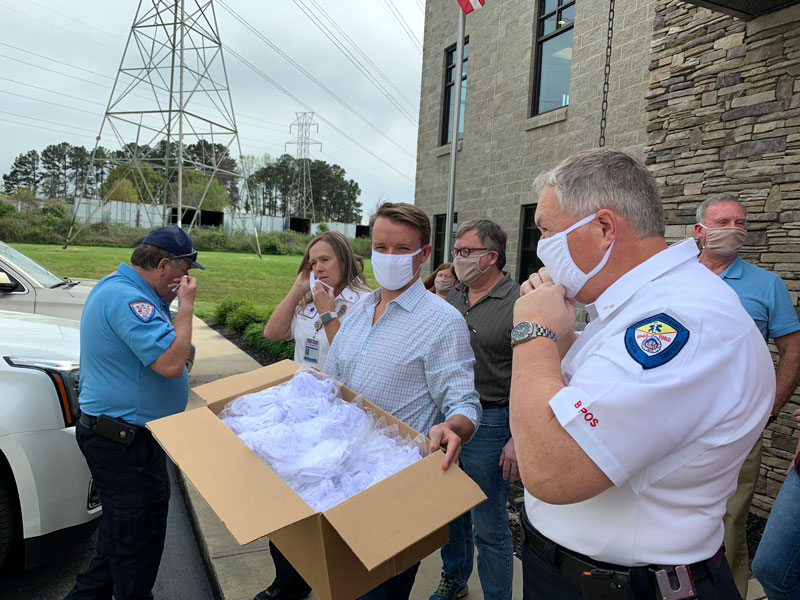
As part of Beverly Knits’ ongoing commitment to flattening the COVID-19 curve, the company recently donated face masks to Gaston EMS and the Gastonia Police Department in Gastonia, N.C.

Posted April 14, 2020

Source: Beverly Knits

Promethean Particles Puts Its Nano-Copper To The Test In The Fight Against Viruses

NOTTINGHAM, England — April 14, 2020 — United Kingdom-based manufacturer Promethean Particles is collaborating with textile companies and leading research facilities to explore the anti-viral effects of its novel copper nanoparticles designed for use in fabrics and personal protective equipment (PPE) for the healthcare sector.

Dr. Selina Ambrose, technical manager at Promethean Particles, said: “At Promethean, we have traditionally developed nano-copper for the printed electronics market, due to the conductive properties of copper. Copper is also well known for its antimicrobial properties and during the past few years we have researched this further in the funded Innovate UK project, ACTIn.

“We are now looking to take that a step further to consider the potential effect copper could have on viruses. If we can show evidence of anti-viral properties from the testing currently being carried out, then it’s particularly relevant to the current Covid-19 outbreak, and we may see a lot more urgency in its development.”

Promethean Particles played a key role in the ACTIn project, funded by the Newton Fund, which saw Mexican and U.K. companies and research institutes successfully develop durable antimicrobial textiles for the healthcare sector. By embedding nano-copper into polymer fibers, such as nylon, via a melt extrusion process, it was found that the antimicrobial effect lasted longer than other similar antimicrobial fabrics on the market, which tended to be surface-coated and therefore lose functionality with each wash.

Now, in conjunction with the Mexican research institute, CIQA, and textile trade association, NWTexNet, fibres embedded with copper nanoparticles manufactured by scientists from Promethean, have been sent to independent laboratories in the United States and United Kingdom for anti-viral testing to ISO standards. If certified, it could open the door to the manufacture and supply of nonwoven fabrics and Personal Protective Equipment (PPE), such as garments, face masks, hats, uniforms and bed linen, which is resistant to viruses — such as the coronavirus that causes Covid-19 — and will offer much needed improved protection for frontline health workers.

By using nano-copper, as opposed to larger copper particles, a smaller mass of active material is required to achieve the same antimicrobial effect bringing both cost and process benefits to the manufacturer.

Dr. Ambrose added: “Prior to the Covid-19 pandemic, this research was a strategically important focus area for both the UK and Mexico due to the significant economic and social impact of healthcare acquired infections that lead to extended patient stays in hospitals, higher healthcare costs, and thousands of deaths globally each year. With current events, clearly it has become absolutely critical that progress is made now.”

Promethean says there is potential to further develop its nano-copper materials for use in coating applications for door handles, handrails and beds within the healthcare sector.

The company, a developer of high specification nano-materials for a wide range of sectors, is also in talks with a manufacturer to develop a transparent antimicrobial coating containing its nano-copper technology suitable for glass. Ideal for incorporating into a range of touchscreen personal devices, as well as those found at train stations, cinemas and fast-food restaurants, the coatings would inhibit the growth of bacteria and mold on surfaces. By using nano-copper particles, glass transparency is retained.

“For most applications, having both antimicrobial and anti-viral functionality will be of huge benefit to manufacturers,” Dr. Ambrose added.

“Our nanomaterials offer many advantages over others on the market. Our liquid dispersions are easier to process and provide a more effective, functional final product. We are pleased to say that the success we have seen with our work with CIQA to date has provided us with the opportunity to supply more of our copper dispersions to them for other projects they are leading.”

Posted April 14, 2020

Source: Promethean Particles

Sponsors