Greensboro, N.C., Cone Denim® has transitioned a portion of its weaving capacity over to making Maxima® medical fabrics for its sister division Burlington. Maxima fabrics are reusable, which is a key advantage currently when demand for medical personal protective equipment (PPE) is at an all-time high. The fabrics are available in a variety of constructions offering specific properties and meet the end-use applications (See “Quality Fabric of the Month: Time-Honored Protection,” TW, May/June 2020).
“Being a part of the larger Elevate Textiles family has opened many opportunities for Elevate’s brands including Cone, Burlington and American & Efird to collaborate and innovate to better serve apparel brands and others within the textile and apparel industry who are stepping up to produce lifesaving PPE,” said Steve Maggard, president, Cone Denim. “The Cone and Burlington technical teams have been working closely to quickly transition a portion of looms in our Cone Denim Yecapixtla operation in Mexico to produce Burlington medical fabrics. Production is set to ramp up in June.”
In other company news, Cone Denim released Pride Rainbow Selvage Denim in honor of Pride Month. The selvage edge on the fabric, which typically is white, is crafted using a unique rainbow set of colors. The denim is the latest style added to the Cone® Community Collection, which shows the company’s support of a wider and more inclusive community. Cone will donate a portion of the proceeds from the sale of Pride Denim and related accessories to the Human Rights Campaign.
Lydall Inc., Manchester, Conn., has signed a $13.5 million contract award with the U.S. Department of Defense (DoD) that will support the company’s investment in two new production lines for meltblown nonwovens at its Rochester, N.H., facility. The company had previously announced the addition of one line, and the DoD contract supports and accelerates its capacity increases for this filtration media critical in the production of N95 respirators and surgical masks. Lydall reports by May 2021 it expects to produce enough media for 140 million N95 respirators or 540 million surgical masks, as well as air filtration media for indoor spaces.
The investment will turn Lydall’s Rochester plant into the largest U.S. site for meltblown filtration media production, according to the company.
“We are incredibly thankful to the U.S. government for recognizing the importance of accelerating domestic production of N95 and surgical face masks and providing the grant we need to do just that,” said Sara A. Greenstein, president and CEO, Lydall. “We have done everything within our capacity to ramp up our production of filtration media for N95 respirators and surgical face masks. With the support of the U.S. government, we will increase production even further.”
The contract award is a product of the ongoing collaboration between the Department of Defense and the Department of Health and Human Services, led by the Department’s Joint Acquisition Task Force and funded through the Coronavirus Aid, Relief, and Economic Security (CARES) Act.
Denver-based Johns Manville, a Berkshire Hathaway company, reports its Spartanburg, S.C.-based facility has begun production of a polyester nonwoven. The new fabric — named Evalith® 017/120H3 — is designed for the production of Level 3 medical gowns. According to the company, the fabric meets the ANSI/AAMI PB70:2012 Liquid barrier performance and classification of protective apparel and drapes requirements for Level 3 medical gowns intended for use in healthcare facilities; as well as passes AATCC water resistance tests 42-2017and 127-2017, and flammability standards.
“The fabric offers superior liquid barrier performance compared to materials used for Level 1 and Level 2 medical gowns, while also providing comfort and stitch-strength,” said Souvik Nandi, director Nonwovens Technology at Johns Manville Engineered Products.
“There is a desperate need in North America and in Europe for medical gowns,” added John Vasuta, president of Johns Manville’s Engineered Products business.
“Our teams are working quickly to create solutions and manufacture a new coated polyester spunbond nonwoven fabric.”
The company also recently began producing nonwoven media for face masks at its Richland, Miss., facility.
Austria-based Andritz AG reports it has received an order from Eruslu Nonwoven Group, Turkey, for a complete neXline spunlace line with a capacity of 18,000 tons per year. The line, scheduled for installation and start-up at the beginning of 2021, can process a variety of fiber types including polyester, viscose and bleached cotton into nonwovens weighing between 30 and 75 grams per square meter. Applications for the nonwovens include wet wipes, feminine care products and baby diapers, in addition to many other products.
The line includes Laroche opening and blending machinery, two inline TT cards, one JetlaceEssentiel unit for hydroentangling, one neXdry double drum air-through dryer, and a NeXecodry S1 system for energy savings.
Australia-based OZ Health Plus has chosen spunbond and meltblown equipment from Germany-based Oerlikon Nonwoven for its new production plant, which will be the first such facility in Australia for making these nonwovens. Up until now, Australia’s face mask producers have had to rely on overseas fabric sources, and access to the materials has been affected as a result of the COVID-19 pandemic. The plant has capacity to produce enough meltblown fabrics for 500 million masks per year in addition to other medical and non-medical grade nonwovens. The Oz Health meltblown plant is scheduled to start up in April next year, with a second stage planned for late 2021.
“Australia has access to raw polypropylene feedstock but lacks the plant to convert that raw material to specialized spunbond and meltblown fabrics,” said OZ Health Plus director Darren Fooks. “These fabrics are essential for local mask manufacturing. The Australian-based Oerlikon Nonwoven plant will fill the production chain gap for Australia by producing the fabrics we need for mask production and many other products — it will reduce Australia’s protective mask supply chain from thousands of kilometers, to tens of kilometers.”
Cap Yarns CEO brings a keen perspective and deep industry knowledge to NCTO leadership in a time of major challenges and change.
TW Special Report
Cap Yarns CEO David Roberts was recently named chairman of the Washington, D.C.-based National Council of Textile Organizations. Cap Yarns, Clover, S.C., develops specialty yarns for the knitting and weaving industry and manufactures an average of 300,000 pounds of yarn a week.
Roberts succeeds Leib Oehmig, president and CEO, Glen Raven Inc. The pandemic dictated a different succession process than a typical face-to-face gavel hand-off that would have occurred following an election held during NCTO’s cancelled 2020 annual meeting. The election was carried out via a teleconference meeting with NCTO board members.
Announcing the results of the election, NCTO President and CEO Kim Glas, stated: “This is a critical juncture for our industry as we continue to navigate through an uncertain business environment this year. I could not be prouder of our industry, which has stepped up and retooled to produce critical personal protective equipment (PPE) for frontline workers battling the COVID-19 pandemic. With the support of our newly elected officers, NCTO will continue to work on behalf of its members to shape policies that will help our industry persevere and thrive. Through a dedicated association staff and a committed group of industry leaders, we will ensure that together we continue to have a seat at the table in Washington.”
Textile Worldrecently had the opportunity to talk to Roberts about the state of the U.S. textile industry, the pandemic and the role NCTO plays in the industry’s current business environment and response to future challenges.
TW: Congratulations on the NCTO chairmanship. Taking the helm certainly is a different experience for you compared to past chairmen. As chairman, how do you plan to support NCTO, its mission and President and CEO Kim Glas.
Roberts: First of all, it is an honor to be elected as NCTO chairman by my peers. I have spent my entire career in textiles and this is a small way to give back to an industry that has done so much for me.
I would be remiss if I did not thank Leib Oehmig who has done an outstanding job of serving as NCTO’s chairman for more than 14 months. Leib willingly served an extra two-and-a-half months beyond his term limit as a result of the postponement in late March of NCTO’s annual meeting and Board elections stemming from the COVID-19 pandemic.
This is a critical juncture for our industry as we seek to shape policies that will allow the textile industry to navigate the current health and economic crisis brought on by the spread of the coronavirus. As such, one of my first priorities will be to work with NCTO President and CEO Kim Glas and staff to secure a long-term strategy to expand and maintain domestic production of personal protective equipment (PPE). Many in our industry are on the forefront of PPE; it’s paramount that we make these life-saving products domestically long after the pandemic is over.
We will place an emphasis on advocacy and continue to pursue policies that will position the industry for growth and potentially the expansion of domestic and Western Hemisphere supply chains.
It’s my turn to pitch in and do my part to help meet the many challenges that face our sector in Washington.
TW: How do you see the role of NCTO, and what does the organization mean to the U.S. textile industry, especially this year with the increased demand for medical textiles?
Roberts: Obviously, we need to acknowledge that the coronavirus will continue to pose a unique set of challenges in the coming months. First and foremost, this is a humanitarian crisis and it needs to be solved for that reason as soon as feasible.
Secondly, like every other sector of the economy, the virus is impacting textile supply chains and demand for orders. NCTO will be working with the White House and Congress on common sense initiatives needed to ease burdens on manufacturers and employers and to establish long-term domestic PPE supply chains. In that light, we certainly urge our elected officials to work in in a bipartisan fashion to address the unique problems confronting manufacturers and society as a whole as a result of this very serious situation.
Beyond the challenges posed by the coronavirus, NCTO will remain diligent in its advocacy role. That has always been the key value aspect for our broad-based membership. Consequently, it is critical to ensure that we have a substantial voice in shaping issues that directly impact our industry.
Sometimes our engagement involves proactive support. That was certainly the case with the U.S.-Mexico-Canada Agreement (USMCA). Other instances, like a proposed expansion of the Generalized System of Preferences (GSP), require full opposition. Regardless, all our advocacy activities require the need to nurture relationships with the administration and key congressional offices. Maintaining these important relationships is a lot of work in and of itself.
Further, we need to continue to communicate an accurate picture of the industry’s PPE efforts and its important contribution to the U.S. economy to policymakers and the press. In order to secure good policy determinations, the people who make those decisions must be fully aware of the enormous contribution our modern industry provides to the national economy and to so many local communities where textile facilities are located.
TW: As the leader of an innovative textile business, how do you see the current state of the industry, including current and/or future challenges and opportunities?
Roberts: We as an industry regained a strong position in the global textile marketplace in 2019, becoming the second largest exporter of textile-related product in the world, and continued the trend of making billions of dollars of investment that have flowed into the domestic textile sector each year.
The COVID-19 pandemic has hit the industry hard this year, as is the case for most manufacturing sectors in the United States. Some of our member companies lost a significant percentage of orders and furloughed workers, even as they ramped up overnight to pivot to the production of PPE.
With the economy slowly reopening, we expect the industry to regain some of the business it lost and find new opportunities with PPE production that did not previously exist.
With the dedicated work of the NCTO staff and a committed group of industry leaders, we will diligently work to realize policy goals aimed at sustaining growth and innovation and incentivizing domestic production.
TW: As the U.S. faced shortages of PPE, and the realities of America’s reliance on imports of vital medical supplies came to light in mainstream America, what do you see as an answer to prevent such shortages in the future, and could it take the form of a Berry-like amendment?
Roberts: Working with industry leaders, NCTO has played a critical role in bringing together the entire domestic PPE supply chain while also closely coordinating with White House advisers and various government agencies to get vital PPE product to frontline workers battling the COVID-19 pandemic.
Kim Glas contributed to a broader strategy of connecting textile producers with hospitals, medical facilities and healthcare organizations, all of which were urgently seeking critical PPE supplies, while tirelessly working with NCTO member companies to navigate the complicated government procurement application process.
To that end, we will work to educate Congress and the administration on what policy proposals are needed to onshore PPE. Supply chains that were created in the midst of a crisis do not evaporate as soon as the crisis is over. Getting the right policies in place will take our collective membership.
We will work to expand Berry requirements to PPE procurement by all federal agencies and push for policies that incentivize domestic production and onshoring.
In addition, our sector is not immune to the impacts across manufacturing as a result of the economic downturn. We will continue to be fighting hard in Stimulus 4 and beyond for relief to help our industry recover.
TW: Prior to the COVID-19 crisis, the focus of industry leadership seemed to be on improving trade agreements, as well as advocating for China 301 tariffs on imported finished apparel to counter decades of trade theft violations by China. Where do you see these issues moving forward and what other policy issues are priorities this year?
Roberts: We will continue to monitor the administration’s actions regarding the China 301 tariffs this year and advocate for maintaining tariffs on finished apparel in any additional phases negotiated as part of the China agreement, while also seeking exclusions for certain textile inputs that are not made domestically.
In addition, we will continue to oppose any attempts to advance the GSP expansion proposal, which would give duty-free treatment to textile and apparel exports from countries like Cambodia, Indonesia and Pakistan. These concessions would not be reciprocal, so we as the U.S. industry get nothing in return. Further, the Asian suppliers that qualify under the GSP program almost always use Chinese fibers, yarns and fabrics as inputs. As a result, at a time when we are trying to reign in China’s immense impact in our market, they will get a backdoor benefit through this ill-conceived proposal. I am proud of the work NCTO has been doing and know our Hemispheric trade partners and their industries have been very engaged and opposed to any expansion.
Beyond GSP, we will push for renewal of the Caribbean Basin Trade Partnership Act, which will continue to strengthen the Western Hemisphere textile production chain. We also will support a balanced Miscellaneous Tariff Bill (MTB) to help reduce costs on inputs that are not available in the U.S but we continue to oppose tariff relief on finished products. Regrettably, more than 75 percent of the textile, apparel, footwear and travel goods petitions submitted in the MTB process this year were for end items.
It is also possible the Trump administration will begin new trade negotiations with the United Kingdom and Japan that will require NCTO’s engagement.
These are just a few of the policy items that will occupy NCTO over the next several months.
TW: The concept of reshoring, particularly as it relates to refocusing apparel sourcing from Asia to the Americas, continues to be a significant topic in the industry. Do you think reshoring is a reality, and have these trends accelerated or slowed?
Roberts: We have a rare opportunity and opening to work with members of Congress and the administration to craft a long-term onshoring solution, particularly as it relates to PPE production.
There is bipartisan interest on Capitol Hill to reduce our country’s overreliance on the foreign production of PPE and eliminate China’s dominance in the space. We think the time is ripe to act now to put incentives in place to onshore production and ensure we never face the severe shortages our nation experienced at the outbreak of the pandemic. That will require establishing a more permanent domestic PPE supply chain that provides business certainty for our members.
TW: For textile industry leaders who step forward to serve in various NCTO elected positions, there is a tremendous commitment of time and brain power to these duties involved. How do you balance those new demands with your responsibilities at Cap Yarns?
Roberts: I see the NCTO chairman’s role as primarily functioning as a facilitator and a spokesperson. The organization is now a very mature one [16 years old] and has a very efficient committee and council structure. Our staff, led by Kim Glas, is incredible and have shown their ability to execute under extreme pressure during the past six months. NCTO is blessed with a vast network of incredible industry leaders who are totally committed to the sustainability and growth of our domestic textile industry. Working together, we will get through this crisis and emerge as an even more viable and relevant participant in the global textile and apparel supply chain.
TW: Going forward, what is the vision for your term as chairman, and what do you see for the future of U.S. textiles?
Roberts: COVID-19 has demonstrated NCTO as a critical leader on issues, and as the chairman, I want to see the organization continue to grow our membership and relevance on Capitol Hill.
This challenge creates an enormous opportunity for us to help strengthen the organization long-term and I am really pleased to see this organization at the forefront.
Further, we owe it to our workers and the communities that are dependent on our production facilities to be fully engaged in Washington. We simply must do everything in our power to construct government policies that make it feasible to produce textiles in this country. NCTO is the vehicle by which we, as an industry, undertake this critical activity. Anyone that has an interest in the success of the U.S. textile industry simply should be a fully committed and active member of NCTO.
Our work is being noted by the highest level of the administration and on national news. Now is not the time for the industry to be on the sidelines; we must be engaged in Washington. There is simply too much at stake.
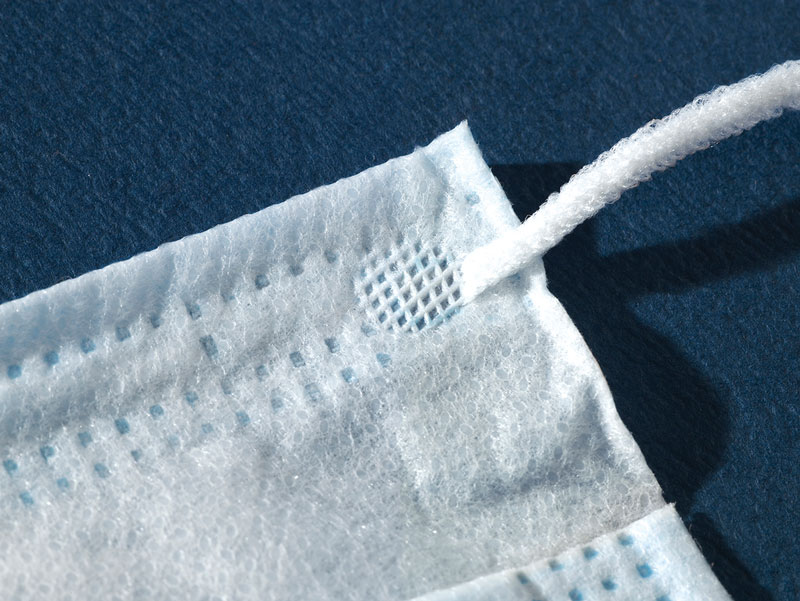
Ultrasonic welds strongly bond even small items such as ties on a disposable surgical mask at a fraction of the cost of stitching or using glue.
Ultrasonic welding equipment is an essential technology for producing nonwovens-based personal protective equipment.
By Mark Cragin
By any measure, global demand for medical-grade face masks and N95 respirators soared in early 2020 with the onset of the COVID-19 pandemic. The World Health Organization estimated that 89 million medical masks are needed globally each month just to protect medical providers. Yet the demand for masks goes much, much further than protecting medical personnel. In some 50 countries, ordinary citizens are also seeking masks — or making their own — to comply with government mask-wearing mandates and recommendations from the Centers for Disease Control and Prevention (CDC).
The rapid onset and circumstances of the pandemic have stressed medical supply chains worldwide and resulted in a huge shortage of personal protective equipment (PPE), particularly face masks. The suddenness of the global shortage made many types of PPE hard to obtain at any price. The shift has led governments, medical manufacturers and product buyers worldwide to rethink the value of maintaining, or recreating, a domestic supply of medical-quality face masks.
And so, manufacturers in the United States, Australia, India and other countries have joined China — the global market leader — in expanding and strengthening their supply chains for face mask production with investments in expanded nonwovens capacity and new face-mask production lines. According to market estimates, purchases of face masks will occur at dramatically higher rates for the next five to seven years.
In the southeastern United States, the region’s medical manufacturers continue to gear up production of surgical face masks and N95 masks to meet demand. For the producers of ultrasonic welding equipment — the equipment used to bond multiple layers of nonwovens into a mask product — the demand has been felt in constant meetings, continuous quoting activity with manufacturing engineers and systems integrators, a spike in the sales of ultrasonic equipment, and greatly increased demand for startup and technical support for welding equipment associated with mask production.
The low cost and utility of nonwoven fabrics have made them essential in the global battle to prevent the spread of infection. When built into PPE such as medical face masks, gowns and scrubs, and even foot covers, disposable nonwovens can provide effective and inexpensive protection against microorganisms. The key to their effectiveness is in multilayer construction, which combines an inner layer weighing 10 to 25 grams per square meter (g/m2), an outer layer of spunbond polypropylene (PP) weighing 25 to 40 g/m2, and a middle layer typically 25 g/m2 of meltblown PP fibers.
While the inner and outer spunbond PP layers provide protection and structure, it is the middle layer of meltblown PP fibers that is key to filtering out pathogens. If the meltblown fibers in this layer are negatively charged during manufacturing, they can attract and hold extremely small particles. Technology like this, together with expert design and high-quality manufacturing, is why a product like the N95 respirator mask can effectively protect medical personnel working with COVID-19 patients.
Ultrasonic Welding In Mask Construction
The ultrasonic welding equipment that is essential to the production of medical-grade face masks and respirators is often, but not always, embedded within larger, fully automated mask-production machines. These machines typically are fed by two or three rolls of nonwoven material — the inner, middle and outer layers — which are processed continuously.
Simply explained, ultrasonic welders convert electrical energy to high-frequency mechanical vibration, which is transmitted using tooling into thermoplastic material. The vibration creates frictional heat that melts the plastic, an operation that can be focused and utilized to:
cut or slit a large roll of nonwoven fabric into narrower strips — cut edges are simultaneously seamed/ sealed by the heat;
“quilt” multiple layers of nonwoven material into a laminated product such as a multilayer face mask, or;
bond multiple layers of nonwoven fabric into a finished seam — the edge of a face mask, for example — or attach a nonwoven tie strap or stretchable nonwoven ear loop to the edge of a mask.
Branson Ultrasonics technology is used to produce a variety of sterile surgical drape kits as well as surgical caps, masks, gowns and scrubs.
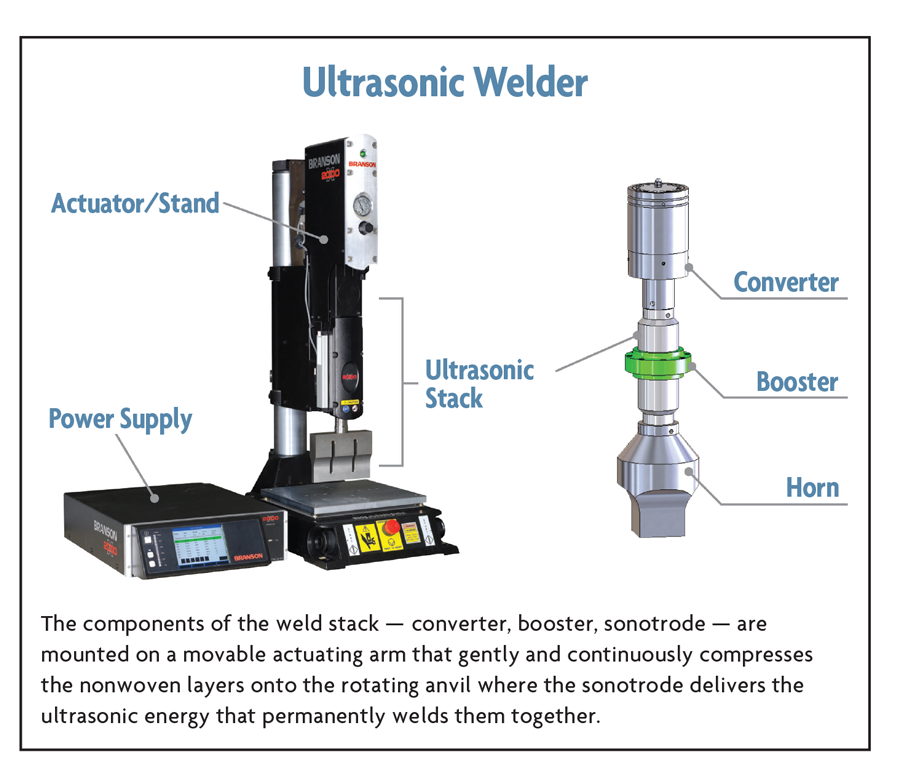
The basic structure of an ultrasonic welder used for nonwovens resembles that of a sewing machine in many respects. Layers of material are drawn continuously across a flat surface, moving between the weld “stack” on one side and a rotating wheel — the weld “anvil” — on the other. Components of the weld stack — a converter, booster and sonotrode — are mounted on a movable actuating arm that gently and continuously compresses the nonwoven layers onto the rotating anvil. There, the sonotrode delivers the ultrasonic energy that welds the layers together as the face of the rotating anvil embosses the finished seam.
Because a typical face mask requires two welded seams — on at the top and one at the bottom — on both its width and its length, as well as two bonds on each side to hold tie or elastic straps, an automatic mask-making machine incorporates multiple ultrasonic welding stations. Parallel welders continuously seam across the top and bottom width of the mask in the first step of the process. Then, after mask laminates are cut to size, they move perpendicular to the line and proceed through another parallel welding station that seams their length on both sides, again using a continuous weld that takes place as material moves across a rotating anvil. From there, precut straps are positioned and plunge or “point” welded at the top and bottom — this time onto a flat anvil — completing the construction of the mask.
Ultrasonic welding technology, together with well-designed machinery and automation, makes nonwoven fabric bonding seem almost effortless. However, it takes a lot of technology and skill behind the scenes to focus high-frequency vibration into a force that cuts, quilts and bonds with medical-grade precision and reliability.
The control of the welding process — the electronics and programming that power the stack and deliver the weld energy — originates in the welder’s power supply, carried to the working welding components by cabling. Most welding operations involving nonwovens utilize a 20 kiloHertz power supply, which can be accessed for programming through an onboard human machine interface (HMI) display or a networked computer connection. For continuous welding operations on nonwovens, many mask-machine builders rely on Emerson’s Branson™ DCX power supply, which features a powerful, compact design with closed-loop amplitude controls, advanced diagnostics and easy configurability.
In addition to a flat or rotating anvil, the other crucial weld system components are those in the stack, which is mounted on an actuating arm and comprises:
a converter, which converts electrical energy from the power supply into mechanical vibrations of the proper frequency for welding,
a booster, which increases or decreases the intensity of the vibration as needed, and
a sonotrode, or horn, whose shape and composition are specifically designed for the nonwoven cutting or bonding task at hand.
Before and during the introduction of ultrasonic welding technology at a medical nonwovens facility, it is common for ultrasonic welding experts to work closely with the manufacturer to develop and optimize all aspects of the technology. Often, each nonwoven welding application requires a specialized sonotrode and an optimized set of weld parameters. These parameters, typically created using a DOE approach, provide a range of proven weld program settings that allow the production equipment to adapt to ordinary process and material variations while delivering quality welds.
Benefits, Efficiencies Of The Ultrasonic Process
Whether ultrasonic welding is used to produce face masks and respirators, surgical garb or any of a range of other medical PPE, the benefits relative to other production methods have made it an essential technology for processing nonwoven materials used to combat COVID-19 and other diseases. These benefits include:
Exceptional speed and productivity. Ultrasonic welding technology cuts, seams and bonds nonwovens with exceptional speed. In continuous production lines, ultrasonics can weld nonwoven layers in a fraction of a second, creating repeatable bonds that are as strong as the parent material.
Strong, continuous seams and bonds. Compared to sewing, ultrasonic technology offers major benefits because it creates high-strength, high-integrity seams and bonds without the need for thread and without creating mechanical holes in fabrics, which can hold and conceal microorganisms or contaminants.
Zero consumables or contaminants. Compared to adhesives, ultrasonic technology eliminates the added expense of consumables, the added effort of application, the added time required for setup and drying and the added risk of exposure to chemical contaminants. Ultrasonic seams are ready for use as soon as they are produced.
High energy efficiency. Ultrasonic technology only consumes power when it is being used to cut or bond material. Also, since the process generates required frictional heat instantly using vibration, there is no additional energy consumption or waste associated with preheating and maintaining heat knives or hot bonding tools at required operating temperatures.
Continuous technical improvement. Ultrasonic technology for nonwovens continues to evolve and improve, often leveraging new features and capabilities developed for other industries. For example, the latest Branson ultrasonic equipment for nonwovens production — the Branson DCX-F system — incorporates Fieldbus communication capabilities that allow multiple individual systems to link together. This allows the user not only to control the weld parameters for an individual system but also to monitor the status of an entire process.
Editor’s note: Mark Cragin is the Southeast regional manager for Assembly Technologies at Emerson offering Branson Ultrasonic welding technologies located in Lawrenceville, Ga.
WASHINGTON — July 23, 2020 — National Council of Textile Organizations (NCTO) President and CEO Kim Glas is testifying today at the House Ways and Means Trade Subcommittee hearing on “Manufacturing and Critical Supply Chains: Lessons From COVID-19.”
“While domestic textile manufacturers have undertaken heroic efforts to confront the ongoing crisis, the onshoring of a permanent PPE industry will only materialize if proper government policies and other actions are put in place to help domestic manufacturers survive the current economic crisis and to incentivize the long-term investment needed to fully bring PPE production back to the United States,” Glas said in testimony submitted to the subcommittee found here.
Glas outlined policy recommendations and concrete steps the government should take to address the long-term and short-term needs of frontline health care workers, patients and the general public.
“The time is ripe for a revival of American PPE textile manufacturing. It has already begun, but we are at a pivotal point. Without the necessary policy response and support, our recent progress will be undone just as quickly, and the China stranglehold over global medical textile supply will be locked in for the foreseeable future with no reason to invest here,” Glas said.
“The U.S. textile and apparel industry is ready, willing, and able to supply our country’s PPE needs now and for what lies ahead,” she added.
With Savio’s Industry 4.0 technologies — such as the Savio Winder 4.0 data management system and the Savio Smart Bracelet — connectivity, data management, remote machine set-up and real-time operator interactivity are possible.
Spinning technology introductions make efficient, cost-effective and high-quality yarn production more attainable than ever before.
TW Special Report
Spinning technology is a more mature segment in the textile machinery industry. Beginning with Eli Whitney’s cotton gin in 1794, and after several centuries of revolutionary ideas and rapid technology advances, the modern-day spinning plant now is highly automated and technologically advanced. New technology introductions to the space tend to offer incremental improvements rather than earth-shattering innovations. However, spinning remains a highly important textile process and machinery manufacturers continue to innovate for both the staple fiber and man-made fiber spinning sectors.
ITMA 2019 in Barcelona, Spain, provided the perfect opportunity for suppliers to the spinning industry to showcase their latest innovations. Most innovations focused on efficiency improvements and Industry 4.0 concepts.
Savio Group
Italy-based Savio Macchine Tessili S.p.A. is focused on product innovation and Industry 4.0. Its winding systems are suitable for many different needs including challenging operations such as managing man-made fiber yarns and elastomeric yarns. Its Polar Evolution and EcoPulsarS winding machines are designed to handle such challenging yarns with features including special splicing and tension control devices.
The customer’s request for fully automatic link solutions instead of freestanding winders and ring spinning frames without doffing devices led Savio to offer its bespoke Direct Link System solutions. Savio’s Multi Link connects multiple ring spinning frames to one winder compared to the traditional system that is a one spinning frame to one winder configuration. A special iPeg tray circulates the bobbin to and from the winder. Savio reports the Multi Link optimizes space, as well as reduces both energy consumption and production costs.
When it comes to Industry 4.0, Savio is focused on connectivity, data management, remote machine set up and real-time operator interactivity with smart components for online data transmission. Savio offers three levels of sophistication with its Savio Industrial IoT — Basic, Business or Executive — varying from simple connectivity and machinery data downloads to remote machine set up and operator real-time interactivity. The company also offers a new control system that can alert an operator of a machine problem directly to his or her smartwatch. The Savio Smart Bracelet smartwatch communicates the type of intervention required and the operator can act quickly to minimize machine downtime. Today’s Savio Group incorporates Savio, Loepfe, Mesdan, BMSvision, Eutron, Sedo Engineering and Sedo Treepoint. The group provides state-of-the-art solutions for yarn finishing and quality control through its machinery, components, laboratory and systems companies.
Loepfe’s YarnMaster PRISMA yarn clearer features four integrated sensors.
Savio Group company Switzerland-based Loepfe Brothers Ltd. offers spinning quality control solutions including the YarnMaster PRISMA yarn clearer, which was in development for several years, according to the company. It has four integrated sensors — the DM Sensor, which integrates the optical and mass yarn clearing sensing technologies into a single sensing head for dual measurement; the RGB F sensor that sees the full spectrum of light for foreign matter detection; and the P4-Sensor that uses the triboelectric effect to measure electric charge differences for reliable white and transparent polypropylene sensing — that interact intelligently and ensure fault visibility and data quality. According to Loepfe, the yarn clearer takes 480,000 measurements per second. The Prisma GUI operation system is straightforward and intuitive to use; and Loepfe’s MillMaster TOP 2.0 data management system for online quality monitoring is an integral part of the YarnMaster Prisma.
Marzoli
Italy-based Marzoli Machines Textile S.r.l. recently rebranded and changed its logo to reflect the idea that textile engineering is the company’s main activity moving forward. The main message the company hopes to promote is that it is a global partner of customers for the future. Marzoli offers complete spinning lines, components and digitalized solutions for the spinning process.
At ITMA, Marzoli introduced a concept known as the Marzoli Innovative Spinning Module. The new module features 24,000 spindles arranged in a space saving way, which can save on initial investment costs in land, building and lighting; and operating costs such as conditioning, labor and logistics, according to the company. The concept features a new CMX comber, TA Trash Analyzer System, a fully automated LT10 Lap Transport System, MCT for automatic can transportation and FT640 Flexo Roving frames.
The CMX comber features 10 combing heads and a production capacity of up to 115 kilograms per hour. According to Marzoli, this capacity results in an increase of 25 percent over the previous generation model and means a customer needs fewer units for the same production output.
Marzoli’s TA Trash Analyzer combined with its software offers constant waste analysis, which enables optimization of the blow room and carding machine settings. Marzoli also offers the TaomApp for trash analysis. The user may take a photograph of the raw material and the app calculates a value — A, B, C or D — that represents four levels of trash in the raw material.
The company also highlighted Brain Box at ITMA, which is new software for optimization of the entire spinning mill.
Saurer’s new Autoairo is the company’s first air-spinning offering.
Saurer Spinning Solutions
Today, Saurer AG comprises two segments: Germany-based Saurer Spinning Solutions GmbH & Co. KG offering staple-fiber processing solutions from bale to yarn; and Saurer Technologies GmbH & Co. KG specializing in twisting, embroidery and polymer solutions.
Saurer Spinning Solutions reports it is the only global supplier that offers technologies for all five methods of staple fiber manufacturing — ring, compact, worsted ring, rotor and air.
The company introduced the Autoairo, its first air-spinning machine, which features autonomous spinning positions with individual drives, integrated intelligence and digital piecing. SynchroPiecing 24 can carry out 24 piecing operations simultaneously, so positions can return to spinning immediately after a yarn break versus waiting for a central piecing unit. The machine incorporates a compact, double-sided design for increased productivity and space savings. In addition, MultiLot allows up to four different lots to be produced on the Autoairo at the same time, while PilotSpin can reserve up to 12 spindles for spinning trials while production continues on the remaining spindles. The machine also fits in with Saurer’s E3 concept — optimizing energy, economics and ergonomics — with the addition of intelligent features. Yarns produced on the Autoairo may be branded with the Belairo seal of quality. According to Saurer, its machines have self-learning features that allow the machine to optimize the speeds based on the materials processed.
Saurer also introduced the modular Z 72XL ring spinning machine platform for short-staple applications. According to the company, the machine is universally configurable and flexible with up to 2,016 spinning positions. The platform is available for conventional ring spinning or compact spinning, and the customer may choose a mechanically or electronically controlled drafting system. Ring yarns, compact yarns, core yarns, SiroSpun yarns, DuoCore yarns and fancy yarns all may be produced on the Z 72XL.
Another new Saurer introduction is Spinnfinity, a device for doffing without underwinding from Texparts. Benefits include lightweight construction, which reduces spindle friction for lower energy consumption; a dust-resistant design; a cleaning position that can be locked in place for improved ergonomics; longer maintenance intervals; and reduced yarn waste.
Sahm’s BoDo is a fully automatic bobbin doffing and transport system featuring one or more bobbin-handling robots.
Sahm’s BoDo
Germany-based Georg Sahm GmbH & Co. KG — a producer of precision winding machinery, and member of the Austria-based Starlinger Group — recently introduced the BoDo bobbin doffer. This fully automatic doffing and transport system features one or more bobbin-handling robots designed to take up to two bobbins from the winding machine, transport them to a pre-defined position and deposit the bobbins ready for the next stage in the manufacturing process. BoDo also places an empty tube on the winding head to ensure a continuous workflow. According to Sahm, BoDo’s path in the plant, and the pick-up and drop-off points can be freely programmed; while obstacles, including objects or people, are detected in a fraction of a second using BoDo’s laser safety scanner to ensure safe operation. When used with Sahm’s optional radio frequency identification (RFID) IntelliTexCORE RFID system, BoDo tracks bobbins and allows workflows to be visualized and monitored for an Industry 4.0 solution.
Trützschler Spinning’s TD 10 Autoleveler draw frame is designed for high sliver quality with a smaller footprint.
Trützschler Spinning
Trützschler Spinning, a Germany-based Trützschler GmbH & Co. KG company, is a complete supplier for spinning preparation machinery.
With its intelligent TC 19i carding machine, Trützschler Spinning uses state-of-the-art sensor technology along with digital integration to combat cost pressures, personnel bottlenecks and fluctuations in the quality of raw materials.
According to the company, the carding gap — the gap between the cylinder clothing and flats clothing — is a key measure in cotton yarn quality and the smaller the gap, the greater the quality. The TC 19i offers a narrow constant minimum carding gap of three one-thousands of an inch, which is automatically set even as production conditions change. “This [gap] allows us to measurably improve our customers’ raw material utilization and productivity while achieving consistently high quality,” said Dr. Dirk Burger, Trützschler Group CEO.
Trützschler reports three components comprise the intelligent concept of the TC 19i: Gap Optimizer T-GO; WASTECONTROL, which optimizes raw material use and minimizes waste; and; NEPCONTROL.
T-GO optimizes the carding gap even under fluctuating production conditions. Before the cylinder starts up, a functional check occurs. Once the nominal cylinder speed is reached, a reference measurement is taken.
T-GO takes additional reference measurements after the material transport is activated, and after the machine has heated up. Then, the machine performs permanent leveling based on T-CON data. Every time the carding machine is stopped and restarted — even after maintenance work including grinding the card clothing — T-GO automatically repeats the checks and measurements to ensure it is running at the optimum carding gap — a feat that cannot be achieved by even the most experienced technologist, according to Trützschler.
The intelligent Wastecontrol TC-WTC feature uses an optical sensor to monitor waste quality at the licker-in. If too many “good” fibers are seen in the waste, the system automatically adjusts the mote knife via the servo motor. This ensures waste is minimized, which results in raw material cost savings. According to Trützschler, in a mill using 20,000 tons of cotton each year, increasing the yield of good fibers by just 0.4 percent can save approximately 320 bales of cotton a year. If cotton is 63 cents per pound, this yield increase translates to $110,900.
Nepcontrol TC-NCT monitors the card web during production for quality by taking approximately 20 images per second using a precision camera. The images are evaluated by a computer loaded with analysis software to distinguish between neps, trash particles and seed coat fragments. In addition, possible clothing damage can be detected using distribution profiles of nep and particle levels. In this way, Trützschler reports every meter of card sliver is monitored.
Trützschler also offers cloud-based digital monitoring and management systems. The new My Wires app digitizes management of card clothings in just a few minutes. The app offers an overview of key data including clothing condition, service and maintenance, and allows the user to plan and manage clothing-related tasks such as grinding, clothing changes and reorders. The app also is compatible with machinery and clothing from other carding manufacturers. “With the smart networking of machines as well as production and maintenance, we support customers in simplifying their entire spinning process,” said Dr. Christof Soest, chief technology officer, Trützschler Group. “This is why our digital platforms work not only for Trützschler technology.”
Trützschler also recently introduced the Portal Bale Opener BO-P for the blowroom, which offers production speeds of up to 3,000 kilograms per hour; and the autoleveler draw frame TD-10, which automatically adjusts the perfect break draft for optimal sliver quality and cost savings.
Rieter’s C 80 carding machine features a larger active carding area that provides 30-percent more capacity.
Rieter
Switzerland-based Rieter Machine Works Ltd. provides complete systems for staple-fiber spinning with technology for ring spinning, compact spinning, rotor spinning and air-jet spinning. The company also offers fiber and spinning preparation machinery, precision winding machines, yarn texturing machines and automation technologies. The Rieter Group’s component manufacturers Bräcker, Graf, Novibra, SSM and Suessen specialize in key components of all its spinning technologies.
For the blowroom, Rieter’s VARIO line featuring the new UNIClean B 15 precleaning unit processes up to 2,400 kilograms of fiber per hour. According to Rieter, the line consumes approximately 40-percent less energy than other solutions and offers raw material savings of 1 percent.
Rieter’s new card, the C 80, improves upon its predecessor with 30 percent more capacity by using a larger active carding area. This reduces the need for machines from four to three. The company reports the card also offers a higher yield of better quality fiber with a 1-percent raw material yield increase.
The draw frame RSB-Module 50 handles shorter fibers, which is great for recycled products that tend to be shorter. The module may be combined with the C 80 card and new semi-automated R 37 or fully automated R 70 rotor spinning frame — featuring an improved spin box and single automation per spin box — for a cost-effective, efficient rotor spinning process, according to Rieter.
Rieter introduced three new compacting units — COMPACTdrum, COMPACTapron and COMPACTeasy — designed to easily plug in and pull off the ring spinning frame for simple, fast changes. Combined with Rieter’s E 90 comber, F 40 roving frame and ROBOspin piecing robot, ring spinning and compact spinning is more cost effective, according to the company.
The E 90 can produce up to 100 kilograms of combed sliver per hour, and Rieter Quality Monitor ensures consistent quality.
The fully automated F 40 roving frame is efficient with rapid bobbin changes and a quick doffing time of 90 seconds. Its 252 spinning positions — ideal for working with long spinning frames —feature a specially designed spindle crown that ensures the roving tubes click into place correctly for high running performance.
ROBOspin automates the yarn piecing process on a ring spinning frame. A robot — one on each side of the machine — finds the yarn break, moves to the affected spinning position, threads the yarn through the traveler and pieces the yarn. Individual spindle monitoring (ISM) shares data on the ends down with the robot.
In line with Industry 4.0 solutions, Rieter offers the ESSENTIAL digital spinning suite — an all-in-one, modular mill management system that allows the spinning plant to be digitized gradually. ESSENTIALbasic is a starter package offered free of charge to all Rieter customers, who may then add more modules individually according to individual needs. New additions to ESSENTIAL include ESSENTIALorder — which facilitates both urgent and standard orders 24 hours a day — and ESSENTIALconsult — a digital manual that offers quick access to important information including operation manuals. The new functions join ESSENTIALmonitor, ESSENTIALmaintain and ESSENTIALpredict for a system that can monitor and analyze the spinning process.
Recent introductions from Rieter component companies include the C1 ELM ring traveler from Bräcker, the SOLIDRING B 188 from Suessen and the preciforce and fancyflex from SSM, for bobbin build-up optimization and slub yarn production, respectively.
Man-Made Fiber Solutions
At ITMA 2019, Trützschler Man-Made Fibers, Germany, presented the MO40 four-end bulk continuous filament (BCF) machine, which is based on its proven M40 model. The new machine is tailor-made for carpet yarn plants and U.S. companies are showing interest, according to Jutta Stehr, senior marketing manager. The MO40 is a four-end machine with a modified draw panel layout to lead the BCF multifilament gently from the intake to the winder with high productivity and efficiency per square meter — but at moderate speeds to ensure a stable process. “Higher, faster, further is not always the solution,” said Dr. Lassad Nasri, chief technology officer, Trützschler Man-Made-Fibers. “As with the entire Trützschler Group, individual customer requirements always have a priority for us. We support our customers with complete installation concepts, services and know-how from the product idea to new business models.”
India-based Meera Industries Ltd. along with its U.S. subsidiary Meera Industries USA LLC, High Point, N.C., showed its TPRS Twister at ITMA 2019. After several years of research, the company engineered a machine that can add both S and Z twist in a single step. This means doubling yarns — including carpet yarns, embroidery yarns, sewing threads and tire cord — now may be produced in a single processing step whereas it previously required two steps. According to Meera, the resulting TPRS yarn is high quality because the reverse twisting takes place at the same uniform tension as the original tension of the individual pre-twisted yarn. The machine also offers space savings over the traditionally needed primary and secondary twisters, and cost savings are achieved because the final yarn is made directly from cops to the final package.
Meera also offers a lab sampling machine that features four positions — one each for cabling, 2-for-1 twisting, TPRS and four-spindle assembly winding — all built into one machine. This allows a company to trial a variety of products without disrupting production machines.
The Switzerland-based Oerlikon Group offers solutions for textile applications through its Oerlikon Manmade Fibers group, which comprises the Oerlikon Barmag, Oerlikon Neumag and Oerlikon Nonwovens brands. Barmag offers man-made fiber spinning systems and texturing machines, while Neumag supplies plants for BCF carpet yarn and man-made staple fiber plants.
Oerlikon Barmag recently introduced the eAFK Evo texturing machine. The unit is a compact 4.7 meters high, but is equipped with a four-deck winding system with up to 384 positions. The compact size is the result of a very short twisting zone with a new cooling component named EvoCooler, which is only 300 millimeters long. This active cooling technology allows machine speeds to increase by 10 to 20 percent compared to other technologies, according to Oerlikon. The eAFK Evo can produce a broad range of yarn sizes from 30 to 300 denier including microfilaments. The company reports customer-specific machine solutions with various component combinations are available. On the first day of ITMA 2019, it was announced that Greensboro, N.C.-based Unifi Inc. had placed an order for a significant number of the eAFK Evo machines. Unifi worked with Oerlikon to develop a custom machine for its virgin and recycled product lines, and Unifi was granted exclusive rights in the Americas to its unique design.
Oerlikon Barmag also offers new technology for producing fiber using recycled polyester from post-production and post-consumer waste. The VacuFil® recycling series, developed by Oerlikon Barmag with subsidiary company BBEngineering, features a vacuum filter that provides large scale filtration and controlled intrinsic viscosity build-up for consistent melt quality during polyester fiber production.
Oerlikon Neumag introduced the BCF S8 Tricolor for carpet yarn production. This is a platform for its new BCF S8 that allows yarns to be produced with any amount of color separation using the patent-pending CPC-T unit. This unit compacts each color prior to texturing, which prevents unintentional merging of individual colors during texturing or tangling, according to the company. Using just three different colors, more than 200,000 color shades may be produced as a result of individually controllable air pressures for each color.
The technology can handle up to 700 filaments per yarn end, and the Witras III-37 winder operates at a speed of 3,700 meters per minute for increased throughputs. The BCF S8 also is the first Oerlikon Manmade Fibers segment system that is supplied with its human-machine interface (HMI) for intelligent control and monitoring.
An ITMA show always coincides with lots of new textile innovations and there were many spinning introductions for both staple yarn and man-made-fiber yarn production. This article highlights just some of the recent innovations from only a small number of companies that participated in the spinning chapter at ITMA 2019.
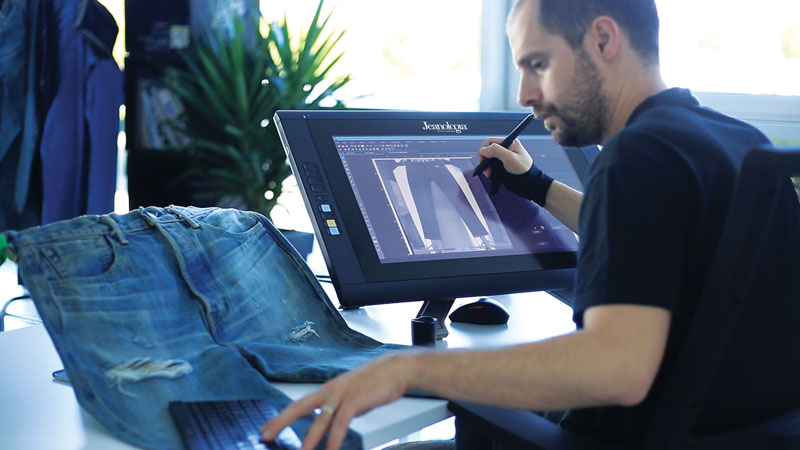
Jeanologia’s patented eMark integrated software simplifies design and enhances productivity, according to the company.
Laser systems for textile finishing and embellishment offer versatile and eco-friendly finishing options
By Dr. Traci A.M. Lamar
At ITMA 2019, most laser finishing system concepts introduced focused on design capability, productivity and a systems approach to sustainability, particularly in denim processing. Lasers also have the capacity to produce an extensive range of finishing effects that would otherwise require application of multiple chemical and mechanical finishing processes using several different pieces of equipment, making these systems versatile and eco-friendly.
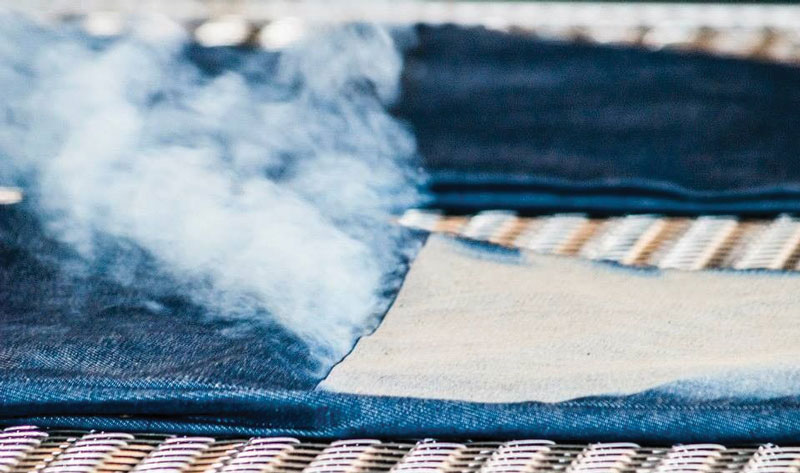
Though these lasers for finishing also commonly have cutting capability, they excel in rapid and flexible distressing and embellishing offering fast and precise engraving and marking effects. Particularly suited to laser treatment of textiles are carbon dioxide (CO2) lasers. CO2 lasers use a mixture of gases such as CO2, nitrogen, hydrogen and helium in a mirrored tube. When excited by an electrical current, the gas produces thermal energy which is reflected by the mirrors and intensified producing a beam of laser light from one end of the tube. The laser beam must be directed to the textile surface for laser treatment to occur. To move the laser beam around the material at the speed required to achieve finishing effects, a galvo mechanism is typically used. Galvo systems use motorized, high speed mirrors to direct the laser beam onto the material surface. Because only the motorized mirror is moving during processing, the laser can be directed over the material being treated at very high speeds with great precision. Because the laser head does not physically move, galvo lasers are very fast and efficient systems for distressing and finishing textiles. Such systems are able to cut and enhance single layer fabrics, as well as age and distress products.
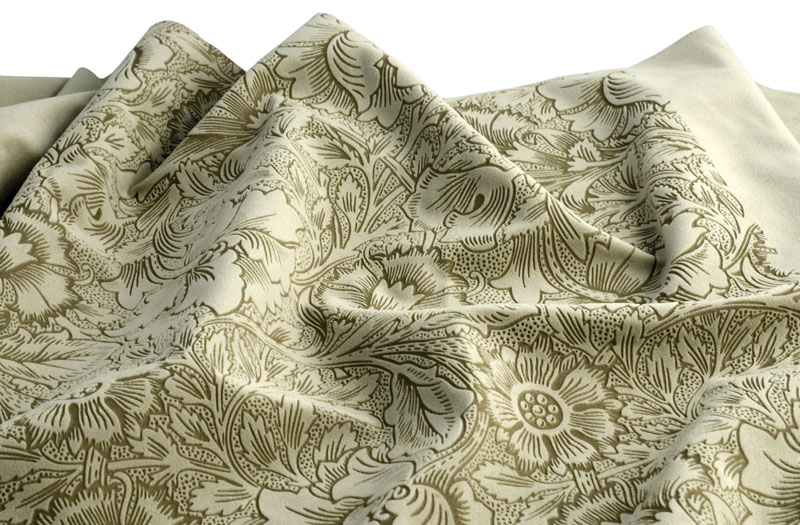
At ITMA, systems were shown both for enhancing finished products and for treating fabrics prior to assembly. Finished product treatments, especially jeans, were the predominant focus of demonstrations. Textile laser systems are increasingly important to the denim industry where they can be integral in sustainable production systems for fabrics and products. Laser application in denim finishing is particularly attractive from a production system perspective because lasers can recreate the combined effect of several other chemical and mechanical processes in one single operation.
A Variety Of Capabilities
Aside from variations in laser power, which is expressed in watts, internal capabilities of the laser mechanism itself are quite similar across most textile laser systems. Key differentiators from one textile laser system to the next include the software interface and capabilities, the effectiveness of the system over time, and the required production capacity. At the most recent ITMA, laser finishing concepts introduced focused on design capability, productivity and a systems approach to sustainability particularly in denim processing. One exception to this is VAV Technology, which showcased an innovation related to the laser tube itself. Companies based in Italy, Spain, and Turkey were well represented at ITMA 2019 in the field of laser marking and engraving. A few Chinese firms also were showcasing laser capabilities although the main focus of their exhibits was laser cutting rather than finishing.
Laser Systems From Italy
OT-Las S.r.l. introduced its ReJeans concept at ITMA 2019 emphasizing it as a versatile concept supporting creativity and design flexibility. The concept utilizes its CX-T system, which can laser treat textiles in a continuous or stepwise process and offers flexibility for customized products — an approach that was demonstrated during the show feeding denim into the laser treatment booth from a roll where garment parts were laser treated for finishing effects and cut out for assembly in one combined process. To highlight the creative potential of the ReJeans concept, OT-Las featured products from Italy-based Ideal Blue, a design and manufacturing company that utilizes OT-Las treatment for denim in its ethical manufacturing process. A diverse array of unique products was shown with details including elaborate repeating textile designs, tonal photographic effects, and novel textures achieved using lasers. OT-Las also offers a roll-to-roll laser treatment system for creating continuous effects on roll goods.
SEI’s Matrix Textile laser system may be used to decorate man-made materials as well as denim.
Sei S.p.A., also known as Sei Laser, showcased its Matrix Textile laser system and its potential as a disruptive technology in denim processing. The modular Matrix Textile system can be used for high productivity roll-to-roll and roll-to-garment part processing, allowing manufacturers to mark for assembly, cut garment parts and finish with laser effects in one step. The flexibility provides an opportunity to optimize production flow in manufacturing. The Matrix Textile system targets faster turnaround and production, reducing it to a few days in a well-planned production and finishing system. During ITMA 2019 presentations, Sei Laser highlighted the eco-friendly nature of the laser processing because it uses no water and no chemicals, as well as its ability to optimize fabric utilization and thereby reduce fabric consumption. Of particular interest in terms of material utilization and efficiency, Sei showed how the brand marking, care label, size information, and style number can be directly applied to the inside of the waistband. In addition, the cut parts were labeled for assembly with some instruction. Unlike cutting garment parts with blades that inherently includes some limitations in shape, the Matrix Textile laser has no limitations on cut shapes. The approach advanced by Sei Laser offers an appealing solution for a micro-factory environment where flexibility and versatility are key to an effective production system. The Icaro Textile software developed for the laser can process any vector or raster image specifically for adding the laser surface effects including importing a wide range of image file types. Sei Laser also offers the Flexi Denim system for garment processing.
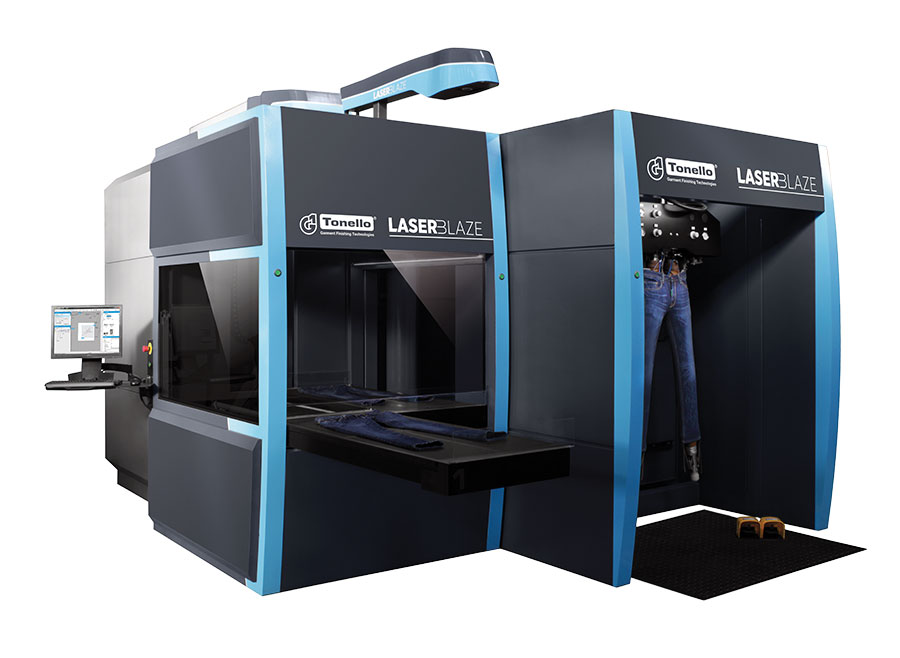
Tonello’s Laser Blaze TM offers three different power options.
Tonello S.r.l. also offers unique design capability in its system with an online shop for laser designs — the first in the world, according to the company — with downloadable options available 24/7 as well as custom laser design service. In addition to the new laser software touted as user-friendly and responsive, Tonello’s mannequin laser systems allow 360° treatment for authentic laser effects mimicking actual wear and crossing seamlines. This approach is in contrast to flat-folded products that are laser treated on a table one side at a time, which does not allow the decorative effects to continue around the garment. Three variations of Tonello’s Laser Blaze are available — T, TM and C — offering a fixed or double sliding table, mannequin, table and mannequin, or conveyor loading. The system includes a design library of laser designs to get new users started.
At ITMA, Tonello featured a flat table Laser Blaze featuring a laser head that could be positioned in either of two locations to support two loading tables side-by-side.
Laser Systems From Spain
Jeanologia S.L. offers lasers in a variety of configurations targeted to differing levels of production from its Flexi Lab flat booth system for prototyping and small-scale production, to the Twin Pro mannequin system that employs two laser heads for simultaneous treatment of both legs of a garment. Jeanologia laser components included a mannequin-type laser that can treat jeans on a form, and a flat-bed-type system capable of handling varied products such as jackets and T-shirts. Jeanologia’s eMark software drives the lasers and offers enhanced design capabilities and tools for novel effects including light scraper, light PP spray and light drill to easily mimic manual and chemical finishing processes. At ITMA, Jeanologia showed its laser equipment as part of a fully conceived finishing system for denim products that also included ozone finishing equipment and a water recycling unit. According to the company, the system can provide a dramatic decrease in water consumption during denim processing, and is connected via digital technology making it flexible and providing the opportunity for a customizable, customer-responsive production system.
Machines from Iberlaser can impart distressing effects as well as all over repeating textile designs.
Iberlaser incorporates a variety of productivity features across its laser models reflecting several approaches. One system features two laser heads each with its own belt feed allowing constant operation of the laser and continuous loading of products to be processed. Its most advanced laser system uses only one laser tube that can move, allowing laser treatment on a flat table with two automatic loading belts as well as a mannequin in one unit. Sample products, including jeans and T-shirts, featured all-over repeating textile designs that pushed beyond the most often seen distressing .
Macsa ID S.A. offers three laser system alternatives — a mannequin, a flat system, and a smaller scale laser for customizing products. The mannequin system features side-scrolling loading for continuous loading and processing; the flat table offers double conveyor loading for enhanced productivity; and the third system provides a 30 centimeter (cm) by 30 cm bed for smaller scale product customization. The company reports its technology reduces water and energy use, optimizes denim distressing using no chemicals, and offers productivity of up to 200 pieces per hour. The denim lasering has no effect on fiber strength, but rather only sublimates the indigo dye, according to the company.
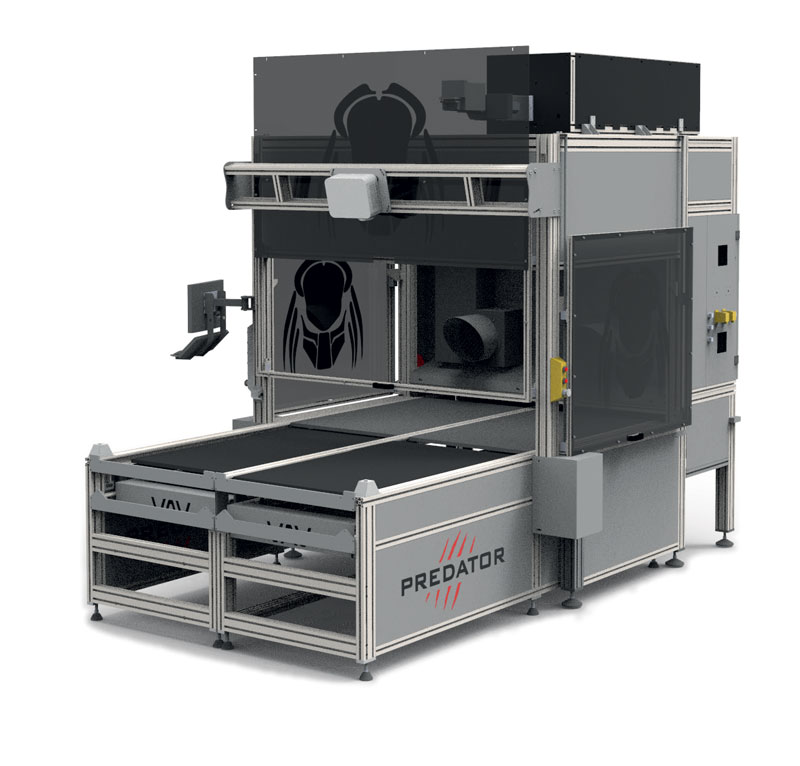
VAV Technology’s Predator series machines feature the unique Never- Ending Power Laser Tube technology.
Other Laser Systems
Germany-based VAV Technology GmbH, with facilities in Turkey, has a comprehensive focus on denim finishing technology. The company has taken a novel approach with the Predator laser machine series included in its finishing line by designing it to run with its NEP — Never-Ending Power Laser Tube. A canister provides the gas mixture needed to produce the laser beam. Consequently, the gas mix in the laser tube on the machine is renewed constantly and never loses its quality. In conventional laser tubes, gas is contained in the laser tube and over time it depletes causing the laser tube to lose power and require replacement. The Predator’s gas replaceable canister not only continuously renews the gas in the laser tube, but can also be easily changed periodically to maintain constant laser power over time. The machine series includes several flat bed systems and a mannequin system. One machine shown at ITMA 2019 featured a system of four sliding tables, arranged in pairs side-by-side, feeding a flat laser. As the laser treatment finished, the table inside the machine dropped and began to slide forward and out of the machine while the loaded table slid above it into the laser booth. The computerized interface allowed the operator to observe what was happening on each of the four tables at any given time, whether a product was processing, waiting, preparing or unloading. VAV Technology includes its laser as a component of its “No Hand Touch” total system of eco-friendly finishing equipment. The company recommends an ozone treatment process to brighten products as needed following laser processing.
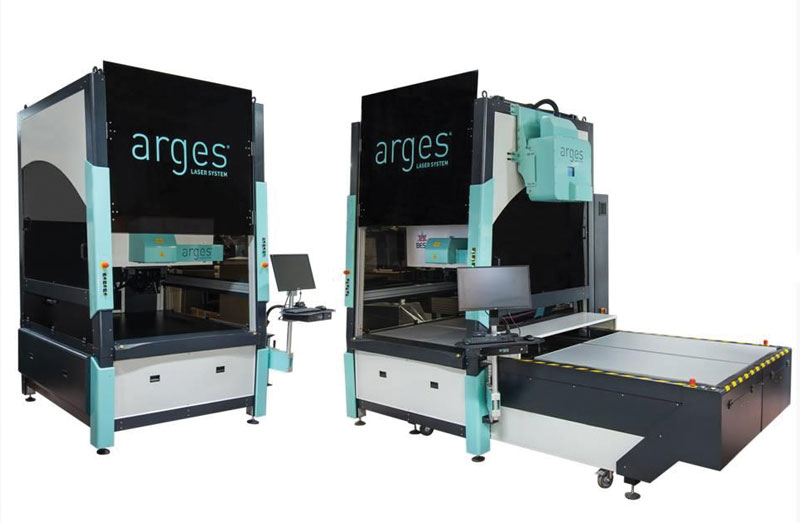
Denim Marking Machines from Arges Laser System feature a 3D+ Optical System that can rapidly change an automatically focused beam diameter using specialized software.
The textile laser configurations from Arges Laser System, Turkey, are flat table systems with for enhanced processing speeds. The system offers four moveable tables for loading, unloading, and laser treating continuously with two operators working side-by-side. A projection screen shows the engraving location on each product as it is loaded for treatment. Notable features include its 3D+ Optical System developed for better design transitions, thinner lines and greyscale; and the Arcon software that drives the laser, which is capable of processing a wide range of file types. Arges Laser technology also is eco-friendly and efficient in terms of power utilization and therefore a good fit with sustainable finishing systems. The company also offers an ozone washing system as a complement to the laser in a more sustainable processing system.
Laser Systems From China
At ITMA 2019, Han’s Yueming Laser showed a small scale laser with a bed that can easily adjust to dramatically raise and lower the laser platform. This adjustability allows the focal length of the laser beam — the distance where the beam actually focuses — to engrave with high accuracy and efficiency, and the machine can accommodate materials diverse in thickness and shape. The laser is envisioned for quick and easy embellishments or other customizations on finished products, and its small size allows the laser to be used in a environment such as a shopping center or mall. Though the laser treatment surface is small, the adjustable laser allows the bed to move up and down for significant variation. Customized products on display included a shoe and a volleyball.
CK Laser offers a variety of laser technologies including ones that feature laser engraving ability. The systems range in size and utilize a flat bed rather than a mannequin. They also feature optical placement guides that project onto the loading surface to ensure that operators can properly position the materials before the laser treatment.
Wuhan Golden Laser Co. Ltd. and Gbos Laser Inc. both showcased their laser cutting systems at the last ITMA. Golden Laser does have some laser engraving systems available including machines targeted to the footwear industry and to textile material processing. Among the offerings is a roll to roll engraving machine for textile roll goods. Likewise, Gbos laser has a variety of systems available with capabilities including cutting small pieces for lingerie and engraving for denim. The company highlighted systems that recognized visually what to cut and where. These cutting systems were very small and accurate, for items the size of a garment label. The laser systems recognize color differences and can cut specifically to an outline or a pattern based on the placement of a design on a textile surface.
Sustainable Production
Sustainability in relation to denim production was a notable overall theme at ITMA 2019. One of the greatest advantages of laser finishing for denim and denim products, aside from its sustainability aspects, is the laser’s ability to produce an extensive range of effects that would otherwise require application of multiple chemical and mechanical finishing processes using several different pieces of equipment. This capability makes laser treatment an attractive option for firms targeting customized and small run production, and micro-factory environments where versatility is key. When supported by a robust, design-focused integrated software programs, lasers become a powerful tool in creating innovative products for niche and exclusive markets. Laser firms are starting to explore laser applications to materials beyond denim, including pile fabrics and knit goods. The roll-to-roll machine configurations offered by some laser manufacturers, is poised to impact the production and finishing of textile materials themselves in the future, as well as product categories beyond denim.
Editor’s Note: Dr. Traci A.M. Lamar is an assistant professor in Textile and Apparel Technology and Management at North Carolina State University, Raleigh, N.C.

 In other company news, Cone Denim released Pride Rainbow Selvage Denim in honor of Pride Month. The selvage edge on the fabric, which typically is white, is crafted using a unique rainbow set of colors. The denim is the latest style added to the Cone® Community Collection, which shows the company’s support of a wider and more inclusive community. Cone will donate a portion of the proceeds from the sale of Pride Denim and related accessories to the Human Rights Campaign.