New Partner Inner Fashion And Polygiene Launch Underwear And Facemasks For Pierre Cardin And Valentino Rudy

MALMÖ, Sweden — November 26, 2020 — Polygiene presents its new partner Inner Fashion from Thailand, a renowned producer and distributor of men’s inner- and underwear from the brands Pierre Cardin and Valentino Rudy. The launch will include several styles treated with Polygiene Stays Fresh technology. With a yearly forecast of 300,000 pieces. Additionally, facemasks for Pierre Cardin with Polygiene ViralOff® will be launched in December.

The products will be distributed via a number of leading department stores, around 60 shop in shop around the country, as well as on online platforms such as Shopee, Lazada, JD Central and Wemall.“We continuously want to develop our products to create a positive perception toward the customers and make them feel that they receive the promised benefits and services. We also focus on sustainability by trying to reduce the environmental footprint from the garments. That’s why Polygiene is our answer!” says Sureeporn Tawankanjana, managing director, Inner fashion.

“Our Stays Fresh solutions have shown a strong growth in South Asia as well as in the new market Thailand, this last year. We are looking forward to a long-term partnership and increasing volumes with Inner Fashion. They see the benefit of using both our Stays Fresh solutions that fit the underwear segment very well, as well as our successful Polygiene ViralOff antimicrobial technology that is a perfect fit for the Pierre Cardin facemask — all products with the benefit of lasting longer as well”, concluded Ulrika Björk CEO Polygiene.

Posted November 26, 2020

Source: Polygiene

Borealis Makes Progress Towards “Goal Zero” Thanks To Upgraded State-Of-The-Art Water Treatment System In Schwechat, Austria

SCHWECHAT, Austria — November 26, 2020 — Borealis announces that the upgraded wastewater treatment system at its integrated production location in Schwechat, Austria, is now fully operational. Successful tests of the sophisticated new multi-step system, which was installed in November 2019, show that the facility is now even more effective than before in reducing the risk of unintentional plastics spillage or loss. Borealis invested around 6 million euros in the custom-built filtration system, which is the result of extensive and productive collaboration with Austrian universities and technology providers.

New filtration system utilizes best technology

As a responsible company, Borealis is committed to enhancing sustainability in its own operations and across the entire supply chain by striving to eliminate plastics loss altogether.

The new filtration system in Schwechat is the most recent example of concrete measures taken at an operational level to achieve “Zero Pellet Loss,” the umbrella term for Borealis and industry efforts to reduce spillage. Regular internal monitoring of wastewater flows ensures that emissions always remain within stringent regulatory parameters.

Borealis collaboration with the Technische Universität Wien (TU Wien) and Graz University of Technology (TU Graz) provided a way forward in the upgrade of the Schwechat treatment system. After determining at the start of the project that there were no off-the-shelf solutions that offered better performance than the existing equipment, Borealis engineers first worked closely with scientists from these universities to find novel ways to measure the presence of plastic matter in water before proceeding to design and construct its own new systems for removing such matter from wastewater.

The custom-built filtration infrastructure installed on the Schwechat grounds towards the end of 2019 includes two separate filtration systems for the multi-stage treatment of clean water. This novel system is able to filter a broad range of particle sizes of total suspended solids (TSS), from several millimeters to extremely fine — in the low micrometer range. The equipment is installed downstream from existing polymer separators and acts as an additional layer of protection. A study of the TU Wien confirms that the filtration system has enabled us to make a step change in the purity of our wastewater.

Borealis has and will further leverage learnings from the study as well as the development of this custom-built filtration system not only in all its production locations to further improve its operations, but also the whole value chain to foster the European “Zero Pellet Loss” and Operation Clean Sweep goals.

“The purification capabilities we had in place in Schwechat were already good, but the upgraded system boasts a level of sophistication that is leading in all of Europe’s plastics industry,” said Borealis CEO Alfred Stern. “Innovating for more sustainable living together with our partners in science and making substantial investments in such upgrades enhances our operational excellence. We intend to deliver on our commitment to reducing plastics loss in order to achieve our ‘Goal Zero’ of no losses whatsoever.”

Alongside operational measures, the Borealis “Zero Pellet Loss” effort encompasses a wide range of activities within the industry. Borealis was an early signatory to Operation Clean Sweep® (OCS), an international programme initiated by the Society of the Plastics Industry and the American Chemistry Council. In Europe, this programme is coordinated by PlasticsEurope, and in 2019, Borealis contributed to the drafting of stringent new requirements. In Austria, Borealis is also a signatory to the “Zero Pellet Loss” pact, which shares similar goals to the OCS program.

Posted November 26, 2020

Source: Borealis

Radicigroup Releases Its Sustainability Report 2019: Creating Shared Value In A Long-Term Perspective

BERGAMO, Italy — November 26, 2020 — In 2019, RadiciGroup continued to pursue the creation of value for its stakeholders: production chain, environment, employees, and local communities and territories. The group’s Sustainability Report, based on the data supplied by 22 industrial sites located all over the world and the parent company, highlights the group’s actions and achievements. Positive performance was achieved through continuous effort to harmonize business goals with optimal resource efficiency and to protect local communities and people. This is how RadiciGroup contributed to reaching the goals set out in the United Nations 2030 Agenda for Sustainable Development.

“The commitment to more sustainable development from an economic, environmental and social point of view is a topical issue, also — and above all — in a delicate moment like the one we are going through right now. Indeed, this commitment plays a strategic role in the process of economic and social revival and is fundamental to ensure a better future for the generations to come,” Angelo Radici, president of RadiciGroup, commented. “In a dramatically changed context, the sharing of goals, efforts and experiences is central to continuous growth. Also, in 2019, we realized our mission by creating durable value through initiatives shared with all our stakeholders. We knew how to react to the difficulties and changes in the market by remaining united, and this gives me confidence for the future, even though we still have difficult months ahead of us.”

Creating Value For The Whole Value Chain

RadiciGroup’s commitment starts from within its own production chain, which generates a competitive advantage for the company and creates value added for the whole value chain.

A virtuous system based on the exchange of ideas with suppliers, customers, associations and partners, on the one hand, and the circular economy business model, on the other. All efforts are directed at creating durable high-quality products developed by investing in innovation, using low impact and recyclable raw materials, choosing renewable source materials, minimizing waste, enhancing processes and adopting rigorous systems for environmental impact measurement.

In 2019, the Renycle® yarn range was added to the RadiciGroup low impact product portfolio. Renycle yarns are made from recycled nylon and offer 100 percent end-of-life recyclability; they are targeted at applications in the textile/fashion, interiors and automotive industries. Renycle polymer offers a saving of more than 87 percent in energy and 90 percent in water, while achieving technical performance comparable to that of its virgin counterpart. In addition, CO2 emissions are reduced by almost 90 percent.

Creating Value For The Environment

RadiciGroup recognizes the environment as a privileged stakeholder and protects it through initiatives and sizeable investments. In 2019, the group invested 7.6 million euros on enhancing the sustainability of its activities.

Furthermore, the data for the three-year period 2017-2019  demonstrate improvement in the ratio process waste per unit produced, which declined from 9.76 kg/t to 8.85 kg/t (-9.3 percent).

As regards direct primary energy consumption, the 2019 data show a decrease in terms of both absolute numbers (-13.6 percent) and per unit produced (-2.8 percent).

Wherever possible, the group continues to rely on renewable sources: In 2019, the group energy mix included a significant portion of green energy (42.1 percent). Numerous group sites are powered by green energy, and, in Italy, a number of sites rely on the hydroelectric energy provided by supplier-partner Geogreen. In 2019, the choices made by the group to foster the use of green energy and low impact fuels allowed it to reduce greenhouse gas emissions by 23.8 percent,compared to the amount of emissions generated by the use of the standard national energy mixes.

Still another relevant result was the percentage saving of water of 70 percent compared to the theoretical requirement (+5 percent saving compared to 2017). Furthermore, RadiciGroup uses no water in its products and does not use water resources to create long-term water storage for its production activities, thus, leaving the water at the disposal of local communities.

Creating Value For Employees

People are a precious resource for RadiciGroup. Respect for human rights, protection of workers’ health and safety, team spirit, striving for continuous improvement and transparent communication are the group’s key values.

More than 90 percent of the Group’s employees have a permanent employment contract. Personalized continuous training plans are provided and over one-third of the total training hours is allocated to health and safety.

Creating Value For Local Communities

RadiciGroup continues to strengthen its relationship with local communities, a relationship based on continuous exchange, also made easier by the proximity of group companies to urban centers. Specifically, in Italy, 80 percent of its workers live within a 20-km radius from the corporate site where they work, just as the Radici family members maintain a strong physical presence in the places where the group was founded and still operates.

In 2019, the group started numerous initiatives for the benefit of local communities, including projects with schools for the development of talent and support for local youth sports activities. The passion for sports as a “gym of life” is expressed through the sponsorship of the RadiciGroup Ski Club, which has over one hundred athletes in the various categories. Also very important is the collaboration with Atalanta B.C., the football club that is a reference point for Bergamo and the entire province.

Today, RadiciGroup offers job opportunities to local young people, passes on solid manufacturing know-how from generation to generation, and promotes a continuous relationship of trust with the industrial firms in the local area. This latter aspect was instrumental in setting up a Made-in-Italy production chain for personal protective equipment during the Covid-19 health crisis.

With a view to continuous evolution, RadiciGroup has created Radici InNova, a consortium dedicated to the Group’s research and innovation activities for sustainable solutions. The new company has collaborations with multiple partners, including external scientific and educational institutions.

Posted November 26, 2020

Source: RadiciGroup

Mogul Tekstil: Madaline® — Utilizing A Unique Hybrid Bicomponent Nonwoven Technology For Producing Continuous Microfilaments

BASPINAR-GAZIANTEP, Turkey— November 26, 2020 — Madaline® is a unique hybrid nonwoven technology that uses bico technology composed of polyester (PET)/nylon for producing continuous microfilaments. Good mechanical characteristics result in a fabric that will not lose its shape or uniformity, even after heavy use and multiple wash cycles.

Madaline fabric has unique inherent features like non-fraying edges, barrier against house dust mites and high bacterial filtration efficiency — help to prevent odours — low linting and low pilling, quick dry, absorbent, breathable which bridges gap between nonwovens and textiles and makes it a perfect fabric for home textile applications.

Since Madaline is low lint product it protects the environment by not having polymer fragments carried away with the wash of water during washing and thereby polluting bodies of water and entering the food chain. Such microscopic pollution is presently among the most serious environmental concerns.

Mattress, mattress covers and pillowcases

Madaline, a natural barrier to dust mite particles, with zippered encasings for duvet, mattress and pillows are the best protection against dust mite allergies. Dust mites and their by-products are trapped within the Madaline encasing and the allergic sleeper is not exposed to the dust mite allergic threat. Similarly, bed bugs are trapped within the encasing and cannot move to propagate other parts of the room.

Madaline can also be used for bedsheets, mattress protectors and bedspreads in hospital, institutional, residential and home use.

Madaline is certified by globally recognized ECARF as being Allergy Friendly Products and Services.

Since Madaline requires no treatment for its barrier properties, the fabric’s protective features remain secure, even after multiple washing.

Madaline also breaths well and does not retain moisture which microorganisms thrive on.  Moisture vapor migrates out of the fabric and it dries very quickly.

Lightweight and breathable Madaline has good thermal insulation to maintain body warmth which all contribute for a good blanket material. Madaline is both comfortable and warm without creating a hot effect.

Absorbent Madaline, whether printed or dyed is ideal for  tea towel production. Lightweight, attractive and effective it can be used for home, residential and institutional applications.

Madaline printed and colored designs, make Madaline an attractive fabric for table linens, service settings and table runners. It can be treated for stain resistant, washable, durable, non-linting and low pilling.

Madaline has unique acoustic properties. This makes it an excellent choice for wall coverings. Madaline can be printed, dyed and embossed to create unique, bold and sophisticated looks for walls, ceilings and vertical surfaces. Madaline is durable and its structure blocks penetration of bacteria. Treatments include fire retardancy to institutional standards and easy soil and stain release for easy cleaning.

With its multidirectional stability Madaline is a strong candidate material for window blinds and linings for curtains. Easy to cut and securely stitch, printed or dyed Madaline is an attractive fabric to decorative windows and provide shade. Available treatments include printing, dyeing, coatings, UV absorption, fire retardant and hydrophobic attributes.

Madaline with extra treatment has been certified  as UV-Label Grade 80, the highest grade of UV protection, per UV Standard 801.

Therefore, curtains with Madaline fabric are a proper application for hotels, care homes, schools, hospitals and other institutional and residential facilities.

Multi-directional strength, durable, uniform surface, washable, quick drying and breathability are all inherent attributes that make Madaline a great upholstery fabric. Also, Madaline is lint-free and low-pilling which makes it a superior upholstery material compared to microfibers.

Madaline has exceptional capability for enhanced printing and dyeing for stunning visual effects. These printed or dyed fabrics can also be laminated with traditional textiles to give the resultant fabric a heavier and ‘full’ feel.

Posted November 26, 2020

Source: Mogul Tekstil Sanayi ve Ticaret A.Ş.

Gap Inc. Appoints New Chief Growth Officer, And New President And CEO Of Banana Republic

SAN FRANCISCO — November 24, 2020 — Gap Inc. today announced that Asheesh Saksena will join the Gap Inc. senior leadership team as chief growth officer, a newly created position that will focus on executing the company’s strategic agenda, as well as leading growth initiatives for the future. In addition, the company also announced that Sandra Stangl will join Gap Inc. as the new president and CEO of Banana Republic, as the brand redefines affordable luxury.

“Gap Inc. has significant opportunity to grow our purpose-led, billion-dollar lifestyle brands through the power of our platform, sophisticated end-to-end capabilities and by harnessing the advantages that come with operating a portfolio that targets 80 percent of the addressable apparel market,” said Sonia Syngal, CEO of Gap Inc. “With the addition of Asheesh and Sandra, two strong industry veterans and proven creators, I have even greater confidence in our ability to deliver against our Power Plan 2023 as we steer the company into the future”

Saksena most recently served as president of Best Buy Health where he led the formation and operation of the brand’s strategic diversification into Digital Health after serving as the company’s chief strategic growth officer. During his time with Best Buy, he helped expand the company’s addressable market and incubated new platforms for growth. Prior to his time at Best Buy, he led strategy and growth organizations at Cox Communications, Time Warner Cable, and as partner at Accenture. He will join Gap Inc. in January 2021, and upon arrival will assess value creation opportunities to ensure consistent growth across the company.

Stangl is a strong creative leader known for delivering design vision, brand expansions and financial results. During her 23 years at Williams Sonoma, she held numerous leadership positions including President, Pottery Barn Brands and launched two iconic brands — Pottery Barn Kids and Pottery Barn Teen. Stangl was president, chief merchandising & new business development officer for Restoration Hardware where she led new assortment, inventory and quality strategies enhancing the customer experience. Most recently, she cofounded and was the chief merchant of MINE, a disruptive pure-play home business. Stangl will bring the agility and strategic orientation of a tenured retail executive and entrepreneurial leadership to Banana Republic when she joins in December 2020.

Posted November 25, 2020

Source: Gap Inc.

November 2020: Textile Activity At A Glance

November 2020

Bemis Associates Shares Insider View On Reflective Films

SHIRLEY, Mass. — November 25, 2020 — Bemis Associates Inc. — a manufacturer of thermoplastic films, tapes, and adhesives for bonding — hosted a set of technical webinars on November 17 and 18 featuring various types of reflective materials available to designers and engineers. The expert panel also presented demonstrations on different levels of brightness and how best to apply the reflective materials for maximum visibility.

A total of 120 people attended the webinars from across the globe including Asia, Europe, and the United States. More than 50 brands were represented from 27 different countries. Post-webinar metrics indicated the presentation achieved a 74-percent interest rating and 63-percent attentiveness rating which was supported by the positive comments received from attendees in the company’s survey. Feedback such as “It was very informational, informal and user friendly. I liked the mixed media your panelists used, and the visuals kept my attention.” “The images and graphs were simple and easy to understand. The imagery and layout aesthetically reflected the quality.” “Loved the live demos!”

“We will continue to plan more product-focused webinars for the future,” said Scott Wood, director, Product and Marketing. “With such a variety of highly knowledgeable and skilled engineers and designers on our staff, sharing their expertise with our customers and partners is a win-win for everyone,” he said.

Bemis Associates Inc., has been perfecting optimum adherence to a variety of fabrics for many different applications across the apparel, consumer electronics, and industrial markets for more than 100 years. During this webinar, company panelists offered ‘Best Practices’ based upon their longstanding and deep rooted understanding of the industry and leadership position in the adhesive manufacturing industry.

Posted November 25, 2020

Source: Bemis Associates Inc.

A Look Back: COVID-19 Dominates 2020 News

By Jim Phillips, Yarn Market Editor

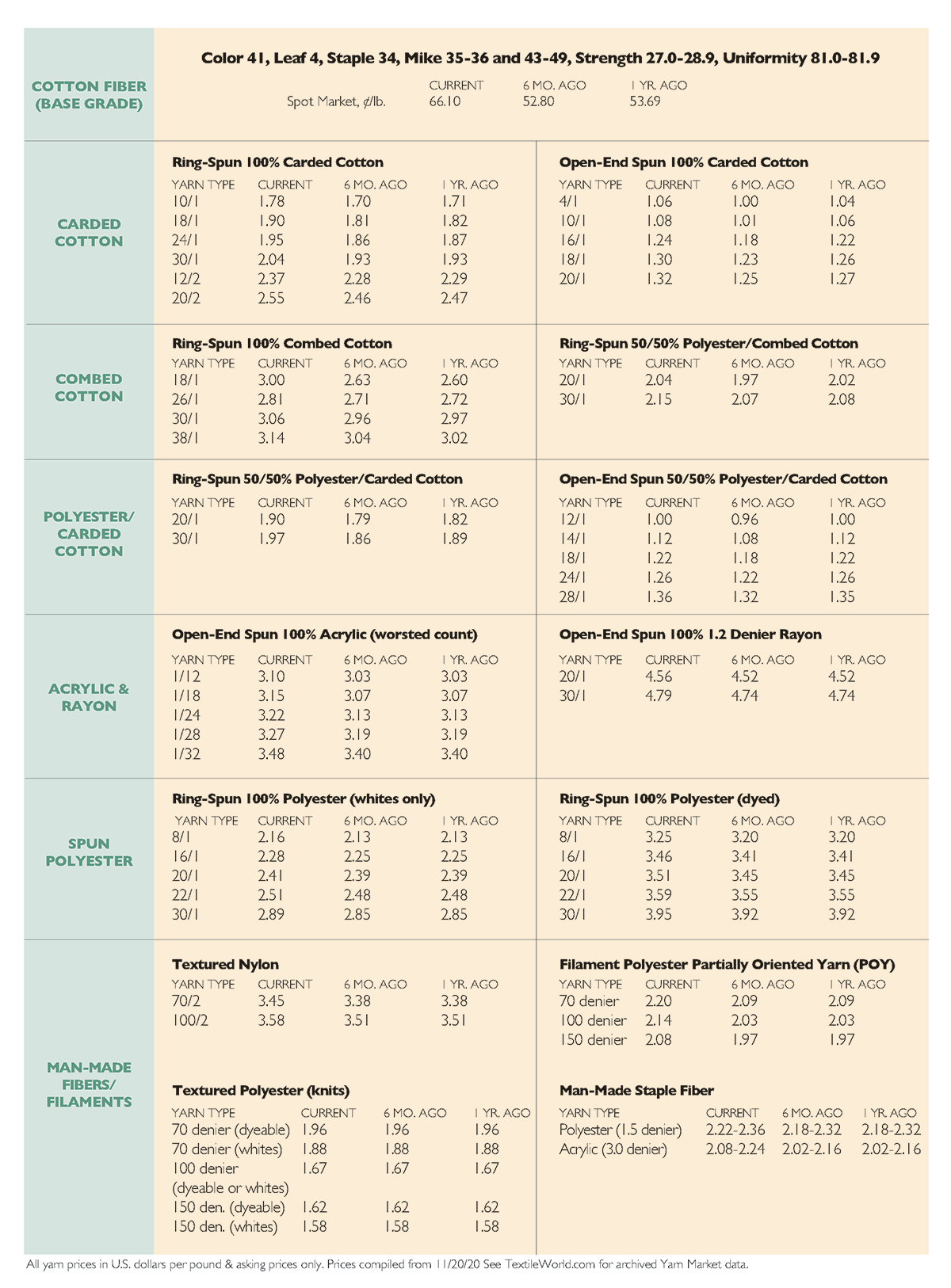
The impact of COVID-19 is the lead story in 2020 for the U.S. yarn and textile industries. A review of the year to date reveals a January brimming with optimism, a March veiled in uncertainty, and an April and beyond doubt and worry.

For example, an excerpt from the January-February 2020 Yarn Market reveals anticipation for solid business growth: “As the post-holiday retail inventory adjustment comes to a close, spinners are once again reporting an increase in orders. ‘It’s the same cycle every year — at least in good years,’ said one spinner. ’We go full-out to meet holiday orders and then we have a lull in the fourth quarter and the beginning of the first quarter. Then, a few weeks into the first quarter, we start seeing business trickle in again.’ Added another spinner: ‘I would not say it’s booming, but it is definitely picking up across the board. Cottons, blends, home furnishings, they are all beginning to tick upward.’”

Fast-forward to March: “‘Right now, it’s just wait and see,’ said one industry expert. ‘With retailers like Abercrombie, Levi’s and Nordstrom closing at least through the end of March, we expect to see a general slowdown in orders across the entire supply chain. How deeply it will affect individual companies — and the industry as a whole — will depend on how long the epidemic lasts.’

‘What we are really concerned about, from a business perspective, is how long this is going to last,’ said one executive. ‘If it lasts long enough to affect back-to-school and holiday orders, it could turn into a bad year for the industry as whole.’”

Those last words were prophetic. According to OTEXA, COVID-19 resulted in an approximate 22 percent drop in the value of U.S. textile output in the second quarter. By the end of July, the value of U.S. yarn exports went down 31 percent year over year. By mid-year, overall employment in the U.S. textile and apparel industry was down by some 80,000. As the year winds down, many of these workers are still unemployed, with diminishing unemployment benefits and little-to-no health insurance. The unemployment and insurance disaster has been further exacerbated by a U.S. President that, according to numerous sources, has essentially “checked out” since losing the election. With little help anticipated from Washington over the next few months, the outlook for some of these displaced workers is grim, according to health officials and economists.

Some companies were able to at least somewhat offset the loss of regular business by manufacturing personal protective equipment (PPE) for front-line health workers.

For example, Unifi, supplied yarns and fibers to more than 100 companies that produced masks, gowns, and other PPE needed by first responders, medical personnel and the military. Unifi’s fiber is an essential ingredient in the production of hundreds of critical components and products, including masks, gowns, sewing thread for gowns, sterile wipes, drapes, and elastics for masks and face shields.

One Unifi customer, Contempora Fabrics, based in Lumberton, N.C., shifted from the production of baseball uniforms to making medical masks and gowns. And S.C.-based Phenix Engineered Textiles used Unifi fiber and yarn to make elastic trapping for face masks.

As the year ends with news of multiple vaccines with more than 95 percent efficacy that should be available beginning in Q1, the hope is that 2021 will see a return to some semblance of normalcy. The next Yarn Market will take a look at what spinners see in the crystal ball for 2021.

Traceability update

In the October 2020 Yarn Market report, the primary topic was the emergence of supply-chain traceability as a critical factor in the production of fiber, yarn, and fabric.

With increasing instances of counterfeiting, product contaminations and incomplete or inaccurate labeling, immutable traceability can help restore consumer confidence and ensure product safety by tracking every product development from initiation to end use. For example, for a cotton yarn, fabric makers will be able to see every detail of the yarn’s life cycle, from the moment the seed was planted until the yarn arrives at the weaver or knitter. Consumers will be assured of getting an authentic product with an accurate label.

Lenzing Uses Blockchain For Traceability

Shortly after last month’s column was published, Austria’s Lenzing became the latest to announce a large-scale traceability program. “To date, supply-chain traceability has become a top priority for apparel and home brands,” Lenzing stated in a news release. “To address both consumer demand and compliance risks increasingly faced by brand partners, Lenzing is introducing a brand-new blockchain-enabled supply chain traceability platform powered by TextileGenesis™.”

For those unfamiliar with the term, blockchain in a decentralized distributed ledger technology originally created for recording cryptocurrency transactions, such as those with Bitcoin. It uses blocks of information on many different computers to create an almost tamper-proof record of actions and transactions, as well as a complete and accurate chain-of-custody record.

According to the news release, the platform went live on November 5 and will be phased in incrementally. It will be accessible for all brands using Tencel™ and Lenzing™ Ecovero™-branded fibers, as well as for all supply chain partners globally across Asia, Europe and the Americas.” In the United States, Lenzing operates a Tencel fiber plant in Axis, Ala.

One of the core components of the platform powered by TextileGenesis is integration with the Lenzing E- Branding fabric certification system, which allows brands and retailers not only to access the full supply chain traceability for Tencel and Lenzing EcoVero branded fibers but also to view the results of forensic (physical) verification of fabric samples via the digitally signed Lenzing E-Branding fabric certificates.

“Over the past year, during the pilot program and field trials we have been receiving very positive feedback from brands and supply chain partners,” said Robert van de Kerkhof, chief commercial officer and member of the board at Lenzing. “Our brand partners have also been encouraging us to accelerate the global roll-out for traceability of Lenzing fibers. With this new system and the integration with Lenzing E-Branding fabric certificates, the entire Lenzing ecosystem will create an unprecedented level of transparency. This will provide consumers with the most sustainable and climate-friendly clothing and home textile products that are made of Tencel or Lenzing EcoVero branded fibers.”

November 2020

Adapting To The New Normal

Manufacturers must accelerate digital transformation to survive the coronavirus pandemic

By Claudia Jarrett

COVID-19 is disrupting business on an unprecedented scale. From reduced workforces to implementing social distancing measures and work from home policies, the pandemic has redefined normal business practice. Here, Claudia Jarrett, country manager at obsolete parts supplier EU Automation, explains why it is time for manufacturers to use big data processes to adapt to this new normal.

A digital future lies ahead. By acting early, being bold and decisive, manufacturers can accelerate their factory digital transformation to mitigate implications of COVID-19. After all, nobody knows how long the disruption caused by the global pandemic will last or what shape the recovery will take. Already, it has forced businesses to adjust to a new digital reality far sooner than they might have planned, and there is no guarantee that, once it is over, things will return to how they were before.

For example, it is generally accepted that the explosion of Chinese e-commerce was a direct result of the severe acute respiratory syndrome (SARS) epidemic in 2003. That was their new normal. And since, China’s annual economic output multiplied more than eightfold, to nearly $14 trillion from $1.7 trillion — that is according to the World Bank.

One route manufacturers can take to adapt to today’s new normal is by investing in artificial intelligence (AI) technologies like big data. Big data is a term that describes the large volume of data that inundates a business on a day-to-day basis, which can help bridge the gap caused by the pandemic’s impact on the workforce.

However, it is not the amount of data that is essential, it is what organizations do with the data that matters. Big data can be analyzed for insights that lead to better decisions and strategic moves. This can only be achieved by remembering the three Vs — volume, velocity and variety.

Volume

The first V, volume, refers to the amount of data handled in big data systems. Big data is large in volume and relies on massive datasets, often as large as petabytes or zetabytes, to operate. To put this in perspective, one petabyte is one million gigabytes, which is the combined storage capacity of 15,625 iPhone 11s. This scale might seem unfathomable, but these large datasets are not as difficult to collate as you might think.

For example, Facebook boasts more users than China has people. Each of those users store a lot of photographs, with Facebook storing roughly 250 billion images. As far back as 2016, Facebook had 2.5 trillion posts, which is a number incredibly hard to envisage.

Taking this theory onto the factory floor, adding more connected sensors to devices means all that telemetry data will add up. In fact, the increasing prominence of smart technology, like smart sensors, means that manufacturers can capture large volumes of data from almost any type of machine.

For instance, variables such as temperature, humidity, pressure, vibration and changes in operations can be used to monitor individual components and predict equipment failure. Data analytics tools can use this mass collection of information to predict when a component is likely to fail, meaning maintenance can be planned upfront, minimizing costly unplanned downtime.

Velocity

The second V, velocity, refers to the speed at which data is generated and the time it takes for this data to be processed. Returning to our Facebook example, users upload more than 900 million photos a day. So, the 250 billion number mentioned, will be outdated in a matter of months.

In short, data does not only need to be acquired quickly, but also processed and used at a faster rate. Add in the fact that the Industrial Internet of Things (IIOT) continues to increase its prevalence in the factory, more connected sensors will be out in the world transmitting data at a near constant rate.

For example, modern smart sensor technology using non-contact, highspeed laser sensors can detect issues traditional accelerometers cannot. With these laser sensors able to rapidly identify everything accelerometers can, as well as monitoring characteristics such as joint domain and modal analysis, condition monitoring capabilities are vastly improved. But, the onus remains of using real-time data to make the most accurate and appropriate decisions.

Variety

Onto the third and final V, variety. This refers to the different types of data involved in big data processes. Equipment status, parts condition, inventory and product service life are just some of the variables that create the complex web of data that must be managed by manufacturers.

Managing this data requires multiple integrated systems to create an all-encompassing view of the facility. For example, parts condition monitoring data might identify when a machine component is showing signs of failure. This can be automatically cross-referenced with the facility’s inventory data to see if a replacement is available.

If replacement parts are unavailable in your facility’s inventory, they can be ordered from an industrial parts supplier in advance to prevent machine failure. With supply chains being heavily disrupted by the pandemic, planning maintenance and ordering replacement parts before downtime occurs is a necessity.

Although COVID-19 is disrupting business on an unprecedented scale, it should encourage manufacturers to use big data processes and adapt to this new normal. By simply remembering the three V’s, manufacturers can analyze big data for insights that lead to better decisions and strategic moves.


Claudia Jarrett is country manager at obsolete parts supplier EU Automation, Chicago


November 2020

IDF Direct Spinning: Process Shortening With Technological Advantages

TW Special Report

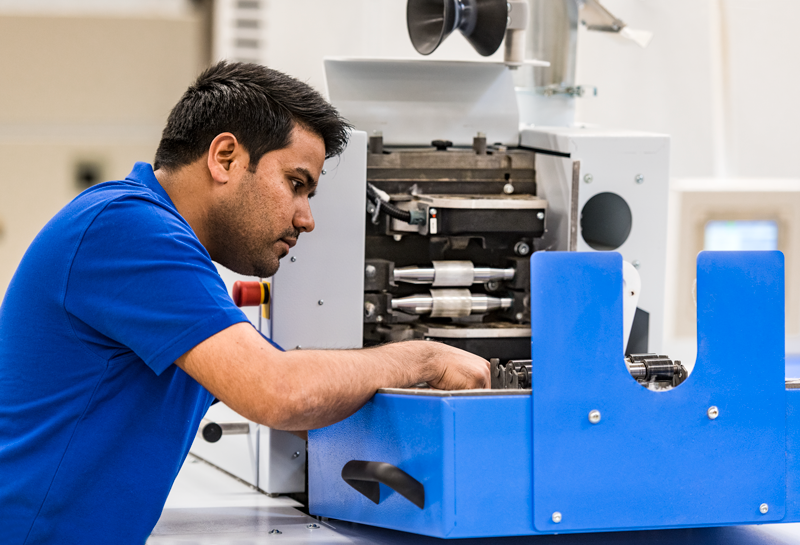
High yarn quality is becoming less and less dependent on the presence and experience of employees in a spinning mill. Nowadays, it is significantly influenced by futuristic plant solutions and intelligent machine systems. In the world of spinning, options for shortening processes, and thus reducing outlay in production, are becoming more and more relevant. One example is the IDF integrated draw frame from Trützschler which so far is superior to all competitor solutions. It can be used to combine two important aspects which currently heavily occupy the minds of our customers. For one, the shortening of processes means lower staff numbers are possible, whilst the IDF also provides a solution for tackling the increasing demand for spinning high-grade yarns from inferior raw material.

For years, Trützschler has been watching the trend that fiber lengths used in the rotor yarn sector in particular are becoming shorter and shorter. In 2003, the average fiber length for our customers’ rotor yarn installations was 28.5 millimeters (mm), today it is only 26 mm. This is a remarkable decline. The reasons for this can be manifold and may be related to cotton cultivation and harvesting methods. However, a crucial aspect is that the economic pressure on spinning mills and their production costs is increasing, leading to the use of ever shorter fibers.

Development History Of The IDF At Trützschler

It takes time for optimized processes to establish themselves on the market. This is because process shortening initially presents a challenge in the spinning mill. It must be ensured that the same yarn quality is achieved in terms of processing parameters such as strength, elasticity or appearance. In the mid-nineties, at the beginning of the IDF development, it was unimaginable that yarn could be produced from 100 percent noils, but today this is certainly the case. This is also a way for large combing mills to include their own waste in the value chain and selling it with added value. Trützschler has significantly advanced this development and implemented the IDF system in 1999, based on Spanish market requirements for the card TC 11. In the following years, it was continuously developed and improved.

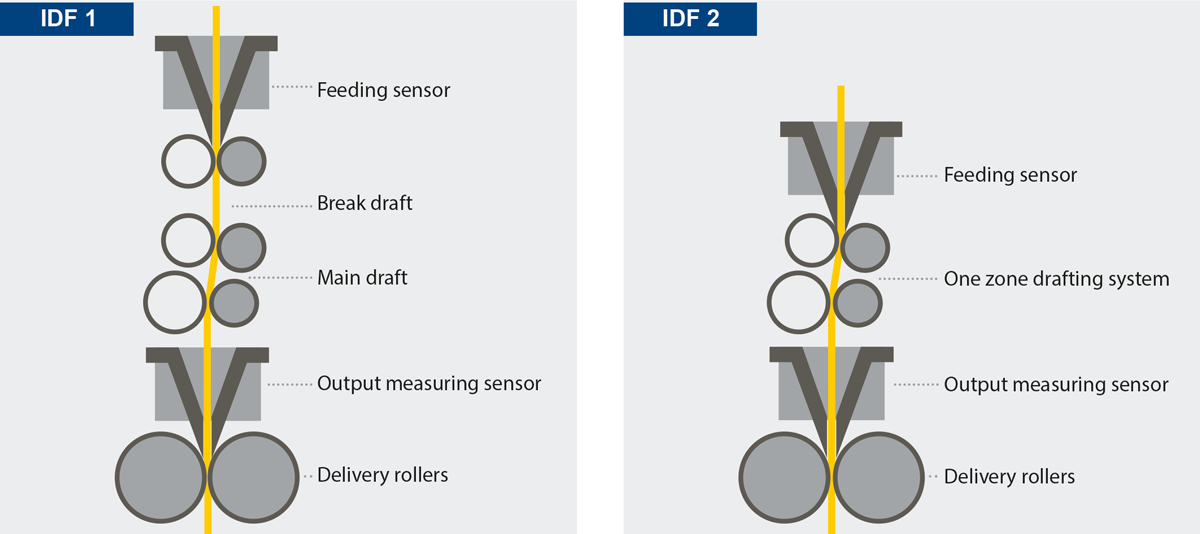
In 2013 Trützschler presented a fundamental revision: The Integrated Draw Frame IDF 2. The special feature was the reduction of two drafting zones to one. Thus, the IDF 2 responds to the increasingly urgent demands of our customers for production cost reduction on the one hand and a high quality standard despite poor raw material qualities on the other. This is because only the 1-zone drafting system allows particularly low drafts, which are the decisive guarantee of success for the processing of particularly short fibers.

Mechanical differences between IDF 1 and IDF 2

The main difference between IDF 1 and IDF 2 lies in the drafting system itself. Experience has shown that low total drafts are the key to success — especially with short-staple cotton, which is usually used in rotor spinning. However, dividing this small draft into break draft and main draft results in more disadvantages than advantages. For instance, if the goal is to achieve a 1.3-fold total draft using a break draft of 1.15, then only a draft of 1.13 remains for the main draft (1.15*1.13 = 1.3). This means that the leveling dynamic is limited to 13 percent. This is much too low to respond to short-wave fluctuations. For comparison: With the autoleveler draw frame, the main draft and thus the leveling range often exceeds 400 percent.

By eliminating the break draft in the IDF 2, the entire drafting takes place in one drafting zone. Thus the leveling range is fully utilized. Fluctuations are ideally compensated this way. If two parameters must be optimized simultaneously, it is much more difficult to find the technologically better setting. This is because break draft and main draft must be varied and constantly adapted to material changes. The IDF 2 is thus not only the better technological solution, but also simplifies handling. This is a particular advantage, since nowadays many spinning mills have to deal with the problem of having hardly any qualified personnel available to technologically evaluate settings of this kind.

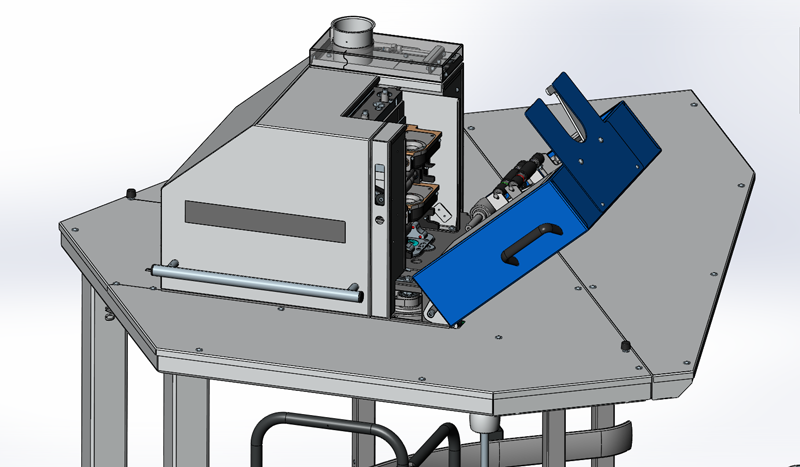
When using a normal-width drafting system, larger masses are accelerated and decelerated again during leveling, which can lead to increased energy consumption. For this reason the width of the bottom and top rollers of the IDF 2 has been reduced to the width of a sliver. This also allowed the introduction of the clever solution of rotating top rollers, which has led to a doubling of the service life before grinding.

The IDF 2 also introduced the sliver loop storage. This driven deflection roller levels the sliver loop by means of an integrated light barrier, resulting in perfect synchronization between card and IDF. The leveled loop permits high change speeds. This ensures a higher efficiency at the card, especially when using small rotor cans.

Development IDF 2: The new retention lock facilitates operation in case of minor production interruptions.

The combination of Trützschler cards with IDF 2 gives customers an advantage, because they produce a thin, stable web which is perfectly suited to be drawn directly to the desired sliver count — at highest production rates and lowest drafts. If cards produce a heavier web, the use of low drafts is not possible at all, as, for example, from 12 ktex to 5 ktex a draft of 2.4 is applied.

One Versus Two Drafting zones – Technological Advantages

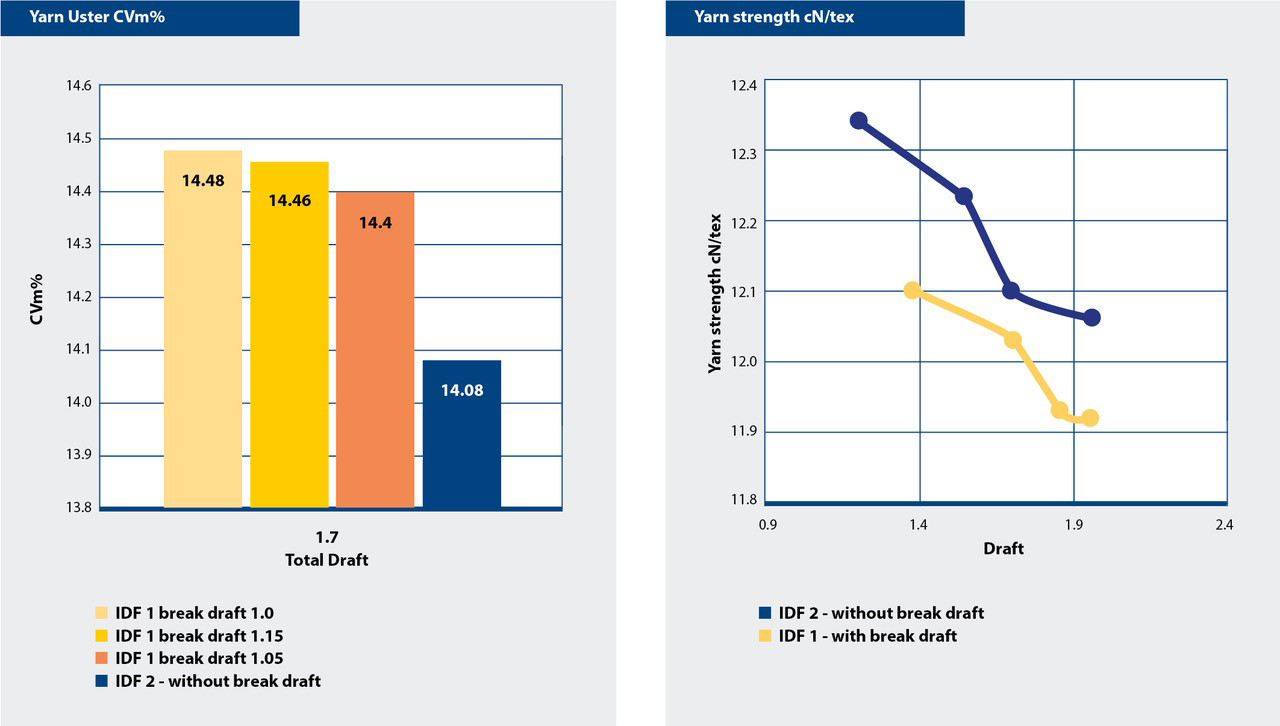
In order to show the influence of the distribution of drafts on main draft and break draft as opposed to only one draft zone, a yarn of 100 percent raw cotton (Mato Grosso) with Ne27 was spun in the direct spinning process with a card production of 170 kilograms per hour. With IDF 1, break drafts of 1.0, 1.05 and 1.16 with different main drafts were combined. The IDF 2 was run with drafts of 1.2 to 1.95. The tests showed the trend across all parameters that IDF 2 with its 1-zone drafting system has clear advantages over IDF 1.

The first diagram shows the influence on yarn evenness for a total draft of 1.7. There is clear evidence that the break draft in the IDF has a negative influence on yarn parameters. It is noteworthy that for all quality parameters, the presence of the first drafting zone in the IDF 1 alone has a negative effect on the results, without any actual tension being applied. (IDF 1 break draft 1.0).

The second diagram illustrates that IDF 2 and IDF 1 both have the same trend, i.e. that the yarn strength decreases with increasing total draft. Compared to IDF 1, IDF 2 shows overall strength at a higher level. This confirms the statement that the use of only one drafting zone has a positive effect on the yarn properties.

Development Of The IDF 2

The IDF 2 has been established on the market for seven years. The advantages of the system are now recognized by the entire professional community, competitors and customers. Initially, the shortened process was only used with 100 percent cotton — preferably from the recycling sector — but today it is no longer limited to this. The system is successfully applied in the processing of 100 percent raw cotton and other materials. It thus offers an answer to the requirements of our customers with regard to increasing and necessary flexibility in the production process.

The handling of the IDF has also been improved. For example, there is now a retention lock that prevents the cover of the IDF from always having to be opened completely during the piecing process. Similarly, the use of maintenance-free deep groove ball bearings entirely eliminates the need for relubrication at the delivery rollers: The number of lubrication points is thus reduced to four. The self-adjusting lap monitoring of the top rollers, already known from the draw frames, has now also found its way to the IDF. There is no need to readjust after grinding intervals and changed settings.

November 2020

Sponsors