TOKYO — January 21, 2021 — Toray Industries Inc., announced today that it has created a new polymer that retains the outstanding thermal resistance, rigidity, and strength of polyamide 6 (PA6) while delivering a bending fatigue limit that is 15-fold that of conventional polymers. Prospective applications for such exceptional durability include automobiles, appliances, and sporting goods. Toray looks to initiate full-fledged sample work in fiscal year 2021 while cultivating applications in diverse industrial materials fields.
PA6 is an engineering plastic whose diverse uses include automobile engine compartments and appliance housings. PA6 resin incorporates a flexible elastomer1 to resist fatigue and optimize the lifespan. The tradeoff, however, is that this lowers PA6’s thermal resistance, rigidity, and strength. The challenge for many years has thus been to develop a new material that offers all of these desirable properties.
Toray focused on polyrotaxane2, which has a sliding molecular bond, as a polymer whose structure moves in response to external forces. The company endeavored to balance the inherent attributes of PA6 and fatigue resistance by finely dispersing polyrotaxane in the resin.
Toray drew on proprietary Nanoalloy®3 microstructure control technology to maximize the effectiveness of polyrotaxane by dispersing it in the 10 nanometer crystals of PA6. The resulting flexible stress-dispersion mechanism led to the creation of the new polymer. Tests at the Spring-84 synchrotron radiation facility in Japan confirmed that the new polymer suppresses changes in the crystal structure of PA6 when subjected to external forces.
Toray will fully leverage its core capabilities in synthetic organic chemistry, polymer chemistry, biotechnology, and nanotechnology to materialize its corporate philosophy of contributing to society by creating new value.
Elastomer – The name is derived from elastic polymer, describing a material that recovers its initial shape after extensive stretching.
Polyrotaxane – This is a supramolecular polymer with a beaded or necklace-like structure, its molecules consisting of strings and rings.
Nano alloy® – This Toray-developed microstructure control technology dramatically improves polymer properties by minutely dispersing multiple polymers on a nanometric scale.
Spring-8 – Synchrotron radiation is the electromagnetic radiation emitted from accelerating charged particles radially, and features high brilliance and directivity. SPring-8 in Hyogo Prefecture, Japan, conducts experiments as one of the world’s largest synchrotron radiation facilities.
By Howard Bradshaw, Edward C. Gregor and Dave Black
According to Wikipedia, “smoke inhalation is the primary cause of death for victims of fires. The inhalation or exposure to hot gaseous products of combustion can cause serious respiratory complications. Some 50–80% of fire deaths are the result of smoke inhalation injuries, including burns to the respiratory system. Additionally, continued flame spread results in more combustion and generation of additional hot-toxic gases.” This is the reason firefighters wear tight-fitting masks and carry oxygen tanks on their backs when entering a building to fight a fire.
In the United States, interior building materials have to meet certain minimal flame retardant performance of a handful of flame retardant tests. Since about 2000, the European Union has harmonized the flame retardant performance properties of building materials using classification method ISO EN 13501-1.
This standard method of classification applies to all building materials whether the materials are considered combustible or incombustible. Since most thermoplastics and other polymeric materials are considered combustible, the higher performance classifications for these materials classified under the U.S. test methods and the European EN 13501-1 require no or limited burning drips, low flame spread and low smoke generation.
Thermoplastics are used extensively throughout commercial interior applications. Walls, wall coverings/finishes, floors and floor coverings, furnishings, partitions and cubicles, window treatments, ceiling applications and upholstery are all examples where large volumes of thermoplastic materials are used.
In the western hemisphere and other parts of the world the use of halogenated flame retardants (flame retardants containing bromine or chlorine) are formulated into thermoplastics to reduce flame spread/flaming drips and to reduce smoke in high occupancy or more confined spaces where people gather.
While halogenated flame retardants can reduce flame spread/flaming drips, these chemicals do not reduce smoke density and the smoke evolved contains very-toxic gases when used as flame retardants in plastics.
Carbon monoxide is always liberated in a fire situation and can kill you if exposed for a period of time, yet it’s the extremely acute toxicity of the combustion gases that can literally stop someone “dead-in-their-tracks” when trying to egress from a burning confined space.
Maximum allowable toxic combustion gas concentrations are also very much of concern in private and commercial aircraft in cabin and cargo container applications as well as some public transportation standards (trains, commercial and military ships/boats and buses) where they are being held to a minimum via the use of expensive advanced engineering polymers costing as high as $40 per pound or more.
Other on-going concerns involving the use of traditional halogenated flame retardant chemicals of concern that tend to bio-accumulate in the environment and body are receiving more regulatory pressure and either have been eliminated in Europe or are being voluntarily phased out in the United States.
Any flame retardant chemical that is classified as a banned chemical or chemical of concern due to its bio-accumulative properties tends to also be a chemical that releases deadly toxic combustion of gases in fire events. Furthermore, polyvinylchloride (PVC), for example, with synergistic antimony oxide and other synergists release extremely toxic gases when exposed to flames.
Due to concerns to eliminate bio-accumulative chemicals of concern and toxic off- gassing a great need exists for a technological break-through in the area of economical flame retardant technology. Any new flame retardant technology that addresses these concerns also needs to remain light-weight. There is now a new thermoplastic flame-retardant materials technology. PAL…VersaCHAR™ and it is a member of the Clean FR technology that addresses the above concerns.
Clean FR Technology Attributes
The current leading product of the Clean FR offerings is PAL…VersaCHAR and possesses the following performance and physical properties:
Low-flame spread with no flaming drips, matching UL V-0 performance;
Tested at 1,9500°C (highest temperature tested to date);
Not bio-accumulative, allowing for rapid escape;
Generates extremely low-smoke density (maximum of <3 percent of allowable in ASTM E 84 testing);
Does not contain toxic chemicals;
Ability to nominally modify the hydrophobic or hydrophilic properties of the material;
Does not generate toxic off-gassing when exposed to flames;
No volatile organic compounds (VOC’s) present;
Lightweight. Good mechanical properties at highest flame retardant performance before char. Choices are available to match the need;
Most versatile performance for a reasonably priced plastic;
Can be formulated to achieve a range of flexibility/rigidities;
Is easy to extrude and process;
Tends to naturally resist microbial growth;
Very high levels of chemicals, solvent and water resistance/absorbency;
Easy to recycle and sustainable;
Is economical. Can be extruded, calendered, molded, film/sheet or coated fabrics; and
Available in commercial quantities now.
Clean FR Technology also have has a great advantage in meeting newer green health initiatives such as the Healthy Hospital Initiative where hospitals have an important need to control microbial growth and at the same time provide material solutions that require the elimination of toxic chemicals of concern from the environment while providing healthcare worker and patient security.
Clean FR thermoplastics can be used to replace thermoset composites materials in higher performance applications where light weight and high-levels of clean flame retardant performance are required e.g. aircraft passenger cabins and cargo-bay liners, honeycomb structures for paneling, tray/seats, etc.
The on-going problem with thermosets is that up until fairly recently, even though thermosets offered high levels of performance in various areas thermosets are difficult to recycle, are expensive due to long curing times and manual layup and create worker production hazards due to the hazardous nature of many of the toxic chemicals used to formulate thermosets. These hazards and concerns are not present with Clean FR thermoplastics technology.
In the last few years there has been a rapid trend in the composites market to seriously begin moving toward design and use of thermoplastic composite constructions instead of thermoset polymers. Use of Clean FR technology can hasten the design of thermoplastic composite constructions to replace thermoset composite constructions.
This means that thermoset applications that previously could not be recycled and once contained chemicals of concern can now use Clean FR technology which is safe for biological systems and the environment, but have the added benefit of ease of sustainable recycling.
Areas of Possible Future Increased Clean FR Use
Thermal Bonding via Melt Adhesives
Clean FR flame retardant melt adhesives are now possible with Clean FR technology.
Aerospace/Aircraft
Both throughout the main cabin and cargo bay locations can be further light-weighted saving fuel with Clean FR materials.
Appliances
Because Clean FR matches UL 94 V-0 rating with no flaming drips, it can be used to house in the inner-workings without the need for halogenated flame retardants and heavy metals.
Batteries
What better way to protect an electric powered vehicles and occupants, than an outer-casing of PAL…VersaCHAR polymer, the Clean FR.
Boats/Ships
Much like aircraft, especially commercial shipping and military ships and cruise lines are sorely deficient in the use of Clean FR materials for safety of its travelers. Think safety!
Building and Construction
The major unmet need, is Clean FR technology in buildings, such as safer wallcoverings, high-performance wallboard, upholstery, certain floor coverings, window treatments, as they all may qualify for LEED points in America and REACH in Europe.
Bus, Rail & Truck
Why be under-served with little protection of both personal and/or valuable assets when Clean FR is available at a modest cost while saving lives via longer times for egress.
Coated Fabrics
The world is full of flame retardant coated fabrics to protect valuable assets such as the storage of boats and transportation of cars, money and securities, or indoor signage.
Composites
Whether formatted as a sandwich construction and other uses, including over molding and non-burnable materials to flame up to 1,9550C, with endless possibilities.
Conduit and Pipe
This topic relates to the building above as conduits protect wiring, where pipe can use co-extrusion over existing pipe, with customer specified interior material inside the pipe.
Military
There is a large array of uses in the military for Clean FR where flame retardant materials are often required and at a lower-cost than incumbent materials from personal use to support functions.
Oil & Gas
Uses including seaming-tapes, and over-coatings on pipe both above ground with UV inhibitors and below ground of on O&G platforms for worker protection and safety.
Recreation Vehicles
An industry where fire occurs during both travel and on-location to unsuspecting campers. The industry is ripe for Clean FR for protection and occupants safety.
Shelters, Tents and Domes
Whether party or storage tents or inflatable domes over sports arenas, many materials generate toxic gases for occupants when a fire occurs.
Tankers, Silos and Storage
What better way to protect valuable asset contents than by Clean FR. Possibilities range from both flexile and rigid containers protecting valuable assets.
Clean FR technology is now commercially available and can be rapidly tailored to meet lighter-weight demanding flame retardant applications where on-going concerns about workplace safety, the environment and toxic chemical exposure can be mitigated. Clean FR technology was developed to save lives, provide safety and eliminate environmental concerns in places that people gather, work and enjoy their lives with peace of mind.
Howard Bradshaw, hbradshaw@dynamicmodifiers.com, is a polymer chemist. He is president and CTO at Dynamic Modifiers LLC, a specialty chemical developer and compounder. Edward C. Gregor, ecg@egregor.com, is an independent consultant, who works with clients to bring new disruptive technologies to market in a variety of industries. Dave Black is a co-founder of Dynamic Modifiers LLC and a member of the board of directors.
MILAN — January 21, 2021 — Global Hantex Co. Ltd. is one of the biggest and most modern knit fabric producers in Vietnam and plans to enhance the footprint further in the region by adopting latest manufacturing and IT technologies.
Part of Hansoll Textile Group, with $1.4 billion annual revenue, Global Hantex has specialization of k fabric manufacturing across yarn, and fabric dyeing, knitting and processing operations for globally leading brands.
After careful and detailed evaluation, Global Hantex has finalized Datatex Software solutions for ERP for the modules of Logistics, Financials and Costing, Capacity Balancing and Production Scheduling for advanced planning, Shopfloor Automation and Fabric Inspection for its smart factory.
Datatex is eager to begin this new journey with Global Hantex in the year 2021!
BRUSSELS — January 21, 2021 — The world’s largest textile and garment technology showcase, ITMA will continue to present and share innovative manufacturing technology and materials with the industry at its 19th edition in Milan. ITMA 2023 will feature the theme, “Transforming the World of Textiles.” It is supported by four sub-themes: advanced materials, automation and digital future, innovative technologies, and sustainability and circularity.
Ernesto Maurer, president of CEMATEX, the European Committee of Textile Machinery Manufacturers, which owns the ITMA exhibition, elaborated: “ITMA 2023 will highlight innovations and new approaches that serve as catalysts to inspire and help textile and garment manufacturers grow their business, scale and sustain their transformation journey.”
“We are in the midst of the 4th Industrial Revolution that is filled with business and technological advances, hence, transformation is even more critical for the continued success of the textile and garment industry. Speed and agility are also of the essence to effectively tackle the ecological and medical challenges that we face today.”
Charles Beauduin, chairman of ITMA Services, which organizes ITMA, added: “As the world’s leading exhibition, ITMA offers the industry an unrivalled platform to present and share industry innovation and to collaborate with other stakeholders. As the Covid-19 pandemic has adversely affected the business environment, we will be monitoring the situation closely, mindful about the importance of health and safety of all participants and staff. At the same time, we will be launching several initiatives to create additional opportunities to help our exhibitors better connect and do business with potential customers. We will be announcing the new initiatives and enhancements to ITMA 2023 very soon.”
He continued, “ITMA was successfully held in Milan in 2015 and strong response is expected when the exhibition returns to Milan. We welcome all to visit the new ITMA 2023 website to get the latest updates on the exhibition. Please mark your calendar to join us for the ITMA 2023 virtual launch which will be held live on Facebook and YouTube on 28 January 2021.”
ITMA 2023 will be held from 8 to 14 June at Fiera Milano Rho, Milan. Space application will open on 3 March 2021. Interested participants can visit www.itma.com to get details. For participation inquiries, please email: application@itma.com.
The last ITMA exhibition, held in Barcelona in 2019, featured exhibits from the entire textile and garment making value-chain, including raw materials and fabrics. It drew a record-breaking participation of 1,717 exhibitors from 45 countries and visitorship of almost 105,000 from 136 countries.
A new shredder technology from BCA Industries is enabling recyclers to simultaneously shred, chip and size on-site, speeding production and reducing manufacturing input and processing costs.
A new shredder technology is enabling recyclers to simultaneously shred, chip, and size on-site, speeding production and reducing processing costs
By Del Williams
Traditionally, recyclers have shredded paper, fibers, textiles, carpet, mattress, and plastic products, followed by granulating them to a size suitable for further processing and use as a recovered manufacturing input.
However, the cumbersome process of shredding, screening, and grinding such materials to size with different equipment in separate processes has not only been inefficient but also a bottleneck to processing.
Now, for the recyclers of a wide range of paper, fiber, textiles, carpet, mattress, and plastic products, industry innovation has developed a much more efficient alternative: A shredder knife technology that can cut, screen, and size in a single pass with one machine on-site.
Because the sizing of reduced scrap can be specified, uniform, and even tailored to suit the manufacturing process, more material can be successfully processed by recyclers with less labor, boosting profits. Shipping costs are also reduced for scrap transported off-site to buyers since any voids — empty spaces — within the container are minimized.
In addition to these materials, the knife system design effectively shreds and sizes a wide variety of others including rubber, wood, copper wire, aluminum, fiberglass, and even garbage and batteries.
Since the knife technology simultaneously does the work of both a typical shredder and granulator, it is also more energy efficient and takes less space on the production floor. The technology is flexible enough to be incorporated into the smallest to largest recycling, shearing and grinding equipment.
Conventional Equipment Limitations
For decades in recycling, the reduction of large paper, fiber, textile, carpet, and mattress scrap or unusable product has usually involved shearing equipment such as dual or quad shaft shredders. To further decrease size, this is typically followed by the use of grinding machinery such as granulators, stone mills, tub grinders, or chippers.
Screeners are often used at various points, which decreases processing speed. As an example, a standard dual shaft shredder typically turns shredder material into strips and requires the use of a re-screening device to reduce the material to a specific size, says Doug Bartelt, president of Milwaukee, Wis.-based BCA Industries, a developer and manufacturer of industrial shredding and recycling equipment.
According to Bartelt, conventional shredders like this are usually used in conjunction with granulators. A single shaft granulator is a simple device consisting of a knife, or multiple knives, attached to a shaft which mates with a stationary bed knife. Material is randomly chopped and continues to be cut until small enough to fit through a sizing screen in the bottom of the machine.
“Both the shredder and granulator create various sized material,” Bartelt said. “Usually, this is determined by a random event in how the material is fed into the system in terms of speed, timing, etc., which results in about 40 to 50 percent incorrectly sized material. So, efficiency on either of these systems only approaches around 50 percent.”
Efficiently Reducing Scrap to Size
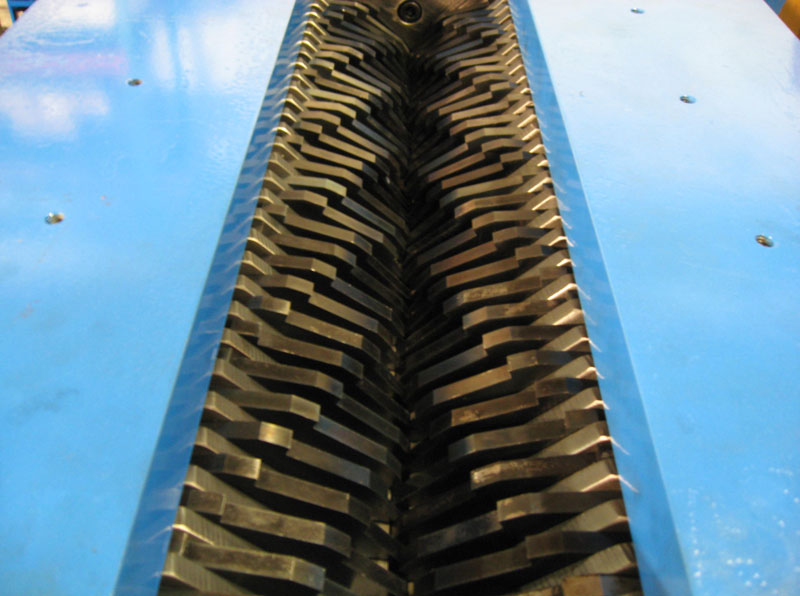
Seeking a better way to size scrap material like paper, fiber, textiles, carpet, and mattresses, Bartelt and his brother discovered a more efficient way to size without a screen. The insight was developed into BCA’s patented Triplus knife system technology, which changes a standard shredder to a hybrid between a dual shaft rotary shear shredder and a single shaft granulator.
The approach uses the precision grabbing action of the high torque, dual shaft shredder to cut the width of the material, while the bed knife design of the shredder sizes the length. This is accomplished in one operation, which produces accurately sized material in one pass without a screen. The end-product size is based on the size and geometry of the knives.
Unlike traditional equipment, the knife system is capable of shredding, chipping, and sizing any kind or size of material in a single pass without utilizing a screen. A shredder utilizing this design can produce over 85 percent correctly sized material in one pass with less than 10 percent oversized material, according to Bartelt.
With the knife system, a recycling operator just specifies the chip size needed, and it produces chips in the specified size. The design works with wet or difficult to screen materials, and clean cuts those that normally create fines and dust. With a traditional system, fines and dust must be air vacuumed away, and are considered undesirable for many reasons.
Functionally, for recyclers looking to streamline paper, fiber, textiles, carpet, and mattress scrap processing, the knife system increases efficiency and throughput that surpasses the typical granulators, hammer mills, chippers, and quad shaft shredders used in the industry.
By eliminating separate equipment and steps to shred, screen, and grind scrap to size — and combining this into a single function — the manufacturing process is expedited.
Another factor increases production output for recyclers: The revolutions per minute (rpms) of the knives can be adjusted to the load needed for optimal production efficiency. Unlike typical shredders that tend to operate at low speed and high torque, BCA shredders using the knife design can be operated at high speed and low torque for higher production speeds. When more torque is required for anything tougher to grind like large mattresses, the system automatically provides the rpms necessary; it then readjusts to the higher speed, lower torque setting for faster production within seconds.
Additionally, the knife system can reduce scrap to the appropriate size with much less energy than typical shearing and grinding equipment. Power efficiency approaches 150 percent over any standard shredder or granulator.
As an example, with this technology, a 50-horsepower single pass shredder can produce the same amount of recyclable product per hour as a standard 100-150 horsepower conventional system. This can reduce recycler energy costs by $1,500-$5,000 per month while producing a more consistently sized product, ready for cost-effective transport to a purchaser.
The technology is flexible enough to be installed in any size shredder that BCA builds, from 10 HP to 800 HP, from 15” x 12” cutting chamber to 48” x 72” cutting chamber, in both stationary and portable units.
Recyclers needing to reduce the size of paper, fiber, textile, carpet, and mattress scrap, plus a wide variety of other materials, have long resorted to overly complex in-house shredding, screening, and grinding processes as well as costly shipping to customers.
With industry innovation, however, recyclers now have the ability to quickly and efficiently cut these scrap materials to size onsite. This has the potential to both simplify production and reduce shipping costs to boost the bottom line.
Editor’s Note: Del Williams is a technical writer based in Torrance, Calif. For more information about BCA’s shredder knife technology, contact 414-353-1002; 414-353-1003 fax; john@bca-industries.com; www.bca-industries.com.
TOKYO — January 21, 2021 — Teijin Ltd. announced today that it has established the European Sustainable Technology Innovation Center (ESTIC) in Arnhem, Netherlands, as a research and development facility tasked with developing technologies for a more sustainable world.
As a research and development hub for Teijin’s environmental-value solutions, ESTIC will facilitate collaboration among researchers across borders to strengthen development initiatives in Teijin’s various business units. ESTIC will also undertake the challenge of developing all-new businesses that leverage the lifecycle capabilities of Teijin’s core materials and the development of green materials to support the global circular economy. This includes efforts to reduce CO2 emissions and to stimulate the hydrogen economy.
ESTIC will also establish a satellite office at Brightlands Chemelot Campus, an international open-innovation community active in performance materials, sustainable processes and biomedical solutions in Sittard-Geleen, Netherlands, to further activate communication with external innovation communities and research institutes.
Teijin, aiming to be a company that supports the society of the future as well as the United Nations Sustainable Development Goals (SDGs), looks forward to ESTIC contributing to the development of sustainable products and technologies that help to lower environmental impact.
Since the signing of the Paris Agreement, the world has come to recognize decarbonization as an urgent global task, based on which the agreement’s signatory nations have declared their respective national goals to realize carbon neutrality. Teijin declared its long-term goals for reducing environmental impact in the company’s 2020-2022 management plan, entitled ALWAYS EVOLVING, that was announced in February 2020. The company is now pursuing growth and development in line with these goals. Teijin also supports the United Nations Global Compact as well as the SDGs through measures such as developing environmental solutions for a more sustainable world.
Under Teijin’s medium-term management plan to continuously create accurate business opportunities and accelerate market development, the company is prioritizing initiatives to strengthen internal and external collaboration, further diversity and inclusion, and fast-track innovation, ultimately to support the company’s development of innovative products and services.
NEW YORK CITY — January 20, 2021 — Fit for Life announces it has added adidas and Reebok to its world-class portfolio of brands. adidas and Reebok join Fit for Life’s already impressive portfolio of active brands including Gaiam, SPRI and Tommie Copper.
Fit for Life is the market leader in small, at-home fitness gear at popular retailers including Dick’s, Amazon, Target, Walmart and Kohl’s. Its brands and product lines continue to experience strong growth and resonate with consumers as they increase their practice of at-home health and wellness routines. RFE Sporting Goods recognizes Fit for Life’s success and credibility among top-tier active brands and is proud to partner on distribution for adidas and Reebok fitness equipment.
“RFE is excited to partner with Fit for Life, a proven company, with deep relationship across the US market,” said Dean Jackson, CEO of RFE Sporting Goods. “The Fit for Life expertise along with RFE products and brands is a strong recipe for success.”
Fit for Life is eager to begin innovating with adidas and Reebok brands, creating new products to meet the growing demand for at-home fitness and wellness.
“Adding adidas and Reebok to our portfolio of brands will be a powerful way to continue to penetrate the market and expand into new categories,” said Joey Shamah, co-founder and CEO of Fit for Life. “RFE’s trust and partnership is a true testament to our market knowledge and respected position in the industry.”
The distribution deal between RFE Sporting Goods and Fit for Life kicked off on January 1, 2021 and will quickly bring real value to consumers across the United States.
NEW YORK CITY — January 20, 2021 — S&S Activewear and Clayton, Dubilier & Rice (CD&R) announced a new partnership in which CD&R-managed funds will invest alongside current owners and management to acquire S&S, a North American distributor of imprintable apparel and accessories. The terms of the transaction were not disclosed.
With approximately four million square feet of warehouse space and more than 2,000 employees, S&S specializes in distributing blank sportswear, corporate apparel, and accessories, including T-shirts, fleece & sweatshirts, headwear, athletics and outerwear from more than 100 leading brands such as adidas, Champion, Columbia, Bella+Canvas, Next Level Apparel and Gildan. The company stocks more than 80,000 products and serves a broad range of customers, including screen printers & embroiderers, promotional product distributors, e-decorators, and team dealers.
Founded in 1988, S&S has grown under the current management team and owners from a successful midwestern T-shirt and fleece distributor into an industry leader with approximately $1.5 billion in sales. S&S emphasizes speed and quality of service, having made significant investments in national distribution capacity and technology and established the largest one & two-day distribution footprint in the industry. The company has also expanded geographically with three acquisitions since 2010, including the acquisition of the largest wholesale apparel distributor in Canada, Technosport, in 2020. Today, S&S products can reach 99 percent of the U.S. and Canada population within two days, and 44 states in just one day.
The transaction is expected to close in the first quarter of 2021, at which point S&S President Jim Shannon will assume the role of Chief Executive Officer and CD&R Operating Partner John Compton, former president of Pepsico, will become chairman of the board.
“This transaction is an important milestone for S&S and a validation of our continued success; as successful as we have been over the last two decades, we believe our growth story is just beginning,” Shannon said. “CD&R has a deep understanding of our business, from sourcing, freight, and distribution center scaling to technology and sales and marketing.”
“We are delighted to partner with a talented, entrepreneurial S&S team that shares our core values in a business we know and understand,” said Ken Giuriceo, CD&R Partner. “We look forward to working together to achieve our vision for continued strong growth that creates exciting opportunities for employees, vendors and customers, as well as the local communities where they operate.”
Barclays, Deutsche Bank Securities Inc., BMO Capital Markets Corp. and Credit Suisse Securities (USA) LLC acted as financial advisors and Debevoise & Plimpton LLP acted as legal advisor to CD&R in connection with the transaction. Baird served as the exclusive financial advisor and McDermott Will & Emery LLP acted as legal advisor to S&S.
MUMBAI — January 19, 2021 — The new hybrid edition of Techtextil India poised to be held from September 1-3, 2021, at Hall 4, Bombay Exhibition Centre, Mumbai, will connect technical textile players from across the globe through its multimodal platform. The combination of physical and digital platforms will enable exhibitors to connect with wider audiences, increase their market presence and expand their business alliances significantly.
The demand for medical textiles, particularly spun bond nonwovens have skyrocketed ever since the onset of the pandemic. Geotextile products in India have also experienced a strong leap in demand supported by government’s continual investments in the development of highways and roadways. With a manifold of opportunities lying ahead for the technical textile segment, it is crucial for the players to increase their market presence and build networks to effectively leverage imminent demands.
Over the years, the editions of Techtextil India have been instrumental in uniting the technical textile fraternity and creating an atmosphere of collaboration through its physical platform. However, the new hybrid edition that is set to be held from 1 – 3 September 2021 will not only physically, but also digitally unite exhibitors from the technical textile industry with key buyers and suppliers PAN India and worldwide.
While the physical fair offers the benefit of face-to-face interaction under strict observance of safety protocols, the digital platform will help exhibitors increase their brand exposure and interact with potential buyers from across the globe via features such as live streaming, video calls, live chats and more. Live product demonstration on dual platforms will further enable exhibitors to showcase their products and new emerging technologies to a vast array of business attendees.
The hybrid fair will also make collaborative engagements extremely simple through its AI assisted platform. Potential suppliers will be automatically matched when buyers launch product or service queries, following which virtual appointments can be set-up at a mutually agreed upon time.
Organizer of the fair, Messe Frankfurt India, is also looking forward to incorporate online panel discussions and knowledge programs to impart erudite market insights and rejuvenate confidence among players across the 12 application areas of technical textiles.
Currently the Indian technical textile industry is pegged at USD 19 billion (growing at a CAGR of 12 percent since the past five years) and accounts to approximately 13 percent of India’s total textile and apparel market*. With new demands arising in the segment, the hybrid edition of Techtextil India 2021 will enable technical textile players to engage with businesses beyond geographical constraints, forge new alliances and gain specialised insights to strategically equip themselves for the new normal.
HAYWARD, Calif. — January 19, 2021 — AMETEK Surface Vision now offers remote training courses to provide safe, convenient instructions on how to get the best performance from its industry-leading online surface inspection solutions.
The online training sessions allow customers to discover all the features and benefits of the SmartView defect detection and identification system, building technical proficiency, increasing operational productivity, and maximizing system uptime.
Conducted by highly skilled, experienced professionals, the training is divided into sections for specific job functions or system components. It uses a “live” training system to reinforce the material and focus on particular customer tasks.
Each course typically consists of four-hour sessions held over three consecutive days; they are available for both US and central European office hours.
The subjects covered in the next four months are:
SmartView Fundamentals
SmartView Advanced
SmartView Maintenance and Troubleshooting
These training programs will enable those attending to achieve added benefits from their SmartView system. All that is required is a PC, an internet connection, the Microsoft Teams application, a headset, a large screen, and a webcam for class interaction.
Paul Stuyt, Global Manager of Projects from AMETEK Surface Vision said: “Our expert training courses are designed with the customer in mind, answering any questions that may arise and providing a deeper understanding of our products, systems, and applications.
“With online tuition, customers can learn how to set up their system, inspect live production, display, and report on defects and process conditions, and maintain system health. All of this without the inconvenience and safety risks associated with travel during the current COVID-19 global pandemic.
“For those staff members working from home, there’s no reason for their training and development to stop. We continue to provide everything they need to achieve optimum SmartView performance for their processes.”