VF Corp. Enters Into Definitive Agreement To Sell The Occupational Portion Of Its Work Segment

DENVER — April 28, 2021 — VF Corp. — a global supplier of branded lifestyle apparel, footwear and accessories — today announced that it has entered into a definitive agreement to sell the occupational portion of its Work segment to a subsidiary of Redwood Capital Investments LLC, a diversified holding company.

The occupational workwear portion of VF’s Work segment includes the following brands: Red Kap®, VF Solutions®, Bulwark®, Workrite®, Walls®, Terra®, Kodiak®, Work Authority® and Horace Small®.

The sale does not include the Dickies® and Timberland PRO® brands.

Commenting on the agreement, VF’s Chairman, President and CEO, Steve Rendle, said, “The sale of our occupational work brands reflects our continued focus on transforming VF into a more consumer-minded and retail-centric enterprise while further simplifying our portfolio and operating model. We are pleased to have reached this agreement with Redwood Capital Investments. They are an ideal owner to guide these brands and businesses into their next phase of growth.”

The transaction, which is expected to close in the first quarter of fiscal 2022, is subject to customary closing conditions and regulatory approvals for a closing to occur. Terms of the agreement were not disclosed.

Barclays is serving as exclusive financial advisor to VF on the transaction. Davis Polk & Wardwell LLP is acting as legal advisor. J.P. Morgan is serving as exclusive financial advisor to Redwood Capital Investments and Kirkland & Ellis, LLP is acting as legal advisor.

Posted April 28, 2021

Source: VF Corp.

Cintas Promotes Max Langenkamp To Newly Elevated Executive-Level Position Of Senior Vice President Of Human Resources

CINCINNATI — April 28, 2021 — Cintas Corp. has announced that Max Langenkamp has been promoted to the newly created position of senior vice president of Human Resources, effective June 1, 2021.

With Langenkamp’s promotion, human resources will be elevated to an executive-level area of oversight. Before this change, human resources reported up through outgoing Senior Vice President, General Counsel and Secretary Tom Frooman, who earlier this week announced his retirement, effective July 31, 2021.

Langenkamp, currently vice president of Human Resources, will also continue to serve as chief diversity officer, the company’s top diversity, equity, and inclusion official.

“We are confident that with Max’s leadership and guidance at the executive level, Cintas will continue to attract talented candidates; retain great employee-partners; and help to develop them to take advantage of all of the professional growth opportunities that Cintas has to offer,” said Todd Schneider, currently Cintas’ executive vice president and COO and incoming CEO and president as of June 1.

“We have done an incredible amount of amazing work to position Cintas as an employer of choice, and a company that truly values its employee-partners,” Langenkamp said. “With this new role, I’m looking forward to taking that further and working with our other senior executives to continue our work growing Cintas.”

Langenkamp joined Cintas in 2006 as a member of the in-house legal counsel staff, where he managed labor and employment and litigation matters for the company. In 2011, he was promoted to Senior Director of Human Resources, supporting the Rental Division, the company’s largest division. In 2014, Langenkamp was promoted to VP of Human Resources where he oversaw the teams focused on labor and employment, talent acquisition, and employment branding. In 2019, he was further recognized by earning the role of Cintas’ Chief Diversity Officer.

Cintas currently employs almost 40,000 employee-partners across the United States and Canada.

Among the many employment-related commendations Cintas has earned under Langenkamp’s leadership include Forbes’ “Best Employer For Diversity” (2019, 2020, 2021); GI Jobs’ “Top Military Friendly Employer” every year since 2005; and Diversity Plus Magazine’s “Top 30 Champion of Diversity” multiple times. Cintas is also a regular on Forbes’ “America’s Most Admired Companies,” “Best Employer for New Grads,” and “Best Large Employer” lists.

Langenkamp was also honored by Law & Politics Magazine as one of Ohio’s “Rising Stars” in 2018, and in 2019 received Chief Human Resource Officer of the Year – For Profit Enterprise from HRO Today Magazine.

Prior to joining Cintas, Langenkamp was an attorney at Cincinnati, Ohio, law firm Dinsmore & Shohl, LLP, where he specialized in labor and employment matters in addition to general business litigation.

He earned his undergraduate degree from The Ohio State University and his juris doctorate from the University of North Carolina, Chapel Hill School of Law. He is a member of the Association of Corporate Counsel, the Ohio State Bar Association and the American Bar Association.

Langenkamp is also active with many Cincinnati-area philanthropic organizations, including serving on the board of directors of The Urban League of Southwestern Ohio, Greater Cincinnati-Dayton Red Cross, the Community Action Agency Foundation of Hamilton County and the Multicultural Foodservice and Hospitality Alliance.

Posted April 28, 2021

Source: Cintas Corporation

Darryl Wilson And Robert Pragada Elected To Eaton’s Board Of Directors; Michael J. Critelli Retires From The Board

DUBLIN, Ireland — April 28, 2021 — Power management company Eaton today announced that Darryl Wilson and Robert (Bob) Pragada have been elected to the company’s board of directors effective April 28, 2021.

Wilson is the founder, chairman and president of The Wilson Collective, a business advisory and investment firm that invests in startup companies and provides advisory services to clients in the power generation, industrial, material supply and consumer segments. Prior to founding the organization in 2018, Wilson worked for more than 25 years in global leadership roles at General Electric Company. During that time, he held a number of leadership positions of increasing responsibility including vice president of commercial, GE Power division, vice president and chief commercial officer of GE Energy Connections, and president and chief executive officer of GE Aeroderivative Gas Turbines.

Pragada is the president and chief operating officer of Jacobs Engineering Group (NYSE:J), a professional and technical solutions company that provides consulting, technical, scientific and project delivery services for the government and private sector. In this role, he has executive oversight of the company’s global operations, which consist of the Aerospace, Technology and Nuclear, and Buildings, Infrastructure and Advanced Facilities lines of business. Pragada has also previously served as president and chief executive officer of The Brock Group, Inc.

“Darryl and Bob bring extensive experience in the power, industrial and technology sectors, as well as a global perspective that will make them both valuable additions to Eaton,” said Craig Arnold, Eaton chairman and chief executive officer. “We are pleased to welcome them to the Board.”

Arnold continued, “These appointments also mark a milestone in the evolution of our Board, with two-thirds of our directors now women or U.S. minorities. At Eaton, we know having diverse teams drives innovation, growth, and strong performance. Our commitment to inclusion and diversity is also reflected in the strength of our global leadership team, more than half of whom are U.S. minorities.”

Wilson and Pragada succeed Michael J. Critelli who has reached the mandatory retirement age for directors and Richard H. Fearon who retired from the Board on March 31, 2021, having reached the mandatory retirement age for officers.

“I’d like to thank Rick and Mike for their many years of extraordinary service to Eaton,” said Arnold. “They have both made a meaningful and lasting impact on the organization, and we wish them the best for the future.”

Posted April 28, 2021

Source: Eaton Corp.

Gerdau Floats New Company To Operate In The Graphene Market

SÃO PAULO — April 28, 2021 — Gerdau inaugurated a new company today called Gerdau Graphene, which will develop and market products based on graphene applications. The Company, which will operate independently from the steel business divisions, is born with the mission of becoming the benchmark in marketing products based on graphene applications on an industrial scale in Brazil and with the focus on reaching global markets. Graphene’s benefits are derived from its mechanical properties such as reduced weight and friction, more efficient lubrication, and higher thermal and electrical conductivity, among others.

The new business unit is positioned as a major producer of graphene in the Americas. Headquartered in São Paulo and with a branch office in the United States, the Company plans to offer more technology to the construction, industrial and automotive lubricants, rubber, thermoplastics, paints and sensors industries in Brazil and countries across North America.

Gerdau Graphene is part of the portfolio of Gerdau Next, the new business division launched by Gerdau in the second half of 2020 to operate in new segments apart from steel, which account for a sizeable share of Gerdau’s revenues.

“Gerdau Graphene’s market entry is unique, thanks to its proposition of making graphene production on a large scale commercially viable. We are reaching the market with the unique advantage of being part of a solid group that enjoys high global credibility, but whose philosophy is based on open innovation in collaboration with multiple ecosystems. Our unique value proposition is to supply the market with graphene additives, boosters and plug-and-play solutions for our customers’ industrial processes. In other words, we will market both the product and the service and know-how in graphene, for which we have entered into strategic alliances with domestic and global partners. Finally, our first customer is Gerdau and its steel mills, which enables us to develop and test new products and solutions quickly and with the intimacy of application”, explains Alexandre de Toledo Corrêa, head of Gerdau Graphene.

“The launch of Gerdau Graphene is another strategic move by Gerdau Next towards diversifying the Group’s businesses to complement the steel chain and our customers’ businesses. We have already been working with graphene in Manchester, England, since 2019. Graphene is the strongest material ever found and is one of the best conductors, with numerous potential applications. Thanks to strategic alliances already established in this new business, we are confident that Gerdau Graphene will be an important player in the Americas”, says Juliano Prado, vice president of Gerdau.

Initially, Gerdau Graphene will focus on the construction, industrial and automotive lubricants, rubber, thermoplastics, paints, batteries and sensors markets in the Americas.

History of innovation

Gerdau has been researching graphene for four years. In 2019, it entered into a partnership with the Graphene Engineering Innovation Centre (GEIC) at the University of Manchester, UK, to conduct research on graphene. At the time, the company joined a select global group of companies with exclusive space for research at the center, one of the global references on the subject.

To start a business unit with a strategic positioning and a broad reach, Gerdau Graphene already has strategic alliances with major graphene developers. In the Brazilian market, it has strategic partnerships in the automotive sector with Baterias Moura and SKF do Brasil to develop applications in energy storage, rubber products, composites and paints.

About graphene and its applications

Graphene is a nanomaterial consisting only of carbon, in which the atoms are connected to form hexagonal structures. In other words, just like diamond and graphite, it is one of the crystalline forms of carbon. Due to its unique characteristics, it has become the top electrical conductor, one of the best thermal conductors and one of the toughest and most resistant materials currently in existence. Its optical properties allow almost 98% of incident light to pass through and it is extremely flexible and waterproof.

For Alexandre de Toledo Corrêa, head of Gerdau Graphene, graphene applications go beyond anticorrosive coatings and polymer composites for the automotive, construction, chemicals, plastics and rubber markets. “Setting up a business unit based on graphene for its multiple applications and the numerous opportunities for innovation is aligned with the DNA of Gerdau, which is constantly reinventing itself. Due to its small size, graphene provides us with a visionary and additional business dimension. Gerdau Graphene kickstarts its operations as a consolidating hub for the entire chain and for ongoing research in Brazil and around the world to accelerate and facilitate its application in the processes and products  of our customers,” he added.

Corrêa also states that the new company will propose solutions and applications for Gerdau’s existing customers and suppliers, generating synergies between future graphene operations and existing sales, procurement and technical application channels. “By relying on the entire Gerdau structure, we will ensure efficiency, excellence and speed, in this initial stage, in the deliveries with the partnerships we are entering into.”

Posted April 28, 2021

Source: Gerdau

A Radical Leap In Fabric Inspection: Uster Q-Bar 2 Becomes The Unique Formation Monitoring System

USTER, Switzerland — April 28, 2021 — The best way to avoid off-quality is simply not to make it. Uster Q-Bar 2 introduces a radical leap in fabric inspection. It monitors the fabric additionally at the earliest point — the critical stage in fabric formation — with automatic, in-line inspection. Identifying problems here brings enormous benefits, preventing defects and enabling weavers to deliver constant quality and stay competitive in the market.

Q-Bar 2 is best described as a formation monitoring system, because of its ingenious positioning directly at the interface of warp and weft threads. That allows rapid response as soon as a defect appears, avoiding long-running or repeating faults. Alarm and stop signals alert the operator to correct problems immediately — and early detection reduces second quality and material loss, as well as minimizing the need for post-production checks.

For weavers, these advantages represent genuine and long-awaited innovations with a positive impact on both productivity and quality.

Formation monitoring

Weaving defects can have various root causes, so Uster Q-Bar 2 provides different algorithms to identify specific defects and their causes. This inbuilt knowledge can prevent defects within the weft insertion cycle.

Its enhanced detection position in the fabric formation zone means the warp is monitored even before it is traversed by the weft — a truly unique benefit. It allows detection of incorrect warp positions, missing warp, loose warp ends and even pattern irregularities.

Another important innovation is the control of weft irregularities. By monitoring each inserted weft in the formation area, Q-Bar 2 primes users to react to weft irregularities at the earliest possible stage. At this point, it can detect weft-related defects such as double picks, broken weft or slubs and loops.

“Formation monitoring is the answer to market requests. Weavers demand zero defect standards, increased sustainability by waste reduction and they want to produce the fabric meeting specific quality requirements,” says Michelle Salg, product manager Fabric Inspection at Uster.

Total supervision

Defects that become visible only in the woven fabric are the nastiest threat. Often, it’s too late when defects such as reed marks, dirty yarns or floats are spotted — but it can’t happen with Uster Q-Bar 2. Its fabric inspection algorithms detect even ‘invisible’ defects in the fabric. It’s the simple solution to improving fabric yield by automated formation monitoring.

Q-Bar 2 also monitors critical machine units in the formation zone. If there is a problem here, the system makes it easy to identify and eliminate it, preventing further defects and again maximizing fabric yield.

Another element of the total supervision provided by the formation monitoring system is its special focus on the selvedge area. This is not only critical for an efficient weaving process, it is also important in further process steps. Specific algorithms detect irregularities in the selvedge, as well as broken leno — but also identify any pattern defects. Continuous pattern monitoring flags up incorrect patterns at the earliest stage, so the loom can be stopped and the problem fixed before many meters of fabric are wasted.

Last but not least, the system has a permanent eye on the fabric width, an essential factor for further processing. For this reason, Q-Bar 2 provides continuous width measurement of the woven fabric, from loom setup to full roll.

Designed for users

The technology in this new formation monitoring system is impressive, but Q-Bar 2 is highly developed in many other aspects too. Its attractive industrial design is also ergonomic, so users have easy access to all important parts. Weavers appreciate its simple installation on existing weaving machines. And operators like the integrated LEDs used by Q-Bar 2: system status is indicated and the positions of detected defects shown by red lights. The improved hardware platform is capable of handling high loom speeds and is ready for future innovations.

First-quality production, to customer specifications, is the overall goal. That is especially important in demanding applications such as industrial and safety textiles. In apparel and home textiles too, it is vital to avoid seconds and minimize waste fabric. “Independent of the fabric application, Uster Q-Bar 2 is a game-changer. For the first time, weavers can actually prevent weaving defects instead of only reacting to them,” Salg said.

Posted April 28, 2021

Source: Uster Technologies AG

ANDRITZ Nonwoven Offers Solutions For Optimization Of Raw Material Consumption

GRAZ, Austria — April 28, 2021 — International technology Group ANDRITZ has always been at the forefront in providing innovative and sustainable solutions for the global nonwovens industry. Optimization of resource management, especially reducing the consumption of raw materials and other substances used and also keeping resources in use for as long as possible, are decisive factors in enabling nonwovens producers to offer competitive and sustainable products.

As a world market leader for nonwovens production equipment and services, Andritz offers a full range of products to meet these challenging demands.

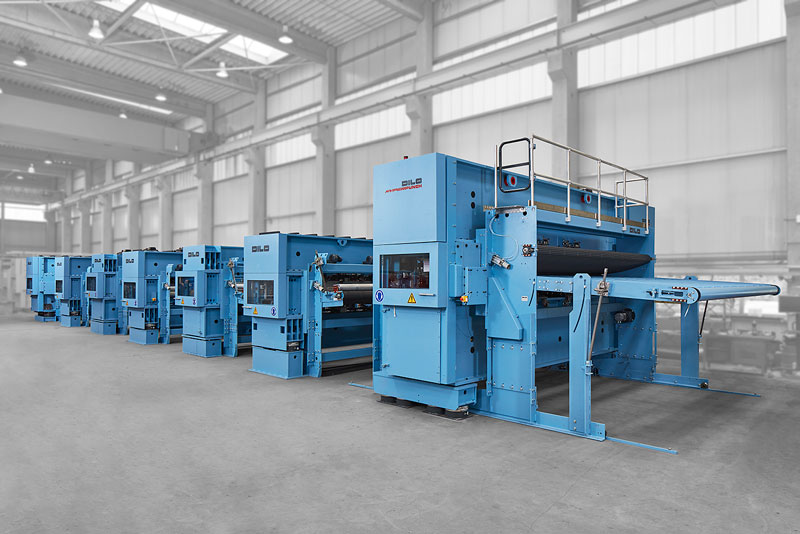
Maximizing the evenness of the product across the entire production line is one of the key success factors. The weight profiling product range of Andritz — consisting of ProDyn™ and ProWid™ – has been extended by ProWin™. This new development is the combination of the two existing systems ProDyn and ProWid. It allows nonwovens producers to achieve optimum weight profiling at the crosslapper delivery and increase their process speed by up to 15 percent at the same time. ProWin combines the long-term process experience and in-depth knowledge Andritz has on needlepunch lines with innovative software to synchronize action across the line.

Guillaume Julien, Head of Needlepunch Sales at Andritz Nonwoven, explained: “We have developed a self-regulating, advanced technology to reduce fiber deposits at the edges of the web and eliminate the “smile” effect across its width. ProWin enables producers to optimize the CV ratio autonomously and precisely while also generating significant fiber savings of up to 10 percent and increasing production speed. Thus, it also provides a faster ROI.“

When it comes to the spunlace process, a better product quality can be obtained by ensuring that the different equipment units in the production line are consistent with one another. The TT card, the Jetlace hydroentanglement unit, and the neXdry through-air dryer are the perfect combination to obtain premium visual quality and characteristics in the web. For an equivalent amount of fibers, this set-up is designed to produce an even web with significant bulkiness and an excellent MD:CD ratio without impacting the production capacity.

Maximizing performance by minimizing the raw material input and the amount of waste produced is a real driver of cost optimization. This is why Andritz has created and integrated a solution that allows nonwovens producers to retrieve the wasted edges of their spunlace fabric and re-use it as recycled fibers. As a result, roll-good producers can even obtain the same web characteristics as when using virgin fibers, and most importantly, the exact same quality.

Andritz also offers — under the brand Metris — Andritz digital solutions — a variety of several service apps for optimum customer benefit. The Metris Cost Management app is used to track raw material consumption. It is an advanced system aimed at monitoring fiber consumption and allowing in-depth diagnoses to investigate raw material losses and savings grouped by different process areas. Thanks to this Metris application, Andritz customers are able to optimize their system’s consumption of raw materials.

All these innovations are available in Andritz’s technical centers, where Andritz process experts will be glad to welcome customers in order to discuss and define their product expectations.

Posted April 28, 2021

Source: ANDRITZ GROUP

Polyester Filtration: Visco+ Vacuum Filter For IV Setting

REMSCHEID, Germany— April 28, 2021 — Under vacuum, the new BB Engineering large-area filter produces a homogeneous, pure melt with a targeted IV setting — for instance, for returning polyester production waste to the melt flow, but also for achieving a homogeneous viscosity in the case of virgin material.

BB Engineering has expanded its melt filter portfolio to include a patented large-area vacuum filter designed especially for processing polyester waste. The so-called Visco+ filter is already known as the key component of the BB Engineering VacuFil recycling system. Now, it is also available as a separate and easily-integratable upgrade component for existing systems. Within this context, the uses of the Visco+ are by no means limited to just decontamination. Here, the Visco+ offers the following solutions:

  • IV homogenization: if an existing production system is struggling with IV fluctuations, the Visco+ is able to actively intervene and balance out any irregularities;
  • V increase: if the final viscosity is insufficient when processing recycled materials, the Visco+ can increase the IV without the negative impact of long residence times.

In this way, the Visco+ enables fast and flexibly-controllable viscosity build-up and reliable viscosity monitoring of the polyester melt using a to-date unique, patented process. Depending on the intended end use, the melt can be adjusted to the further processing procedure in a targeted manner. The requisite melt properties — above all the intrinsic viscosity, but also the purity and homogeneity — are achieved in a reliable and reproducible manner and can also be adjusted during ongoing operation.

The BB Engineering process is both completely new and super-efficient. As a melt filter, the Visco+ operates like a liquid-state polycondensation unit. A maintenance-intensive reactor or a deposit-prone stirring unit are not required. Moisture is removed from the PET in the filter, which — in conjunction with an adjustable residence time — results in the desired IV increase in the vacuum. This enables a controlled IV build-up of up to 30 percent. The intrinsic viscosity is the central quality figure in PET recycling and rPET processing. It determines the melt performance in the downstream production process and the properties of the end products. The intrinsic viscosity is continually monitored by means of an integrated viscosity measurement unit and reliably adjusted in the event of deviations caused by disparate input qualities, for example. At the same time, the filter provides an enormous material surface compared to the volume and continuously renews this. To this end, contamination can be removed particularly effectively from the starting material by means of automatically-regulated high-performance vacuum (1-30 mbar).

The result is a pure, homogeneous melt with controllable IV values and consistent quality. For this reason, the Visco+ is particularly suitable for recycling PET waste that is to be reused for high-end products.

Posted April 28, 2021

Source: BB Engineering GmbH

Technology That Neutralizes Coronavirus By 97.48 Percent: Aksa Akrilik‘s Everfresh

YALOVA, Turkey — April 28, 2021 — The Everfresh technology developed by acrylic fiber producer Aksa Akrilik demonstrated its impact on the Covid-19. As a result of the tests conducted, it was observed that the coronavirus had become ineffective at 97.48 percent in 30 minutes in the textile products with Everfresh.

Introduced to the market in 2020 after four years of work at Aksa Akrilik R&D Center, the antimicrobial fiber product Everfresh successfully passed the Covid-19 test. With a lasting antimicrobial effect, Everfresh offers a wide range of products, ranging from masks to home textiles, which greatly neutralizes coronavirus in many products such as denim, active clothing, smoking, socks, carpet and bedding. According to the tests, coronavirus loses its effect by 97.48 percent within 30 minutes in the products applied with Everfresh.

Everfresh assurance in crowded locations

Unlike spray products or other products produced with similar methods, Everfresh has antimicrobial effects thanks to the zinc compound in the fiber. The product does not harm human health and skin as it is not a finishing, and can be used for products such as carpets, blankets, quilts, beddings, towels and pillows. The coronavirus effect is greatly reduced by the use of Everfresh products in crowded areas such as hotels, mosques and dormitories, where the need for social hygiene is felt at the highest level. Everfresh, which is expected to stand out especially in the use of carpets in public spaces, is ideal because it prevents the formation of bacteria, fungi and mold. The product stands out with its superior qualities and offers an advantageous price. Even if washed repeatedly, Everfresh maintains its strong microbial activity and its impact against coronavirus as it has on the first day, and meets the hygiene needs better than ever.

Developed to meet social expectations

Aksa Akrilik Board Member and General Manager Cengiz Taş stated that Everfresh technology is an important R&D product that has been introduced to the textile industry, and underlined that the product does not provide a protection against coronavirus, but inactivates the virus by 97.48 percent within a certain period of time.

Taş stated that the demand for antibacterial products increased after the pandemic and said, “With our new product Everfresh, we are delighted to respond to the health-sensitive needs of our society. Everfresh once again made a difference in textile products by eliminating coronavirus by 97.48 percent in half an hour. Thanks to its zinc compound, Everfresh provides antimicrobial properties to the products and reduces the need to wash the product by preventing bad odors. I can tell that it meets all expectations with its fast drying, water vapor permeability, air permeability, thermal insulation, soft, light and comfortable structure. Our product has been on the market since last year and is currently attracting a lot of attention. In addition to this, we anticipate that in the coming period we will meet the increasing needs especially for carpets with Everfresh technology in the market.”

Posted April 28, 2021

Source: Aksa Akrilik

Motion’s 2020 Supplier Of The Year Award Winner: NSK

BIRMINGHAM, Ala. — April 27, 2021 — Motion Industries Inc. — a distributor of maintenance, repair, and operation replacement parts, and provider of industrial technology solutions — named NSK “2020 Supplier of the Year.” The award recognizes companies that have shown exceptional commitment to Motion through quality products and services, as well as earning the highest score in the multi-faceted Supplier Stratification rating system.

“2020 was a tough year in general, so for NSK to move to the top of the ranks is impressive,” said Joe Limbaugh, Motion executive vice president of Supply Chain, Operations Support, Marketing and Enterprise Excellence. “Our standards as measured through ourSupply Chain process are rigorous, and improvement takes understanding, dedication and overall hard work. NSK rose to the occasion and we are proud of their accomplishments. Suppliers who finished in our Top 50 are the ‘best of the best’ in our industry.”

“NSK is committed to delivering value to our customers above and beyond being experts in our own business by demonstrating expertise in our partners’ and customers’ business,” said Reid Jajko, vice president, Aftermarket Business Unit, NSK Americas. “Our success is not defined by the sale of a bearing; it is defined by our ability to positively impact our partners’ operations. I cannot imagine a greater affirmation of our commitment than to receive this acknowledgement from Motion.”

Award recipients are determined based on Motion’s Supplier Stratification formula — a rating system that evaluates each supplier’s performance in a number of Supply Chain, Marketing, and Field Support categories.

Posted April 28, 2021

Source: Motion

Timberland Expands Regenerative Leather Offerings, Sets Out To Build World’s First Regenerative Rubber Supply System For Footwear

STRATHAM, N.H. — April 27, 2021 — On the heels of Earth Day, Timberland announces important advancements in its regenerative agriculture efforts, working toward a vision for Timberland® products to have a net positive impact on Nature by 2030. Timberland continues to lead the industry in the regenerative space — expanding upon its growing Regenerative Leather footwear offerings for spring, and forging a partnership with Terra Genesis International (TGI) to build the world’s first regenerative rubber supply system for footwear, with plans to pilot a collection in 2023. The brand also has a progressive campaign underway, tapping experts and multidisciplinary social media platforms to create consumer awareness around regenerative agriculture in new and engaging ways.

Our planet has a problem — there is too much carbon in the air and not enough in the ground. Regenerative practices mimic nature, enabling the land to pull more carbon out of the atmosphere and efficiently store it in the ground, where it can rebuild the structure of the soil, leading to healthy, hydrated, fertile ground — and ultimately, net positive impacts for the land and the farmers. As part of Timberland’s vision for a greener future, the brand has set a goal for 100 percent of its natural materials to be sourced from regenerative agriculture by 2030.

“At Timberland, we strive for a greener and more equitable future, and investing in regenerative agriculture is one of the most powerful levers we have to achieve this vision,” said Zack Angelini, senior manager of environmental stewardship for Timberland. “We are excited about the progress we’re making to source our top volume materials in a way that supports the farmers and ranchers working to reverse environmental degradation and create a world that is more abundant, more resilient and even more beautiful than it is today.”

Expanded Regenerative Leather Footwear Offerings

The new Greenstride™ Solar Wave EK+ Collection joins several Timberland styles now featuring Regenerative Leather, and is packed with eco-conscious materials. In addition to Regenerative Leather in the uppers, GreenStride™ comfort soles are made of 75 percent renewable materials (a combination of sugar cane and natural rubber from trees). They are Earthkeepers® Edition styles, marked with an EK+ to reflect Timberland’s pinnacle eco-innovations.

Later this summer, the Timberland PRO® line for the skilled trades will introduce its first Regenerative Leather boot, the Gridworks EK+.

As Timberland rapidly expands its Regenerative Leather supply chain, the brand hopes to use its global scale and powerful sourcing arm to incentivize the transition of more farmers to regenerative agriculture across the world.

Building the World’s First Regenerative Rubber Supply System for Footwear

Timberland, along with parent company VF Corp. and sister brands Vans and The North Face, is partnering with Terra Genesis International in Thailand to build the industry’s first regenerative rubber supply system.

Rubber is typically grown in a monoculture; it uses a single type of tree, degrades biodiversity and often uses chemicals or may involve exploitative labor practices. Monoculture rubber plantations are also a significant contributor to rainforest deforestation across Southeast Asia.

Based on local indigenous knowledge, regenerative rubber farming incorporates multiple tree species to mimic a natural forest ecosystem. This revitalizes biodiversity and enhances ecosystem services such as soil health, water cycling, carbon sequestration and the creation of favorable microclimates. This approach also provides a diversity of yields that farmers can rely on for multiple streams of income, leading to increased resiliency and long-lasting positive impacts for the community. By supporting “train the trainer” programs, Timberland and VF will help to scale local indigenous knowledge and transition more plantations to regenerative systems.

“We are grateful that, through our partnership with Timberland and VF Corporation, we can move this vital regenerative process forward,” said Luke Smith, CEO of TGI. “While the transformation from rubber monocultures to regenerative farming on one farm is impressive, as the shift spreads wider, it is likely to have significant social, ecological and economic impacts in Thailand.”

Timberland plans to pilot its first Regenerative Rubber footwear in 2023. This supply system will eventually be open to brands across and outside the industry, aiming to significantly scale regenerative sourcing of rubber.

Inspiring The Next Generation

“As a consumer-led brand with a vision to build an equitable and green future, Timberland is perfectly placed to translate the concept and benefits of regenerative agriculture to the next generation,” says Drieke Leenknegt, global vice president of marketing for Timberland.

Tapping into experts and creators — including farmers, ranchers and soil advocates from the film Kiss The Ground – Timberland is launching a multidisciplinary campaign across an ecosystem of social media platforms such as Instagram, TikTok and Clubhouse, to inspire and educate consumers about the power of regenerative agriculture to heal our planet.

“Transmedia storytelling allows us to translate the ins and outs of regenerative practices in unique and different ways,” says Leenknegt. “Through TikTok – the newest entertainment and education platform — we can partner with creators to bring the concept to life in a quick and approachable way. For our Clubhouse activation, we’re partnering with superhost Swan Sit to host a series of rooms to delve deeper into the topic. By educating the next generation, and raising awareness and excitement around the power of regeneration, we can continue, together, to move the world forward.”

For information about Timberland’s commitment to better product, stronger communities and a greener world, visit the brand’s responsibility site.

Posted April 27, 2021

Source: Timberland

Sponsors