Nearly 400 years ago,an English theologian named Thomas Fuller first wrote the words, “It’s always darkest before dawn.” From the reality of 2020, to the forecasts for the remainder of 2021, perhaps at no time in U.S. history have such words been more appropriate.
Even as vaccinations against COVID-19 accelerate, new outbreaks are occurring — largely in states and cities that have rescinded mandatory mask ordinances and reduced social distancing requirements. The CDC estimates that nearly 600,000 Americans will have lost their lives to the pandemic by the end of April.
At the same time, the rate of vaccinations continues to increase. COVID-19 vaccine distribution began in the United States on December 14. Through the last week
of March, more than 147 million doses have been administered, fully vaccinating over 53.5 million people or 16.1 percent of the total U.S. population. In many states, vaccination stages have escalated much more quickly than expected. Most initially thought it would take until late Spring to get through Stages 1a and 1b. However, as of the end of March more than a dozen states are making — or preparing to make — vaccines available to all adults.
As a result, those who look toward the future with expert eyes are making aggressive — even staggering — projections about U.S economic growth the year. Economists at Goldman Sachs, for example, project GDP to grow at a rate not seen in this country for70 years. In a note to its clients, the company wrote, “We have raised our GDP forecast to reflect the latest fiscal policy news and now expect 8 percent growth in 2021 (Q4/Q4) and an unemployment rate of4 percent at end-2021.”
The last time U.S. GDP grew at 8 percent was 1951. Goldman Sachs’ prediction is more aggressive than most. The average prediction among Wall Street analysts is in the range of 4.5 to 5 percent.
Consumers are also optimistic about the economy. A recent release from the Conference Board shows that the Consumer Confidence Index® surged in March to its highest reading in a year, after a modest increase in February. The Index now stands at 109.7 (1985=100), up from 90.4 in February. The Present Situation Index —based on consumers’ assessment of current business and labor market conditions — climbed from 89.6 to 110.0. The Expectations Index — based on consumers’ short-term outlook for income, business and labor market conditions — also improved, from 90.9 last month to 109.6 in March.
“Consumer confidence increased to its highest level since the onset of the pandemic in March 2020,” said Lynn Franco, senior director of Economic Indicators at The Conference Board. “Consumers’ assessment of current conditions and their short-term outlook improved significantly, an indication that economic growth is likely to strengthen further in the coming months. Consumers’ renewed optimism boosted their purchasing intentions for homes, autos and several big-ticket items. However, concerns of inflation in the short-term rose, most likely due to rising prices at the pump, and may temper spending intentions in the months ahead.”
Business Gaining Steam In Fibers, Yarns, Fabrics
Economic growth is already apparent in U.S. fiber, yarn and fabric mills. While output for 2020 was down, significant growth was apparent in the last several months of the year, said NCTO Chairman David Roberts in his recent “State of the U.S. Textile Industry” address. “I’m happy to report that, at least anecdotally, business is coming back at
a fast clip in the first quarter of this year, as orders continue to bounce back in line with rising consumer demand and retail sales.”
A primary objective of NCTO is to significantly increase personal protective equipment (PPE) production in the United States. To that end, NCTO recently announced that the Biden Administration has awarded contracts to Parkdale Mills and Ferrara Manufacturing Inc., following through on the president’s pledge to procure millions of fully Made in America face masks for community health centers, food pantries and soup kitchens across the country. A third contract is expected to be awarded to a small business early next week.
Gastonia, N.C.-based Parkdale Mills, the nation’s largest cotton yarn spinner, and Ferrara Manufacturing, a tailored clothing company based in New York City’s garment center, are to manufacture more than 17 million reusable masks. The government said it could purchase up to a maximum of 22.2 million masks under the contracts. The masks will be Berry compliant and, as a result, 100-percent U.S.-made.
The seventh edition of the combined ITMA Asia + CITME, though postponed and rescheduled, prepares to move forward in June.
TW Special Report
ITMA Asia + CITME will be held at the National Exhibition and Convention Centre (NECC) in Shanghai June 12-16, 2021. In light of the global coronavirus pandemic, show owners CEMATEX and Chinese partners, the Sub-Council of Textile Industry, CCPIT (CCPIT-Tex), China Textile Machinery Association (CTMA) and China Exhibition Centre Group Corp. (CIEC) postponed and rescheduled the joint exhibition originally planned for October 2020.
At the time, Fritz P. Mayer, then president of CEMATEX, said: “We seek your understanding as this decision has been made with the safety and health concerns of our participants and partners in mind. The global economy has been severely affected by the pandemic. On a positive note, the International Monetary Fund has predicted that there would be global economic growth at 5.8 per cent next year. Hence, it is more prudent to look at a date around mid of next year.”
Wang Shutian, honorary president, CTMA added: “Our exhibitors, especially those from other parts of the world, are deeply affected by the lockdowns. Therefore, we believe that the combined show with the new exhibition dates would be timely when the global economy is predicted to improve. We would like to thank the exhibitors who have applied for space for their strong vote of confidence in the combined show.”
Proceeding With Safety
According to the organizers, “The show owners and organizers are committed to working closely with the authorities, such as the Joint Prevention and Control Mechanism of the State Council and the Shanghai Convention and Exhibition Industries Association (SCEIA), to implement preventive and social distancing measures to enable the combined exhibition to be held safely.”
“We would like to assure that the safety of our participants, partners and staff during the exhibition is of utmost importance to us,” said Ernesto Maurer, current CEMATEX president. “Strict safety measures will be implemented on-site. Visitors should purchase their badge online to avoid onsite queues and allow better and smooth entry process,” he urged.
Despite the COVID-19 pandemic, organizers report the seventh edition of the exhibition is expected to feature a gross exhibition space of 170,000 square meters; and to date, has attracted the participation of 1,500 exhibitors, including many established machinery manufacturers from 24 countries. The last combined show in 2018 attracted the participation of 1,733 exhibitors from 28 economies and registered a visitorship of more than 100,000 from 116 countries and regions.
Online Registration Is Open
Visitors who purchase their badge at itmaasia.com or citme.com.cn will enjoy special online rates. Early-bird rates of 60 renminbi ($9.10) for a five-day badge and 30 renminbi ($4.60) for a one-day badge are available until June 6. Standard onsite rates cost 100 renminbi ($15.20) for a five-day badge and 50 renminbi ($7.60) for a one-day badge. Visitors who register online will be also given access to the exhibition e-catalog.
The organizers report ITMA Asia + CITME 2021 intends to be a huge showcase of cutting-edge solutions for textile makers with strong support from all major trade associations around the world. The exhibition is showcased by product category for the convenience of visitors with stringent control in force to protect intellectual property.
The exhibits will be arranged using the following categories: Braiding; Weaving; Knitting & Hosiery; Research And Innovation; Printing; Garment Making And Embroidery; Finishing; Recycling; Colorants & Chemicals; Nonwovens; Spinning & Man-Made Fiber; Winding, Texturing & Twisting; Testing: Logistics, Software, Equipment For Plant Ops & Services For Textile Industry
ITMA Asia + CITME is organized by Beijing Textile Machinery International Exhibition Co. Ltd. and co-organized by ITMA Services. The Japan Textile Machinery Association also is a special partner of the combined show.
For more information about ITMA Asia + CITME 2021, visit itmaasia.com or citme.com.cn.
NCTO Chairman David Roberts outlined key industry facts and economic data, and recapped NCTO’s PPE and other legislative efforts in 2020 during his “State of the U.S. Textile Industry” address during NCTO’s 17th annual meeting, which was held virtually.
By David Roberts
Let me begin by saying what an honor and privilege it has been to serve as Chairman of NCTO over these past several months.
The year 2020 was marked by a once-in-a-generation pandemic and health crisis that profoundly impacted our businesses, creating challenges and new opportunities that we are still navigating through today and will be confronting for the foreseeable future.
During my tenure, NCTO has had fast-paced engagement with the Trump administration and Capitol Hill — and more recently, the new Biden administration.
The pandemic and ensuing shortages of personal protective equipment (PPE) sparked an unparalleled national response from our industry as we increased our engagement with the Trump administration and Congress to secure long-term government contract and build a permanent personal protective equipment (PPE) supply chain.
This turbulent environment has required constant focus and engagement on the part of our staff and industry leadership to ensure that we effectively partnered with the government to address the emergency needs of our frontline medical providers.
I would like to give special thanks to NCTO President and CEO Kim Glas and her staff for their tireless advocacy and leadership on behalf of our industry. I also want to thank the entire NCTO staff — Sara, Kristi, Todd, Rebecca, Don, Robin and Auggie — NCTO has engaged at every level of the administration and Congress to ensure our industry has a place at the table to provide input on critical policy issues impacting our daily operations.
Perhaps most of all, this past year has demonstrated to Capitol Hill, the White House and the nation our industry’s resilience, know-how and innovation — and the indisputable fact that our government must focus on policies that: support U.S. textile manufacturing jobs and investment; strengthen trade enforcement; expand the Berry Amendment to medical PPE; and build a permanent domestic PPE supply chain.
In fact, many of you have participated over the last several weeks in several Zoom calls with House and Senate leadership and with our congressional footprint. Your participation in these discussions matter and are critical to pushing our issues collectively. As many of you have seen, we have had record attendance in our meetings from Members of Congress who are eager to hear how they can help our industry onshore and succeed moving forward. Many thanks to the entire NCTO staff for this enormous effort and to all the NCTO members who participated in these critical discussions.
By The Numbers
As everyone in this audience knows, the U.S. and global economies were severely impacted by the COVID-19 pandemic, which triggered a deep recession and high unemployment levels in 2020.
The metrics for our industry and the U.S. manufacturing base as a whole, mirrored that of the overall economy, with output falling in the first five months of 2020, but slowly regaining ground in the latter half of the year.
Economic activity in the U.S. manufacturing sector grew in December, marking the eighth consecutive month of overall economic growth, according to a closely watched business survey.
Of 18 manufacturing industries, textile and apparel was among the 16 sectors that reported growth in December, according to the Institute for Supply Management’s manufacturing index. We have also seen these positive trends repeated in the Institute’s January and February surveys this year.
Here are a few key industry facts:
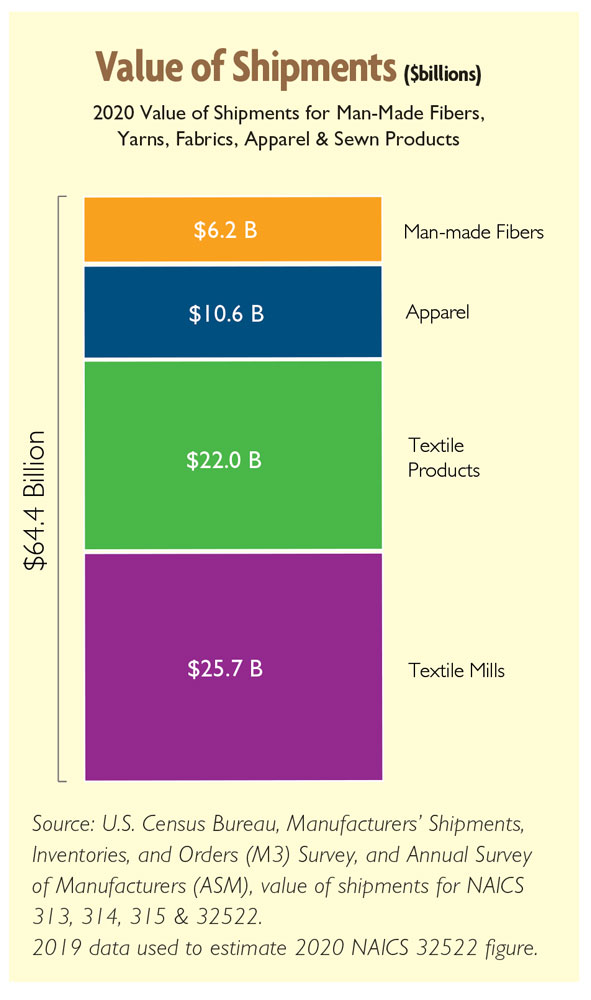
In 2020, the value of U.S. man-made fiber, textile and apparel shipments totaled and estimated $64.4 billion. While output was down for all of 2020 versus 2019, the last several months of 2020 saw an upward trend as shipments gradually recovered from a low in April (Source: Bureau of Economic Analysis).
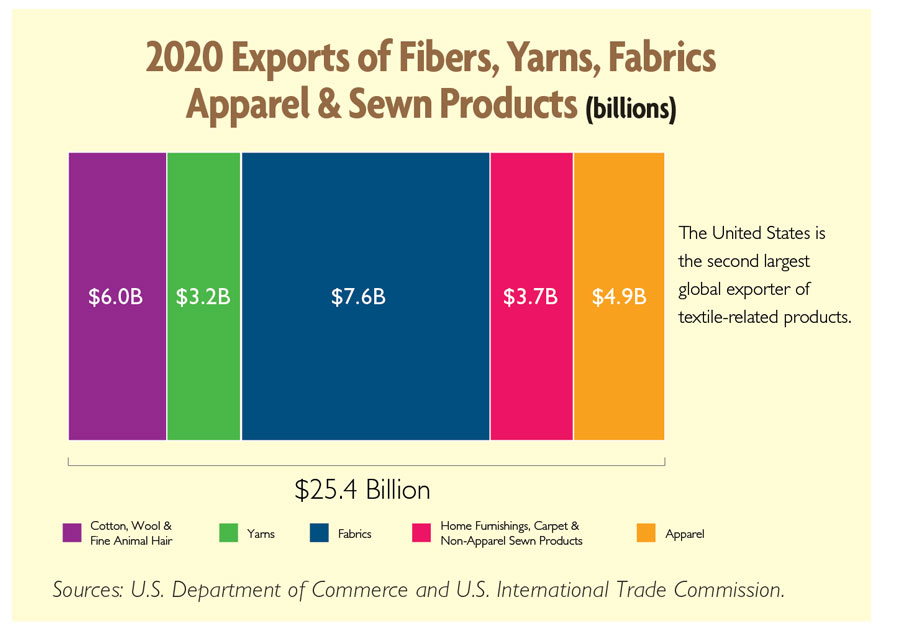
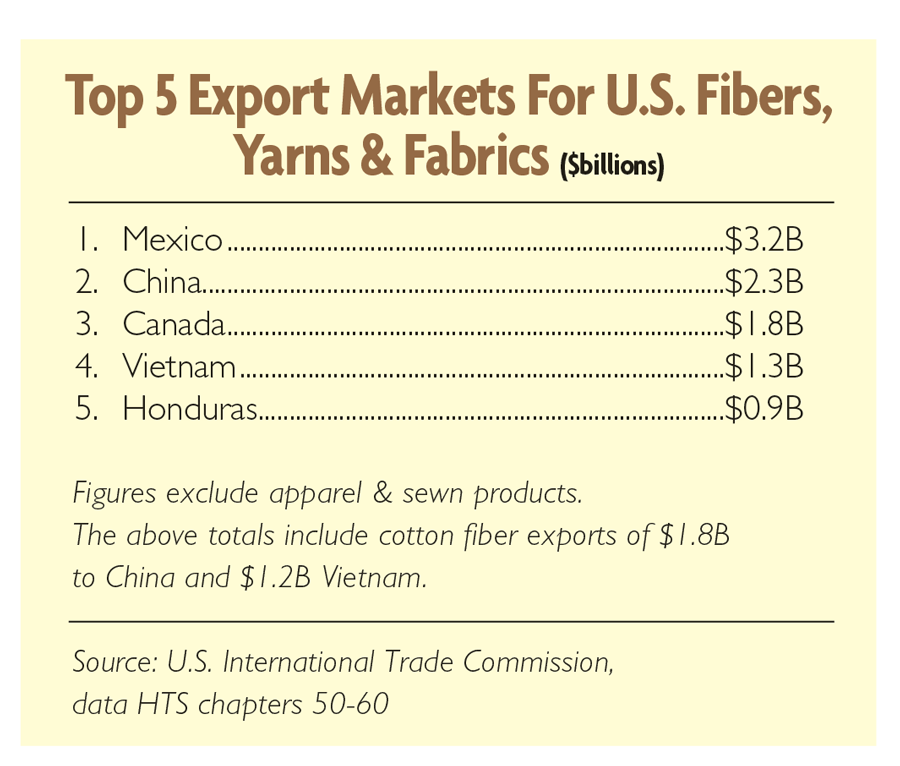
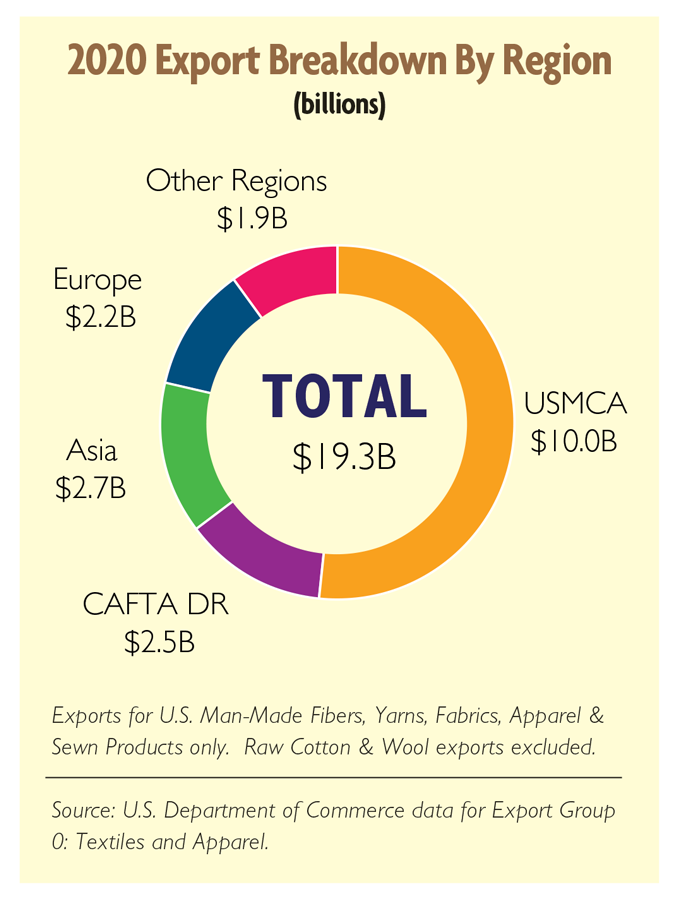
U.S. exports were also down last year compared to 2019. Exports of fibers, textiles and apparel were $25.4 billion in 2020 (Source: U.S. Department of Commerce data for Export Group 0: Textiles and Apparel).
Building on innovation, productivity, and an improved policy environment, the U.S. textile industry remains the second largest individual country exporter of fibers, yarns, fabrics and sewn products.
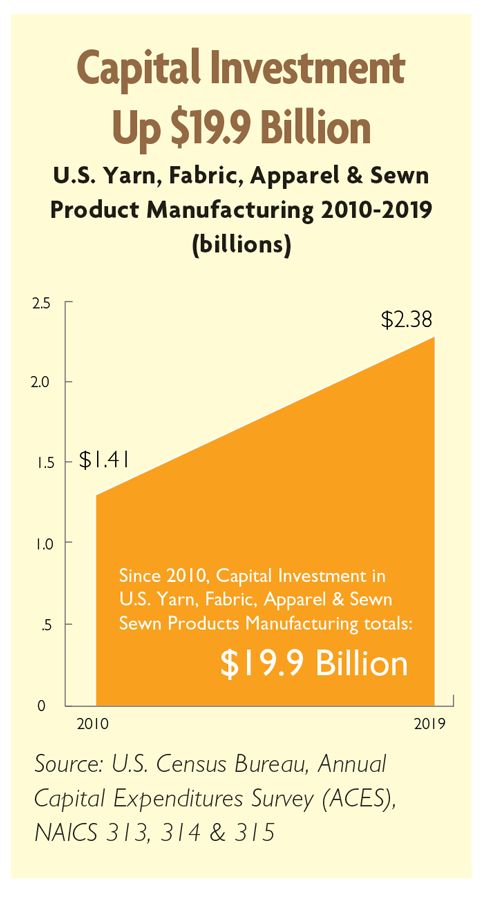
Capital expenditures have remained strong. Investment in yarn, fabric, apparel and sewn product products manufacturing in 2019 (the latest figure available) hit $2.38 billion. Since 2010, capital investment in U.S. yarn, fabric, apparel and sewn products manufacturing totals $19.9 billion.
The Western Hemisphere supply chain continues to be a vital economic engine for the textile and apparel sectors.
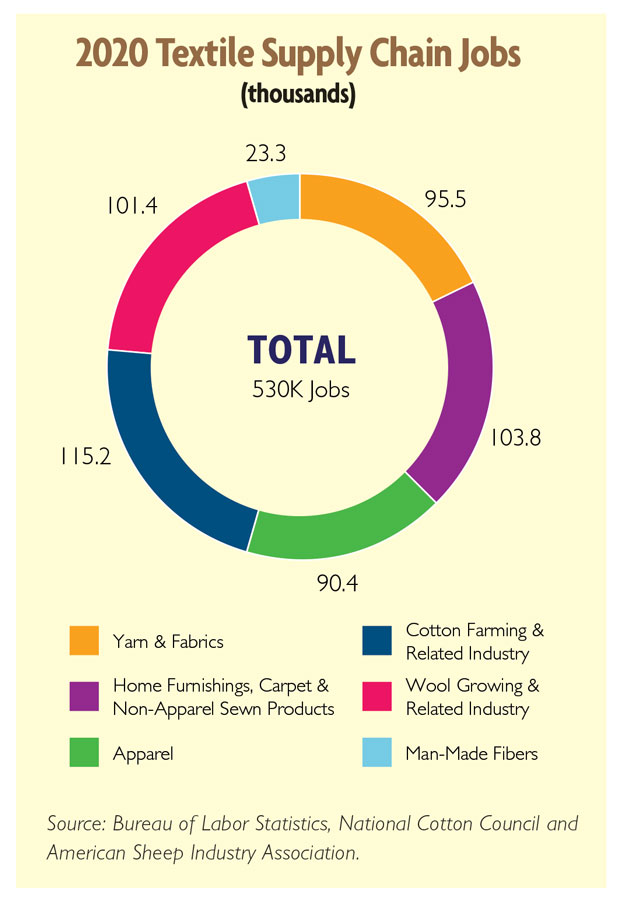
Last year, we had $28.5 billion in two-way trade with the Western Hemisphere, which supports 2 million direct jobs in the entire regional supply chain.
Taking all things into consideration, the volatility in supply chains and in demand that we saw in the first half of 2020 began to stabilize somewhat in the second half. We began to see increased economic activity and an uptick in demand, pointing to promising signs of a recovery — which was fragile — but steady.
I’m happy to report that, at least anecdotally, business is coming back at a fast clip in the first quarter of this year, as orders continue to bounce back in line with rising consumer demand and retail sales.
Policy Issues
NCTO has been actively engaged in shaping policies in Washington that have major implications for small, medium and large businesses in our industry.
Our staff worked diligently to support the industry’s needs through not one — but four — economic stimulus bills that passed Congress, providing important benefits to businesses and unemployed workers.
Of paramount importance was NCTO’s role in securing a win in the FY 2021 National Defense Authorization Act (NDAA) and helping shape policies and legislation designed to secure a long-term strategy to establish a permanent domestic production base for PPE.
I want to extend my appreciation to our dedicated members who have been at the forefront of
PPE production, pivoting overnight to stand up these production lines and answer the call of the nation.
PPE Efforts
I cannot stress enough how intensely engaged NCTO staff has been in providing input on PPE policy and legislative development.
We all know how critical it is to garner support for long-term PPE government contracts and policies that will expand the Berry Amendment and establish a permanent domestic supply chain.
NCTO was engaged at every level of government contracting and procurement issues, bringing together the entire domestic PPE supply chain, while also closely coordinating with White House advisers, congressional allies and others to get vital PPE product to frontline workers battling the COVID-19 pandemic.
With NCTO’s engagement and lobbying efforts, lawmakers introduced four separate PPE-related bills in 2020.
One bill I would like to highlight in particular is The American PPE Supply Chain Integrity Act, co-sponsored by Congressman Patrick McHenry of North Carolina and Congressman Bill Pascrell of New Jersey, which would expand the Berry Amendment to nearly all federal purchases of PPE.
In addition, Kim testified in several hearings before Congress and the U.S. International Trade Commission, and supplied comments to the administration on the U.S. public health industrial base and necessary policy reforms.
National Defense Authorization Act
I would venture to say that the vast majority of NCTO members present today are familiar with and benefit from the existence of the Berry Amendment. It is for this reason that NCTO maintains an extremely active Government Textiles Committee that directly engages with our Defense Department and Homeland Security customers, analyzes policy proposals, and supports our advocacy efforts.
Their hard efforts paid off in 2020.
I would like to extend my appreciation to the NCTO staff for securing a major, long-sought-after win for the U.S. textile industry in the FY 2021 National Defense Authorization Act (NDAA).
Specifically, we were able to lower the contracting threshold for the Berry Amendment to $150,000 — after it has been raised to $250,000 by Congress in the FY 2017 bill — and chain future increases to the consumer price index — a feat that took considerable effort on our part.
Lowering this threshold will reserve an additional $50 million-plus in Berry-compliant contracts for domestic textile manufacturers who supply the U.S. military.
There are numerous other issues requiring NCTO’s focus and resources, such as the need to pass a new Miscellaneous Tariff Bill that grants relief on unavailable component materials but doesn’t allow unnecessary duty relief on sensitive finished textiles — and continued engagement with the Hill to vigorously oppose attempts by importers to expand the Generalized System of Preferences to apparel and footwear.
Time simply will not allow for me to go into detail on all these important issues. With that said, please know that without exception, NCTO is highly engages on every policy matter that affects the U.S. textile industry with the intent of shaping policy determinations in a manner that directly benefits U.S. textile investment, production and workforce.
That concludes my formal remarks.
On a personal note, I am honored to serve as chairman of such an incredible organization on behalf of a vitally important industry.
Through our leadership, NCTO has carved out a seat at the policy table in Washington and that is critical in terms of ensuring our industry’s interests are represented and reflected in critical policies and legislation.
It has been a year marked by challenges and resiliency and our industry has remained strong throughout this crisis.
I am optimistic about the future, knowing that I am part of an industry that made such an incredible commitment to our nation, along with the willingness to come to those in need of aid.
Editor’s Note: David M. Roberts is CEO of Clover, S.C.-based Cap Yarns. He served as the 2020 NCTO chairman. At the annual meeting, Roberts was re-elected chairman for 2021; and David Poston, president of Palmetto Synthetics, was elected vice chairman.
Shawmut Corp. has made investments at its West Bridgewater, Mass., facility.
In a year marked by COVID-19 and a very challenging economic environment, U.S. textile companies continued to invest.
TW Special Report
Surprisingly, under the pall of the COVID-19 pandemic, the news pages of TextileWorld.com reveal a fair amount of recent investment by the U.S. textile industry.
Investments including general investment in plant and equipment, polymer and fiber technology, furniture manufacturing, bedding and a strong investment trend in support of domestic production of personal protective equipment (PPE), have defied business challenges in support of new opportunities.
PPE: Domestic Source Focus
Domestic PPE production has become a matter of national security and has the attention of the Federal government.
PPE independence and rebuilding the Strategic National Stockpile (SNS) has also garnered attention at the state level.
In Georgia, Governor Brian Kemp announced the roll out of House Bill 304, the Georgia Made Medical Manufacturing Act. The bill, “will incentivize the production of medicines and medical devices in Georgia, limiting the state’s need to compete with other states or foreign nations for critical supplies.”
“One of the lessons we learned early on in the pandemic is that we cannot waste time in bidding wars with others for life-saving supplies,” Governor Kemp said. “Last session, we incentivized the production of PPE in the Peach State to alleviate that problem, build up our stockpile, and make it easier to stay in business in the era of COVID-19. HB 304 is a natural next step to that program and will help us build on Georgia’s momentum to become a leader in all sectors of the health care industry.”
The Fallon Co. partnered with Shawmut Corp. on a domestic N95 respirator production operation.
Masking Up
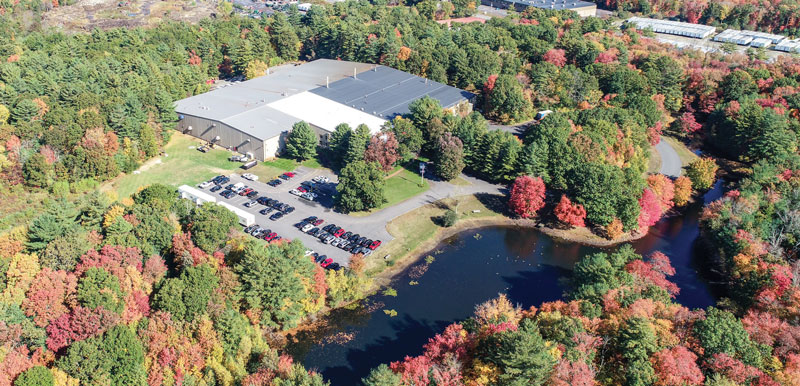
Late last year, The Fallon Co. and Shawmut Corp. announced a new domestic manufacturing operation to produce N95 respirators. A press release noted: “State-of-the-art manufacturing equipment installed in an expanded facility based in West Bridgewater, Mass., will enable end-to-end production of up to 180 million masks per year. Additionally, the operation is expected to create as many as 300 new jobs in Massachusetts.”
Then in February 2021, Shawmut announced the creation of a new Health & Safety business unit. The company is making isolation gowns and N95 respirators in a 70,000-square-foot retrofitted space in its West Bridgewater facility. Shawmut also invested in almost 60 tons of specialized, high-precision, meltblown machinery from Germany, installed a fully automated and flexible production system to support its N95 particulate respirator line, and installed roughly 50 new assembly lines for gowns and masks, some of which are augmented with advanced robotics capabilities.
Not all PPE investments were on such a grand scale, but still were important in supporting demand. In Harrisonburg, Va., Valley Guard Supply LLC announced investment of $1 million to establish PPE manufacturing. “A service-disabled, veteran-owned company, Valley Guard produces three-ply disposable masks that are 100-percent made in the United States and intends to manufacture other types of safety and security gear in the future. The project will create 45 new jobs,” announced the company.
“Domestic manufacturers of personal protective equipment are critical as we battle this global pandemic, and we thank Valley Guard Supply for answering the call right here in Virginia,” said Virginia Governor Ralph Northam. “The company’s new Harrisonburg operation will play an important role in localizing our supply chain and keeping health care workers and citizens safe.”
Polymer And Fiber Investments
Eastman Chemical Co. recently announced plans to “build one of the world’s largest plastic-to-plastic molecular recycling facilities at its site in Kingsport, Tenn.” The company plans to invest approximately $250 million over the next two years in the facility and “will use over 100,000 metric tons of plastic waste that cannot be recycled by current mechanical methods to produce premium, high-quality specialty plastics made with recycled content.” According to the company, “Eastman was one of the pioneers in developing methanolysis technology at commercial scale and has more than three decades of expertise in this innovative recycling process.”
Milliken & Company recently purchased Zebra-chem to support its long-term focus on sustainability.
Also following the trend and investing in the recycling arena is Spartanburg, S.C.-based Milliken & Company as it recently announced the acquisition of Zebra-chem GmbH. In a release, the company noted: “With more brands and governments globally setting goals to increase their use of recycled materials, plastics manufacturers are faced with the challenges of using recycled plastics effectively. Peroxide masterbatches, like those from Zebra-chem and Milliken, make it possible to incorporate up to 100-percent recycled content into these new plastics.”
“Milliken’s long-term focus on innovation and sustainability encourages us to consider how we contribute to some of today’s leading challenges, like how to effectively incorporate recycled plastics in manufacturing,” said Halsey Cook, Milliken & Company president and CEO. “I’m excited to welcome the exceptional talent within Zebra-chem as they join the passionate team at Milliken to move the needle on sustainable innovation.”
Rome, Ga.-based Integrated Fiber Solutions (IFS) announced it will invest $30 million to expand its operations to meet growing demand. IFS — a manufacturer of man-made bulked continuous filament (BCF) yarns for the carpet, rug, and automotive industries — was established in 1986 to serve the man-made yarn needs of multiple carpet and rug industries in Georgia with locations in Rome, Dalton, and Lafayette, Ga.
In other fiber-related news, Duluth, Ga.-based FiberVisions Corp., a subsidiary of Indorama Ventures Public Co. Ltd., will invest $48 million to expand its polyolefin fiber manufacturing operations in Newton County, Ga. According to the company, “This expansion, which comes in response to a sharp increase in demand for hygiene products made with bicomponent fibers such as face masks and baby wipes, will create 21 additional jobs.” Installation of this bicomponent fiber line is expected to be complete during the first half of 2021.
Keeping Up With The Strategic Plan
Burlington, N.C.-based Glen Raven Custom Fabrics announced the progress of its “Multi Phase Expansion Plan” with its first phase initiated at the end of 2019. The plan includes new equipment as well as upgrades “to support the continuing growth of Sunbrella® fabrics and other Glen Raven textile products in the company’s U.S. and Asia facilities.” The customized equipment will be brought online in stages during the first half of 2021. According to the company, the expansion “will not only increase output, but also reduce energy and water usage, laddering back to Glen Raven’s sustainability commitments.”
In addition, Glen Raven announced the purchase of a production facility in France. “Taken together, these actions represent an investment of more than $65 million in expanded production capacity to support its customers and the increased demand for Sunbrella, Dickson® and other Glen Raven fabrics. Future phases of the program include additional production and distribution capacity for the U.S. and Asia markets.”
Nonwoven Moves
Nonwoven manufacturer, Fitesa Simpsonville Inc., announced expansion of operations in Greenville County, S.C. The $100 million investment will expand overall capacity and include the installation of a new melt-blown production line to produce materials for the healthcare market. The expansion is expected to be completed by 2023.
Atlanta-based Georgia-Pacific LLC announced that it has reached an agreement to sell its nonwovens business to Glatfelter, a global supplier of engineered materials, headquartered in Charlotte, N.C., for $175 million. According to a press release: “The proposed transaction includes Georgia-Pacific’s nonwovens operations located in Mt. Holly, N.C., along with a research center operation in Memphis, Tenn. The nonwovens operations in Mt. Holly produces airlaid nonwoven material for commercial customers used to make table top, wiping, food pads, hygiene and related products. In the proposed transaction, current Georgia-Pacific nonwovens employees, totaling approximately 150 people, will become employees of Glatfelter at the time the deal closes.”
Kernersville, N.C.-based Texwipe, a global manufacturer of contamination control supplies, will invest more than $4.5 million to locate a manufacturing facility in Mount Airy, N.C. “Our state’s economy continues to grow, despite public health and economic challenges,” said North Carolina Governor Roy Cooper. “Companies like Texwipe choose to grow in North Carolina because of our talented workforce and our state’s strong management of the pandemic.” Texwipe has been headquartered in Kernersville since 1991.
Greenville, S.C.-based Fibertex Nonwovens Inc., just announced an expansion at its Gray Court, S.C., spunlace production location. The $49.5 million investment is expected to create 39 jobs. The expansion includes a second spunlace line for rolled nonwoven products as well as the acquisition of an 84-acre industrial plot adjacent to the company’s facilities.
“With this new investment, we’ll be able to build an extremely strong position in the important North American market for, among other things, high-performance wipes for sanitizing and disinfection purposes in the healthcare/medical sector, sustainable personal care products, a range of industrial applications, as well as in the automotive industry and the construction sector,” said Jorgen Bech Madsen, CEO, Fibertex Nonwovens.
Bedding Makes News
Multiple companies recently announced investments in the bedding market.
Mattress manufacturer and retailer Brooklyn Bedding officially announced plans to expand in its home state, breaking ground on a new state-of-the art manufacturing facility and corporate headquarters in Glendale, Ariz. According to the company: “The new manufacturing facility and corporate headquarters will merge the capacity of both the company’s current factory and warehouse. The plan entails an investment of more than $72 million to make Brooklyn Bedding nearly 100 percent vertically integrated.”
Tempur Sealy International announced expansion of its manufacturing operation in Scott County, Va., with an investment of $16.7 million. “Tempur Sealy has expanded a number of times since opening in Scott County in 2001, and this expansion will enable the Duffield plant to increase its production and support the growth of Tempur Sealy’s award-winning products,” said Scott Thompson, Tempur Sealy Chairman and CEO. “We have developed a strong relationship with the community, and we are fortunate to have a well-educated workforce committed to excellence in quality, safety, productivity, and environmental compliance. The company reports the expansion will be mostly complete by the end of 2021 with capacity increases realized by 2022.
High Point, N.C.-based Culp Inc. together with its consolidated subsidiaries, CULP — recently announced “strategic investments and enhancements to its global cut and sew mattress cover platform.” CULP will purchase the remaining 50-percent ownership interest in an unconsolidated joint venture in Haiti. The business produces cut and sew mattress covers. Upon completion of the transaction, CULP will be the sole owner and operator of the Haiti operation. “We are very pleased with our Haiti operation, which has proven to be an ideal location for our growing sewn mattress cover business,” said Iv Culp, president and CEO of Culp Inc. “Through our strategic investments, we have demonstrated our ability to improve our operating efficiencies, and we believe there are additional opportunities within CULP to leverage the production capacity and distribution capabilities from Haiti.
Furniture, Home Furnishings & Flooring
Raleigh, N.C.-based furniture and home furnishings manufacturer Riverside Furniture Corp. announced a $5.4 million investment for a warehouse and distribution center in Caswell County, N.C. A recent press release reported: “Founded in 1946, Riverside Furniture Corporation designs, manufactures and distributes residential furnishings to 3,000 furniture retailers across the United States. Since opening their first plant in Arkansas nearly 75 years ago, the company has experienced exponential growth. Riverside’s additional 300,000-square-feet of distribution and warehouse operations in Caswell County will reduce shipment lead times to retailers in the Eastern United States from receipt of order. “
“Riverside’s investment in North Carolina, including both the new High Point showroom and the Caswell County distribution center, is a combined $15 million, which is a reflection of our growth as a company and the expansion of service to our customer base,” said Fred Henjes, CEO and president of Riverside Furniture. “Because the distribution center is situated on 50 acres of land, the campus will give us the ability to expand.”
Lawndale, N.C.-based Ison Furniture Manufacturing Inc. will invest $3.5 million to acquire and renovate the recently closed A.C. Furniture Co. Inc. facility in Pittsylvania County, Va. The company also will purchase new equipment for the assembly and full production of its upholstered furniture products. The company’s supplier, Dogwood Global LLC, will locate to a vacant 30,000-square-foot building on-site, investing $500,000 in new equipment to manufacture high-end wood tables and custom furniture frames that will be upholstered by Ison Furniture.
“We are pleased to welcome Ison Furniture Manufacturing and Dogwood Global to Southern Virginia,” said Governor Northam. “Manufacturing is an important pillar of many communities across our Commonwealth and is key to rebuilding our economy in the wake of the ongoing global pandemic. The region’s strong history with textiles and furniture combined with the caliber of the existing upholstery and furniture-building workforce makes this project a natural fit for Pittsylvania County, and we look forward to the future success of this new operation.”
Skutchi Designs Inc., a national contract office furniture company, recently announced a more than $3.5 million investment and plans to expand operations in Horry County, S.C. The company specializes in producing office cubicles, interior glass office walls, and desks and conference room furniture, among other workplace products. According to the company, the expansion is expected to be completed by 2022.
On the flooring front, Mohawk Industries Inc., a global manufacturer of residential and commercial flooring products based in Calhoun, Ga., announced an investment of $22.5 million to expand an operation in Carroll County, Va. The Hillsville facility will grow by 19,000 square feet to house new extrusion and loom equipment for increased production speeds. The expansion will create 35 jobs. According to a press release about the expansion: “Mohawk employs more than 900 Virginians. The company’s Hillsville facility manufactures carpet-backing from 100 percent recycled post-consumer materials, which is then used to manufacture commercial carpet at its Rockbridge County facility as well as other Mohawk carpet manufacturing locations across the Southeast.”
Knitting And Apparel
Pennsylvania-based AKAS Tex has announced an increase in its knitting capacity. According to the company: “Due to overwhelming demand of the fabrics that are used for face masks and surgical gowns, AKAS Tex has added five knitting machines in the year 2020. Two machines are for double knits, such as its the ProCool® interlock; two machines are for its Zorb® Dimple spacer fabric; and one machine is for its TransWick® 1-Way Wicking fabric. These five machines will add 200,300 pounds per year to the existing knitting capacity and generate much needed employment.”
In the childrenswear space, New York City-based United Legwear & Apparel Co. (ULAC) has acquired TicTacToe, a brand of infant, toddler, and children’s legwear, accessories and apparel. According to the company: “The acquisition of TicTacToe allows ULAC to offer a wholly-owned brand to retailers who want to give their customers top-quality children’s apparel and accessories at a good value. Additionally, ULAC is developing a global licensing program across all categories in the kids’ market, from layette, infant, and toddler sets to baby blankets, underwear, toys, and more.”
Denver-based VF Corp. recently announced the completion of its acquisition of Supreme®, a privately-owned global streetwear brand, for an aggregate base purchase price of $2.1 billion. Supreme now is a wholly owned subsidiary of VF Corp. “The acquisition of the Supreme brand accelerates VF’s consumer-minded, retail-centric, hyper-digital business model transformation and builds on a long-standing relationship between Supreme and VF, with the Supreme brand being a regular collaborator with VF’s Vans®, The North Face® and Timberland® brands,” VF Corp. stated in a press release. “The Supreme brand is expected to contribute at least $500 million of revenue and $0.20 of adjusted EPS in fiscal 2022.”
Investment Continues
As the pandemic trends downward and the economy opens up, one would expect growth and consumer spending to strengthen. U.S. textiles is poised for that growth and looks forward for additional opportunities.
Parkdale Chairman and CEO Andy Warlick discusses the influence of automation on the spinning industry and its development at Parkdale.
TW Special Report
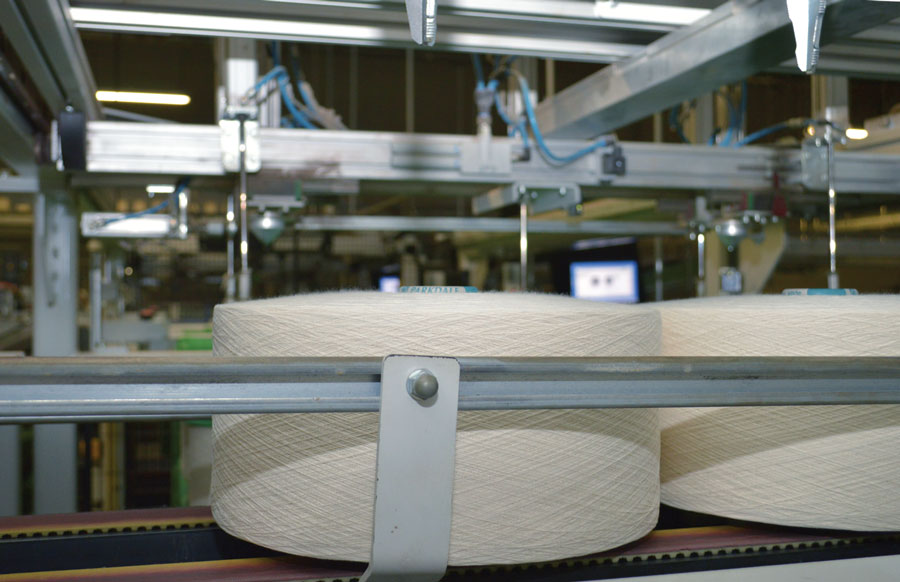
Gastonia, N.C.-based Parkdale Inc. has a long history as an early adopter of technology and as an investor in automation innovations, demonstrating a commitment to quality through automation. Today, spinning is one of the most automated manufacturing processes in the textile industry.
Textile World recently had the opportunity to discuss the history and development of automation in the spinning industry with Parkdale’s Chairman and CEO Anderson D. “Andy” Warlick.
TW: What about the spinning process specifically made the adoption of automation technologies possible?
Warlick: Ring spinning was and is very labor-intensive. The desire to reduce cost drove manufacturers to pursue automation. The resulting technology began with automated winding, then automated doffing of the ring spinning frames. Next was automated doffing and transport of roving and combing. Linking systems together like roving to spinning to winding has helped significantly reduce the handling cost.
TW: How did automation in the spinning industry develop?
Warlick: Automation in the spinning industry developed in countries that had higher wages than third world countries. It helped Western companies remain competitive.
TW: What was the first automated spinning process that Parkdale adopted?
Warlick: Automated winding was the first development we adopted at Parkdale. Next, we bought automated Schlafhorst open-end machines to replace our manual open-end spinning machinery. Then we invested in automated ring spinning doffers, then automated opening of our cotton. We then purchased automated combers with transport of the lap, automated cone packaging, robotic delivery of sliver cans. And today, we are installing robots that automatically spin or put up ends on our ring spinning machines.
TW: Was there any particular technology development that resulted in a big leap in spinning automation?
Warlick: Open-end spinning technology allowed the greatest leaps in automation and productivity. Open-end spinning created the opportunity for the best in the world to pursue the “lights out factory” in the 1990s. The sliver to yarn aspect of this technology allowed fewer processes that took up less space as well. If you went to an ITMA trade show during the 90s, there were more automation and monitoring companies exhibiting than there were at ITMA shows from 2000-2014!
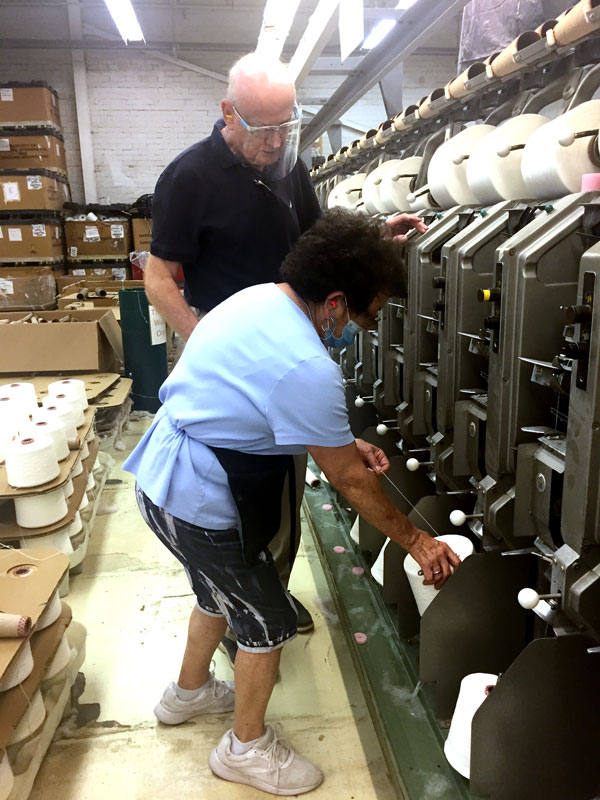
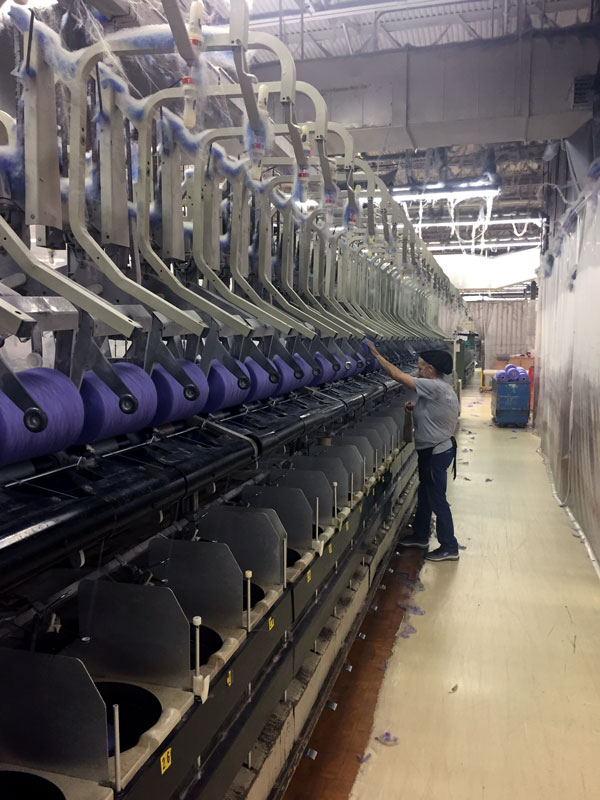
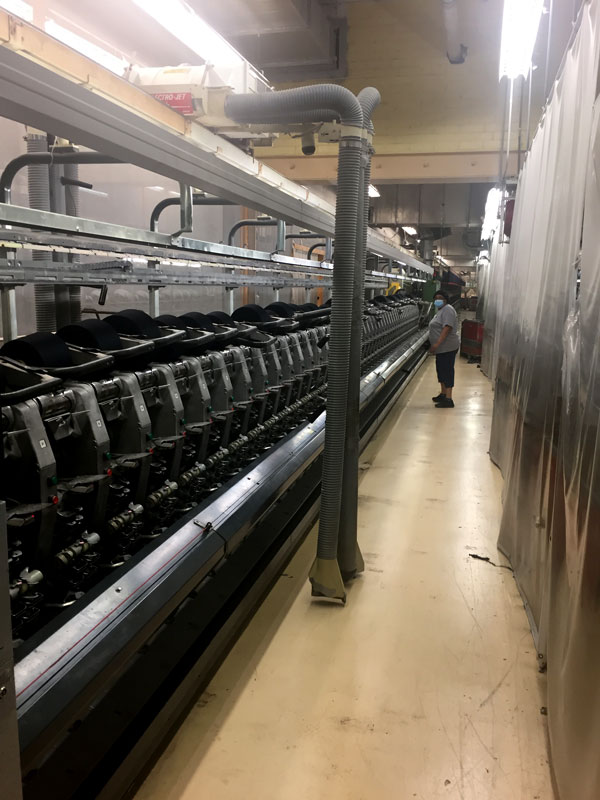
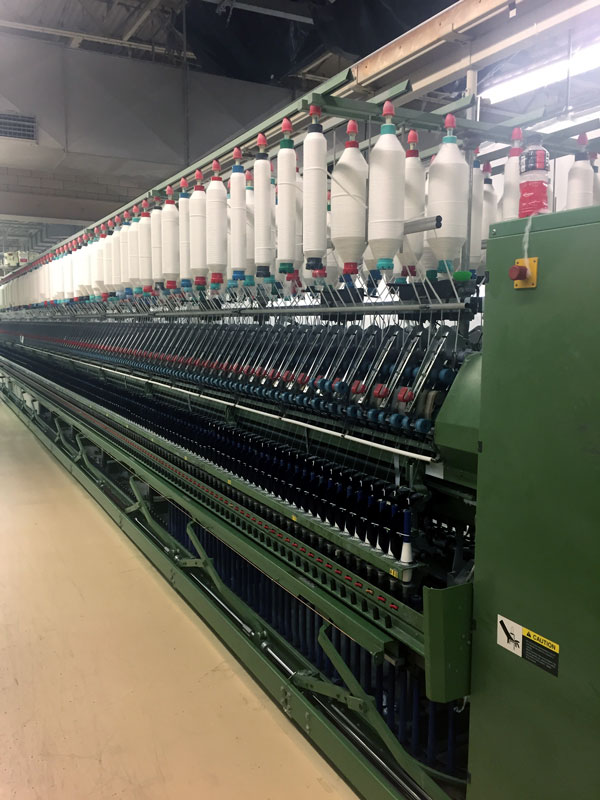
Parkdale’s spinning plants are highly automated from cotton bale to finished yarn packages.
TW: Are there any pinch points in automating the spinning process? For example, processes that are too variable or require a human touch?
Warlick: No pinch points in automating except cost.
TW: What were/are the biggest hurdles that had/have to be overcome?
Warlick: The biggest hurdles have been cost and availability. Once devalued currency became a competitive weapon for third world countries, the cost/labor benefit became steeper and many technology providers stopped working on automation technologies. Instead, they turned their attention to making less expensive manual machines that were demanded by countries taking advantage of cheap wages. In 1998, the currencies collapsed across Southeast Asia, and that was when our most important technology suppliers started the de-automation of machines.
TW: Where is automation focused today, and what impact does artificial intelligence (Al) have on automation?
Warlick: Automation has been focused on taking non-technical manual labor out. The textile industry has actually been a leader in AI in many ways over the past three decades. We have total plant monitoring and we have processes that make automated adjustments to the machinery to improve quality and eliminate defects. Plant conditions and electrical use have been monitored and controlled automatically for 40 years in Parkdale facilities.
TW: Is there any new technology, which if developed, could further advance or improve the spinning process?
Warlick: New developments in spinning need to focus on automating the ring spinning process — sliver to yarn, and bigger package distribution throughout the factory. Electrostatic spinning at high-speed that can emulate ring-spun yarn quality could be a remarkable improvement.
TW: Automation has always fascinated you. What are your views for the future of automation — both inside and outside of the textile industry?
Warlick: Automation will continue, particularly in the Western world where labor costs and labor availability are an issue. China’s wages have started to rise on the east coast and this has been a boon for automation. Many of our suppliers are starting to reinvest in automation since their demand and market is now larger than just the Western world.
I have invested in a Tesla to keep up with the technology. The improvements that have been made to the technology in just three years of ownership have been amazing. Our industry needs a Tesla and Elon Musk with ideas to drive exponential growth and change.
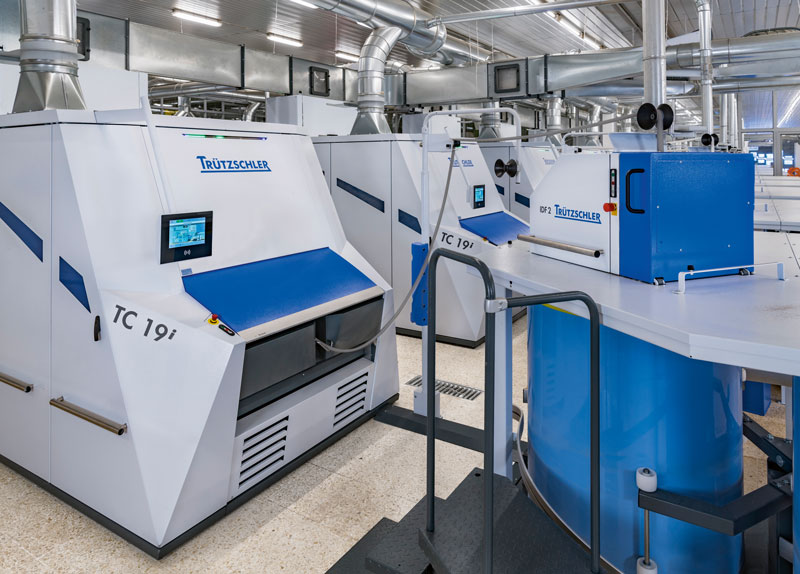
Trützschler’s TC 19i “intelligent” card can precisely perform important machine settings.
Despite a difficult business climate created by the pandemic, spinning technology companies continue to innovate.
TW Special Report
Spinning operations still thrive in the United States, in part, because the process lends itself well to automation therefore making competition from low-cost labor markets less of an issue compared to some other more labor-intensive steps in the textile processing chain (See “Spinning Automation: Development And Progress,” TW, this issue).
According to the new “Spinning Machines – Global Market Trajectory & Analytics” report from Dublin-based market research company Research and Markets, for the 2020-2027 period, the global market for spinning machines is predicted to grow from $5 billion to $7.3 billion at a 5.5 percent compound annual growth rate. In the United States, the value of the spinning machine market in 2020 is estimated at $1.4 billion.
Sustainability and circularity concepts are a new focus for the spinning industry as textile manufacturers look for creative ways to save textile waste from landfills. The desire to use recycled fiber in yarns is increasing and technologies need to be refined or created to handle such fiber in a cost-effective way, while producing a high-quality product for downstream processing.
Here, Textile World presents a look at some of the latest technologies introduced to the spinning market. Despite the COVID-19 pandemic, which resulted in a decline in overall textile machinery shipments, it is clear the interest and investment in new innovations from technology producers has not diminished.
Trützschler Spinning
Germany-based Trützschler Group’s Spinning business unit focuses on spinning preparation technologies for cotton as well as the man-made fiber sector. This includes blow room, carding, drawing and combing equipment.
Trützschler’s newest card, the TC 19i, is billed by the company as the “first intelligent card.” The machine can perform important settings independently in a more precise manner than a human operator for an unprecedented level of quality, according to the company.
The optimal gap between the cylinder and flat clothing for cotton carding is 0.075 millimeters, which is so small even an experienced technologist cannot set the machine when the card is cold. Temperature changes and centrifugal forces during operation also influence these settings. The TC 19i card features Gap Optimizer T-GO technology to ensure an ideal carding gap at all times. Once the gap is set initially by a Trützschler machine specialist, the card responds automatically to changes in material properties, production level, cylinder speed and environmental changes such as room temperature.
Optical sensors on the TC 19i card monitor waste in the suction. If too many good fibers are detected in the waste, the system automatically adjusts the mote knife setting on the WEBFEED using a servomotor. The company also offers as an optional feature Trützschler Nep Sensor NCT, which monitors the web on the doffer using a camera to detect neps, trash particles and seed coat fragments. Data is displayed on the card and also shared with Trützschler’s My Mill monitoring system to help immediately recognize any deviations.
Jürgen März, carding specialist at Trützschler, reported hearing positive feedback at ITMA. “By talking to our customers about problems in their mills, we learned about their dependence on skilled staff,” März said. “The precision of the flat setting is highly influenced by the operator, but reliable and well-trained personnel is difficult to find today. Customers were very impressed by the fact that very narrow settings can be set completely independent. The carding gap is no longer set by a technician, but by an intelligent system.”
Processing post-industrial or post-consumer recycled fiber is one such problem that spinning companies are working to solve. Such recycled fibers tend to be short and may contain unwanted yarn or fabric particles that make processing difficult. For such applications, Trützschler offers the TC 19i for Recycling.
“At Trützschler, we are always seeking solutions to the latest market trends, and we are passionate about sustainability,” said Thomas Schmitz, head of development, Fiber Preparation. “The TC 19i for Recycling empowers our customers to make the most of recycled material by optimizing opening and cleaning processes. It also offers a gentle, but effective treatment of short fibers and ensures no unnecessary waste is produced.”
Trützschler reports the TC 19i for Recycling combined with the IDF 2 integrated draw frame and Trützschler’s blowroom and carding solutions present a complete solution for direct spinning of rotor yarns from recycled materials.
“By producing high-quality sliver from recycled fibers for new yarn, our customers are able to make progress toward their targets for sustainability, while also staying ahead of rising regulatory pressure and increasing consumer demand for eco-friendly products,” said Markus Wurster, head of Global Sales. “The TC 19i for Recycling is an intelligent card that helps companies in the textile industry to embrace sustainability and turn this megatrend into a mega opportunity.”
Other new technologies offered by Trützschler include the Portal Bale Opener BO-P, Autoleveler Draw Frame TD 10, and its digital solutions My Mill and My Wires. The Portal Bale Opener allows more bales to be placed side-by-side to be processed in parallel using two opening rolls for improved blending and increased production speed of up to 3,000 kilograms per hour. The TD 10 draw frame is based on the previous generation TD 8, but with new advantages including a compact structure, energy-saving suction system, individual sliver sensors in the SMART CREEL, and modified drive concept. In keeping with Industry 4.0 themes, Trützschler’s My Mill and My Wires offer digitized mill solutions for production and quality, as well as maintenance and card clothing management. The digital offerings allow plant managers to make “informed, data-based decisions and generate quick wins as of day one,” according to the company. My Wires provides an automatic digital tracking method for clothing wear and can notify users of important events such as wire replacement.
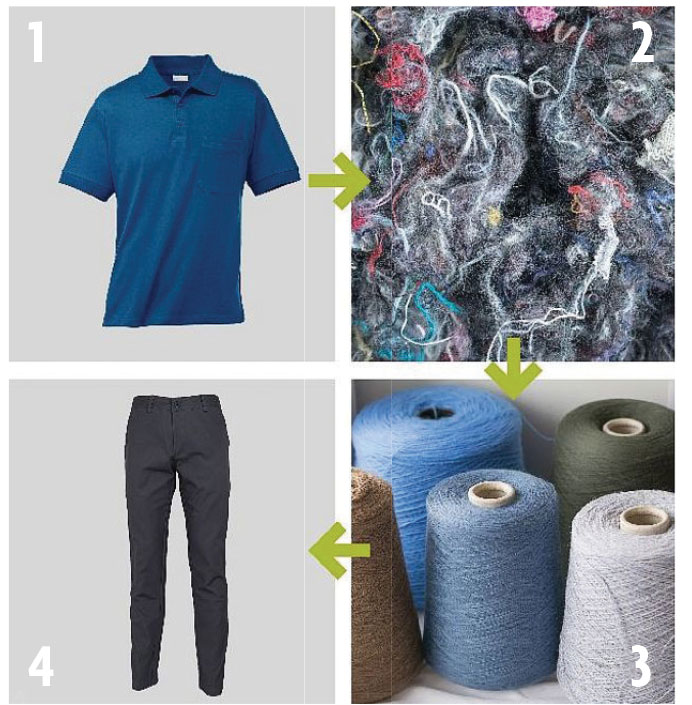
Equipment and expertise from Rieter allow fiber to take a recycling journey: from a second hand T-shirt; to torn fibers; to recycled high-quality yarn; to a new chino pant.
Rieter
Switzerland-based Rieter specializes in machinery for short-staple fiber spinning. The company currently is focused on technologies for recycled fibers in rotor and ring spinning processes. It recently undertook a study that showed it was possible to use Rieter systems to spin both rotor and ring yarns of different qualities using a “considerable amount” of recycled material inputs despite the presence of very short fibers found in post-consumer recycled fibers.
Using its rotor spinning system, Rieter reports it is possible to spin yarn up to Ne 20 using a blend of 75-percent post-consumer material with 25-percent virgin fiber; or a yarn up to Ne 30 with a blend of 87.5 percent pre-consumer material and polyester.
According to Rieter, recycled yarns are rarely manufactured using ring spinning lines because of the short fiber content. However, the company’s system is designed to produce ring-spun yarns up to Ne 20 using a 60-percent post-consumer material and 40-percent virgin cotton; or yarn up to Ne 30 using a blend of 60-percent pre-consumer material and 40-percent polyester that are suitable for weaving and knitting applications.
Rieter recommends the following machinery from its product line for manufacturers wishing to process recycled yarn content: the VARIOline blowroom line; C 80 carding machine; double-head draw frame SB-D 26; autoleveler draw frame RSB-D 26; autoleveled draw frame module RSB-Module 50; the fully automatic roving frame F 40 and semi-automated roving frame F 20; and ring spinning machine G 38.
The company also has established the Rieter Recycling Classification system to help spinners determine what targets may be reached based on the recycled input material. The system looks at short fiber content, mean fiber length and the 5 percent fiber length — which are important parameters after the tearing process — to determine the best spinning process to use and what quality and fineness can be achieved. According to Rieter, the rotor spinning machine is well-suited for processing fibers with a high short fiber content of more than 30 percent and up to 75 percent, and will produce a more even yarn. The more intensive fiber integration of the ring spinning process results in the highest yarn tenacity, which increases options for using the recycled-content yarn especially in the weaving mill.
Marzoli Textile Engineering
Italy-based Marzoli Textile Engineering, part of the Camozzi Group, offers solutions for preparation and short-staple-fiber spinning for both the woven and nonwoven sectors. Marzoli recently introduced a Trash Analyzer for online analysis of waste during fiber preparation. A weighing pan provides weight analysis in conjunction with the visual analysis of sample images to produce a performance index of the overall efficiency of trash removal for the opener or card in question. The system can be employed anywhere there is material flowing through a pipeline and sampling does not require any machine downtime.
At the end of April, the company will launch an updated version of its TAOMApp, an application developed to analyze trash inside cotton bales quickly and easily using photo scanning technology. According to the company, the new version is more user friendly and precise when identifying and defining the trash level in the bale, among other improvements.
The company also recently contributed its technologies and experience to a recycled yarn project with the Egyptian cotton industry (see sidebar).
Savio’s Multi Link spinning innovation connects multiple ring-spinning frames to one Savio winder.
Savio Macchine Tessili
Founded in 1911, Italy-based Savio Macchine Tessili S.p.A. is a machinery company specializing in yarn finishing operations including automatic winders, two-for-one twisters as well as rotor spinning machines. Recently, it was announced that the Belgium-based Vandewiele group has reached an agreement to acquire Savio from Itaca Finance S.A, a company controlled by Alpha Private Equity. The transaction is expected to close this spring.
“Receiving such strong interest from important players in this challenging period is a recognition of Savio’s strategic value,” said Alexander Zschokke, who will continue in his role as chairman of Savio Group. “In the long term, being part of the Vandewiele Group will preserve our entrepreneurial culture focused on innovation, operational excellence and commercial development.
“We are extremely proud to welcome the Savio Group with its strong tradition and technology in our group,” said Charles Beauduin, CEO of Vandewiele. “The joining of our technological capabilities, R&D and industrial operations will allow us to grow strongly in the next few years”.
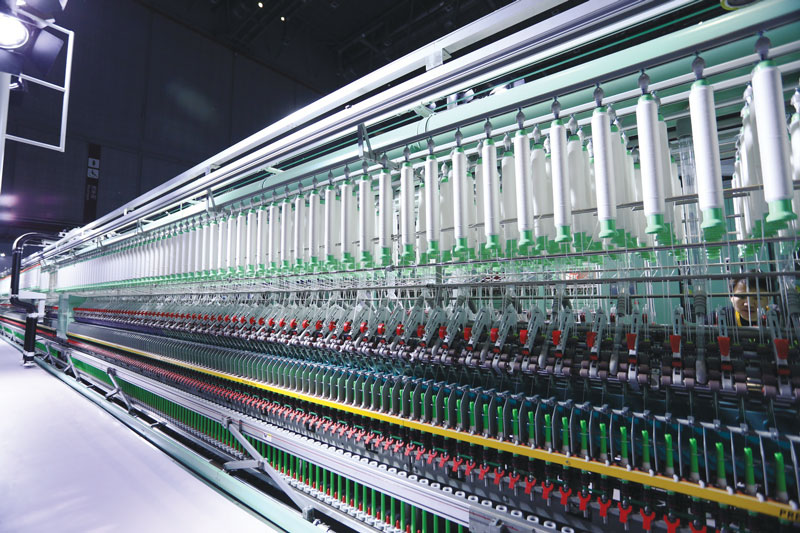
Savio’s latest spinning innovation is the Multi Link, which connects multiple ring-spinning frames to one Savio winder. The company created the technology in response to demand for increased integrated automation in the spinning process to improve quality and productivity. According to Savio, the solution optimizes space, and reduces energy consumption and production costs. Contact-free material flow is ergonomic with a shortened patrolling path for machine operators. Savio also offers bespoke systems tailored to fit the exact need of the customer. Winders may be prepared to process two or three different yarn counts.
Uster recently announced the release of the Uster Quantum 4.0, the next-generation Uster clearing system.
Uster Technologies
Last year, Uster’s Quantum 3 yarn clearer, engineered by Switzerland-based Uster Technologies AG, marked its 10th anniversary. This third generation of Uster’s clearing system was the first yarn clearer with automatic clearing limit proposals based on the Yarn Body concept — an outline of a “normal” yarn with its expected and tolerable natural variations made possible by powerful processing electronics.
This year, Uster launched the Quantum 4.0, the next generation in Uster clearing systems. The Smart Duo system combines both capacitive and optical sensors in one for intelligent yarn quality control and optimized profitability, according to the company. The two sensors operate intelligently in tandem using Uster’s Cross Clearing innovation. This technology locates and eliminates hidden defects in double checks using a main sensor and an assistant sensor. Issues such as unseen fluff events that may cause breaks in downstream processing, are caught.
A density feature prevents sub-standard cops caused by ring spinning malfunction, as well as quality issues that arise in compact spinning. “No matter where density variations originate, be it compacting, different twist levels due to slip spindles or otherwise, Uster Quantum 4.0 takes care of it — and this is a real technical innovation,” said Katrin Hofer, product manager, User Technologies.
Quantum 4.0 also features the Blend Mix-up option enabled by improved hardware and software. This option detects any incorrect raw material in greige and white yarns, preventing the unwanted barré effect in woven fabrics. An enhanced Continuous Core Yarn option also continuously detects both missing and off-center cores.
In addition, a new polypropylene (PP) classification offers an overview of PP content, while the Quantum 4.0’s Advanced FD classification shows foreign matter below the 5 percent line.
Uster also offers Quantum Expert as part of the product package, which enhances process control and defect prevention via the Total Contamination Control, Ring Spinning Optimization and RSO 3D Value Module.
“Failure prevention is the key to success and tackling issues at source is the way to do it,” Hofer said. “Uster Quantum 4.0 plays an important role in this, offering options to strengthen it.”
All data collected by the system is handled by Uster Quantum Expert in an intuitive way. According to the company, a new central Smart-Limit button allows an operator to adjust all available smart limits with the simple tap of a button; or, individual limits can be fine-tuned as preferred.
Loepfe Brothers
Switzerland-based Loepfe Brothers Ltd. recently introduced the YarnMaster® EOS for reliable yarn clearing on open-end spinning machines. The device features a newly developed state-of-the-art stable optical sensor that enables accurate yarn clearing tailored to the desired yarn quality. The sleek design of the outer casing allows the device to be used on a wider range of open-end machines compared to its predecessor. Loepfe also created an intuitive user interface to complement the advanced functions. of the EOS clearer.
“This is a must-have for all open-end spinning machine owners — the combination of consistency and efficiency offered by the YarnMaster EOS is unrivaled anywhere on the planet,” said Loepfe’s Head of Products & Solutions Guido Wieland. “It gives owners greater control of yarn quality than they have ever had before, while ensuring that machine efficiency is optimized for maximum productivity.”
The company also offers the YarnMaster Prisma — a new generation of clearers that feature four established sensor technologies fused together in one device: an optical infrared sensor; a mass sensor; an optical RGB sensor; and a triboelectric sensor. The company engineered a way to effectively combine two dominant sensors — optical and mass — into one sensing head for precision yarn clearing with no compromise on quality. This dual measurement or DM sensor technology measures basic yarn faults. The RGB F sensor illuminates the yarn in the full spectrum of light, which enables the smallest shade and glossiness differences to be detected in any type of yarn or color for effective foreign matter detection. The Prisma’s triboelectric P4 sensor evaluates electric charge differences created by different raw materials during the winding process, thereby reliably detecting white and transparent polypropylene, according to the company.
The Prisma clearers are available in three versions — Prisma DM, DMF or DMFP — depending on the customers manufacturing requirements.
Most recently, Loepfe announced a collaboration with Italy-based Loptex S.r.l. The two companies aim to improve yarn quality and productivity for spinning mills with an integrated offering. Customers can now buy from Loepfe its YarnMaster Prisma and YarnMaster Zenit+ yarn clearers together with the Loptex Exa and Centra sorters for a complete solution from one supplier.
“We welcome this collaboration which harnesses the strengths of both the Loptex and Loepfe products for our customers,” said Loptex CEO Renato Gerletti. “There are many synergies between the approaches of our two companies, not least of these being our dedication to using leading edge technology to deliver great results for spinning mills everywhere.”
“Next to our in-house R&D commitments, this is a complementary partnership that puts customer needs first and will deliver a vital combination of top quality and greater productivity to textile mills,” said Loepfe’s CEO Dr. Ralph Mennicke about the collaboration with Loptex.
“Despite the challenging times in which we are living, Loepfe has remained true to its values and kept on investing in R&D,” Mennicke said. “Recognizing the challenges faced by all in the spinning and weaving industry today, our investment in developing the finest Swiss technologies to support our customers continues at full speed.”
Loepfe is not alone in this commitment to drive the industry into the future with innovative solutions and creative technologies for the spinning industry, and there is no doubt the industry will see more spinning innovations introduced at the upcoming ITMA Asia + CITME trade show in June (See “ITMA Asia + CITME 2020 On Track For June,” TW, this issue).
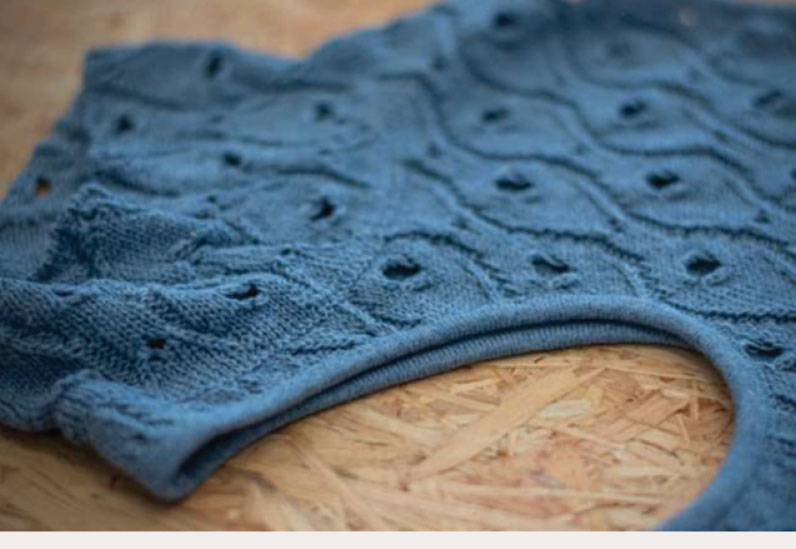
A knitwear capsule collection was created as part of the RE.ACT denim recycling project.
RE.ACT: Exploring Circular Solutions For Denim Recycling
Italy-based Marzoli Textile Engineering recently participated in the denim recycling RE.ACT pilot project. Created by the United Nations Industrial Development Organization (UNIDO) in collaboration with Circle Economy, “The Egyptian Cotton Project” aimed to explore circular solutions for denim recycling in the Egyptian cotton textile industry including market opportunities and technology capacities.
The project was a multi-stakeholder partnership between Egypt and Italy, sharing knowledge, expertise and technology to show that recycling in a profitable manner is possible. Marzoli contributed its technology and advanced know-how to the project and was joined by T&C Garments, which supplied the post-industrial denim; yarn spinner Filmar S.p.A., and weaving and finishing company Albini Group. Post-industrial denim waste was transformed into NE 30/1 cotton yarns that were then used to produce high-quality knitwear and fabrics. Italian fashion designer Marina Spadafora hosted an educational “Knitwear Design for Sustainability” workshop for Egyptian and Italian fashion design students, which produced a knitwear capsule collection.
Circle Economy supported a life-cycle assessment (LCA) on the recycled yarns produced in a scaled-up scenario. The LCA showed that the recycled yarns had a lower impact than virgin cotton with regards to water consumption, total energy demand and global warming potential. The promising results were shared in a report, “Egypt’s Market: Environmental and Economic Assessment of Post-Industrial Cotton Waste Recycling.”
“We are focused on continuous innovation in mechanical regeneration of fibers,” said Cristian Locatelli, Marzoli’s general manager. “Developing and adopting green technologies means for us at Marzoli to carefully balance economic with environmental sustainability. Circularity of fibers, thanks to fabric regeneration, is creating a synergistic value chain among all the stakeholders. The new paradigm of a circular fiber supply chain will accelerate learning and development of know-how for all participating stakeholders pushing innovation and opening up to new potentials.”
National Spinning got its start in manufacturing as a yarn spinning company, but in more recent years has added nonwovens and craft products to its portfolio of businesses.
National Spinning, a diversified company with its origins in yarn spinning, celebrates its centennial in 2021.
TW Special Report
Washington, N.C.-based National Spinning Co. Inc. has reached a very impressive milestone. Founded in 1921, the company celebrating its 100th anniversary this year. During its 100-year-history, the yarn spinning company — highly skilled at producing wool, acrylic and complex blended yarns, as well as tailored yarns to meet customer needs —has expanded beyond its core spinning competencies with the acquisitions of craft company Hampton Art and airlaid nonwovens producer Carolina Nonwovens.
The company strives to be a reliable trustworthy partner and a go-to resource offering quality products and service in a most professional way to create financial health for itself, its customers and its suppliers.
“We get satisfaction out of delighting our customers, while providing a positive work environment for our associates and being good corporate citizens,” said President and CEO Jim Booterbaugh.
National Spinning employee Matt Meade doffing acrylic roving.
Company History
Established in 1921 by Phillip and Carl Leff in Brooklyn, N.Y., National Spinning initially sold wool yarns to the New York apparel trade.
With the formation of National Worsted Mills in 1934 in Jamestown, N.Y., the company officially became a manufacturer in its own right. In 1954, the company shifted its manufacturing south to Washington, N.C., at which time National Spinning became an early adopter of man-made fibers such as acrylic and nylon as alternatives to wool.
During the 1960s, the company expanded its manufacturing footprint with additional plants in Whiteville, Warsaw and Beulaville, N.C. Over the ensuing several decades, National Spinning became the dominant U.S. manufacturer of natural, fiber-dyed and yarn-dyed acrylic yarn. Its strong capabilities in colored acrylic yarn manufacturing and increase consumer demand, National Spinning became a wholesale manufacturer and distributor of craft yarns and yarn kits in the 1970s using the National Yarn Crafts branding. The company’s acquisition of Tina of California and Caron Spinning expanded this business area.
In the early 1990s, National Spinning became employee-owned via an Employee Stock Ownership Plan (ESOP). Today, employees continue to hold a 50 percent share in the company.
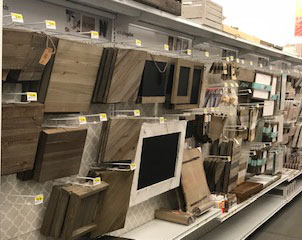
National Spinning-owned Hampton Art offers a large selection of non-textile craft supplies including planks and boards for home décor projects.
21st Century Diversification
During the 2000s, National Spinning embarked on a diversification plan to move beyond the apparel and craft yarn markets that had been so important to the company’s roots. In 2004, the company bought Hampton Art to grow within the craft space — a decision made because of the company’s connections to the craft industry through its craft yarn sales. Hampton Art has grown into a major distributor of non-textile craft supplies to major craft retailers. Its focus is on DIY supplies for scrapbooking, home décor, weddings and party supplies.
National Spinning bought Carolina Nonwovens, a producer of airlaid nonwoven pads, in 2012.
Another major part of the diversification effort took place in 2012 when National Spinning bought Carolina Nonwovens, a producer of airlaid nonwoven pads based in Lincolnton, N.C. Such pads find applications in the automotive, appliance, construction, bedding and cold chain packaging markets. Growth of the business between 2012 and 2015 necessitated an expansion, and the business was relocated to Maiden, N.C., in 2016.
“Over the past 15 years, National’s yarn business has evolved from predominantly wool and acrylic for apparel, to a broad mix of various fibers for technical applications,” said Booterbaugh, a National Spinning employee since 2003. “The current product line still includes wool and acrylic, but yarns are now made using fire resistant fibers such as modacrylic, Nomex®, Conex®, FR rayon and PyroTex®. In addition, fibers such as polypropylene, nylon and Twaron® are spun for industrial applications.”
Changing Of The Guard
Booterbaugh added the title of CEO after his name in 2018. In 2020, well-known industry figure and National Spinning Chairman Jim Chesnutt retired leaving Booterbaugh solo at the helm of the company. “Jim still has an office across the hall from mine and I see him on a regular basis,” Booterbaugh said. “He’s been a mentor for me for 20 years and we maintain a strong line of communication. I’m fortunate to have him as a mentor because he’s just been such a solid contributor to the textile industry over the years.”
Chesnutt remains on the board of directors, but last year, he handed the chairman role to Bob Miller, who is a member of the company’s founding family. “Bob brings a great historical perspective, experience with wool and acrylic sourcing, and a passion for environmental stewardship to the table,” Booterbaugh noted.
Textile World recently had the opportunity speak with Booterbaugh to discuss the centennial milestone, and how the company has positioned itself to remain on a successful path for many more years to come.
TW: What type of spinning technologies does National Spinning employ today? Are there certain technologies the company has invested in over the years that have helped differentiate the company and its products?
Jim Booterbaugh
Booterbaugh: National Spinning is one of the few remaining companies with long staple worsted spinning for fibers between 60 millimeters and 120 millimeters. This technology is ideally suited for wool and high bulk acrylic — including hand knitting yarns, hosiery and sweaters — but it is becoming more popular for technical fibers and certain industrial products that require the additional strength, bulk or luster from long fibers as well. Short staple ring spinning is available for polyester, pigmented acrylic and fire-resistant blends.
We also have some spinning equipment for very heavy yarn counts in the range of 0.5/1 to 3/1 — 1,800 to 10,000 denier — for special industrial applications. All yarns can be twisted.
The most interesting/different capability National Spinning has is our specialty blending operation. Because some customers require small percentages of fibers in a blend or greater than three fiber components, National Spinning has a blending facility that provides the most thorough blending available. The unit also allows for the use of multi-fiber blends that are difficult to handle under normal circumstances in a spinning plant.
Whereas this equipment was previously only for internal use, it is now available for customers who just want fiber rather than finished yarns.
TW: Do you have any brands that you promote within the industry? Do you promote any brands at the consumer level?
Booterbaugh: Our premier polyester hosiery brand is called UltraSpun®. It is a proprietary blend of polyester that offers enhanced wicking in addition to a soft hand.
National Spinning’s Whiteville Plant manager Rudy Ballance provides instructions to winder operator Betty Harrelson. Ballance and Harrelson are long-time employees with 52 and 59 years, respectively, employed by National Spinning.
TW: The company turns 100 this year. Do you have any special celebrations planned?
Booterbaugh: We plan to have celebrations at all of our plants in September. In addition, to a celebratory meal, we will have gifts for all of our associates and a raffle with some large prizes. We will also present a historical timeline in the plants, recognizing critical steps in the company journey.
TW: As a 100-year-old spinning company, how has diversifying and broadening your product base allowed you to combat changes in the industry?
Booterbaugh: Diversification has been critical to survival. Not only have we needed to diversify our yarn business, but it has been important to diversify our overall business into nonwovens and crafts to weather the inevitable storms. Diversification also helps us balance out seasonality.
TW: What made the company consider nonwovens when it was looking to diversify?
Booterbaugh: We saw a sector of the industry that was growing and was continuing to grow, and we were able to use fibers. For 90 years, National Spinning took fiber and turned it into a card sliver and then into a yarn. For nonwovens, in the back process you’re still handling fibers in the same way, but instead of turning it into sliver, it instead is made into a mat.
So, it wasn’t a huge leap technology-wise for a spinning company to move into airlaid nonwovens. We looked around and found a company that wanted to sell, and advertised, we’ve seen consistent growth and there’s a lot of flexibility and directions we can go with our product. The business also is very much import resistant because our products are very light and it’s expensive to ship them over long distances.
It puts us in some different markets too — the automotive sector, construction, bedding and appliance products. It’s a totally different product mix and market than for the yarn division and that’s great for the diversification because if the automotive market goes down, it affects our nonwovens division, but it doesn’t really affect our yarn division. And if apparel goes down, it affects our yarn division, but it doesn’t affect our nonwovens.
The other thing that we really liked about the nonwovens business is that we have the ability to use recycled fibers. A large component of what we use are industrial cutting scraps from apparel mills. We have a main product line that is predominantly made using repurposed denim scraps. One of the synergies that we thought could work was to take the waste from our yarn manufacturing operation to repurpose it into nonwovens. We’re not doing that directly yet, but at some point in time there could be a direct waste connection between our spinning and nonwoven operations.
On the nonwovens side, we can handle short recycled fibers. It’s a little bit tougher for the spinning machines, but with nonwovens we can run the post-industrial or post-consumer waste without a problem. We can also handle jute and hemp and other natural fibers a lot easier in our nonwovens process than the spinning process at this point in time.
National Spinning employee Melinda Williamson processing acrylic craft yarn on a Volkmann twister.
TW: What is the company’s philosophy on traceability and sustainability — both growing industry trends?
Booterbaugh: We participate in several programs that demonstrate our focus on sustainability and ethical practices. One example is the use of wool certified through the responsible wool sourcing (RWS) program, which is a traceable, certified program to ensure that sheep, land, and people are managed ethically and sustainably standards. Some of that yarn will be used in uniforms provided by Ralph Lauren for the Olympics. We also are developing programs using hemp fibers, and we have been spinning yarns from post-consumer, recycled polyester for quite some time.
In our nonwovens division, the majority of the fiber that we use is recycled from industrial and/or post-consumer cutting scraps.
TW: Please expand on the company’s experience with hemp — another growing area of interest for the textile industry that is frequently in the news at the moment.
Booterbaugh: On the fiber side, we get contacted continually with people wondering if we can spin hemp, so we’ve been interacting with many hemp producers to find the ideal fiber hemp growers in the United States.
Our spinning equipment lends itself well to hemp if it’s processed right. Naturally, when hemp comes off the stalk, it’s a very long fiber. So theoretically, we should be able to get very long fibers that match up very well with wool for processing. But as the fiber is removed from the hemp plant and processed before it reaches the spinning mill, the length gets degraded to the point where, as of right now, the best hemp they are able to produce has been knocked down to about 1 inch in length. This length really processes better on the short-staple systems to blend with cotton or polyester. But we’re still hoping for a long-length hemp that can blend with wool effectively.
Hemp fits in with our core competencies with long-staple spinning and wool. We like anything that we can blend with wool, so hemp seems like the perfect partner.
Sandra Battle tends to black acrylic on a Savio winder.
TW: How does your workforce contribute to producing a high-quality product? Do you have skilled workers with a long history at the company?
Booterbaugh: In any business, you will only be as good as the strength of the team. We have an incredible group of long-term associates that bring tremendous experience and skill to the table. We have two associates with more than 50 years of tenure at National Spinning, and they are still going strong.
TW: What are the challenges you encounter running a spinning operation in the United States?
Booterbaugh: It is extremely difficult to compete with foreign competition on price, because we pay more for fiber and labor than our eastern competitors. As a result, we don’t do any commodity business. Our customers buy yarn from us for quick response or special yarns that are not available readily from overseas.
The U.S. supply chains that still exist are critical for supplying products to our government and to customers that require a dependable flow of product. There is still room for U.S. spinners and fabric manufacturers to fill that space.
One of Whiteville’s linked Marzoli ring spinning frames.
TW: How did the COVID-19 pandemic impact the company? Did you see demand for certain products change?
Booterbaugh: The COVID-19 crisis caused a major interruption in several yarn markets, particularly those related to apparel and protective gear. Some of that reduction in business was covered by demands for yarns that were used for PPE products, but the PPE business was just a small portion of normal business.
One bright spot during the pandemic was the demand for hand knitting yarns and craft sales. COVID created the cocooning effect — a phenomenon that’s seen during really cold winter months when people are staying at home and need things to do inside. People often turn to hand knitting or crocheting, or scrapbooking and other home crafts. This cocooning effect caused a huge increase in hand knitting yarns and craft sales, which helped us weather the storm of the pandemic.
Along those lines, our entire craft division was impacted far less than the textile divisions, and the nonwovens division recovered much quicker than the yarn business. It was a clear demonstration on the value of diversification within a company.
The nonwovens division is critical to our spinning division as is our craft division, because all three divisions support and contribute to the corporate overhead. When one does well, it helps them all.
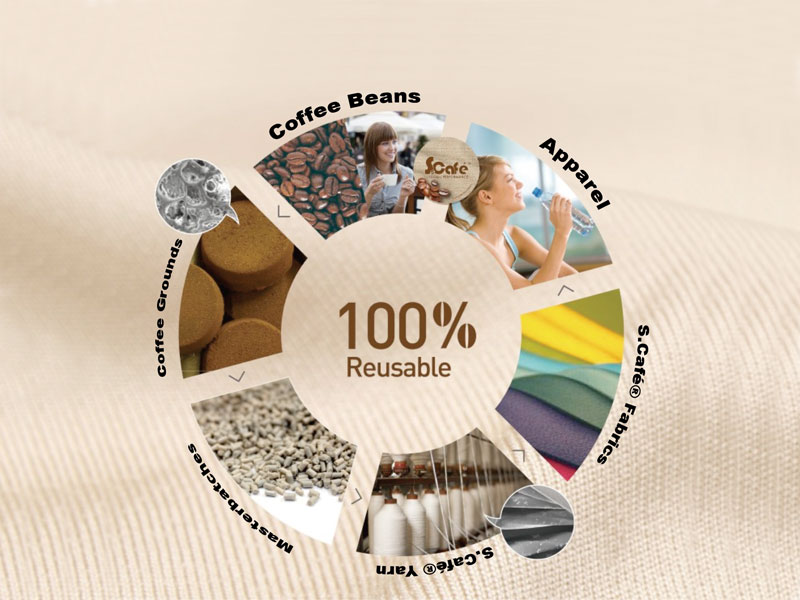
Taiwan-based Singtex Industrial offers S.Café® yarn, which is made using coffee grounds mixed with polymer.
The increasing availability of alternative plant-based fibers offers sustainable options for textile products.
By Dr. Andre West, Technical Editor
Sustainability can be defined as how natural systems function, remain diverse and produce everything necessary for them to remain in balance with nature. In textile science, natural plant fibers are sustainable raw materials. For humankind to exist sustainably means maintaining productivity in agriculture and ecology despite obstacles. The world’s ecosystems are under stress from the abundance of plastic production and the disposal of it. Perhaps now is the time to gain a deeper understanding of the availability of natural plant fibers for textiles.
All natural plant fibers are biodegradable and sustainable. Most made-made fibers will degrade over time, but the length of time is significantly longer, and the process of degradation can have adverse effects on the soil and water and subsequently, the overall environment. With the onset of global warming and climate change, a growing level of environmental consciousness, and the easing of legislative regulations, there is a resurgence of interest in natural fibers. Several plants, fruits, and seeds are now either being rediscovered or newly processed to develop new fabrics that can heal the planet.
Fiber plants have existed worldwide for centuries. Plant fibers have a long history of use in textiles, cordage, paper, and more recently in technical applications in composite materials. The use of textile fibers can be traced back to 9000 B.C. Fibers from plants can be considered renewable and biodegradable as they grow and can be returned to the soil without harm and sometimes even with beneficial effects, as in the case of hemp.
Types Of Plant Fiber
Cellulose is the substance that makes up most of a plant’s cell walls. Since all plants make cellulose, it is probably the most abundant organic compound on earth. Cellulose is a fibrous material of plant origin and the basis of all-natural and human-made cellulosic textile fibers. All plant-based fibers have to go through a process where they are separated from the parts of the plant that are not used for the end product, usually through harvesting, separating from the chaff, and cleaning. Some of these processes can be considered natural and organic, while some require intensive use of chemicals, which can negate their validity, such as bamboo.
There are four main types of plant fiber:
Bastal fiber, or so-called phloem fiber or skin fiber, is plant fiber collected from the phloem — the inner bark, sometimes called skin — or bast surrounding the stem of certain dicotyledonous plants. Bast fiber supports the phloem’s conductive cells and provides strength to the stem; examples include flax and hemp.
Leaf fibers, or hard fibers, are a type of plant fiber mainly used for cordage or vegan leathers. They are the toughest of the plant fibers because of their increased lignin content. These are not traditional leaves, but more fleshy leaf plants such as pineapple and agave, which are used for sisal.
Fiber from seeds and fruits of plants are often attached to hairs or fibers or encased in a husk that may be fibrous such as cotton, coir and kapok.
Wood fibers are sourced from trees, grasses, and bamboo. These fibers are stiffer and usually need an extra process to soften the fibers. Often, sodium hydroxide is solubilized with carbon sulfide for viscose and N-methylmorpholine-N-oxide for lyocell, which is less harmful than carbon sulfide, then extruded in the same methods as man-made fibers.
Many natural fibers have to go through processing to extract the fiber strands from other plant tissues. In some cases, the natural gum binding them together must be removed. This removal can be achieved in the field using a process called retting — also known as degumming — which involves the extraction of fiber bundles from the harvested stem. Further processes can take place that are either biological or mechanical, and, in many cases, a mixture of both processes is required.
There is a renewed interest in more sustainable methods of biodegradation. Biodegradation is the decomposition of a material due to the biological activity of microorganisms such as bacteria, fungi, and other biological agents. Biodegradable fibers can be broken down by microorganisms. Because most natural fibers are biodegradable, there is a delicate processing balance needed to keep the fibers at their optimum performance level.
Increased Interest In Alternative Fiber Types
With the recent interest in renewable resources, alternative plant fibers from non-traditional plants are being studied. More economic methods of separating the fibers from plant leaves or stems need to be developed because the traditional techniques passed down through generations are labor-intensive, very time-consuming and may be weather-dependent. As consumers look for ways live more sustainable lives, manufacturers and entrepreneurs are looking for ways to take natural fibers into the 21st century and the fashion mainstream.
Hemp Black — a new company researching and commercializing applications for hemp in textile and industrial products — offers the Sunn pant, a garment incorporating full spectrum hemp flower extract for odor-neutralizing and antibacterial properties.
Hemp
Hemp has received a lot of interest more recently as the law related to hemp growing in the United States has changed. Hemp is a fast-growing plant that requires very little water and relatively few, if any, herbicides, pesticides, or synthetic fertilizers. The cultivation of hemp improves soil health by replenishing vital nutrients and preventing erosion.
Hemp fabrics possess antibacterial activity against a wide range of pathogenic bacteria. It has the best heat capacity ratio compared to all other fibers, so it keeps the wearer cooler in the summer and warm in the winter. It dyes well and does not discolor easily. It is also tough and is more resilient and longer-lasting than cotton garments. The U.S. Marines recently issued a Request for Proposals to research how hemp might be used to increase performance in fabrics used in combat uniforms.
Hemp carries the stigma, however, of the Cannabis sativa plant as a recreational drug, which has hampered the production and use of industrial hemp, especially in the western world. However, the Hemp Farming Act of 2018, a law to remove hemp — defined as cannabis with less than 0.3 percent tetrahydrocannabinol, or THC — from Schedule I controlled substances and to make it an ordinary agricultural commodity, was enacted. This act allowed U.S.-based hemp growers to play catch up with the worldwide hemp industry.
However, farmers recently were burned by cannabidiol (CBD), also made from hemp, as the market price for CBD declined drastically because of overproduction. Farmers now are wary of venturing down the same path with fiber hemp.
China accounts for more than 50 percent of the global hemp production and holds more than half of the over 600 international patents on hemp fiber and textile production. India and Romania have been producing finer hemp yarn using wet spinning processes. The majority of hemp processing is completed by cottonization — the process of removing the lignin that binds the hemp fibers and cuts the fiber to an average cotton length of about 1-1/8th inch to be spun and finished on already existing slightly modified cotton or wool processing equipment. Although a step in the right direction to get a production restarted, this technique does not incorporate the main attribute of hemp, which is that of a long, strong fiber able to be spun to produce fine, hard-wearing fabric
Patagonia recently supported the “Bring Hemp Home | Colorado” video proposing hemp production. The video points out there will need to be a substantial increase in textile machinery and innovation to move this fantastic fiber into the wardrobes of the U.S. consumer.
Stinging Nettles
The stinging nettle is a plant that most children avoid at all costs because brushing up against the underside of the leaves causes a nasty rash. However, the fabric made from stinging nettles is perfectly safe to wear and has a similar advantages to hemp without hemp’s associated legal issues. Despite its protective armored exterior, the fibers inside a stinging nettle plant are surprisingly ideal for textile production. The fibers are pliable and a good length to be spun into yarn. The final woven fabric is similar to linen but much stronger. Its strength even increases when wet, making it ideal for more structured garments. It blends nicely with other fibers, which can help to add softness and increase longevity when needed. Kenya-based Green Nettle Textiles was a winner of the 2019 Global Change Award sponsored by the H&M Foundation. Stinging nettles are easy to grow and conserve biodiversity, maintain mountain slopes and provide habitat for insects and animals. Green Nettle’s product range supports plans to offer work for more than 200,000 small farmers across Kenya.
Samatoa Lotus Textiles offers fabrics made using fiber from the root of the lotus plant.
Lotus Flower
Lotus flower fiber from the root of the lotus plant has been used for centuries to produce rare fabrics used in hand-spun scarves. The process, in which the stems of the lotus are cut and twisted to expose the fibers, is however time-consuming. The process produces a luxurious fabric that feels like a combination of silk and raw linen. Lotus fabric has unique properties — it is naturally soft, light, breathable and antibacterial. Cambodia-based Samatoa Lotus Textiles reports the Lotus plant is believed to have healing abilities, and wearing a fabric made using the fibers lotus fibers may have healing effects curing the wearer of headaches, heart ailments, asthma and lung issues.
Pineapple
Pineapple leaves are a by-product of the pineapple fruit harvest, and this waste is creating an additional income stream for some farming communities. The chemical composition of pineapple fiber is similar to flax and jute fiber. Pineapple fiber is white in color, soft, smooth, and feels like silk. The mechanical properties are higher than cotton. The fibers in their natural state can be used for triangular core linens in geotextiles and central reinforcement material for rubber conveyor belts. It can also be manufactured into vegan leather when mixed with a water-based polyurethane. London-based Ananas Anam Ltd. manufactures Piñatex®, a material comprised of 80-percent pineapple leaf fiber and 20-percent polylactic acid (PLA) that is biodegradable under controlled industry conditions.
Coffee Beans
Fabric made using discarded coffee grounds is one example of an interesting textile innovation. Two companies are offering such products.
Sneaker brand Nat-2™ offers sneakers made using recycled coffee grounds.
Germany-based sneaker brand Nat-2™ recently debuted a sneaker that smells like coffee made using repurposed coffee grounds. The sneakers feature up to 50 percent recycled coffee grounds depending on the style, which produces a smooth and fine texture, according to the company. The type of coffee used varies upon sustainable availability.
Taiwan-based Singtex Industrial Co. Ltd.’s S.Café® yarn is made using coffee grounds. The patented yarn manufacturing process maximizes the functional performance capacity of the coffee grounds. Singtex’s technology combines the processed coffee grounds and polymer to create masterbatches before spinning it into yarn. The company reports the yarn offers excellent natural anti-odor qualities, ultraviolet protection and fast drying times up to 200-percent faster than drying times for cotton.
Desserttex® is a cactus-based material designed for automotive use.
Prickly Pear
Prickly pear, otherwise named Nopal cactus, has been processed into a vegan-friendly leather alternative by Mexico-based Adriano di Marti S.A de C.V. Desserto® is highly-sustainable, high performance, and also has a soft hand, according to the company. The product is partially biodegradable and is suitable for fashion, leather goods, luxury packaging and furniture applications.
Its Deserttex® product was developed to meet the standards of the automotive industry. According to the company, the material “has a degree of roundness and spring [that] you would normally only find in leather where the collagen acts in this way.”
The cactus plantation is perennial with each plant lasting for approximately eight years with selective harvesting. This nonwoven fabric can be produced in a large variety of colors, thicknesses and textures.
Banana
Banana fiber extract is from the bark of the banana tree, and again, is a byproduct of fruit farming. The outermost fibers of the shoots, as the coarsest, are suitable for tablecloths; the softest innermost fibers are suitable for clothing.
Bananatex® is a soft and lightweight, but durable, waterproof fabric made from banana plants by Switzerland-based Qwstion International GmbH in collaboration with a yarn specialist and weaving partner both based in Taiwan. The chemical treatment-free banana plants are grown in the Philippines within a sustainable forest, which has helped reforest areas previously eroded by palm plantations.
Bananatex fabric is available in a line of bags and backpacks designed by Qwstion; used as the upper material in a sneaker designed in collaboration between Good News and H&M; and is used for the cover on the Kolter Eco daybed offered by Magazin and Denmark-based Softline.
Oranges
Orange fiber is created from citrus juice by-products that would otherwise be thrown away. In Italy alone, production of waste materials from orange peels exceeds 700,000 tons per year. Orange Fiber®, a 100-percent citrus textile manufactured by Italy-based Orange Fiber S.r.l., is lightweight, soft and silky. It may be blended with other materials including silk, cotton and elastane, and is available in a range of fabric styles including jersey, poplin and twill. As the fabric is made using citrus by-products, the natural oils within the fabric contain vitamins A, C, and E, according to the company. Upon contact, these vitamins may be released and absorbed through the skin.
The Future For Alternative Plant Fibers
Researchers, manufacturers, entrepreneurs and consumers, all have a huge role to play in fighting the negative effects of fashion pollution by changing the idea of textiles and clothing as throwaway items. This article mentions just some of the alternative sustainable materials currently available. As research methods grow and scaling takes place, these fibers, yarns, fabrics, and other alternative materials will become increasingly available. The burden should not just lie with consumers. Businesses must take responsibility for their actions, and governments need to provide incentives to allow companies to research alternative methods to create valuable products from their waste. Tackling those global and complex issues requires more than a shift in an individual’s shopping habits. It requires a system change to try to provide a circular fiber industry. Textiles made using leaves, fruits, or nuts may sound strange now, but mountains of discarded clothing waste will hopefully become a memory from the past with the beginning of an environmental and social clothing shift.
Editor’s Note: Dr. Andre West is director of the Zeis Textiles Extension for Economic Development at NC State University’s Wilson College of Textiles, Raleigh, N.C.
John Elmuccio, co-founder of St. Louis-based knitwear company Evolution St. Louis, has joined the Textile and Apparel Management Professional Advisory Board at the University of Missouri.
New Valdese Weavers’ President Blake Millinor
Valdese, N.C.-based Valdese Weavers has named Blake Millinor president. Long-running President and CEO Mike Shelton will continue to serve as CEO of the company until the end of the year at which time Millinor will also assume CEO responsibilities.
Chevron Phillips Chemical Co. LLC, The Woodlands, Texas, has named MitchEichelberger executive vice president, Polymers and Specialties; and Benjamin “Benny” Mermans, vice president, Sustainability.
Alice Ballenger has joined Spartanburg-based Milliken & Company as director of strategy for the Textile Division. The company also promoted Cindy Boiter to executive vice president and president of Milliken’s Chemical Division.
Finland-based Spinnova named Ben Selby CFO.
Jane Newman
HanesBrands, Winston-Salem, N.C., has appointed Jane Newman chief design officer, global innerwear.
J.Crew, New York City, has added four new people to its senior management team: Jose Davila, chief people officer; Danielle Schmelkin, chief information officer; Derek Yarbrough, chief marketing officer; and Liz Hershfield, senior vice president, Sustainability. The team is led by CEO Libby Wadle.
Denver-based VF Corp. has named Susie Mulder global brand president, Timberland®. She reports to VF’s Chairman, President and CEO Steve Rendle.
Marty Davis has joined Alder Color Solutions, Portland, Ore., as co-president. He will work alongside current President Keith Voight.
Mauro Consalvi
Matik Inc. has added Mauro Consalvi to its sales management team. Consalvi is director of North American sales for Olbrich coating/laminating products.
David Johnson Jr. has joined Atlanta-based Hamilton International as sales director.
The Association of the Nonwoven Fabrics Industry (INDA), Cary, N.C., has named the following seven people to serve three-year terms on its board of directors: Richard Altice, president and CEO, NatureWorks; Dr. Ashish Diwanji, president, Lydall Performance Materials Inc.; Lee Ellen Dreschler, senior vice president, Corporate R&D, The Procter & Gamble Co.; Barbara Lawless, business director, Nonwoven Medical Fabrics, Precision Fabrics Group Inc.; David K. Smith, senior vice president, Engineered Performance Products Autovation, Milliken & Company; Mike Tuck, vice president, Global Product Supply, Procurement and Manufacturing, Owens and Minor Products Division; and Robert Weilminster, president, U.S. and Canada – Hygiene, Berry Global.
Portland, Ore.-based Columbia Sportswear Co. has named Craig Zanon senior vice
president, Emerging Brands. He replaces Doug Morse who is retiring.
At its recent annual meeting, the Washington-based National Council of Textile Organizations (NCTO) re-elected Cap Yarns CEO David Roberts chairman, and elected Palmetto Synthetics President David Poston vice chairman. The organization also elected chairs for each of its four councils as follows: Fiber Council, David Poston; Yarn Council, Frontier Spinning’s Robin Perkins; Fabric and Home Furnishings Council, Glen Raven’s Leib Oehmig; and Industry Support Council, Fi-Tech’s Ian Mills. The following people were elected to NCTO’s board of directors: Fiber Council – PHP’s Jay Brinson, Auriga’s Tom Brekovsky, William Barnet & Son’s Chuck Hall, The Lycra Co.’s Melissa Minihan, DAK Americas’ Alejandro Sanchez, and Stein Fibers’ Chip Stein; Yarn Council– National Spinning’s Jim Booterbaugh, Parkdale Mills’ Charles Heilig, Unifi’s Eddie Ingle, American & Efird’s Allen Smith and Shuford Yarns’ Marvin Smith; Fabric Council – Inman Mills’ Norman Chapman, Auburn Manufacturing’s Kathie Leonard; Milliken & Company’s Chad McAllister, Leib Oehmig, Sage Automotive Interiors’ Dirk Pieper, and Valdese Weavers’ Blake Millinor; and Industry Support Council – Picanol’s Cyril Guerin, Ian Mills, and Marisa Fumei-South with Two-One-Two New York Inc. Elected by their respective councils to serve on the Executive Committee were Ian Mills, MelissaMinihan, Leib Oehmig, Robin Perkins, Allen Smith and Chip Stein.
Glen Raven and United Fabrics have launched “Reflections,” their second joint contract upholstery collection featuring 30 durable, soft and bleach cleanable fabrics. Patterns in the collection include Inga-Boho, Palma, Daphne, and Miles and Velma.
Following an audit, France-based Elkem Silicones’ Saint-Fons plant has received its ISO 14001 certification.
Austria-based Andritz has received an order for four new needlepunch lines from Chongqing Double Elephant Microfiber Materials Co. Ltd.
The Association of the Nonwoven Fabrics Industry (INDA), Cary, N.C., has launched an on-demand training series and collection of webinars led by subject matter experts. The programs are designed for all levels of professionals in the nonwovens and engineered fabrics industry. More information can be found at pathlms.com/ inda/courses.
France-based Arkema’s Pebax® elastomer brand is celebrating its 40th anniversary.
Germany-based Freudenberg Performance Materials’ Apparel business unit has launched an online store front for interlinings, paddings, tapes, canvas and preformed materials, linings and comfortemp® thermal insulation used in the apparel industry. The website is located at shop.freudenberg-apparel.com.
Motion Industries Inc., Birmingham, Ala., is celebrating its 75th anniversary with a rebranding. Moving forward, the company will be known as Motion.
The American Floorcovering Alliance (AFA) has announced FloorTek Expo 2021 will be held September 14-15, 2021, at the Dalton Convention Center in Dalton.

 By Jim Phillips, Yarn Market Editor