Texo Trade Services Introduces Sustainable Textile Line: GREEN Textiles

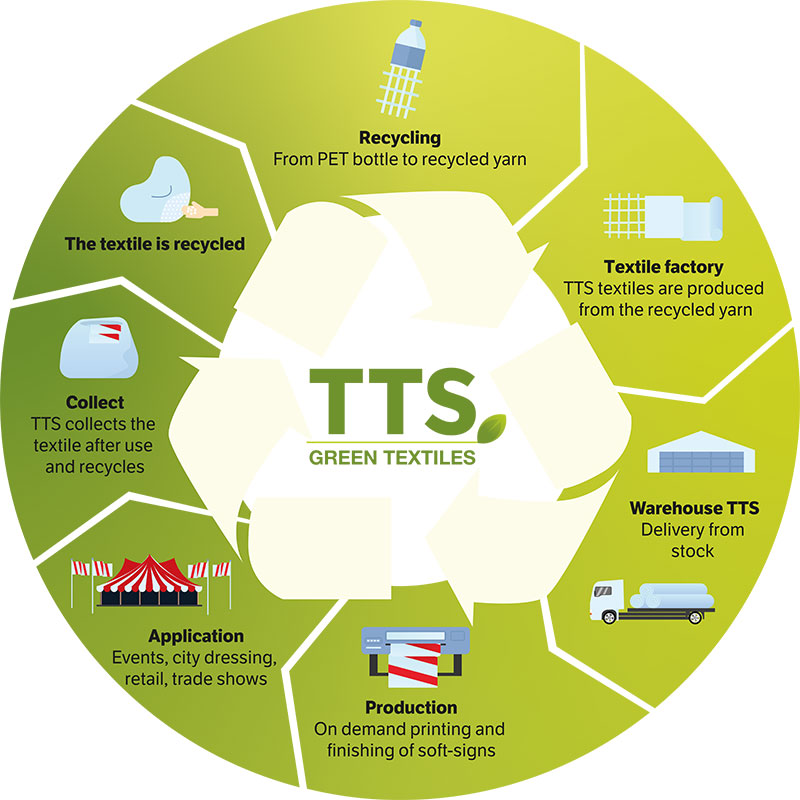
MOORDRECHT, the Netherlands — June16, 2021 — Texo Trade Services (TTS) is helping its customers run their businesses in a socially and environmentally responsible way by launching a sustainable textile line: GREEN Textiles. These products are made from recycled PET yarn, and will allow businesses to meet market demand for eco-friendly print products and make a direct contribution to a sustainable future.

Leading the way in environmentally aware business practices

This launch marks a new era for TTS as it aims to lead the way in corporate social responsibility and environmental awareness. TTS had previously invested in energy-neutral business premises, taken steps to recycle all its waste flows and minimise its use of product packaging. The company set up a Textile Recycling Service to facilitate logistics and offer its customers in the Benelux (and later in Northern France too) the possibility of collecting and recycling used sublimation printed textiles. This gives its soft signage customers the chance to offer circular signage to their own customers.

TTS GREEN Textiles

The whole textile range offered by TTS is already 100-percent PVC-free. This means a huge reduction in waste because products made of polyester are often half the weight of comparable PVC ones. Additionally, polyester textile can be made from recycled PET bottles. However, this still doesn’t always happen, even though demand for sustainable print products is increasing. TTS is set to change all this though with its GREEN textile line: it is offering a green variant of every type of textile, made from 100-percent recycled polyester. The yarn used for this purpose is produced in a sustainable way from recycled PET bottles, without affecting the properties of the original textile.

A high quality, sustainable alternative

TTS has a recycled alternative to almost every form of soft signage that uses both sublimation and UV inks. For example, nonwoven outdoor banners, flag cloth, display cloth and lightbox textile. Not only are festival organizers looking for this kind of product, so are large retail companies, and garments made from recycled yarns are increasingly filling the racks of fashion chains. It would be even better if the chains could follow this trend when decorating their stores. Opting for a green textile variant means choosing quality as well as sustainability.

Posted June 16, 2021

Source: Texo Trade Services (TTS)

Allied Home Launches RENU:700 Bedding Made With Performance Recycled Down

MONTEBELLO, Calif. — June16, 2021— Furthering its commitment to sustainability by helping reduce the massive textile waste that ends up in landfills, Allied Home, manufacturer of quality crafted bedding products designed to give you a better sleep experience, has launched its new RENU:700 Performance Recycled Down bedding, the first of its kind on the market.

By working with a global recycling supply chain, Allied is able to collect post-consumer bedding from Germany, Italy, Russia and North America and reuse the down inside these products for its RENU:700 Performance Recycled Down bedding.

The collected down undergoes an intensive sanitation process at Allied’s facility. It is cleaned using a proprietary DuraWash Method using environmentally safe, bluesign-approved detergents to meet the strictest levels of cleanliness and high-quality standards. The result are down clusters and feathers that are resilient and strong — creating a down quality that is unmatched.

Allied’s RENU:700 Performance Recycled Down bedding, and its supply chain, is certified to the GRS (Global Recycling Standard), an independent certification auditor considered the most comprehensive and stringent Recycling Standard. This certification ensures all material has been collected from post-consumer goods and processed within strict chemical regulations and social compliance guidelines.

“With the future of our planet top of mind, more and more consumers are choosing eco-friendly products from brands that are in line with their values,” said Jonathan Uretsky, COO, Allied Home. “We’ve seen acceptance of post-consumer products increasing and we are very excited to launch an exceptional quality recycled bedding collection that’s been years in the making. Consumers can sleep deeply knowing they made a sustainable impact by choosing to rest on RENU:700.”

The down inside RENU:700 bedding is a lofty 700FP white recycled down, providing you with pillows and comforters that provide the perfect combination of fluffy and soft with ultimate comfort and support. The pillow and comforter shells are made with a 233TC 100% certified organic cotton. Grown free of pesticides, herbicides, and chemical fertilizers, this luxurious, breathable natural-color cotton shell is more sustainable than conventional cotton.

Posted June 16, 2021

Source: Allied Home

Combining Expertise For More Sustainable Fashion

TW Special Report

Ever wonder how much water was used to make your favorite cotton T-shirt? About 2,700 liters, or roughly three years of drinking water. What first comes to mind is probably the water that was essential to growing the cotton crop. Surprisingly, cotton is a drought-tolerant plant, and often less recognized is the strain that can be put on water resources to dye cotton textiles.

Progress is being made across the industry to lessen the strain on our precious water resources. Over the past several years, Dow has collaborated with Cotton Incorporated to research and validate Dow’s product — ECOFAST™ Pure Sustainable Textile Treatment — that can help drastically reduce water and chemical use during the dyeing process. Major fashion brands like Ralph Lauren are integrating it into their supply chain to dye more sustainably, without sacrificing color or quality.

Problem

Cotton dyeing is very resource-intensive and puts strain on local waterways. A large amount of water is used in the dyeing process — up to 5 trillion liters a year, or nearly enough to supply all of humanity with drinking water. Significant amounts of chemicals and dye are needed to get the desired colors consumers expect too. This is part of the reason textile mills account for 20 percent of industrial water pollution globally. Wastewater from the dyeing process can be polluting and require costly treatment and these challenges are found in regions that already face water scarcity.

Solution

Reforming processes in an industry as established as textiles is no easy feat. Collaboration across the sector is needed to bring about sustainable change. With that in mind, Cotton Incorporated approached Dow. They wanted help scaling a cotton technology to support more sustainable textile dyeing. It turned out we were developing a similar technology that had improved performance, and we were looking for help too. Leveraging Cotton Incorporated’s industry expertise and Dow’s material science knowledge, we worked together to understand and validate the benefits of our patented ECOFAST Pure Sustainable Textile Treatment.

How Can Colors Be More Responsible? 

ECOFAST Pure is a pretreatment applied before the dyeing process to produce cationic cotton. This means the charge of cotton is permanently changed from negative to positive, so it acts like a magnet to attract negatively charged dye to the material. How does that benefit the textile mill? It significantly decreases the amount of water, chemicals, dye and energy needed to color cotton. A third party reviewed and validated life cycle assessment, available by request, helped further prove the benefits.

Click to watch the LCA video

Why Is Collaborating Across The Value Chain Essential?

Collaboration is critical for change to be meaningful and sustainable. As a not-for-profit focused on conducting research to benefit every link in the cotton supply chain, Cotton Incorporated has a unique expertise that complements our own. Working with Cotton Incorporated gave important insights about our product in application. Insights that would have taken much longer to discover without the industry expertise they offered.

Together we were able to evaluate the benefits of ECOFAST Pure compared to existing cationic chemistries. This was critical, because cationic cotton isn’t a new concept and this research helped prove our new product was advantaged over others — including no odor in application. We were also able to test compatibility across a variety of popular dyes, connect with expert consultants and more through this collaboration.

Still, Cotton Incorporated and Dow are only two players at two distinct points in the textile value chain. Like we’ve seen in our work with Ralph Lauren, we have to reach further — collaborating with brands, mills and others — to color cotton with integrity. Will you join us?

June 16, 2021


Inkjet Printing Shows Promise As New Strategy For Making E-Textiles

By Laura Oleniacz

In a new study, North Carolina State University researchers demonstrated they could print layers of electrically conductive ink on polyester fabric to make an e-textile that could be used in the design of future wearable devices.

Since the printing method can be completed at room temperature and in normal atmospheric conditions, researchers believe inkjet printing could offer a simpler and more effective method of manufacturing electronic textiles, also known as e-textiles. In addition, researchers said the findings suggest they could extend techniques common in the flexible electronic industry to textile manufacturing. They reported their findings in the journal ACS Applied Materials & Interfaces.

“Inkjet printing is a rapidly advancing new technology that’s used in flexible electronics to make films used in cellphone displays and other devices,” said the study’s corresponding author Jesse S. Jur, professor of textile engineering, chemistry and science at NC State. “We think this printing method, which uses materials and processes that are common in both the electronics and textiles industries, also shows promise for making e-textiles for wearable devices.”

In the study, researchers described how they used a FUJIFILM Dimatix inkjet printer to create a durable and flexible e-textile material, what they did to reliably create the e-textile, and its properties. Part of their challenge was to find the right composition of materials so the liquid ink would not seep through the porous surface of the textile materials and lose its ability to conduct electricity.

“Printing e-textiles has been a very big challenge for the e-textile industry,” said the study’s first author Inhwan Kim, a former graduate student at NC State. “We wanted to build a structure layer by layer, which has not been done on a textile layer with inkjet printing. It was a big struggle for us to find the right material composition.”

They created the e-textile by printing layers of electrically conductive silver ink like a sandwich around layers of two liquid materials, which acted as insulators. They printed those sandwich layers on top of a woven polyester fabric. After they printed the layers of silver ink and insulating materials — made of urethane-acrylate, and poly(4-vinylphenol)  –— they monitored the surface of the material using a microscope. They found that the chemical properties of the insulating materials, as well as of the textile yarns, were important to maintaining the ability of the liquid silver ink to conduct electricity, and prevent it from penetrating through the porous fabric.

“We wanted a robust insulation layer in the middle, but we wanted to keep it as thin as possible to have the entire structure thin, and have the electric performance as high as possible,” Kim said. “Also, if they are too bulky, people will not want to wear them.”

The researchers evaluated the electrical performance of the e-textile after they bent the material multiple times. They tested more than 100 cycles of bending, finding the e-textile didn’t lose its electrical performance. In future work, they want to improve the materials’ electrical performance compared to e-textiles created using methods that require special facilities and atmospheric conditions, as well as increase the material’s breathability.

Eventually, they want to use the printing method to create an e-textile that could be used in wearable electronics such as biomedical devices that could track heart rate, or used as a battery to store power for electronic devices.

“We were able to coat the ink on the fabric in a multi-layer material that’s both durable and flexible,” Kim said. “The beauty of this is, we did everything with an inkjet printer – we didn’t use any lamination or other methodologies.”

The study, “Microstructures in All-Inkjet Printed Textile Capacitors with Bilayer Interfaces of Polymer Dielectrics and Metal-Organic Decomposition Silver Electrodes” was published online in ACS Applied Materials & Interfaces. In addition to Jur and Kim, the other authors were Beomjun Ju, Ying Zhou and Braden Li. It was funded by VF Corp. The authors also acknowledge Liquid X Printed Metals for the preparation of the reactive silver inks used in this study. The authors acknowledge the U.S. Department of Defense and the Air Force Research Laboratory for provision of the Science Mathematics and Research for Transformation (SMART) scholarship to Li. This work was supported by the National Science Foundation through Nanosystems Engineering Research Center for Advanced Self Powered Systems for Integrated Sensors and Technologies under Grant EEC 1160483.


Editor’s Note: Laura Oleniacz is Public Communications Specialist at NC State News Services.


June 16, 2021

Beaver Paper Group Appoints Allen Wheeler TexSewn® Product Manager

ATLANTA — June15, 2021— Beaver Paper Group, a manufacturer of sublimation media and TexSewn® cut & sew papers is pleased to announce the promotion of Allen Wheeler to the new position of TexSewn® product manager.

As the new TexSewn Product Manager, Wheeler will play a pivotal role in generating new sales and market opportunities for Beaver Paper’s TexSewn product portfolio.  Wheeler is responsible for developing new products and initiatives that will increase sales and awareness for the brand.

“We are thrilled to have Allen move into this leadership position. He is extremely knowledgeable about the Sewn Products industry and will be key in developing new markets for TexSewn,” explained Tobias Sternbeck, CEO of Beaver Paper. “Allen’s deep industry knowledge and experience makes him a perfect fit for his new role.”

“I am honored to be able to use my extensive experience to spearhead and breathe new life into a legacy product line that is still heavily used in the sewn products industry,” Wheeler said.

Wheeler has been with Beaver Paper for more than six years in progressive roles including National TexSewn Sales Representative and Southeast Regional Sales Representative before being promoted to his new management position.

Posted June 15, 2021

Source: Beaver Paper Group

Shawmut Corp. Announces New Military & Protective Materials Business Unit

WEST BRIDGEWATER, Mass. — June 15, 2021— Today, Shawmut Corp. announced the creation of a new Military & Protective Materials Business Unit that will apply the company’s trademark advanced materials, textile manufacturing and process innovation techniques to produce high-quality, U.S.-made, ultra-high-specification and high-performance technical fabric solutions. Shawmut’s military and protective solutions feature waterproof, windproof, flame-resistant and chemical and biological protection applications and are ideal for high-stakes usages required in military and in-the-field professionals who need high-performance gear to safely do their jobs.

This new Military & Protective Materials Business Unit is a natural extension of Shawmut’s 105-year history in advanced materials manufacturing and builds upon the company’s deep experience in high-performance materials innovation, design and manufacturing expertise. Dating back to World War I, Shawmut has been supplying engineered materials and garments for critical military applications. Shawmut is also widely recognized as a leading producer of laminated components for high-performance technical fabric applications, such as wind, flame and water resistance used in rainwear, packs, footwear, body armor and more.

“Military personnel and other high-performing individuals in the utility industry are living and working in a high-spec, high-stakes world. Yet, many of the leading market fabrics and designs for military and protective wear are not up to par with the demands of these jobs,” said James Wyner, CEO of Shawmut. “We’re excited to leverage our expertise in textile engineering, process innovation and commitment to excellence to produce the highest quality materials for the highest performing individuals.”

Shawmut’s Military & Protective Materials division integrates the company’s textile manufacturing, dyeing, finishing and lamination capabilities to develop game-changing new technologies and establish Shawmut as a key player within the US textile and garment industry. The new division positions Shawmut as a catalyst for change and innovation in this highly specialized industry in need of advancements.

To lead the development of this new business unit, Shawmut has hired Noelle Christensen, a seasoned leader in the military and high-performance protective materials industry with more than 20 years of supply chain and business development experience. Noelle brings a diverse perspective and wealth of knowledge across textile manufacturing, domestic and federal garment supply chain, business development, operations and innovation to Shawmut. As the leader of this new business unit, she will position the company as a key provider of innovative textile technology for high performance applications, with a focus on military and protective materials.

Prior to joining Shawmut, Noelle spent 14 years at Massif, a developer of advanced flame-resistant clothing for military and other high-performance applications. Most recently, she served as Massif’s vice president/general manager where she led the brand through exponential growth as it launched new textile innovations and high-performance clothing categories.

“As a previous customer of Shawmut, I bring a unique perspective to the team, having witnessed its engineers solving seemingly unsolvable problems,” said Christensen. “I am excited about how much more Shawmut has to offer than the market is aware of, such as our ability to quickly solve complex problems and test products on the fly for rapid innovation, and our dedication to quality control that ensures premium, consistent outputs for our customers. The commitment the company is making to sustainability initiatives while expanding our presence in this market is a natural extension of its core expertise learned in another exacting market vertical – automotive.”

Posted June 15, 2021

Source: Shawmut Corp.

Xinfengming Group Invests In Innovative Staple Fiber Technology From Oerlikon Neumag

NEUMUENSTER/SHANGHAI — June15, 2021— In the context of the ITMA ASIA + CITME currently taking place in Shanghai, Oerlikon has now announced that it has concluded the largest staple fiber plant order in the history of Oerlikon Neumag with the major Chinese group Xinfengming in the run-up to the trade fair. This involves eight complete staple fiber lines with a total of 320 spinning positions for the production of synthetic staple fibers. Oerlikon will not only supply the technology, but will also take over the engineering of the lines. Delivery is scheduled for 2022.

With a total capacity of 1,800 t/d, the project is Oerlikon Neumag’s largest staple fiber plant order to date. The eight two-step lines will produce cotton-type staple fibers in a titer range of 1.0 – 1.4 denier. With this investment, the Xinfengming Group is expanding its product portfolio. As one of the world’s leading FDY and POY polyester filament yarn producers, the Chinese company has relied on Oerlikon Barmag technologies for decades and now also on those of Oerlikon Neumag.

Posted June 15, 2021

Source: Oerlikon

Barco® Uniforms Hits A new Sustainability Milestone: 40 Million Plastic Bottles Recycled

LOS ANGELES — June 8, 2021 — Barco™ Uniforms has announced in honor of World Ocean’s Day that due to record sales of its top-selling brands of sustainable healthcare scrubs, the company has collectively recycled over 40 million plastic bottles, marking a 115-percent year-over-year increase.

Barco’s in-house design team relies on the innovative rPET process, where plastic bottles are cleaned, shredded into pellets, and spun into thread woven into polyester.

In 2016, Barco launched the Barco One sustainable brand of scrubs, which has quickly become the number one choice not only for healthcare professionals, but also for veterinarians who love the proprietary fabric’s anti-static and temperature-regulating properties, and Barco’s Quick-Shed technology, which releases animal hair quickly from the surface of the fabric. Barco One incorporates five recycled plastic bottles into the fabric of each garment. The Skechers by Barco scrub brand, launched in 2017, incorporates seven recycled bottles per garment.

If these bottles were lined up end-to-end, they would stretch approximately 4,875 miles – close to a round-trip from Los Angeles to Pittsburgh.

Research shows that every day, more than one million plastic bottles are sold per minute around the world. Worse yet, studies also show that approximately 91% of plastic is still not recycled and ends up in the ocean instead.

“Healthcare professionals have shown a growing preference for brands that make a difference and are aligned with their values, with sustainability being at the top of the list,” explained Ron Wagenseil, president and CEO of Barco Uniforms. “Barco’s commitment to improving its sustainable practices is a natural extension of our mission to lead with purposeful innovation.

“It’s clear that our customers agree, as both Barco One and Skechers by Barco have shown dynamic and sustained sales growth year-over-year.”

Consumers may purchase Barco sustainable products by visiting the BarcoMade.com online store or finding a local retailer through the Barco retail store locator.

Posted June 15, 2021

Source: Barco

SGS Launches One-Stop-Shop For Mattress Testing In Farmingdale, N.Y.

FARMINGDALE, N.Y. — June 10, 2021 — SGS — a testing, inspection and certification company — has announced an expansion of its mattress testing services in its testing facility in Farmingdale, N.Y.

The 15,000-square-foot physical and fire testing facility now offers a one-stop-shop to those manufacturers and retailers seeking a complete mattress testing service. New physical testing equipment now broadens the labs scope to include Cornell Impact Testing and Roller Testing.

This covers the following standards:

  • ASTM F1550-16;
  • BFD IX-11;
  • 16 CFR Part 1633;
  • BS 6807:2006;
  • BS EN 597-1 2015; and
  • BS EN 597-2-2015.

Bobby Brown, director of operations, said: “We’re proud of the excellent reputation we have established within fire and flammability testing for a host of industries from apparel to aerospace.

“Sleep products have always been a core aspect of our service and we are delighted to expand our testing capability to support an industry that affects all of our lives. To consumers around the world, we believe it’s only trusted because it’s tested.”

SGS Furniture Testing Services

SGS offers a comprehensive furniture testing to help the industry assess the safety and the durability of a wide range of indoor and outdoor furniture products for adults and children, including:

  • Mechanical testing;
  • Chemical testing;
  • Finish testing;
  • Textile testing;
  • Flammability testing;
  • Electrical safety and performance testing; and
  • Comparison testing/fit for use (FFU) test/performance test.

Posted June 15, 2021

Source: SGS

Luxury Bags Created With Eco-Friendly Compo-SiL® Vegan Leather

HSINCHU, Taiwan — June 3, 2021 — Experienced silicone product manufacturer General Silicones (GS) is proud to share the creation of luxury fashion handbags and tote bags using Compo-SiL® vegan leather. The prototypes are designed and manufactured by an experienced local OEM bag manufacturer.

It was the first time for the manufacturing partner to use silicone-based vegan leather.

“It was a pleasant surprise how easy it was for our manufacturing partner to work with Compo-SiL vegan leather,” said Allen Yang, head of Business Development of GS. “Thanks to our patented technology, the bag maker combined our silicone leather without difficulty to the bag’s different inner material with HMA adhesives. Compo-SiL is the only silicone rubber began leather that accepts adhesion with HMA adhesives, giving designers the opportunity to explore the many advantages silicone rubber can add to products to the fullest. The prototypes were created to demonstrate that Compo-SiL is an excellent vegan fabric for the luxury fashion industry.”

An Eco-friendly Alternative to PVC Based Faux Leather

The demand for animal cruelty-free leather alternatives is growing each year. Finding high-quality animal leather alternatives without opting for plastic and harmful PVC-based faux leather products is not always easy. Compo-SiL leather by General Silicones is an eco-friendly fabric made of silicone rubber. Silicone has a low carbon footprint during manufacturing and is environmentally friendly. The material is widely used for skin-friendly baby and medical products for its harmless properties.

A Versatile High-quality Vegan Fabric for Luxury Brands

General Silicones developed the patented Compo-SiL technology allowing the company to create silicone rubber sheets suitable for the mass production of leather products. The fabric’s surface can be embossed to create the structure and feel of various types of leather. The pigmentation is adjusted to clients’ demands with eco-friendly pigments. Hot glue adhesions and roll-to-roll processing of large quantities of this silicone leather is possible thanks to unique and patented Compo-SiL technology.

Fashion brands and leather goods manufacturers can contact the sales team of General Silicones at compo-sil@gsweb.com.tw for more information on the prototypes, or visit www.compo-sil.com.

Posted June 15, 2021

Source: General Silicones

Sponsors