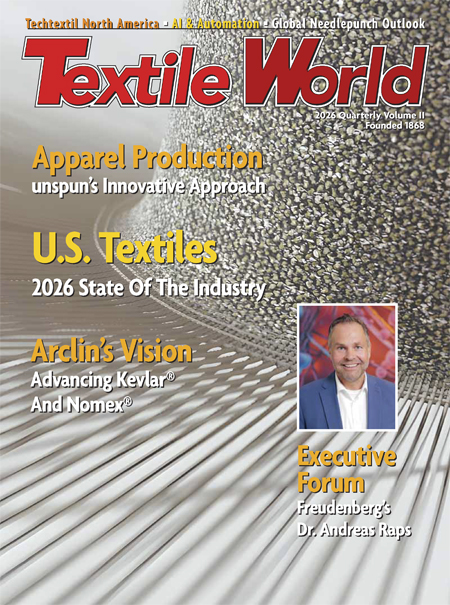
Arclin, Alpharetta, Ga., has entered a definitive agreement to acquire DuPont’s Aramids business, including the Kevlar® and Nomex® brands, for approximately $1.8 billion. The deal expands Arclin’s portfolio into aerospace, electrical infra-structure, electric vehicles, defense and personal protection, complementing its existing positions in construction, infrastructure and transportation. About 1,900 employees will transfer with the business. The transaction is expected to close in Q1 2026, pending approvals.
“We are confident that under Arclin’s leadership, these businesses will continue to thrive and expand their impact in new industries and applications,”said Lori Koch, DuPont CEO.
Circulose has partnered with Marks & Spencer (M&S). The collaboration supports Circulose’s goal of expanding circular materials in the fashion industry, with M&S planning to integrate a significant volume of CIRCULOSE® — a material made entirely from textile waste — into future collections. CIRCULOSE enables brands to reduce reliance on virgin fibers while lowering waste and emissions.
“We are thrilled to welcome M&S as Circulose’s first Scaling Partner in the UK,” said Jonatan Janmark, CEO of Circulose. “Their leadership in sustainability and commitment to circular fashion plays an important role in accelerating adoption of next-generation fibers.”
Avery Dennison, Mentor, Ohio, has extended its partnership with the San Francisco 49ers, continuing as the team’s exclusive partner for personalization and embellishment technologies via its Embelex solutions portfolio. The updated agreement expands in-venue customization at the 49ers Team Store at Levi’s® Stadium with new stations for personalized jerseys and customizable Levi’s jackets.
“This partnership shows how far fan engagement has come,” said Steve Mason, vice president, general manager, Commercial & Embelex, Avery Dennison. “It used to be about buying a jersey off the rack. Now, with on-demand customization and digital patches, fans can create something personal and interactive; a memento that connects them to a moment, a season, even the community around the team.”
Bluestar Alliance, New York City, has completed its acquisition of the Dickies brand from VF Corp. The deal brings the heritage workwear label into Bluestar’s expanding portfolio —which includes Off-White, Palm Angels, Scotch & Soda and Hurley — and represents more than $13 billion in global sales. Dickies will operate within Bluestar’s youth-luxury division and continue growing its presence across global streetwear and workwear markets.
“Dickies is one of the most authentic, resilient brands in global apparel,”said Joey Gabbay, CEO of Bluestar Alliance. The company plans to expand Dickies through new categories, partnerships, and international distribution while maintaining its longstanding identity.
Printeez recently installed two more Kornit Atlas MAX POLY systems.
Printeez Inc., a Quebec-based custom apparel provider, has expanded its digital production capabilities by increasing its Kornit Atlas MAX POLY systems from two to four units. The company serves brands, creators, franchises, non-profits and sports teams across North America, focusing on polyester and blended garments. By shifting production volumes from screen printing to digital, Printeez reports reduced labor needs, fewer manual steps and faster turnaround times.
“Printeez was born out of a passion to disrupt and transform the future of the apparel industry,” said Shawn Sckoropad, founder and CEO at Printeez. “Our mission is to build a true retail-grade print-on-demand solution for individuals and major brands alike.”
Spain-based lining fabric producer Textil A. Ortiz recently commissioned a fourth Monforts Montex tenter from Germany-based A. Monforts Textilmaschinen GmbH & Co. KG. The nine-chamber Montex 8500-9F installation at Textil A. Ortiz’s Santa Perpètua de Mogoda facility features direct gas heating, a Hercules needle chain, Matex finishing padder and two heat exchangers. The equipment is used to finish fabrics with softeners, water repellents and flame retardants.
Altoteks, a specialist in dyeing and finishing fabrics for workwear and uniforms, has installed its third Monforts Thermex continuous dyeing range at its Çorlu, Turkey facility. The company already operates two Thermex units and a Montex finishing range as part of its annual 18-million-meter dyeing and printing operation. The new two-meter-wide line includes three linked Thermex units, gas-powered infrared predryers, and cold pad batch winding. It also features the Econtrol® process for reactive dyes, designed to support faster, simplified continuous dyeing.
With its robotic apparel manufacturing platform and microadhesive technology, startup company CreateMe is pioneering a new approach to apparel production that could help bring manufacturing back to U.S. shores.
TW Special Report
It’s a widely accepted fact at this juncture that reshoring cut-and-sew operations in the United States is going to require some use of automation and robotics in order to overcome a trained labor force shortage, among other issues.
Founded in 2019, Newark, Calif.-based CreateMe is on a mission to combine automation, robotics and advanced adhesive technologies to transform apparel manufacturing. Originally a small innovation lab, the company has grown into a multi-disciplinary technology organization that employs a team of engineers, chemists and designers — all operating with a start-up mindset — to bring sustainable garment production closer to the consumer.
CreateMe recently announced the launch of its robotic apparel manufacturing platform as well as the first commercial grade products made using the technology — women’s intimates. The Modular-engineering Robotic Assembly (MeRA™) paired with a proprietary microadhesive technology named Pixel™ provides “a scalable, high-precision platform that replaces traditional sewing for longevity, shortens production timelines, and enables sustainable, on-demand manufacturing in the U.S.,” according to the company.
CreateMe notes that the apparel industry generates 92 million tons of textile waste and loses more than $180 billion to inefficiencies tied to speculative production.
“CreateMe enables a new business model for the industry — responsive, localized, on-demand manufacturing that replaces forecast-driven production with data-driven precision,” said Cam Myers, CreateMe’s founder and CEO. “Our value lies in transforming how apparel is made and how manufacturing works, making it faster, cleaner, and closer to demand.”
Textile World recently had the chance to speak with CreateMe’s Myers to learn more about this apparel manufacturing platform — with more than 200 prototypes, more than 1,000 process tests and almost 100 issued patents — and its potential to bring manufacturing closer to the consumer.
CreateMe’s Modular-engineering Robotic Assembly (MeRA™) unites robotics, computer vision technologies and the company’s Physical AI software.
TW: What led to the development of MeRA and the Pixel microadhesive technology?
Myers: The development of MeRA and Pixel grew directly from CreateMe’s mission to redefine how apparel is made. Traditional sewing and offshore production had reached their limits — too slow, too labor-intensive, and too resource-heavy to support the future of on-demand, sustainable manufacturing. Rather than improving legacy processes, our team chose to rebuild them entirely.
By uniting robotics, computer vision, and adhesive science, our engineers and materials scientists developed MeRA, a modular robotic assembly platform, and Pixel, a precision microadhesive technology that bonds fabrics without thread. Designed in tandem, they form a single integrated system that enables faster, cleaner, and more flexible production, laying the foundation for truly scalable, on-demand apparel manufacturing.
TW: Automation in soft goods is notoriously difficult, especially when handling soft, drapey fabrics. How does the CreateMe technology handle those issues?
Myers: Soft-goods automation has long been constrained by the nature of fabric; it stretches, drapes, and shifts unpredictably, making precision control extremely difficult. CreateMe tackles this from the ground up through advanced material-handling and assembly algorithms. Our systems use specialized end-of-arm tools and vacuum fixtures to maintain fabric tension and alignment, effectively transforming a deformable textile into a stable, robot-readable surface.
The MeRA platform is designed to assemble as much of each garment as possible in 2D, where accuracy and throughput are highest, before transitioning into controlled 3D operations for forming or joining. Traditional sewing is especially hard to automate because it demands two-sided access, continuous feeding and dynamic thread control. Our Pixel microadhesive bonding process removes those constraints, enabling static, single-sided assembly with precise edge alignment and integration into 3D molds or shaping tools.
Building on this foundation, CreateMe’s Physical AI software extends our machine-learning and computer-vision algorithms into a unified control layer that adapts in real time to different fabrics and garment types. It’s what allows our systems to achieve fine-dexterity manipulation and industrial-grade repeatability across one of manufacturing’s most variable and complex materials.
TW: Can you talk about how the adhesives work and if there are any limitations compared to sewing?
Myers: Unlike traditional sewing, which mechanically stitches fabric together with thread, CreateMe’s process uses precision robotics and Pixel microadhesive technology to bond materials at the fiber level. This approach eliminates puncture holes, reduces bulk, and creates seamless, flexible joins that enhance comfort, durability and design freedom. The adhesives are engineered to be lightweight, washable, and compatible with a broad range of fabrics, and in some cases thermoreversible, allowing garments to be reheated and separated for recycling.
Integrated within CreateMe’s MeRA robotic platform, the process is faster, more consistent, and easily automated, enabling scalable, on-demand production that minimizes waste and inventory risk. While certain niche applications or highly textured materials may still favor traditional stitching, CreateMe’s bonded construction meets or exceeds sewn performance across strength, comfort and sustainability metrics.
TW: How durable and sustainable are the bonded garments? What’s the potential for recycling?
Myers: CreateMe’s bonded garments are engineered for both durability and sustainability. The Pixel microadhesive forms strong, flexible bonds that often exceed sewn seams in tensile strength and wash performance, maintaining integrity through repeated wear and laundering.
On the sustainability side, the process eliminates thread, minimizes material damage from needle punctures, and supports on-demand, localized production — reducing excess inventory, transport and waste. A major advantage of CreateMe’s adhesive platform is its recyclability potential: certain formulations, known as Thermo(re)set™, are thermoreversible, allowing bonds to be safely released under controlled heat so fabrics can be separated and recycled by material type.
This capability creates a pathway toward circular manufacturing — where garments can be disassembled, reclaimed, and reintroduced into production rather than discarded.
CreateMe’s Pixel™ microadhesive technology bonds materials at the fiber level.
TW: Is the technology proprietary and only to be used in CreateMe facilities, or is it something you foresee licensing to other producers?
Myers: Our technology is proprietary by design, forming the foundation for both our own manufacturing operations and select licensing partnerships. Within apparel, we’re already engaging with partners on a license-to-operate model while continuing to scale production within CreateMe-operated facilities. Longer term, the versatility of our underlying platform also opens opportunities in adjacent industries that rely on the assembly of technical textiles, such as automotive, aerospace, home goods and medical, where we expect to extend licensing as well.
TW: What’s the potential for reshoring and nearshoring in the United States?
Myers: The potential for reshoring and nearshoring in the United States is both significant and accelerating. Over the past decade, fragile global sourcing models have buckled under freight disruptions, tariffs, and geopolitical shocks, costing retailers tens of billions and exposing the limits of offshore dependency. What once promised cost efficiency now drives overproduction, poor demand matching and mounting risk.
Over the next five years, we expect a more balanced, matrixed supply chain to emerge. Today, more than 95 percent of apparel manufacturing remains offshore; that mix should evolve toward roughly 70 percent offshore, 15 to 20 percent nearshore, and 10 to 15 percent onshore. The goal isn’t full reshoring; it’s diversification and resilience. By producing closer to demand, brands can reduce lead times, cut waste, and respond dynamically to market shifts.
Technology is the unlock. Digital tools are reshaping design, planning, and product intake to align production with real-time demand, while robotics and Physical AI will enable automated, cost-competitive manufacturing closer to the point of sale. This convergence will give rise to a new generation of responsive supply networks that are faster, leaner
and more transparent.
TW: What are some of the biggest challenges facing wide-scale re/nearshoring especially in cut-and-sew operations?
Myers: In the United States, the challenge extends far beyond labor costs. Decades of offshoring have eroded the physical and technical infrastructure that once supported domestic manufacturing. Mills, dye houses, trim suppliers, and equipment manufacturers have largely disappeared, creating critical gaps in the upstream supply chain. Even with mounting pressure from tariffs, sustainability mandates, and consumer demand for transparency, most brands face a hard truth: there simply isn’t enough local capacity or expertise to bring production back at scale.
True reshoring requires more than intent; it requires rebuilding capability from the ground up. That means new tools, new infrastructure, and new forms of collaboration to reconnect the entire value chain. Without dependable access to raw materials, finishing, and components, even the best-equipped cut-and-sew operations struggle to scale. This is where automation and robotics become essential. By digitizing and linking every stage of production, from design to assembly, technologies like CreateMe’s MeRA and Pixel platforms make onshore manufacturing not just viable, but economically competitive.
The most forward-looking brands are proving the model first, then scaling it. Pilots and automated microfactory programs demonstrate that onshore production can compete on cost, quality, and speed; each success signals confidence that draws in capital and accelerates capacity investment. As those deployments grow, they directly expand domestic cut-and-sew, or bonded-assembly, capacity, rebuilding the foundation of a modern, technology-enabled manufacturing base. These compounding wins form the blueprint for a resilient, regionally balanced supply network that replaces fragile, far-flung chains with intelligent, localized production systems.
TW: Do you think there are things the government could do to further incentivize companies to reshore operations?
Myers: Absolutely. Reshoring depends on creating the right economic and innovation conditions for apparel manufacturing to thrive locally. That means aligning tax incentives, procurement policy, and workforce development to make domestic production both viable and competitive, and the current administration deserves real credit for bringing greater focus to this effort.
In recent years, we’ve seen a policy shift toward rebuilding American manufacturing through legislation such as the CHIPS and Science Act (2022) and, most recently, the One Big Beautiful Bill Act (2025), which provides immediate expensing for qualified manufacturing investments, including machinery, automation and other production equipment. For companies like CreateMe, these measures accelerate ROI on new manufacturing lines, bonded-assembly systems and AI-enabled production technologies, directly improving the economics of onshore production.
The proposed FABRIC Act could be even more transformative for apparel and textiles. It represents the first comprehensive, bipartisan effort to reestablish a competitive U.S. apparel base, pairing strong worker protections with meaningful incentives for domestic production, supply-chain rebuilding and facility investment. If enacted, it would directly support the kind of infrastructure renewal, workforce development and technological advancement required to make U.S. apparel production globally competitive and environmentally sustainable.
Government procurement is another powerful lever. The U.S. remains one of the world’s largest purchasers of apparel — uniforms, workwear and protective gear among them — but smaller, technology-driven manufacturers often face barriers to participation. Stream-lining qualification and contracting processes, or piloting procurement programs that prioritize innovative and automated facilities, would open this channel to next-generation domestic producers.
Finally, workforce development must advance in parallel. Programs modeled on those in semiconductor and advanced-manufacturing sectors, focused on digital design, robotics and systems integration, would ensure reshoring creates future-ready jobs.
TW: How do you position the company as both disruptive and compatible with the current apparel supply chain?
Myers: Our platform, anchored by a deep IP portfolio, operates on a made-for-demand model that transforms the speed and economics of apparel manufacturing. Instead of the 30- to 120-day offshore cycle, brands can design, sell, produce, and ship in 5 to 30 days. That 10-fold acceleration lets companies respond to real-time demand, reduce inventory exposure, and minimize waste. Automation stabilizes costs, reduces labor dependency, and breaks reliance on fragile offshore supply chains; brands gain faster speed to market, and consumers get better products.
The core disruption lies in efficiency and circularity. Traditional offshore models depend on long lead times and overproduction, creating both financial and environmental inefficiency. By eliminating those inefficiencies, CreateMe improves unit economics while setting new sustainability standards. Our fully automated bonded assembly, powered by proprietary thermoreversible adhesives, allows garments to be both assembled and disassembled at scale, making true circular fashion viable. Unlike stitching or permanent adhesives that block recycling, our process allows trims, zippers, and fabric layers to be separated easily for reuse.
At the same time, CreateMe is built for compatibility. The platform integrates directly with existing digital design and production workflows, connecting to standard CAD files and automated cutting systems, to extend today’s CAD/CAM automation into the assembly phase. Where traditional manufacturing hands off to manual sewing, CreateMe continues the digital thread, using bonding and robotics to maintain precision, consistency, and efficiency through final construction. This plug-in compatibility gives brands and manufacturers a practical on-ramp to automation while accelerating the shift toward scalable, onshore production.
And because any technology in apparel must scale to matter, we’ve engineered CreateMe for high-volume categories first, starting with T-shirts and underwear, where throughput, waste, and impact are greatest.
TW: What is your long-term vision for the CreateMe platform?
Myers: CreateMe’s mission is to redefine how all apparel is made. We’re building toward a future where digital bonding, robotics, and Physical AI form the foundation of how clothing is designed, produced, and experienced. Over the next decade, we see a systemic shift in apparel manufacturing that mirrors the transition from internal combustion to electric vehicles, driven by consumer demand for performance, sustainability, and speed. Digital bonding will replace sewing as the dominant method of garment construction, delivering products that are more comfortable, longer lasting, and cleaner to produce.
This transformation begins by uniting digital design and manufacturing, allowing brands to move from static, labor-dependent models to intelligent, data-driven systems that produce exactly what’s needed, when and where it’s needed. By connecting design software, material science, and automated production, CreateMe enables true mass customization at scale, closing the loop between creativity, commerce and circularity.
While apparel is our starting point, the same tools and software that power digital bonding and robotic assembly can extend to footwear, accessories, furniture, automotive interiors, and other consumer products. The convergence of digital design, advanced materials, and intelligent automation will redefine how products are made across industries — faster, cleaner, and closer to demand.
TW: What are the company’s greatest strengths and how do you differentiate from competitors?
Myers: While others are optimizing legacy systems, CreateMe is building the next industrial platform — one that enables cost-competitive, onshore manufacturing at scale and positions brands to thrive in a market defined by speed, sustainability and resilience.
We’ve reimagined how apparel is made from the ground up. CreateMe achieved a world-first with the commercial launch of two integrated technologies that replace sewing and manual handling with robotics, AI, and precision bonding: MeRA and Pixel microadhesive technology. Together, they form a unified platform that delivers a step change in precision, efficiency, and circularity. MeRA is an intelligent robotics and AI platform that automates garment assembly end-to-end, enabling fully digital production lines that remove the need for sewing entirely. At its core, Pixel forms precision-bonded seams less than one millimeter wide, stronger, lighter, and more consistent than traditional stitching. Its Thermo(re)set formulation allows garments to be disassembled cleanly at end of life, unlocking true circularity and large-scale textile recycling. Pixel™ also brings new functionality to apparel, from thermal regulation and moisture management to enhanced comfort and design flexibility.
With nearly 100 patents granted, CreateMe’s technology establishes the foundation for a new model of manufacturing, faster, cleaner, and more adaptable than anything before it. Our first commercial deployment in women’s intimates validated both technical and economic viability, and we’re now expanding into high-volume categories such as T-shirts and everyday apparel. Each MeRA line is designed to produce over one million units per year, delivering garments up to twenty times faster and with double the precision of manual methods.
TW: Why do you do what you do? What motivates you?
Myers: We’re motivated by the ingenuity and grit of the people determined to transform this industry— the engineers, scientists, designers and entrepreneurs who refuse to accept “business as usual.” Every day, we’re inspired by forward-thinking partners who are building new models and proving that apparel can be made better, smarter, and closer to home.
At the same time, we’re driven by the industry’s inertia. Despite years of conversation around sustainability and innovation, real change has been slow. The technology to make apparel more responsibly already exists; it takes conviction to move beyond entrenched, volume-driven systems.
At CreateMe, we’re turning that conviction into action. Our work is about proving that a different future for apparel isn’t theoretical — it’s within reach, and we’re building it.
Youngone’s Rae Eun Sung spoke with Textile World about her role in the family business and the company’s role in the global apparel industry.
TW Special Report
The Youngone Group was founded in South Korea in 1974 by Kihak Sung. The company began life as a producer of down-filled winter jackets and ski suits for customers in Europe. Since its founding, the company has become one of the world’s largest manufacturers of premium outdoor clothing, sportswear, shoes, bags, accessories and materials for many of the world’s leading performance brands. Youngone also produces its own brands for the outdoor industry serving consumers across the globe. In addition, Youngone operates the license business for The North Face brand in South Korea, so it not only manufactures but sells directly to consumers through its extensive retail network across Korea.
Today, the Youngone Group is comprised of Youngone Holdings and Youngone Corp., and both companies are listed on the Korean Stock Exchange.
Textile World recently had the pleasure of speaking with Youngone Group’s Vice Chairman and President Rae Eun Sung. As the daughter of Youngone’s chairman and founder, during her childhood Ms. Sung spent time accompanying her father on business trips, shadowing him and visiting the company’s factories during school holidays. “I was fascinated to visit various factories around the world,” Sung said. “I was always destined to be involved with the family business!
Background
TW: What does your current job entail and how do you approach the role?
Sung: I began working full-time for the company after I finished my undergraduate studies at Stanford University in 2002. My father insisted I learn about all aspects of the business, so I’ve worked in virtually every part of the company over the last 22 years.
My father is still actively involved, and he is passionate about the factory designs, investing in state-of-the-art machinery and the production processes. His vision for our Korean Export Processing Zone (KEPZ) facility in Bangladesh is to create an entire ecosystem, complete with factories, lush green spaces, schools, a technical institute, a medical complex, a botanical garden and eventually a sports arena, to serve not just Youngone employees and their families, but the wider community.
So I tend to focus on the day-to-day operations of the business, as well as the longer term strategic direction. For example, I set up a $65 million corporate venture capital fund in 2022 in Singapore to nurture startups and innovators, especially in the areas of sustainability and circularity. We are now in the process of setting up the second fund to further expand our investment portfolio.
Youngone Group
TW: What is the company’s mission and has the mission changed over time?
Sung: From an early stage I felt it was important to clearly define our company’s vision and mission. So, I developed our vision and mission statements: “Striving for Excellence with Passion.” The company is relentless in its pursuit of excellence and customer satisfaction. Our mission is to be “A trusted and reliable partner, a caring employer and a responsible corporate citizen, focused on sustainability.”
It is now a group of companies with over 90,000 employees with a presence in 17 markets and annual revenues in excess of $3 billion.
TW: Are there any landmark moments in the company’s history?
Sung: There are several highlights worth noting. Becoming the first foreign investor in Bangladesh’s garment industry in 1980 was a key moment. We were also the first company to employ a predominantly female workforce, which challenged cultural norms at the time. Today,Young-one is the largest foreign investor in Bangladesh and the largest private employer with over 65,000 employees. Another important milestone was our acquisition and long term development of the KEPZ in Chittagong, Bangladesh.
We acquired a barren area of 2,492 acres and over a period of eleven years, we have transformed the area into a lush industrial zone by planting over 3 million trees, creating 37 water bodies to harvest more than 600 million gallons of rainwater each year, and cultivating botanical gardens. As a result, the area illustrates the rich bio-diversity that can be achieved by balancing development and one’s commitment to the planet. I am proud to share our export zone is home to over 137 species of birds and wildlife along with 500 species of plants.
In Korea, one of the most significant milestones was when we set up a joint venture company with our partner Goldwin to launch The North Face products domestically.
Youngone is the largest foreign investor in Bangladesh and the largest private employer with more than 65,000 employees.
TW: Can you share a little about the company’s strengths and current capabilities?
Sung: In terms of our overall key strengths and capabilities, I’d say first and foremost we have unrivaled experience, having started more than 50 years ago. In that time, we’ve worked incredibly hard to build a reputation for quality, reliability and innovation, which is why we work with so many of the world’s leading brands. Second, our diversification strategy not only enables us to be closer to our customers, it also gives us greater flexibility and resilience. Finally, our vertical integration strategy is a key competitive advantage as it balances our dependence on suppliers, while giving us greater control over quality and improving consistency.
I believe that establishing a clear corporate culture from the outset has been vital to our success. I created the company’s “Core Values” over a decade ago and we recently conducted a refresh to ensure all of our global colleagues understand and live the Core Values.
Our Core Values are encapsulated in the mnemonic HEART:
Honesty and Integrity — We are true and sincere and adhere to high ethical principles;
Excellence — We take pride in our work and strive for the highest levels of customer and employee satisfaction;
Agility — We navigate changing market conditions quickly;
Responsibility — We value, promote and contribute to communities and society at large and conduct business in a responsible and sustainable manner; and
Together — We must all live the core values and be accountable for our actions. Together we can make a real difference.
Supply Chain & Retail
TW: What advantages does a vertically integrated supply chain provide in terms of speed, quality and innovation?
Sung: We embarked on our vertical integration strategy even before the pandemic. At the height of the pandemic it became clear that we needed to accelerate the expansion of our materials division in order to avoid supply chain disruptions. However, we also saw an opportunity to develop new business models by producing enough material to supply local factories in Bangladesh, so that they too can avoid having to import long lead time materials. Currently, we sell around 50 percent of our Draw-Textured Yarn, 30 percent of our woven and knitted fabrics, and 40 percent of our Ecoloft insulation to local companies.
Aside from avoiding potential supply chain disruptions, we also have complete control over the quality of our own materials, and we can quickly adjust production volumes depending on demand.
TW: The company has a global footprint with manufacturing facilities in Asia as well as Central America. What advantages does this offer?
Sung: We began diversifying our production facilities more than 20 years ago. In addition to our main production base in Bangladesh, which accounts for around 60 percent of our production, we now have factories in Vietnam, El Salvador, Uzbekistan, Ethiopia and India. This strategy is partly designed to be closer to our customers, which reduces and simplifies logistics. It also provides greater flexibility in case of disruptions for our customers, who seek multi-country, multi-category, vertical operations like ours.
TW: How is a changing apparel retail environment impacting Youngone?
Sung: We firmly believe changing consumer behavior is a good thing. Buying fewer, better quality garments that last longer is definitely better for the environment. However, we still see continued growth as we acquire new customers and expand into new and developing markets, such as India. We recently opened our first factories in India because it is well known that consumers there favor products made in India.
TW: Did the advent of “fast fashion” affect Youngone and did you observe any changes with customers.brands in reaction to the movement?
Sung: Youngone is not involved in “fast fashion” as much. The majority of our customers produce specialized performance sports or winter clothing, shoes and bags. The advent of fast fashion has had a challenging impact on the garment industry due to the increase in waste and pollution.
However, we believe consumer awareness and advocacy is helping to address the problem. Conasumers everywhere are becoming more environmentally conscious. They are interested in knowing where their clothes are made and whether they have been produced sustainably and in factories with safe, humane, working conditions. This is a really positive trend we believe will continue.
TW: As supply chains shrink, do you anticipate Youngone moving closer to the customer? How would this affect the company’s relationships with brands and retailers?
Sung: Shrinking the supply chains is not only good for the environment with fewer products being shipped over long distances, it also helps to provide great control over quality, delivery lead times and inventory levels. Youngone began adopting a diverse, vertically integrated business model many years ago and we have been accelerating that process since the pandemic, which demonstrated how vulnerable entire industries can be to supply chain disruptions.
Youngone is committed to sustainability and environmental protection. It has invested in major initiatives across the globe including solar panels.
Production
TW: How does Youngone balance contract manufacturing with developing its own brands and intellectual property?
Sung: We take intellectual property very seriously, which is why we often have specific factories dedicated to our key customers. We also organize our company to create the appropriate firewalls in development and maintain best in class processes to ensure the security of our data and especially our customers’ designs and innovations.
Our retail footprint is in South Korea and focused on The North Face brand which is customized for this specific market. Over the years we have also made targeted investments in performance companies, always taking great care not to compete with our customers and instead finding the appropriate adjacency, or a totally new category.
TW: How does the company maintain consistency in quality, compliance and innovations across its global manufacturing network?
Sung: In terms of quality and consistency, we have rigorous quality training standards for our quality inspectors across all of our factory operations. The training is updated regularly when we introduce new product lines or processes.
TW: Youngone manufactures apparel and other products for some iconic outdoor and athletic brands. What do you think makes these customers choose and stay with Youngone?
Sung: I believe we have been successful in retaining our iconic global customers because we take a very collaborative approach. We work closely with their design teams when developing new materials and processes. This is a fast-paced, highly competitive industry, so above all, these customers demand consistent quality, innovation and reliability.
TW: Do you have any thoughts about how AI and automation may affect production, and are there any tools or technologies Youngone is looking to adopt?
Sung: We believe AI will definitely have a role to play in the future. We have already started running some trials using AI in areas such as logistics, material planning and utilization. We think there could be significant reductions in material wastage for example.
Working closely with our customers, with their own AI assisted design programs and in combination with our own research and development facilities, we are constantly looking at new materials, tools and technologies.
Sustainability/CSR
TW: In the United States, attracting and developing a trained workforce is a challenge. Does Youngone experience workforce issues and does the company have any initiatives to tackle the problem?
Sung: So far we have been fortunate to maintain a very low staff turnover level globally. There are several possible reasons for this. However, we believe the main reason is that we prioritize safe, comfortable working conditions. We embrace diversity and equality, and all employees are protected under our global code of conduct. In addition, we provide subsidized canteen facilities, on-site medical care, childcare facilities and a host of other benefits.
TW: What are some of the ways Youngone supports workforce development and well-being across its production facilities?
Sung: Youngone has a predominantly female workforce — around 80 percent globally. However, at the KSI Garment Factory, women only make up around 20 percent of the supervisors. To address this issue, we have introduced several programs, such as our GEAR program — Gender Equality and Returns — which is designed to train female supervisors. So far, more than 200 women have completed the training in Bangladesh to become supervisors. We have also introduced another program for female supervisors to become managers or technical specialists, called GEAR Advance. While this is a relatively new program, more than 30 women have already progressed to become managers and specialists.
TW: Environmental stewardship is an underlying tenet of Youngone. What are the most impactful sustainability initiatives the company has implemented across its global facilities?
Sung: Sustainability and environmental protection has been at the heart of everything Youngone does since the very beginning. Our major initiatives include our solar panel investments. Our goal is to reach 100 MWp across our global facilities by 2030.
We recently phased out coal-fired boilers in Vietnam and replaced them with biomass boilers. The resulting ash is collected and used to produce fertilizer, which is made available to local farmers.
All of our factories have wastewater treatment plants and effluent processing facilities. We also have rainwater harvesting facilities at many of our operations.
One of the major initiatives underway is to make of use scraps or recycled material, such as our award-winning “Ecoloft” range of products. More than 40 percent of our synthetic down fillers are made from recycled or scrap materials.
At our KEPZ operations in Bangladesh, we have planted more than 3 million trees and created 37 water bodies that are capable of harvesting more than 600 million gallons of rainwater.
Youngone has introduced training programs dedicated to helping female workers become supervisors, managers and specialists.
Looking Forward
TW: Are there any trends in apparel and outdoor performance Youngone is watching?
Sung: The number one trend is focused around sustainability and circularity. That means products made with a high level of recycled content, which can be further upcycled or recycled. We have been investing in startups and innovators in this space through our corporate venture capital group.
TW: Do you see any growth opportunities for the company?
Sung: Much of our production is still outerwear and winter clothing categories for which Youngone is well known. Notably, our “performance and athleisure wear”sector grew significantly during the pandemic, and it continues to grow. The key advantage of this sector is that it is less seasonal. We also see great potential for growth in the footwear sector, as well as premium products such as merino wool.
TW: How is the company positioning itself over the next five to 10 years?
Sung: Our main priority is to continue supporting our new and existing customers with high quality and reliability, especially with so much volatility and the uncertain impact of changing trade landscapes.
In the short to medium term, we will continue to ramp up our sustainability efforts with investments in solar power and recyclable materials. We are continuing to diversify with new factory locations in Africa and Central America. And we are focusing on developing the next generation of designers and innovators with the opening of a Textile Institute in Bangladesh.
TW: If you had to identify one key challenge for Youngone going forward, what would that be and how is the company positioned to meet the challenge?
Sung: We believe the main challenge for Young-one and the garment industry as a whole is sustainability. The combination of regulatory changes in several markets, coupled with growing consumer awareness and shifting buyer practices, means we have to continue innovating and finding more ways to make our business more sustainable.
TW: Please give a quick synopsis of the Youngone’s value proposition. Tell readers what sets the company apart and makes it unique.
Sung: There are several key things that differentiate Youngone from other OEM garment makers. Our 50-year history of continued growth and development clearly demonstrate that our fundamental business model is sound and that we are here for the long term. Second, our diverse global operations gives us greater resilience and flexibility, while being closer to our customers. Our “Core Values” ensure all of our 90,000 employees worldwide understand and embody the principles of honesty, integrity, quality and responsibility. And lastly our vertical integration strategy enables us to guarantee consistent quality and reliability.
bluesign is celebrating 25 years of helping the entire textile and apparel value chain deliver measurable impacts that matters to industry, people and the environment.
TW Special Report
Switzerland-based bluesign technologies recently celebrated its 25th anniversary. Established in 2000 to offer sustainable chemical and environmental management solutions for the textile and fashion industry, bluesign developed a science-based input stream management system with the aim of eliminating harmful substances at the source. The system also helps ensure safer working conditions, reduces environmental impacts and provides safer products for consumers.
Esther Paez
Today, bluesign counts more than 900 global system partners who work towards benchmarks for responsible production using bluesign’s criteria for chemical use, environmental performance and resource efficiency, while delivering measurable reductions in environmental impact.
“We are the only service provider in the textile sector offering a comprehensive eco-system approach that connects chemical management, manufacturing process optimization, and sustainable product stewardship,” said Barbara Oswald, chief commercial officer, bluesign.“Our work goes beyond certification and compliance. We deliver measurable improvement solutions and ongoing support to help our partners make sustainability an integral part of their business.”
“bluesign was born out of a bold idea, that sustainability could be embedded into the DNA of product creation,” said Daniel Rüfenacht, CEO of bluesign technologies.“Twenty-five years later, we’re proud to be a beacon of trust, innovation, and responsibility, and to partner with industry leaders worldwide in building a more sustain-able future together.”
Textile World recently had the opportunity to speak with Oswald as well as Esther Paez, bluesign’s Sustainability product manager, about the company and what lies ahead having achieved this milestone anniversary.
TW: How has bluesign’s mission evolved since the organization was founded 25 years ago, and what role do you see bluesign playing in the next decade as new regulations such as the EU Green Deal and Digital Product Passport take shape?
Barbara Oswald: Over the past 25 years, bluesign has evolved from an industry pioneer focused on safer inputs to a trusted partner driving sustainability transformation across the textile value chain. As regulatory expectations increase, our mission remains the same — to help industry produce the lowest possible impact on the environment and people, backed by primary verified data, transparency and practical solutions. Our system is geared for digital traceability and verified information that initiatives like the EU Green Deal and Digital Product Passport will require. In that sense, bluesign enables companies not only to comply, but to lead.
TW: There are other sustainability frameworks including ZDHC, OEKO-TEX, and GOTS. How does bluesign position itself among these organizations?
Esther Paez: We welcome the work of other frameworks that contribute to the industry’s sustainability goals. What makes bluesign unique is our integrated, end-to-end approach, geared towards sustainability improvement. We work across the entire value chain, connecting chemical suppliers, manufacturers, and brands through a single verified system. bluesign functions as a service partner, combining data-driven insight, on-site verification and continuous improvement support.
Over the years, bluesign has expanded the textile and apparel categories covered by its system to include denim, footwear and leather products.
TW: How does bluesign ensure alignment and accountability among a wide range of mills, suppliers, and brands in the global System Partner network?
Paez: Alignment comes from a shared framework built on trust, transparency, and measurable performance. All bluesign System Partners are part of the same ecosystem, connected through common principles, verifiable criteria and a commitment to continuous improvement.
Each partner’s performance is verified on-site and supported through data analysis. But our approach goes beyond verification: Our experts work closely with partners to interpret results, identify improvement areas and implement solutions. This continuous engagement fosters accountability, builds capability, and strengthens collaboration across the entire network.
TW: What are some of the greatest challenges you see today in managing impact, and how does bluesign help manufacturers and brands address them?
Oswald: Today’s biggest challenge is navigating the complexity of multiple sustainability expectations — balancing impact reduction, costs, due diligence, reporting or compliance across many dimensions (ESG). Many companies struggle to connect these dots across their supply chain and geographies. bluesign helps by providing verified primary data, technical insight, and tailored improvement pathways that make sustainable transformation manageable. Through our collaborative model, we help partners move from reactive compliance to proactive impact reduction.
TW: How does bluesign measure and verify envi-ronmental improvements at partner facilities?
Paez: Our partner assessments go beyond certification to our standards, they are designed to drive measurable improvement. We measure resource efficiency, chemical performance, and emissions to air and water. Following each assessment, we share results and tailored improvement plans with partners, supporting them in setting clear targets and taking practical action. The verified data that results from this process provides a transparent and credible foundation for measuring progress and demonstrating real impact.
TW: How does bluesign maintain credibility in a world where greenwashing and self-reported data are common?
Oswald: Credibility comes from verification and science, not promises. bluesign enables its partners and brands to provide evidence-based sustainability data, helping them communicate honestly and avoid greenwashing. Our ongoing assessments and action plans are based on data review, technical validation and independent on-site evaluation. This gives both brands and consumers’ confidence that bluesign stands for proven, trustworthy performance.
TW: Are there any new innovations in pro-cessing or monitoring that excite you as potential breakthroughs in cleaner textile production?
Paez: Innovation today is happening where chemistry, process efficiency and circularity meet. We’re particularly encouraged by advances in cleaner dyeing technologies, chemical recycling of polyester, and closed-loop systems that reduce waste and extend material life. bluesign’s solutions are flexible to accommodate these welcomed new developments — working with chemical suppliers, manufacturers, and recyclers to ensure that new processes meet our safety and sustainability requirements from the start. These innovations show that true sustainability is not about compromise — it’s about smarter chemistry, efficient production and a system that keeps resources in use.
TW: Certification can be complex and expensive, especially for smaller companies or those in developing regions. How does bluesign work with companies to make its services accessible?
Paez: We recognize that every partner has different starting points and capabilities. bluesign offers scalable implementation pathways, allowing each company to progress step-by-step while receiving hands-on guidance from our experts. Our role is to support, not to police. By offering practical tools, regional engagement, and capacity building, we help companies of all sizes participate in responsible production.
bluesign’s work with textile manufacturers focuses mainly on tier 2 of the textile supply chain.
TW: Tell readers about the bluesign Academy.
Oswald: The bluesign Academy has long been recognized as our knowledge hub for sharing expertise and training across the industry. As we continue to evolve, this work is becoming more closely integrated within bluesign itself, reflecting how deeply knowledge and expertise are embedded in everything we do. Going forward, we may call it something different, but its purpose remains the same — to equip our partners and the broader industry with the under-standing, tools and insights needed to drive measurable improvement and responsible production. At its core, it’s still about the people and the expertise behind bluesign — helping our partners turn knowledge into lasting progress.
TW: Looking ahead, do you see a future where “clean production” is the default and not the exception? What will it take to tip the scales closer to a safer, cleaner textile production environment?
Oswald: That is exactly the future we are building toward. The shift will depend on these things:
Collaboration — a shared responsibility across the entire value chain;
Verification — so progress can be measured and trusted;
Continuous improvement — supported by knowledge, data and partnership;
Innovation and scalabilty — to ensure solutions can grow and deliver impact at every level of the industry; and
Consumer awareness —empowering people to understand, trust, and choose responsibly produced textiles.
When these elements come together, responsible production becomes not an aspiration, but the industry standard.
TW: How is bluesign thinking about the role of consumers in driving sustainability?
Oswald: Looking forward, we are focused on building awareness with end consumers. Ultimately, the demand for sustainable products comes from those who buy them. By evolving our certifications, communication, and transparency, we aim to make it easier for consumers to understand, trust, and choose responsibly produced textiles.
TW: Please give a quick synopsis of your company’s value proposition. What should readers expect from bluesign in the future?
Oswald: bluesign is the only service provider in the textile industry offering a comprehensive eco-system approach, from chemicals to end products, built around delivering improvement solutions and ongoing support. We bring together science, data, and collaboration to help the industry reduce adverse impact and operate responsibly. What truly sets us apart is the long-term trust and collaboration we’ve built with our System Partners over more than two decades. These relation-ships allow us to continuously refine our system and deliver solutions that are both practical and proven. Looking ahead, we’ll continue expanding our system’s digital capabilities and supporting our partners through data-driven insights, collaboration, and innovation, always focused on measurable, real-world results.
TW: Why do you do what you do? What motivates you?
Oswald: Our motivation comes from the belief that sustainability should be achievable for everyone in the textile industry. We are driven by the progress we see when our partners reduce impact, improve operations, and lead the way toward responsible production. For us, it’s about partnership and empowerment, helping the entire value chain deliver measurable impact that matters to industry, people and the environment.
CALHOUN, GA. — December 2, 2025 — Tiger Group today announced plans to auction assets from the 210,000-square-foot Calhoun plant of a major synthetic turf maker and installer.
Bidding in the timed online auction at SoldTiger.com opens on Thursday, December 4, at 10:30 a.m. (ET) and closes on Thursday, December 11, at 10:30 a.m. (ET). The plant-closing sale is an assignment for the benefit of creditors.
Tiger Group’s December 11 online auction includes machinery and equipment, rolling stock, inventory and plant support equipment from ACT Global Americas, Inc’s closed warehouse.
“ACT Global Americas, Inc.’s former warehouse is full of useful machinery and equipment, rolling stock, inventory and plant support equipment,” said John Coelho, Senior Director, Tiger Commercial & Industrial. “It’s a strong opportunity for other artificial turf manufacturers, textile companies or just those who are looking for great bargains on assets such as trucks, tractors, tools and landscaping inventory.”
The company describes itself as one of the world’s largest producers of artificial turf, with products that include capping systems and artificial grass geomembrane liners for landfills and artificial grass for airport ground cover as well as sports such as football, soccer, baseball, rugby, tennis and field hockey.
Highlights of the December 11 auction include:
MANUFACTURING & INSTALL
2008 CMC half-gauge, single-feed tufter with PIV yarn drive and 365 position, two-story creel
2022 Zhejian Tianzhu textile machinery yarn twister (less than 5 hours of use)
Allma/Saurer Technocorder twister
ATI PD96 3D precision laser box grader
(2) Jacobsen Turfco Met-R-Matic XL topdressers
(4) model 920HDE GreensGroomer turf brushes
(2) Hot Melt Technologies Benchmark 315 portable hot melt gluers
RAW & FINISHED INVENTORY Artificial turf manufacturers and landscapers will find more than 250,000 pounds of polyethylene (PE) yarn in assorted colors and deniers (thickness); more than 100,000 linear yards of primary backing, and more than 475,000 square feet of landscape inventory.
ROLLING STOCK & FORKLIFTS
(30) gas and diesel Ford, Chevrolet and Dodge Ram pickups
Open and enclosed trailers, some from as late as 2025
Gooseneck trailers by Texas Bragg and Load Trail
Utility and cargo trailers by Arising, Homesteader, American Hauler and others
(2) Kubota Tractors, L3302HST & L3301D
Forklifts by Linde, Clark and Komatsu ranging in capacity from 5,500 to 8,000 pound, some from as late as 2022
OTHER ASSETS Also available are a walk-behind power broom, spare creel, Lay-Mor 8′ grooming broom, turf sewing machines, portable generators, laser levels, a pedestal drill press, a PVC welder, a bench grinder, paint sprayers and various powered hand tools.
Plant support and office assets include a hydraulic pallet jack, ladders, hand trucks, carts, pedestal fans, a strapping cart, shop vacs, a floor jack, a parts washer, flame-proof storage cabinets, maintenance supplies, office sundries, desks, chairs, a conference table, a breakroom, file cabinets and a reception desk.
Inspections are available by appointment on Wednesday, December 10, at the Calhoun plant. To arrange an inspection or obtain other information, email: auctions@tigergroup.com
For asset photos, descriptions, and other information, visit https://soldtiger.com/sales/