Fabrics Of The Future

Swiss weaving machinery manufacturers are in the forefront of novel application development

TW Special Report

Shoes and electronic calculators are probably not the first products people would associate with the textile weaving process. But they certainly signpost the future for woven fabrics, as two examples of the ever-wider possibilities of latest technology in the field. Fashion and function already combine in the increasing popularity of woven fabrics for shoes, and this is a present and future trend. Calculators in fabrics? That’s another story of ingenious development, using so-called “meander fields” on the back and keys printed on the front of the material.

These glimpses of the outlook for modern weavers are among the highlights of developments now being pioneered by Swiss textile machinery companies. All weaving markets require innovation, as well as speed, efficiency, quality and sustainability. Member firms of the Swiss Textile Machinery Association respond to these needs at every point in the process – from tightening the first thread in the warp to winding the last inch for fabric delivery. They also share a common advantage, with a leading position in the traditional weaving industry as well as the expertise to foster new and exciting applications.
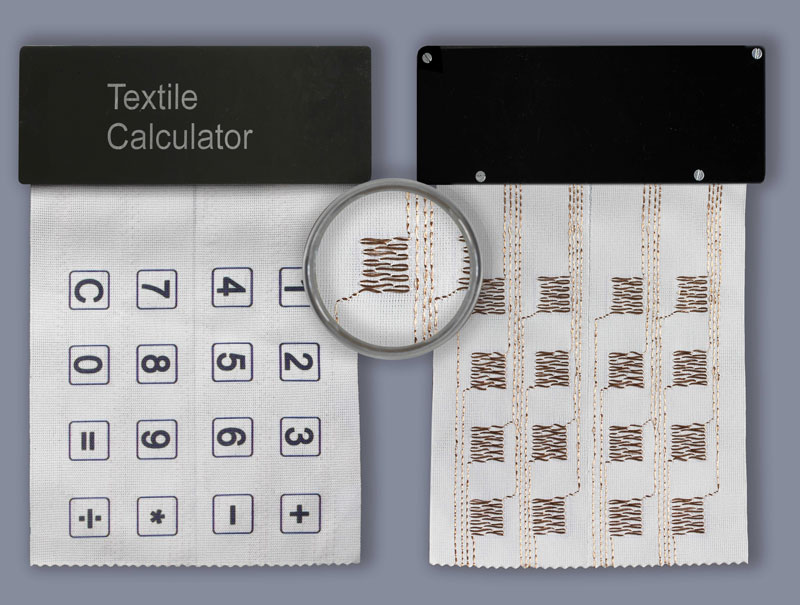
Jakob Müller’s Textile Calculator

Technology and research cooperation

The concept of a “textile calculator” was developed by Jakob Müller Group, in cooperation with the textile research institute Thuringen-Vogtland. Müller’s patented MDW® multi-directional weaving technology is able to create the meander fields which allow calculator functions to be accessed at a touch. A novel and useful facility, which suggests limitless expansion.

Today, the latest woven shoes are appreciated for their precise and comfortable fit. They score through their durability, strength and stability, meeting the requirements of individual athletes across many sports, as well as leisurewear. Stäubli is well-known as a global specialist in weaving preparation, shedding systems and high-speed textile machinery. Its jacquard machines offer great flexibility across a wide range of formats, weaving all types of technical textiles, lightweight reinforcement fabrics — and shoes.

A Multilayer Aramid produced using Stäubli machinery

It’s possible to weave new materials such as ceramics, mix fibers such as aramid, carbon and other, and produce innovative multi-layers with variable thicknesses. Such applications put special demands on weaving machines which are fulfilled by Stäubli high-performance TF weaving systems.

Great weaving results are impossible without perfect warp tension, now available thanks to the electronic warp feeding systems of Crealet. Some market segments in weaving industry today demand warp let-off systems which meet individual customer requirements. For example, the company has recognized expertise to understand that geotextile products often need special treatment, as provided by its intelligent warp tension control system. Individual and connective solutions are designed to allow external support via remote link. Crealet’s warp let-off systems are widely used in both ribbon and broadloom weaving, for technical textiles applied on single or multiple warp beams and creels.

Functional, sustainable, automated

Trends in the field of woven narrow fabrics are clearly focused on functionality and sustainability. The Jakob Müller Group has already embraced these principles — for example, using natural fibers for 100-percent recyclable labels with a soft-feel selvedge. It also focuses as much as possible on the processing of recycled, man-made materials. Both PET bottles and polyester waste from production are recycled and processed into elastic and rigid tapes for the apparel industry.

For efficient fabric production environments, it is now recognized that automated quality solutions are essential. Quality standards are increasing everywhere and zero-defect levels are mandatory for sensitive applications such as airbags and protective apparel.

Uster’s latest generation of on-loom monitoring and inspection systems offers real operational improvements for weavers. The fabric quality monitoring prevents waste, while the quality assurance system significantly improves first-quality yield for all applications. Protecting fabric makers from costly claims and damaged reputations, automated fabric inspection also removes the need for slow, costly and unreliable manual inspection, freeing operators to focus on higher-skilled jobs.

Smart and collaborative robotics (cobots) offer many automation possibilities in weaving rooms. Stäubli’s future oriented robotics division is a driver in this segment with first effective installations in warp and creel preparation.

Control and productivity

Willy Grob’s specialized solutions for woven fabric winding focus on reliable control of tension, keeping it constant from the start of the process right through to the full cloth roll. Continuous digital control is especially important for sensitive fabrics, while performance and productivity are also critical advantages. In this regard, the company’s large-scale batching units can provide ten times the winding capacity of a regular winder integrated in the weaving machine.

The customized concept by Grob as well as design and implementation result in great flexibility and functionality of the fabric winding equipment — yet another example of Swiss ingenuity in textile machinery.

There is even more innovation to come in weaving — and in other segments — from members of the Swiss Textile Machinery Association in future! This confident assertion is founded on an impressive statistic: the 4077 years of experience behind the creative power of the association’s member firms. It’s proof positive that their developments grow out of profound knowledge and continuous research.

September 23, 2021
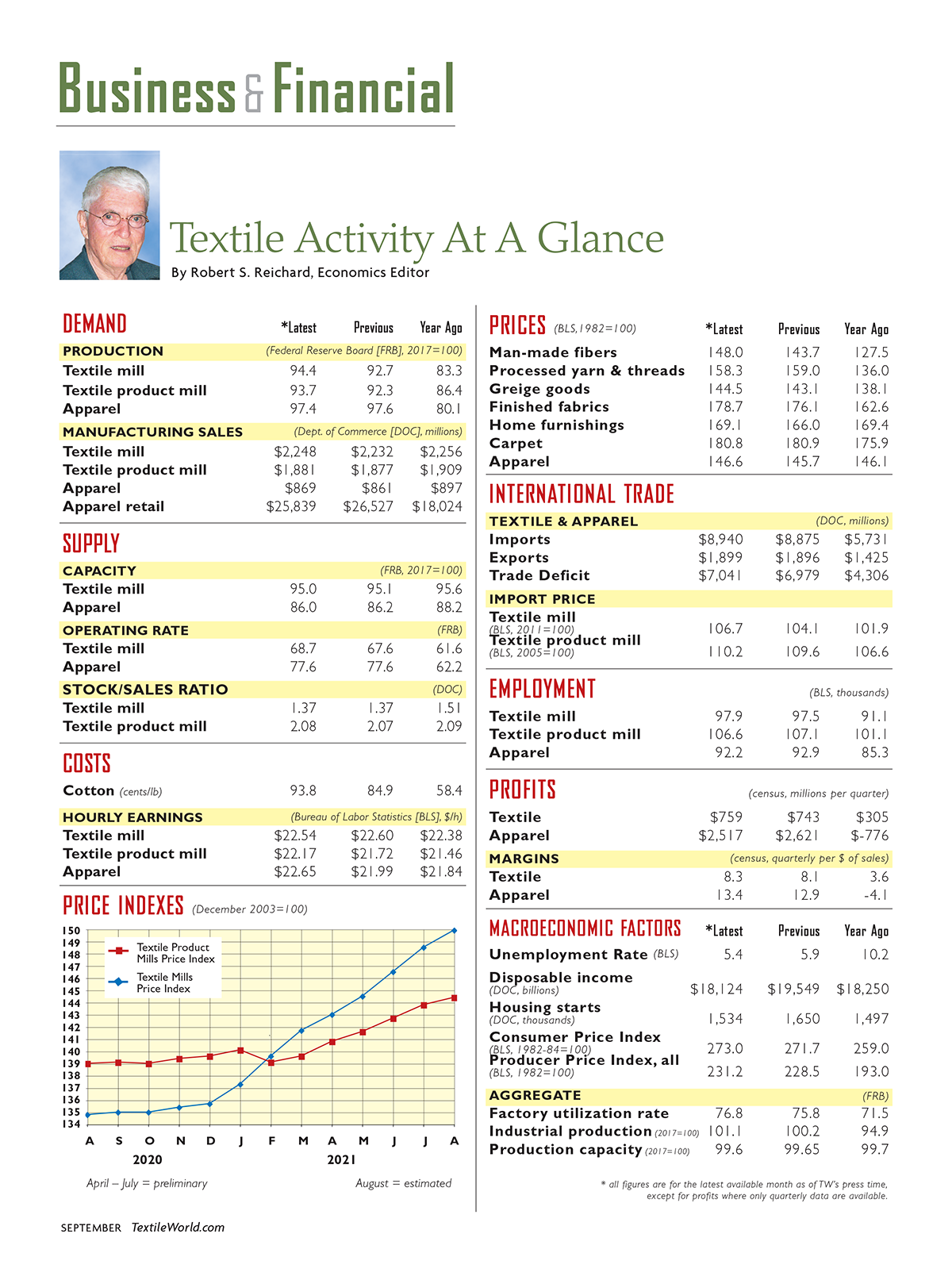
September 2021: Textile Activity At A Glance

September 2021

Military Tent Products Manufacturer Camel Awarded $50 Million Contract

PIONEER, Tenn. — September 22, 2021 — Camel Expeditionary, a manufacturer of military tent products, was recently awarded a new five-year, $50 million contract with the Defense Logistics Agency.

Under the contract, Camel will produce light maintenance enclosure (LME) structures, primarily for use by the United States Army. These tents are designed for all-weather use and typically house military vehicles, including high mobility multipurpose wheeled vehicles (HMMWV or Humvee) and M1 Abrams tanks, the main battle tank of the Army and Marine Corps.

In a collaboration with the United States Army Corps of Engineers, Camel helped develop these LME structures in 1999 and has been the primary producer ever since. In addition to use for vehicle storage and maintenance, the tents can be modified for use as laundry facilities and general storage needs.

A contract of this size and scope will allow Camel to grow. As a leading employer in Campbell County, this contract impacts the surrounding region as well as the organization.

“We are truly pleased to make this announcement, especially for our local community,” says President and CEO Mark Riffle. “This contract means we will be able to expand our production capabilities and our staffing.”

“We know this helps us create a strong foundation for future growth, in our company and in our local economy,” Riffle adds. “We plan to be in full production for this contract by the end of this year.”

Camel currently employs 125 people living in Campbell, Anderson, Scott, and Knox counties, and hopes to add 12 more as a result of this contract.

“Citizens from across Campbell County are proud to work for such a dynamic company that provides solutions around the world,” says E.L. Morton, mayor of Campbell County. “These contracts are won because of the quality that is sewn into Camel products and because of Camel’s dedicated leadership team. The impact of such a strong manufacturer in our community is tremendous.”

“With Camel’s response to the COVID-19 pandemic these past two years, that impact has been even greater,” Mayor Morton adds. “Camel is meeting the need on the battlefield and in clinics and hospitals across America where portable shelters are needed most.”

Posted September 22, 2021

Source: Camel Expeditionary

Five Strong Organizations Rebranded To Form Teijin Automotive Technologies

AUBURN HILLS, Mich. — September 22, 2021 — Five strong organizations — Continental Structural Plastics (CSP), Inapal Plásticos, Benet Automotive, CSP Victall and Teijin Automotive Center Europe (TACE) — have come together under a single brand to form Teijin Automotive Technologies, a global leader in composite materials and solutions for the worldwide mobility industry.

Through this rebranding, Teijin Automotive Technologies becomes a proven manufacturer of highly-engineered materials for dynamic market divisions with the ability to supply consistent materials and components to customers across North America, Europe and Asia — a capability no other supplier can provide. Spanning several mobility related industries, including automotive, heavy truck, marine and recreational vehicle segments, the new organization which includes Teijin’s automotive composites team in Japan, is positioned to provide advanced materials solutions through its 29 strategically located manufacturing and technical centers. Utilizing all the strengths from the previously separate companies, Teijin Automotive Technologies can provide unique solutions for the next generation of mobility.

“With the integration of these organizations, we can supply expertise in a wide range of materials allowing us to develop solutions that address our customers’ most difficult design challenges,” said Steve Rooney, CEO of Teijin Automotive Technologies and general manager, Teijin Composites Business Unit. “Now, as Teijin Automotive Technologies, we are able to develop new materials, source them where and when they are needed, and provide the expertise that meets the world’s ever-changing mobility needs.”

This move establishes a singular organization with a global footprint and 5,400 employees capable of combining world-class materials expertise with cutting-edge engineering and design to create solutions that make vehicles safer and more eco-friendly. By selecting the right material for the right application, Teijin Automotive Technologies creates components and systems that enable lighter, stronger, safer and more energy efficient vehicles. This unification further strengthens the organization’s capabilities as a vertically integrated, full-service supplier that develops materials to meet customer needs today, while anticipating needs of tomorrow.

As an organization committed to sustainability and innovation, Teijin Automotive Technologies is currently engaged in a variety of research projects aimed at making its operations and products more environmentally friendly. These include carbon footprint analyses, complete life cycle assessment of composite materials, and material recycling processes.

“Teijin has a very strong commitment to sustainability and the society of the future, so we are engaged in a number of initiatives that support this commitment,” Rooney explained. “By identifying sources of CO2 emissions in our materials and processes, we will identify ways to reduce our environmental impact and establish targets for long-term improvement.”

Teijin Automotive Technologies’ innovation awards include Automotive News PACE Awards, JEC Innovation Awards, multiple CAMX and SPE Innovation Awards, and the General Motors Supplier Innovation Award.

Posted September 22, 2021

Source: Teijin Automotive Technologies

Premier Collection Of Enkay Rugs & Accessories Features Simple Luxury Woven By Treasured Artisans

ATLANTA — September 22, 2021 — Fashioned in the finest natural fibers, with a sublime and sensory feel, Enkay celebrates the ancient craft of rug-making with the launch of its premier collection, Origins, on September 13, 2021. As the world moves into the future, works by hand remain a touchstone connecting to the past.

Featuring 23 different styles, talented weavers based in their home villages of India have lovingly produced a range of top-quality, unique, and distinctive designs under the auspices of Enkay. These hand-made works of art will now be available to collectors of fine home furnishings nationwide. Styled for modern living, Enkay has one simple, noble intention: to make hand-made, high-quality rugs attainable. Retail price points start at $500 and will be available through its e-commerce site .

The inaugural collection houses a variety of subtle and sophisticated neutral tones and a mix of textures to adorn inside spaces and beautify any home environment. Born out of the intense desire to honor centuries of workmanship, Enkay artisans use only the finest materials like un-dyed New Zealand wool and employ the technique of using hand carding, hand knotting and hand finishing. Enkay brings warmth to rooms and texture to life, with understated color gradations, high/low pile contrasts, refined geometric patterns, and exquisite craftsmanship.

Asha Chaudhary, CEO, and co-founder of Enkay, daughter of the legendary N.K. Chaudhary of Jaipur Living, India’s largest manufacturer of hand-knotted rugs, proudly carries on the legacy of her father’s devotion to respecting and supporting makers, weavers, and designers whose creations have passed through generations. Enkay, as a woman-led business, has intensely focused on empowering women and their families to secure the future of hand-made rugs, as well as creating her aesthetically driven, direct-to-consumer luxury brand.

“Weaving is an ancient art. In creating Enkay, we have connected customers with artisans practicing these timeless skills in villages across India. We connect directly with makers and remove complexity from our ecosystem, ensuring each person in the chain is paid fairly for their contribution. We can ensure the highest ethical standards are upheld through this model, and a totally fair value exchange occurs. Weavers and their communities thrive. Additionally, by investing in these communities, through skills training, education, and health initiatives, we’re able to support these vital crafts and the people who practice them, making them sustainable for generations to come,” Chaudhary says.

Enkay is designed for modern living, bringing welcome texture into any home, and making it possible to see a classic design with fresh eyes. The hand-woven rugs are fashioned in jute or ultra-soft wool and are virtually stain and water-resistant making it easy to live with for kids and pets, handcrafted for life. In addition, Enkay’s rugs are an environmentally conscious way to incorporate naturally beautiful elements into the home, as synthetic rugs contain toxic dyes and emit harmful VOCs (volatile organic compounds). Colorways include bright whites, soft creams, pale beiges, and subtle greys.

Some highlights from the Enkay Origins collection of rugs include:

  • Sarvan – Sarvan is inspired by the individualism of a rug worked on by multiple weavers using multiple yarns on a single piece. In Sarvan, the tonal variations of undyed wool combine with yarns woven at different tensions to create a textured piece that’s both casual and cosmopolitan. Hand-woven from hand-spun and carded Afghan wool, Sarvan retains the wool’s prized length, strength and luster in the finished rug. Sarvan is ideal for adding a bit of luxury to modern life.
  • Adras – An undyed, natural palette, braided fringe, and contrasting, high/low pile makes Adras feel like modernity meets Moroccan style. Crafted from lustrous, hand-carded wool, Adras is hand-knotted then hand-trimmed with shears to create a subtle texture that evokes a field of diamonds. Taking just under three months to make, Adras is form without formality, ease without edge—providing a perfect backdrop to a casual contemporary home.
  • Tigaria – Tigaria is an updated Moroccan style. The variation in color inherent in natural sheep’s wool creates a delicate linear pattern, with no two rugs the same. The soft pile and easy design make it a perfect backdrop to a casual contemporary home. With a natural sheen to the wool and a contrasting high/low pile, Tigaria’s boho style makes it a natural complement to a modern space.
  • Sarnic – Sarnic echoes the tribal patterns woven long ago in the Kars region of modern-day Turkey. The difference is in its palette. Rendered in neutral shades rather than the rich hues of tribal carpets, Sarnic trades traditional boldness for calm classicism. Sarnic is noted for its especially solid, lush feel, which is created by a complex knotting technique that produces a flat-woven feel from a cut pile.

Enkay’s Origins collection is a statement of intent, crafted to express enduring subtlety and effortless luxury. This foundational collection has been shaped using the lightest touch. It imbues understated design with the depth and movement inherent to natural materials. Origins embraces contrast and the character of the rugs emerges in the space between design and making. It draws on tradition but lives just outside of time.

Posted September 22, 2021

Source: Enkay

Lubrizol Helps Enable The Circular Economy With 100-Percent Thermoplastic Polyurethane (TPU) Prototype Shoe

CLEVELAND — September 22, 2021 — Lubrizol Engineered Polymers announces the launch of its first 100-percent thermoplastic polyurethane (TPU) prototype shoe. The prototype meets the high-performance demands in the footwear industry while achieving greater sustainability through enhanced recyclability* and less material waste.

Incinerated shoe waste and non-recyclable material scrap has contributed to increased carbon emissions, heightening demands for sustainability in the footwear industry. Footwear manufacturers can now partner with Lubrizol to deliver a sustainable end-to-end solution with performance and circularity at its core.

Efficient Production, Responsible Consumption
In contrast to traditional footwear products made with mixed materials, Lubrizol’s 100-percent TPU prototype shoe helps enhance circularity by being composed of one core material. The prototype demonstrates a combination of Lubrizol’s advanced TPU solutions for footwear that work together, including: Esdex™ TPU for upper yarns to keep shoe construction lightweight; BounCell-X™ TPU for foam, a low density, plasticizer-free and recyclable* material used for cushioning; and ESTANE® TRX TPU leveraged as a functional alternative to rubber outsoles.

These Lubrizol TPU materials enable simplified production through improved compatibility between parts. TPU materials also allow for in-mold adhesion during the shoe soling process, which can increase automation and efficiency, while reducing multiple gluing processes.

Post-industrial recycling options mean shoe producers can reclaim and reuse scrap in their own operations, while helping simplify the process of post-consumer recycling* through the regrinding of old shoes and repurposing materials into new goods.

Bio-Content Grades

ESTANE ECO TPU, a renewable-sourced polymer from Lubrizol under the Bio TPU portfolio, is a key component of the prototype shoe. ESTANE ECO TPU is derived from natural resources and delivers the same outstanding mechanical, physical, and chemical performance properties in comparison with petroleum-based TPUs. With a 5- to 10-percent lower density than traditional TPUs of the same hardness, ESTANE ECO TPU helps meet the requirements for lightweight and high-performance attributes in sports shoe production. This sustainable material grade also enhances footwear development because of its high transmittance, resistance to yellowing and compatibility with other materials.

A Partnership with Industry-Leading Processors

Most of the components used in the new prototype shoe are a result of multi-year partnerships with established producers in the athletic shoe industry. These industry and customer partnerships have made Lubrizol faster, more reliable, and adaptable to global footwear market needs.

Today, the importance of environmental protection and sustainable development has reached a global consensus. Lubrizol’s innovative solutions are designed to support the upgrading and development of global footwear industry with more eco-friendly materials and more customized processing, helping our customers increase the circularity impact of their products.

* Recyclability is based on access to a readily available standard recycling program that supports such materials. Products may not be available in all areas.

Nothing contained herein is to be considered as permission, recommendation, nor as an inducement to practice any patented invention without permission of the patent owner.

Posted September 22, 2021

Source: The Lubrizol Corp.

The Fibres Of Filo: Bemberg And ROICA By Asahi Kasei

BIELLA, Italy— September 21, 2021 — The 56th edition of Filo dedicates much space to fibres. A particular attention is given to natural and synthetic man-made fibers, able to match exceptional performances together with sustainability and traceability.

Among fiber producers who participate in the 56th edition of Filo, the Asahi Kasei group, stands out. Asahi Kasei brings at Filo two of its flagship products.

The first one, Bemberg™, is a fiber obtained by the smart-tech transformation of pre-consumption material of cotton linter and changed into a traceable and transparent closed-loop process. Bemberg’s story starts with the lining of high-quality garments; however, today it is possible to find this material in many other applications: couture, coats, underwear, bed linen, and sportswear, where its unique touch and its incredible quality are particularly appreciated.

The second fiber proposed by Asahi Kasei at Filo is ROICA™. A premium stretch fiber, ROICA distinguished itself in fashion, underwear, sportswear, hosiery, and fabrics thanks to its smart innovation.

At the 56th edition of Filo, Asahi Kasai doesn’t only present innovative materials, but it is the protagonist of three ‘Dialoghi di Confronto’ in the Networking Area of the Exhibition.

During the first ‘Dialoghi di Confronto’ (scheduled on the 29th of September at 4 p.m.), which is entitled “Il viaggio di Bemberg by Asahi Kasei verso una moda contemporanea, premium e responsabile” (‘The journey of Bemberg by Asahi Kasai towards a contemporary, premium and responsible fashion’), Ettore Pellegrini, Marketing & Sales Manager Asahi Kasei Fibers Italia, talks with Giusy Bettoni, C.L.A.S.S CEO and founder, about essential themes for textile’s future.

During the second ‘Dialoghi di Confronto’ (scheduled on the 30th of September at 11 a.m.) – The contemporary consumer: Stretch your imagination with ROICA by Asahi Kasei smart innovation” – Uwe Schmidt, managing director Asahi Kasei Spandex Europe, will explain ROICA’s sustainability, made of production and processes, dwelling on performance, objectives and future project, product innovations and case histories told through the fabrics of partner groups.

During the third meeting (scheduled on the 30th of September at 4 p.m.), Ettore Pellegrini and Giusy Bettoni will resume the discussion talking about quality, applications, and traceability of Bemberg fiber.

‘Dialoghi di Confronto’ represent one of the most interesting innovations of the 56th edition of Filo Please find here the whole agenda of the two days of meetings (https://filo.it/wp-content/uploads/2021/09/Dialoghi-di-confronto-2.pdf).

We wait for you at the 56th edition of Filo scheduled September 29-30, 2021, at MiCo!

Posted September 22, 2021

Source: Filo

TESTEX AG, Swiss Textile Testing Institute: Setting Standards For 175 Years

ZURICH,
 Switzerland — September 22, 2021 — Founded in 1846 and originally known as the “Seidentrocknungsanstalt Zürich” (Silk Conditioning Institute), TESTEX is one of the oldest companies in Switzerland. The institute’s core business was determining the commercial weight of raw silk. However, the second half of the 20th century saw the decline of the silk industry, and the company underwent a transformational process. It began to extend its testing to other fibers and was renamed to TESTEX in 1970.

Its transformation into a leading independent testing institute for human ecology began in the early 1990s, and TESTEX joined the OEKO-TEX® Association in 1993. The association and its founding institutes have spent almost three decades envisioning a sustainable textile industry and pride themselves on being pioneers in sustainability solutions. Consumers and brands alike are increasingly selecting products and companies that demonstrate action and make commitments on key environmental topics like water usage and climate change.

A variety of modern testing equipment is available for both physical textile testing and analytical tests. The most modern and up-to-date testing equipment and software now allows laboratory staff to process their results competently at home and to control devices remotely, which has been an important part of TESTEX’s digitalization process.

Today TESTEX focuses on a holistic approach, offering its customers complete solutions to successfully take on the sustainability challenges that the fashion industry faces today.

Posted September 22, 2021

Source: TESTEX AG, Swiss Textile Testing Institute

FiloFlow And Sustainability At The Center Of The 56th Edition Of Filo

BIELLA, Italy — September 22, 2021 — FiloFlow, Filo’s sustainability project which has been launched for some years, is increasingly developing. The number of exhibiting companies participating in it is constantly raising.

The 56th edition of Filo confirms the centrality that the theme of sustainability has gained for the whole textile industry. Consequently, the FiloFlow project will have an even higher visibility compared to the past: it will be indeed the focus of the new Sustainability Area, comprehensive of a specific trend area of FiloFlow companies. Almost all exhibiting companies have now joined the FiloFlow project. And the approach that Filo wanted to give to the project also contributes to its success: the goal is to enhance productions carried out according to sustainable criteria and processes related to environmental and ethic profile. All this with a perspective of supply chain, the only way to reach a truly traceable and sustainable end-product. In fact, as has been the case for some years, a group of dyeing mills are present at the 56th edition of Filo, showing their solutions for environmentally responsible textile products.

Posted September 22, 2021

Source: Filo

Supply Chain Boost At Carrington Textiles To Meet Changing Customer Demand Across Europe

ADLINGTON, England — September 22, 2021 — After 18 months of global supply chain disruption, workwear fabric manufacturer Carrington Textiles, revealed the company’s challenges during this period and the growth its supply chain team has been through to be able to maintain the company’s high levels of service.

Since early 2020, the COVID-19 pandemic caused a whole new set of challenges for Carrington Textiles, ranging from the team having to adapt to a new dynamic way of doing things remotely, to lockdowns and positive cases around the world impacting the availability of raw materials and freight.

Brexit was another big task for Carrington Textiles, as the company had to find ways for establishing new procedures that adhered to the Trade Cooperation Agreement (TCA) with the European Union to ensure products could still be shipped to customers without unnecessary delays

Additionally, the Suez Canal blockage which lasted six days, had a severe impact on the supply chain, generating even further delays on blank sailings, loops changing and unforeseen transhipments.

With the rollout of the vaccine program and the coronavirus pandemic restrictions gradually easing in many countries around the world, Carrington Textiles saw a considerable increase in demand from the beginning of 2021, a situation to which it had to respond quickly to meet customers’ expectations.

Supply Chain Director for Carrington Textiles Stuart Pritchard explained: “We have seen in 2021 extraordinarily high levels of demand in comparison to 2020, which were higher than we could have predicted. We worked in collaboration with our internal teams to understand where we produce fabrics, ensuring we have the right raw materials in the right place, at the right time. With a multisite operation in the UK, Portugal for EU origin fabrics and Pakistan, these challenges were complex.”

The supply chain boost

Stuart outlines what has changed in Carrington Textiles’ supply chain and how is this benefiting not only customers but the environment.

“We have introduced a new warehouse in Portugal with a bespoke management tool written by our own IT team, so we have full control on the system and its features.

“We’ve also had to restructure the entire supply chain team by adding 50 percent more talent in order to ensure we have the right competence operating at the right level to meet our customers’ needs. We looked outside the textile industry to find the best people with a wide range of experience and ideas that can improve our service to customers.

“With this growth, the team is not only able to implement new customs procedures and documentation, but also to spend more time analyzing and improving processes, stock performance, global production capacity utilization and ensuring our worldwide raw material needs are fit for purpose.

“Because it’s important for us to have access to the right data at the right time and in the right format we have also invested in a demand planning tool that will produce forward sales, production and stock projections and help manage our business in order to meet that all our customers’ expectations. This will no doubt enable us to be more agile and predict where we need to focus our efforts to ensure smooth operations through what’s been a very tough couple of years for supply chains.

“This new technology will also make our supply chain a lot more sustainable and environmentally friendly, as it will help us ensure we are not purchasing and shipping more product than needed. I believe in managing our capacity needs and production facilities ahead, so we utilize our assets efficiently and don’t waste energy”.

Posted September 22, 2021

Source: Carrington Textiles

Sponsors