U.S. Textile Investment Roundup

Eastman announced it will invest up to $1 billion to build a molecular plastics recycling facility in France.

The textile industry continues to expand with new products, plants, equipment and activity in mergers and acquisitions.

TW Special Report

Following last year’s textile investment roundup feature story, continued industry investment and merger and acquisition activity is still filling the news. A quick count of press announcements on TextileWorld.com’s “New Plant and Equipment, M&A” news section yielded almost 300 postings over the past 12 months. Sectors including apparel, bedding, floorcovering, traditional textiles, nonwovens and technical textiles all saw investment, expansion and innovation activities — with sustainability and interest in Central America featuring heavily in the investment activities.

Hot Topic: Sustainability

Building on its January 2021 announcement of a $250 million investment in plastic-to-plastic molecular recycling facilities at its site in Kingsport, Tenn, Eastman Chemical Co. announced the company’s plan to invest up to $1 billion in a material-to-material molecular recycling facility in France. According to the company: “This facility would use Eastman’s polyester renewal technology to recycle up to 160,000 metric tons annually of hard-to-recycle plastic waste that is currently being incinerated. This multi-phase project includes units that would prepare mixed plastic waste for processing, a methanolysis unit to depolymerize the waste, and polymer lines to create a variety of first-quality materials for specialty, packaging, and textile applications.”

“The plan to build the world’s largest plastics recycling facility in France is an important part of our overall circular economy strategy,” said Eastman Board Chair and CEO Mark Costa. “Today’s announcement is a key milestone towards our commitment, and we expect to achieve additional milestones in the coming months, including agreements related to securing the plastic waste that will be raw material supply, securing government incentives, and the site location decision.”

West Sacramento, Calif.-based Origin Materials Inc. announced plans to invest at least $750 million to develop a biomass manufacturing facility in Ascension Parish, La. According to the company: “The plant in Geismar will utilize sustainable wood residue — sourced partly from Louisiana’s timber mills and managed forests — to produce plant-based polyethylene terephthalate (PET) used in packaging, textiles, apparel and other applications. Hydrothermal carbon, which can be used in fuel pellets, also will be produced at the site.”

Textile innovations company Evrnu, Seattle, raised $15 million in its Series B financing to scale and meet the surging demand for its fiber regeneration platform, NuCycl — a depolymerization technology for textile waste. “Over the last few years, we have iterated and fine-tuned NuCycl technologies to meet and exceed the quality and performance demands of the luxury industry,” said Stacy Flynn, CEO and co-founder of Evrnu. “We are now proving these technologies at scale, with short-term plans for global expansion.”

MycoWorks — an Emeryville, Calif.-based biotechnology company that specializes in mycelium-grown materials for use as sustainable leather alternatives — announced plans to establish operations in Union County, S.C. The $107 million investment will create 400 new jobs. MycoWorks’ products, such as Reishi™, mimic the performance and luxury quality of animal leathers, while reducing the environmental impact. According to the company, its patented Fine Mycelium™ process produces materials that offer creative solutions and new design possibilities for fashion and luxury brands.

Well-Established Firms March Forward

In early 2022, Mount Vernon Mills announced that it agreed to acquire Wade Manufacturing Co.’s yarn spinning and weaving facility located in Rockingham, N.C. With the acquisition, Mauldin, S.C.-based Mount Vernon Mills will be vertically integrated from yarn production to finished fabric in certain products. “The Rockingham facility is a modern, cost-efficient operation with an experienced and stable workforce, making it a great fit as we increase the amount of control that we have over our yarn supply, weaving operations and overall costs,” said Bill Duncan, CEO, Mount Vernon Mills. “We are also proud to expand our footprint in the U.S. and build upon our made in America commitment and heritage.”

Also in early 2022, polyester staple fiber manufacturer Fiber Industries LLC announced plans to invest $30 million to expand its operation in Darlington, S.C. The investment includes increased capacity through upgrades and modernization of production lines such as the addition of state-of-the-art control systems, as well as increased warehouse space. “We are excited about the continuing growth of our facility which is now even better positioned to serve the needs of the American textile industry,” said Fiber Industries CEO Don Bockoven. “We also are proud to be part of the wider effort to reshore jobs and bring textile manufacturing back to the USA.”

Glen Raven has a multi-phase investment plan underway, which includes an expansion of its Custom Fabrics operation.

Glen Raven, N.C.-based Glen Raven Inc. continued its multi-phase investment program with the announcement of an expansion of its Custom Fabrics operations with an investment of up to $82 million in Norlina, N.C. Glen Raven later announced a $70 million investment plan to expand operations for its custom fabrics division in Anderson County, N.C. Glen Raven has operated in Anderson County since 1986, and is widely recognized for its global brands including Sunbrella® and Dickson®.

Shaw is expanding a fiber operation that supplies its residential carpet manufacturing operations.

Focus On The Home

Multiple floorcovering operations expanded in the recent past. Dalton, Ga.-based Shaw Industries Group Inc., a global flooring provider, announced plans to expand its operations in Aiken County, S.C. The approximately $400 million investment will create more than 300 new jobs at the manufacturing facility which creates fiber used to manufacture residential carpet. According to the company, this location currently employs more than 600 associates and the expansion will increase the company’s manufacturing capacity and support future growth for new products.

Sherrill Furniture Co., a manufacturer of high-end furniture, will invest $2.9 million to open a new custom upholstery production facility in Conover, N.C. Founded in Catawba County in 1945, the company has maintained its legacy of manufacturing high-quality custom furniture in America for more than 75 years. According to Sherrill, its custom upholstery and case goods portfolio includes nine furniture brands for retailers and interior designers in all 50 states. “Backlogs within the furniture industry are at an all-time high,” said Sherrill President Thad Monroe. “We are 100-percent focused on substantially reducing lead times for our customers and are willing to invest heavily to more quickly fulfill orders of our USA-made products.”

Investing In Central America

In December 2021, Vice President Kamala Harris announced significant multimillion-dollar investments by Parkdale Mills and six other companies into Central America.

According to a press release from the Washington-based National Council of Textile Organizations (NCTO): “Vice President Harris, who is overseeing diplomatic efforts with El Salvador, Guatemala, Honduras, and Mexico, announced several private sector commitments to strengthen economic opportunities in the Northern Triangle … Gastonia, N.C.-headquartered Parkdale Mills, one of the largest manufacturers of spun yarn and cotton consumer products in the world, will make a multi-million-dollar investment in a new yarn spinning facility in Honduras and make an additional substantial investment to support existing operations in Hillsville, Va. This investment will help customers shift 1 million pounds of yarn per week away from supply chains in Asia and China and enhance U.S. and CAFTA-DR co-production resilience and increase regional product offerings. Parkdale’s announced investment will create hundreds of jobs in Honduras and further support hundreds of employees in Parkdale’s Hillsville operations.”

“Parkdale’s investments will support good paying jobs in the United States and in the Central American region and significantly increase our extensive product offering and capacity, including the production of sustainable specialty yarns,” noted Parkdale’s Chairman and CEO Anderson Warlick.

Intradeco Holdings announced more than $100 million of investment in Central America, part of which will be used to expand the company’s solar energy power.

Miami-based Intradeco Holdings announced investments of more than $100 million in Central America to make the most of the CAFTA-DR and nearshoring opportunities, advance full circularity, and expand solar power with three major projects. Its first project is the Central American Spinning Works, a state-of-the-art ring spinning mill in Honduras that began operations earlier this year. The second project is the creation of a manufacturing plant in El Salvador that uses 100-percent recycled yarns — both cotton and man-made fibers. A third project will allow the company to expand its solar energy power to attain 30 megawatts by the third quarter of 2022. “[Our] announcement is consistent with our 40 years of innovation and service which comes with being an integral part of the textile, apparel, and retail industries,” said Intradeco Chairman Felix Siman. “With our comprehensive distribution channels and state-of-the-art supply chain, we can reach our customers in an efficient and cost-effective manner in the shortest time possible. Intradeco is a founding member in The HUGE (Honduras, USA, Guatemala, El Salvador) Business and Investment council. Through these investments, our company is helping to create more than 1,000 jobs in Central America, while contributing to the region´s environmental sustainability objectives.”

Investing In Sleep

Sleep products saw tangible interest in the recent past with much of the new investment focused on South Carolina. Somnus Mattress International LLC, a manufacturer of hybrid memory foam mattresses, announced a $13 million investment with plans to establish operations in Blacksburg, S.C. The operation will manufacture mattresses to serve clients across the United States.

Founded in Turkey in 2006, BRN Sleep Products, a premium manufacturer and supplier of bedding products, announced an investment of more than $4.3 million to establish operations in Orangeburg County, S.C. The company specializes in manufacturing and assembling mattresses and bases; as well as marketing, distribution and sale of bed products. “We are beyond excited for the opportunity to invest in both South Carolina and the United States,” said BRN Sleep Products Owner Berna Gözbaçi. “We look forward to growing with Orangeburg and the surrounding communities.” S.C. Secretary of Commerce Harry M. Lightsey III stated, “Foreign direct investment is a crucial element of South Carolina’s business environment, and we are excited that BRN Sleep Products has joined the roster of international firms that have decided to call South Carolina home.”

Columbus, Ohio-based wholesale mattress company Solstice Sleep Products Inc. announced plans to establish operations in Marion County, S.C. The facility — its sixth new manufacturing facility opened in the past 10 years — will increase the company’s capacity to meet growing demand for its Jamison brand mattress and foundation sleep products throughout the Southeast. “We are proud to work with the state of South Carolina and Marion County to expand our base of operations throughout the Southeast!” said Solstice Sleep Product President Dennis Straily. “Marion, S.C., will help us secure our long-term growth plans with our dealer base and meet their growing business demands.”

Established in 2021, APEX Mattress Manufacturing Inc. announced an investment of more than $1.9 million to establish its first manufacturing operation in Walterboro, S.C. “APEX Mattress Manufacturing Inc. is delighted to announce the presence of our first U.S. mattress manufacturing facility in Walterboro, S.C.,” said President Jack Hung. “Through our comprehensive strategic planning and study, South Carolina offers the best climate for new business, and Colleton County offers the best location for being close to both the Charleston and Savannah ports.”

Joe Megibow (right, holding scissors), Purple CEO, and John Legg (left, holding scissors), Purple COO, with elected officials at the opening of the company’s manufacturing facility near Atlanta.

Lehi, Utah-based Purple Innovation Inc. recently celebrated the grand opening of its newest manufacturing facility in Henry County, Ga., located just 27 miles south of Atlanta. “Georgia has been our second home since we chose the state to build our largest manufacturing facility,” said Purple’s CEO Joe Megibow. “We’re thrilled to mark this occasion … and celebrate the success we’ve accomplished thus far in already bringing more than 400 jobs to Georgia.” Purple’s ribbon cutting comes on the heels of the company’s recent joint announcement with the State of Georgia to expand operations in the area and add more than 500 new jobs over the next two years. This expansion will also include a customer care center slated to open in the spring of 2022.

Mattress manufacturer and retailer Brooklyn Bedding officially broke ground on a new state-of-the art manufacturing facility and corporate headquarters in Glendale, Ariz. The 648,165-square-foot building will be located on 42.8 acres. The new manufacturing facility and corporate headquarters will merge the capacity of both the company’s current factory and warehouse. The investment of more than $72 million is intended to make Brooklyn Bedding almost 100-percent vertically integrated.

Waterford, N.Y.-based Soft-Tex International, a producer of bedding and home comfort products, announced that it has opened a new facility in Sugar Land, Texas, which will double the company’s production capacity for fiber-filled products. Soft-Tex Principal, Mark Smiderle, remarked on the opening of the Sugar Land and the company’s commitment to domestic supply chains noting: “As promised, Soft-Tex has delivered and now continues to expand upon its commitment to growing its domestic footprint. These efforts will continue to improve Soft-Tex’s, and in turn, our partners’ overall service quality, speed, and costs, which we recognize is critical to driving continued growth.” Soft-Tex launched initiatives to shift volume for many other bedding product categories back to domestic and/or nearshore supply chains.

Technical Textiles And Nonwovens

Avgol® America Inc., an Indorama Ventures Ltd. company, recently announced a partnership with YanJan USA LLC to deliver exclusive apertured nonwoven product offerings to the North American market. “This is an exciting partnership for our companies,” said Ronnie Batchler, vice president Americas Region at Avgol. “The spunbond ‘precursor’ material will be specifically designed to meet customer specifications and deliver optimum performance. Aperturing of the spunbond will then give the nonwoven material additional unique attributes, such as improved physical performance and aesthetic appeal.”

North Chesterfield, Va.-based Verdex recently reported that it has secured financing to scale its proprietary nanofiber technology and complete a commercial manufacturing facility located in Richmond, Va. According to the company, the investment follows 10 years of development activities for its unique functionalized production technology capable of producing a wide range of advanced nanofiber products. “One of the most unique abilities in The Verdex Process® is our ability to customize and functionalize our nanofibers,” said Damien Deehan co-CEO at Verdex. “This allows Verdex to incorporate particles into the fiber matrix to target specific challenges and problems in multiple industries to create game-changing products.”

Spunlace products manufacturer Fibertex Nonwovens Inc. announced an investment of more than $49.5 million to expand its operations in Grey Court, S.C. The expansion, which will add 39 jobs, includes a second spunlace production line for rolled nonwoven fiber products. Fibertex also acquired an 84-acre industrial plot adjacent to the company’s existing facilities. The expansion is expected to be completed by 2023.

Mountainside, N.J.-based Gusmer Enterprises Inc., a manufacturer of filtration and fermentation products, announced $26.5 million investment to build a production facility in Hickory, N.C. A family-owned company for almost 100 years, Gusmer’s products are used in a variety of industrial and commercial applications. The new 135,000-square foot manufacturing facility is Gusmer’s third plant, and it will support the production of filtering devices for liquids including COVID-19 treatments.

Emigsville, Pa.-based Herculite Products Inc., a manufacturer of high performance and custom fabrics, announced it has acquired the Laminated Fabrics Division of Burlan Manufacturing LLC. According to the company, this acquisition strengthens Herculite’s position as a global leader in high performance reinforced textile composites. Later in the year, Herculite announced it completed the second phase of a multiyear strategic investment into its facilities adding significant additional capacity. Herculite’s multiyear, multi-million-dollar investment is focused on strengthening its position as a global leader in high-performance reinforced textile composites by increasing production capabilities, expanding manufacturing capacity, and improving organizational efficiency. The recently completed phase was specifically focused on increasing manufacturing capacity at its Emigsville, Pa., facility. This additional capacity has allowed Herculite to further grow its U.S.-based workforce, achieve record fabric production levels and respond to the historical and unprecedented demand across all Herculite product lines.

Precision Textiles opened a new 160,000-square-foot-facility in Troy, N.C.

Totowa, N.J.-based Precision Textiles made several significant announcements in the past year. The company signed a lease for a new 160,000-square-foot, 25-acre campus in Troy, N.C., which is its first domestic manufacturing facility outside of its New Jersey headquarters. The new plant is expected to be operational by September 1 and will employ 100 people, all from the local area. It will double the manufacturer’s needlepunch nonwovens production and boost its high-loft quilting fiber output by 50 percent “Demand for these products has risen to the point where we are near full capacity at our home facility in New Jersey,” said Scott Tesser, CEO of Precision Textiles. “In addition to keeping pace with current demand, this investment positions us for future growth as we continue to expand our customer base in the bedding and automotive industries.” Precision also recently signed a lease for a 50,000-square-foot manufacturing and distribution center in Phoenix, Ariz. that employs 35 associates and serves its customers throughout the western United States.

Apparel Investment

Cincinnati-based TSC Apparel relocated its Fullerton, Calif., operation to a larger, state-of-the-art 125,000-square-foot distribution center in Moreno Valley. The new facility is the latest development in an expansion effort that began in 2017 with a 100,000-square-foot distribution center in Houston and 135,000-square-foot DC in Philadelphia. In 2018, TSC also added a 200,000-square-foot distribution center in Cincinnati.

Standard Textile’s investment in Union County, S.C., includes a new rapid prototyping center similiar to its Prototype Production Center at its headquarters in Cinncinnati.

Cincinnati-based based Standard Textile Co. Inc. announced an investment of more than $15 million to expand operations in Union County, S.C. “In addition to meeting growing demand, this expansion allows us to create a state-of-the-art rapid prototyping center for the development of innovative products and a showroom to share the company’s innovation history and unique products,” said Bradley Fry, COO and CFO. The company partners with industry leaders to create products and services that solve the unique needs of the healthcare, hospitality, interiors and home markets.

Denver, Colo-based VF Corp. announced the investment of $10.2 million to grow its Martinsville, Va., operation. The company will use its 500,000-square-foot facility in Martinsville to increase distribution capacity to deliver products to its consumers faster. “VF Corporation has thrived in Henry County for nearly 20 years, and we are thrilled to see the company continue to invest in the Commonwealth,” said Governor Northam. “Virginia’s strong outdoor recreation economy supports the growth of companies like VF Corporation. We look forward to the company’s continued success here in the Commonwealth as our ecotourism industry grows.” “We’ve proudly operated our distribution center in Martinsville for 18 years and we know that continuing to invest in Martinsville is the right choice given its location and committed employees,” said Cameron Bailey, executive vice president, Global Supply Chain, VF Corp. “The planned investments in this facility, from enhanced technology to improved distribution equipment, as well as the 82 new full-time positions, will help deliver our products to our consumers in a more efficient and prompt manner.”

Through one of its wholly-owned subsidiaries, Montreal-based Gildan Activewear Inc. acquired 100 percent of the equity interests of Phoenix Sanford LLC — the parent company of Frontier Yarns — for a total cash consideration of approximately $168 million. Frontier produces 100-percent cotton, polyester, and cotton-blend yarns primarily manufactured on open-end and vortex spinning technology. Gildan acquired four Frontier facilities located in North Carolina that employ approximately 800 employees. During 2021, approximately 40 percent of Frontier’s production was dedicated to yarn sold to Gildan for textile manufacturing in Central America and the Caribbean. The Frontier acquisition will allow Gildan to build on its global vertically integrated supply chain by further internalizing yarn production. In addition, the purchase will support yarn availability for Gildan’s textile capacity expansion plans in Central America and the Caribbean.

Charlotte, N.C.-based clothing and apparel company Citadel Brands LLC announced an investment of more than $7.5 million to establish operations in Kingstree, S.C. The company specializes in promotional clothing and apparel. Citadel Brands’ new operations will increase distribution capacity and promote future growth for new products and brands. The Kingstree facility is expected to be operational in June 2022.

LT Apparel Group announced an expansion of operations in North Carolina with an investment of at least $57 million in Greensboro, N.C. Headquartered in New York City, LT Apparel designs, sources, manufactures, and markets children’s apparel. The company’s family of brands includes adidas Kids, Carhartt Kids, and its own brand French Toast — a prominent schoolwear brand for kids. The company will maintain its design center in Greensboro as it adds new capacity and warehousing space in the city.

New York City-based Ferrara Manufacturing — a family-owned apparel manufacturer that partnered with Ralph Lauren to create the U.S. Olympic and Paralympics uniforms from 2014-2022 — recently announced the launch of Ferrara Uniform. Ferrara Manufacturing produces garments worn on the runways of New York and Paris, as well as clothing worn by American Olympians and the U.S. military. Located in Manhattan’s Garment District, Ferrara Uniform is a new division of the company focusing specifically on uniforms made in the USA, and led by Gabrielle Ferrara, the COO at Ferrara Manufacturing and daughter of founders Carolyn and Joseph Ferrara. The mother-daughter team of Gabrielle and Carolyn aim to be an innovative force in the industry and have developed a proprietary custom-fit technology designed to dress women of all shapes and sizes. The company continues to grow, and with a recent expansion to a facility in Long Island City, Ferrara Manufacturing plans to continue increase in capacity and hiring more employees.

A $1.2 million expansion by Allegiance Flag Supply will add 25 new jobs. Photo: Andy Turner

Editor’s Choice

Not every investment in U.S. textiles needs to be in the tens of millions of dollars to be impactful or symbolic of what it means to be a member of the U.S. textile industry. When reviewing the many investments made over the past year, one stood out. Allegiance Flag Supply, a producer of American flags, announced plans to expand operations in North Charleston, S.C. The company’s $1.2 million investment will create 25 new jobs. Founded in 2018, Allegiance Flag Supply utilizes American-sourced materials and seamstresses to produce high-quality flags that can withstand outside elements. The company’s expansion will consolidate its operations to include a self-sustainable sew shop and distribution center which packages and ships products across the country.

March/April 2022

A Textile Education, Circa 2022

Janet Brady, director, Jefferson University’s Bruner Materials Characterization Laboratory, explaining some of the lab’s capabilities.

Part two of Textile World’s two-part feature on textile education focuses on alternatives to the college and university offerings

By Jim Kaufmann, Contributing Editor

The need for well-trained men and women to meet the demands of a growing textile industry…” are the first words of a Textile World article published some 20 years ago (See “Making the Grade,” TW, January 2002). If written today, that sentence likely would conclude with words reflecting a heightened awareness and fast-growing urgency for training options in order to generate viable candidates to fill the numerous textile industry job openings. As both the United States and global textile industries re-emerge from the COVID-19 pandemic with an invigorated economy, but faced with an aging workforce (see “What Do We Do When All the Old Guys and Girls Are Gone,” TW, September 2017) coupled with what some are referring to as the “great resignation,” human resource and plant managers are scrambling to find, hire and train able bodied workers for their locations. As a result, affirmed by Sam Buff, vice president and general manager at the Manufacturing & Textile Innovation Network (MTIN), Gastonia, N.C., “training is getting hot!”

Training needs are indeed getting hotter specific to today’s textile industry. This realization has prompted many of the colleges and universities referenced in part I of this feature (See “A Textile Education, Circa 2022, TW, Jan/Feb 2022), as well as several textile industry organizations to build upon their current program offerings specific to textiles. What follows is a brief discussion of alternatives for gaining a targeted knowledge of textiles and the industry without the need to acquire a formal textiles degree.

So Many Types And Options

By definition, training relates to the act of teaching people a particular skill set. Perhaps reflecting the ever-growing breadth of the textile industry, today’s iterations of training can range in scope from how to properly drive a forklift to a basic introduction of the textile industry or more detailed specifics of how to operate precision equipment such as complex spinning or high-speed knitting machines.

The variety of topics and training available can accommodate someone who is completely new to the textile industry, someone looking for a refresher on one aspect of the industry, or someone knowledgeable about the textile industry who is looking to learn about a different industry sector or piece of equipment. As alternatives to a formal textile degreed program, these offerings include casual programs or presentations at trade shows; training courses offered by industry organizations; classes offered by colleges or universities; and highly detailed operator and technician training offered by major textile machine manufacturers. Most training is offered in the form of webinars, online tutorials, workshops, formal classwork ranging from a one-hour class to multiple several week-long courses, and apprenticeships and hands-on lab work with personalized trainers and mentors.

Government Interest

The U.S. Government, and in particular the Department of Defense (DOD) — a major customer and consumer of untold amounts of textile products — has in recent years taken an interest in maintaining and even upgrading the U.S. textile industry. The Berry Amendment — a statutory requirement restricting the DOD from purchasing textiles produced outside of the United States — certainly invigorated segments of the textile industry. More recently, the DOD through numerous Small Business Innovative Research (SBIR) grants and by providing grant funds to establish the Cambridge, Mass.-based Advanced Functional Fabrics of America (AFFOA) organization in 2016, has worked to advance textile technologies as well as revitalize U.S. textile manufacturing.

AFFOA’s charge involves building a rather complex, yet collaborative ecosystem “across academia, industry and government partners” that addresses the many “grand challenges” presented to the U.S. textile industry. Segments of focus include developing systems-level solutions, rapid prototyping and transitioning technologies, many geared towards developing advanced e-textiles products. An important component of these endeavors includes “inspiring, preparing and growing the future advanced textile workforce pipeline in the U.S.” As a result, AFFOA is developing programs specific to education requirements, working with the textile industry and establishing partnerships with various universities — including NC State, U Mass – Lowell, Drexel, Cornell and MIT — to align educational opportunities and industry recognized credentials.

College, University Non-Degreed Offerings

It is fair to say that most colleges and universities currently offer some form of training specific to textiles, fashion, design and engineering. “Jefferson does offer a more traditional ‘textiles 101’ type class, but the bulk of our training requests currently are more customized to a company or group’s specific needs,” offered Marcia Weiss, director, Textile Design Programs at Thomas Jefferson University. “Because of our history as a textile institution and our on-campus lab facilities, training courses can be patterned to include weaving, knitting, nonwoven and jacquard design and execution, digital printing and physical testing elements.” These offerings are mostly non-credit courses focusing primarily on the skill sets and technologies targeted for learning.

According to Weiss, the COVID-19 pandemic and ensuing restricted access to college campuses temporarily impacted the extent of textile training. “With COVID, a lot of in-person trainings were slowed, cancelled or moved on-line,” Weiss noted. “There are on-line training apps that span all facets of textiles, but it’s really just not the same as hands-on, in-person training. There’s truly no substitute for hands-on learning when it comes to textiles.”

While expanding on different resources available at Jefferson and possibly of potential interest to those involved in biomedical textile applications, Weiss referenced Jefferson’s Institute of Bioprocessing (JIB). “JIB is also a full-service development and training organization for biotechnologies. It offers product development, testing and evaluation capabilities as well as training and credentialed programs. And we can certainly complement it from a textiles perspective or vice versa.”

The Zeis Textiles Extension (ZTE), an element of NC State’s Wilson College of Textiles, offers an assortment of training and certification classes in textiles and Lean Six-Sigma methodologies. It also provides prototyping and pilot production services through the school’s textile laboratories, which include spun yarns, knitting, weaving, nonwovens, dyeing and finishing, and physical testing.

“We also are developing a new textile fundamentals course consisting of 16 micro courses broken down into different modules that is expected to launch formally in the fall,” noted ZTE Director Andre West. “We’ve seen some gun-shyness throughout the industry due to employee turnover during present times. Companies are asking, ‘Do we invest in an employee’s training knowing they may shift to another position or leave the company?’ So, we’re breaking this program down into component parts because you may just need specific areas, which will make it faster and easier to obtain with a reduced commitment of time and investment.”

A big impediment continually facing the textile industry is labor and identifying new population segments to tap into for new employees, which directly affects training efforts. ZTE, through a research grant funded by a DOD/AFFOA, is working to build workforce development ecosystems in order to increase employee counts and commitments. “We’re being driven by industry needs which directly feed into DOD needs,” said Melissa Sharp, ZTE’s associate director. “Through this grant and working with Gaston College’s Textile Technology Center, we are employing gap and needs analysis techniques to identify non-traditional labor pools. After identifying these segments, we’ll be able to broaden who we reach out to and better understand their needs towards providing stable employment foundations, an element of which will likely include building more flexibility into our training methods.”

Gaston College recently introduced the Textile Academy, which along with its Textile Technology Center, is revamping all textile-related programs and training classes. “Initially, the curriculum will be driven by our ‘champion companies’ and their pain points, but as we progress, we’ll be able to adjust the curriculum and content thru feedback from the participating companies and individuals to make sure we’re addressing their collective needs,” said Emily Hansley, Gaston’s director of Customized Training. “Textiles require rather specific skill sets and the demand for training is certainly there. Our goal is to provide a feeder system for better trained, more qualified talent to the industry.” College track programs kick off in June and the general training options with a variety of class offerings, available through the Textile Academy, are slated to begin in the fall.

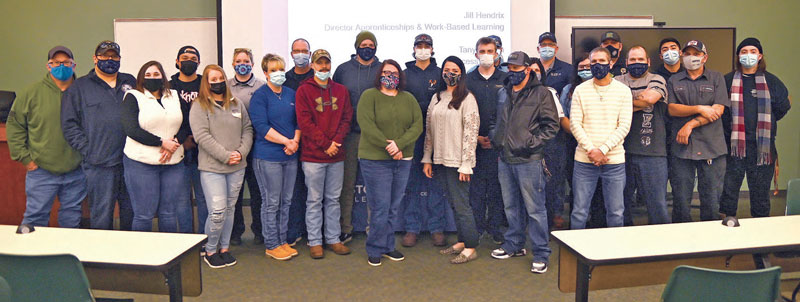
The 2022 attendees at Gaston College’s New Apprenticeship 321 orientation.

In addition to its training activities, Gaston College also offers a unique alternative — the Apprenticeship 321 program. Established in 2015, the program’s goal is to “cultivate highly skilled workers for small to large companies who can enter the workforce immediately upon completing the program.” To date, 108 individuals have completed the program. There are currently 68 apprentices and 25 youth apprentices in training at Gaston, ranging in age from 18 to 62. The youth apprentices are typically high school juniors and seniors who gain exposure to companies looking to hire while also learning specific skill sets.

“The program really offers the best of both worlds,” suggested Jill Hendrix, Gaston’s director, Apprenticeships and Work-Based Learning. “The company selects the individual, hires them and enters them into our apprenticeship program, also identifying a ‘mentor’ for the employee to ‘keep them safe.’ Collectively, the program is selected with related instruction, then we manage it through completion including handling the paperwork, associated standards and documentation.” Successful apprentices can qualify for nationally recognized certifications, academic credentials from Gaston College and a National Career Readiness Certificate. A variety of occupations are currently being offered and a textile-based occupation track is in development.

It should be noted that for many of the options mentioned, costs can vary depending on the content and complexity. There may be scholarships, grants, financial assistance and possibly company sponsorships available to lessen any tuition concerns.

Industry Organization Offerings

Several industry organizations also have established a variety of branded offerings specific to their membership’s interests. The Research Triangle Park, N.C.-based American Association of Textile Chemists and Colorists (AATCC) is involved from both the academics and professional/industry perspectives. AATCC sponsors student chapters at several universities, which provide members with access to digital labs, discounts for conferences, scholarships and grants. On the industry side, AATCC hosts a variety of conferences, workshops and other textile events, each of which provide avenues for education and training activities.

Offerings include digital labs focused on textile and color technologies, processing equipment, quality systems and testing standards. Workshops are more in-depth programs and target those looking to learn something new or refresh their knowledge. Formal conferences tend to be topic specific, which include its annual conference and participation in other organization’s conferences. Also, in 2020, AATCC held its first Textile Discovery Summit, an annual event covering a broad range of textile related topics. The next summit will be held in Charlotte, October 4-6, 2022.

INDA offers on-demand, virtual and in-person training options on topics specific to nonwovens from a variety of industry experts including Chris Plotz, INDA’s director of Education and Technical Affairs.

The Cary, N.C.-based Association of the Nonwoven Fabrics Industry (INDA) also offers an assortment of training and education offerings to  those interested in learning more about nonwovens. “Education and training in general are critical to textiles and nonwovens,” said Chris Plotz, INDA’s director of Education and Technical Affairs and an Adjunct Professor at MIT. “We offer on-demand, virtual and in-person training options on topics specific to nonwovens technologies and applications. Onsite classroom training is conducted at our Cary, N.C., location and we partner with the Nonwovens Institute (NWI) at NC State for hands-on training options.”

INDA, AATCC and other related organizations are basically full-service development sources with subject matter experts and a real world understanding of industry segments. These organizations, as well as the colleges and universities involved in textile industry segments, are generally able to provide a great source of industry knowledge, trends and opportunities through their conferences, white papers, professional services, education/training and apprenticeship offerings. “We’re all always looking to expand interest in the textiles and nonwovens industry and coursework that can spur your senses is always better!” concluded Plotz.

March/April 2022

H&M Versus Zara: Are Premium Fabrics On The Rise?

A recent report compiled by Lectra used Retviews automated benchmarking solution to examine successful strategies in a changing fast-fashion industry.

TW Special Report

In a changing fashion industry, consumer expectations and priorities are shifting, and new opportunities are emerging, driving leading brands to innovate. Factors such as the growing prominence of digital channels, supply chain disruptions and increased social and environmental mindfulness, are shaping the industry’s future. Taking this into consideration, how are leading brands keeping up with the evolving industry and staying ahead of the competition? Two giants, ZARA and H&M continuously lead apparel retail and have successfully bounced back following the global pandemic.

Zara’s parent company Inditex recorded net sales of 11.9 billion euros ($13.2 billion), nearly 8.5 billion euros ($9.4 billion) of which originated from Zara alone, in the first half of 2021. The Spain-based company’s most recent collections even showcased a sales increase 9-percent higher than its 2019 pre-pandemic levels during the same period.

H&M Group, parent company of H&M also moved towards a return to pre-pandemic levels in 2021, with a fourth quarter sales increase of 8 percent in comparison to the same period during the previous year, standing at a sales value of over 5.5 billion euros ($6.1 billion).

Considering both brands’ continued success within an industry where “fast fashion” is widely criticized and where consumers are increasingly concerned about the sustainable aspect of their purchases, how have ZARA and H&M adapted their strategies?

Investing In Quality

ZARA has differentiated its strategy in the past year and has ventured into the introduction of higher end, premium collections such as its Studio Collection or the launch of “ZARA Origins,” its premium concept collection. Partnerships have also been a part of the brand’s strategy this year with its popular limited-edition collaborations with Dutch collective Kassl Editions and South Korea-based streetwear brand ADER Error.

As consumers are gravitating towards investing in timeless and versatile pieces, the Spanish brand increased the share of premium collections and pieces in its assortment by 17 percent throughout 2021, far more than H&M, whose existing premium collection grew by only 2 percent throughout the past year. Placing an emphasis on premium pieces this year, ZARA is leading the growth in higher quality apparel.

Moving Towards Premium Fabrics

Looking at the fabrics that are most prominent in each brand’s assortment, there is an evident similarity between the two, both ZARA and H&M placing the largest emphasis on cotton and polyester, including recycled versions of both fabrics, each making up between 20 percent and 30 percent of the brands’ fabric mix.

However, as the two brands have amped up their higher quality collections, premium fabrics have also gained momentum within both brands’ assortments, namely cashmere, wool and leather. Although H&M has a higher share of products containing cashmere in its assortment, ZARA is close behind, and is significantly increasing investments in premium fabrics, thus solidifying its move towards a more premium positioning.

Sustainability

H&M has kept its focus towards increased sustainability and has developed new initiatives such as its “Innovation Stories” with innovative textiles and design, the Looop recycling system as well as its Circular Design Tool. In 2021, the giant’s sustainable conscious collection made up 21% of its total assortment, whilst ZARA’s Join Life collection represented 16 percent of its total collection. Conveying ambitious goals, the brands are moving towards increased circularity and sustainable innovation, with H&M taking the lead.

However, will this be sufficient to stay ahead of competitors or will the brands need to make more significant changes to put behind the negative connotation of being deemed a “fast fashion” brand?

Premium Pricing Evolution

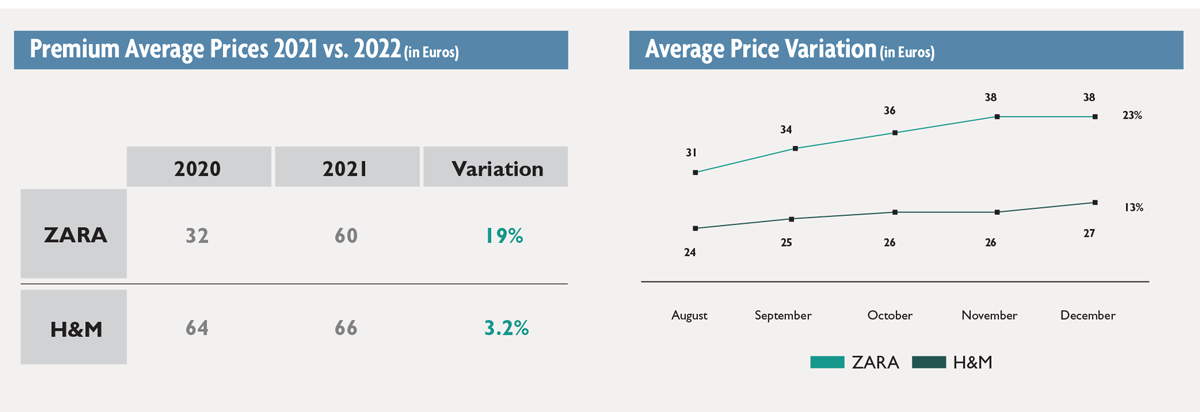
The mass market giants have both increased the size of their premium assortment and with that, these same collections have become more expensive. The use of higher quality fabrics and the collaboration with high-end brands have evidently contributed to an increased price point, with ZARA’s premium pieces being 19 percent more expensive than the previous year. H&M’s premium collection growth has taken a slower pace, and its pricing has only gone up by 3.2 percent throughout the past year. ZARA, quickly expanding its collection of premium quality pieces and collaborations this past year, has seen a major change in pricing for the segment.

How Much More Expensive Is Premium?

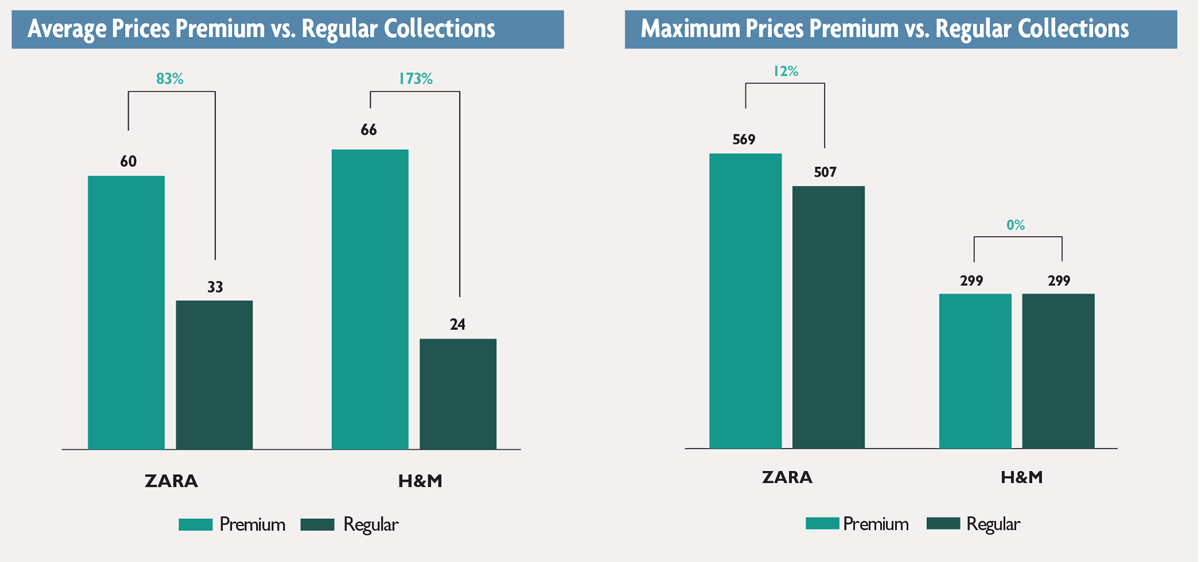
Where does premium quality stand when compared to non-premium collections and is it significantly more expensive? H&M showcases an average price for its premium collection of over three times the price of its regular collection. ZARA’s premium collection stands at a lower average price than H&M, at 83 percent more expensive than its regular collection, which itself has a higher average price than H&M’s regular collection.

With regards to maximum prices, ZARA holds a higher price point for both its regular and premium collections than H&M. Unlike H&M, whose maximum prices do not differ between premium and regular collections, ZARA has a higher maximum price for its premium collection. Within its regular collection, ZARA continuously keeps its prices higher than its Swedish competitor.

The Effect Of The Supply Chain On Prices

Considering the pandemic-driven supply chain disruptions that have started to take a hold of the fashion industry, ZARA and H&M have significantly increased prices throughout the past several months. However, the two brands have very different business models. Zara matches consumer demand with small production numbers, thus bypassing heavy supply chain struggles and allowing the brand to stay on the cusp of each emerging trend. H&M, sourcing a large part of its products in Asia, has been faced with supply chain disruptions and delays, and indicates an overall 13-percent increase in average price, within the past five months.

In ZARA’s case, the increase in its average price was a strong 23 percent, as the brand significantly increased its share of premium fabrics — a major contribution to its price increase, further driven up by the raw material price increase for textiles such as cotton, wool, and recycled fabrics.

A Digital Future

There was a strong pivot towards the digital realm throughout the past year, with an increased prominence of the metaverse in the fashion industry. Key brands like ZARA and H&M are venturing into the metaverse with their digital collections and collaborations. ZARA launched its digital collection with South Korean brand ADER Error, and H&M launched its own sustainability-focused digital collection within the popular game, Animal Crossing.

Considering the current change in consumer behavior, pandemic-induced logistic issues and the increased need for sustainability, market leaders ZARA and H&M are staying ahead of the curve and adapting their strategies, allowing them to outpace competitors. Where ZARA has shifted focus towards a more premium positioning reaching a wider consumer base, H&M has upped the ante on its sustainable initiatives.

Understanding what lies behind the apparel giants’ strategies allows brands to stay on top of the industry. Thanks to Retviews data, fashion retailers can monitor competitors’ assortment, pricing and discount strategies in real time and take the lead in the changing fashion industry.


Editor’s Note: Retviews is an automated benchmarking solution that allows fashion brands and retailers to monitor competitors’ data on assortments, pricing and discounts in real-time. It helps them pinpoint the perfect retail strategy with the right product at the right time and price, save time on competition analysis and make decisions based on accurate, actionable data.


March/April 2022

March/April 2022

Peter Zimmer

Peter Zimmer recently passed away shortly after celebrating his 98th birthday. Zimmer spent some 70 years of his life developing new and revolutionary ideas for textile printing, including rotary-screen-printing technology, a magnetic roll rod system and the Chromotronic — the first digital carpet ink-jet printer. Even in the last decade of his life, Zimmer continued working developing a digital printing/ dyeing system for fiber strands and sliver. His achievements are his legacy.

Ultrafabrics, Tarrytown, N.J., has named Jennifer Hendren senior director of product development. In addition, Theo Haag, based in the Netherlands, was hired as European sales director.

Jenni Brown was appointed head of sales for Northern and Eastern Europe for global workwear manufacturer Carrington Textiles.

Schaumburg, Ill.-based Composites One recently named Leon Garoufalis president and CEO, and Al Dobbeck executive vice president and COO. The company’s former CEO Steve Dehmlow will continue as chairman of the board.

Sagee Aran was named to lead product development and commercialization initiatives for Israel-based nylon 6,6 producer Nilit. In addition, new hire Michelle Lea will direct worldwide marketing programs for the company.

Grand Rapids, Mich.-based X-Rite and Pantone LLC have named Chris Brooks president of X-Rite.

Farrell

Ruth Farrell was promoted to general manager for Kingsport, Tenn.-based Eastman Chemical Co.’s Textile Business. Farrell is based in Switzerland.

England-based Gen 2 Carbon, formerly known as ELG Carbon Fibre, has named Tim King technical sales consultant.

Ocean State Innovations, Portsmouth, R.I., has named Geoff Senko senior vice president of sales. He will be responsible for leading sales in North America and globally while supporting customers in various market segments.

Ashley Goldsmith, executive vice president and chief people officer of Workday Inc., was elected to the board of directors at Kontoor Brands Inc., Greensboro, N.C.

Mannington Commercial, Calhoun, Ga., has appointed Shane Totten to the new role of director of sustainability.

Peter B. McKernan was recently promoted to director of Supply Chain Management for Herculite Products Inc., Emigsville, Pa. He is responsible for managing all corporate planning and forecasting, and planned capacity scheduling.

Italy-based Kemin Industries has named Valter Dompè president of its Garmon Chemicals textile auxiliaries business unit. Dompè replaces Kimberly Nelson who has moved into a new role in another Kemin Industries’ business unit

Posa

Bast Fibre Technologies Inc., Victoria, British Columbia, named James Posa president and CEO. Company Cofounder and Former CEO Noel Hall has transitioned to executive chair.

Dr. Jonathan Goff was promoted from chief technology officer to president of Gelest Inc., Morrisville, Pa.

Delta Apparel Inc., Greenville, S.C., has named Simone Walsh vice president, CFO and treasurer.

Jeffrey W. Bruner — president of Hemp Black and 1973 graduate of the Kanbar College of Design, Engineering and Commerce — will be honored with a Leaders of Innovation Medal from Thomas Jefferson University at the end of April. The medal is presented to graduates who “make significant or trendsetting contributions to education, industry or other professional fields that exemplify Thomas Jefferson University’s mission and innovative spirit.”

The Association of the Nonwoven Fabrics Industry (INDA), Cary, N.C., named experienced policy advocate Jennifer “Jen” Greenamoyer director of Government Affairs.

Chadd Coltrain was named director of Strategic Global Sales for Culp Home Fashions, the mattress fabrics division of Culp Inc., High Point, N.C.

Following the acquisition of England-based MagnaColors by Avient Corp., Gustavo Figueroa has transitioned from Avient to MagnaColours’ team as Business Development manager for the Americas.

Avery Dennison, Glendale, Calif., named Deon Stander president and COO.

March/April 2022

Circuitex®: Conductive Shielding

A close up of Circuitex® fabric

Noble Biomaterials’ Circuitex® can shield against high-frequency energy waves from directed-energy weapons.

By Rachael S. Davis, Executive Editor

Circuitex® was designed by Scranton, Pa.-based Noble Biomaterials Inc. for multi-spectral energy management. While the technology is not new, the company recently announced that Circuitex fabric and foam technologies are capable of reflecting high-frequency energy waves similar to those presumed responsible for the Havana Syndrome attacks produced by directed-energy weapons (DEW).

Circuitex advanced materials can move electrical energy and data through soft surface materials without the assistance of wires, making them suitable as either a conductive energy material or a conductive shielding material. The highly conductive materials are also flexible and super lightweight. According to Noble, the shielding effects of Circuitex perform across a broad range of the electromagnetic spectrum from 30 megaHertz up to 30 gigaHertz.

The genesis of Noble Biomaterials was in using silver to metalize fibers for antimicrobial consumer apparel applications. The company spent two years developing its proprietary technology, which bonds pure silver to the surface of a polymer. The innovation allowed Noble to capitalize on the antimicrobial effects of silver for apparel applications. From those beginnings, the company’s technologies have expanded into a variety of medical and antimicrobial products supplied to the U.S. Military and healthcare industry, while its consumer anti-odor business continues to thrive.

Circuitex® fibers

“We have always been in the intelligent fabrics business,” said Allon Cohne, chief marketing officer, Noble Biomaterials. “From preventing infections to eliminating odor to improving telecommunications, our technology adapts to provide a myriad of benefits. The more we learned about the technology, the more obvious it became that it would be a perfect platform to manage electromagnetic energy waves in order to solve some of the most challenging military and aerospace issues.”

Circuitex is typically used in applications requiring more than antimicrobial properties. Copper and other antioxidant minerals can be bonded to the polymer as well as silver depending on the required characteristics. “The core technology used for the Circuitex products is similar to the antimicrobial offerings, but we use a variety of polymer substrates, mineral-based active ingredients, and bonding techniques to optimize for very specific, and different, performance requirements” Cohne said.

Circuitex is available in fiber, fabric or foam options. “Most commonly, customers will incorporate our continuous filament fiber into fabrics, or simply purchase fully metalized fabrics from us, depending on their requirements” Cohne noted. “Foam could be used as a backing or layer in a laminate.”

In response to the growing threat of Havana Syndrome, Noble developed passive and active mitigation systems with the ability to counter DEW attacks in fixed and mobile locations.

“Circuitex is proven effective in mission-critical military and aerospace applications,” said Joel Furey, founder and chief commercial officer, Noble Biomaterials. “Noble Biomaterials has spent years developing multi-spectral energy management systems for security and protection. Whether the objective is to transfer or shield energy, our portfolio of products is uniquely suited to deal with the challenges of directed energy.”


For more information about Circuitex® visit noblebiomaterials.com


March/April 2022


Macy’s Announces $584 Million Investment To Build A Major East Coast Fulfillment Center In Rowan County, N.C.

RALEIGH, N.C. — March 31, 2022 — Macy’s Inc., the iconic American retailer, will invest more than $584 million to build its first automated fulfillment center in the Town of China Grove, N.C., Governor Roy Cooper announced today. Once fully operational, the company says it plans to employ 2,800 new jobs in Rowan County.

“We are delighted to welcome Macy’s and its state-of-the-art facility to North Carolina,” said Governor Cooper. “When you combine our robust transportation network with our skilled workforce and great quality of life, economic development wins like these will continue to be celebrated statewide.”

Macy’s Inc. operates one of retail’s largest e-commerce businesses integrated with a nationwide footprint of stores and fulfillment centers to deliver the most convenient and seamless shopping experiences. Macy’s expansion to North Carolina will locate a new 1.4 million square-foot automated fulfillment center to ship orders directly to customers nationwide, accounting for nearly 30 percent of the retailer’s digital supply chain capacity once fully operational.

“This state-of-the-art facility is a significant milestone for Macy’s Inc. as we invest in strengthening our omnichannel ecosystem. It will support growth of our business as a leading omnichannel retailer,” said Dennis Mullahy, Macy’s chief supply chain officer. “We are delighted to become a member of the China Grove community and look forward to partnering with local and state officials to bring jobs and drive opportunity for local residents.”

“When companies want to expand their operations and reach customers faster, North Carolina is always a top choice,” said N.C. Commerce Secretary Machelle Baker Sanders. “In addition to an inclusive workforce training system to help increase resiliency, North Carolina boasts a prime location that places iconic brands within a day’s drive of more than 170 million customers, alleviating supply chain issues and helping them maintain a continuity of operations.”

The North Carolina Department of Commerce led the state’s efforts to support Macy’s location to North Carolina. Salaries for the new positions will vary, but the project could create a potential annual payroll impact of more than $93 million per year for the region.

Macy’s expansion will be facilitated, in part, by a Job Development Investment Grant (JDIG) approved by the state’s Economic Investment Committee earlier today. Using a formula that takes into account $564 million of the company’s investment as well as the new tax revenues generated by 230 JDIG-qualified jobs, the JDIG agreement authorizes the potential reimbursement to the company of up to $2,313,000 spread over 12 years. Payments for all JDIGs only occur following performance verification by the departments of Commerce and Revenue that the company has met its incremental job creation and investment targets. JDIG projects result in positive net tax revenue to the state treasury, even after taking into consideration the grant’s reimbursement payments to a given company.

Macy’s is locating to Rowan County, classified by the state’s economic tier system as Tier 2, the company’s JDIG agreement also calls for moving $257,000 into the state’s Industrial Development Fund – Utility Account. The Utility Account helps rural communities across the state finance necessary infrastructure upgrades to attract future business.

“Macy’s multimillion-dollar investment is a strong vote of confidence in Rowan County,” said N.C. Senator Carl Ford. “I am grateful for the diligent collaboration of local, state, and company officials that helped bring this project to our community.”

“This is yet another great win for North Carolina and Rowan County,” said N.C. Representative Harry Warren. “Our region is home to incredible talent that are ready to fill these new positions and support Macy’s growth strategy. Many thanks to our great local economic development folks, Rod Crider, County Commission Chairman Greg Edds, and their respective teams for the excellent work they continue to do bringing great companies to Rowan County.”

In addition to the North Carolina Department of Commerce and the Economic Development Partnership of North Carolina, other key partners in the project include the North Carolina General Assembly, the North Carolina Department of Transportation, the North Carolina Community College System, Rowan-Cabarrus Community College, Rowan County, Town of China Grove, Rowan Economic Development Council, Duke Energy, Dominion Energy, Salisbury-Rowan Utilities, and Centralina Workforce Development Board.

Posted: March 31, 2022

Source: North Carolina Office of the Governor

Mizzen+Main Appoints Former Under Armour Executive Noreen Naz Naroo-Pucci As Chief Design Officer

DALLAS — March 31, 2022 — Mizzen+Main today announced the appointment of Noreen Naz Naroo-Pucci as new chief design officer, effective April 4, 2022. Naroo-Pucci, a veteran of the retail industry, was senior creative director and then vice president of Global Design Engine for Under Armour Inc. from 2008-2018. Most recently, she was the senior vice president of Design Menswear – North America for Calvin Klein, as well as co-founder and chief creative officer of KIK Axion Sports.

She joins a rapidly growing team that has already made an extraordinary impact in menswear and the apparel industry overall.

“Noreen is an industry leading talent that will drive Mizzen+Main to new heights, integrating and improving product, brand, and design in exceptional new ways. We’ve admired her work and look forward to her leadership on our team,” commented Founder and Chairman Kevin Lavelle.

“The team at Mizzen and the brand promise of creating the best-in-class product and the opportunity at hand has no ceiling,” Naroo-Pucci said. “Mizzen is the perfect storm of craft and purpose. We have the opportunity to take the art of being well dressed into the future, and I am super excited to see where we can take our modern Mizzen man by simply making and giving him beautiful, desirable, and meaningful products — all with purpose.”

The Mizzen+Main team is excited to add a high caliber global creative leader. As the brand continues to grow, Naroo-Pucci’s track record of commercial success as a visionary will help improve both the company’s products and brands at every level.

Having played a critical part in growing the Under Armour brand from $600million to $5billion in global revenue, Naroo-Pucci is eager to build again. And the Mizzen+Main team is all behind her.

Posted: March 31, 2022

Source: Mizzen+Main

Canada Goose Strengthens Executive Team, Appoints Carrie Baker President

TORONTO — March 31, 2022 — Today, as a part of its continued global expansion, Canada Goose Holdings Inc. has announced the appointment of Carrie Baker to president, Canada Goose, effectively immediately. The role will report to Dani Reiss, chairman and CEO, Canada Goose.

This announcement enhances the executive structure to accelerate its next phase of global growth. Dani Reiss will continue to oversee all aspects of the business, operations and strategy — with a consolidation of commercial leadership and marketing under Baker.

“Carrie has played an instrumental role in making Canada Goose the business it is today. She is a dynamic leader and proven operator, and I am excited to partner with her in executing the Company’s bold vision,” said Dani Reiss, chairman and CEO, Canada Goose. “This change in structure marks an important inflection point for Canada Goose, on our way to the next milestone.”

In her most recent role Baker was responsible for accelerating the North American business, one of the company’s fastest growing regions, achieving 36 per cent revenue growth in the first three quarters of fiscal 2022. A company veteran, Baker has been with Canada Goose for more than 10 years, having also held positions of executive vice president, chief of staff, and chief communications officer. Recognized as a strategic and collaborative leader through key stages of the company’s growth, Baker has helped lead critical initiatives including the company’s IPO and the development of its industry-leading Sustainable Impact Strategy.

“Seeing the company’s growth around the world and expansion into new categories over the last ten years, Canada Goose is truly a brand like no other,” Baker said. “I am proud of the incredible brand momentum we’ve built over the last decade, and our proven success in establishing sustainable industry standards, but it’s only the beginning — I am truly excited to unlock the incredible opportunity ahead of us.”

Ana Mihaljevic will assume the dual role of president, North America and executive vice president, sales operations & planning, expanding her operational leadership experience in Canada Goose’s most established commercial market. With almost two decades of experience, Ana has a strong track record of driving commercial performance and has played a pivotal role in establishing the Company’s insights, sales operations and planning functions as the Company has accelerated its direct-to-consumer business.

Posted: March 31, 2022

Source: Canada Goose

Oerlikon Publishes Sustainability Report 2021

PFÄFFIKON & SCHWYZ, Switzerland — March 31, 2022 — Oerlikon has published today its Sustainability Report 2021, outlining the progress and achievements of the company in environmental, social and governance topics.

“Sustainability is an inherent part of our strategy and technologies, which is reflected in our solutions for customers and in our own operations,” said Georg Stausberg, chief sustainability officer and CEO of Oerlikon’s Polymer Processing Solutions Division. “On our journey toward our 2030 targets, I am very pleased that we have made excellent progress in our sustainability achievements, initiatives and processes in 2021, especially against the challenging COVID-19 pandemic backdrop.”

In 2021, Oerlikon demonstrated that it was well equipped to respond swiftly and effectively to the pandemic to ensure the safety, health and well-being of its employees, customers, vendors and communities, and with minimal disruption to its operations and business.

In Oerlikon’s approach to sustainable innovation, collaboration remains a hallmark as the company remains focused on extending tool life, reducing fuel consumption in cars and airplanes, improving textile machinery efficiency, increasing recycling of fibers and materials and pioneering future technologies. In the report, there are many case studies and examples of how Oerlikon continues to help customers with cost-effective and climate-friendly solutions and services to build their business in key markets.

“We will continue to engineer solutions that contribute to a more sustainable planet, and further work on our environmental, social and governance performance in our operations in pursuit of the 2030 targets we have set for ourselves,” added Stausberg. “We recognize the need to implement improvements on an ongoing basis — that sustainability is not a sprint toward the finish line but a continuum on our journey to make Oerlikon a more sustainable and responsible company for all our stakeholders.”

Please find the online and PDF (download) version of the report on Oerlikon’s website: oerlikon.com/sustainabilityreport-2021

Posted: March 31, 2022

Source: Oerlikon

Ascend Agrees To Acquire Formulated Polymers Ltd.

HOUSTON — March 29, 2022 — Ascend Performance Materials has reached an agreement to acquire the compounding division of Formulated Polymers Ltd., an engineered materials manufacturer in Chennai, India. This acquisition will establish Ascend’s first manufacturing base in the subcontinent and strengthen Ascend’s global reach in the electrical and e-mobility application space.

The deal includes a world-scale manufacturing facility in Chennai as well as warehouses throughout India. Formulated Polymers, which has operated over three decades as a polyamide compounder in India, is currently a licensee of Ascend’s Starflam® flame-retardant polyamides.

“Demand for our materials in India is strong and growing,” said Phil McDivitt, Ascend’s president and CEO. “The team at Formulated Polymers has built an excellent, diversified business with a proven track record of technology development in polyamides. We are excited to build on their expertise to drive additional value-added growth in India and beyond.”

Ascend, a fully integrated producer of durable engineered materials, has grown its global production footprint with five acquisitions over the last four years, each focused on specific synergies with the company’s core business. This acquisition provides a significant growth opportunity for Ascend in India, one of the highest growth economies in the world.

“Being customer-focused is one of our values,” said John Saunders, Ascend’s vice president for Europe, the Middle East, North Africa and India. “We look forward to supporting our customers in a fast-growing market by continuing to invest in capacity, technical resources and product development to meet their needs.”

The deal is expected to close on May 1, after receiving necessary approvals. Terms of the agreement were not disclosed.

Posted: March 31, 2022

Source: Ascend Performance Materials

Sponsors