Weaving A Network Of Circularity

The Swiss Textile Recycling Ecosystem is a network comprising fabric and textile manufacturers, waste collectors and sorters, as well as retailers, brand owners and technology providers. (Image Source: shutterstock_2019164822)

Worn Again Technologies initiates Swiss Textile Recycling Ecosystem

TW Special Report

Worn Again Technologies (WAT) has announced the launch of the Swiss Textile Recycling Ecosystem. Bringing together key industry players across the entire textile value chain, the initiative will support the creation of a circular economy based on Worn Again Technologies’ innovative polymer recycling technology.

To cause a paradigm shift in the fashion industry and realize true circularity requires all members of the value chain to be on the same page and working towards the same goals. The Swiss Textile Recycling Ecosystem is a network comprising fabric and textile manufacturers, waste collectors and sorters, as well as retailers, brand owners and technology providers. All these parties will cooperate to make their shared sustainability vision for the sector a reality.

The partners will provide different types of textile waste to Worn Again Technologies’ demonstration plant, which will process 1,000 metric tons of material per year and is being built near the WAT’s technology scale-up partner, Sulzer Chemtech in Winterthur, Switzerland. After advanced chemical processing, virgin-like recycled fibers, such as polyethylene terephthalate (PET) and cellulose, will be provided to the same industry players to produce new high-quality fabrics.

The creation of Swiss Textile Recycling Ecosystem marks a key milestone in the upscaling of Worn Again Technologies’ recycling process technology.

More precisely, the consortium will be composed of WAT’s main shareholders, Sulzer, Oerlikon and H&M Group. In addition, Rieter will support short-staple spinning, Monosuisse will take care of PET fiber production, Coop will act as retailer, TEXAID will manage collection, sorting and provide feedstock together with Sallmann (ISA) and Serge Ferrari – all coordinated by Swiss Textiles.

The creation of Swiss Textile Recycling Ecosystem marks a key milestone in the upscaling of Worn Again Technologies’ recycling process technology. It also supports its ambition to create a circular economy where non-reusable, hard-to-recycle textiles can be reintroduced into supply chains to become new fibers, textiles and other products.

The construction of Worn Again Technologies’ first demonstration plant will start this year in Winterthur, Switzerland. This represents a crucial step towards upscaling and commercializing the company’s recycling process technology.
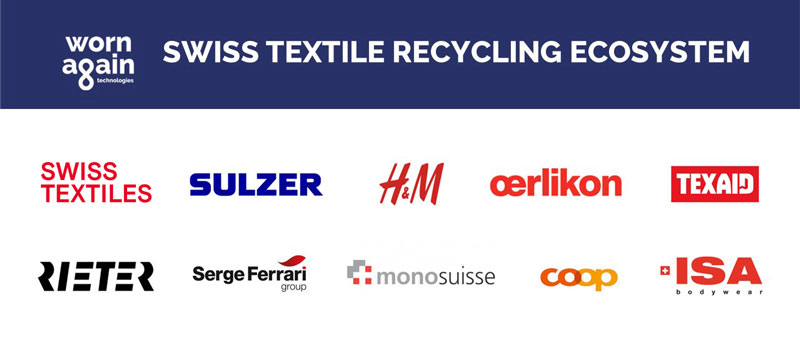
Bringing together key industry players across the entire textile value chain, the initiative will support the creation of a circular economy based on Worn Again Technologies’ innovative polymer recycling technology.

Erik Koep, CEO at Worn Again Technologies, comments: “Launching the Swiss Textile Recycling Ecosystem is a vision coming true. This leading group of likeminded organizations will help to shift the fashion industry from traditional, linear product lifecycle models to eco-conscious, circular material management. We believe that zero waste strategies can only become a reality if the entire sector is committed to acting as a whole. We see the Ecosystem as a way to align sustainability efforts across the whole textile value chain and as the next step towards a green fashion industry.”

Torsten Wintergerste, Chairman of Worn Again Technologies and Division President at Sulzer Chemtech, adds: “We look forward to working together with all members of the Swiss Textile Recycling Ecosystem. Their support is extremely valuable and their trust in our project is much appreciated. The Ecosystem members will support our textile recycling demonstration facility by providing textile waste that can be used as feedstock. The collaboration will also play a key role in scaling up our capabilities and building a network to support the implementation of industrial-scale plants globally.”

July 28, 2022

Lean Manufacturing Losing Pulling Power

New approach required to ensure a steady supply

By Claudia Jarrett

According to Opportimes.com, a strong rebound in global demand, supply disruptions and depletion of inventories have driven up raw material prices and transportation costs around the world — especially in North America. An increase in the price of raw materials, coupled with increasing uncertainty in manufacturing supply chains, has led many to rethink their stock management. Plant managers should consider the alternatives to lean manufacturing.

Lean manufacturing, which was previously coined just-in-time (JIT) manufacturing, was originally developed by Toyota in 1970. It is a production method designed to help reduce production time, while reducing response times to customers and suppliers. JIT also encourages manufacturers to order parts only when needed, as close as possible to the point of assembly, so there is minimal stock held in inventory.

Simply put, the strategy aims to increase efficiency by eliminating waste, optimizing processes and cutting costs. This is achieved by producing only what is in demand and not overstocking. By reducing the production time, the method improves the productivity rate and helps increase profits. In turn, lean manufacturing has been a popular method for manufacturers to ensure products are received only at the time needed, saving space in their inventories and reducing time in the production cycle.

The Current Landscape

COVID-19 exposed problems in lean manufacturing that have caused manufacturers to reconsider this methodology. JIT is built on forecast demand which, while reliable in the past, has now become more unpredictable. This is because forecast is based on historical data, but unpredictable social and political upheavals, such as the national lockdowns and conflict in Ukraine, mean that this data can no longer be relied on to the same extent. However, there are a few strategies to prevent stockouts even given the current levels of uncertainty over the future.

Manufacturers are now after alternatives to ensure components are in continuous supply. Conventional approaches, such as just-in-case (JIC), where manufacturers create a stockpile of components, also provide their own set of challenges. Businesses are instead wanting a middle ground, which offers reliability without reducing profits.

A solution is moving to nearshoring or reshoring. A supplier closer to production can significantly lower replenishment times and deliver parts faster at times of need. The issue of shipping parts has always hindered faster cycle times, while relying on suppliers overseas can add shipping time and coordination complexity.

Manufacturers can also implement a supply chain that operates on a global level, but also adapts to local demand. This is what we call a “glocal” supply chain. Companies like EU Automation rely on a reliable network of global suppliers and work with international sales experts, that speak more than 20 languages, to overcome linguistic and cultural barriers. Operating from four different locations — including the US — we offer manufacturers both the knowledge of global demand and local markets to ensure the right quantity of stock is delivered on time.

New methodology

By offering visibility over production, newer automation technologies can also help manufacturers decrease lead times and stay afloat during unexpected events. This provides manufacturers with the ability to target specific areas of production that need improving. Moreover, awareness of a component’s journey throughout a warehouse offers insight into waste and consumption rates.

Automated replenishment ensures businesses can manage warehouse assets. Automated devices identify components in short supply, before automatically reordering them from the distributor. This helps production managers to cope with demand, without worrying about component shortage.

Disruptions are likely to affect manufacturing for many months to come, and while manufacturers enjoyed the benefits of JIT production and lean manufacturing for many years, times have changed.

We are now living in an era where alternative approaches must be considered for a steady supply, with the reality being that supply chain difficulties and component shortages will likely persist for some time. Therefore, it is essential for manufacturers to adapt their stock management to avoid downtime and reduce delays — and consider the benefits of alternative approaches.

Editor’s Note: Claudia Jarrett is U.S. country manager at industrial parts supplier EU Automation.

July 28, 2022


Insempra Announces Strategic Investment In Solena Materials

MUNICH — July 26, 2022 — Insempra, a biology-powered company enabling businesses to make superior products in partnership with nature, today announces a strategic investment in Solena Materials Ltd., a synthetic biology company. Solena, a spin-out from Imperial College London, develops synthetic proteins for high-performance clothing fibers.

The investment will allow Insempra, formerly Origin.Bio, to accelerate its strategy of harnessing new technologies to advance biological production processes, creating naturally superior products to drive the regenerative revolution. Solena will be a major part of Insempra’s platform to deliver high-performance, intrinsically sustainable ingredients for a broad array of industries.

Solena is using computational design to develop new classes of synthetic proteins to produce high-performance clothing fibers, which can absorb large amounts of kinetic energy. Insempra will accelerate the development and production of these synthetic proteins on an industrial scale, offering better, biobased solutions to the petrochemically sourced, non-biodegradable materials or fibers extracted from nature or animals, such as silk, currently used in the textile and clothing industries. This technology also reduces other environmental impacts such as the rise of microplastics in water bodies coming from washing petrochemically-sourced textiles.

Jens Klein, founder and CEO of Insempra and CEO of Solena Materials, commented: “We are hugely excited by this investment in Solena, which will help to accelerate our market-first approach to develop superior, intrinsically sustainable ingredients. We look forward to fast-tracking Solena’s development and production of their unique synthetic proteins to develop customized, high-performance fibers for a variety of applications.”

Dr. James MacDonald, inventor, co-founder and CTO of Solena Materials, added: “The team and I are very excited to make this technology a huge success.”

Professor Paul Freemont of Imperial College London, added: “This investment from Insempra recognizes the potential of our technology to revolutionize high-performance fabrics, and their supply chains. Together, we can harness our synthetic biology capabilities to develop, produce and manufacture a new class of superior, more sustainable fiber technology.”

Insempra, a co-founder of Solena, will be the sole contributing shareholder in Solena, which is based at Imperial College’s Translation & Innovation Hub (I-HUB) in White City, London. Solena’s Board will be comprised of Dr James MacDonald of Solena, Professor Paul Freemont and Professor Milo Shaffer of Imperial College London, and Jens Klein and Andreas Heyl of Insempra.

Posted: July 27, 2022

Source: Insempra

Columbia Sportswear Company Releases 2021 Environmental, Social, And Governance Report

PORTLAND, Ore. — July 27, 2022 — Columbia Sportswear Co. today released its 2021 Environmental, Social, and Governance (ESG) Report, which includes performance highlights and progress made throughout 2021 in the three pillars of its corporate responsibility strategy — Empowering People, Sustaining Places, and Responsible Practices.

The year 2021 proved to be another challenging year with operations across the globe affected by the pandemic, but ESG remained a priority for Columbia Sportswear.

“Despite facing challenges, the company had its best year in history, and we did so while maintaining our commitment to environmental, social, and governance issues. We proved, once again, that by living our core value of Doing the Right Thing, we can thrive and do well by our people, places and practices,” said Tim Boyle, chairman, president and CEO.

The report highlights work accomplished by its four primary brands — Columbia, SOREL, Mountain Hardwear and prAna. In 2021, Columbia Sportswear:

  • Finalized one Carbon Leadership Project program and one Clean by Design program with two cohorts of manufacturing partners at the Tier 1 and Tier 2 levels to help the partners reduce their environmental impact. Reduction in emissions by the Company’s manufacturing partners will help it to meet its previously established manufacturing climate target of a 30-percent reduction in manufacturing emissions by 2030, as compared to a 2019 baseline.
  • Introduced the Coalition of Asian & Pacific Islander Employee Resource Group, bringing the total number of Employee Resource Groups to seven.
  • Built two new water towers in supply chain locations to bring clean water to the children of our manufacturing partners and their employees with the Planet Water Foundation, bringing the total number of water towers built to 24.
  • Coordinated COVID-19 community vaccine clinics in Portland, OR and launched an educational campaign encouraging all employees to get vaccinated.

Posted: July 27, 2022

Source: Columbia Sportswear Co.

Delta Galil Acquires Sustainable Clothing Brand Organic Basics

TEL AVIV, Israel — July 26, 2022 — Delta Galil Industries Ltd. — the global manufacturer and marketer of branded and private label apparel products for men, women and children, as well as leisurewear, activewear and denim — today announced that it has acquired the Organic Basics brand and certain assets. Terms of the deal were not disclosed. Founded in Denmark by three young entrepreneurs in 2015, the digitally native brand is known for its sustainably, ethically made women’s and men’s underwear, activewear and base layers. Delta Galil plans to bring this strong brand to consumers worldwide and to extend the Organic Basics product line to include items for babies and kids as well as additional items for women and men. The collection will launch globally in 2023.

“Organic Basics is a digital brand with sustainability and ethical production at its core and these values align perfectly with Delta Galil’s focus on creating a more sustainable fashion industry through innovation,” said Isaac Dabah, CEO of Delta Galil Industries. “We see a significant opportunity to grow the Organic Basics brand globally, particularly in the US and Europe, and to expand the product line to include items for the whole family. Our goal is to sell affordable, sustainable, organic products direct to the consumer.”

A certified B Corp, Organic Basics is also Global Organic Textile Standard (GOTS) certified and a member of 1% for the Planet. The brand has built a strong reputation and following for its use of responsibly, ethically sourced and certified materials, including organic cotton and natural dyes, and its commitment to minimizing its carbon footprint and impact on the planet.

More than 75 percent of the materials used to manufacture Organic Basics items are plant-based, while more than 15 percent are recycled. The brand assortment includes ultrasoft, comfortable women’s underwear, bralettes, sports bras, tees and socks and men’s underwear and tees.

In recent years, Delta Galil has focused on strategically building its e-commerce presence, investing in its owned brands’ digital offerings and in strategic M&A transactions.

Posted: July 26, 2022

Source: Delta Galil Industries, Ltd.

Atlas Introduces Sealed Lamp Technology For The Ci4000 And Ci4400 Weather-Ometer® Instruments

MOUNT PROSPECT, Ill. — July 26, 2022 — Atlas has just introduced Sealed Lamps for its Ci4000 and Ci4400 Weather-Ometers®. The unique preassembled design makes the world’s most-advanced weathering instruments even easier to operate and maintain.

The Ci4000 and Ci4400 Weather-Ometers currently use interchangeable glass filters attenuating the xenon light spectrum to closely match light conditions of a product’s end-use environment.

The process of changing filters requires taking apart the lamp assembly, which includes the xenon-arc lamp, inner glass filter, outer glass filter, and associated hardware. It can be quite tedious and offers the potential for human error resulting in lamp or filter breakage or incorrect filter installation.

The new Atlas Sealed Lamp incorporates all assembly elements into a single, factory-sealed unit. The advantages are significant:

  • Simplified installation – just plug and play;
  • No assembly/disassembly errors;
  • Less downtime;
  • Reduced accidental breakage or premature failure due to mishandling;
  • Repeatable test conditions due to minimal handling; and
  • Easy identification of filter combinations and part numbers.

The initial roll-out of the Atlas Sealed Lamp will include the Type S Boro (Inner)/Type S Boro (Outer) and Right Light (Inner)/Quartz (Outer) filter combinations. Each Atlas Sealed Lamp is a direct replacement for its corresponding lamp/filter assembly and includes the same 1,200 light-hour warranty.

Posted: July 26, 2022

Source: Atlas Material Testing Technology

Hyosung Creora® Bio-Based Spandex Receives First Global SGS Certification

SEOUL — July 26, 2022 — Hyosung has received eco-product certification from Standard Global Services (SGS) guaranteeing that creora® biobased spandex is made with plant-based materials and is produced in a harmless and eco-friendly environment. SGS, a leading inspection and verification company, is recognized world-wide for providing an international standard for quality and reliability.

Hyosung’s creora biobased spandex is made by replacing 30 percent of petroleum-based resources with biobased raw materials derived from industrial field corn, which is also called dent corn. According to a recent third-party life cycle assessment (LCA), the manufacture of creora biobased spandex reduces its carbon footprint by 23 percent as compared to the production of regular spandex.

Additionally, the sustainably grown feed-stock used to make the fiber is responsibly grown by farmers who target and measure their efforts to protect the land, air and water.

“Brands are looking to develop deeper connections and trust with consumers concerned with how products they love impact the environment,” said Mike Simko, Hyosung Global Marketing director, Textiles. “As a sustainable textile solution provider, it was very important for us to certify and document creora® bio-based spandex so that our brand partners are able to pass along this verification and sustain consumer loyalty.”

While ideally used with other bioderived natural fibers and bio-derived synthetics, creora bio-based spandex is suitable for all textile applications used for sportswear, ready to wear, and loungewear. It provides the same ultra-stretch quality and recovery as Hyosung’s creora Powerfit spandex.

According to Simko, Hyosung is planning on introducing creora biobased spandex made with 100-percent bio-derived content in the future.

Posted: July 26, 2022

Source: Hyosung

BASF Commits $780 Million To Complete Geismar, Louisiana Chemical Plant Expansion

GEISMAR, La. — July 19, 2022 — BASF announced a final investment decision on a $780 million project to double production capacity at its chemical manufacturing complex in Ascension Parish, marking the beginning of the third and final phase of an expansion plan announced in 2018. Counting all three expansion phases and other site investments, BASF will retain more than 1,000 existing jobs and add 37 new direct jobs with average annual salaries from $86,600 to $105,600 per year, plus benefits. LED estimates that the total project plan will result in 147 new indirect jobs, for a total of 184 new jobs in the Capital Region.

Upon completion, BASF’s Geismar Verbund site – signifying the physical integration of production, market platforms and technologies that tie the business together – will be able to produce 600,000 metric tons per year of methylene diphenyl diisocyanate (MDI). MDI is an important component for polyurethanes, a versatile, lightweight plastics material used for insulation and a variety of other industrial and consumer products.

“BASF is one of the largest chemical companies in the world, and this substantial reinvestment in its Geismar complex speaks volumes about the strength of Louisiana’s advanced manufacturing sector,” Gov. John Bel Edwards said. “By increasing production of a material vital to the creation of energy-efficient products, BASF has positioned our state as an important contributor to the global sustainability supply chain. That is a win for workers and their families in the Capital Region, and for the state’s economy as a whole.”

The company said in its announcement that the seven-year expansion project – representing more than $1 billion in combined capital investment – will allow it to meet growing North American demand for its products in construction, appliance, transportation, automotive and other sectors.

“Thanks to our strategic location and infrastructure, access to competitive raw materials, highly-skilled workforce and strong government support, BASF has now invested more than $2 billion in new projects and improvements at the Geismar site since 2009,” said Jerry Lebold, BASF’s Senior Vice President and General Manager at the Geismar site. “This continued investment demonstrates our commitment to our employees, our community and our presence in Louisiana which is more than 60 years strong.”

Construction will begin this year and is expected to be complete by mid-2025. The expanded facility will utilize leading-edge technology that combines the highest safety standards with advanced digitalization in its operations, the company said.

To secure the final phase of the BASF expansion project, the State of Louisiana offered a competitive incentive package that includes a $1 million Retention and Modernization Tax Credit, to be claimed in equal installments over five years. BASF also is expected to utilize Louisiana’s Industrial Tax Exemption and Quality Jobs programs.

“As both a top employer and taxpayer, BASF is an economic engine for Ascension Parish,” Parish President Clint Cointment said. “Working together to facilitate growth opportunities like this series of MDI investments is key to our continued success in sustainable manufacturing and quality local employment opportunities.”

“BASF continues to demonstrate its commitment to community by operating responsibly, hiring locally and donating time and resources to local programs and organizations,” said Kate MacArthur, president and CEO of the Ascension Economic Development Corp. “The company’s commitment to sustainability and reliability in product line investments mirrors its efforts in community advancement.”

“We are fortunate to have BASF in the Capital Region and it’s very positive to see them continue to invest in Louisiana for production of more sustainable products,” said Adam Knapp, president and CEO of the Baton Rouge Area Chamber. “The company’s expansion capitalizes on the region’s skilled workforce and strong supply chain.”

Posted: July 25, 2022

Source: Louisiana Office of the Governor


Anthropologie Announces Collaboration with Cotton Incorporated’s Blue Jeans Go Green™ Program

PHILADELPHIA — July 25, 2022 — Anthropologie is pleased to announce their collaboration with Cotton Incorporated’s Blue Jeans Go Green™ program: an initiative at the forefront of denim recycling. Beginning today, Anthropologie customers are invited to bring in their pre-loved denim to any of the brand’s 200+ US retail locations to be recycled into insulation materials used in various applications through Cotton Incorporated’s consumer sustainability program.

Earlier this year, Anthropologie announced its A Greater Good platform, which details their journey to becoming more environmentally sustainable and socially conscious. Through conservation initiatives, partnering with a diverse array of non-profit partners, and working to ensure the products they sell are ethically sourced, the brand hopes to incite meaningful change.

In support of their A Greater Good platform, Anthropologie aims to launch their denim circularity initiative, support their waste-reduction initiatives, and reduce their environmental impact. Aiming to divert denim waste from landfills and turn old denim into something new, the brand will bring together their loyal community and engaged social network to amplify this nationwide sustainability effort.

“At Anthropologie we are committed to creating a more sustainable future and being mindful of our environmental impact on the planet across our business operations,” states Elizabeth Preis, Anthropologie’s Chief Marketing Officer.  “We are continually ideating new and inventive ways to enforce sustainability efforts across all facets of our brand’s ecosystem by repurposing reclaimed objects into imaginative displays in our stores, utilizing upcycled materials in our one-of-a-kind windows, and transforming everyday materials into unique and surprising packaging. We are thrilled to be working with Cotton’s Blue Jeans Go Green™ program to extend the lifecycle of jeans by collecting unwanted denim from our devoted community which will be recycled to create something new.”

“As part of their ongoing commitment to sustainability, we are thrilled to have Anthropologie participate in the Blue Jeans Go Green™ program as they introduce denim recycling to their customers,” says Andrea Samber, director of consumer marketing, brand partnerships for Cotton Incorporated.  “While denim, made from cotton, is natural, sustainable, and durable, we know consumers change preference in style, size, or it can just get worn to the point that it’s time to move out of the closet.  By reimagining what their old denim can do, their customers can reduce textile waste and close the loop on cotton sustainability, ensuring Anthropologie’s continued mindfulness about their environmental impact.”

Today through August 7, 2022, customers who recycle their denim at Anthropologie stores across the US will receive $20 off a new, full-price jean purchase of $100 or more. Customers are invited to recycle any type of denim apparel item inclusive of jeans, jackets, shirts, skirts and more, as long as it’s made of 90% cotton or greater. The brand will be accepting denim drop-offs through August 31.

Posted: July 25, 2022

Source: Anthropologie

RUDOLF Turns 100 Years Old And Dresses Up Differently For The Occasion

GERETSRIED, Germany — July 22, 2022 — RUDOLF, the global provider of responsible specialty chemicals, sustainable solutions and services for the global textile industry celebrates the beginning of a whole new chapter with a new corporate brand identity.

Since time immemorial, Bavaria, the German area known for its pristine forests, clean air and wealth of culture, has been the cradle of technical and scientific wit with a dash of creativity. The first Nobel laureate for physics, Wilhelm Conrad Röntgen made his home in Munich, Bavaria. Levi Strauss, the German-American businessman who founded Levi Strauss & Co, came from the Bavarian town of Buttenheim. So it would seem almost inevitable that RUDOLF GmbH, a company deeply devoted to chemical research and rooted in the discovery of technologies – mostly for textile – often borrowed from Mother Nature’s work, would find home in Geretsried, a small town in Bavaria.

“Eng. Reinhold Rudolf begins operations of Rudolf & Co. on January 1, 1922” says Wolfgang Schumann, 3rd generation owner who have been Managing Director since the 70’s and who was the main driver of the international expansion of the Group. He continues: “My grandfather, Ernst Schumann, acquires shares in the company in January 1925 and plays a central role in the strategic orientation of the factory. Then, in the turmoil of WWII, contact with the company founder Reinhold Rudolf broke off and his trail is completely lost”.

Since 1922 RUDOLF has been fueling the textile, construction and other industries with very same innovative energy so necessary to ensure continuous progress and to solve some of our civilization’s current and future issues. An agent of positive change for a more sustainable living.

“Turning 100 years old is a very important milestone” says Dr. Wolfgang Anton Schumann, current MD at RUDOLF “However, it isn’t a finish line at all but, rather, the beginning of a whole new chapter. As we change pace, we send out a very important signal and transform what is most precious, intimate and meaningful to us. We change the essence of who we are: our corporate branding”.

RUDOLF’s products have always been rooted in science and experience, whereas RUDOLF’s brand has always been a celebration of trust, reliability and inclusiveness. The new brand identity is directly extracted from the historical and cherished company’s heritage mark and it is a very modern interpretation of the same. A very contemporary brand identity for a very contemporary organization that proudly steps into its second centenary of operations – with a global mindset.

Dr. Wolfgang Anton Schumann continues: “We took inspiration from our heritage mark with the idea of using it as launch pad to the future. Because the future isn’t going to be what it used to be”.

Posted: July 25, 2022

Source: RUDOLF GmbH

Sponsors