Knitting, Dyeing And Finishing Specialist Dolinschek Alert To The Diversity Of Textiles With Monforts

The new seven chamber Montex TwinAir stenter range with Montex®Coat coating at the plant.

MÖNCHENGLADBACH, Germany — October 12, 2022 — The identification of profitable new niche markets has been central to the success and continuous expansion of Germany’s Dolinschek, a knitting, dyeing and finishing specialist located in Burladingen in Baden-Württemberg.

“There is so much more to textiles than just clothing,” said Theo Dolinschek, who runs the company with his brother Erwin. “We handle many different technical materials such as automotive components, geotextiles and wallcoverings, but also those for more unusual applications such as inlays for extractor hoods, cut protection fabrics and even wool felts which are employed as insulation on wind turbines.

“We have also recently started to produce compression stockings in a variety of colours, because not everyone wants them black, beige or skin coloured. The most important product areas for us now are in sportswear, corsetry and lingerie, as well as orthopedic and medical products, workwear and protective clothing, but in addition, many other technical applications. It’s very necessary to keep thinking ahead and recognise the full diversity of the textile sector.”

Historic location

The Dolinschek brothers moved their business to the historic site of the former Ambrosius Heim textile company in Burladingen in 2001 in order to expand. At the time, the company — founded by their father in 1980 as a textile wholesaler before moving into dyeing — employed just 13 people. Within a year, the company had bought additional space at the site.

Now, with Theo in charge of technology and sales, and Erwin responsible for production, the company employs almost 100 people and operates on an integrated site of 35,000 square metres.

In 2005, a laminating department was established by the company and since 2012 investment in knitting machines has been ongoing.

“The further we went into vertical integration, the more of our own products we were able to position on the market and so we were also able to make ourselves more independent,” Theo said. “We have continued to develop and today we can produce high-quality fabrics for many fields, with 42 knitting machines, 36 dyeing machines, three stenter frames and many other production and processing machines.”

Theo Dolinschek: “It’s very necessary to keep thinking ahead and recognize the full diversity of the textile sector.”

Proprietary technology

Dolinschek has also developed its own proprietary TMG dyeing machines which have subsequently been successfully sold to many other companies all over the world. There are currently 11 of these machines in operation at the Burladingen site and around 45 installed at other companies.

“There are many general techniques for finishing textile fabrics but it is necessary to constantly look for other ways and solutions,” Theo said. “We do this all the time, if only to save time, energy and other resources.”

For finishing technology, however, the company relies on Monforts, and has installed a new seven chamber Montex TwinAir stenter range with a Montex®Coat coating unit in knife execution, enabling the coating of dimensionally stable knitted fabrics with polyurethane or acrylate. Another unique feature is the Teflon-coated (non-stick) transportation belt through the system.

The Montex line is also equipped with integrated heat recovery and exhaust gas purification to ensure the most resource-efficient processing available on the market. The exhaust air goes from the Monforts heat recovery system into an existing air/water heat recovery system and then into an electrostatic precipitator.

Highly-intuitive Monforts Qualitex visualization software allows all machine functions and process parameters to be assessed and controlled easily, and thousands of article specific settings and formulations to be called up at any time — with 100-percent reproducible results.

“The system was installed quickly and the well-engineered technology was soon put into operation,” Theo says. “We enjoyed a very good cooperation with Monforts from the planning stage and especially during the commissioning. We have also just put a new Erbatech open-width washing machine into operation to round off our new in-house technology and we are constantly involved in staff training and development and the improvement of our products, as well as currently with the stabilization and safeguarding of all processes.”

Posted: October 13, 2022

Source: A. Monforts Textilmaschinen GmbH & Co. KG

Teijin To Deploy Power Cogeneration Facility At Matsuyama Plant

TOKYO — October 12, 2022 — Teijin Ltd. announced today that it will convert the in-house fossil fuel-based power generation facilities currently in use at its Matsuyama plant to a cogeneration system running on city gas. Cogeneration systems supply both electricity and heat on premise, and their high energy efficiency result in significant reductions in carbon dioxide emissions.

The Teijin Group has established the long-term goal of achieving net-zero emissions across its own sites by fiscal 2050. Specific targets include reducing internal CO2 emissions by 30 percent of fiscal 2018 levels by fiscal 2030. Allowing for future business growth, this requires the company to reduce its annual CO2 emissions by approximately 600,000 tons per year; the introduction of this gas-based cogeneration system in its Matsuyama plant is expected to achieve around 30% of this reduction. The gas will be replaced with carbon-neutral energy supplies in the future, further reducing the plant’s environmental footprint.

In January 2021, Teijin introduced internal carbon pricing (ICP) to determine the economic efficiency of investments in new facilities. The company based its decision to make this particular investment on forecasted cost reductions of EUR 50 per ton of CO2 emissions. The total investment is expected to be over JPY 10 billion, including the replacement of existing aging power receiving and distribution equipment, and the generating capacity of the new power plant is expected to be approximately 30,000 kW.

The new power generation facility in the Matsuyama plant will become fully operational in fiscal 2025, in line with Teijin’s objective of becoming the first Japanese chemical fiber manufacturer to realize complete decarbonization of its power generation globally. Going forward, the Teijin Group will continue its adoption of renewable energy supplies and steadily enhance energy efficiency and energy conservation in each of its business domains, with the aim of achieving its respective emission reduction targets by fiscal 2030 and 2050.

Teijin is a people-focused company that develops innovative solutions to enhance the quality of life, and we also work to minimize any negative impact of our business activities on the environment or society.

Posted: October 13, 2022

Source: Teijin Limited

Zero-Tolerance Contamination Control

Uster solution gives nonwovens producers total confidence in demanding applications

TW Special Report

Drylaid nonwovens producers operate to the most stringent quality levels – with zero-tolerance standards for defects bigger than 1 millimeter. In this nonwovens segment, end-product quality depends absolutely on the efficiency of contamination sorting, early in the process. Uster’s exclusive solution ensures best-possible initial inspection and removal of contamination.

Nonwovens applications such as medical, hygiene and cosmetics demand two non-negotiable rules: zero-tolerance and reliability. Contamination control is the supreme discipline in producing nonwovens for sensitive applications. The Uster contamination sorter masters this essential job with ease and security. It ensures customer satisfaction and a perfect experience for the final consumer – whether the end-product is made of natural or synthetic fibers.

Natural and pure                          

Bio-cotton is a trend growing from the sustainability movement. Customers are willing to pay higher prices for ‘all natural’ products. It’s a promising business scenario, but a tricky one! Bales of cotton typically contain various kinds of contamination — none of which should get into the final product, and ideally should be removed at the earliest stage of production.

Eliminating contamination during fiber preparation — and before the contaminants are shredded into smaller particles by the further processes — absolutely improves the quality of the raw material and reduces waste. The Uster Jossi Vision Shield N contamination sorter ensures the best possible detection and removal of contamination, right after the fiber opener.

Conventional camera-based systems cannot match the performance of the top-level spectroscope technology from Uster. The high-end Imaging Spectroscopes in Jossi Vision Shield N are backed by over 20 years’ experience. These spectroscopes can find contamination even within the ‘invisible’ range of IR and UV light.

The same expertise also works with bleached cotton. Fragments of contamination in light pastel colors and white are also no problem. The ‘Quick Teach’ feature automatically learns the correct color of each new raw material, to prevent false ejections when material lots are changed.

Synthetic and clean

Nonwovens producers expect high quality and no contamination when purchasing synthetic fibers. Control is the only secure method when operating a business in highly sensitive applications such as medical textiles. Durable or non-durable, the product must be super clean. Contamination is not acceptable, and snow-white color generally a must. Producers have the security they need with Uster Jossi Vision Shield N. Detection of tiniest contamination fragments, even in light pastel colors and whites is not a problem.

Slim and powerful

Uster Jossi Vision Shield N is the result of surveys, close collaboration with international nonwovens companies and countless hours of field tests. Installation is easy, since the fiber cleaner’s slim design fits perfectly into existing lines. The system readily copes with the pace of standard production environments — up to a capacity of 2,000 kg per hour. Stainless steel inserts, in areas which come into contact with the fibers, guarantee unmatched durability.

The future-oriented graphical user interface gives a quick overview of running performance in real time, on a large high-resolution touchscreen, showing the most relevant data at a glance. User-friendly, quick and intuitive navigation makes data handling easy.

No fault, no risk

Managing quality with Uster Jossi Vision Shield N at the fiber preparation stage gives manufacturers the total confidence that only contamination-controlled products are delivered. The paramount need is to prevent defects from the production processes reaching the end-product — and the Uster system simply does that.

Uster Technologies has built experience and technological know-how over nearly three decades of fiber cleaning in spinning. Contamination is unwelcome in yarn, just as it is in nonwovens! Worldwide, 5,000 installations of Jossi Vision Shield fiber cleaning systems in spinning mills underline Uster’s success.

October 13, 2022

Users Care About Assistive Devices’ Look, Feel And Smell

An adjustable wrist brace. Source: http://sabies.eu/0/Wrist_brace.jpg

By Laura Oleniacz

A new study by North Carolina State University researchers found that people often considered the look, texture and, occasionally, the smell of two assistive devices — compression gloves and a knee brace — in online reviews of the products.

The findings detail key aesthetic characteristics that users care about as well as the language they’re using to describe them — factors that could be important for manufacturers to consider in product development.

“Aesthetics of assistive devices are often not taken into account despite the fact that research shows one reason for abandonment is that users feel embarrassed or stigmatized by their devices,” said the study’s lead author Kate Nartker, assistant professor of textile and apparel technology and management. “There’s also an assumption that users want to conceal their devices, but increasingly some want to express themselves, and need more opportunities for creativity and self-expression.”

In the study, researchers analyzed online reviews of assistive devices on Amazon.com to look for descriptors of the visual aesthetics of the products, such as their color, appearance, style, feel, smell and sound. They analyzed 1,000 reviews of a knee brace posted between Aug. 10, 2019, and March 18, 2021, and 1,082 reviews of compression gloves posted between Dec. 27, 2017, and March 31, 2021.

They found users did comment on the aesthetic qualities of their devices, and most commonly made comments about their visual qualities.

One of the most common words that people used in reference to visual aesthetics was “color,” which occurred 92 times. Some reviewers praised sellers for offering a variety of color options, while others requested more neutral colors, as well as colors not currently available including beige, dark brown, or grey.

“Some users complained about there not being a broader range of browns,” Nartker said. “It’s only recently we’re starting to see different shades of skin color in medical products like Band-Aids. Our findings align with this and suggest that there is a need for more skin tone colors if people want to conceal their devices. Color was also the one aesthetic option for each device, and users appreciated having multiple colors to choose from. I imagine if the device were offered in different patterns or textures, maybe that would have come up more.”

The researchers also noted that some consumers commented on their devices’ style, using that term 18 times, while the word “look” was used 144 times. Commonly, the word “look” was used to praise devices when they looked stylish and not “medical.”  Users liked it when products aligned with fashion trends.

“We had consumers who were excited that they felt the product was not read as a device from others — that the gloves looked like normal gloves and used materials they were familiar with, so they could wear them conspicuously,” Nartker said. “Devices are made to be functional, so they’re often made with industrial materials that might stick out. But consumers responded when they used recognizable materials.”

The word “smell” occurred 18 times in online reviews, primarily in a negative context. Six customers said they found a disturbing smell when they opened the product packaging, which researchers said could be an indicator to designers and developers to allow for off-gassing when packaging materials. Users also responded when the device felt rough, scratchy, soft or stretchy.

“When you’re looking at tactile characteristics, it’s hard to distinguish between aesthetics and functionality,” Nartker said. “Some had a sensation of it slipping — that could also be considered a functionality issue. In terms of smell, some people noticed body odor or off-gassing when you open the product — smell is something designers often don’t take into account.”

In future work, researchers plan to dig deeper into different demographics to find out what it is about the appearance, sound, smell or texture that appeal to product users, or not.

“This study gave us insight into how people talk about aesthetics; the language and terms are different from what is used in the field of design,” Nartker said. “It also told us that visual aesthetics was the most common feature people were concerned with, but users were also interested in texture and smell as well. Overall, this supports the argument that aesthetics need to be a bigger piece in the development of assistive devices.”

The study, “Consumer perceptions and concerns regarding aesthetic attributes of textile-based assistive devices: A qualitative analysis of online retail product reviews,” was published online in the Research Journal of Textile and Apparel. The study was supported by the Wilson College of Textiles Research Opportunity Seed Fund.


Editor’s Note: Laura Oleniacz is Public Communications Specialist at NC State News Services.


October 13, 2022

Could Automation Be The Answer To The Great Resignation?

By Claudia Jarrett

Regardless of location, if you are a manager in manufacturing, you will have seen the increasingly staggering data about the so-called Great Resignation, a phenomenon where employees voluntarily decide to quit their jobs. How can automation help manufacturing businesses cope as staff retention rates fall?

The Great Resignation, a term coined by Anthony Klotz, a professor at Texas A&M University, is a growing economic trend in which employees have been voluntarily resigning from their jobs en masse since early 2021. Wage stagnation in the midst of a cost-of-living crisis, job dissatisfaction and safety concerns due to COVID-19 are all contributing factors as to why staff resignation levels are persistently on the rise across the globe. So, what does this mean for the manufacturing industry?

According to the Harvard Business Review, due to the COVID-19 pandemic, employees are now self-evaluating, significantly reconsidering their career paths and prospects. Humans are creatures of habit, but the pandemic has caused a shift in both perspective and work-life balance for manufacturing staff.

In Germany, the main factor triggering this shift in the workforce was inflation. Price hikes across food and energy products meant that in 2021, Germany saw inflation rates of 4.1 per cent in September 2021 — the highest in nearly 30 years, causing employees to seek higher-paid jobs with benefits such as working from home.

What’s more, in manufacturing there are few options for remote work compared to other sectors. The Washington Post reports that manufacturing workers fear a new COVID-19 outbreak, and feel that their safety is not sufficiently protected. Other reasons for why staff retention has plummeted are the stagnation in pay rates, especially in manufacturing that involves ‘nondurable goods’, and harsh working conditions.

Leveraging Automation

Job functions within the manufacturing industry often involve constant repetitive actions that might be monotonous and even lead to strain injuries. Leveraging automation systems across production lines to automate repetitive actions will reduce the chance of human error and increase levels of accuracy, but also allow employees to move into more fulfilling job roles, increasing job satisfaction. This might reduce the levels of staff resignation and increase productivity.

Pick and place robots are just one example of how manufacturers can leverage automation for increased efficiency. Using advanced vision systems, these robots can identify, pick up and move objects from one place to another and can be configured with a myriad of end-of-arm tools, thus making the robot useful for an array of tasks. Automating repetitive processes such as this can help increase levels of production, allowing workers to focus on more complex and rewarding work.

Automating the quality assurance function of the manufacturing process can also assist managers with harnessing automation effectively. The process of quality assurance can become a tedious task for workers over time and inspectors can make mistakes due to the complex nature of the item they are inspecting, whose quality is best assessed by an automated solution. Replacing manual inspection with an autonomous machine vision solution will lead to higher inspection accuracy, while workers can be moved to tasks that require reasoning and decision-making. Navigating the automation industry and sourcing new parts for these manufacturing functions can be a costly process, but sourcing your parts from a supplier of reconditioned and obsolete parts could be the solution.

Crucially, manufacturers should not hesitate to deploy new automated solutions for fear that breakages will lead to increase maintenance costs and more downtime. Liaising with a supplier such as EU Automation will allow managers to access parts easily and affordably, so that repairs can be made quickly and stress-free. While the Great Resignation movement continues, the manufacturing industry should accelerate the adoption of new technology to optimize productivity while moving their current employees into more rewarding, fulfilling jobs. Managers must see that automation is not just another expense but an asset to be valued.

October 13, 2022


How To Build Consumer Trust With SGS Product Certification Marks

TW Special Report

What consumers want from the products they buy is changing. Better ergonomics, performance, safety and sustainability are now the key deciders when consumers choose new products. In crowded, global markets, how can manufacturers, buyers, importers and retailers increase trust in their consumer products?

Changing Consumer Habits

Consumers want more from their products, and now, with resources such as online review sites, they have access to information that enables better-informed decision making. Traditional bricks and mortar retailers, brands and e-commerce retailers are becoming increasingly aware of these trends and need to find effective ways to respond to altered purchasing habits.

Using the issue of sustainability as an example, a global study from 2021 found that 85 percent of survey responders reported changes in their purchasing habits.* They were now actively seeking greener alternatives and were willing to pay more for them. A different study in the United States found 64 percent of people would pay more for sustainable products, but it also highlighted a major problem — 74 percent didn’t know how to identify a more sustainable product. This creates a business opportunity, as 78 percent said they were more likely to purchase a product that was clearly labeled as environmentally friendly.**

The message is clear — consumers want products that clearly meet their demands and they are willing to pay more for them.

Fragmented Markets

Whether it’s buying a new frying pan for the kitchen, a laptop for the home office, or a pair of shoes for a party, consumers will ask essentially the same sorts of questions before making a purchase.

Increasingly, consumers are also asking themselves if a product is environmentally-friendly. If not, they will actively look for an alternative that can demonstrate sustainability.

In a retail environment governed by online marketplaces and review sites, the primary mechanism they will use to answer these questions is certification. Independent certification to recognized standards is a clear demonstration that a product has been robustly tested, and factories and processes have been routinely inspected and audited. The end result is not only trust in compliance with relevant standards but also that it will meet any claims that are being made for it.

The issue for manufacturers, buyers, importers and retailers is that in global markets there is no single set of defined standards. Whatever market they operate in around the world, they will need to stay up to date with a vast array of ever-changing regulations. Using food contact materials and products as an example, so far in 2022, multiple US states, The Netherlands, Brazil, Uganda, Thailand, Germany and Uruguay are just some of the territories that have introduced or updated their regulations.

With cybersecurity, this fragmented regulatory landscape becomes even more difficult for consumers and industry to navigate because many countries are still playing catch-up in terms of effective governance. Regulators are constantly updating legislation to combat the rapidly evolving cybersecurity landscape.

Building Trust

In fragmented markets, the key to success is trust. The will to change purchasing habits exists, but what is holding consumers back is confusion stemming from a lack of clarity and trust.

Consumers are also more aware than ever of the tricks used in advertising and that has made them skeptical. Authorities are also responding with more robust rules to stop misleading claims. Using sustainability as an example, ‘greenwashing’ – making unsubstantiated environmental claims that lack transparency – is now a major problem. A recent ruling by the UK Advertising Standards Agency in relation to ‘green’ claims made it clear that “absolute claims must be supported by a high level of substantiation.”***

Authorities and consumers want transparency and are no longer just willing to trust a claim. Instead, they want evidence of independent assessment to prove all safety, compliance, performance and sustainability claims.

Marked For Success

Product certification marks provide the ultimate stamp of assurance that a product has been independently evaluated and is part of a process of continuing assessment. The consumer can instantly see the broad scope of the certification, whether it’s for food contact materials, cybersecurity, performance or environmental claims, and they are given a clear indication that the product conforms to a pre-defined set of standards. Consumers can also gain in-depth information on the criteria against which the product has been assessed via the QR code.

Product certification marks help businesses to build trust in their products while providing a mechanism for market differentiation. For consumers, they give an assurance that the products they buy conform to their requirements.

SGS Solution

SGS has long been recognized as the global leader in testing, inspections and certification and, with SGS Product Certification Marks, it completes this circle.

With the launch of the SGS Performance Mark, SGS Food Contact Product Mark, SGS Cybersecurity Mark and SGS Green Mark, SGS is supporting manufacturers, suppliers and retailers in the delivery of safe, high-performing and compliant products to target markets. These marks improve transparency and enable differentiation in competitive markets. They also give consumers access to greater information on the purchasing drivers that inform their decision-making, whether that’s concerns over cybersecurity, environmental protection or performance.

Assessment is conducted using SGS’s global network of experts and state-of-the-art testing facilities, ensuring compliance with defined market requirements. In areas without enforced regulations, SGS will work with the manufacturer to ensure conformity with relevant market standards.

When trust is important, SGS Product Certification Marks provide clarity and increase consumer confidence.


References

*https://www.simon-kucher.com/sites/default/files/studies/Simon-Kucher_Global_Sustainability_Study_2021.pdf

** https://www.businesswire.com/news/home/20210322005061/en/GreenPrint-Survey-Finds-Consumers-Want-to-Buy-Eco-Friendly-Products-but-Don%E2%80%99t-Know-How-to-Identify-Them

*** https://www.asa.org.uk/rulings/unilever-uk-ltd-a22-1150985-unilever-uk-ltd.html


October 13, 2022

Demand Still Soft; Future Uncertain

By Jim Phillips, Yarn Market Editor

Demand for yarn from U.S. manufacturers continued to be somewhat middling in October, continuing a trend that began earlier in the third quarter.

Spinners and analysts agree that a saturated source-to-retail pipeline is the primary reason for a slowdown. “Retail shelves are full, and mills have an ample inventory of yarns to meet their immediate needs,” said one source.

“There is also some trepidation about where the economy is headed over the next few quarters,” said an analyst. “The Fed continues to try to slow the economy down to limit inflation, but whether its acts can help avoid a full-out recession is still very much in doubt.”

From a consumer spending and confidence standpoint, falling energy prices spiked a surge over the past few months, according to the Consumer Confidence Index, published by The Conference Board®. Also contributing to the increase, according to other sources, were lowering inflation rates over the past several months. However, they warned, recently announced cuts in oil production by OPEC could plunge confidence levels back to mid-year historical lows.

“At this point, it is just wait and see, for both consumers and businesses,” noted one executive. “We’re hoping for a good holiday season that will lead to some robust orders by the start of the year. But if a lot of product is left on the shelves after the holidays, we could be looking at a slower beginning to the year than we would hope. All things considered, if the European situation stabilizes, we could see a lot of things change for the better in a relatively short time. We could expect a drop in inflation, enhanced supply and reduced costs of energy resources, and a continued revitalization of the global supply chain.”

LYCRA Publishes Planet Agenda Update; Announces Bio-Derived Spandex

The LYCRA Company, dedicated to developing sustainable and innovative fiber and technology solutions for the apparel and personal care industries, announced in mid-October the publication of its first annual Planet Agenda Update.

The Planet Agenda Update is named for The LYCRA Company’s sustainability framework that was established in 2008. It has three pillars that touch every aspect of its business: corporate responsibility, product sustainability and manufacturing excellence.

“We believe in transparency and think it’s important to have a clear sustainability roadmap to guide our business into the future — a bold plan that fully supports our customers and stakeholders,” said Julien Born, CEO of The LYCRA Company. “I’m proud of our teams’ work to advance our sustainability efforts.”

“We have a long legacy as an industry leader known for investing in developing sustainable fibers and collaborating across the value chain,” said Jean Hegedus, sustainability director at The LYCRA Company. “As we created our 2030 goals, we researched our customers’ goals to ensure that our goals supported them, which inspired the update’s theme of ‘What moves you…is what moves us.'”

In other news about the company, LYCRA recently announced it has entered into an agreement with Qore® to enable the world’s first large-scale commercial production of bio-derived spandex using QIRA®, the next-generation 1,4-butanediol (BDO), as one of its main ingredients. This will result in 70 percent of the LYCRA fiber content being derived from annually renewable feedstock. This change could potentially reduce the carbon footprint of LYCRA fiber by up to 44 percent versus equivalent product made from fossil-based resources.

“As part of our sustainability goals, we are committed to delivering products that support a more circular economy while helping our apparel and personal care customers reduce their footprint,” Born said Julien Born. “We are especially pleased to collaborate with Qore, a company that shares our vision for innovative, sustainable solutions. Their expertise in operating fermentation processes and understanding of the chemical value chains makes them the ideal partner to help develop a bio-derived LYCRA fiber at commercial scale.

Cotton Conference To Offer Research, Rechnology Updates And More

The 2023 Beltwide Cotton Conferences (BWCC), set for January 10-12 at the New Orleans Marriott in New Orleans will offer attendees updates on the latest research, technology and issues affecting U.S. cotton production and processing.

The BWCC, coordinated by the National Cotton Council, annually brings together university and USDA researchers, regulatory agencies, extension personnel/agents, consultants, and industry sales/support personnel to exchange information about new products and production/processing systems that can be tailored to individual farming operations for maximum efficiency.

October 2022

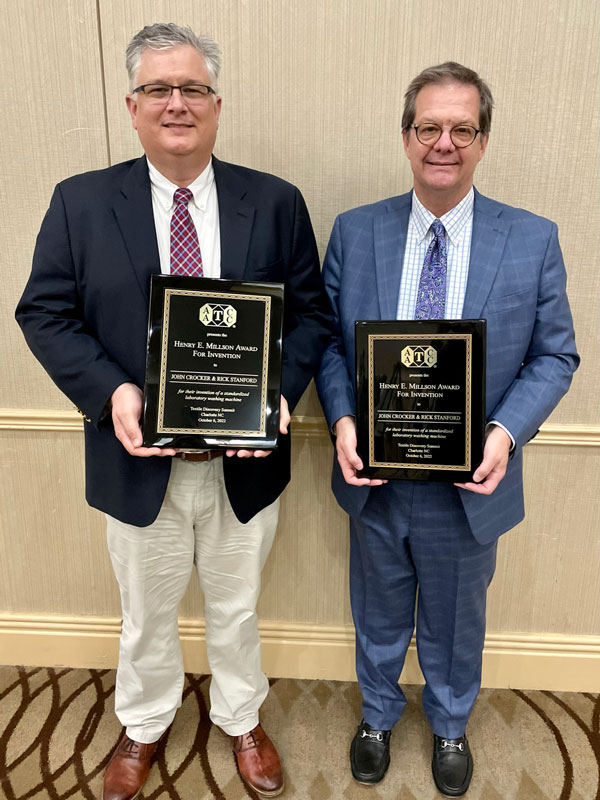
John Crocker And Rick Stanford Receive Millson Award For Invention For Development Of The Vortex M6 At AATCC Textile Discovery Summit

Crocker (left) and Stanford

ROCK HILL, S.C. — October 6, 2022 — The American Association of Textile Chemists and Colorists (AATCC) have awarded John Crocker and Rick Stanford the Millson Award for Invention during the Textile Discovery Summit on October 6, 2022. The award was presented for the pair’s work at SDL Atlas in developing the Vortex M6.

The Vortex M6 was the first commercial grade top loading washing instrument engineered specifically for textile laboratory use for meeting global testing wash standards. The instrument provides programable precision via a multi-language touch screen controller that can manage custom cycles with duration up to 100 hours. The Vortex M6 can be calibrated to ISO 17025 requirements and adjusted back into compliance easily by qualified personnel.

“All of us at SDL Atlas are very proud of Crocker and Stanford. It is a great honor that AATCC has recognized the Vortex M6 as a true step forward in innovation. The textile industry has definitely taken on the Vortex as the new standard top loading washing machine,” said Chuck Lane, SDL Atlas President.

SDL Atlas has recently released a second instrument to the Vortex line, the Vortex Plus, which provides an integrated automatic liquid detergent dispenser which allows for up to 50 repeated wash cycles without operator intervention while also performing all of the same functions as the Vortex M6.

Posted October 11, 2022

2023 Beltwide Cotton Conferences Offering Insight On Latest Innovative Technology, Research

CORDOVA, Tenn. — October 6, 2022 — The 2023 Beltwide Cotton Conferences (BWCC), set for January 10-12 at the New Orleans Marriott in New Orleans, La., will offer attendees timely updates on the latest research, technology and issues affecting U.S. cotton production and processing.

The BWCC, coordinated by the National Cotton Council, annually brings together university and USDA researchers, regulatory agencies, extension personnel/agents, consultants, and industry sales/support personnel to exchange information about new products and production/processing systems that can be tailored to individual farming operations for maximum efficiency.

Those planning to attend are encouraged to register via the BWCC home page at www.cotton.org/beltwide/ and clicking on the registration tab. The BWCC home page also includes links to more information about the forum, including housing reservations and an updated program.

Registration costs for the 2023 BWCC before December 14 are: $200 for NCC/Cotton Foundation members, university and USDA researchers, extension personnel, and associations; $500 for non-U.S. research, extension, associations, and consultants; $400 for non-NCC/Foundation members; and $80 for producers, independent crop consultants, and students.

On-site conference self-registration kiosks will be available 24 hours a day beginning on the evening of January 9. Beginning on the morning of January 10, NCC staff will be available for attendees needing assistance with registration and name badge printing.

The BWCC’s Consultants Conference will run the afternoon of January 10 and extend through the morning of January 11. Topics being considered include updates on ThryvOn™ cotton and its effectiveness on providing season-long protection against spider mites; herbicide resistance; the U.S. Cotton Trust Protocol®; changes in weather patterns and the impact on crops; regulatory updates and pesticide impacts from the Endangered Species Act; new precision agriculture technologies; impacts of climate; retail inventory and supply chain status of fertilizer and chemistries; and Dicamba usage.

The BWCC’s 12 cotton technical conferences, which now includes the Cotton Sustainability Conference, will provide findings from current research and updates on emerging technology that are aimed at elevating U.S. cotton production and processing efficiency. Those sessions will meet concurrently beginning on the morning of January 11 and conclude by noon on January 12.

The Cotton Sustainability Conference will plan to focus on the U.S. Cotton Trust Protocol®, including multiple panel discussions with many name brands and industry leaders, as well as sustainability experts.

The Cotton Engineering-Systems Conference is planning presentations on data analytics, robotics, remote sensing and unmanned aerial vehicles, among others.

Posted October 11, 2022

Source: National Cotton Council

Devan Chemicals Appoints New Managing Director

RONSE, Belgium — October 11, 2022 — With Thomas Bremer, Devan Chemicals (part of the Pulcra Group), welcomes a new managing director, who will be managing the business of the innovative textile chemical solution specialist going forward. Bremer succeeds Sven Ghyselinck who will move into the board directors of Devan. Bremer, will assume, in addition to his current role as Global SBU Head Textile of parent company Pulcra, also the role of managing director of Devan. The focus of this dual role is to intensify the collaboration between Devan and Pulcra globally and to unlock synergy effects in the textile area and beyond. Devan is headquartered in Belgium and has offices in the U.K., Portugal and the United States. This year, the company celebrates its 45th anniversary.

Bremer has more than 23 years of global business development experience in the area of sales, product and business management for textile chemicals. Prior to joining Pulcra / Devan, Bremer was with Huntsman Textile Effects in Singapore since 2012, where he held various roles during his tenure including Global Business Unit Direct- Textile Chemicals and lately the role of Global Product and Direct Purchasing Director. Before that, Bremer worked at DyStar Singapore and was responsible for the Textile Auxiliaries business in Asia since 2005. From 1999-2005 Thomas was working at Rotta Germany and relocated to China as Sales Manager Asia in 2002. Thomas graduated from the University for Applied Science in the field of Textile Chemistry in 1998.

“I am convinced that Thomas Bremer’s intensive expertise and thorough industry knowledge, combined with his solid vision and leadership skills, make him a perfect match with Devan and its team,” said Ümit Yaldiz, CEO of Pulcra.

“With the support of all the talented and passionate people working here I am excited to guide Devan further on its path towards sustainable business growth,” Bremer stated. “I am looking forward to develop more end-to-end solutions from the Pulcra and Devan range for our customers in various enduse segments like apparel, denim and workwear as well as for home, transport and institutional textiles. The product and solution offering of both companies are complementing each other’s. Pulcra is focused on processing excellence with a wide range of process chemicals and softeners, while Devan offers unique value adding solutions on textiles like thermoregulation, flame retardants, encapsulation technologies and novel anti-microbial products.”

Posted October 11, 2022

Source: Devan Chemical

Sponsors