HOUSTON — November 8, 2022 — Ascend Performance Materials has purchased a majority stake in California-based Circular Polymers, a recycler of post-consumer, high-performance polymers including polyamide 6 and 6,6, polypropylene and polyester (PET). The deal provides Ascend with a consistent supply of high-quality PCR materials for its ReDefyne™ sustainable polyamides, launched at K 2022.
Circular Polymers, which as part of the deal is renamed Circular Polymers by Ascend, reclaims and processes post-consumer carpet via a unique technology and has redirected approximately 85 million pounds of waste from landfills into new goods since 2018.
“We are focused on helping our customers reach their sustainability goals and Circular Polymers by Ascend provides materials that offer strong performance with a considerably smaller environmental footprint, compared to other technologies like pyrolysis,” said Phil McDivitt, president and CEO of Ascend. “Since we launched ReDefyne, the demand for our circular products has been significant across all segments of our business, including automotive, consumer, electronics and high-performance fibers and textiles.”
Ascend, a fully integrated producer of durable materials, has a sustainability strategy based on three pillars: empowering people, innovating solutions and operating without compromise.
Ascend has committed to reducing its greenhouse gas emissions by 80 percent by 2030 and recently announced two new efforts to reduce the carbon footprint of its products.
David Bender, founder and CEO of Circular Polymers, will hold the remaining equity and stay on as CEO of the company.
“Since 2018, we have focused on improving the sourcing and processing of post-consumer high-performance polymers,” Bender said. “Having Ascend on board will accelerate our growth and ensure these materials go back into new long-term, high-performance applications.”
BURNLEY, England — November 7, 2022 — Family-owned weaving group the Ashfield Mill Company based in Burnley, are pleased to announce the sale of the business and its subsidiaries, John Spencer (Textiles) Ltd and Ian Mankin Ltd. by sixth-generation owners and majority shareholders, David and Megan Collinge.
The two businesses have been acquired through a management buyout by Simon Blackley, a current Managing Director who has been with the businesses since 2009.
John Spencer (Textiles) Ltd was incorporated in 1971 but has a rich history of weaving in Lancashire that dates back more than 150 years. The company weaves finished products for a number of industries from home furnishings to filtration and components. The Ian Mankin brand was acquired in 2010, when the then owner of the business, and its namesake, was ready to retire. Already weaving with John Spencer, and a keen proponent of British manufacture, it made sense for Ian to sell the business to his weaving mill; safe in the knowledge that the team here would deliver continuity for his customers and uphold his values of ‘affordable elegance’.
The sale has been the result of 12 months of planning and is supported by HSBC bank, PM+M accountants, Napthens and Taylors solicitors. In a positive move for the businesses, this MBO means that the whole of the workforce has been retained and the business will continue to operate from their existing Burnley and London premises.
Both John Spencer Textiles and Ian Mankin will continue to be led by the existing senior
management team and David Collinge will continue on in his current role.
Exiting co-owner, David Collinge, said: “I took over the running of the business from my father when he retired in 1992 and since then, have had wonderful support from a highly skilled and dedicated team without whom our success would not have been possible. The buyout represents the next chapter for some exciting developments and I have no doubt that under Simon’s leadership the businesses will continue to do amazing things.”
The newly formed Ashfield Mill Group headed by Simon Blackley is committed to building on the relationships created over the past 150 years with customers and suppliers and will continue to trade on the same terms as before.
Blackley commented on the acquisition: “I have inherited a fantastic business, with an impressive 150 year history! As the new owner I’m committed to ensuring that the legacy created by David, Megan and their family is not lost to faceless investment. I wanted to be there to ensure continuity of the business, not just for our customers but for our staff and David too.
“This MBO will build on the success of 6 generations of weaving, the strong standing of both companies and their enviable position in weaving and fabric retail is testament to the dedication and commitment of David and Megan. With an incredibly talented team and a loyal customer base, I’m looking forward to steering both into the future.
“For me it is very much business as usual. The John Spencer side has some fantastic customers and, with David still very much in the business, I have no plans for huge change. My intention is to build on the strength of our weaving knowledge, continuing to encourage a new generation of weavers in Burnley and the local region, whilst also pushing the boundaries of skill and knowledge within the existing, capable team. In turn this will help to build relationships with existing customers and to further strengthen the fantastic reputation this company holds.
“We are a small but ambitious team. David, the team and I have built up a wonderful network of customers and distributors both in the UK and internationally, but there is still more we can do. I intend to build on this tried and tested blueprint to extend our reach into new markets.
“The reputation of Ian Mankin fabrics has always been around quality and value. Keeping both businesses within the same group means that there are no changes to the supply chain or provenance and our customers can expect that same attention to detail and great service as they always have with a friendly hello at the end of the phone line.
“It promises to be an exciting and immensely rewarding journey for me, our staff, our suppliers and customers alike.”
The acquisition of the business was completed on October 31, 2022.
TOKYO — November 8, 2022 — YKK Corp. has signed the UN Biodiversity COP 15 Business Statement for Mandatory Assessment and Disclosure by 2030 as convened by Business for Nature.
Business for Nature was formed in 2019 by 13 international organizations, including the World Wide Fund for Nature (WWF) and the World Economic Forum (WEF), as an international coalition calling on corporations to take comprehensive action to recover from the destruction of nature and protect ecosystems. This Business Statement, being made toward COP 15 to be held in December 2022 in Montreal, Canada, is a call to Heads of State to require all large businesses and financial institutions to assess and disclose their impacts and dependencies on nature by 2030.
The YKK Group adopted the YKK Group Environmental Pledge in 1994. In 2019, it established the YKK Group Environmental Vision 2050 with four themes, including “symbiosis with nature.” In October 2020, it established the “YKK Sustainability Vision 2050,” which converted the YKK Group Environmental Vision into concrete numerical targets for the Fastening Business. YKK is working toward achievement of goals under the five themes of Climate Change, Material Resources, Water Resources, Chemical Management, and Respect People, as well as 10 corresponding SDGs (Sustainable Development Goals), and the company discloses its progress in achieving these goals every year.
By becoming a signatory of the Business Statement, YKK declares the following four actions:
COP15 Business Statement for Mandatory Assessment and Disclosure by 2030 (action pledge) and YKK Initiatives
(1) Assess impacts and dependencies on nature
YKK conducts company-wide risk assessments, and within these assessments, it evaluates the impact on the natural environment, such as the discharge of harmful substances into bodies of water and the air, and the contamination of soil. Furthermore, YKK uses an original checklist[1] to assess and understand water risks at each manufacturing site.
(2) Disclose important information related to nature
Important data on nature and the environment, including biodiversity, is published each year in the This is YKK (YKK Integrated Report) Databook.
(3) Commit to prioritizing the most critical issues within the business, value chain, and portfolio, and to disclosing avoidance and reduction of negative impacts
YKK made its commitment in the YKK Group Environmental Vision 2050, which outlines the Group’s long-term direction in relation to its environmental initiatives up to 2050. Furthermore, the Group formulated the YKK Sixth Mid-term Environmental Policy based on the Vision and has disclosed it in the This is YKK (YKK Integrated Report) Databook.
(4) Transform business strategies and models to restore and rehabilitate nature and work collaboratively in river basins, on land, and in the sea
By switching to the use of sustainable materials for fastening product materials and packaging, YKK is working to prevent the destruction of nature when virgin materials are harvested. At YKK’s Kurobe Manufacturing Center, the company is working to recreate the original landscape of Kurobe by developing forests and waterside areas to realize the ideal of “a factory in the forest” envisioned by YKK founder Tadao Yoshida.
In addition to continuing and enhancing the initiatives that YKK has been taking up to now, YKK will work even harder toward achievement of a sustainable society through its core business under the Cycle of Goodness YKK Philosophy.
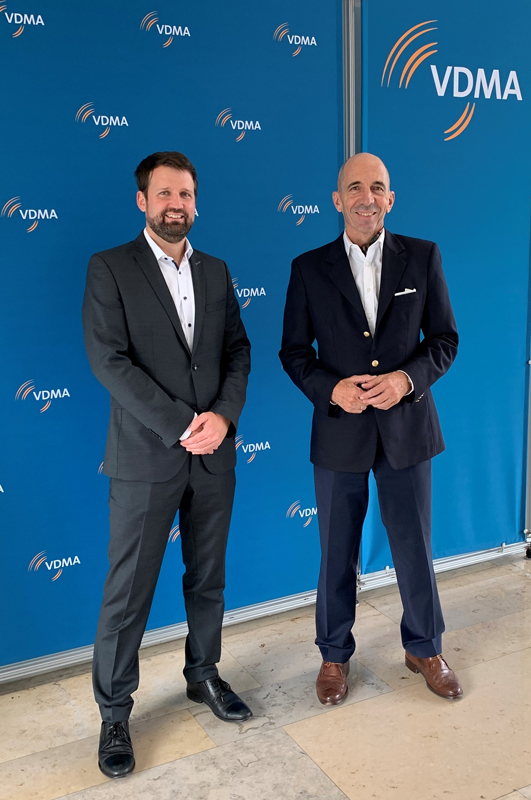
FRANKFURT, Germany — November 8, 2022 — Dr. Harald Weber will become the new managing director of the VDMA Textile Machinery Association on January 1, 2023. The 44-year-old industrial engineer succeeds Thomas Waldmann, who has held the position since 1991 and will retire at the end of the year.
After completing his doctorate at the Technical University of Darmstadt and working as a lecturer at the University of Applied Sciences Mittelhessen (THM), Dr. Weber joined the VDMA in 2011. Since then, he has been responsible for the topics of technology and innovation in the Plastics and Rubber Machinery Association.
Dr. Janpeter Horn, chairman of the VDMA Textile Machinery Association and Managing Director of August Herzog Maschinenfabrik, commented on the change of personnel: “From his previous work in the plastics industry, Dr. Weber has profound knowledge and experience in topics that are also gaining in importance in textile machinery manufacturing. Examples include recycling and the circular economy, as well as digitalisation and especially the communication standard OPC UA.”
Dr. Horn added: “We combine our warm welcome to Dr. Weber with a big thank you to Thomas Waldmann. 30 years as managing director at the Textile Machinery Association also stand for constantly changing framework conditions. Mr. Waldmann has always had his finger on the pulse of the industry and, together with his team, has represented the special interests of the member companies: From technology policy to challenges of market access to the leading trade fair ITMA and the European association CEMATEX. ITMA 2007 in Munich was certainly a highlight. The executive board of the association wishes Mr. Waldmann all the best for the new phase of his life that is now beginning.”
OXFORD, N.C. — November 4, 2022 — Today, Saint-Gobain held a groundbreaking ceremony to mark construction toward a new, state-of-the-art glass mat facility at its CertainTeed Roofing campus in Oxford, N.C. The investment, now projected at $167 Million with additional funds allocated toward new technology to enhance employee safety and sustainability, marks the company’s largest ever investment in a U.S. roofing facility.
The event, hosted at the future site of the glass mat facility, featured remarks from North Carolina Secretary of Commerce Machelle Baker Sanders, Vice President of CertainTeed Roofing Carmen Bodden, Oxford Mayor Jackie Sergent, County Commissioner Tony Cozart, and Glass Mat General Manager Pedro Romero.
Glass mat is a material composed of short fiberglass filaments that are uniformly distributed and bonded together by a polymer resin. The mat forming process produces a fabric that is strong, stable, and heat-resistant, and is a key component in the production of roofing shingles.
The project, which was supported with more than $700,000 in incentives and grants from the State of North Carolina, including funds from the One North Carolina Fund and a Rural Division Building Reuse Grant, will support the company’s growing customer base in the southeastern United States and aligns with Saint-Gobain’s global Grow and Impact Strategy, which includes expanding its presence in key, fast growing markets. In addition, new additional investments in automation and new technology will maximize employee safety and contribute towards Saint-Gobain’s global vision of carbon neutrality by 2050.
“The construction of this facility in Oxford is an important step to maintain our industry-leading service to our customers,” said Carmen Bodden, vice president of CertainTeed Roofing. “Our goal is for this plant to be the new industry standard — it will utilize cutting edge energy and water reduction technology, as well as innovative automation. We thank the State of North Carolina, Granville County and the Town of Oxford for their unwavering support of our business as we continue our work to be a leader in light and sustainable construction.”
“The State of North Carolina is proud to partner with CertainTeed and to celebrate such an exciting milestone in the City of Oxford,” Secretary Sanders said. “This multimillion-dollar expansion is an outstanding investment in rural North Carolina, our talented workforce, and our shared commitment to advanced manufacturing that will continue to support this company for decades to come.”
Today’s ceremony in Oxford follows several other growth investments taken by Saint-Gobain to grow its business in North America in recent months:
In September, Saint-Gobain completed the acquisition of GCP Applied Technologies Inc., furthering its worldwide leadership position in construction chemicals.
In August, Saint-Gobain completed its $928 Million acquisition of Kaycan Ltd., a family-owned manufacturer and distributor of exterior building materials, becoming the top siding player in Canada.
In May, Saint-Gobain announced a $100 Million expansion of its CertainTeed roofing facility in Peachtree City, Ga., more than doubling the site’s production capacity while also reducing its carbon dioxide emissions.
Also in May, the company announced a $28 Million investment in its ADFORS technical textile products facility in Dublin, Ga., creating 400 jobs over the next two years.
In April, Saint-Gobain announced it was doubling the manufacturing footprint of its CertainTeed Architectural manufacturing site in Lakewood, Ohio, by moving to a new, state-of-the-art location in nearby Strongsville, Ohio.
In February, the company invested $32 million in its CertainTeed insulation manufacturing site in Chowchilla, Calif., increasing the location’s production capacity by 13 percent while also reducing its carbon footprint.
DALLAS, N.C. — November 2, 2022 — Celebrating its 50-year anniversary, the Synthetic Yarn and Fabric Association (SYFA) has teamed up with Gaston College to create a scholarship fund that will help support Gaston’s new Textile Technology program students.
SYFA members produce technically advanced yarns and fabrics for use in important industries, such as health care, military, automotive, apparel, and furnishing sectors. “U.S. manufacturers need a talented workforce with the skills, know-how, and motivation to implement state-of-the-art technologies. Scholarships are a proven way for attracting talent that, otherwise, might have taken a different path,” said Hardy Sullivan, SYFA president.
Starting in the Spring semester 2023, the scholarship fund will cover $500 of one student’s tuition per year. To support ongoing funding, SYFA’s first fundraising event will be a golf tournament in April 2023.
The Textile Technology Associate in Applied Science (AAS) degree program launched in the Fall 2022 semester. It prepares students to work as technicians in product development and testing, machine operation, fiber construction and other projects, and as textile designers. A bilateral 2+2 articulation agreement between Gaston College and the Wilson College of Textiles at NC State gives interested students a seamless pathway to pursue a bachelor’s degree at NC State University.
The Textile Technology AAS program is taught at the Textile Technology Center, located at Gaston College’s Kimbrell campus in Belmont, N.C. There, students get hands-on experience with the latest technology and equipment. Construction of a world-class Fiber Innovation Center will soon be underway on the Kimbrell campus.
SYFA Scholarship recipients will be selected by the Gaston College Foundation, administrator of 100+ scholarships that are awarded annually to Gaston students. “We are grateful to SYFA for the establishment of this scholarship,” said Luke Upchurch, executive director of the Gaston College Foundation. “The ability to provide this financial assistance makes our Textile Technology associate degree program even stronger for students who will become a vital part of the expanding textile industry.”
SYFA is a non-profit, volunteer-based organization that holds conferences twice a year in Charlotte, N.C., serving as a forum to discuss product and process innovations, regulatory activities, and economic forecasts. Founded in 1972 as the Textured Yarn Association of America (TYAA), SYFA’s mission remains to advance synthetic yarns and fabrics through education and promotion of new technologies and end-uses.
The SYFA Scholarship is a visible way for the industry to demonstrate its enthusiastic support for Gaston’s new Textile Technology program, and it is a win-win for students and industry. The industry will benefit from a larger pool of technically trained associates while students will make career-shaping connections to globally competitive employers.
LONDON — November 1, 2022 — With a mission to reduce textile waste, Alterist Marketplace along with its community of 68 designers, launched on October 25. Showcasing over 500 unique one of a kind upcycled garments, Alterist will be demonstrating the beauty and creativity that can come from upcycled materials. As one of Alterist’s co-founders, Hannah Standen explained, “We want Alterist to be the catalyst for change within the fashion industry, giving people the power to make more sustainable choices.”
The sustainability market is booming, valued at over $6.35 billion in 2019; however, the majority of the market is still focused on creating new products. Despite the significant increase in awareness, knowledge and technologies within the fashion industry surrounding sustainability, levels of environmental impact have shown no net reduction. Two female co-founders, Hannah Standen and Martina Sorghi witnessed firsthand the amount of clothing produced and a huge amount of this being unused. Whilst campaigning for change within the fashion industry, both was discouraged by the lack of tangible change and wanted to provide an alternative solution, leading to the creation of Alterist.
Alterist is a marketplace that unites a community of upcycle designers who are using creativity to drive change, transform fashion culture and make a positive impact on our planet. As explained by one of Alterist’s co-founders, Martina Sorghi, “We see upcycling as a way to create one of a kind, iconic pieces while also keeping these materials out of landfill.”
Alterist is about Altering the world’s perception of fashion and what is considered to be textile waste. It challenging the social norms, being experimental with style. It’s about altered vision.
With an estimated 100 billion pieces of clothing produced each year and less than 1 percent being recycled into new clothing, it is clear that the current linear structure of the fashion industry is unsustainable. However, it is worth noting that the most common processes of garment recycling rey on the use of chemicals or mechanical procedures to break down fibers to be made into new fabrics. Whereas upcycling utilizes discarded clothing, objects or materials in their current form, creating new and unique products. Upcycling can double the life expectancy of a garment while avoiding further engineering processes, reducing further environmental impact and therefore, making upcycling one of the most sustainable things you can do within the fashion industry today.
“At Alterist we believe that for the fashion industry to become truly sustainable, collaboration is key,” Sorghi said. That is why along with the marketplace, Alterist’s next step will also be working with brands to help them creatively utilize their excess materials. Alterist will be providing a space for designers and brands to participate in the creativity and expression of fashion but through a more sustainable lens.
Considering the majority of greenhouse gas emissions from the fashion industry come from the production of textiles, it’s crucial that reusing materials that already exist becomes common practice within the fashion industry. With the likes of Balenciaga, Marni and Miu Miu featuring upcycling in their collections and Vogue calling upcycling “the biggest trend of SS21” , upcycling is the future of fashion, with Alterist set to be the industry leader. As explained by Standen; “At Alterist, we see that fashion is culture, and culture drives change. Upcycling can lead the change in revolutionizing the fashion industry”.
RESEARCH TRIANGLE PARK, N.C. — November 4, 2022 — In recognition of his outstanding service to the American Association of Textile Chemists and Colorists, AATCC named Gang Sun the 2021 recipient of the Harold C. Chapin Award. The award was presented at the recent AATCC Textile Discovery Summit in Charlotte, N.C.
AATCC Involvement
A member of the Association since 1995, Sun has been active in AATCC as an educational speaker and paper presenter. He has also been very involved with AATCC publications and has authored numerous peer reviewed papers published in AATCC Journal of Research, AATCC Review, and their predecessors. One of his papers received the 2006 J. W. Weaver Paper of the Year Award. Sun also contributed a chapter in the AATCC publication, Analytical Methods for a Textile Laboratory, 4th Edition.
In 2017, Sun joined the AATCC Publications Committee. He has been a part of AATCC Journal of Research since its inception in 2014, first as a dedicated Associate Editor, and as the Editor in Chief since 2019. Under his leadership, journal submissions increased and have been cited frequently, strengthening the value and rank of the Journal among textile research publications. Not only has he overseen the standard issues of AATCC Journal of Research, Sun also oversaw three special issues created in conjunction with national and international conferences.
As an academician, Sun has trained and introduced AATCC to countless textile professionals. Sun’s promotion of AATCC to students and colleagues nationally and internationally has led to the recognition of AATCC and its publications as valued, credible resources for textile professionals. He was the 2016 recipient of the Olney M Medal for outstanding achievement in textile science and presented this year’s Medal during the Textile Discovery Summit awards luncheon.
Professional Accomplishments
Sun is a professor in the Department of Biological and Agricultural Engineering at the University of California, Davis. He received his BS and MS degrees in Materials Science and Fiber Engineering at Donghua University. Ten years after this, he completed his PhD in Chemistry at Auburn University, and in 1995, began his career as an Assistant Professor at the University of California, Davis. Sun has published more than 320 peer reviewed articles, co-written 24 book chapters; and has 18 US patents, with five provisional patent applications pending.
Chapin Award
The Chapin Award was established in 1958 in honor of Harold C. Chapin, professor of chemistry at Lowell Textile School, who served as national secretary of AATCC for nearly 25 years.
Posted: November 7, 2022
Source: The American Association of Textile Chemists and Colorists, (AATCC)
BURLINGTON, N.C. — November 2, 2022 — Chris Martin has assumed a new role as director of Technical Sales for the company’s GlenGuard® brand of flame-resistant and arc-resistant fabrics, which are used to make protective apparel. Martin first joined Glen Raven Technical Fabrics (GRTF) in 2019 as Product Development manager for the GlenGuard brand.
In his new position, Martin will be responsible for all technical and product specification-related aspects of the GlenGuard business, customer relationship management for select accounts, and representing GlenGuard on numerous industry-related committees.
“Chris knows the technical aspects of our products inside and out, which will translate wonderfully into this new role and take the GlenGuard brand to the next level,” said Patti Bates, general manager – Protective.
Martin will be based in Burlington, N.C. He joins current GRTF GlenGuard team members, Jeff Michel, vice president, Protective Fabrics; and Sammy Dobbs, director of New Business Development.
OBERTSHAUSEN, Germany— November 5, 2022 — The goal of Adidas’ ambitious Knit-For-You project was the production of customised clothing locally and by everyone, nothing more and nothing less. It combined a store with a miniature factory, allowing customers to have their very own personalized sweater knitted. There was a wide diversity of design possibilities within the set framework, and production took only a few hours. It was done directly in the pop-up store, on STOLL flat knitting machines that produced 3D flat knits in an automated ready-to-wear process.
Adidas investigated the manufacturing potential behind digitalisation as well as customers’ needs for individualisation through its Storefactory activities. It launched at the end of 2016 and ended in March 2017. Ulrike Schlenker from KARL MAYER Corporate Communication wanted to know how the market and production technology for 3D knitted fabrics for immediate use have developed since then, so she asked an expert: Michael Händel, Vice President Sales & Service at KARL MAYER STOLL Textilmaschinenfabrik GmbH.
Schlenker: What is the current technology like in STOLL knitting machines used for the automated production of 3D flat knitted articles?
Händel: Generally speaking, STOLL flat knitting machines can produce any 3D knitted fabric, and every modern STOLL flat knitting machine can be used for process automation. All the latest generation models have interfaces for using automation software through which they can be integrated into the complete workflow, from design creation to the finished product – all developed in-house by STOLL. STOLL offers autocreate® for the simple definition of workflows. Whether different pattern variations, sets of different sizes or customised on-demand articles, STOLL autocreate® allows for the creation of knit patterns in fully automatic sequences without manual intervention. The data required for this is imported via open interfaces from other programs or physical data storage. STOLL has developed CREATE PLUS to convert all design data into a final knitting program for the machine.
CREATE PLUS and autocreate® make every latest-generation STOLL flat knitting machine an indispensable automation module for 3D flat knitting production.
Schlenker: The Knit-For-You project focused on 3D knitwear for the fashion sector. Where and how are STOLL machines used today for 3D knitting?
Händel: 3D knitted fabrics and STOLL flat knitting machines are used for clothing as well as in the technical textiles sector.
Knit-and-wear articles along with seamless and close-to-skin designs are especially in demand in the fashion segment. Our current WONDERFUL trend collection has great examples of this. The manufacturers produce exclusive designer pieces, which is where the impressive design possibilities of 3D flat knitting really come into their own. They also produce standard goods, such as seamless knitted sweaters, which can be produced in only a few process steps and at low cost. Low material waste also offers advantages in terms of sustainability.
These same advantages come into play in the technical textiles sector when it comes to the production of articles for the automotive, sports, furniture and medical segments.
Examples include form-knitted covers for upholstered furniture and car seats, 3D bandages and orthoses, and even sports shoes. This allows for significant streamlining of processes, especially in the footwear sector, as demonstrated by a project carried out in conjunction with DESMA: the complete shoe upper was produced in a single piece on a STOLL knitting machine. All that remained was for the sole to be moulded onto the product.
Schlenker: What are the major locations in Europe for the production of 3D flat knitwear?
Händel: The real hub for 3D flat knitted fabrics is Italy, where they mainly produce exclusive articles for the fashion industry. Germany also enjoys a long tradition in this area, with other major 3D flat knitting locations to be found in Poland and France, and a number of prominent, specialised industry players in Switzerland and Austria.