Dow And Public-Private Cooperation Pave The Way For A Sustainable Fashion Industry In Ethiopia

HORGEN, Switzerland — September 29, 2022 — Dow supported a three-year cooperation project with Deutsche Gesellschaft für Internationale Zusammenarbeit (GIZ) GmbH and the Dutch ZDHC Foundation to develop more sustainable manufacturing processes within the fast-growing fashion industry in Ethiopia. Through education, training programs and business consultancy capabilities, the project successfully paved the way for improved sustainable chemical and waste management practices along the textile value chain.

The textile industry is one of the key growth sectors in Ethiopia. In recent years, the country has attracted foreign investments for new textile and garment manufacturing facilities and several international brands and retailers have shifted their textile and garment sourcing to Ethiopia.

“Ethiopia has the potential to become one of the leading textile and apparel hubs in Africa. Alongisde this growth, there are opportunities to improve chemical management and prevent water pollution,” said project leader Maimuma Hussein, Dow Industrial Solutions.

“We believe that through industry collaboration and best practice knowledge sharing we can support the textile value chain in implementing more sustainable chemical and waste management practices and make a positive social, environmental, and economic impact in Ethiopia,” adds Cicelia van Rooi, sales director, Dow Industrial Solutions Middle East, Africa & India and Managing Director, Dow Southern Africa (Pty) Ltd.

Value Chain Collaboration

The scope of the project was twofold, involving academia and industry stakeholders. First, the project team worked with the Ethiopian Institute of Textile and Fashion Technology (EiTEX), part of the Bahir Dar University, to implement a technical training program for lecturers and develop a new Chemical Management curriculum for undergraduate students. The Ministry of Education in Ethiopia approved the curriculum and adopted it as a national program of studies.

The second project pillar focused on building awareness and capabilities of factory management and workers across the textile supply chain to implement and maintain an effective sustainable chemical management system based on industry best-practice guidelines from ZDHC. To enable a continued and cost-effective support to local businesses and industry professionals, sustainable chemical management consultancy capabilities were set-up through a network of trained local consultants. These companies are now listed as ZDHC Approved Training Providers and can provide the official ZDHC training programmes to the Ethiopian markets.

The project was able to establish sustainable structures for training in the environmentally and ecologically responsible disposal of chemicals and waste. The first 100 university students already completed the e-learning curriculum, and managers and operators from 20 textile factories were trained and kick-started the implementation of improved chemical management system processes. As the project ends, the network of seven qualified chemical management consultants will continue to support businesses and industry professionals with ongoing training and on-site consultancy. All materials developed in the project will remain available to the educational institutions for their further use.

“We gladly worked with Dow and GIZ on this project as it directly supports our ‘Roadmap to Zero Programme,’ aimed at leading the fashion industry to eliminate harmful chemicals from its global supply chain by building the foundation for more sustainable manufacturing,” said Klaas Nuttbohm, Implementation Director of ZDHC Foundation. “Working together with local stakeholders paved the way to improved sustainable chemical and waste management practices being implemented in Ethiopia.”

Project Funding

The three-year project was co-funded by Dow’s program designates corporate contributions toward projects designed to help address social This competitive grant problems through our technology and expertise. Funding proposals come directly from Dow employees worldwide, tapping into their unique skills, business knowledge, and diversity of locations and experiences.

Dow and GIZ have been working together within the framework of the develoPPP funding programme, which GIZ implements on behalf of the German Federal Ministry for Economic Cooperation and Development (BMZ). In the cooperation project, the public and private partners bundled their expertise and financial contributions and worked closely together in all steps from project planning to the development and implementation of the trainings and awareness-raising activities.

Posted: September 30, 2022

Source: Dow Europe GmbH

Durst Announces Winners Of RSC Label Masters Awards

BRIXEN, Italy— September 27, 2022 — The winners of this year’s Durst’s RSC Label Master Awards were officially revealed for the first time during Labelexpo Americas in Chicago from September 13-15, where insights on the new Tau RSC platform, its printing technologies, ink systems, software and important developments were provided.

Durst Group showcased the highly successful and globally placed Tau RSC technology. In addition to spotlighting its ecosystem of printers and software, Durst presented the awards to the winners by the machinery. Visitors received deep insights into the award winners from experts.

Martin Leitner, Durst’s Product manager for Label & Flexible Packaging, said: “The Tau RSC is a true game changer for us as a company and for all our customers. With that in mind, we challenged them to take part in the Durst RSC Label Masters awards. There were an impressive number of entries. They were all truly inspiring, making it a difficult task for the judges to choose the winners.”

This year, the judges consisted of international representatives of the industry:

  • David Pittman – Editor, Digital Labels & Packaging;
  • Vladimir Tyulpin – Avery Dennison, Global Segment Digitaldruck;
  • Matthew Burton – Sales Director AB Graphic International;
  • Christian Ring & Bernhard Zölch – Owner Design Agencie Die guten Agenten; and
  • Durst Team – Label & Flexible Packaging.

China’s Shandong Golden Realm Industrial captured the RSC Combination Print category for its Cloisonne label with ancient enamelling technique), RS Druk was runner-up and Color Press, third. The 100 percent RSC Print category winner was Shanghai Yingcai Printing of China, for its Flying Crane – Embroidery Label entry. Runner-up was Clever Systemtechnik, with The Label Makers in third place. Nanning Jiecheng Label won with Longevity Spring in the category Innovation. Shandong Golden Realm and RS Druk respectively were second and third.

“Since the Durst Tau RSC platform was launched just over five years ago, we have achieved over 300 installations worldwide in less than five years. This demonstrates that our printing solutions have been very well received by the market. We are looking forward to the future despite these uncertain times for everybody,” Leitner concluded.

Posted: September 30, 2022

Source: Durst

BASF Offers Neopentyl Glycol And Propionic Acid With Product Carbon Footprint Of Zero

LUDWIGSHAFEN, Germany— September 30, 2022 — BASF for the first time offers neopentyl glycol (NPG) and propionic acid (PA) with a cradle-to-gate product carbon footprint (PCF)1 of zero2. Produced at BASF’s Ludwigshafen Verbund site, Germany, the products are available globally as “NPG ZeroPCF” and “PA ZeroPCF.” BASF achieves the zero PCF for NPG and PA by using renewable raw materials in its unique Verbund production system via its biomass balance (BMB) approach. For NPG, BASF additionally uses renewable energy for production.

NPG ZeroPCF and PA ZeroPCF are “drop-in” solutions: They are identical in quality and properties to the standard products, allowing customers to use them in their production without the need for adjustments to their existing processes. In this way, customers can simply and efficiently reduce emissions from purchased goods or services (Scope 3) and increase the share of renewable raw materials in the value chain, thus contributing to the shift to a circular economy.

Biomass balance approach with waste-based renewable raw materials

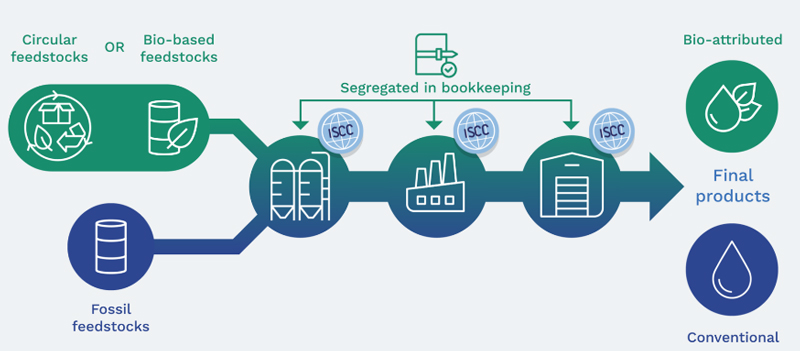
BASF manufactures NPG ZeroPCF and PA ZeroPCF in its integrated Verbund production system applying its BMB approach. For this, BASF feeds renewable raw materials into its Verbund in the very first steps of chemical production and attributes a corresponding share of the renewable raw materials to specific sales products by means of a certified mass balance method. The renewable raw material used is waste-based. BASF’s biomass balanced products are certified according to recognized standards like either REDcert2 or ISCC plus.3 In the production of NPG ZeroPCF, BASF additionally uses renewable energies via Renewable Energy Certificates.

The PCF comprises the total greenhouse gas emissions that occur until the product leaves the BASF factory gate for the customer, from the extraction of resources through manufacturing of precursors to the making of the final chemical product itself. On its journey to achieve net zero CO2 emissions by 2050, BASF is the first large chemical company to make the individual carbon footprints of all its sales products available to its customers.

NPG ZeroPCF and PA ZeroPCF certified Carbon Neutral by the Carbon Trust

BASF has achieved Carbon Neutral certification from global climate change consultancy the Carbon Trust for its NPG ZeroPCF and PA ZeroPCF. The Carbon Trust certifies products as Carbon Neutral that are either carbon neutral through temporary natural upstream carbon sinks like plants4 or through carbon credits purchased by the manufacturing company. BASF achieves the cradle-to-gate product carbon footprint of zero for NPG ZeroPCF and PA ZeroPCF without purchasing carbon credits.5 The certification will be reviewed on an annual basis.

Neopentyl glycol with broad application fields

An essential field of NPG application is powder coatings, especially for the construction and automotive industries as well as for household appliances. Besides emitting minimal to zero volatile organic compounds (VOC), the coatings process with powder coatings also reduces processing times and energy requirements. By applying NPG ZeroPCF, the carbon footprint of the powder coating resins can be reduced significantly. This can help manufacturers in the construction, automotive, white goods and furniture industries to achieve their upstream Scope 3 CO2 emission reduction targets.

Due to its high chemical and thermal stability, the versatile polyalcohol NPG has proven itself in many further applications, in particular as a building block for the production of polyester and alkyd resins for various coatings and plastics. Other areas of application for NPG include the manufacture of lubricants, plasticizers and pharmaceuticals: It is used as a building block in the synthesis of, for example, hormones, cardiovascular drugs and painkillers. With decades of expertise, BASF is today among the leading NPG producers globally.

Wide range of uses for propionic acid

For decades, BASF customers have been utilizing PA, which is fully biodegradable, as a mold inhibitor for the preservation of food and feed grains. In this application PA offers economic and ecological benefits over preservation through drying or storage in airtight silos. Other application areas of PA include the production of crop protection agents, flavors and fragrances, pharmaceuticals, solvents and thermoplastics. With decades of expertise, BASF is among the leading PA producers globally.

1 BASF’s product carbon footprint (PCF) calculations follow the requirements and guidance given by ISO 14067:2018. In a methodology review, TÜV Rheinland has certified that the PCF methodology SCOTT developed and used by BASF SE for calculating the PCFs of BASF products is scientifically- based, is in accordance with ISO 14067:2018, and reflects the state of the art (ID-Nr. 0000080389; BASF SE – Certipedia).

2 The product carbon footprint (PCF) of NPG ZeroPCF and PA ZeroPCF is zero in a cradle-to-gate assessment, taking into account all product-related greenhouse gas emissions and the biogenic uptake of the renewable raw materials used in the value chain and attributed to the products via a certified mass balance approach. The calculation does not include downstream value chain emissions such as transportation emissions from factory gate to customer, emissions from further processing and the end-of-life emissions (e.g., from waste treatment).

3 REDcert2 and ISCC plus are standards for the use of sustainable biomass as raw material in the chemical industry. Regarding BASF’s biomass balance approach, certification according to these standards confirms that the biomass used is sustainable and has been fed into the production Verbund in the required amount. It also confirms that the sustainable biomass has been correctly attributed to the corresponding sales products. The certifications are awarded on the basis of on-site audits conducted by independent auditors.

4 A carbon sink is a natural or artificial system that extracts more CO2 from the atmosphere than it releases into it. Plants are an example of a natural carbon sink, as they remove CO2 from the atmosphere through photosynthesis (biogenic uptake). The raw materials used in BASF’s biomass balance approach are plant-based and the biogenic uptake is accounted for in the calculation of the cradle-to-gate product carbon footprint.

5 To achieve carbon neutrality for NPG ZeroPCF and PA ZeroPCF in relation to their complete product life cycle (cradle-to-grave), all downstream value chain emissions have to be offset by the respective actors in the value chain, e.g., by purchasing carbon credits.

Posted: September 30, 2022

Source: BASF SE

Reflective Apparel Introduces WildSpark™, Athletic-Inspired Reflective Uniforms That Keeps Employees Safe Both On And Off The Clock 

MARIETTA, Ga. — September 29, 2022 — Reflective Apparel, known for making people visible with its robust line of ANSI safety workwear, introduces WildSpark™, high-visibility workwear and uniforms designed be visible and comfortable on the job, while being stylish after work.

WildSpark performance apparel can be used in situations where American National Standards Institute (ANSI) safety standards are not required, but visibility still needs to be a focus. High visibility is important in any environment where there is heavy equipment, moving vehicles or low visibility. This includes not only workplace environments, but also after-hours safety.

“We believe that everyone should be visible and safe at all times, not just on the job,” said Scott A. Corrao, president of Reflective Apparel. “People should be visible at work, as well as when they walk to the bus stop, ride their bike, or walk their dog after work. In my 25 plus years in the safety industry, I’ve seen employers encourage their employees to use hearing, eye and respiratory protection whenever it is needed, not just at work. Safety awareness shouldn’t stop at the job site.”

WildSpark high-visibility workwear has reflective properties that are discrete in the daylight, but provide high-vis retro-reflectivity in low-light situations. With the added features of UPF50+, moisture wicking and anti-microbial technologies, employees can transition from work to personal activities without feeling like they are in workwear.

The high visibility and reflective properties of WildSpark garments allow people to “Be Safe and Be Seen” while at work or play. These patent pending reflective designs are strategically incorporated onto the fabric.

“Until you shine light on a WildSpark garment, you would assume it was just fashionable, performance apparel,” said Becky Keith, vice president of sales for Reflective Apparel. “Once a headlight hits the garment, the retro-reflective properties are immediately apparent, making the wearer highly visible even in extremely low light situations.”

More than 7,000 pedestrians in the United States were killed in crashes involving a motor vehicle in 2020, according to the Centers for Disease Control (CDC). That equates to one death every 75 minutes. Reflective Apparel hopes to help reduce this number by making people more visible.

“Our philosophy is, as long as you are going to wear performance apparel, it should be reflective as well,” Corrao said. “Reflective gear doesn’t have to call attention to you when it isn’t wanted. We now have a solution to be comfortable, stylish and visible, all at the same time.”

Wildspark will be available wholesale, through Reflective Apparel’s network of distributors.

Posted: September 29, 2022

Source: Reflective Apparel

Sonobond Ultrasonics Now Part Of Inductotherm Group: New Website, Brand Logo And Increased Resources The Company Can Now Provide Its Customers

WEST CHESTER, Pa. — September 29, 2022 — Janet Devine, president of Sonobond Ultrasonics Inc., announced today that becoming part of the Inductotherm Group will now provide its customers with increased resources and benefits. Although Sonobond has been a wholly owned subsidiary of Inductotherm Group’s parent company for more than 30 years, Sonobond and its customers will now have greater access to advanced power supply technologies, global service resources, and expanded supply chain resources.

The launch of Sonobond’s new website is the first of many positive changes for the company. According to Devine, “our new brand logo and website represent a lot more than a new design. They signify our direct connection to more than 40 companies that offer advanced technology and manufacturing resources that will enhance our ability to deliver the innovative products our customers have come to rely on.”

Devine continued: “we wanted to take advantage of all the advantages and benefits Inductotherm Group provides for our customers, as quickly as possible, so transitioning our marketing materials to our new ‘Inductotherm’ look will continue after our new website has launched.”

Posted: September 29, 2022

Source: Sonobond Ultrasonics Inc.

New Hand and Touch Feel Standard for Textile Industry

ROCK HILL, S.C. — September 29, 2022 — FZ/T 01166-2022: “Textile Fabric Touch Determination and Evaluation Method: Multi-Index Integration Method” Standard Releases October 1, 2022.

The first textile industry standard that specifies how to test and evaluate the hand of textiles via a multi-index instrument is set to be released on October 1. SDL Atlas is pleased to offer the FTT® Fabric Touch Tester which meets the requirements of this new standard.

The standard includes: rules on the scope of applying the test method, definitions of the primary physical indicators, the testing principle and main parameters of testing instruments, the sample preparation and test procedures, the calculation formula of the result, rules on the subjective evaluation method, and provides the modeling procedure and reference example for the readers who have the need to establish their own evaluation model.

“Hand feel has continued to be difficult to communicate just as color was decades ago,” says SDL Atlas President Chuck Lane. “This new standard now provides a common method for the industry to speak the same language regarding hand feel. The FTT is a key component in communicating this traditionally objective measurement, just as the spectrophotometer does the same for color.”

Dr. Junyan Hu, chief technology officer, Best Pacific International Holdings Ltd. said, In a historic day, the standard “Textile Fabric Touch Determination and Evaluation Method Multi-index Integration Method” (FZ/T 01166-2022) has been officially implemented. The formal implementation of this standard will take a new step in the objective measurement of the subjective feeling of contact between fabric and skin, and will help the evaluation and quality control of subjective feelings in both the virtual world and in the real world.”

The new FZ/T 01166-2022 standard can be purchased beginning October 1, 2022, from the China Quality Standards Publishing and Media Co., Ltd. website: http://webstore.spc.net.cn.

Committed to providing customers confidence in standard based testing, SDL Atlas has offices and experts in the United States, United Kingdom, Hong Kong and China, plus agents serving over 100 countries, SDL Atlas is ready to support its customers with instruments, consumables, and services anywhere in the world.

Posted: September 29, 2022

Source: SDL Atlas, LLC

Sensoria Health & Defender Announce Availablity Of First Smart Diabetic Boot With Remote Patient Monitoring

LOS ANGELES, Calif. — September 29, 2022 — Sensoria® Health www.sensoriahealth.com, developer of Remote Patient Monitoring and Artificial Intelligence wearable solutions, and Defender, next-generation designer and manufacturer of innovative foot care solutions for people with complex foot care issues, announced today at the DFCON Conference the availability of the Foot Defender® powered by Sensoria Smart Boot, the world’s first smart diabetic footwear. Available now, the Foot Defender powered by Sensoria is designed to help heal diabetic foot ulcers and reduce the risk of amputations for extended quality of life. The solution combines the Foot Defender Smart Boot with Sensoria Core microelectronics and the Sensoria Patient Mobile App and Clinician Dashboard to monitor a patient’s diabetic foot ulcer healing and rehabilitation compliance to the clinician’s prescribed stabilization and mechanical offloading protocol.

The Foot Defender powered by Sensoria is designed to improve patient adherence to mechanical offloading, monitors patient usage, activity, improves outcomes, and reduces healthcare cost. Designed by Dr. Jason Hanft, a leading podiatrist, together with a former Nike industry-leading shoe designer, Michael DiTullio, to create a protective boot specifically built to better protect foot wounds in a form factor that patients will actually want to wear, Foot Defender powered by Sensoria is available now; visit https://sensoriahealth.com/diabetic-foot-ulcer-boot/ for more information.

Shoe-Like Design Alleviates Foot Contact Pressure by up to 50% as Compared to Other Protective Diabetic Boots

Foot Defender powered by Sensoria has an easy-to-use shoe-like design with a low-profile abrasion resistant compression-molded outsole that alleviates average contact pressure across the foot by up to 50 percent as compared to other protective boots on the market. Used for both stabilization and offloading, the boot is non-intrusive, cost-effective, and readily usable or embeddable and deployable for a broad spectrum of devices and patient types, whether they are bed-bound, chair-bound, or ambulatory. The Foot Defender powered by Sensoria solution is compliant to the IWGDF guidelines and is the most referenced product in the latest offloading clinical gold standard guidelines. It is also currently being validated by USC Keck School of Medicine and Baylor College of Medicine, which received a $2.5 million R01 NIH grant to validate its clinical value.

Reduce the Risk of Diabetic Amputations

In the United States, 80 million people will be older than 65 years of age in the next few years, according to the CDC. In addition, every 20 seconds world-wide, a limb is amputated due to diabetes; and every 1.2 seconds, there is a new Diabetic Foot Ulcer (there is no amputation without an ulcer). After an amputation, there is a 50 percent chance that the same patient will have the other limb amputated within two years, with patient five-year life expectancy worse than most cancers. In addition, Diabetic Foot Ulcers are responsible for more hospitalizations than any other complication of diabetes, driving direct costs of at least $40 billion dollars annually worldwide and at least $17.5 billion in the United States alone.

“Usually subjects with diabetic foot ulcerations wear their offloading devices in just 28 percent of their daily steps. And there is strong evidence that uncomplicated plantar ulcers can be healed in 8 to 12 weeks. Yet current standard of care in U.S. clinical trials have a 76 percent treatment failure rate at 12 weeks,” said Dr. David G. Armstrong, professor of Surgery at USC Keck School of Medicine. “Through the marriage of Sensoria Health’s sensors with the Foot Defender, AI/ML algorithms, custom microelectronics, and remote monitoring cloud software, the system extends the reach of clinicians and potentially contributes to deliver better outcomes for our patients. By injecting sensing technology into footwear and garments that are already a part of the patient workflow, we can likely improve adherence, accurately monitor patients, improve outcomes, and reduce healthcare cost around the world.”

“Combining Foot Defender with Sensoria’s smart technology offers the best of biomechanical engineering and modern footwear design with mobile, plus cloud patient monitoring to promote faster healing, improve overall compliance and ensure healthier outcomes,” commented Dr. Hanft. “It’s a game-changing solution that brings the science of off-loading and protecting diabetic feet into the 21st century.”

Availability

The Foot Defender powered by Sensoria is available now. For more information, see https://sensoriahealth.com/diabetic-foot-ulcer-boot, contact Sensoria Health at Info@Sensoriahealth.com or contact Defender to purchase at Info@DefenderOps.com. The solution may be reimbursable by Medicare and additional codes may be available for remote patient monitoring.

Posted: September 29, 2022

Source: Sensoria Health

Milliken, Together With EREMA And PreZero, To Showcase Technology For Producing Top-Quality Recycled Polypropylene At K 2022

GHENT, Belgium — September 28, 2022 — Milliken & Company, a diversified global manufacturer with more than 70 locations worldwide, is partnering with European recycling leaders EREMA (Engineering Recycling Maschinen und Anlagen Ges.m.b.H.) and PreZero at the upcoming K 2022 show to highlight the use of our Hyperform® HPN® performance additives in recycled polypropylene (rPP) compounds. Our common purpose is to close the loop and advance circularity.

At the October 19-26 trade fair in Düsseldorf, the Austria-based recycling machinery manufacturer EREMA will put its technology on full display. Operating in the EREMA Circonomic Centre in the outdoor area (OA/-CE03) of the fairgrounds, it will present a live recycling demonstration of recycled material supplied by German environmental services provider PreZero (Hall 8B/A57).

For the live recycling demonstration, the partners will use post-consumer waste that was collected by PreZero. Then, in an example of true value-chain collaboration, PreZero leverages its formulation expertise using EREMA recycling technology and Milliken’s Hyperform HPN additive to make the recycled PP resins. EREMA’s machinery innovation allows PreZero to create odor-optimized premium rPP pellets directly from contaminated post-consumer material.

Hyperform HPN upgrades the recycled PP by improving the material’s physical properties while also reducing the cycle time needed to process it. Additionally, these additives also provide for better dimensional control and crystallization stability during the post-injection molding period.

The efficient use of our HPN nucleating agent brings the performance of rPP closer to that of virgin PP. As PreZero likes to say: “With our plastic recycling activities we give seemingly worthless material, waste, a new life.”

Milliken’s popular Hyperform HPN performance additives contribute to faster, trouble-free production of both virgin and recycled PP and deliver proven energy savings. “UL Environment & Sustainability, a unit of the global UL group, has reviewed and certified that Hyperform HPN enabled an average of 5-8 percent energy savings for firms that injection mold thin-wall PP products,” notes Wim van De Velde, Milliken’s Global vice president – Plastic Additives. “This helps users to lower costs, reduce carbon emissions[1] and advance circularity while producing stronger, lighter products. They also enable greater use of rPP in an increased number of applications.”

At the K show, EREMA will run its patented INTAREMA® TVEplus® RegrindPro® extruder system with ReFresher technology, which sets new standards in the recycling of materials that are difficult to process such as heavily printed films and very moist materials. This is made possible through ultrafine filtration, thorough melt homogenization, and high-performance degassing in a single step. The proven basic principle of TVEplus technology is that melt filtration takes place upstream of extruder degassing.

As Michael Heitzinger, managing director of EREMA Engineering Recycling Maschinen und Anlagen GmbH, explained: “The efficient interplay of our ReFresher technology with this proven extruder system makes it possible to achieve odor-optimized premium recycled pellets directly from contaminated post-consumer material. The unbeatable combination of top pellet quality and odor optimization opens up completely new application opportunities for recycled plastics.”

Visitors to K 2022 can watch a live recycling demonstration in the EREMA Circonomic Centre in the outdoor area (OA/-CE03) on two different days: Friday, October 21, from 10.00 am-1.30 pm, and on Wednesday, October 26, from 2.30-5.30 pm.

For more information on Milliken’s purposeful collaborations, visit us in Hall 06/6A27 at the K Show or k2022.milliken.com.

Posted: September 29, 2022

Source: Milliken & Company

RISE® Research, Innovation & Science For Engineered Fabrics Delivers Material Science Innovations To Advance Sustainability

CARY, N.C. — September 29, 2022 — Product development and innovators in nonwovens & engineered materials gained valuable expert insights on material science innovation and sustainability at the 12th edition of RISE® – Research, Innovation & Science for Engineered Fabrics conference.

INDA, the Association of the Nonwoven Fabrics Industry, and The Nonwovens Institute, North Carolina State University co-organized the event, Sept. 27-28 at North Carolina State University in Raleigh, N.C.

More than 20 industry, academic, and government experts from across the globe presented technical developments in sessions focused on circularity and sustainable inputs from such sources as Polylactic Acid Polymers (PLA), natural fibers, biofibers, and waste products. Participants called the conference “thought provoking” with outstanding speakers.

Highlights included presentations on:

  • Achieving Supply Chain Circularity, by Dr. Kat Knauer, program manager – V Research, National Renewable Energy Laboratory, NREL;
  • The Global Plastic Crisis: Winners/Losers in the Marketplace, by Dr .Bryan Haynes, senior technical director, Global Nonwovens, Kimberly-Clark Corp.;
  • Sustainable Fibers – Development and the Future by Dr. Jason Locklin, director, University of Georgia – New Materials Institute;
  • PLA & PLA Blends: Practical Aspects of Extrusion by Dr. Behnam Pourdeyhimi, William A. Klopman Distinguished professor, and executive director, The Nonwovens Institute, North Carolina State University; and
  • Mitigation of Quat Incompatibility with Cotton and other Cellulosic-based Substrates, by Dr. Doug Hinchliffe, Research Molecular Biologist, USDA-ARS.

RISE participants found the high-quality and on-point technical program valuable.

Paul Latten, director of Research and Development and New Business, Southeast Nonwovens Inc., praised the high quality and depth of the science presented by speakers and said it will help him do a better job for his company and clients.

“RISE is an excellent conference for us to discuss concept strategies with the industry. I very much appreciate the focus on sustainability,” said Lars Heepe, Head of Research and Development and Intellectual Property, at Gottlieb Binder GmbH & Co. KG.

RISE® Innovation Award Winner

DiaperRecycle was awarded the RISE® Innovation Award for its innovative technology to recycle used diapers into absorbent and flushable cat litter. The annual award recognizes innovation in areas within and on the periphery of the nonwovens industry that use advanced science and engineering principles to develop unique or intricate solutions to problems and advance nonwovens usage.

By diverting used diapers from households and institutions, and separating the plastic and fiber, DiaperRecycle strives to decrease the climate-changing emissions of diapers from landfills.  “I am thrilled and grateful to win this award as it proves we are on the right track,” said Cynthia Wallis Barnicoat, CEO of DiaperRecycle.

Other award finalists included Binder BioHook® by Gottlieb Binder GmbH & Co. KG and Sero® hemp fibers from Bast Fibre Technologies Inc. (BFT).

The event also featured poster presentations by North Carolina State University graduate students, a tour of the Nonwovens Institute’s state-of-the-art facilities, an industry reception, networking breaks and luncheons.

The 13th edition of RISE® – Research, Innovation & Science for Engineered Fabrics conference will be held Sept. 12-13, 2023, at North Carolina State University in Raleigh, N.C.

Posted: September 29, 2022

Source: INDA, the Association of the Nonwoven Fabrics Industry

September/October 2022

Jim Kearns, executive director and CFO of Alsco Uniforms, recently was elected chair of the board of directors of TRSA – the organization Strengthening the Linen, Uniform and Facility Services Industry.

Teijin Holdings USA President Jane Thomas has again been appointed to the Investment Advisory Council of the U.S. Department of Commerce. She will serve until 2024.

Spartanburg, S.C.-based Milliken & Company has promoted David Smith to executive vice president and president of Milliken’s Textile Business. He replaces Chad McAllister who has left the company.

Ulrich Reifenhäuser, chief sales officer of the Germany-based Reifenhäuser Group, recently was awarded the 2022 Georg Menges Prize at the 31st International Colloquium on Plastics Technology. The award recognizes those who have contributed outstanding service to the transfer of research results into industrial practice.

Web Industires Inc., Marlborough, Mass., has promoted Kathrin Doyle Arena to vice president of human resources.

Matt O’Sickey has joined the Association of the Nonwovens Fabrics Industry (INDA), Cary, N.C., as director of Education and Technical Affairs. INDA also recently named Ryan Ragan director of Membership and Industry Relations.

Kraig Biocraft Laboratories Inc., Ann Arbor, Mich., has contracted Jeff Dorton to help the company develop innovative yarns and fabrics using its Dragon Silk™ spider silk fiber. Initial developments will be used by Spydasilk Enterprises, the company’s Singapore-based joint venture apparel brand.

Mayzo Inc., a specialty chemicals company based in Suwanee, Ga., has named Doug Hartman director of sales and customer care. He replaces Eduardo Padilla who was promoted to president of the company last year.

Elin Wengström has joined Coloreel, Stockholm, as vice president of marketing.

Cambridge, England-based Global Inkjet Systems Ltd. (GIS), a Nano Dimension division, has announced that GIS Co-founder Nick Geddes has joined the executive team at Nano Dimension as senior chief technology officer. Steve Williamson has been promoted to GIS general manager.

The New York City-based American Down and Feather Council (ADFC), a division of the Home Fashion Products Association (HFPA), has named Brett Rife chair. Rife is vice president of sales for Keeco LLC and succeeds former Chair Travis Stier.

Advanced Functional Fabrics of America Inc. (AFFOA), Cambridge, Mass., has announced the promotion of Michelle Farrington to chief technology officer. She will lead AFFOA’s integrated technology development team and is responsible for developing AFFOA’s technical strategy.

Steven Bethell of Bank and Vogue has joined the board of directors at Accelerating Circularity.

Conover, N.C.-based Nufabrx® has named former W.L. Gore & Associates CEO Dr. Jason Field board member; and Elise Donahue, former CEO of Airborne, South Beach Diet and co-founder of Prestige Brands, advisory board member.

Unifi Inc., Greensboro, N.C., has elected Frank Blake to its board of directors.

Dearborn, Mich.-based Carhartt has appointed Susan Hennike chief brand officer. She reports to President and CEO Linda Hubbard.

Chico’s FAS Inc., Fort Myers, Fla., has named Leana Less senior vice president of marketing.

Tommy Bruno has joined Culp Inc., High Point, N.C., as executive vice president of Culp Home Fashions. He replaces long-time employee Sandy Brown who is retiring at the end of the year. The company also named Teresa Huffman chief human resources officer; and promoted Forrest Buck to vice president of Information Technology.

Emilie Arel, president and CEO of Casper Sleep, has joined the board of directors at Macy’s Inc., New York City.

September/October 2022

Sponsors