ERCA: REVECOL® Responsible Innovation And Making A Difference In The Textile Industry

GRASSOBBIO, Italy — June 27, 2023 — ERCA successfully showcased their latest product during the recent ITMA 2023 exhibition, taking the opportunity to share with ITMA visitors the journey that stood behind the creation of REVECOL®.

Thanks to the high tech and pioneering manufacturing process, REVECOL transforms critical waste materials — exhausted vegetable oils — into a line of innovative and responsible chemical auxiliaries destined for the entire textile industry and its various applications, offering unique characteristics: circular DNA, certification, safety, high performance, competitivity and applicability on any type of textile fiber, whether virgin or recycled.

Two of the industry’s best-known brands, Patagonia® and trim supplier YKK teamed up with ERCA to deploy REVECOL in their manufacturing process. This unique alliance was presented to ITMA visitors as an example of what the industry can achieve through collaborative practices.

Now, however, it’s time to share REVECOL by ERCA’s responsible innovation with a wider audience in order to make a genuine difference.

The process of sharing REVECOL with the
industry really started with the announcement of
ERCA’s partnership with Patagonia and YKK
 and deepened during the inspiring in person
session Upcycling Minds Think Alike moderated by
 Giusy Bettoni, CEO and founder, C.L.A.S.S. 
(Creativity, Lifestyle and Sustainable Synergy), and which saw the participation of Matt Swartz, Color and Material Quality manager of Patagonia, Fabio Locatelli, head of ERCA, Textile Specialties Business Unit and Mike Maekawa, Sales and Business Development manager, YKK Vietnam.

During the talk, each participant spoke about how the partnership will benefit the industry at large.

“Through thoughtful consideration we designed our approach and conversion to REVECOL LV-TS to have an outsized impact from the start. The real success is seeing this go beyond Patagonia® products and spread across supply chain partners, brands and consumers. This is one domino to fall in how we do business to save our home planet,” Swartz noted.

“We are thrilled to be part of this unique three-way collaboration, exemplifying how true upcycling on a mass-production scale is made possible at the center of garment manufacturing. We look forward to the expansion of REVECOL across the entire textile industry,” Maekawa said.

“One of the most rewarding achievements is not only to see that REVECOL® can really make a difference, but that leading companies are teaming up with us to utilize it in products that bring the message of sustainability to the end consumer,” Locatelli added.

Responsible innovations like REVECOL find success when they are embraced and adopted by other industry players. Success is measured by how widely the market utilizes these advancements and what their ultimate impact on the environment is. It is vitally important that new sustainable products and technologies are used on a large scale, otherwise, true change hasn’t taken place and tangible benefits cannot be measured.

So, now is the perfect time to share REVECOL, a next generation advancement, across the market as a whole and to as many end consumers as possible.

After all, when it comes to sustainability, the key to success is in strategic partnerships and sharing advancements within the industry, with an eye to expanding it on a mass scale.

REVECOL® is a trademark of E.R.C.A. ESPERIENZE RICERCHE CHIMICHE APPLICATE S.P.A.

Posted: June 27, 2023

Source: ERCA SPA
BASF Venture Capital Invests In Startup DePoly SA

MANNHEIM, Germany — June 27, 2023 — BASF Venture Capital GmbH (BVC), the corporate venture company of the BASF Group, announced today an investment in the Swiss startup DePoly SA (DePoly), a sustainable plastic solutions provider developing a unique chemical recycling technology. Founded in 2020, the company has developed a chemical recycling technology that converts mixed post-consumer and post-industrial polyester plastic waste streams, as well as polyester-containing fabrics and fibers, back into their precursors at virgin-grade quality. This process is energy efficient — operating at room temperature and standard pressure, without the need for pre-sorting, pre-washing, or removal of contaminant materials. For BVC this investment underlines BASF’s ongoing commitment to developing sustainable solutions for a circular economy.

BVC co-led DePoly’s 12.3 million Swiss franc seed financing round along with Wingman Ventures, with the participation of Beiersdorf, Infinity Recycling, CIECH Ventures, Angel Invest, and others. The proceeds of the financing round will enable DePoly to accelerate the scale-up and development of its depolymerization process, leading to the building of a demonstration plant expected to be operational in 2024.

Plastics are an essential part of everyday life. But only about 10 percent are recycled, with the majority going to incineration or landfill. As brand owners increasingly aim for higher recycled content rates in their products, the demand for advanced recycling technologies is expected to grow. DePoly offers a unique solution to address this need.

“Our technology has the potential to fundamentally change the lifecycle of PET plastics and reinforce the global efforts in tackling the climate challenge. We are thrilled to have BASF Venture Capital and other strategic investors in this round supporting us in implementing our solution on a larger scale,” said Samantha Anderson, CEO and co-founder of DePoly.

BASF aims to move toward a more Circular Economy by increasingly using recycled and renewable feedstocks, shaping new material cycles and creating new business models. BASF is therefore running a Circular Economy Program. By the year 2030, the company aims to double its sales generated with solutions for the circular economy to 17 billion euros. One example for these efforts is BASF’s ChemCycling® business. The investment in DePoly is another commitment towards supporting this goal.

“To truly implement the circular plastics economy, we must transform our business practices, and that requires collaborative efforts from various stakeholders. DePoly’s technology offers a promising solution to address the global plastic waste challenge and concurrently support the reduction of greenhouse gas emissions related to the production of virgin plastics. We are excited to support their mission to create a more sustainable future,” said Markus Solibieda, managing director at BASF Venture Capital.

Posted: June 27, 2023

Source: BASF Venture Capital GmbH (BVC)

Milliken & Company Launches New CRM System Built On Salesforce

SPARTANBURG, S.C. — June 26, 2023 — Global diversified manufacturer Milliken & Company successfully launched an enterprise customer relationship management (CRM) solution, Spark, last month, built on the foundation of Salesforce and with the help of Salesforce partner eVerge. Milliken’s Spark represents a new strategic enabler for the company as part of its ongoing digital transformation efforts.

More than 100 Milliken team members collaborated with eVerge Group to envision and implement the Spark platform, built on Salesforce technology. The project converted seven independent CRM systems within Milliken into a single enterprise solution. Spark offers more than 30 integrations with other systems, including SAP, and currently has 1,200 Milliken users across its corporate entity and four business divisions.

“Milliken’s Spark platform, built on Salesforce technology, represents our company’s largest agile implementation to date, and my sincerest congratulations go to this team for making it happen,” says David Smart, Milliken’s chief financial officer and chief information officer. “With their efforts, Milliken is future ready with a CRM solution that combines automation and best-in-class technology to serve our entire organization.”

Milliken partnered with award-winning technology consulting firm and Salesforce partner eVerge Group to execute the Spark project. eVerge Group worked alongside Milliken associates from the U.S., India and the U.K. to complete the first fully remote, enterprise-wide implementation with minimal business impacts. Using Salesforce as the backbone system, Milliken and eVerge Group tailored that platform with both standard and custom applications.

“eVerge Group was excited to partner with Milliken on the Spark project,” shared Mayank Srivastava, vice president of Architecture and Solutions for eVerge Group. “Our team specializes in advanced, technology-driven solutions, complementing the Milliken implementation team throughout the project timeline. Together, we were able to bring a strong, data-driven platform to the table to enable future success for Milliken.”

“We are confident that Spark is the solution that will shape and support the Milliken customer experience for years to come,” adds Danna Vetter, Milliken’s chief marketing officer. “It’s one more way we will impact our customer experience to drive meaningful growth.”

Salesforce and others are among the trademarks of Salesforce Inc.

Posted: June 26, 2023

Source: Milliken & Company

Midland Apparel Acquires Southern Point Co.

COLUMBUS, Ga.— June 26, 2023 — Midland Apparel LLC announces today the acquisition of the Southern Point Co. brand from Southern Point Co. LLC and its owner Brent Howell. A graduate of the University of Alabama, Howell founded Southern Point Co. in 2009. The brand quickly became popular throughout the Southeast and is well known for its classic, timeless designs and its distinct logo featuring a German Shorthair Pointer. After growing the company and surviving the COVID pandemic, Howell elected to sell the brand to a group of successful and experienced entrepreneurs.

Midland Apparel LLC was founded by three high school friends, brothers Keith and Greg Paul, and Scott Danford, all from Columbus, Ga. The Paul brothers are veterans of the solid waste and hauling business, having sold their bio-solid waste business in 2019. Danford is an apparel industry veteran, having held various positions at Realtree Outdoors since 2002. After successfully launching High Pines Outfitters, an outdoor lifestyle store, in Columbus in late 2022, the trio began to explore launching their own apparel brand. During their exploration, they learned about the Southern Point Co. opportunity and successfully closed on the transaction earlier this year.

“We are very excited about this acquisition,” said Scott Danford, president of Midland Apparel. “We believe that Southern Point Co. is a very distinctive lifestyle brand and that we have a strategy that will enable us to further differentiate ourselves from the competition. We have big plans for the brand.”

“When I founded Southern Point Co., I could not find a Southern lifestyle brand that made high-quality products that stood out from the crowd,” Howell said. “We have been successful in growing the brand through hard work and determination. When I met Keith, Greg, and Scott, I felt they shared my vision and possessed the business acumen and financial strength to take Southern Point Co. to a new level. They have asked me to continue to help them with product design which I am happy to do. I think the future is very bright for Southern Point Co.”

Howell will continue on with the Southern Point Co. brand serving as a consultant and product designer.

Posted: June 26, 2023

Source: Midland Apparel LLC

Kelheim Fibres: Change In Management Team

(left to right): Mark von der Becke, Dr. Dr. Marina Crnoja-Cosic and Matthew North

KELHEIM, Germany — June 26, 2023 — After nearly 30 years with the company, Matthew North, commercial director at renowned viscose specialty fiber manufacturer Kelheim Fibres, will retire on July 1, 2023. Throughout his long and successful career, he has played a significant role in transforming Kelheim Fibres from a supplier of standard fibers to the European textile industry into a supplier of predominantly customized specialty fibers for the hygiene, specialty paper, and textile industries.

Craig Barker, CEO of Kelheim Fibres, said: “On behalf of the entire team, I would like to express our gratitude to Matthew for his outstanding work over the past decades. His wealth of experience, calm nature, and British humor will be greatly missed. We wish him all the best for his exciting new chapter in life. At the same time, we wish Mark von der Becke and Dr. Marina Crnoja-Cosic much success in the new responsibilities they have now assumed.”

Mark von der Becke will assume the position of sales director and become part of the management team at Kelheim Fibres. The 48-year-old brings extensive experience in sales, marketing, and key account management. He has held various leadership positions in renowned companies such as Hoechst, Clariant, and DS Smith in Germany, Switzerland, and China. He is known for successfully developing and implementing strategy and change programs.

Dr. Marina Crnoja-Cosic, who has been serving as director of New Business Development and a member of the management team at Kelheim Fibres since 2020, will take on the responsibility for marketing and communications. She has already proven herself as a dedicated and competent leader and will now drive the further development of the marketing strategy and communication with customers and partners.

Posted: June 26, 2023

Source: Kelheim Fibres GmbH

From Field To Fiber With Tatham Hemp Technology

MANCHESTER, England — June 26, 2023 — BTMA member Tatham has just delivered an advanced industrial hemp processing line to a major customer in Turkey and had many fruitful discussions about its machinery for the processing of natural staple fibers at the recent ITMA 2023 held in Milan from June 8-14.

The Bradford, England-based company continues to equip mills around the world with staple fiber spinning and nonwoven technologies for manufacturing a wide range of products, while its TS system for drives and controls is suitable for retrofitting to all OEM textile machines, to provide user-friendly control systems with complete synchronization and significant energy savings.

“We are currently fielding a lot of inquiries for technologies for the decortication, fiber opening and fabric forming of hemp,” said Tatham director Tim Porritt. “This is being driven by the sustainability of the fiber and concerns over climate change as brands seek solutions to meet their sustainability goals. As a result, there has been an explosion in the interest in hemp production, from farmers through to fiber production, and a wide range of new potential end-uses are being explored.”

Hemp is a very versatile fiber with a wide range of end uses, he added.

“These include construction and insulation materials, paper and packaging and composites, while some of our customers are modifying the fiber properties so the hemp can directly replace synthetic fibers in existing processing lines, such as spunlace for wipes, for example.”

Tatham offers a complete ‘Field to Fibre’ service for industrial hemp fiber production and its decortication and cleaning process has a gentle opening action to maintain the fiber length, to make it suitable for subsequent processing.

Tatham Director Tim Porritt

“In the UK we have two of the most efficient hemp decortication lines operating in the world, with efficiency measured in machine utilization, low maintenance costs and machine operatives,” said Porritt. “The main challenge facing hemp processors is in the harvesting/retting process which is critical to producing a good quality fiber, but hemp production also provides significant benefit in agriculture, improving soil health and enabling nutrient cycling via crop rotation. It also sequesters carbon dioxide from the atmosphere for carbon negative production.

Tatham decortication lines take care of both the shiv and the fiber and for each 1,000 kilograms (kg) of stalk there is a maximum potential yield of 300 kg of fiber and 600 kg of shiv.

“We discussed many options with companies either looking to enter this field or expand their existing capabilities in Milan,” Porritt concluded.

“An extensive range of technologies and services from the UK was on display at ITMA 2023, with over 30 members of the British Textile Machinery Association in attendance,” added BTMA CEO Jason Kent. “It was a really fantastic exhibition. Sustainability, circularity and Industry 4.0 have been the primary themes coming from the market for some time now and our members have responded with innovations spanning the entire supply chain — from fibers to finishing — and with a specific emphasis in many cases on improved software and digitized control solutions.”

Posted: June 26, 2023

Source: The British Textile Machinery Association (BTMA)

TechStyle Innovation: A Hot New Business Opportunity For Textile Printers

By Naomi Kaempfer

Set to be worth $6.65 billion by 2030, the digital textile printing market has no doubt gained traction in recent decades, fueled by technological advancements that have helped to increase efficiencies and drive the industry forward. Today, however, with digital printing technology now the industry standard, textile printers are having to work harder than ever to push the boundaries of creativity and achieve true product differentiation. Regardless of designs or fabrics, the end result for textile printers to date has essentially been much of the same market-wide: a two-dimensional pattern that exhibits the same mechanical properties as the substrate textile. Looking to the future, it’s clear then that the next creative and commercial move for textile printing needs to go beyond just improving current processes to truly bring textile to life and reimagine what’s possible — which is precisely what direct-to-textile 3D printing is now delivering.

The world of fashion and textile is no stranger to the 3D printing process itself. 3D printed elements have been incorporated into textiles before, by first 3D printing the desired element then manually working it into an individual garment. We have seen elaborate 3D printed elements being used to elevate dresses and create show-stopping shoes for years, with esteemed designers from Iris van Herpen to Julia Koerner, Karim Rashid and Neri Oxman embracing the technology. This process, however, has for the most part been limited to the highest end of fashion and for conceptual and artistic endeavours.

Tech And Style For Textile Printers

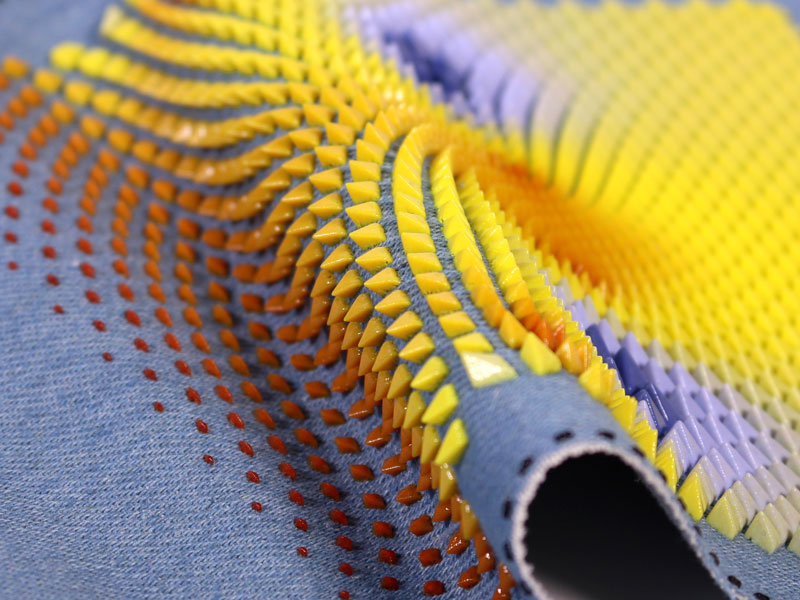
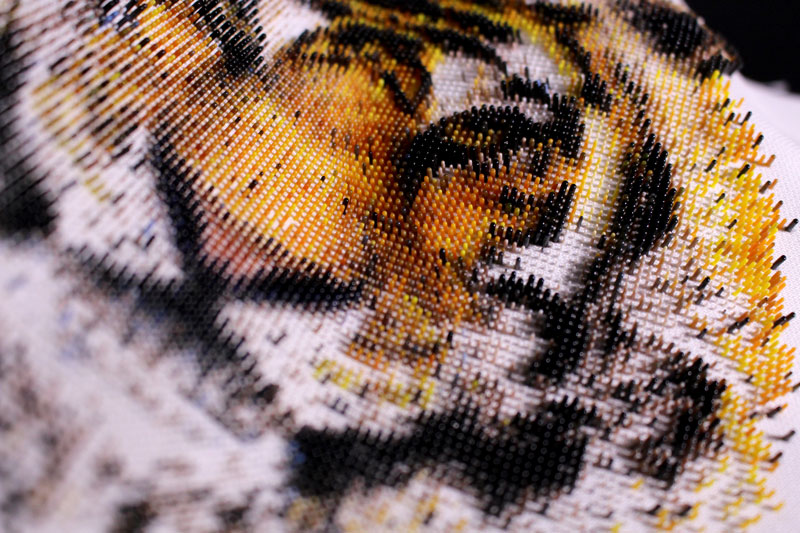
Fortunately, new advances in the technology are now taking this process even further — both reinventing what is possible and, importantly, putting these revolutionary capabilities directly in the hands of textile printers, ultimately ushering in an entirely new era of textile printing. For the first time, we are now able to 3D print direct-to-textile, opening up a host of new opportunities. By enabling the construction of patterns and objects directly onto textiles such as denim, cotton, polyester and linen, it is possible to build 3D printing into textile production from the outset, effectively turning fabric into a blank canvas for new visual and tactile effects.

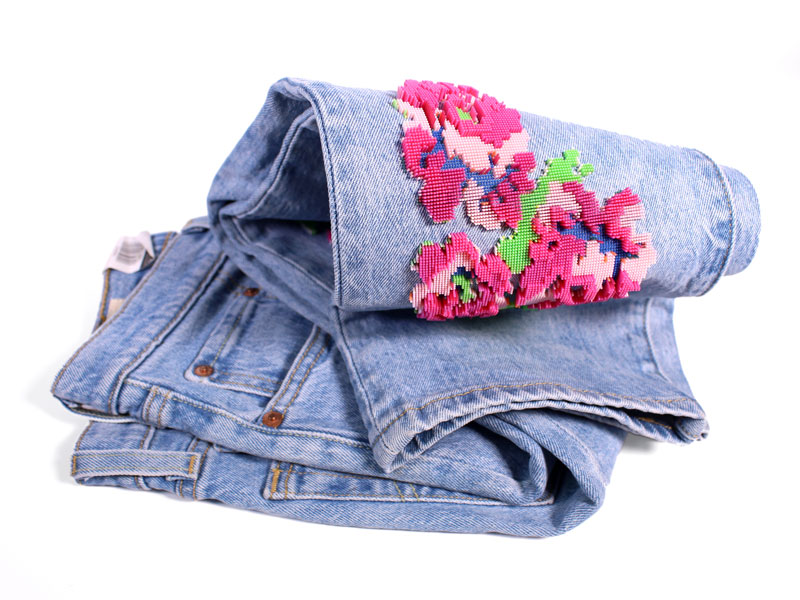
While direct-to-textile 3D printing technology is relatively new to the market, early applications have already included decorative patterns on jeans and dresses, graphics on shoes, wearables and bags. With countless more potential creative applications still to be explored this is merely the beginning.

Landmark pieces such as the Greta Oto Dress designed by threeASFOUR and Travis Fitch are showcasing how 3D printing onto textiles can create never before seen textile designs. Exploring the interplay of light and fabric, the dress harnesses the lenticular effect of the 3D printed elements — printed directly onto a polyester substrate — to reflect and refract light creating a butterfly-like shimmer — ultimately resulting in a final product that simply couldn’t be produced by any other means.

Direct-to-textile 3D printing not only allows innovation in new products, but can even extend product lifecycle by enabling used clothing and accessories to be repurposed with the addition of 3D printed elements, including customized designs and one-of-a-kind personalization.

Looking beyond the surface, the true value of this technology grants textile printers the means to deliver a differentiated, stand-out service offering. Changing the way they can engage with fabrics, this opens the door to new revenue streams and provides an all-important critical edge in a competitive market landscape.


Editor’s Note: Naomi Kaempfer is creative director of Art, Design and Fashion at Stratasys, and is responsible for exploring innovative new applications for 3D printing across the creative disciplines and developing key collaborations with designers and artists to push the creative envelope.


June 26, 2023

Terrot: A Strong Line-Up At The ITMA 2023

CHEMNITZ, Germany — June 23, 2023 — With an impressive combination of new developments, enhanced blockbusters and ever-growing variety of leading applications the company presented at the fair a highly demanded range of solutions, in particular for mattress ticking, upholstery, sports and functional wear clients.

“ITMA was also 2023 a great platform to present our products and services to a wide trade audience. The fair exceeded our expectations in all areas. Given the circumstances, the economic slowdown and crises in the textile industry we were overwhelmed by the interest and feedback generated. The high frequency of visitors to our booth that continued until the very end gave us all the opportunities to intensify existing business relations, generate important deals and make valuable new contacts,” said Managing Partner Robert Czajkowski.

The showcased 8-lock blockbuster I3P 196 premiering with the integrable Smartex inspection system, is only one example of Terrot’s ability to manufacture world’s best circular knitting machines and its dedication to constantly improve their outstanding customer value in terms of productivity, efficiency and flexibility.

The demand for innovative technical solutions will continue to increase being additionally fueled by digitization. With the continuous development of value-added technologies and customer-centric solutions we are best positioned to be successful in the markets. Responding to our customers‘ needs and offering reliable, easy-to-use solutions is one of our USP’s and at the same time of highest customer relevance.

“The market response at the ITMA confirms the high demand for Terrot machines as well as our technical solutions. This is an incredible source of motivation for our team and a constant incentive to deal with all the challenges ahead of us. I am convinced that with the strength of our dedicated staff, agents and partners, we will be able to meet any of the challenges arising. We are already looking forward to ITMA 2027 in Hannover” Czajkowski added.

Many thanks to our fantastic team, our loyal agents and partners, and our valued custo- mers for making ITMA 2023 a great success for Terrot!

ITMA Highlights

  • The I3P 196 OW a highly flexible and productive, interlock and fine rib machine with open width frame that has been much demanded globally in the past years. The I3P 196 is a creates „8-lock“, interlock and modified structures like punto di roma, mila- no rib, piqué rodier and also racer mesh with maximum efficiency. Equipped with up to 4 needle tracks in cylinder cam and 2 needle tracks in dial cam the I3P 196 promises maximum flexibility and a wide range of pattern options. At ITMA it was combined with the latest technology of our partner Smartex. Their build-in CORE system gives the customer the power of latest hardware and software technology to control their fabric production, inspecting every inch of fabric using arti- ficial intelligence algorithms, which are constantly being upgraded. Smartex’s patented hardware set is comprised of an AI-powered graphic processing server, high resolution cameras with machine learning capabilities, and enhanced lighting for optimal grei-
ge fabric inspection controlled by an intuitive industrial grade touchscreen interface. Smartex’ software provides the customer with 24/7 access to real-time production in- formation including automated roll maps, business intelligence data, and performance analysis from anywhere, using their preferred device (computer, tablet, smartphone).
  • The UCC 672-ME in 3-way technology in dial and cylinder is Terrot’s flagship in the production of highest quality mattress covers, upholstery and fashion with unlimi- ted pattern possibilities on both fabric sides. With 88 feeders at 38“ (available from 34“ to 42“), newly developed dial needle selection and reliable elastane plating, the model’s flexibility and extremely high productivity are the newest demonstration of Terrot’s reputation as world’s leading producer of most sophisticated electronic jacquard ma- chines.
  • The Interlock model I 1120 as one of Terrot’s newly designed circular knitting ma- chines with 34” and 136 feeders (30“ – 42“ on request) can be with many innovative and current demand reflecting features an attractive alternative to our blockbuster ever- green the I 2108. You can reach maximum efficiency and productivity with an industrial frame and fabric rolls up to 1,050 mm. The motorized fabric take-down with three rol- lers and the automatic winding-up device supports industrial production at its best.
  • The UCC 572-T is Terrot’s flagship in the production of functional sport and leisu- re textiles, offering great flexibility and a high production output. The machine features a wide variety of applications while producing single and double jersey structure area combinations in addition to hole patterns. This model makes designer’s dreams come true.
  • Terrot extends its product portfolio even further and launches the new JV-3.0, which stands for high production outputs in the field of single jersey fabrics. This very productive knitting machine is easily capable of a speed factor of 1,280. In addition, other single structures like piqué can also be knitted with the JV-3.0. Despite its high efficiency the machine displays outstanding flexibility, long maintenance cycles and unseen operational convenience.
  • The JSP5-4 produces high-quality plush with uniform loop lengths and provides a variety of different applications for various market requirements like fashion, home and technical textiles. Terrot offers different highly productive single jersey knitting ma- chines for nearly every application and is very successful on the global market with its product portfolio.

Posted: June 23, 2023

Source: Terrot GmbH

Data, Legislation And Climate Crisis In Focus At Better Cotton Conference

AMSTERDAM — June 23, 2023 — Better Cotton has concluded its annual conference, which was held June 21-22 in Amsterdam.

The in-person and online event attracted more than 350 industry stakeholders from 38 countries around the world, and explored four key themes: Climate Action, Sustainable Livelihoods, Data & Traceability, and Regenerative Agriculture.

On the opening day, following a member meeting in which the impending launch of Better Cotton’s India Impact Report was previewed, keynotes from Nisha Onta, Regional coordinator for Asia at WOCAN, and Antonie Fountain, CEO of the VOICE Network, set the scene for discussions on Climate Action and Sustainable Livelihoods, respectively.

On the former, sessions highlighted both the scale of the impact of climate change on cotton farming communities, and the scope for collaboration. Breakout sessions centered on the potential of localized primary data and carbon financing projects to unlock farm-level improvements.

On the topic of Sustainable Livelihoods, meanwhile, Fountain’s presentation blended into a lively conversation on living income that he facilitated with support from IDH Senior Innovation Manager Ashlee Tuttleman. Together, they oversaw a quiz which explored agricultural myths bandied around across commodity sectors, before winners were invited to take to the stage as impromptu panelists.

Later sessions on the topic explored in greater detail the concept of wellbeing and sustainable livelihoods. Julia Felipe, a Better Cotton Farmer from Mozambique shared her experiences; as did Jyoti Macwan, the secretary-general of SEWA, a women’s employment association that’s helped millions of Indian women secure necessities through local social enterprises.

The second day started with a keynote presentation from Maxine Bédat, the founder and director of the New Standard Institute, on the important role of data and traceability in a sector that’s facing increasing regulation.

Better Cotton Senior Traceability Manager, Jacky Broomhead, took to the stage soon after to outline the potential of the organisation’s traceability system as one solution. Joined by Erin Klett, senior director, Research & Policy at Verité, and Sarah Solomon, International Relations officer at the U.S. Department of Labour, they discussed the system’s impending launch and how it aligns with an influx of legislation.

A series of breakout sessions followed covering a myriad of topics, from pilot traceability efforts in India and the value of increased transparency for farmers, to the issue of greenwashing and methods of measuring impact.

A look at regenerative agriculture rounded off the event, starting with a keynote from Felipe Villela, founder of reNature.

Better Cotton, which continues to refine its approach to regenerative agriculture, featured throughout the theme, with Nathalie Ernst, the organization’s Farm Sustainability Standards Manager at Better Cotton, and Emma Dennis, senior manager Sustainable Agricultural Practices, helping set the scene as to how this approach can benefit nature and society.

This, before delegates heard from a panel of farmers representing India, Pakistan and the U.S. about how their operations have been impacted by the adoption of regenerative practices and the misconception surrounding its applicability.

Alan McClay, CEO, Better Cotton, said: “This year’s conference has been a resounding success. We’ve heard from experts throughout fashion supply chains, from valued cotton farmers in our network right through to the brands and retailers that source their product. Discussions have reiterated the urgent action required to tackle the worst effects of the climate crisis, but there was also a clear consensus around the need to deliver profound impact at farm level. With a regenerative approach and this group of changemakers we can push for social and environmental transformation.”

Posted: June 23, 2023

Source: Better Cotton

International Textile Manufacturers Federation (ITMF): Shipments Of New Textile Machinery Decreased In Most Segments In 2022, Except In Spinning

ZÜRICH, Switzerland — June 23, 2023 — In 2022, global shipments of new short-staple spindles, open-end rotors, and long-staple spindles rose by 27 percent, 85 percent, and 195 percent, respectively, year-on-year. Deliveries of draw-texturing spindles decreased by 13 percent and the number of shipped shuttle-less looms dropped by 23 percent. Shipments of large circular knitting machines declined by 27 percent and shipped flat knitting machines registered a 24-percent reduction. The sum of all deliveries in the finishing segment decreased by 28 percent on average.

These are the main results of the 45th annual International Textile Machinery Shipment Statistics (ITMSS) just released by the International Textile Manufacturers Federation (ITMF). The report covers six segments of textile machinery, namely spinning, draw-texturing, weaving, large circular knitting, flat knitting, and finishing. A summary of the findings for each category is presented below. The 2022 survey has been compiled in cooperation with more than 200 textile machinery manufacturers representing a comprehensive measure of world production.

Spinning Machinery

The total number of shipped short-staple spindles increased by 2.1 million units in 2022 to a level of 9.76 million. Most of the new shipments went to Asia & Oceania (86 percent) where deliveries increased by 21 percent compared to 2021. Europe (including Turkey) and America, North, rank second and third with respect to new deliveries. While levels remained relatively small in Africa, the region ranked fourth and experienced the strongest surge in year-on-year shipments with a  290-percent increase (primarily going to Egypt). The six largest investors in the short-staple segment were China, India, Bangladesh, Pakistan, Turkey, and Uzbekistan.

1.28 million open-end rotors were shipped worldwide in 2022. This represents 587 thousand additional units compared to 2021. Some 87 percent of global shipments went to Asia & Oceania where deliveries increased by 91% to 1.1 million rotors. China, India, and Turkey were the world’s three largest investors in rotors and saw investments surging by 67 percent, 261 percent and 91 percent, respectively. Deliveries of rotors rose in all major destination countries except for Vietnam and Brazil, the seventh and eighth largest destinations in 2022, where shipment of rotors decreased by 34 percent and 30 percent compared to 2021 (totalling around 15 thousand units in each case).

Global shipments of long-staple (wool) spindles increased from 31.6 thousand in 2021 to 93.000 in 2022 (up 195 percent). This effect was mainly driven by a rise in deliveries to Asia & Oceania with a 435-percent increase in investment. Some 21 percent of total deliveries were shipped to China, 20 percent to Uzbekistan and 15 percent to Iran.

Texturing Machinery

Global shipments of single heater draw-texturing spindles (mainly used for nylon filaments) decreased by 14 percent from nearly 75.1 thousand units in 2021 to 64.4 thousand units in 2022. With a share of 95 percent, Asia & Oceania remained the strongest destination for single heater draw-texturing spindles in 2022. China, Turkey, and Japan were the three main investors in this segment with a share of 84 percent, 3.5 percent, and 2.3 percent of global deliveries, respectively.

In the category of double heater draw-texturing spindles (mainly used for polyester filaments), global shipments decreased by 13 percent to a level of 756 thousand spindles. Asia’s share of worldwide shipments remained at 95 percent and China continued to be the world’s largest investor, accounting for 86 percent of global shipments.

Weaving Machinery

In 2022, global shipments of shuttleless looms decreased by 23 percent to 114 thousand units. Deliveries in the categories “air-jet” and “water-jet” dropped by 13 percent and 38.4 percent to 39.3 and 46.6 thousand looms, respectively. The number of “rapier and projectile” looms rose by 5.3 percent to 28.3 thousand units. The main destination for shuttleless looms in 2022 was Asia & Oceania with 93 percent of worldwide deliveries. 95 percent, 85 percent, and 97 percent of global air-jet, rapier/projectile, and water-jet looms were shipped to that region, respectively. The main investor for air-jet and water-jet looms was China. The main investor for rapier-and-projectile looms was India with 11.4 thousand units (a 70-percent increase compared to 2021).

Circular & Flat Knitting Machinery

Global shipments of large circular knitting machines declined by 27 percent to 28,651 units in 2022. The region Asia & Oceania was the world’s leading investor in this category with 77 percent of global shipments. China was the favored destination with 45 percent of all deliveries (i.e., 9,930 units) despite a decrease of 55 percent compared to 2021. India and Bangladesh ranked second and third destinations with 3,105 and 2,644 units, respectively.

In 2022, the number of shipped electronic flat knitting machines decreased by 24 percent to 72.6 thousand machines. Asia & Oceania was the main destination for such machines with a share of 83 percent of world shipments. China remained the world’s largest investor with a 63-percent share of total shipments despite a 41-percent decrease in investment. Shipments to the country dropped from 67.7 thousand units in 2021 to 39.6 thousand units in 2022.

Finishing Machinery

In the “fabrics continuous” segment, the number of shipped tenters decreased by 35 percent from 2,750 units in 2021 to 1,780 units in 2022. This number includes an estimate for the total number of tenters shipped by companies which have not participated to the ITMF survey to better grasp the global market size for finishing machinery. Participating companies reported a decrease in all other machine categories covered in the report (between -2.5 percent for “Relax Dryers/Tumblers” and -81 percent for “Bleaching – Line”), with exception of “Singeing Line” which grew from 4 to 22 units. In the “fabrics discontinuous” segment, the number of shipped “jigger dyeing/beam dyeing” and “air jet dyeing” declined by 35 percent and 45 percent to 707 units and 675 units, respectively. In 2022, deliveries in the categories “overflow dyeing” increased by 4 percent to 1,714 units.

Posted: June 23, 2023

Source: International Textile Manufacturers Federation (ITMF)

Sponsors