ITMA 2023: Mahlo Looks Back On Successful Trade Fair

SAAL ON THE DANUBE, Germany — June 29, 2023 — After the rapid and unpredictable challenges of recent years, ITMA 2023 was eagerly awaited. The world’s most important textile trade fair has always been a visitor guarantor, but would that be the case this time?

All expectations exceeded

After a week at the Fiera di Milano, it is clear: expectations were exceeded many times over. The stand of the German machine builder Mahlo GmbH + Co KG was bustling from the first to the last day.

“We are more than satisfied with the way ITMA went,” said Mahlo CEO Rainer Mestermann. “After the events of the last few years, we could not automatically expect such a large crowd at our stand and at the entire fair.” The interdisciplinary team at the stand in Hall 18, consisting of sales, application technology and service staff from Germany as well as the international sales and service partners, received visitors from all parts of the world. “Of course, there was a strong influx from Italy, but Turkey, India, Bangladesh, Pakistan and Latin America were also particularly well represented, in our estimation.” The number of guests from China was somewhat lower, but this is understandable, as ITMA Asia is due to take place there later this year.

At the Mahlo stand, guests could inform themselves about the product portfolio and the latest developments of the machine manufacturer for process optimization in textile finishing. The visitors felt very well looked after by the internal and external team. “A workshop preceding the ITMA at the headquarters in Saal guaranteed that all contact persons of the target markets were up to date with the latest developments.” This expertise was then in demand virtually around the clock.

“The topics of quality, energy saving and return on investment were at the top of the agenda for many visitors,” said Stephan Kehry, Textile Product manager. This was accompanied by great interest in data management and data recording. “Our new X-Series concept for forward control of knitwear with strong distortions was particularly in focus.” The Orthopac RXVMC straightening machine, which was presented for the first time in Milan, can remove distortions in textile fabric webs even faster and more precisely. The exhibit was delivered to a customer in Italy after the fair.

New straightening concept of the X series convinces

“With the new straightening concept, special attention was paid to the straightening mechanics and their interaction with the analysis electronics of the scanner system,” explained Head of Sales Thomas Höpfl. Two individually controlled and driven straightening modules with a total of four bow and three skew rollers ensure that the correction of bow and skew distortions takes place in small steps. The control concept is also new. A scanner group at the infeed of the straightening machine detects distortions even before they reach the correction rollers. This way, the rollers are brought directly into position and the fabric is corrected from the very first centimeter. A scanner group at the outlet also detects possible residual distortion, which is corrected at the second straightening module. This enables an even more precise and faster response when it comes to reacting to rapidly changing distortions. The Orthopac RXVMC therefore shows its full strength when straightening knitwear and distortion-sensitive fabrics. It guarantees higher quality goods and thus less waste. “Especially at a time when our customers are under increased cost pressure and competition in the textile industry is intensifying, our new concept has been convincing.”

Not only the exhibits proved to be a visitor magnet, but traditionally also the Mahlo bistro with its Bavarian specialties. With the successful combination of high-tech and Bavarian down-to-earthness, Mahlo’s trade fair appearance at ITMA 2023 was impressive.

Posted: June 30, 2023

Source: Mahlo GmbH + Co. KG

Finishing Machinery Specialist Monforts Has Secured A Significant Number Of Major Orders From Textile Manufacturers In Central And South America — Successful ITMA 2023

MÖNCHENGLADBACH, Germany — June 29, 2023 — Finishing machinery specialist Monforts has secured a significant number of major orders from textile manufacturers in Central and South America recently, and was very pleased to welcome an unexpectedly high number of visitors from the region to its stand at ITMA 2023 in Milan from June 8-14.

Among new orders are those for three Montex tenters delivered to the AustralTex Group in Argentina and a further Montex range to denim manufacturer CIT in Brazil. Guatemala’s Global Textiles placed an order for its second Montex tenter, while Mexico’s Zentrix ordered its third and Avante, also in Mexico, has opted for its sixth.

ITMA 2023

Elsewhere, orders have also been placed for the delivery of three new Montex senters to one of Pakistan’s major corporations, as well as a new Thermex dyeing range to nonwovens manaufacturer Orsa in Italy. Further orders — both for new machines and retrofit modules — are now anticipated following ITMA 2023, which attracted more than 111,000 visitors to Milan.

“Visitor footfall at ITMA 2023 was well beyond the company’s expectations, and we were especially pleased at the constant number of visitors from South American companies, as well as from Asia and Europe,” said Monforts Marketing Manager Nicole Croonenbroek. “We were able to provide them with detailed information about our portfolio of machines and technologies digitally and fielded an unprecedented number of serious inquiries, many of which promise to turn into new business.”

Monforts Montex tenters for processes such as drying, stretching, heat-setting and coating, she added, are already the industry standard for the fabric finishing industry, providing a number of advantages in terms of production throughput and especially in energy efficiency and resource savings. Other key technologies in the Monforts portfolio include relaxation dryers, Thermex dyeing ranges and Monfortex compressive shrinking ranges.

Montex®Coat

“We were also very pleased with the interest in the Montex®Coat, the latest addition to our range of technologies, which we displayed in Milan,” Croonenbroek said.

The Montex Coat can serve a very diverse number of markets and enables full PVC coatings, pigment dyeing or minimal application surface and low penetration treatments, as well as solvent coatings. Knife coating, roller coating or screen printing can also all be accommodated with this system.

As such, it provides the ultimate in flexibility and the ability to switch quickly from one fabric run to the next, without compromising on the economical use of energy or raw materials.

Many refinements have been made to the Montex Coat in the past few years, resulting in higher coating accuracy and the resulting quality of the treated fabrics. A number of advanced new improvements were introduced in Milan, including automatic edge limiters for immediately adapting to new coating widths and a new and simplified hand-held control device. These save considerable time in setting up the machine and ensuring consistent production.

The Montex Coat unit displayed in Milan was sold to Vietnamese company Thai Tuan during the show.

Upbeat

“Prior to ITMA 2023, we were expecting this year to be challenging, given the generally gloomy analyst forecasts for the immediate future of the textile industry, so the number of new sales being announced and the upbeat atmosphere took us by surprise,” Croonenbroek said in conclusion. “Meanwhile, we are preparing for the future and always working on improvements and innovations together with our customers to meet their demands and help transform the world of textiles with value-added — monforized — products.”

Posted: June 30, 2023

Source: A. Monforts Textilmaschinen GmbH & Co. KG

ITMA MILAN: A Success For Italian Textile Machinery Manufacturers

MILAN — June 28, 2023 — The 19th edition of ITMA proved to be a great success for Italian textile machinery manufacturers. ACIMIT President Alessandro Zucchi noted. “So many satisfied visitors and exhibitors, confirming the vitality of the global textile machinery industry, and of the sector in Italy particularly,” Zucchi said.

ITMA 2023, which was held in Milan June 8-14 at the exhibition fairgrounds of Fiera Milano – Rho, closed with some impressive figures. Hosting 1,709 exhibitors in total, the seven-day fair registered an attendance of over 111,000 people hailing from 143 Countries.

With 422 companies exhibiting their wares, Italy was by far the Country with the largest contingent, coming in first for the number of visitors as well at 29 percent of the total in attendance, followed by Turkey, India and Germany (6 percent each), France (4 percent) and Brazil (3 percent).

“ITMA remains a must event for the industry, and the figures for the edition in Milan speak for themselves, confirming the resilience of the textile sector worldwide” Zucchi commented. “As far as our country is concerned, the number of exhibitors and visitors testifies to the vitality of the entire Italian textile supply chain. Italy’s success, both in terms of visitors in attendance and orders acquired during the fair, is the consequence of a deep rooted commitment — which is also an economic investment — put forward by our manufacturers, and the indispensable support in implementing promotional initiatives for ITMA with the support of the Ministry of Foreign Affairs and International Cooperation and by the Italian Trade Agency”.

Solutions were being proposed for more sustainable textile productions by most of the exhibitors, and here too Italian manufacturers were absolutely at the forefront, with solutions catering to saving water, energy and raw materials. Sustainability was also the main focus of the ACIMIT press conference, in which the ACIMIT Green Label Award was assigned to two Italian manufacturers, Pafasystem S.r.l and Brazzoli S.r.l., who among ACIMIT’s associated members have proved to be the most committed to reducing the amount of carbon dioxide equivalent emissions produced during the operation of their machinery over the past few years.

Among the many government representatives in attendance, ITMA 2023 hosted high-level delegations from two of the world’s major textile producing countries, India and Uzbekistan. ACIMIT’s top management thus met with the President of Uzbekistan Shavkat Mirziyoyev and the Indian Minister of Textiles, Darshana Vikram Jardosh, showcasing the excellence of Italian technology on offer. Other significant encounters took place with the Ambassador of Iran Mohammad Reza Sabouri, as well as with representatives of the Italian Government, such as the undersecretary of the Ministry of Foreign Affairs and International Cooperation, the Honourable Giorgio Silli.

In conclusion, a comment by ACIMIT president Zucchi: “This edition will be remembered for the message it conveyed, as exhibitors presented numerous technological innovations focusing on a search for greater sustainability and a more decisive digitization of textile production processes. Sustainability and digitization: a combination that constitutes the key to success for the entire textile supply chain, and which I am sure will see new developments at ITMA’s next edition, to be held in Hannover (Germany) from September 16 to 22, 2027.”

Posted: June 28, 2023

Source: ACIMIT – Association of Italian Textile Machinery Manufacturers

Bloom Labs Pioneers Next-Generation Protein-Based Alternatives To Fibers And Plastics

LONDON — June 21, 2023 — Today, Bloom Labs launches to accelerate the world’s transition towards a circular economy, by developing next-gen alternatives to natural and synthetic fibers, and plastics.

Bloom Labs is pioneering breakthroughs in material science by harnessing the value of natural waste by-products, a protein-rich and globally abundant raw material, to create new high-performance clothing and plastic materials that are scalable and commercially viable yet avoid the use of harmful petrochemicals and resource-intensive processes.
Using bio-manufacturing, advanced protein engineering, and molecular biology, our proprietary technology plasticizes waste, regenerating it into uniquely practical and versatile pellets. The pellets are spun into high-performance fibers, designed to emulate the properties of current materials — as plush as cotton, as lush as silk, and as functional as polyester.

The easily transportable “plug and play” pellets are a game-changer within the material science space, where scalability and feedstock risks can prohibit accelerated growth. The pellets can be seamlessly integrated into manufacturers’ production processes and the abundant protein raw material comes without the feed stock risks or environmental impact of petroleum.

Simardev S. Gulati, a third generation textile entrepreneur and the co-founder and CEO of Bloom Labs, shared: “Our mission is to make circularity an actuality. We see a future where old resource intensive processes are replaced with cutting-edge sustainable alternatives.”

According to Textile Exchange, the global fiber production has doubled in the last 20 years to 113 million metric tons produced in 2021 and is predicted to continue growing to 149 million metric tons in 2030 should business as usual continue. Increasing the use of recycled fibers and next-gen materials is critical for fashion to reduce the greenhouse gas emissions, minimize water consumption, halt negative impacts on biodiversity, and manage its ever-increasing post-consumer waste.

While 8.5 percent of global fibers produced in 2021 originated from recycled materials — primarily recycled polyester from PET bottles — less than 1 percent of fibers were produced by recycling existing textiles. Circulatory and material innovation are the key to breaking fashions dependence of fossil fuel and mitigating the impacts of our current linear economic systems.

The current problem is two thirds of global fiber production are synthetic fibers. Polyester alone has been the most widely produced fibers since the mid-1990s. The problem is these fabrics are fossil-fuel based, shed microplastics and will never biodegrade. Petro-Chemical fiber production requires 1.3 billion barrels of oil each year — more than Spain’s annual oil consumption. These imperishable pieces compile in landfills, often in the global south, or incarcerated, releasing toxic chemicals.

Gulati added: “I stand on the shoulders of giants. Our expert team of interdisciplinary scientists, which includes the inventor of plasticized protein, Walter Schmidt, Ph.D., are reimagining material sourcing for multiple sectors, and developing commercially feasible alternatives which will create a future of seamless integration, infinite feedstock, and limitless possibilities.”

Posted June 27, 2023

Source: Bloom Labs

Sheep Inc. Unveils Negative Carbon Footprint T-Shirt

LONDON — June 21, 2023 — Knitwear brand Sheep Inc. has launched what it describes as the world’s first naturally negative carbon footprint T-shirt with a Near Field Communication (NFC) enabled tag for consumers to trace the source and environmental impact of their purchase.

The company is proud to announce the first T-shirt that naturally has no carbon footprint: Climate positive since launch, this global first has been achieved by Sheep Inc.’s relentless drive for sustainable supply chain innovation and its commitment to regenerative farming methods. With today’s milestone, Sheep Inc. is among the first company that can not only be classified as a sustainable fashion brand, but as a truly regenerative one.

“We believe in the fashion industry’s collective responsibility to create products that work within safe, planetary boundaries,” said CEO & Co-Founder of Sheep Inc. Edzard van der Wyck. “We therefore need to start designing products that naturally have a regenerative effect on our planet. Products that in their creation and use give back more to nature than they take, without the need to offset. This T-shirt serves as a testament that this is possible. To reach a future where we design in harmony with nature.”

Synergistic supply chain innovation to achieve zero emissions

To achieve its naturally regenerative profile, Sheep Inc. spearheaded a synergistic partnership across suppliers and manufacturers, with the aim to minimize impact and maximise performance. With the collective belief of leveraging the best of nature and science-based material innovation to create knitwear with no equal.

At the raw material stage, Sheep Inc. exclusively uses carefully sourced, extra-fine 19.5 micron Merino wool from three regenerative sheep stations in New Zealand: Lake Hawea Station, Middlehurst Station and Omarama Station. These three farms sit at the forefront of the regenerative farming movement and use innovative land management, feeding and grazing techniques to capture more CO2e from the atmosphere than their operations emit. Making their properties, as well as the wool they produce, carbon negative. This carbon-negative fiber is then processed by Sheep Inc.’s supply chain partners across Europe, who run on 100-percent solar power, to spin the yarn, manufacture the garment and run logistics.

Using the next evolution in material science, Sheep Inc. works with Germany-based yarn mill Südwolle to spin the extra-fine Merino wool and apply a chlorine- free treatment to the yarn called Eternity X-Care®. A pioneering, performance-increasing treatment for the wool that uses no chlorine or harmful chemicals and is Bluesign© and OKEO-TEX® certified. With the aim to achieve unparalleled quality, machine-washability, and generational durability. Each T-shirt is then created by Portugal-based specialist knitter Fatextil using 100-percent solar powered, 3D Wholegarment® knitting machines, to ensure a zero-waste manufacturing process. All orders are fulfilled from the UK’s first carbon-neutral logistics partner Airbox, which is completely solar powered.

Merino wool’s unique self-cleansing properties and zero-odor retention ensure that emissions from washing, and drying are reduced to a minimum. And every T-shirt is 100-percent biodegradable to ensure zero trace at end of life. On top of this naturally negative carbon profile, Sheep Inc. will continue investing 3 percent of its revenue into their Radical Farming Fund. Investing funds back into biodiversity and research initiatives at their own suppliers to ensure a continuous improvement of sustainable impact.

Not A T-shirt. A new design standard. 

Each piece of Sheep Inc. knitwear is engineered to restore our relationship with the natural world. With every element of the brand considered, the Sheep Inc. design approach sources natural materials that are enhanced by science.  Pared-back luxury, realized in the finest quality 19.5 micron Merino wool. A perfect blend of the technical benefits of Merino wool, enhanced through material and design science to achieve a garment that feels as soft as cashmere but is crafted with generational durability. The T-shirt is available in six natural base colors and four limited edition pastel hues

The T-shirt also carries Sheep Inc.’s signature design elements: a hand-finished “smit-mark” detailing on the back of the neck, using factory offshoot yarn that would otherwise go to waste. And Sheep Inc.’s symbol of reconnection, the signature Connected Dot.  An NFC enabled tag clipped on the hem of the garment that is made from bio-based EcoPAXX®, and removable via a clip system.

Taping the Connected Dot provides all details of the T-shirt’s unique creation journey and gives the carbon footprint per step. And as the name Sheep Included suggests, it also links the wearer to a sheep on one of the New Zealand farms that contributed to the knitwear. Allowing you to interact with the origins of your product. In our case a sheep. Creating a product that is in constant dialogue with nature and can be returned to nature. This is what working in harmony with nature looks like.

Sheep Inc work with Carbon Footprint Ltd. to independently calculate and verify the negative carbon profile of each T-shirt produced via an unbiased Product Life Cycle Assessment from cradle-to-grave.

Winner: Positive Luxury’s “Environmental Innovator of the Year” award for 2022. 

Sheep Inc. recently won Environmental Innovator of the Year at the 2022 Positive Luxury Awards. This award recognises entrepreneurs, developers, agencies, suppliers, brands and other organisations that have demonstrated the most impressive innovation within an environmental sustainability initiative or project.

“Sheep Inc. showcase the positive impact fashion brands should be striving for by being naturally carbon negative through regenerative farming and products which are 100-percent biodegradable. Added to that is 100-percent traceability and trackability — with innovative NFC tagging — ensuring consumers can see first-hand the environmental impact of their purchase,” said George Scott, Senior Sustainability Client Services manager, Positive Luxury

Posted June 27, 2023

Source: Sheep Inc.

Stoll Premieres “Color In Knitting” Pattern Compendium Based On Stoll Flat Knitting Technique

OBERTSHAUSEN, Germany — June 27, 2023 — The book “Color in Knitting: By Designers, for Designers” invites you on a fascinating journey through the world of color in knitwear design and to discover its limitless potential. The 208-page work explores the methods of knitting multicolored patterns through knitting structures, techniques and technologies. This makes the publication by authors Jörg Hartmann from STOLL, Anna Gitelson-Kahn and Luca Missoni an indispensable source of inspiration for all designers working in the textile field.

The new publication “Color in Knitting” presents the almost infinite possibilities of multicolored knitwear. It is intended as a practical handbook for designers who wish to expand or deepen their design practice. The reference book covers the topic of color in conjunction with flat knitting technology. Other color-related finishes such as dyeing, printing or embroidery have been deliberately omitted in favor of a concise focus. The introductory ‘color journey’ presents the fascinating variety of industrially produced knitting patterns, using the example of the extensive archive of the long-established STOLL company, which today belongs to the KARL MAYER GROUP. The selected patterns from past decades illustrate the various methods of multicolor knitting and the resulting color effects particularly clearly. Each pattern is given a pattern number and is available online in STOLL’s so-called Patternshop. This allows further details to be researched via the website.

Next to the patterns are keywords that refer to the technical chapters in the second part.

In this part there are insights into the specific techniques used to make the patterns presented. Technical drawings of the stitch progressions make the construction of the knits understandable. Based on this, creatives can explore structures and techniques individually to achieve their own goals in combining colors.

At the end of the book, all examples are summarized in a clear matrix and the connection of the patterns shown to the corresponding technical chapters is established. Finally, a glossary provides information on the meaning of the technical terms used.

With its many large-format illustrations of colored knitwear and its details, as well as its profoundly researched information, diagrams and references, “Color in Knitting” is a book that is as beautiful as it is practical and will delight designers as much as anyone interested in the possibilities of colored knitting with flat knitting technology.

The reference book can be ordered at https://arnoldsche.com/en/product/color-in-knitting-by-designers-for-designers/ in German or English. The price is 38 euros, $65 or 42 GBP.

Posted June 27, 2023

Source: Stoll

Jowat Receives ISCC PLUS Certification

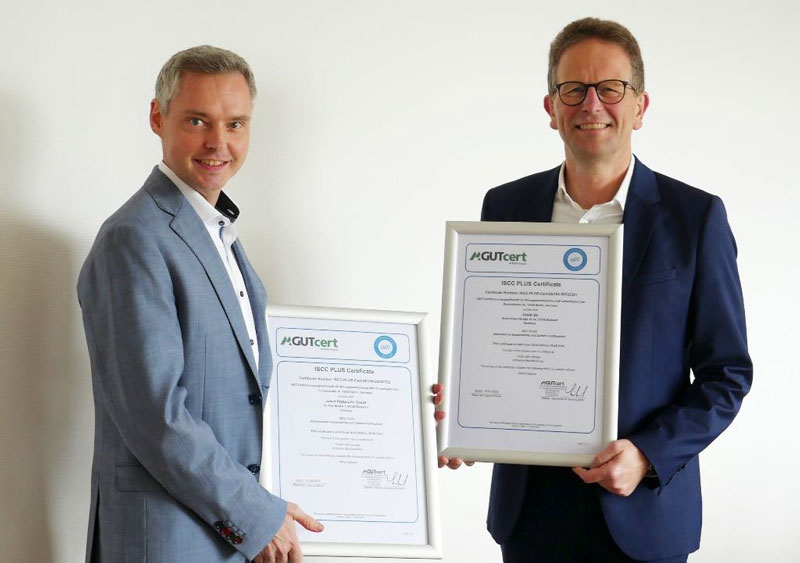
The adhesive manufacturer Jowat received ISCC PLUS certification for its plants in Detmold and Elsteraue, Germany. Manuel-Robert Meier (left), head of Management Systems, and Dr. Christian Terfloth, member of the board of directors.

DETMOLD, Germany — June 27, 2023 — Jowat SE has now been accredited with an ISCC PLUS (International Sustainability and Carbon Certification) certification for its Germany-based manufacturing locations in Detmold and Elsteraue. In addition, the globally active manufacturer is planning to have further locations within the Jowat Group certified. The certification allows Jowat to engage customers in a sustainable value stream via mass balance certificates. In future, Jowat will therefore also be supplying sustainable variants of its tried-and-true adhesives in addition to Jowat Green Adhesives.

In the mass balance approach, the biobased or recycled feedstocks are added early in the production process of raw materials and then allocated to the finished adhesives based on calculation. This conserves fossil raw materials while maintaining the same high quality and performance of the adhesives. It also offers advantages in production: The tried and trusted formulations, machines and processes do not have to be changed.

ISCC is an internationally recognized system which certifies the sustainability of e.g. biomass and bio-energy. The standard covers all stages of the value chain and is widely used around the world. As part of the ISCC PLUS mass balance certification, the use of renewable raw materials is verified and tracked from the feedstocks to the finished product.
“The first ISCC PLUS certification is an important step for the entire Jowat Group and strengthens our strategy to increase the sustainability of adhesive bonding,” said Dr. Christian Terfloth, member of the Board of Directors at Jowat SE. “The mass balance approach provides a great opportunity for the chemical industry. It enables us to actively and successfully take part in the European Green Deal.”

Jowat regards itself as a leading innovator in the field of sustainability. Today, Jowat Green Adhesives of the adhesives expert already supply a comprehensive portfolio of sustainable adhesives for most fields of application. The goal set by the enterprise: Ensuring that at least 80 percent of Jowat innovations will meet its strict sustainability criteria by 2025.

Posted June 27, 2023

Source: Jowat

TrusTrace Releases its Second Industry Playbook: ‘The Traceability Roadmap’, Featuring Learnings from Tapestry, ASICS, Kharon & More to Facilitate Global Supply Chain Transformation

COPENHAGEN — June 27, 2023 — Released in collaboration with Fashion for Good, TrusTrace, a global SaaS company with a market-leading platform for product traceability and compliance, today unveiled the second iteration of its industry playbook.

The Traceability Roadmap features interviews and insights from iconic brands like ASICS and Tapestry on implementing traceability to foster sustainable transformation, as well as expert insights from Kharon and Policy Hub into how the future regulatory landscape shapes the needs for traceability. Furthermore, it looks at how industry standardization and collaboration can be achieved, with expert commentary from GS1 and MACN, the Maritime Anti Corruption Network. The TrusTrace Traceability Roadmap was officially unveiled on June 27th at the Global Fashion Summit in Copenhagen.

“In just a few short years, supply chain traceability has  become recognized as the central tenet of sustainable  transformation. Brands that want to communicate product  information with consumers, adhere to certification criteria, abide by current and incoming regulations, and avoid greenwashing can only do so by tracing their complex network of suppliers and manufacturers. Yet despite its importance, there is still a lack ofunderstanding on  implementation,” said TrusTrace CEO and Co-Founder Shameek Ghosh. “Our first Traceability Playbook focused on why traceability is needed. Now, our new Traceability Roadmap provides the industry with a detailed guide on how it can be achieved, with learnings from global leaders in traceability.”

TrusTrace’s first industry playbook released in June 2022 — which quickly garnered thousands of downloads — outlined the business case for implementing traceability and the wider considerations for brands, including incoming regulation, material innovation and the circular economy. TrusTrace’s Traceability Roadmap hones in on the journey to implement traceability, including defining your needs, navigating legislation, ensuring your organization is aligned and ready, finding the right solution, implementing successfully, and standardizing and scaling traceability industry-wide. While primarily leveraging examples from the fashion industry, the guide can also be a useful reference for other industries currently grappling with similar supply chain challenges and legislation.

“The TrusTrace Traceability Roadmap serves as a guide for brands, suppliers, and ecosystem players to understand, and implement traceability effectively,” said Kathleen Rademan, director of Fashion for Good’s Innovation Platform. “It helps companies choose useful digital and physical tracing solutions to meet their business, policy, and ESG needs.”

The chapters of the Roadmap are built to facilitate learning and include expected outcomes, theory, secrets to success, case studies, expert interviews and tool kits with downloadable templates and worksheets that brands can use to get started.

According to Kit Conklin, vice president at Kharon, the playbook also offers unparalleled insights into a precedent-setting law that has put many industries on edge: the Uyghur Forced Labor Protection Act (UFLPA). “Since being instituted in June of 2022, the UFLPA law has catalyzed the adoption of traceability solutions for compliance,” Conklin said. “It’s imperative that brands across industries understand the impact, and what’s required of them, in order to comply. The Traceability Roadmap provides in-depth insights as to why and how brands can prepare for this game-changing law.”

The TrusTrace Traceability Roadmap also features an in-depth case study on the traceability programs of Tapestry and ASICS, and how the initiatives tie into their broader mission. Sherry Fazal, Senior Manager, Global ESG & Sustainability Solutions explains: “The long-term vision is to have traceability and transparency throughout the entire life cycle of a product. How we get there won’t be linear — that’s the important part. We learn, we tweak, we pivot. Our work in ESG is not an add-on or something that we ‘should’ have; it’s a key part of our business that is making us more resilient and forward-looking. ESG is part of our DNA as a company.”

Matthew Xu, ASICS CSR and Sustainability lead, shares his insights from the Asics traceability program, which is treated as a company-wide transformation project to move from a linear to a circular business model: “Traceability plays a vital role in achieving transparency — not only to share our story but also to exchange best practices and foster collaboration in addressing challenges.”

According to Ghosh, he believes the new Traceability Roadmap will continue to support and guide brands on their journey to initiate and implement a traceability program — regardless of which solution they use. “As an industry leader, we want to support fashion’s decision-makers by defining the best practice for supply chain traceability,” Ghosh concluded. “Across the industry, everyone from the C-Suite to sustainability, legal, production and sourcing teams are facing unprecedented challenges and demands to change their supply chains for the better. Our aim is that this will help them get there successfully, faster, and through increased collaboration.”

Posted June 27, 2023

Source: TrusTrace

Material Exchange Launches Deadstock Depot Marketplace

STOCKHOLM — June, 21, 2023 — Once swept under the rug by the fashion industry, deadstock fabrics and their use in apparel and footwear lines are quickly growing in popularity. These excess materials have traditionally been stacked and forgotten on warehouse shelves — but they’re now presenting a win-win scenario: for brands looking to reach new sustainability goals or add last-minute items to their collections, and for suppliers eager to showcase these materials and cash in on what otherwise goes to waste. Bridging the gap between these two groups has been the challenge — until now with the launch of our Deadstock Depot.

“The Deadstock Depot makes it easy for brands to find deadstock materials and take advantage of the many benefits they bring,” says Ben Felton, Material Exchange’s chief strategy officer. “This includes lower cost, lower environmental impact, and faster speed to market. For suppliers, it’s also a big win, giving them an opportunity to get materials that are gathering dust in their warehouses back into circulation.”

The need for sustainable measures within the fashion industry is acute, as can be seen in some of the latest statistics:

  • Since the 2000s, fashion production has doubled and it will likely triple by 2050, according to the American Chemical Society;
  • 92 million metric tons of unwanted fabrics are disposed of each year; and
  • 14.5 million tons of textiles were landfilled and incinerated in 2018.

More clothes are being made than ever before — and huge quantities of them are going to landfills or being burned. This is why the use of deadstock is so important. These leftover fabrics have already been produced so there’s no expenditure of water, energy, or virgin raw materials to create something new. And with the Deadstock Depot, they’re available and accessible on a global level for brands to use in creating their upcoming collections.
Suppliers who sign up for the Deadstock Depot benefit from having their deadstock fabrics digitized and marketed both online and at physical shows. Brands who are interested in sourcing deadstock can access everything they need within this marketplace: high-quality visuals of deadstock materials alongside detailed attribute data, Fabric Detail Sheets, Internal Test Reports, as well as the ability to order samples.

Through the Deadstock Depot, we aim to reduce the quantity of materials that go to waste each year and help contribute to making fashion a more circular, sustainable industry. Brands benefit from sourcing materials at a lower cost and receiving their materials faster than when ordering new ones. Suppliers increase their revenue flows from what’s previously been a commodity to dispose of.

Using deadstock doesn’t solve all of fashion’s sustainability problems, but it’s a step in the right direction. We just need to make these fabrics available to the brands that want them.
And that’s exactly what the Deadstock Depot is doing.

Posted June 27, 2023

Source: Material Exchange

Glen Raven To Sell Strata Geosynthetics Business As Company Focuses On Core Portfolio

BURLINGTON, N.C. — June 27, 2023 — Glen Raven, a provider of innovative textiles and performance solutions, announced today it has reached an agreement to sell its Strata geosynthetics products and related construction business to Hella Infra Market Private Ltd. (Infra.Market), an India-based B2B online procurement marketplace for construction materials.

This sale represents the next step in executing Glen Raven’s long-term global investment strategy in support of its key brands. “This move enables us to focus on expanding our leadership in Glen Raven’s core markets and extending our brands into new spaces,” said Leib Oehmig, CEO of Glen Raven.

Strata was acquired by Glen Raven as part of a larger acquisition in 2007 and has expanded into a global presence in partnership with India-based Strata Geosystems India Pvt. Ltd. Today, Strata is known globally as a full-service solution provider for the construction industry.

“We are proud of the tremendous success of Strata as part of Glen Raven and the work of the outstanding team that supports the business,” said Oehmig. “Aligning the business with a construction-centric organization positions Strata and its associates for continued growth and success.”

The transaction is not expected to result in any job eliminations and Strata’s global business operations are expected to continue without interruptions. The company is not disclosing the financial terms of the agreement.

Posted June 27, 2023

Source: Glen Raven

Sponsors