REVECOL® By ERCA Textile Chemical Solutions: “Circular Solutions For A Textile Revolution”

GRASSOBBIO, Italy — December 1, 2023 — What’s new for REVECOL® by ERCA Textile Chemical Solutions? After the inspiring and productive meetings last June at ITMA where synergies with Patagonia® and YKK were announced, REVECOL® resumes its dialogue with professionals from the textile world, keeping its promise not only to “share” this responsible innovation with stakeholders, customers and the general public, but above all to illustrate its evolution and ongoing development. We are talking about a company and a range of products capable of “transforming problems into solutions” with the aim of bringing a new culture of sustainability and circularity within textile production, and inevitably leading to innovations that follow one another at an incessant pace.
Thanks to a 100 percent Made in Italy, highly technological, pioneering and end-to-end certified production process, REVECOL transforms critical waste materials (in this case, used vegetable oils) into a complete range of innovative and responsible chemical auxiliaries designed for the entire textile industry and its various applications.

Conveying the values of the new generation REVECOL chemicals to the public – from customers within the textile production chain to final consumers — is not an easy task, even more so if we then add the “many” unique characteristics defining REVECOL such as circularity, safety, high performance, competitiveness and its ability to be used on any type of textile fibre, both virgin and recycled … we are clearly facing a challenge.

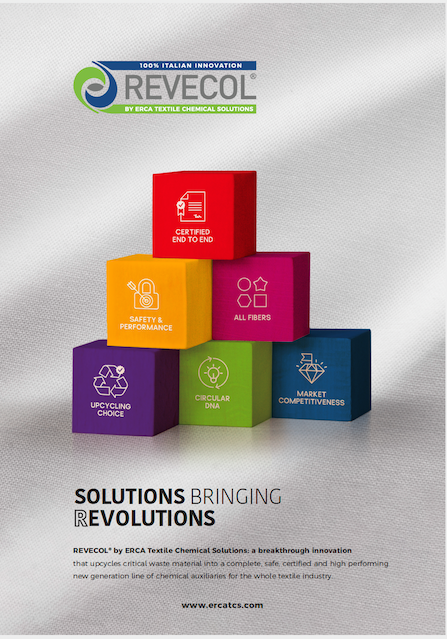
For this reason — and this is the first notable feature — the brand has chosen to present itself through an image that makes immediate not only the idea of responsible innovation in the REVECOL range of products, but one that also shows its values, representing them as “bricks” which together and in combination constitute the uniqueness of this range.

The new image captures the essence of responsible innovation: each shade in the vibrant colour composition tells a story about the company’s commitment to making a positive impact on the environment and on society. Chemical auxiliaries play a crucial role in different phases of the textile production cycle, but at the same time they represent a complex challenge in terms of reducing environmental impact. The bottom blocks in the image represent specific choices made by ERCA TCS: the use of recycled materials, the vocation for circularity, competitiveness in the market. Attention to safety is built on this foundation, and it is combined with exceptional performance, as well as the ability to use the range of chemical auxiliaries on all textile fibers. Everything is then guaranteed by end-to-end certifications. It is this combination of values and features that brings solutions to the textile market, solutions that mark a real revolution in the name of circularity.

The REVECOL by ERCA TCS range now includes 18 new generation chemical auxiliaries. For all of them, thanks to its unique and innovative characteristics, REVECOL has obtained the most important certifications:

GRS, RCS, ZDHC Chemical Gateway, bluesign® and GOTS. In particular, with the support and analysis of bluesign Academy, it is creating, where possible, the Product Carbon Footprint (PCF) for some REVECOL products, certifying the reduction of CO2 emissions compared to the use of conventional chemistry.

Last, but not least, this great effort in the search for profoundly innovative and increasingly environmentally friendly production processes has earned ERCA the prestigious European Responsible Care® Award 2023, awarded by Cefic-the European Chemical Industry Council, the largest European chemical industry association, founded in 1972. The award recognizes ERCA TCS’ commitment, through the REVECOL range, to climate neutrality, circularity and the transition towards safe and sustainable chemicals. And it reiterates that the REVECOL range paves the way for a new generation of chemical auxiliaries capable of transforming critical waste, massively present in the environment, into a range of certified, high-performance, safe and competitive products designed for textiles and suitable for any fiber, with a strong focus on sustainability and carbon neutrality, as confirmed by analyses and certifications.

Posted: December 1, 2023

Source: ERCA Textile Chemical Solutions

Protein Evolution, Fashion Sustainability Pioneer Stella McCartney Debut The World’s First Garment Made Using Biological Recycling

NEW HAVEN, Conn. — December 1, 2023 — Today, Protein Evolution Inc., a biological recycling company working to decarbonize plastic production, unveiled the world’s first garment produced using its Biopure™ technology at COP28, the United Nations Climate Change Conference. The parka, designed by Protein Evolution investor and brand partner Stella McCartney, is made from rigid packaging waste and industrial textile strappings — formerly used to secure international freight containers — processed by Biopure.

“Today marks a pivotal moment in the move towards textile-to-textile circularity in the fashion industry,” said Connor Lynn, co-founder and chief business officer of Protein Evolution. “Not only is this coat validation for the utility and quality of biorecycled polyester — specifically polyester chips created using Biopure — it also offers companies an alternative to the landfill or incinerator for their fabrics, extending the life of their materials indefinitely.”

Protein Evolution’s Biopure technology leverages AI-designed enzymes to break down polyester waste into the raw materials of new polyester that are indistinguishable to the petroleum-derived raw materials used in polyester manufacturing today. Once these raw materials are re-integrated into the manufacturing process, the result is an infinitely recyclable polyester with a meaningfully lower carbon footprint than polyester produced from petroleum. Biopure is capable of handling a variety of waste streams, from plastic bottles and clam-shells, to industrial textiles and garments.

“Anybody who knows me knows that I hate waste, which is why I am so thrilled about our collaboration with Protein Evolution,” said Stella McCartney. “Through my SOS Fund, we were among the first to invest in their pioneering biological recycling technology; one that has the potential and power to transform the world’s plastic waste into infinitely recyclable polyester. Over the last year, Protein Evolution has taken unused fabrics from my past collections to test and prove their textile-to-textile circular process. This allowed my atelier to design and create the beautiful, airy parachute parkas made from biologically recycled polyester that you can see today at our Sustainable Market at COP28.”

The pioneering parka will be in soft natural tones and reference parachute styles that have appeared throughout the British brand’s collections, blending sustainable and sport attitudes. The coat serves as a proof of concept that highlights a new innovation for textile-to-textile circularity and will be on display at COP28 at the Stella McCartney sustainable fashion exhibit through December 12, 2023.

To create the parka, Protein Evolution transformed rigid packaging and industrial textile waste into textile-grade polyester — highlighting the versatility of the company’s Biopure technology. Working with partners in the EU, the polyester was then spun into yarn and woven into new fabric by Stella’s team to be used in the design of the coat.

A pioneer in sustainable fashion, and a catalyst for bringing new materials to the mainstream fashion industry, Stella McCartney was an early investor in Protein Evolution and is an advocate for the company’s innovative technology. Protein Evolution’s initial fundraising round was led by Collaborative Fund’s climate-focused Collab SOS, which is in partnership with McCartney and LVMH. In late 2022, Protein Evolution and Stella McCartney announced a groundbreaking R&D collaboration for Protein Evolution to turn unused polyester fabrics from Stella McCartney’s previous collections into virgin-quality polyester, piloting a circular solution for the fashion industry. With the introduction of the first-of-its-kind parka, the team has marked a major breakthrough and milestone for the partnership in less than a year.

Protein Evolution is the only company in the world that has validated biological recycling technology through a piece of clothing, and the application across the broader plastics industry is promising as the process integrates directly into the existing supply chain – a real solution to decarbonize plastic production and deal with the plastic waste crisis.

“We’re excited for the world to learn about a company we’ve believed in, and backed, from day one. Protein Evolution’s break-through technology delivers a cost-effective, high-quality way to combat plastic waste and create a truly circular product, not only in fashion, but across industries,” said Sophie Bakalar, Collaborative Fund Partner. “It’s remarkable what the company has achieved in less than a year of this collaboration with our partner Stella McCartney. It really demonstrates Protein Evolution’s laser focus on creating solutions that can be used today — not decades in the future — to have the biggest impact at the fastest pace possible.”

Posted: December 1, 2023

Source: Protein Evolution, Inc. / Stella McCartney

ANDRITZ: First Automated Textile Waste Sorting And Recycling Line In France Inaugurated

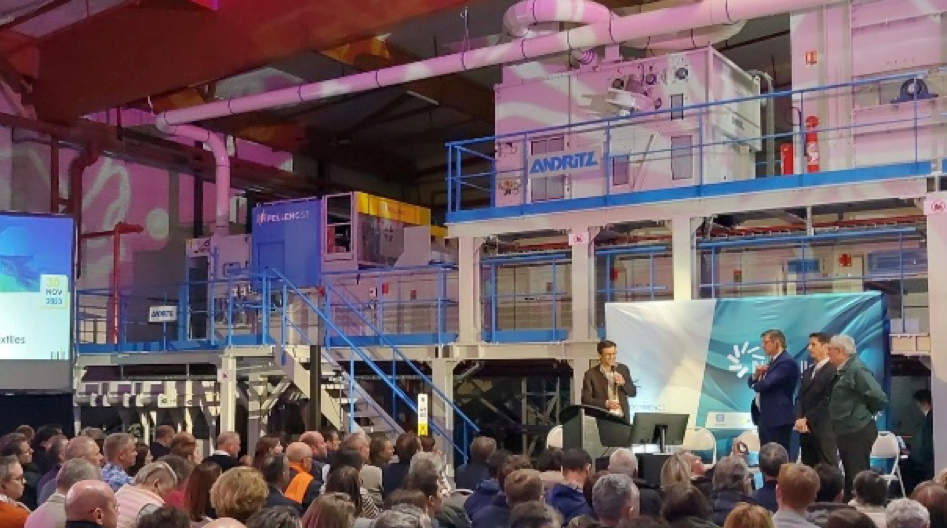
Inauguration of automated textile waste sorting and recycling plant at Nouvelles Fibres Textiles
© ANDRITZ

GRAZ, Austria — December 1, 2023 — France’s first industrial plant for automated sorting and recycling of textile waste was officially inaugurated at Nouvelles Fibres Textiles, Amplepuis, on November 30, 2023. The plant is the result of an ambitious partnership between textile recycling company Nouvelles Fibres Textiles, waste sorting specialist Pellenc ST and international technology group ANDRITZ, a specialist in textile recycling machinery and processes.

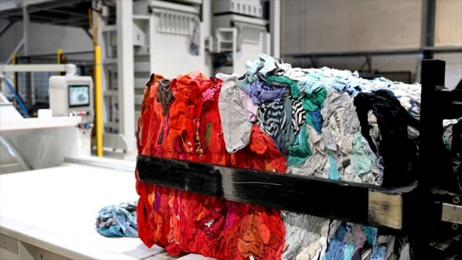
Textile waste before sorting © SBO EVENT

This partnership is a clear contribution to tackling the challenge of textile waste in the EU. The EU’s strategy for sustainable and circular textiles aims to ensure that by 2030 textile products are made to a great extent of recycled fibers and incineration and landfiling of textiles are minimized.

Capable of automatically sorting garments by composition and color, the new line meets the needs of both post-consumer and post-industrial waste markets. The line also removes hard parts such as buttons and zippers to prepare the material for further processing in an ANDRITZ tearing machine.

The automated textile sorting line at Nouvelles Fibres Textiles is dedicated to industrial-scale production, customer trials and projects, and the R&D activities of the partners. It will process textile waste to produce recycled fibers for the spinning, nonwovens, and composites industries.

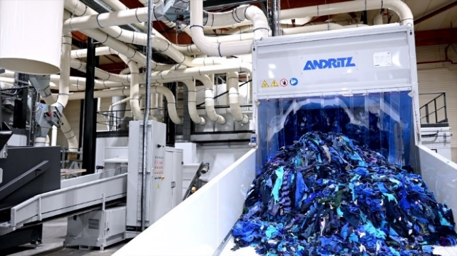
Sorted and cut textile waste ready for tearing © SBO EVENT

Automated sorting was the last missing link needed to develop a complete ecosystem in France, where the fashion industry, social and solidarity economy actors, waste management companies, and textile producers from different sectors are working together towards a textile circular economy.

Eric Boel, general manager, Nouvelles Fibres Textiles, said: “The opening of the new line marks a milestone in our efforts to turn textile waste into resources. And we are already laying the foundations for a second material preparation plant with a capacity to process 25,000 tons of post-consumer textiles per year.”

Alexandre Butte, general manager, ANDRITZ Laroche: “We are proud to be part of the sustainable transformation. With our technologies and our close partnership with Nouvelles Fibres Textiles and Pellenc ST, ANDRITZ is making a significant contribution to a circular economy for textiles.”

Posted: December 1, 2023

Source: ANDRITZ

Ivar Vatne Appointed CEO Of Billerud

SOLNA, Sweden — December 1, 2023 — The Board of Billerud has appointed Ivar Vatne to be the president and CEO of Billerud. Vatne has been acting president and CEO since July 2023 and enters the permanent position with immediate effect.

“The board has conducted a thorough recruitment process and has evaluated both internal and external candidates. We are very pleased that Ivar is willing to take on the job and it shows real strength that we find the best candidate within the company. Ivar is a highly appreciated leader, and he has deep knowledge about the company’s strategic direction. He has also proved that he understands the importance of continuous improvements to secure competitiveness, and has the ability to drive them,” said Jan Svensson, chairman of Billerud.

Ivar Vatne to be the President and CEO of Billerud.

Vatne started as CFO in Billerud in May 2019. He was appointed Deputy CEO in October 2022. Since July 2023, he has been the acting president and CEO of Billerud. Ivar has a background from senior positions within Arla, Fiskars and P&G.

“I’m both happy and proud that the Board gives me the confidence to continue in the role as President and CEO. Billerud is a company with great potential and fantastic employees. I look forward to continuing the work of releasing that potential,” Vatne said.

Posted: December 1, 2023

Source: Billerud AB

MycoWorks Opens Fine Mycelium™ Plant

(Left to right): MycoWorks Chief of Culture Sophia Wang, COO Doug Hardesty, South Carolina Governor Henry McMaster and CEO Matthew Scullin at the ribbon cutting ceremony held to celebrate the opening of the biomaterials company’s factory.

MycoWorks recently held a ribbon-cutting cere-mony at its new full-scale Fine Mycelium™ production facility in Union, S.C. The event was attended by South Carolina Governor Henry McMaster, as well as other government officials, community leaders and brand partners. The facility will help MycoWorks meet demand for its patented Reishi™ biobased, leather-like material that is used by luxury brands, among other companies.

“I was proud to join with MycoWorks to cele-brate the grand opening of their new Union facility,”said Governor Henry McMaster.“It’s great to add a biomaterials manufacturer to South Carolina’s expanding range of products and services, and we look forward to the opportunities this investment will bring to students and technicians across the state.”

November/December 2023

Trützschler Donates Equipment To New Gaston College Fiber Innovation Center

The Gaston College Fiber Innovation Center, Belmont, N.C., recently received an equipment donation worth $1.2 million from Germany-based Trützschler GmbH & Co. KG for the new facility expected to open in 2024. The equipment is designed to promote circularity and a reduce the carbon footprint in fiber and textile production.

“Trützschler is excited to be a part of the new state-of-the-art Fiber Innovation Center at Gaston College and proud to show our commitment to the textile industry for the future,”said Greg Duncan, vice president of Sales, Spinning at American Trützschler, Charlotte, N.C.

“Thanks in part to our longtime partnership with Trützschler, the Fiber Innovation Center will help revolutionize the textile industry as we know it,” said Stephen Sharp, vice president of Fiber Innovation at Gaston College.

“The current process for developing innovative textile solutions is expensive, timely, and highly fragmented. With this center, and through Trützschler’s gracious donation, textile innovation can occur from conception to completion, all here at Gaston College.”

November/December 2023

PVH Sells Warners, Olga And True&Co.

PVH Corp., New York City, has announced plans to sell its Warners, Olga and True&Co. businesses to Basic Resources Inc. also based in New York City. The purchase price is $160 million all cash, which is subject to adjustment plus a maximum value earn-out of $10 million based on the net sales on a portion of the businesses for calendar year 2024. PVH plans to use net proceeds from the sale to repurchase shares of its common stock.

“This transaction is an important next step as we continue to accelerate our focus under the PVH+ Plan to build our core brands, Calvin Klein and TOMMY HILFIGER, into the most desirable lifestyle brands in the world,”said PVH CEO Stefan Larsson. “I want
to thank our teams for building Warners, Olga and True&Co into the beloved brands they are today. We know the Basic Resources team well as a longstanding PVH partner and are confident they are the right company to help grow these brands and ensure their continued success over the long term.”

November/December 2023

Milliken & Company Rebrands Healthcare Subsidiary

Milliken & Company, Spartanburg, S.C., recently unveiled OVIK Health — a new brand platform for its healthcare business, Milliken Healthcare Products LLC. As a subsidiary of Milliken & Company, OVIK Health will continue to carry the same products — wound and burn dressings, compression solutions, cohesive bandages and tapes — and current product names will remain the same. However, the branding for these products will become OVIK Health in name and visual instance.

“Launching OVIK Health marks a new era in our work to positively impact the healthcare industry,” shared Halsey Cook, president and CEO of Milliken & Company. “Through OVIK, we reaffirm our commitment to providing innovative healthcare solutions and open the door to future opportunities that can heal, protect and support patients.”

The new branding unites under one umbrella Milliken & Company’s business with that of Andover Healthcare, a company it acquired in 2019.

November/December 2023

Redefining the Future of Textile Authenticity with Forensic Traceability

Oritain provides a solution to regulatory barriers with forensic isotopic testing, a method approved by the U.S. Customs and Border Protection (CBP), to verify the origin of cotton imported into the U.S.

Sponsored Content

The textile industry has been a major contributor to the global economy for centuries. However, with the rise of counterfeit and fraud, the authenticity and integrity of this industry are being compromised. The National Council of Textile Organizations (NCTO) revealed that 72% of Chinese cotton products use Xinjiang cotton, linked to forced labor, many finding their way into U.S. supply chains and those of its free trade agreement regions. In response, the U.S. textiles association is pushing for stricter inspections and testing of such imports from China.

Rupert Hodges, Chief Commercial Officer at Oritain, observed, “Today’s consumer is not just buying a product; they are buying a story. They want to know where the raw materials in their clothes come from and the journey they’ve been on. For the textile industry, this means ensuring the authenticity of their products through every step of production.”

Fraud and unethical practices often undermine supply chains, especially in the cotton space. The Uyghur Forced Labor Prevention Act (UFLPA) and similar legislations worldwide are responses to these malpractices, which have put brand reputations on the line. Oritain provides a solution to these regulatory barriers with forensic isotopic testing, a method approved by the U.S. Customs and Border Protection (CBP), to verify the origin of cotton imported into the U.S.

Dr. Kate Jones, Oritain’s Senior Scientific Advisor, said, “Our technology is based on the naturally occurring isotopes found in soil, water, and air. These isotopes are unique to a specific geographical location and act as a natural fingerprint for the products grown there.”
Oritain’s team collects samples of raw cotton, or genuine products, directly from the farm or from other authorities around the globe. These samples are then analyzed using innovative chemical fingerprinting technology, robust and proven science developed in the criminal forensics fields, to identify the isotopic fingerprint of the cotton.

“Once we’ve created a genuine origin fingerprint, it can be used to audit a wide variety of products throughout the supply chain, from farm to fabric, to differentiate the legitimate from the fraudulent,” added Dr. Jones.

Hodges explained, “We help brands confirm their raw material sourcing and validate the integrity of their supply chain. We gather samples to test and compare them against our extensive database of global isotopic signatures. This allows us to provide robust scientific proof of origin and authenticity for our clients.”

Oritain’s forensic testing has already been implemented by major clothing brands, empowering them to assure their customers of the ethical and sustainable practices followed in their supply chain. Dr. Kate Jones added, “Our audits only require a small product sample and can integrate seamlessly into existing supply chains. This makes auditing at different stages in the supply chain, even up to a retail store, easy and scalable.”


Visit oritain.com/cotton to learn how you can promote supply chain transparency by verifying and authenticating the origin of your cotton.

This sponsored content was been provided by Oritain.


November/December 2023

Shows, Meetings, Events Dominate Textile Schedule

By James M. Borneman, Editor In Chief

After a fairly manageable spring and summer 2023 schedule, Textile World editors saw no shortage of events fill the fall calendar as the new year quickly approached.

Shows, meetings and events of all stripes dominated the industry calendar — a welcome turn from the bleak days of COVID seclusion, and healthy sign that the industry is curious, outgoing and searching for new ideas and innovations.

Meeting old friends and making new connections is a great feature of the old school face-to-face event schedule. Strong themes including sustainability, recycling, traceability throughout supply chains, efficient manufacturing, near shoring and technical applications, dominated conversations.

With the overhang of an uncertain economy, investment activity and the search for innovative technologies continues to be center stage.

In some areas, like fiber recycling — or better yet fiber “regeneration”— there seems to be a maturing theme as budding technologies are taking hold.

Recently, a press release posted in TextileWorld.com’s “Breaking News” section informed readers about a new company, Reju, formed by Technip Energies, IBM Corp. and Under Armour to “address the fast-growing market of global rPET.” According to the news release, global rPET — recycled polyester —demand from the textile market is “expected to grow up to 20 [million tonnes per annum] by 2033, driven by industry pledges and targets on recycling, regulation and consumer awareness of the need to reduce plastic waste.”

Apparently, the trio of codevelopers have been working together since 2021 to bring IBM’s VolCat technology to a commercial level and using the “molecular sorter” to regenerate polyester indefinitely.

According to Reju, former Under Armour CEO and apparel industry veteran Patrik Frisk will lead the new company along with Alain Poincheval as COO, a senior executive with Technip Energies. Arnaud Pieton, CEO of Technip Energies, stated: “Globally, less than 1 percent of PET textiles waste is recycled today. This means that most textiles end up as waste in landfills when they could be repeatedly reused in new clothes. What has been holding the world back in textile circularity is not a lack of demand for textile recycling but the lack of a solution that makes recycling of textiles economical on an industrial scale.”

This is just one of many stories illustrating the dynamic nature of today’s textile industry— and the importance of circularity in textiles.

This issue of TW is an interesting mix of stories. On one hand, it presents coverage of the many events that have recently sparked industry conversations, and on the other hand features continued technology coverage from the many innovations showcased at ITMA 2023.

It may seem as if the ITMA coverage will never end, but that is a narrow view. If one stands back and considers things from a technology perspective, what a display of real invention, innovation and creativity there is to explore from ITMA. Consider the hours and level of investment made to bring new manufacturing concepts to a commercial level and then educate the global industry about the potential these new technologies present— it really is an incredible opportunity for the textile industry.

It is heartening to see major players like IBM and Under Amour take a stake in textiles— a challenging industry, but one that always looks to innovation to power a bright future.

November/December 2023

Sponsors