New Reactive Dyes Produced By BASF

BASF Corp. has introduced PROCION® XL+, a new generation of reactive dyes that are polyfunctional
deactivated dyes with a high tinctorial strength and a high-fixation efficiency. These dyes were
produced for the rapid exhaust dyeing of cellulosic fibers and blends.PROCION XL+ dyes are suitable
for all types of dyeing machines and will reduce water and energy consumption, the company says.
Circle 303.

June 1999

Leveraging Internet Technology

 According to the latest research, apparel sales will be the fastest growing product category
on-line through 2002.Forrester Research sees on-line sales of apparel and footwear growing from $92
million in revenue in 1997 to $514 million by 2001.In 1998, holiday shopping figures through
America On-line support the growing trend of on-line sales with a 350-percent growth over the same
period last year and three-quarters of a million people making on-line purchases for the first
time, at an average of $54 per item.While projections such as these make a compelling argument for
selling your products on-line, doing so can be a tremendous challenge for those companies whose
success is founded in more traditional channels of distribution. One question remains: How do you
market the consumer directly without creating channel conflictAt Liz Claiborne, a $2.5 billion
company with annual earnings growth of 18.6 percent, the solution was to support its existing
channels of distribution by developing a web site that was strictly marketing oriented and not
sales driven.LizClaiborne.com is owned by corporate marketing, and is used strictly as a vehicle
for brand building through product information and store locators.

 Leveraging StrategyThe real internet success story at Claiborne is how it has leveraged
the technology as a business-to-business tool as a part of their overall IT strategy. According to
John R. Thompson, Claibornes chief information officer, customer service and logistics
sophistication have replaced brand equity as the differentiators of the 90s.At the heart of
Claibornes strategy is Liz Link, the companys business-to-business extranet web site and
order-tracking system that is dramatically reducing the 1,500-2,000 calls it receives per day from
buyers simply calling to check on the status of their orders.Instead, buyers are now logging onto
the password protected customer service site, where with the use of their browser they can point
and click their way through open, in-work and shipped orders in either units or dollars.
Information can be viewed by account, season, group summary, group, style or by delivery door.The
operational calendar offers allocation, in-store and confirmation due dates by group. Liz News
keeps buyers current on the latest happenings in the company.According to Kevin Keenan, vice
president, Customer ServiceandElectronic Commerce at Claiborne, the benefits from the customer
service site have been tremendous.Since implementation in January 1998, we have been able to
measurably reduce the length and quantity of customer service calls, while changing the calls we do
receive to be more value added as opposed to quantitative. The system offers real-time information,
seven days a week, 24 hours a day, is available from anywhere and allows us to be more pro-active
with our buyers. To date, 25 of Claibornes top 40 accounts are using the system. According to
Keenan, the company has buyers who will go home and use their personal computer to access the
system because they dont have Internet access at the office.So, as the world of fashion races down
the Internet runway in an attempt to grab a piece of the growing on-line marketplace, keep in mind
that the Internet is not just about selling product.Behind what we see on corporate marketing
websites, is a growing web of Intranets and Extranets that are linking business-to-business
throughout the supply chain and making for more efficient technology driven companies who can
better serve the needs of their existing channels of distribution.For more on Liz Claibornes Liz
Link program, see Teri Rosss article, One Step Ahead, in the April 1999 issue of ATI.
Editor’s Note: Teri Ross is owner and president of Imagine That! Consulting Group, publishers
of the award winning techexchange.com. She can be reached via e-mail at 612/593-0776.

June 1999

Power Performance

Textile mills arent that common in Tennessee. But the Dyersburg Fabrics organization actually has
three plants in Tennessee in Cleveland, Trenton and in Dyersburg. The original Dyersburg plant is
now in its 70th year of operation. The plants outside appearance harkens back to its foundation in
1929. But the outside look belies the effectiveness of manufacturing systems inside.As soon as a
visitor enters the main lobby, he realizes that a very modern heart beats here. Today,
Dyersburg Fabrics is known as a textile industry leader in circular knit fleece fabrics and
performance cotton jerseys.Dyersburg Fabrics was purchased by Wesray in 1986, which fueled the
growth momentum even more, and in 1992 the company went public on the New York Stock Exchange
(NYSE).

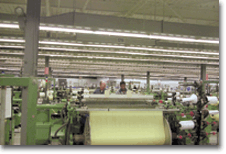
The Mario Crosta nappers have become one of the most favored machines in Dyersburg’s
finishing department. The history of Dyersburg is a story of hard work, determination and
enthusiasm. Best of all, it is a story of success written by generations of great cooperation
between management and dedicated employees. That same spirit continues today.  Setting
BenchmarksIn the early years of operation, the first fabrics that shaped Dyersburgs business were
for cotton sweaters, long underwear and fleece gloves. Since then the company had added several
firsts in the market. For example, it introduced:the first knitted fleece fabric (wool blend) in
1935;the first flame retardant fleece (SEF Modacrylic-Monsanto) in 1972;the first post-consumer
recycled E.C.O. (Environmentally Correct Origins) fleece from recycled plastic soda bottles in 1992
and E.C.O. Lite in 1996; andnew fabrics for technical underwear and outerwear (Dyertech
Stratasystem) in 1998.Dyersburg Fabrics joined forces with Patatgonia and Wellman Inc. to pioneer
the first fleece product made entirely of recycled soda bottles, now known as the DyerSport E.C.O.
Fleece. This double-sided technical fleece has been a landmark product as it is part of an on-going
attempt to integrate environmental issues in fabric and apparel manufacturing.The E.C.O. Fleece is
available in Dyersburgs technical and sportswear line. E.C.O. fabrics can be specifically designed
for moisture management, durability, warmth, high CLO ratings, low pill finishes, stretch and other
applications. The versatile fabric offers a lush feel, combined with strength and breathability, as
well as color and shrinkage control.Dyersburg sees this product as being a part of the solution in
managing the huge amount of solid waste that consumers are creating every day. The Dyersburg
company is determined to maintain its leadership position in its core categories by using efficient
and aggressive product development strategies. The company is ready to expand further into
specialty product applications and to develop new niche markets. Also, the company focuses on new
packaging solutions and strives to maintain lowest possible production cost throughout the
operation. To achieve this, Dyersburg has continuously invested in new machinery and processes, and
is still constantly evaluating new capital investment directions. Production RunsWhen walking
through the plant, H. Lee Lundsford III, executive vice president of Operations, made the point
that not every department has been upgraded with the absolute latest machinery.For example, in the
Yarn Department, certain thoughts have been entertained that had put the capital investment
decision on an observation stage, while priority was put on equipment in other areas. However, that
should not indicate that the spinning equipment is old because it is not.The yarn area covers
approximately 85,000 square feet, which includes modern Truetzschler preparatory equipment, Marzoli
Cards, Rieter RSB drawing frames and Schlafhorst SE9 rotor spinning machines.The Dyersburg spinning
facility produces blended yarns made of polyester, nylon, acrylic and cotton fibers. Dyersburg
fills approximately 2/3 of its yarn needs with its spinning operation, while 1/3 of the required
yarn is purchased from outside sources. Quality testing is done on a continuous daily basis. This
includes Sliver Data, on-line testing of cards and drawing equipment, as well as off-line testing
for sliver and yarns. The yarn lab features the newest technology the Zellweger-Uster Tester UT III
is just one of the latest acquisitions.Dyersburgs Knitting Division was relocated in 1994 from the
main building to a new building, approximately 3 miles down the road. The facility has over 153,000
square feet of floor space. All departments are laid out for the most efficient work flow, and also
the infrastructure of the plant, like air-conditioning and lighting, was selected in a way to
provide its highest efficiency. Knit SuccessSince this facility is young, so are the knitting
machines and auxiliary equipment that it houses. Dyersburg has a wide variety of knitting machines,
mainly categorized for specific purposes and applications. The fabric styles that are knitted are
mainly jersey, fleece, rib and terry.Currently, there are more Vanguard knitting machines, followed
by Monarch knitting machinery. Mayers knitting machines are used for microfiber and terry styles of
technical outerwear fabrics. 

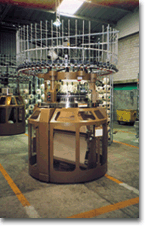
The Camber Knitting machines received high praises at Dyersburg for their dynamic performance
and versatile features.The company recently purchased electronically controlled machines from
Camber/Mellor Bromley, Leicester, England (Schloss Griffin Associates Inc., Charlotte
N.C.). Paul B. Agee, plant manager-Knitting Division, and Lee Lunsford agreed that the Cambers
advanced technology has not even been taken to its fullest potential, and that the plant personnel
is still at a learning curve to use its versatility and all technological features. There was a
true enthusiasm for this machine, and Dyersburgs praises are certainly reflected in recent
re-orders. The knitting plant has a capacity of an average one million pounds per week. Dyersburg
adjusts its production schedule between 5 to 7 days per week, depending on actual requirements.An
important part for the knitting operation is the separate R and D department, where strong emphasis
is put on development of new fabric styles. Besides all regular production machine models,
state-of-the-art machinery, like the Camber knitting machine, are 100-percent designated for R and
D purposes.Dyersburg also puts strong emphasis on quality control and physical testing in the
knitting lab. This includes audits of machine changes, physical testing of purchased yarns, dye-cut
and grading and the full data and production preparation of all styles for the knitting
plant. Material ManagementDyersburg is proud of its state-of-the-art greige goods storage
area, where a 212,000-square-foot expansion project was just completed two years ago at a cost of
$7 million. It stores up to 3.5 million pounds of bar-coded fabric in 16,000 individual high-rise
storage positions.The Frazier Industrial rack stores cloth rolls up to 34 feet high. The high-rise
storage area is serviced by six wire-guided Raymond swing-reach trucks that are equipped with radio
frequency equipment.When the batch clerk receives demand instructions from the dyeing operation he
priorities these instructions and relays the information by radio frequency transmission to the
operators on the lift trucks. The information is then electronically stored and displayed directly
to the drivers on the truck.Even though this facility is laid out to operate without any manpower,
due to present speed advantages, a combination of automation and manual operation has been
selected. The system places the pounds required into containers by dye-port. These containers are
transferred to the main plant by semi-trucks. Dyersburgs yarn storage area is 60,000 square feet
and has 3.1 million pounds of storage capacity. The yarns are stored by month in aisles marked by
ceiling-mounted bar codes which can be scanned from the floor. The software for the greige goods
and yarn systems was developed in-house.  Dyeing DepartmentThe total square footage of the
dyehouse is approximately 58,000 square feet. There are several generations of machines in
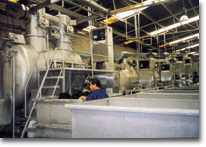
operation, each machine group is used for a specific task.There are several generations of Gaston
County dyeing machinery, including the Aquavel, Aqualuft and Aquaflow models. Also on the floor are
the Theis Ecosoft and the Scholl Bleachstar.The companys latest addition is a fleet of automated
Then AFS dyeing machines (PSP Marketing, Charlotte N.C.). Quality, repeatability, dye- and
water-consumption have lived up to the promises of the vendor, and the two plant experts feel that
the full potential of the Then machines has not even been reached.The Then AFSs use computerized
batch weighing of dyes and automated dispensing of chemicals. It also allows to drain the machine
at elevated levels and perform direct rinses at high temperatures. The soft-flow characteristics of
the machines protect the fabric surface from abrasion and damage throughout the dyeing process.The
Dyersburg management team explained that the purchase of the new Then equipment has helped to
expanded its product line to satisfy customer needs. While the Then dyeing machines are mainly used
for 100-percent cotton fabrics and high-end cotton fleeces, the other machines are used for
synthetic fabrics and cotton blends. Based on a 7-day schedule the total dye-house capacity is
approximately 78 million pounds per year. Dyersburgs dye lab is in operation 24 hours a day, seven
days a week.In 1998 the lab completed over 7,000 projects for internal and external use. Daily, the
lab can accommodate more than 300 dyeings. The current color library consists of over 6,000 colors.
The latest dye lab equipment includes 12 lab dyeing machines like the Ahiba Polymat, Datacolor
Nuance and Datacolor Spectradye, as well as two Datacolor lab dispensing machines with the
Datacolor Autolab solution maker and two Datacolor SF-600 Spectrophotometers with Smartmatch
software.  The Final TouchIn the finishing department, Dyersburg has a wide variety of
tenters. As with the dying department, different equipment is selected for specific applications.
There is a Krantz pin tenter frame, Kenyon pin tenter and different models of the recently acquired
Santex relax dryers. Management pointed out that there are seven heating zones on this Santex dryer
instead of the usual four zones. This is reflected in a high-quality cloth treatment without
sacrificing production speed. It features a state-of-the-art computer system that can store
individual style programs that control zone temperatures, nozzle heights, fan speeds, line start
speeds, tenter width and all overfeeds.Dyersburg has the capability to fold the fabrics into a box,
or the goods can be routed directly to the finishing room by means of a sophisticated conveyer belt
system.When it comes to cloth finishing, Dyersburg has a wide variety of equipment in its
approximately 150,000-square-foot finishing area. One of the latest additions are Mario Crosta
shearing and napping machines (PSP Marketing, Charlotte N.C.).By being fully computer controlled,
the machines enables Dyersburg to precisely control tension, speed and energy. Furthermore,
computer programming can duplicate settings exactly from batch to batch.According to management,
the finishing department has a weekly production capacity of total 1.3 million yards per
week. Superior Delivery Set-UpDyersburgs modern distribution center is a 147,000-square-foot
facility that contains up to 90,000 pieces of finished fabric. The Frazier Industrial rack system
has 17,000 single-roll and 8,700 pallet positions that reach a height of 38 feet. Finished rolls
are sent to the distribution center by the conveyor system, bar coded and shrink wrapped with a
polyethylene film. The wrappers can handle fabric rolls up to 26 inches in diameter.Shipping orders
can be arranged in various sequences, according to customer requirements. Although order
preparation can be filled around the clock, the actual shipping is done on a 5 day, 8 hour basis.
Up to 7,000 rolls of fabric can be shipped in one day.  SafetyandHousekeepingSafety and
housekeeping is a continuous theme throughout the company. At Dyersburg the philosophy is: It comes
before anything else. This relates directly to modifying job procedures, upgrading to safe and
modern equipment, and to educate all plant personnel on a continuing basis. Ahead Of The
GameIn the development area of Dyersburg, task teams work diligently to meet the needs of the
ever-changing market and to efficiently manage multiple product lines. These teams focus on
Activewear/Sportswear and technical applications.Dyersburgs management emphasized that its status
as a leader and innovator in the industry begins here. Besides specially designated R and D labs,
any of the knitting machines on the production floor are available for new product
development.Dyersburgs philosophy is that putting some of the best technicians into R and D paves
the way for the present leading market position and is certainly the foundation for the companys
future long-term success.
For more information on Dyersburg Fabrics, call them at (901) 285-2323, or fax at (901)
286-3474.

June 1999

Springs Announces Two AFI Plant Purchases

Springs Industries Inc., Fort Mill, S.C., has announced that its wholly owned subsidiary, American
Fiber Industries LLC (AFI), plans to purchase a new 300,000-square-foot facility in Martinsville,
Henry County, Va., with an initial investment of $12.6 million.AFI will also purchase approximately
21 acres adjacent to the site for future expansion of the facility. The company also announced the
likelihood of $2.9 million in additional investments over the next year.According to the company,
the investments are expected to create 250 additional jobs, bringing AFIs Henry County employment
to approximately 675. The company currently employees 425 people at a facility it leases in
Ridgeway, Va.We are pleased to invest in Virginia with our growing AFI business, said Crandall C.
Bowles, Springs chairman and CEO. We thank Henry County and the Commonwealth of Virginia for their
assistance in making this investment possible. AFI represents one of our strongest product lines,
and we anticipate future investment in Henry County.During the initial phase of this expansion, AFI
will consolidate and expand its local manufacturing into the new facility. This phase will begin
immediately and should be completed by the end of the year.AFI also announced it has purchased a
100,000-square-foot facility in Bartlesville, Okla., to manufacture pillows.According to the
company, the initial investment of $3 million will create approximately 200 jobs and could lead to
the creation of more than 360 jobs in the next five years.AFI also plans to purchase approximately
29 adjacent acres for future expansion projects.Adding to our California plant and the newly
announced expansion of our Martinsville, Va., plant, Bartlesville is a strategic location in which
to manufacture and distribute products for our growing AFI business, Bowles said.

June 1999

Ciba Introduces New Reactive Dye

Ciba Specialty Chemicals recently introduced CIBACRON® Orange W-3R, a new reactive dye for warm
applications. It has high fixation, good wash-off, wet fastness and build-up.This dye is for
cellulose fibers and is recommended for cost-effective dark shades. Circle 306.

June 1999

IIMAK Line Includes Foil Option For Printers

IIMAK Inc. (International Imaging Materials) has introduced a product line that includes DC-300
thermal transfer foils with cartridges and refills, along with the DC-100 color heat transfer
cartridge foil for the Gerber Edge® printers.This new product line will give users the option of
purchasing cartridge foils or refill foils at a substantial financial savings. Circle 302.

June 1999

Obituary

William T. Kretzer, former president and CEO of Unifi Inc., Greensboro, N.C., died April 23, 1999.
He was 52 years old.Kretzer joined the company in 1971, working in marketing and sales. He was
named president and CEO in 1985. Under his direction, the company grew from $216 million in sales
in 1985 to $1.4 billion in 1998. He retired from Unifi February 1, 1999.Bill was as honest and
straightforward a fellow as there ever was, said Alan Mebane, Unifi founder, chairman and CEO. He
was a hell of a fine individual. His customers, suppliers and employees here had the highest
respect for him. There was every reason in the world to like Bill.Kretzer played NCAA basketball
for N.C. State University in the late 60s, gaining fame when he held the ball for more than 13
minutes during N.C. States 12-10 semi-final win over Duke in the Atlantic Coast Conference
Championship.Kretzer is survived by his wife, Barbara, his son, William Cannon, his daughter,
Cameron K. Parks, his brother, Michael Kretzer, and his sister, Marcia K. Limbo.

June 1999

Made In The USA

Buhler Quality Yarns Corp., Jefferson, Ga., was incorporated on October 26, 1995, and from the very
beginning its purpose was to produce top-quality combed cotton and ring-spun yarns, by using only
high-grade Supima (American grown PIMA) cotton.Buhler also markets and sells the yarns produced by
its Swiss parent company, Hermann Buhler AG, in the NAFTA region. Fine Count LeaderHermann
Buhler is a family-owned company that has been in business for more than 180 years and is renown
for producing the highest quality 100-percent combed ring-spun yarns. The organization has been a
worldwide leader in fine-count cotton yarns for many years. Hermann Buhler has also developed new
yarns with Modal and Micro-Modal, a high-quality viscose fiber produced by Lenzing AG, Austria.
 Furthermore, the company has developed a strong line with Supima Organic, a naturally grown
cotton with a slight green color. Hermann Buhler can produce yarns as fine as Ne 120, But Ne 100 is
todays standard, said Jean Claude Allemann, chief operating officer of Buhler Quality Yarns.

Buhler CEO Werner Bieri leads 140 guests in a toast celebrating the completion of Phase II at
the company’s May 8th open house (Photo courtesy of Bert Brantley, MainStreet Newspapers
Inc.). Plant HistoryBuhlers Jefferson, Ga., facility occupies 150,000 square yards.We started
soft, conservative, with used machinery and half the capacity to test the market, said Allemann,
who along with CEO Werner Bieri, worked with Buhler before coming to the United States in February
1996 to start the operation at its present location.In July 1996, the first machines were started
up on 50 percent of the plants total planned floor space. Buhler decided to install brand new
equipment in yarn preparation. Rieter (Rieter Corp., Spartanburg, S.C.) received the lions share in
this area and supplied opening, carding, combing preparation and combing machinery. Spinning room
machinery was purchased used from plants in Europe. The company installed still-modern Zinser
equipment to fill the void in roving and ring spinning. These machines were linked to Schlafhorst
278 winders. By the end of 1996, the first phase of the mill start-up was completed. Phase II
ExpansionOn November 17, 1998, Buhler decided to start Phase II and fill the rest of the building
with brand new machinery. The total investment plan calls for an additional $20 million, which
would more than double the original production capacity and create 30 additional jobs.  

Rieter F 30 roving frames spinning for final yarn preparationThe expansion includes
additional C51 cards from Rieter; an automatic lap transport system, SERVOlap, which will supply
new Rieter model E 70 R combers; new Rieter D30 drawframes; and new Rieter F30 roving frames.
Rieter G33 ring-spinning frames with 1,200 spindles each complete the equipment lineup. The Rieter
machines are linked with new Schlafhorst winders.  To enhance the efficiency even further, a
new roving bobbin transport system from Electro-Jet (PSP Marketing, Charlotte, N.C.) was installed.
This automation covers the entire operation and includes both Phase I and Phase II. A total of
eight roving frames will be linked to the older Zinser and new Rieter ring-spinning machines. The
Electro-Jet system integrates the return of the clean and empty bobbins to its main station.The way
the machinery was selected, there will be no difference in quality between Phase I and Phase II of
the project, according to Allemann.Some machinery installed in Phase I was upgraded to meet this
criteria. Since the main focus of Buhler is definitely quality, the company will install the latest
version of Rieters SPIDERWeb mill monitoring system, which will provide plant personnel with
instant access to production and quality data. Every manufacturing process of the ring-spinning
plant is integrated. Also, Rieters C-control will be installed to control all the cards. The
C-control will be integrated in the SPIDERweb system. The company will also use a new and specific
ring-data system that will monitor each ring spindle.Buhler also installed another interesting
monitoring product on its winders. This quality monitoring system is the latest development, based
on Windows NT, from Loepfe, and will be officially introduced at ITMA 99 in Paris.The brand new
spindle identification system from Schlafhorst will allow plant personnel to supervise the Yarn
Master foreign fiber detector from Loepfe and the quality parameters on each ringspun bobbin at
each winder position. If a bobbin has too many faults or defects, it will be extracted.This system
is truly capable to identify online which ring-spinning bobbin is bad, and where it came from,
Allemann said. Improved InfrastructureBuhler invested heavily in a new infrastructure for the
plant. Luwa-Bahnson, Winston-Salem, N.C., was selected as the supplier for all air and waste
handling issues. This new equipment includes chillers, a cooling tower, a filtration system, a
press and a high-vacuum system for transportation of the fibers from different
locations.Luwa-Bahnson took care of this project as a general contractor, Allemann said.Luwa will
install the latest version of the Digicontrol system, which will be officially presented to the
public at ITMA 99. The system will enable the company to check every temperature and humidity level
in the mill and will feature the latest energy management features. Digicontrol will be connected
via modem to Luwa-Bahnson in Winston-Salem to support the mill on-line. Safety SystemsBuhler
put also a strong emphasis on fire protection. Besides the standard sprinkler system additional
fire protection detectors were installed by Certified Fire Protection, Duluth, Ga. This included
equipping all cards with automatic CO2 discharge and power discharging in each filterhouse of the
air conditioning system. Infrared detection is installed in many locations, including air ducts and
piping systems, air return tunnels and fiber transport systems. Rieter provided the metal detection
system.The plant also has a new lighting system from Mor-Lite (PSP Marketing, Charlotte, N.C.).
Mor-Lites technology offers good illumination of the production facilities and saves the company a
significant amount of energy compared to conventional lighting systems. Buhler put a strong
emphasis selecting energy conserving equipment. New SullAir oil-free air compressors were another
enhancement to the mills infrastructure. Allemann said that it is extremely important to provide
quality air for the plants high-tech machinery, to enhance the advantage of a truly quality
oriented spinning mill. Minimizing WasteRecycling waste materials has been a high priority for
the plant. Examples include comber noils and card waste, which is efficiently captured, baled and
sold.The yarn is shipped on plastic pallets that are returned by customers to be re-used by Buhler,
eliminating cardboard boxes.Zellweger Uster (Charlotte N.C., Knoxville Tenn.) provided the majority
of the plants testing equipment. The companys laboratory installation includes Zellweger Usters
UT3, TensoJet, and Autosorter. All this equipment is connected to Zellwegers Expert system to allow
long-term analyzes of all data. Buhler Corp. will further install a new host control system based
on Windows NT that combines all information from Rieter, Loepfe, Electro-Jet, Luwa-Bahnson, and
Zellweger Uster. I can be in New York, or Switzerland, anywhere, and I can log-on with my laptop to
see how our combers are running, Allemann said.When Buhler began its operation in 1996 it started
out with 15,120 spindles. After the latest expansion the company will have 31,920 spindles
installed.There are 92 people in our budget to run this mill, including sales, marketing, and all
floor personnel, Allemann said.The company runs a continuous operation, 24 hours a day, seven days
a week. The average yarn count is approximately Ne 45, and fine yarn range from Ne 16 to Ne 80.
Yarns with Ne 60 are easy and the most efficient to produce, according to Allemann. Thread
manufacturing of plied yarns is done on request. All of Buhlers Supima cotton yarn is
electronically monitored to detect foreign fibers and particles.Buhlers goal is to be known as the
most reliable partner to customers and to produce the best possible yarns on best quality packages.
The companys ambition is to set global yarn quality, which means to provide best and most
consistent yarn qualities for applications around the world, and to offer excellent service to its
customers.Buhler stocks no yarns. Everything is sold, Allemann said. Actually, Buhler has to import
yarn from its parent company in Switzerland to fill customer orders in the United States, Canada
and Mexico.Typical customers are weavers, knitters and warp-knitters. At present, the yarns are
used in shirting, blouses, ladies and mens apparel fabrics, high-end T-shirts and polo shirts,
lingerie, underwear and nightwear, hosiery manufacturing, fiber and downproof fabric (bed ticking),
bed linen, other home furnishings, covering yarns and thread manufacturing. Buhlers customers
include Fieldcrest Cannon, Springs Industries, L.L. Bean, Parkdale Mills, Jockey International and
WestPoint Stevens (Ralph Lauren).Buhler’s Supima Product LineBuhlers Supima product line is
manufactured from extra long staple Supima cotton (fiber length 1 7/16 inches (34 – 38 mm).
American grown Pima cotton is used exclusively. Using Buhlers Supima, customers can obtain a
license from the Supima Association to use the Supima label for their marketing purposes.Buhlers
cotton experts test each bale of Supima cotton in its growing region. The raw material concept,
aimed at quality, ensures that the cotton blend is consistent during an entire crop year. Buhler
customers benefit from the uniform dyeing characteristics which allows yarn production batches to
be mixed at the customers site. Buhlers state-of-the-art, on-line monitoring systems is set to
recognize defects and irregularities in any production process. The companys Supima product line is
designed to minimize production costs. This goal is obtained through the excellent performance of
Buhlers Supima yarn in subsequent processing. Mature fibers allow an intense and even dye
penetration, and a superior fabric and garment quality can be achieved.
For more information on Buhler Quality Yarns, call (706) 367-3900, or fax at (706)
367-9837.

June 1999

New Oils Allow Softening Without Yellowing Of Fabrics

Rhodia, a subsidiary of Rhone-Poulenc SA, has created a new line of oils that, according to the
company, will achieve softness without sacrificing the whiteness of a fabric.This patented
amino-silicone formula combines HALS (hindered amine light stabilizing) technology with a silicone
backbone to create what is know as Rhodorsil® HALS oils. These oils are produced as high- and low-
viscosity oils and as a microemulsion.Rhodia is the first silicones company to incorporate this
chemistry to textile softeners. Circle 305.

June 1999

Sterling National Forms Business Network Group

Sterling National Bank, a wholly owned subsidiary of Sterling Bankcorp, New York, announced the
formation of the Sterling Business Network Group. The new organization will partner with
professional advisors to deliver a broad array of value-added banking products to its medium-sized
clients. The group plans to aggressively develop new relationships with qualified businesses by
teaming up with professionals including CPAs, attorneys and investment advisors.Sterling Business
Network Group will be headed by Edwin J. Sirlin, senior vice president, supported by Robert S.
Derbabian, vice president.

June 1999

Sponsors