Technology Helps To Customize

While the conventional textile industry continues to place analog restrictions on digital
printing, a growing number of graphic artists, fine artists, interior designers, custom clothiers,
photographers and sign makers dont see the restrictions, but instead see the new market
opportunities. For these people, the only limits on digital printing technology are their
imaginations.The conventional textile industry has slowly been reaping the rewards of digital
printing for sampling and presentation, which provides both a tremendous cost savings and reduction
in time to market. The industry has been resistant to look at digital printing for production, as
most of the industry has a mass production business model that cant support the slower speeds and
higher costs of digital printing. The post-processing requirements for steaming and washing of
digitally printed fabrics have also created a barrier to entry, as have fear and lack of experience
with the technology.As the textile industry tries to ascertain the future of this emerging
technology, a growing number of creative entrepreneurs are discovering and developing entirely new
products and markets to which they can sell short-run customized products. There are the movie
studios that need printed fabric for duplicate garments and backdrops, the entertainment industry
with its insatiable need for unique costumes, the sports apparel markets need for custom team
uniforms, the artists who see clothes as a new canvas for their work and interior designers who can
express themselves on upholstery as well as wall, floor and window coverings.While the flag and
banner business has been deploying this technology for a number of years, this market is still in
its infancy. The ad specialty business is another market well poised to exploit the
opportunities.As these market demands bring about a convergence of graphic arts, printing and
textile industries, there is a growing number of companies satisfying the growing demand for
fabrics that are custom treated for use on ink-jet printers. Ink-Jet PrintingThe new
generation of ink-jet printers can accommodate virtually any fabric that doesnt leave lint that
might clog the print heads. However, getting the fabric to feed through the printer; getting the
ink to stay on the fabric; getting the colors to pop; and getting the finished product to withstand
washing, sunlight, and for some applications, pollutants, acid rain, intense heat and other
environmental pressures, has become a science created from the marriage of technology, art and
chemistry. This science has created new products and market opportunities for several ink-jet
fabric companies.There are two primary methods used for stabilizing and feeding fabric through an
ink-jet printer. One is a paper backing, and the other is a feed and take-up system. While many of
the OEMs have developed feed and take-up systems that eliminate the need for backing on rolled
goods, experts advise users to work closely with their equipment supplier and to test all fabrics
to be used for either sampling or production.Most fabrics used in ink-jet printing will require a
pre-treated coating in order to prevent the ink colors from bleeding on the fabric.While some
natural fiber fabrics do not require pre-treating, the colors produced on non-treated fabrics will
end up very faded. The only way to obtain vibrant colors is by pre-coating the fabric, and for many
applications it will also require a post-process step of steaming and washing of the fabric after
printing. Ink ChemistryOne of the greatest challenges for this new market has proven to be
that of ink chemistry. The wide-format ink-jet printing vendors, which are now looking to expand
into the textile industry, have been using pigmented process color inks for output to paper. The
textile market wants to use its conventional spot color inks, which include reactive, acid and
dispersed dyes.While several ink companies are developing and delivering inks for the textile
market, the chemistry requires the finished fabric printed with reactive, acid and dispersed dyes
to be steamed and washed if it is to be applied to an end use other than presentation, sampling or
signage. Steaming will fix and enhance the color, and the post-washing will get rid of excess ink
that can adversely affect the finished hand.DuPont claims that its pigmented inks only require
heat-setting for production use on textiles.The ink chemistry issue is magnified when combined with
the various chemical compositions of the different fabric coatings from the growing number of
ink-jet fabric vendors. Each of the vendors we spoke to has its own unique formula for defining
what inks will and wont work, as well as its own methods for finishing and testing printed textiles
for commercial use.Lee Newsom, a 10-year veteran of Colorspan and a partner in Jet Effects Inkjet
Textiles, feels that the time has come for the American Association of Textile Chemists and
Colorists (AATCC) to establish testing standards for the emerging ink-jet textile market. The
Ink-Jet MarketplaceMany of the printing equipment vendors have developed strategic partnerships
with ink-jet fabric suppliers with whom they have conducted a wealth of research on the chemistry
mixes of fabric, coating, inks and washing. While end users will save a tremendous amount of time
and money in working with these proven formulas, they should be aware that there are a growing
number of new fabric options on the market.Los Angeles-based DigiFab was one of the first companies
to offer ink-jet textile fabrics to the market. The companys patented coating process has been
applied to its stock line of sheeting, twill, rayon challis, silk, polyester crepe, cotton jersey,
1X1 rib, cotton Lycra® and interlock, which is put up in bolts of 10 or 25 yards. All fabrics are
available with or without paper backing. DigiFab also offers custom coating for companies that
prefer to use their own fabric or want to coat fabrics DigiFab does not stock such as voile,
velour, corduroy and sheers.DigiFab Systems, the companys newly formed software division, offers
software products and services to support the textile design process for companies developing
prints for both rotary screen and digital printing. They also offer support to Foresight® Design
software and provide custom software development specializing in custom drivers for ink-jet
printers.3P InkJet Textiles, Germany, has been marketing its line of coated fabrics for more than
two years. In addition to a large selection of interior/fashion textiles including cottons, wool
and silk, the company also features a line of flame-retardant textiles for which it is working on
global certification.As owner Thomas Potz points out, when using textiles for printing flags or
banners, it is important that they be fire retardant not just in the country of origin, but in any
country where the finished product will be shipped. 3P claims its flame-retardant textiles require
no special textile inks.While 3P does not offer custom coating, it does offer a licensing contract
under which it will ship coating to mills to allow them to do their own coating. They also offer an
office-size fabric steamer that will hold up to 23 yards of 62-inch-wide fabric. Complete
SolutionsJacquard Inkjet Fabrics, Healdsburg, Calif., is a division of Rupert, Gibbon and Spider, a
company with more than 18 years of experience supplying the fine arts industry. The company
manufactures its own inks and coatings and offers a complete solution from design through
production for ink-jet-printed textiles through alliances with mills, software vendors and printer
manufacturers and the development of a short-run steamer that holds up to 50 yards of 60-inch
goods.We dont just offer solutions, we offer know-how. We have been training people for 18 years on
how to color fabric, said Mark Trimble, principle, Jacquard.Jacquard has leveraged this experience
to create several consumer products that demonstrate a few of the many new market opportunities.
Kits offered by Jacquard feature everything including fabric, solution and instructions that allow
the home craftsperson with an ink-jet printer to create doll pin kits, ties and handkerchiefs, silk
scarves and quilts.While early commercial adopters of Jacquard Inkjets systems have been in the
flag and banner markets, the company is expanding its focus to high-end goods where traditional
dyestuffs will apply. It offers 75 fabrics including silk, cotton, wool, linen, rayon and nylon and
knits. All stock fabrics are available with and with-out paper backing. Custom coating with a
50-linear-foot minimum is also available. Jacquard is the only company selling its goods by the
square foot, a convention derived from the digital printing market.  From Diapering To
DyeingKimberly Clark Printing Technology, Roswell, Ga., is a division of the Kimberly-Clark Corp.,
best known for consumer products such as Kleenex and Huggies. The company leveraged its surface
science technologies in 1998 with the acquisition of FormuLabs, a company with experience in ink
technology. The new business unit is focused on developing solutions for digital printing
applications, one of which is textiles.Its initial product launch included fabrics and inks for
textile design sample printing, as well as its EPIC brand products for signs and banners. Product
Manager Laura Cochran has been working closely with the mills to source a broad range of fabrics
with consistent white point throughout the line.Design products are formulated for color and hand,
while the companys sign and banner products are focused on durability. The base fabric line for use
in sampling includes cotton, silk charmeuse, crepe-de-chine, polyester georgette, polyester chiffon
and nylon Lycra. The company will soon be launching the second generation of fabrics, designed to
work with reactive and acid-dye inks. These production-quality fabrics will need steaming and
washing. All fabrics are paper-backed. The company offers custom coating.In addition to its
full-width fabrics, the company is offering a line of desktop fabrics designed to be used on the
Epson 3000 desktop ink-jet printer. The fabric is put up in 16 1/2-inch widths by 3 yards and is
designed for the production of fabric swatches. In addition to the fabrics, the company offers
several ink sets for the Epson 3000 printer. This is an easy-to-use and compact solution that can
fit in any design studio, Cochran said. Lab To ProductionJet Effects, Las Vegas, is the most
recent entry into this emerging consumables market. Owner Lori Dvir-Djerassi operated a fine arts
gallery for 15 years in the lobby of the Anaheim Hilton Hotel, where she found an increasing number
of clients wanting to reproduce art on garments.The Jet Effects coating process and results are
patent pending. Dvir-Djerassi expects the patent to be issued sometime this fall. Jet Effects has
worked for three years to get the process from the lab to production. The company has just
completed its first full-scale production runs. Jet Effects claims its coatings will accept any
type of dyes or pigments including reactive, acid and even direct dyes. Its printed textiles
require no steaming, and target customers are doing production applications, not strike-offs or
sampling.Jet Effects commercial line of fabrics includes lightweight cottons, heavyweight cottons,
twills, canvas, silk, crepe, denim, rayon, basic knits, velvets and cotton/poly blends. Custom
coating is available on pfp (prepared for printing) goods with a one-bolt minimum. While the
company does offer its textiles with paper backing, Dvir-Djerassi claims to have developed a
manual-feed technique that can be used with nearly any printer, and will feed the fabric without
either a backing or a feed and take-up system. The FutureAll of these textile pioneers are
betting their businesses on the future growth of ink-jet printing for a variety of different
markets and applications. A good indication of the markets potential can be found in the
wide-format printing industry, a market that didnt exist prior to 1994.According to I.T.
Strategies, the estimated retail output for wide-format printing in 1999 was $16.2 billion, with
2000 output estimated to be $21.3 billion. Early adopters, much like the textile industry,
complained that the technology was too expensive and too slow.Just as the paper web press industry
lost a portion of its market to this new digital printing market, so too will the analog textile
printing industry. As the cost of the ink-jet printers falls, more and more of the market will
shift from analog to digital printing. Projections on how much fabric will be digitally printed
range between 12 to 15 percent and 50 percent in 10 years. It is estimated that the market will
shift from 50 major textile printers to 500 smaller ones, many offering short-run customized
solutions to satisfy more sophisticated customer demands.These short-run printers will create new
products and new markets. Potz envisions fabric stores that carry only white goods printed on
demand. He sees this as an excellent solution to seasonal/holiday merchandise, which will no longer
need to be stocked or marked down after the holidays. Potz also sees seamstresses, tailors and
custom clothiers offering their services with printing capabilities in alliance with traditional
retailers. And he sees service bureaus with printers, steamers, washing machines and irons as
playing an expanded role in the market.Trimble envisions mom-and-pop operations approaching local
niche markets, supplying costumes for their kids dance groups and local teams. He also sees the
service bureau operation, specializing in 100- to 500-yard lots, as playing an expanding role in
this emerging market.Service bureaus will work with interior design and decorating studios. Trimble
claims a third tier will offer the complete solution to include cutting and sewing finished goods.
With early adopters all in agreement that sewing the finished product is the greatest challenge,
many see this as a market opportunity and resurgence for the seamstress, tailor and home sewer.The
bottom line is that while the technology isnt perfect, technology limitations are no excuse to
avoid the future. The markets will develop and the limitations will be overcome. Early adopters
will be the big winners. The question is who will these early adopters be, and how much of the
emerging market share will the textile industry give up before it wakes up to the opportunity Editors Note: Teri Ross is a writer, speaker and consultant focusing on CAD/CAM technology and
process improvement strategies for the sewn products industries.She is owner and president of
Imagine That! Consulting Group, publishers of the award-winning techexchange.com. She can be
reached at tross@techexchange.com or at (952) 593-0776.

June 2000

Bayer Continues World-Class Manufacturing

FOCUS 2000By Eric Vonwiller, Senior Technical Editor Bayer Continues World-Class ManufacturingThe Bushy Park spandex fiber plant remains on target with its product and customer
commitment.
In June 1998, ATI reported on Bayers technologically advanced Bushy Park, S.C.,
facility and its $60-million expansion of the Dorlastan® spandex fiber plant. In this issue, ATI
will focus once again on this outstanding manufacturing facility, its success and continuous
growth. Even though this plant is not a typical textile mill, it demonstrates true management
leadership, rapid response and extreme safety consciousness throughout the entire facility.

The Bushy Park management, headed by Neal E. Tonks Ph.D., director of manufacturing, call
themselves “the new kids on the block.” In 1995, Bayer took the North American spandex market by
storm with the opening of its first U.S.-based spandex fiber manufacturing facility. While Bayer
had been producing Dorlastan spandex in Germany since 1964, the company identified that the U.S.
market was looking for alternate spandex suppliers. This prompted Bayer to develop the facility in
Bushy Park with an initial 4,000-metric-ton capacity. Spandex Demand GrowsBased on know-how and the
leading image of Bayers Dormagen plant in Germany, the Bushy Park plant was designed and furnished
with the finest equipment available. In 1997, Bayer considered itself one of the top spandex
suppliers around the world and announced an expansion, supplying Dorlastan to some of the best
textile mills on a global scale. The response to the South Carolina facility was overwhelming as
the demand for Bayers high-quality spandex grew. This prompted a further expansion of its facility
to nearly double spandex production annually. The expansion of the North American plant, combined
with the latest expansion in Dormagen, doubles Bayers global production capacity of Dorlastan. The
company emphasizes that this is the commitment to meet and exceed customer needs, while delivering
the same high-quality product, service and support worldwide. The Fibers Group of Bayers Fibers,
Additives and Rubber Division manufactures and markets Dorlastan spandex fibers for textile and
industrial applications. Bayer has been producing Dorlastan spandex for the global market since
1964, and today it is the worlds leading supplier of the polyurethane raw materials and technology
that are the bases of spandex production. The Fibers Group is an integral part of Bayer, a
research-oriented company with major businesses in healthcare and life sciences as well as
chemicals. Headquartered in Pittsburgh, Bayer Corp. is a member of the worldwide Bayer Group, a
$29-billion international life sciences, polymers and specialty chemicals group based in
Leverkusen, Germany.Safety FirstBayer had the advantage of starting with a greenfield plant for the
spandex production, which permitted a very modern approach in reference to equipment, building
layout and infrastructure. But even more important is the human factor at Bushy Park the selection
and education of its personnel throughout the plant.

Ben L. Bruner, manager, quality and technical service, explained that approximately 150
people were selected from thousands of applications. They were then taken through intensive
training on all technological and practical aspects of manufacturing: hands-on training,
housekeeping, quality training and, on an extremely high-priority level, safety training. Tonks
mentioned an almost unbelievably good safety record, and stated that Bayer has received numerous
safety awards. Since the initial start-up, the plant has not had any incidents that reflected in
lost time and workmens compensation. The Bushy Park plant is a very “lean” operation, and even
after several expansions, the total number of employees is still not more than approximately 240.
“This includes everybody technical people, administration, all,” Bruner said.Rapid ResponseBesides
excellent product performance of all Dorlastan fiber and yarn variants that are shipped to
customers, Bushy Park is very proud of its flexibility to fulfill customers needs, even for the
smallest orders. It is not uncommon for a customer to request a small quantity of yarn for tests
and trials. Such orders often require super-fast response time. Karen E. Flowe, who is responsible
for customer service as well as the material handling side of the business and warehousing,
shipping and receiving, has seen orders come in and go out the door within a few hours. Even when a
customer places a trial order for less than 50 pounds at 4:00 p.m., he gets the same priority as a
large order. Therefore, no matter how big or how small an order is, it gets the utmost attention to
satisfy the most demanding customer needs. This commitment is clearly reflected in more than 500
customers the Bushy Park plant calls its own. Many of the customers may be considered low-quantity
yarn users, but their needs are exactly what drives Bayers innovation, the quality consciousness
and the quest to ultra-quick response. Because quality is always a top priority, the company
executes continuous internal audits and quality insurance tests, as well as supplier
audits.Terrific Customer ServiceBayer is determined to be the most responsive spandex manufacturer
in the world. The entire quality system is built on customer standards. Fiber testing is performed
at the customers plants. “In case of a problem, generally, we are there in a matter of hours,” said
Bruner. “If there is a problem with the shipment, its replaced in less than 24 hours.” Tonks
explained that Bayer fully understands the problems customers face today with just-in-time
inventory control and low inventory, that supply chains can get very, very tight. Bayer has
therefore made the commitment that within NAFTA, the company will respond in less than 24 hours,
with much commitment often in less than 12 hours. Technical service representatives will analyze
the problem, try to solve it on the spot or get fresh yarn out, and even help the customer to
adjust their equipment if necessary. “All of the technical support people are on call 24 hours a
day, seven days a week, 365 days a year,” added Bruner. “Most of our customers have our home phone
or cell phone numbers.” People InvolvementCommunication throughout the entire plant is on a
high-priority level. All personnel groups are self-directed workteams. The typical workteams are
intensively cross-trained to avoid any production problems should an operator be absent. All people
on the production floor are computer literate. Therefore, almost everybody needs to serve time in
the control room where the entire plant is monitored to gain knowledge about the production. If an
operator has a problem with the equipment, everyone will know this immediately, because every
person on the production floor has his own e-mail access. The managements confidence in its
operators is so great that only 30 people are responsible for the entire production over weekends
and holidays without any on-site supervision.Technological EdgeTo keep the top-quality production
going all year round, the plant has a world-class predictive and preventive maintenance program.
This helps to ensure that all vital components are cleaned, exchanged or repaired before any
quality loss occurs down the road. It also eliminates a lot of surprises that typically happen at
the worst times or on weekends. Besides this, every spinning position is 100-percent traceable. For
example, just in case a customer should encounter a problem with some materials, a quality team
member from Bayer can instantly identify the package and trace it back to the specific machine and
operator. The Bushy Park facility received ISO-9002 registration from the International Standards
Organization in April 1998, and offers a fully operational fiber mill on-site to pre-test its
knitting, dyeing and finishing properties. The Dorlastan knitting applications lab is committed to
excellence, using only the best mill equipment including: advanced warp knitters, a Monarch
single-jersey circular knitter, a Lonati hosiery knitter, circular knitting and hosiery machines
such as Karl Mayer warp tricot and raschel knitters and several Karl Mayer warpers. The warping
business plays a significant role in the companys overall market strategy. By being a technology
leader, Bayer continues to support the warp knitting industry and invests in application
development for swimwear, sports apparel, intimate apparel and many other leisurewear spandex
applications.The on-site dyeing and finishing lab also includes equipment typically installed in
customers mill facilities, using either jet- or beam-dyeing machines. Scalvos and Thies are Bayers
preferred brands that simulate mill-dyeing conditions. Proper stretching and fixation of the fabric
is done on a Bruckner tenter frame. After the fabric is heat-set, it is cut and evaluated.
Installation of Santoni seamless equipment is currently underway in the Dorlastan applications lab
in Germany, and the technical team at Bushy Park and their German colleagues will use this
technology to collaborate on product development with garment manufacturers. Bayer is actively
pushing the seamless trend by developing a broad array of applications in activewear, intimate
apparel and even select mens garments. The Logistics Advantage

Bayer invested several million dollars in its new warehousing and shipping department. Headed
by Karen Flowe, the warehouse has undergone an installation of the latest state-of-the-art
computer-controlled storage rack designed and delivered by ALVEY Material Handling Systems, St.
Louis and Cirrus Technologies, Raleigh, N.C. A high-tech warehousing and shipping facility is an
absolute must and one of the key factors to success, according to management. After Dorlastan is
produced, the spools are packed in labeled boxes. Each spool is tracked throughout the
manufacturing process until it reaches the customers operation. Bayers new material handling system
stores and retrieves boxes based on customers orders, which are then shrink-wrapped and shipped.
Even in the warehousing and shipping area, Bayer is environmentally conscious in every aspect and
uses recyclable materials. The storage area is climate-controlled so that the customer receives the
yarn in the best possible condition. At the same time, the customer receives detailed instructions
on how to handle the Dorlastan spandex. Management proudly told ATI that Bayers Bushy Park plant
achieves the on-time delivery goal almost 100 percent of the time.Fiber ExcellenceAccording to
Bayer, Dorlastan offers a number of outstanding characteristics that make it a preferred type of
spandex for almost all applications, including consistent and uniform processing characteristics,
high-stretch and reactive forces for comfort, high-elastic retention for a lasting fit and
excellent dyeability to allow uniform colors and shades. The Bushy Park facility currently produces
Dorlastan spandex in a full range of deniers, from 10 to 1,220 denier, in dull and clear lusters.
Dull Dorlastan is preferable for white color applications and light pastels, while clear Dorlastan
echoes the colors of the yarns with which it is spun and adds brilliance and clarity to color.
Dorlastans quality and value have enabled customers to incorporate the fiber easily into their
lines, including lace interknitting, circular knits, core-spun fabrics, woven fabrics and narrow
elastics. Bayer is committed to being a strong supplier of quality spandex for the global market.
Market research predicts a steady growth in all applications of spandex, specifically in reference
to intimate apparel, hosiery, activewear and swimwear. As fashion trends continue to dictate
stretch and functionality of fabrics and garments, Bayers Bushy Park plant is right on target with
its product and customer commitment.

June 2000

The Santee Company Begins Operations

The Santee Company LLC recently began operations at its Eden, N.C., headquarters. Santee will
concentrate its business on private-label manufacturing of finished products, marketing its own
line of Santee fleece and jersey products, and contract textile manufacturing including knitting,
dyeing, finishing and cutting.”The Santee Company is off to a fast start,” said Duke Ferrell,
president. “We have orders in hand, and production is underway. Approximately 40 experienced people
have already joined our team, and we expect that number to grow continuously through the end of the
year.”

June 2000

CBI Trade Enhancement To Take Effect In October

The U.S. House of Representatives recently passed a bill that will provide enhanced trade between
the United States and the Caribbean Basin. Beginning October 1, 2000, and lasting for eight years,
goods assembled in the Caribbean Basin from U.S. fabric and yarn, whether they are cut in the
region or not, will be eligible for duty-free and quota-free treatment in the United States.The
bill also contains provisions that expand trade with Africa as well as reversing a tariff inversion
on imported wool and correcting a marking rule relating to certain flat goods from Europe.”On
balance, we believe the outcome of the CBI trade bill is favorable for the majority of our
members,” said Roger Chastain, president, American Textile Manufacturers Institute (ATMI). “The
bill will provide American textile companies with significant new export opportunities, which we
have been seeking for years. Some of the changes made in conference will have an adverse effect
within our industry, but we recognize that the overall benefits of the bill will be helpful to the
U.S. textile industry, and we are therefore not opposed to its passage.”Although the Caribbean
measures of the bill are viewed generally as positive, the African portion presents some risks,
according to Chastain.”The potential loss of U.S. textile production and jobs as a result of these
provisions causes us concern and is indicative of the continued failure of U.S. trade policy to
treat the domestic textile industry equitably.”Moreover, the damaging aspects of the bill highlight
the need for Congress to reject permanent normal trade relations (PNtr) for China. Chinas entry
into the World Trade Organization (WTO), under the terms currently envisioned, could cost as many
as 150,000 U.S. textile and related jobs. The damaging provisions of the CBI/Sub-Saharan Africa
bill will only add to the damage that China will cause to our industry should it be granted PNtr.”

June 2000

Quality Fabric Of The Month: X-ITEment Abound!


Innovation, technology and excitement are all woven together in X-ITE, a new concept in fabric development from Burlington PerformanceWear (BPW), Greensboro, N.C., a division ofBurlington Industries Inc. The X-ITE program will identify the most exciting new fibers and technologies across all BPW business units and make them available to all customers.
Perfomance_Wear_50

“Sharing new technology across all BPW business units will benefit all of our customers,”
said Larry Himes, BPW president. “For example, a technology that may have been developed for the activewear business could easily apply to our women’s sportswear or trousers businesses.”Through the X-ITE program, BPW is introducing new technologies and fabric groupings monthly
instead of waiting for seasonal launches.

BPW launched X-ITE in March, when fabrics from three new groupings were released to the market. Innovations unveiled included Emersion, T2TOUCH and an updated collection of multi fiber blends with Lycra®.

Emersion

With the Emersion line, BPW combines ultra-fine fibers with an innovative etched and sueded finishing process to create the next generation of microfiber fabrics. According to the company, the new styles offer a rich, luxurious hand, and they don’t have the luster that is usually associated with microfiber fabrics.

“Emersion is a fabric that is as easily dressed up as it is dressed down,” Himes said. “And its ‘no luster’ properties will be a tremendous advantage to consumers. Emersion fabrics take the no-wrinkle, easy-care properties of microfibers to a whole new level.”

According to Himes, Emersion offers improved drape and comfort when BPW’s Moisture Control
System (MCS), Durepel and SPF performance finishes are added.

“With the addition of these finishes,” he said, “we believe that we’ll see many creative uses for Emersion in the marketplace.”

T2TOUCH

The T2TOUCH line of nylon multifiber blends have their origins in activewear, where extreme performance is essential.

“T2TOUCH embraces the active, extreme working environment in which we live, and adds a little ‘attitude’ to the workplace wardrobe,” Himes said.

According to the company, garments made with these fabrics have a clean, dry hand and move in harmony with the body for maximum comfort.

The Lycra Collection

A subtle amount of stretch provides consumers with ease of movement and added comfort. In BPW’s new Lycra collection, the familiar and the new are blended together to create a wide variety of textures and constructions, with the distinct hand that comes from a finer denier Lycra. Lycra is blended with micro-poly, rayon, flax and super 100’s wool, adding a modern look and touch.

Several fabrics offer two-way stretch, a BPW innovation. “We were the first to offer stretch in both the warp and filling,” Himes said.


For more information on BPW’s X-ITE program, contact Tina Miller, Quixote Group, at (336)
605-0363.

June 2000

Dixie Group Signs Letter Of Intent To Acquire Fabrica

The Dixie Group Inc., Chattanooga, Tenn., announced that it recently signed a letter of intent to
acquire privately held, high-end carpet and rug maker Fabrica International, Santa Ana, Calif., and
Fabricas interest in Chroma Systems Partners dyeing and finishing operations. The transaction is
subject to regulatory approval, due diligence review and execution of a definitive purchase
agreement.Fabrica has estimated its 2000 sales in excess of $50 million. It manufactures and sells
high-end luxury carpet and rugs to retailers, interior designers, luxury yachts, furniture stores
and other markets.

June 2000

Wal-Mart Chooses Datacolor For Digital Color Technology

Wal-Mart Chooses DatacolorFor Digital Color TechnologyWal-Mart Stores Inc. has selected Datacolor International, Lawrenceville, N.J., to communicate color electronically via the Internet throughout its worldwide vendor and manufacturing supply chain. Datacolors Color Information Management System (CIMS) includes the industry-leading ColorTools QC and Colorite software systems together with the Spectraflash® SF600 Plus CT spectrophotometer. According to Bob Connolly, Wal-Marts executive vice president, merchandising, it was a combination of technology and vision that led Wal-Mart to choose Datacolor International. “Its what Wal-Mart is all about,” he explained, “using technological edge to approach and fulfill customer needs in very unique ways.”The CIMS program will provide Wal-Mart, as well as its vendors and suppliers, with precise reproduction, analysis, manipulation and communication of color data and images.”Our mission and philosophy align with Wal-Marts,” said David Crozier, president and CEO, Datacolor International. “We developed CIMS to help retailers and manufacturers provide the marketplace with a higher level of quality product at a faster pace. Using a digital approach to color is the key.” May 2000

Twitchell Announces 2-Million Expansion Project

Twitchell Announces$2-Million Expansion ProjectTwitchell Corp., Dothan, Ala., recently announced an expansion project involving more than $2 million in equipment and technological improvements at its headquarters. The investment will expand four manufacturing departments extrusion, beaming, weaving and finishing boosting capacity and enhancing operations.Key improvements include new looms to expand the production of jacquard fabrics and a state-of-the-art range for the finishing department. Specialized extrusion additions will further improve the companys distinct vertical production capabilities.A new radio frequency system added to the management information systems department will improve efficiency in production and inventory control by producing and assigning bar codes to each unit in process or finished goods.The new additions will increase Twitchells ability to respond to customer delivery requirements and provide a more effective work environment for the companys employees as they respond to continued growth. May 2000

Vendor Of Choice

Each year, Mount Vernons Consumer Products Division consisting of the Johnston, McCormick
and Arkwright plants ships 10 million packages of infant bedding products throughout America. Crib
blankets, sheets, bumpers, comforters, ruffles, towels and receiving blankets are sold under the
most popular names in the business Carter, Babycare, Martha Stewart, Riegel, Honors and Sesame
Street.Our customers place special priority in at least four areas safety, design, delivery and
partnerships, said John Graham, vice president, marketing, Consumer Products Division. To be the
vendor of choice, we must know our customer, their particular profile and what they are saying, in
order to earn and keep their business. We do this through continual customer-driven ideas and
needs.As a vertical producer, Mount Vernon controls all aspects of fabric manufacturing, from the
original bale of cotton or synthetic fiber through the finished, packaged product. Knowing the
exact end use of each baby product is a big advantage as far as engineering the fabric to fit the
products end application, said Graham.Controlling the recipe by testing and knowing fiber length,
strength, color and uniformity results in the ultimate comfort, appearance and long life, according
to the company. In Mount Vernons fabrication facilities, 650 associates employ the latest
technology to cut, sew, finish and package superior quality products for the babys bedroom. Meeting
safety demands is a priority for Mount Vernon. The companys staff of designers creates customized
designs, utilizing a variety of in-house CAD capabilities. Moving fast in design often gives our
customers the competitive edge, continued Graham. Our aim is to make the product better, not
cheaper.Innovation At Johnston
In 1991, K-Mart came to Mount Vernon requesting individual store order fulfillment. This
meant handling orders by store, by product and by replenishment. After extensive investigation,
Mount Vernon partnered with Pinnacle Automation and developed, designed, manufactured and installed
its Direct Store Replenishing System (DSRS).The DSRS consists of three zones that cover an area of
90,000 square feet. The first zone, Rear Storage, is the area designed to maintain the inventory of
Mount Vernon products that move out of the manufacturing (fabrication-cutting, sewing, finishing)
area onto racks. The next area, the Forward Pick zone, is where the individual store order is made
up. A system of lights directs one operator to select every item in the order by correct quantity,
color and size. At this stage, the system also has the ability to automatically replenish the
product inventory before it ever runs out of stock. The operator places the ordered items in
bar-coded totes on an automated conveyor where they move onto the Customization and Packing zone.
Here, packing and assembly of the total order is completed and the cases are routed to the
appropriate shipping doors or temporary storage. Depending on customers requirements, orders are
shipped within 48 to 72 hours from receipt of order.In addition to the obvious savings in handling
and distribution costs, the DSRS allows stores to order smaller quantities than standard case
packs. The system also handles pre-pricing and calculates order size into cubic feet and weight,
which reduces customers shipping costs and corrugated disposal responsibilities.Jim Spinner,
president of this growing division, sums up whats behind this success: Its partnering, partnering.
More and more we are working from the consumer back, not from technology forward. Thats what
motivates us.The Investment Continues
In
1999, the Arkwright plant was brought into the Consumer Products Division, which enhanced the
consistency of fabric quality for Johnstons basic raw material. Being able to monitor and control
every phase, from bale opening through the finished, packaged product, gives our baby products,
napery products and institutional products customers a major advantage, said Spinner. Deficiencies
and inconsistencies in quality of service can occur anywhere in the long road from cotton bale to
delivery in the store. With our vertical capabilities, we eliminate or greatly reduce the risk of
not maintaining purity in our quality.Arkwright introduces a whole new set of customer benefits.
The plant is a single floor, flow-through, total system environment bale opening through rotor
spinning, warping, slashing, weaving, napping and pad dyeing. Technical and key staff have operated
the facilities for many years, and they know the business from start to finish. And now with Mount
Vernons company commitment to continuous capital improvement, they have the best of everything to
produce the best product ever, continued Spinner.A modernization and improvement program was put
into place immediately after the facility was acquired. Today, a total of 140 Picanol rapiers and
Sulzer projectiles turn out 100-percent cotton and 100-percent acrylic fabrics in widths ranging
from 153 inches on projectiles and 190, 220 and 240 inches on rapiers. According to Spinner,
automated sizing capabilities are currently being added to further control warp preparation
quality.
May 2000

Denim And Workwear On A Grand Scale

And
WorkwearOn A Grand Scale
Mount Vernons massive Trion complex invests in customer service. The first thing that
strikes a visitor at Mount Vernons Trion Complex is its daunting physical size. Uniformly the first
thought to flash through a visitors mind seems to be Wow, these plants really are bigger than the
town. The complex is made up of the Trion Denim plant, Trion Finishing plant and the new
88-feet-tall distribution center.Lets look at the denim plant first. Trion Denim is huge. And so
are its production capability and appetite for cotton. The plant produces about 2.5 million square
yards of denim per week and consumes about 5,000 bales of cotton per week.The plant dates back to
1845. It became a denim operation in the early 1970s. Prior to that time, the plant produced cotton
work clothing. Interesting enough, most of the adjacent Trion Finishing plants production is
polyester/cotton work clothing. The Grand Tour: DenimThe plants production processes go from
the cotton bale to finished fabric. Trion Denim has seven Hollingsworth Optomix opening lines. In
carding, there are 53 Hollingsworth 2000 cards and 145 Saco Lowell cards.The older Saco Lowell
cards run at about half the speed of the newer Hollingsworth cards 70 pounds per hour versus 130
pounds per hour. Plant management hopes to replace the older Saco Lowell cards in the next round of
capital programs.The plant has Rieter drawframes and 62 Schlafhorst Autocoro open-end spinning
machines. The spinning machines are equipped with Zellweger Usters Polyguard monitoring system
linked to a central monitoring system. All of the plants spinning capacity is made up of open-end
machines. Trion relies on Mount Vernons Alto Yarn plant and outside vendors for ring-spun yarns.The
warping department is equipped with nine McCoy Ellison warpers and warper creels. All of these
machines are brand new.The Trion plant has one of the largest indigo dye houses in the world
containing two 36-strand Kleinewefers dye ranges and one older 24-strand re-manufactured dye range.
All three ranges can dye the full range of Trion denim products but the 24-strand range is
generally used for sulfur blacks.A sophisticated dyehouse monitoring and control system by
Rosemount a well-known pulp and paper control system vendor controls all three dye ranges. In
addition, all three ranges have Hunterlab on-line shade monitoring systems.Next on ATIs tour was
the rebeaming area where 29 Reed-Chatwood beamers with accumulators prepare warps for slashing. The
plant has six West Point slashers. These machines have been modified to accept larger
1,100-millimeter (mm) beams.The weave room is equipped with 214 Picanol Omni air-jet weaving
machines and 130 Sulzer doublewide projectile weaving machines. At one time, the plant had 440
Sulzer projectile machines.Looking back at changes in the weave room over the last eight years
tells an interesting story. In 1992, the plant added 40 new Sulzer P7100 projectile machines to
increase production capability. In 1993-94, the oldest 130 Sulzer projectile machines were replaced
with 91 new Sulzer P7200 machines.Then in 1997, the Picanol air-jet machines replaced 300
projectile machines. The projectile machines run at about 300 rpm and the air-jets at about 800
rpm. The looms are equipped with a Barco monitoring system and Alexander Machinery off-loom
take-ups.A Luwa Bahnson LoomSphere loom conditioning system is also in place here.The driving force
behind these moves was cost reduction. Warp beam size played a key roll in these decisions. The new
1,100-mm beams used by the air-jet machines can hold more than twice the yardage of the 800-mm
beams used by the projectile machines. This translates to big savings in both weaving and
slashing.Plant management estimates that they have reduced yarn waste by as much as 200,000 pounds
per month since 1992. This reduction also takes into account improvements made in the yarn mill as
well.In finishing, Trion Denim has two denim finishing ranges, a combination overdye and washing
range, and six Morrison sanforizers. In the inspection area, the plant uses a Barco system for
mapping defects and optimizing yardages. 
Don
henderson, vice president, Denim Manufacturing Staying State Of The ArtATI editors visited
Trion Denim just four years ago
(See Making Denim On A Grand Scale, ATI
, March 1996), and there have been many capital improvements over that short time frame.
The weave room was modernized with the addition of Picanol air-jet machines at a cost of about $15
million.The plant has upgraded four of its six slashers to accept larger loom beams for the new
air-jets. All of the plant ball warpers were replaced last year. The power infrastructure was also
revamped.If you go back seven or eight years, the number explodes from $70 million to $100 million,
said Don Henderson, vice president, Denim Manufacturing. Add in improvements to the nearby Trion
Finishing plant and the new distribution center and the number mushrooms to about $125
million. The Distribution Center
The next
stop for ATI editors was the distribution center. Much of Mount Vernons capital spending at this
site went to control costs. At the same time, the modernizations and improvements also addressed
important quality issues. However the $25-million distribution center was built to provide more
intangible benefits including customer service and product perception.Prior to the distribution
center, Trion Finishing was storing its fabric in a warehouse built in the 1940s, and Trion Denim
was handling its fabric four or five times prior to shipping it.The process includes transporting
fabric via an elevator to the loading dock, trucking it to a warehouse, storing the fabric on racks
and finally sequencing the fabric rolls for shipment. Sequencing the fabric involved stacking the
rolls on the floor so they could be placed on the truck in the exact order that the customer needed
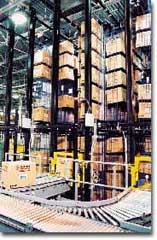
at the cut-and-sew plant.Now the fabric rolls ride a conveyor to the distribution center where
seven telescoping ASRVs (automated storage retrieval vehicles) store the fabric. These ASRVs can
move at speeds up to 600 feet per minute and move rolls and cartons of fabric with precision that
has to be seen to be believed. When it comes time to ship a roll of fabric, it exits the
distribution center via elevator and a forklift places the roll on the truck.Before we were doing
about as good a job of tearing up those rolls as we were making them to begin with, Don Henderson
said. We realized that we needed to do something different with our distribution. The beauty of the
distribution center is that our customers use our shipments now as the model for everyone else. It
was not a cost issue. It was a customer satisfaction issue. Its been one of the most positive
things that weve done. The Grand Tour: Finishing
The final
stop of ATIs tour was the Trion Finishing plant. This plant receives greige fabrics from Mount
Vernons Alto and Cleveland, Ga., plants and the companys Fresno, Calif., plant. About two million
yards of fabric are finished here per week. Trion Finishing is an open-width continuous operation.
Production processes start with two four-stage preparation lines, which desize, scour, mercerize
and bleach the fabric. The dyehouse has four continuous dye ranges. Of these, three have thermosol
capability for dyeing polyester. The plant has three tenter frames and five sanforizers. Trion
Finishing has equipped its sanforizers with the Elbit automated inspection system, so fabric can be
inspected while being processed. There are four sanders for surface finishing. The plant has a
Rosemount process control system similar to the one at Trion Denim controlling approximately 2,500
set points.While this system has a central control center, Mount Vernon associates are still
allowed to make changes in the processes from the production floor without seeking permission from
the control center. It allows our associates to be more in control of the process, said Lee Bryan,
general manager, Trion Finishing. We want them to have the authority to do the things that they
need to do. You cannot separate responsibility from authority. Thats the philosophy of the company
to me.Most of the fabric processed here goes into workwear. Mount Vernon is a player with every
major uniform manufacturer. Another big segment is bottomweight fabric for
sportswear. Innovation On DemandRecently, one of Mount Vernons biggest workwear customers came
to the company with a request. It wanted a softer, more comfortable uniform fabric. But the fabric
had to have the same wear-like-iron performance as the current product. Mount Vernon took the
challenge to heart. After a grueling year-long examination of the fabric, Mount Vernons
manufacturing team knew it better than ever before.We proved everything that we believed about that
fabric again, Bryan said. Some of the things that we always believed about that fabric what had to
go into that fabric to make it successful we actually proved wrong.In the end, they developed a
fabric with hand that the customer wanted without sacrificing performance. The details of this
innovation are proprietary and could not be shared with ATI.
May 2000

Sponsors