NAFTA Six Years Of Fibers

NAFTA UpdateBy John E. LukeNAFTA: Six Years Of Fibers
NAFTA shows mixed results for U.S. manufacturers, but opportunity for cross-border,
intra-industry trade.
 Economists have a habit of reviewing results and predicting the
future in five-year increments. These professionals notwithstanding, it is now past time, six years
and 40 percent through complete implementation, to review the performance of the U.S. fiber
industry in world trade with a specific focus on accomplishments with Mexico and Canada under
NAFTA.NAFTA has been good for the U.S. fiber industry. This is not to say that the industry shipped
all it could make or that fiber prices reflected adequate investment returns. It also is not to say
that the industry was not hammered by cheap fiber and manufactured product imports from all areas
of the world. It is to say, however, that facing the inexorable advance of world/free trade as
evidenced by NAFTA and WTO passage, U.S. fiber producers found new markets in the fabric-producing
industries of our immediate North American neighbors and have turned the tri-country poundage trade
balance from a negative to a positive figure. Accurate cross-border prices are not available, but,
based upon the current border-crossing product mix, the dollar balance of trade is still somewhat
negative, although significantly improved from pre-NAFTA levels.World Fiber TradeIt is important to
note that the negative trade balance in fibers results more from increased imports than from
decreased exports. Since NAFTA, new international capacity particularly in polyester and acrylic
has lusted after the worlds largest market, and U.S. fiber imports surged from a 1995-1996 average
of 1.1 billion pounds to over 1.3 billion by 1999. Simultaneously, U.S. fiber imports from NAFTA
countries remained virtually constant at approximately 480 million pounds. This means that NAFTA
countries share of U.S. fiber imports dropped from approximately 45 percent of total to under 38
percent in the most recent year.
In exports, a contrary story has developed. Between 1995 and 1997, U.S. fiber industry
exports held steady at slightly over 1.1 billion pounds. Since that time, with world polyester
prices tanking and foreign producers offering the output of new polyester and acrylic capacity at
almost any price, domestic manufacturers pulled back; 1998 and 1999 exports dropped to under 900
million pounds. It must be noted in these figures, however, that U.S. fiber manufacturers responded
to NAFTA in the spirit in which it was created. In 1995, at 326 million pounds, U.S. fiber exports
to NAFTA countries represented 31 percent of total fiber exports. By 1999, fiber exports of 501
million pounds an increase of 11 percent per year represented almost 62 percent of total fiber
exports. NAFTA provides the economic essentials to allow and encourage U.S. producers to compete
close to home. This has brought us to a positive poundage trade balance with our NAFTA
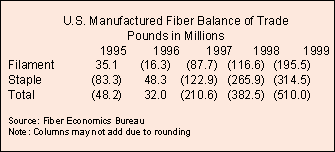
partners.Table 1 details total U.S. fiber trade since the onset of NAFTA. Regular readers of this
space will recognize the abrupt change from an industry contributing a positive balance of trade to
one mired in seemingly eternal negative balances. In a word, the pattern is ugly and speaks loudly
to changes in fiber manufacturing and distribution brought on by the political and economic
turmoil, particularly in Southeast Asia, of the 1990s.In mid-decade, American fiber producers were
struggling to maintain the positive balance of payments historically provided by the industry. The
effort was for naught, however, as economic and political forces, particularly in Asia, unleashed a
frenzy of exporting to generate hard currencies and balance overstretched economies. In fibers, as
has been noted in this space several times in the past, the forces of King Polyester descended on
the U.S. market, resulting in a 160-million-pound positive balance of filament trade in 1995
turning to a 38-million-pound negative by 1999. Similarly, polyester staple swung 100 million
pounds negative to finish 1999 at almost 400 million pounds net imports. Some backing and filling
occurred in other fiber categories, most of which, save acrylic, amounted to little more than
normal variances in trade reporting. Acrylic manufacturers, traditionally an industry sector that
exported a substantial proportion of its fiber production, suffered from recent building of
capacity in Asia, and from customer lack of hard currencies with which to pay for traditional
imports. The first negative balance in memory of acrylic trade occurred in 1999. Considering the
amount of production capacity added in acrylic and polyester in Asia in the 1990s, it is highly
unlikely that the U.S. total manufactured fiber trade balance will ever again be positive.NAFTA
Fiber TradeA recent report from the El Paso Branch of the Federal Reserve Bank of Dallas (El Paso
Business Frontier, Issue 2, 2000, hereinafter called the El Paso Report) reviewing NAFTA trade
patterns provides an interesting perspective on the current shape of cross-border trade engendered
by the treaty. According to the report, at NAFTAs inception, an amusement in the United States
centered on identifying which industries or sectors would be winners and losers in the treaty. A
winner was identified as a sector in which exports would rise as a result of the treaty; a losing
sector would see increased imports. Generally speaking, the U.S. fiber/fabric/apparel complex
designated itself as losers, a title that unfairly groups several winners into the losers category.
As cross-Rio Grande trade has unfolded, it appears that apparel manufacturing accurately falls in
the loser category. Fabric manufacturing rides a middle ground, less impacted by NAFTA than by
expanded Southeast Asian garment production that reduces the overall need for U.S.-produced
fabrics. The El Paso Report notes that in 1999, the states of North Carolina (No. 6), South
Carolina (No. 17) and Alabama (No. 22) were among the top 25 states exporting to Mexico. North
Carolina and Alabama made the list for having apparel and other textile products as their top
export, and South Carolina made it for rubber and plastics products. Together, these three states
in 1999 represented more than 3.5 percent of all exports to Mexico. In the same year, textile yarn
and fabrics and articles of apparel and clothing represented more than six percent of total U.S.
exports to Mexico.The description hints at the shape of Mexican-U.S. bilateral trade. The El Paso
Report, rather than looking for winners and losers, views trade as two positives. Imports create
opportunities for consumers to broaden purchasing patterns, often at reduced prices; exports
provide opportunities for industry to expand markets and potentially operate factories at efficient
levels. In effect, U.S.-Mexican trade is raw materials and work-in-process in and finished goods
out. Trade is moving both ways, and, in the textile complex, it is intra-industry trade with
manufacturers on each side of the border that is adding value in specialty areas. This matches the
El Paso Report description of the U.S.-Mexican macro-trade as 80 percent intra-industry. Mexican
wages are a fact, and trade has changed under NAFTA to reflect their attractiveness. It now becomes
the responsibility of raw material suppliers to optimize opportunities for business south of the
border by combining the capital advantage of U.S. manufacturing with the labor attractiveness of
Mexico.In marked contrast to the world experience and moving toward the intra-industry description,
fiber trade among the three NAFTA partners has moved from a distinct negative position in
mid-decade, soon after NAFTA implementation, to a positive balance by the end of 1999. From a
negative 165-million-pound balance in 1995, the fiber industry has fought back to a positive
10-million-pound balance in 1999. Impressively, as U.S. man-made fibers reversed negative trade
trends and fought to a positive balance, they waged a losing battle with other geographic areas.
Table 2 outlines the balance of trade in fibers among the NAFTA partners. As the U.S. position in
world fiber trade deteriorated to a 510-million-pound negative balance in 1999, the NAFTA position
continued the positive trend first exhibited in 1995. By adding the data in Tables 1 and 2, one can
calculate the size of trade with non-NAFTA world areas can be calculated. In 1995, it was positive
116.7 million; 1996, positive 108.9 million; 1997, negative 202.9 million; 1998, negative 397.2
million; and 1999, negative 520.9 million. It certainly appears the U.S. fiber industry should be
thankful for the apparent positive benefits of NAFTA trade. NAFTA trade has a distinct geographic
slant, with the United States historically running positive trade balances with Canada and
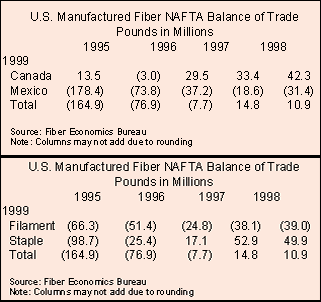
negative, but decreasingly so, balances with Mexico (See Table 3). Canada apparently has focused
its fiber manufacturing in non-apparel markets, particularly in nylon. In total fiber trade between
the United States and Canada, except for a small negative trade balance in cellulosic filament,
only nylon filament runs a negative trade account, one approaching 100 million pounds annually.
This position reflects a regional approach by producers to fiber production, with much nylon
industrial filament production transferred to Canada since 1990. In polyester, the 800-pound
gorilla of trade, the United States maintains with Canada a small positive trade balance in
filament, while dancing around a zero balance in staple. At the southern end of NAFTA geography,
the trade picture with Mexico is significantly different from that with Canada. Consistent with the
difference in apparel industry wages between the United States and Mexico, Mexican trade in fibers
focuses on apparel-type items, and, not surprisingly, the major emphasis is on polyester. Mexican
polyester filament trade has run a consistent deficit approximating 22 million pounds in the past
five years. Once falling below 100 million pounds, staple has settled into a negative balance of
approximately 75 million pounds. This negative balance may grow as DuPont participates with its
Mexican Alpek alliance in building new capacity and faces issues of productivity in old U.S.
facilities vis-a-vis new operations in Mexico.
ConclusionAccording to the El Paso Report, since NAFTA opened the U.S. market to Mexicos
textiles and apparel goods, overall textiles and apparel exports to the United States have
increased 419 percent. In fact, Mexico surpassed China as the top supplier for the United States
for these products. That is the gauntlet. Mexican wage rates will rise, but so will those in the
United States. The U.S. fiber and fabric industries are as efficient and productive as any in the
world. Creativity, marketing and design abound in the United States. If industry marries the
competencies admits that the United States is a capital-sensitive, large-quantity manufacturer of
fibers and fabrics, and supports Mexicos management of its labor competencies then the natural
forces of cross-border intra-industry trade can be ridden to new records.
Editor’s Note: John E. Luke is owner of Five Twenty Six Associates Inc., Bryn Mawr, Pa., a
consulting firm specializing in strategic marketing and operations facing textile fiber and fabric
manufacturers. He is also a professor of textile marketing at Philadelphia University.

September 2000
Open-End Vs Ring-Spun Pricing

Yarn Market ResearchBy Erin Dodd and William Oxenham, Ph.D Open-End Vs. Ring-Spun Pricing
A new progam underway at N.C. State’s College of Textiles uses ATI pricing data to analyze and
forecast production and pricing of open-end and ring-spun yarns.
 There have been several
comments recently in the textile press regarding the differential pricing of ring-spun and open-end
(rotor) yarn. Further concern has been expressed about the difference in yarn pricing associated
with yarn count, and how this difference is influenced by the yarn type (ring-spun or
open-end). Identifying Pricing TrendsA project currently underway at N.C. State Universitys
College of Textiles, Raleigh, N.C., is investigating possible approaches to predicting future
trends in yarn production in the United States. Various sources of data are being utilized,
including data associated with yarn pricing, some of which has been obtained from back issues of
ATI. Based solely on data from ATI, it is possible to clearly identify certain trends that are
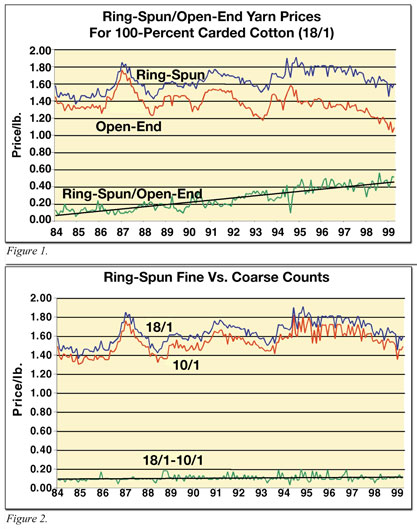
apparent in the figures that follow.Figure 1 shows a comparison of the prices for ring-spun and
open-end yarns of the same count (18Ne) from 1984 to the present. The difference in yarn prices is
also included (ring-spun yarn price/open-end yarn price), and it is clearly shown that the price
difference has increased almost linearly over time.Indeed, while the price difference in October
1984 was 13 cents, the difference in January 2000 was 51 cents. This trend is also shown for other
yarn counts for which prices were available.The reason for the increasing difference in prices is
that while ring-spun prices showed a general increase (up to 1997), open-end prices either remained
static or fell more rapidly than their ring-spun counterparts.Figure 2 compares the prices of 18Ne
and 10Ne ring-spun yarns (again from 1984 to the present), with the difference in yarn price due to
count also included. While there is considerable variation in price over time, it appears the
difference in price between the finer and coarser yarn is increasing slightly.

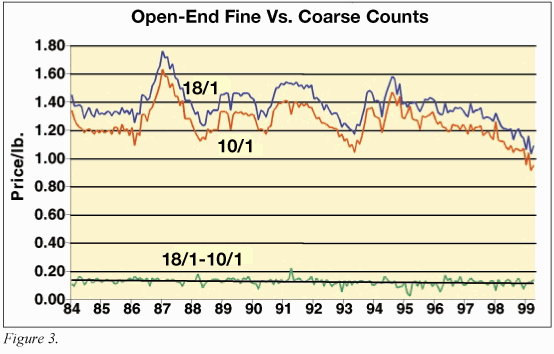
 Figure 3 shows a similar exercise (comparing prices for 18Ne and 10Ne) for open-end
yarns. While the effects are small, the data indicates that for open-end yarns, the difference in
price between finer and coarser yarns is diminishing over the time period studied.While the
analysis is based on historic data, making it risky to extrapolate to make future predictions, the
findings are summarized as follows: The price difference between ring-spun and open-end is
increasing. The price difference between finer and coarser counts is increasing for ring-spun
yarns.The price difference between fiber and coarser count open-end yarns is decreasing.

Editor’s Note: William Oxenham Ph.D, is professor, associate department head and graduate
administrator in the Department of Textile and Apparel Technology and Management in the College of
Texiles at N.C. State University.Erin Dodd is a graduate student at N.C. State’s College of
Textiles. She is completing her Master’s degree and preparing to enter the Ph.D program in Textile
and Apparel Technology and Management.

September 2000

TrendWatch Introduces Report On Textile Apparel Market

TrendWatch, Harrisville, R.I., has developed a new report for aiding technology firms in strategic
analysis of the textile and apparel industry.Published annually, the report will help executives
shed light on this industry and identify market segments, competitors, investment trends and market
opportunities.While design professionals may use similar tools, each market has a unique structure,
workflow, economic factors and expectations about how those resources are best used, said Dr. Joe
Webb, TrendWatch partner.Information is detailed by marketing and type of business, size of
business, geographic region and major investment categories.Discussion and analysis of the
challenges facing these businesses, their investment plans and technology threats will be included.
This report will collect the basic data that has been unavailable, as well as add insight to the
changing industry dynamics, said Alison Hardy, owner of FabriCAD and collaborator with TrendWatch
for this report.Bringing this kind of research to the textile and apparel markets will also result
in a Demographic Atlas and Market Segmentation Guide, which will provide managers with the
necessary statistical background and market sizing information to make strategic and tactical
decisions. The number of design businesses by zip code or major metropolitan area as well as
estimates of annual shipments will be included.

August 2000

Ring-Spun Yarn Sales Fantastic


A
brief comment from a respondent involved in raw cotton markets will be encouraging to
spinners: “The cotton crop looks beautiful this year, even with the drought. A large crop is
anticipated and the quality is good. Prices, however, don’t look good.” In other words – bad
news for farmers, good news for spinners. As with just about everything in this business, it’s not
over ’til it’s over. So we’ll see how it looks a couple of months from now.

The markets for ring-spun yarns are causing exuberance, to say the least, among spinners. One
spinner said, “Ring-spun markets are fantastic in all counts and all market segments.” Another
whole-heartedly agreed saying, “Ring-spun markets are excellent – really tight!” Now, the
question is, how long will it be until everyone moves to these markets and saturates them as we
have done in the open-end (OE) markets?

Spinners of ring-spun yarns are confident that the market is strong enough to see an
improvement in pricing. A spinner commented, “We will start moving prices up – the market can
take it. We are running full, but are still far behind. We have no inventory, and we are booked
solid through the third quarter. I wish we could have run through the fourth.”

Several factors have contributed to the continued excellence of markets for ring-spun yarns,
according to spinners. As one said, “Denim is back. Docker twill is back.” As you know, both of
these markets use tremendous quantities of yarn.


Opportunities Abound

“Open-end yarns, however, give us many opportunities in outerwear, underwear and T-shirt
markets,” commented one such spinner. Despite the lackluster market conditions, most OE spinners
are running full and booking ahead. One spinner informed the Yarn Market that he was booked solid
for the rest of the year and was beginning to book first quarter 2001. He said, “Of course, we are
quoting higher prices for next year, but we will never see inflated prices again. All we want to do
is make a reasonable profit – something we haven’t done in several years.” He also said that
once they got through the current contracts, prices will probably improve.

Many spinners feel the OE markets will always be tough because no one is getting out of it.
Therefore, the oversupply of OE yarns will continue. “It’s funny,” said one spinner, “the spinners
who complain most loudly about pricing in the OE markets are the same ones who are selling low.” In
spite of it all, volume remains good for these markets.

Inventories are strictly controlled, according to virtually all spinners. As if to justify
more than their standard of two-week inventory, one spinner said, “Of course, when you run so many
products, you have to maintain a stock of your basic items.”


South Of The Border

The Yarn Market received some interesting comments from spinners concerning the Carribean and
Mexico. One spinner observed, “While spinners will probably benefit, those textiles which are
labor-intensive will move offshore.” Yet another spinner commented, “I think the CBI will be good
for us as long as it lasts, but a couple of large producers could eat up the quotas. Also, a
company must get positioned beforehand and be able to identify the players. The logistics could be
a problem, such as credit and freight. Those who capture the market will profit the most.” This
same spinner (discussing NAFTA) said, ” Those manufacturers already involved in Mexico are
beginning to question their position, feeling they must supply the local market rather than ship
the goods back to the USA.” Shipping costs are apparently part of the problem.

Weavers are having real problems with synthetic fabrics. As one weaver said, “It’s a struggle
every day.” In cotton and poly/cotton goods, volume is good, but margins are terrible. Doesn’t that
sound familiar to you spinners?


The Good Old Days

A spinner reminisced, “Way back yonder, we had peaks and valleys in our earnings report. Today,
it is all valleys. We need to climb a peak and start making a profit for a change. Seriously, I
think the future for spinners looks good, at least for the near future.” He was reminded that back
in the old days, we came out of the mills covered in so much lint that we never had a problem with
dry hair days. Who wants to go back to the good old days?

Yarn_Table_37

August 2000

Textile Institute Creates Strategy Marketing Group

The Textile Institute, England, has strengthened its network of industry-focused Special Interest
Groups with the creation of a new body to promote strategy and marketing for textiles, apparel and
related industries.Chaired by David Rigby, a strategy and marketing consultant to the global
textile industry, the new group aims to provide services to members associated with the commercial
issues they face in day-to-day business strategy.Increasingly, companies in textiles and related
industries have to think more clearly about business strategies and market focus, said Rigby.
Having efficient operations is not enough if the strategic focus is wrong. Rapid changes in the
global market, and its supply chain, mean that overall business direction and marketing strategies
need to be constantly under review.The group will be based on the Internet so that advice, support
and information can be quickly shared worldwide.

August 2000

Quality Fabric Of The Month: Tactel® Fuses Fashion And Performance

The 2000 International Hosiery Exposition (IHE), held in Charlotte, N.C., was the venue for the introduction of new products made using Tactel®, DuPont’s family of innovative specialty, fine denier per filament nylon yarns. With Tactel, fashion and performance are fused in a variety of seamless applications including swimwear, activewear, lingerie and support garments, as well as the complete spectrum of legwear. Tactel and Lycra® are used in combination to offer softness, luster, texture and visual interest as well as comfort, fit and freedom of movement.


Seamless Concepts

Tactel and Lycra are leading players in the growing market for seamless fashions. “The current uses of seamless have only touched the surface of what is possible with this innovative technology, as more women look for innovative ready-to-wear fashions,” said Kathy Smith, intimate apparel marketing manager for DuPont Lycra. “It is our partnership with key industry leaders that has made this growth possible.”

In the category of seamless apparel, Tactel has developed a multifunctional concept collection which presents possibilities for a variety of garments from intimate apparel to bodywear to ready-to-wear. New silhouettes, patterns and textures are available using jacquards, tone-on-tone, color blocking, striated effects and combinations of sheer/opaque and bright/matte.

“We are seeing a growing awareness of fashion, style and embellishment in the seamless category,” said Ida Corraggio, intimate apparel marketing manager for DuPont Tactel. “The fluid designs of seamless garments help to redefine the silhouette, while trends such as romantic florals and control tops and bottoms softened with ornamentation offer the perfect combination of functionality and allure.”


New Fashions In Legwear

Some of Tactel’s new legwear products combine fashionable new textures and bold colors with softness, breathability and durability. Among these new products is Hue’s new fashion sock, Sport Shell, made of Tactel Aquator™, a double-sided fabric that keeps feet dry and comfortable by wicking moisture away from the skin.

Also new on the legwear scene is Nine West’s So Strong line of 20-denier sheer hosiery made of Tactel Duo™.

“We are thrilled to be a part of the solution in creating products that consumers are looking for,” said Sharon Cook, DuPont’s retail marketing manager for Legwear. “Our Tactel family of yarns can help our customer’s brands stand apart with our offerings of different lusters, shimmers and color vibrancy. We allow the consumer more fashionable options, helping turn hosiery into a contemporary accessory.”


Tactel Soft Black

Tactel Soft Black, the newest offering in DuPont’s line of Tactel products, is solution-dyed to give the black a softer appearance than is achieved in package-dyed yarns. When blended with other yarns, it can be overdyed to obtain a uniform, deep color. The integrity of the companion yarn is maintained, while Soft Black enhances the styling capabilities of the blend. Particularly well-suited for jacquards and other patterned effects in seamless apparel, Soft Black is available
with a variety of yarn effects including air-jet-textured marls, false-twist combinations, covered  and fancy yarns, organzines, metallic looks and soft-as-cotton natural looks.


For more information on DuPont’s new Tactel products, contact Eleanor Walsh, DuPont, (212)
255-1081.


August 2000

Growth Fiber Polypropylene

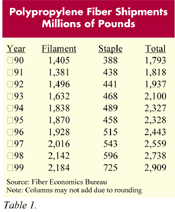
Arguably, the growth fiber of the 1990s is polypropylene. Total production of polypropylene
filament, staple and film was 1.8 billion pounds in 1990 and rose at a compounded rate of 5.5
percent to the 2.9-billion-pound level in 1999, easily besting the 2.7-percent rate posted by its
nearest competitor, polyester fibers
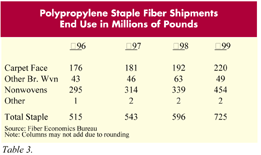
(See Table 1).Filament fiber shipment growth through the 1990s averaged a compounded 5
percent per year while staple averaged 7.2 percent per year. To be sure, the U.S. fiber industry
ships more polyester than olefin, nearly 3.6 billion pounds for polyester filament and staple in
1999, but olefin wins the battle for growth rate hands down and is catching up fast in the total
shipment category.Faced with this growth despite a stagnant domestic market deluged by imports, it
becomes important to pose several related questions. First, is polypropylene technologically and
marketing-wise ready to move up into the class of 3-billion-pound fiber Second, are fiber suppliers
prepared to invest in fiber development to sustain/increase the current rate of growth And third,
are fiber producers prepared to adopt sufficiently creative marketing strategies to balance the
pressures expected from the combination of existing domestic competitors and importers In this
article, we first will review statistics to set the stage, and then reveal marketing and product
strategies planned or in execution by several major players in polypropylene distribution. These
activities are not all that is going on, but we suggest that they are admirable examples of
creative marketing and product strategic thinking found among polypropylene producers and
processors. Setting The StageA closer look at Table 1 suggests that growth in shipments of
total polypropylene fibers has slowed, a pattern consistent with maturing product lines. The data,
particularly in filament, hints that shipments to carpet end uses, representing almost two-thirds
of all filament shipments, gained a substantial boost in 1994 as spending on housing responded to
Federal Reserve-activated lower interest rates and recovered from the early-decade recession. This
was followed naturally by a slowing as current interest rate upticks exacted a toll on housing.
Since 1997, the rate of growth in filament has slowed dramatically, dropping to 2.0 percent from
1998 to 1999.Staple, however, appears to be enjoying a renewed rise, energized by an almost
one-third rise in staple use in nonwovens. In the 1990s, staple has received two positive
market-share shots, all driven by improving fortunes in nonwovens, which represent approximately
three-fifths of all polypropylene staple sales. First came the significant bump from the 1991-1992
recession recovery, followed by a significant jump from 1998 to 1999 as major diaper producers
displaced some film layers with fibrous (staple or spunbonded) layers to diapers to make the
product seem more fabric-like and consumer-friendly (Authors Note: Part of mid-decade growth
represents the Fiber Economics Bureau fine tuning its database to include both captive fiber and
spunbonded/meltblown fiber capacities, which historically had been under-reported).Filament
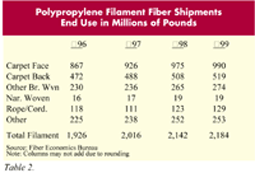
polypropylene in carpet face fibers, the main driver of filament polypropylene market share, grew a
mere 1.5 percent from 1998 to 1999 and filament in carpet-backing fabrics, a barely better 2.2
percent (See Table 2). Other broadwovens incorporating filament, including items like geotextiles
and upholstery, increased an average of 6 percent per year, compounded for the 1996-1999 period, to
retain a 12-percent share of filament shipments. Rope, cordage and fishline grew more slowly than
the category average and watched market share deteriorate slightly. Other filament end uses grew at
the category average of approximately 4 percent and thereby held their own in market share.The
largest end use in the Other category is an amalgam of spunbonded and meltblown filament products
for such markets as carpet backing, interliners, medical disposables, etc. Also included are much
smaller miscellaneous markets for such products as backing/structural materials for sliver knit
products, miscellaneous apparel items like thermal underwear, sport-specific athletic garments for
biking, aerobics, scuba diving, running and the like. Together, all the miscellaneous end uses do
not consume nearly the amount gobbled up by spunbonded and meltblown, but these smaller uses appear
to provide opportunities for new specialized products that can lead to increased market share and
value-added potential.Staple shipments in 1996 grew 12+ percent over 1995 (See Table 1). It must be
noted, however, that 1995 lagged behind 1994 by 6+ percent as all major end-use areas carpet face,
broadwoven (largely upholstery) and nonwovens sagged from record levels. Secondly, 1996 staple
shipments recovered from the 1995 lethargy to scale the 500-million-pound mountain for the first
time, regaining all and more of the 1995 losses (See Tables 1 and 3).This growth has continued to
the present, driven in large part by double-digit gains in carpet-face fiber shipments, coupled
with a mind-boggling 34-percent increase in nonwovens consumption in the 1998-1999 period (See
Table 3). All of this increase is not yet understood, although a significant portion represents
changes in diaper construction.As filament polypropylene is beholden to carpet distribution, so
also must its staple cousin answer to a demanding master, nonwovens. To date in this market,
polypropylene successfully has bested polyester staple, which in its day bested rayon and cotton.
The question now becomes, what can polypropylene staple suppliers do to retain market interest in
the product Is the current product satisfactory or is newness mandatory for continued growth Are
there more diaper construction changes on the horizon to re-energize polypropylene fibers again

 Going ForwardIt is quite apparent from the foregoing analyses that polypropylene fibers
enjoy dominant positions in several large markets. It also appears that these markets are
commodity-focused and often subject to the rawest of price and cost competition actions. These
pressures already have forced current polypropylene technology into efficient manufacturing
postures to fend off inter- and intra-fiber competition and market-share grabs from imports.So far
the campaign is successful in both filament and staple, but some industry observers suggest that
practical machine production/efficiency limits are at hand and a new efficacy paradigm is required
to continue growth patterns. The industry has been effective in providing low-cost materials. Now
it must build new product and marketing strategies and become effective at those endeavors.

 Marketing ChangesPolypropylene fibers are natural receptors for additives that bring
permanent market-specific characteristics to the material. Additives currently in use provide
anti-microbial, flame-retardant, higher heat resistance and higher strength characteristics to the
market. While these product innovation strategies find homes in a wide variety of end use markets,
it is important to note that new, innovative marketing strategies are an integral part of this
movement. The phrases solutions marketing and customer-focused are approaching hackneyed status,
but their impact is proving real in fiber marketing.Slimmed-down marketing organizations, created
by urgent needs for cost control or elimination, patrol customer plants looking for opportunities
to add value to existing businesses. For example, a two-year marketing initiative aimed at
improving carpet backing led Synthetic Industries, Chickamauga, Ga., to develop the secondary
backing, Softbac and the primary backing Patternloc. Both come from customer inputs, but this time
the customer was the installer, not the homeowner, who would be the ulitmate purchaser.Both
carpet-backing ideas came from installers. They save labor and material, making the overall cost to
the consumer lower than previous materials, despite a slight increase in per-square-yard expense
for the carpet because of the new technology.Polypropylenes environmental resistance and light
weight have long made the fiber a material of choice for geotextiles. As geotextiles have matured
into a science, fabric producers have adapted to and adopted specifications substantially more
detailed than predecessor materials demanded. Fiber development has played a small role in meeting
these new requirements. More importantly, however, has been the ongoing dialog with users and
installers that created an atmosphere of trust and gave fabric producers sufficient comfort to
justify the purchase of new processing equipment to meet the upgraded standards.Another example of
market-driven development comes from Coville Inc., Winston-Salem, N.C., which is creating fabrics
for scuba diving. Traditionally, divers like to leave the water and not remove their wet suits.
With traditional materials, this practice often results in rashes from microbe growth under a wet
suit. Coville decided to try using antimicrobial polypropylene in a line of diving fabrics. By
talking to divers, the company discovered that, particularly in warmer climes, diving garments dry
in the heat of the sun from the outside in. The challenge was to reverse this natural sequence by
creating a product that would dry from the inside out, thereby minimizing possible microbe growth
and promoting skin health. The answer lay in combining antimicrobial filament polypropylene with
spandex. The fabric is napped on the inside to create a warmth layer and brings with it the wicking
capacity of polypropylene plus a natural resistance to microbes granted by additive technology.
Individually, all the described technologies existed; it took diver input to group them into a
solution. Coville sells a premium fabric and develops opportunities to translate basic technology
into traditional bathing suit distribution. Fiber suppliers sell premium, performing yarns.

 Technology DevelopmentsThe two cited marketing developments could not have worked
without advances in technology. Marketing is but one of the routes to added-value, niche markets.
Marketing has learned to work with development in an applied nature rather than as basic research.
Polypropylene producers are becoming increasingly adept at translating customer problems into
marketing opportunities incorporating marketing and technology advances.Lightweight filament yarns
are a small part of polypropylene distribution. Historically, the most successful filament olefin
markets have demanded heavy-denier fibers in the 200- to 1,000-denier range.Apparel has been the
holy grail for polypropylene marketers; polymer, fiber and fabric producers have searched for
apparel and home furnishings markets large enough to justify development of fine-denier products.
Until activewear developed around spandex in the late 1980s and early 1990s, polypropylene really
had little exposure in apparel.Following activewear, and development of antimicrobial polypropylene
additives, a natural marriage of two man-made fibers began to enjoy increased volume in the
traditional high-sweat markets of running, cycling and aerobics. Permanent color, wicking capacity
and antimicrobial advantages were wedded in a series of market-specific performance fabrics that
enjoyed vigorous growth among the Boomer and Gen X generation exercise fanatics.In addition to
diving and bathing suit materials, apparel fabric producers are modifying fabrics for running,
cycling and aerobics for a generation attempting to age gracefully, but still demanding hard bodies
and the visible trappings of success. Fabric developments continue apace to expand the fibers role
in activewear markets.Slow progress is being made in lightweight knitted and woven constructions
for apparel and home furnishings. Dyeable polypropylene has been the wish of fiber producers. It
currently is available in heavy deniers for woven rugs through KromaLon® polymer technology
developed by Equistar Chemical, Houston, but it is a long way from commercialization in fine
deniers for apparel and home furnishings. Considering the pressures from polyester and from
imported garments, we suspect that commercialization will continue to remain more a dream than a
reality. Fine denier, therefore, should continue to depend on marketing innovation and additive
technologies for growth.As might be inferred from the last paragraph, developments at the heavy end
of the polypropylene denier spectrum are much more active than those in fine deniers. For example,
the Clean Air Act and the Clean Water Act mandate levels of air and water cleanliness.
Polypropylenes low melting point often has prevented it from acting as a filter in hot-exhaust
environments. Copolymer research currently is providing higher-temperature materials to provide a
new growth market for polypropylene. Copolymers providing high strength are targeted for selected
industrial end uses like belts and geotextiles where tensile strength above current levels is
needed. In these markets, polypropylene will go head-to-head with polyester by bringing a
sufficiently strong material of considerably lighter weight at an anticipated lower
price. ConclusionsOur market background, always as a competitor to polypropylene, injected a
certain bias into this assignment. We are pleased to note, however, that completion of the work
convinces us that the polypropylene industry is populated with inquisitive managers who are
constantly peering around the next corner, not satisfied with the status quo. To be sure, in our
judgment, polypropylene always will depend on commodity-like materials if only because of the
fragmented nature of the supply chain. We are pleased, however, to have had the opportunity to
visit with some forward-thinking members of the industry and be convinced that they, and many of
their colleagues, are working hard to make sure that newness always is a hallmark of polypropylene
development and marketing. 
Editors Note: John E. Luke is owner of Five Twenty Six Associates Inc., Bryn Mawr, Pa., a
consulting firm specializing in strategic marketing and operations facing textile fiber and fabric
manufacturers. He is also a professor of textile marketing at Philadelphia University.


August 2000

Vision Innovation Are Keys To Viability

Supplier PerspectiveBy Jim Phillips, Executive Editor Vision, Innovation Are Keys To Viability
American Savio/Somet CEO predicts prosperity for strategically inventive
manufacturers.
Those pundits ready to sound the death knell for the American textile industry
would be well-advised to speak to Harold Hoke before making any final proclamations.Hoke, the new
chief executive officer of American Savio Corp. and Somet of America Inc., both located in
Spartanburg, S.C., shared his thoughts about the U.S. textile and machinery markets with ATI during
an exclusive interview several weeks before the June open house for Savio and Somet
(See related sidebar, page 100. He is anything but pessimistic about the future of the
industry.This is an exciting time to be associated with this industry, he said. Is employment in
the industry going to continue to decline Very likely. Are the numbers of companies and plants
going to decrease Almost certainly. Is the U.S. textile industry in the sunset of its existence Not
a chance.The U.S. textile industry is going to continue to grow, he said, but differently than in
the past. Mergers, partnerships, acquisitions and closings will continue, and those companies with
dedication to vision and innovation will continue to prosper.I see companies looking intently
toward new product ideas, innovative manufacturing alliances and new technology that is different
than the current easy decisions sometimes made, he said.Ive been fortunate in my association with
this industry that Ive been able to watch a number of companies some of them very old and
traditional make the transition from product-oriented companies to marketing-oriented companies.
These leaders are the first to embrace new technology and the first to realize the cost savings and
productivity enhancements that this technology entails. These are the companies that are truly
competitive in the global market.Hoke issued a wry smile and declined to name specific companies
not, he said, for fear of offending those laggards that havent quite caught on to what its going to
take to prosper, but, instead, from reluctance to omit a truly outstanding company. 

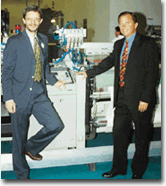
Dott. Fabio Mazzucchetti, president, Somet (left),and Harold Hoke, CEO, American Savio
andSomet of America, pose with the Mythos, Sometsrecent entry into high-speed air-jet
weaving. His resume indicates he has the credentials to both recognize and evaluate what it
takes to compete successfully in a worldwide textile market. Hoke holds a degree in textile
technology from Clemson University. Immediately upon graduation, he took a job with Burlington
Industries. For much of the past 20 years, he directed sales, marketing and service efforts for
Zellweger Uster, both in the Western hemisphere and worldwide, including sister companies in China,
Thailand, India, Germany, England and Brazil. He knows what it takes to establish a presence in
these countries and penetrate markets. As a result, he doesnt share the concern many American
textile leaders have expressed over the granting of permanent Normal Trade Relations (Ntr) with
China.Is this a potential problem for the U.S. industry he asks. Sure it is. But more than that, it
represents a real opportunity. China is, of course, a huge market, and not all of it is captured by
low-end products. There is demand in China an increasing demand for high-fashion products of
world-class quality. So in many ways, this could be a very good thing for those American companies
that will take advantage of it.I certainly would not be afraid of it, unless I didnt really
understand it and didnt have a plan to capitalize on it.Hoke continued: We hear so much about the
effects of the imbalance in world trade within the textile industry. But I think innovation comes
into play also. You dont see too many innovative third world countries when it comes to textiles.
They just produce cheap and sell cheap.On the other hand, every leading Italian and American
manufacturer is continually trying something new. I surely hope innovation wins this battle. If
not, the Paris, New York, and Milan fashion industry will surely suffer.As far as the textile
machinery industry is concerned, those companies that focus their resources and change the rules of
the game will thrive. The others, well, they can always just produce cheap and sell cheap. Its a
strategy, I guess, although not a very exciting one. As the captain of two major players in the
machinery market, Hoke is understandably more optimistic about the ramifications of Ntr status than
those mill owners who seem to be hammered year in and year out by trade imbalance and import
dumping. But his message is nonetheless clear. For the American industry to prosper to its
potential, more and more companies must make the transition to thinking in terms of global
marketing strategies. It is in hopes of capitalizing on such strategies that Hoke left his
comfortable position with Zellweger Uster after so many years to take the helm of American Savio
and Somet of America Inc. Both companies are owned by the Radici Group of Italy, with Savio being
the most recent acquisition. Savio manufactures yarn preparation/finishing machinery, while Somet
is a leading producer of weaving machinery.Both companies have been viable competitors throughout
the world virtually since their respective foundings, Hoke said. I think the answer to longevity
and tradition is innovation. Savio and Somet have truly presented, over many years, innovative
products and innovative, dynamic business strategies. For example, concerning marketing and
manufacturing leadership, Savio has developed strategic marketing and manufacturing partnerships in
India and China and, consequently, is a leader in both markets.Both companies have invested in new
product development and are now delivering the latest in winding and air-jet weaving technology.In
many ways, Hokes vision for the two companies parallels his assessment of the opportunities before
the American textile industry. His goal is to incorporate vision and innovation to maximize any
competitive advantage.Textile machinery companies, like our customers, have suffered financially in
the developed countries over the last few years, he said. You have already seen consolidations,
mergers, and, quite frankly, closings. This is where the financial strength and global marketing
strategy of the Radici Group has helped tremendously. The worldwide markets and successes of Somet
and Savio in developing markets have helped these companies maintain profitability even in these
past difficult several years.It is essential that we combine the technical strengths and
application knowledge of both companies in order to truly be capable of helping our customers solve
their business problems, he said. We are quickly moving to combine our sales, technical support and
service organization. Our company, with this broad knowledge base, will be the only one of its kind
in our industry. Our task is to clearly present the strong advantages of our equipment, especially
now that both Savio and Somet have unveiled technologically advanced new products
(See related sidebar below). Focus is critical, he said, for both Savio/Somet and the
textile industry in general. One of the most important aspects of success is listening to customers
and then acting. Research and development focus is critical. We must concentrate on fewer projects
those that yield the greatest return. If we cant do something as well asit needs to be done, we
will focus on what we do build better than anyone.My CEO at Zellweger Uster in Switzerland, Eddie
Bradley, practiced and implemented that, and it is easy to see the success Zellweger Uster had
because of such a philosophy. We at Somet and Savio understand where those areas of innovation
should be, we will invest heavily, and I am certain, if focused, we will be even more successful.
To be prosperous, innovation, risk, and dedication must not be strategic ideas only, but
implemented actions. Savio And Somet Showcase U.S. OperationsThe move of American Savio Corp.
to the location of its sister company, Somet of America Inc., has created new potential for the
U.S.-based subsidiaries of the Radici Group, according to Harold Hoke, CEO, American Savio and
Somet.The two companies are now combined in an expansive facility in Spartanburg, S.C., and are
merging sales, marketing and support staffs to capitalize on opportunities for new lines of winding
and weaving machinery.It is essential that we combine the technical strengths and application
knowledge of both companies in order to truly be capable of helping our customers solve their
business problems, said Hoke. Our task is to clearly present the strong advantages of our
equipment, especially now that both Savio and Somet have unveiled technologically advanced new
products.Those new products, the Savio Orion winder and the Somet Mythos air-jet weaving machine,
were on display at the companys open house and product demonstration in June.We are extremely proud
of these new products and fully expect the U.S. market to welcome such innovations in its search
for continued competitive advantages in its fight to battle the cheaper and increasing amount of
imported textile goods, said Hoke. If we do our job and can clearly present to the textile spinning
and weaving industries these advantages, Savio and Somet have a wonderful future. And there is much
more to come.Quite frankly, I couldnt be more excited about the future of both these Radici
companies.The Savio Orion winder, first introduced at the 1999 ITMA in Paris, is an innovation that
Hoke claims will change the rules of the game.The production and quality capabilities, if you study
the differences, are clearly superior to anything on the market at this point, he said. The
motivation behind development of the Orion series, Hoke said, was based on a thorough analysis of
customer needs. As a result, the company introduced a machine that would improve total quality of
the wound package, reduce overall process costs and increase manufacturing flexibility.The Orion is
available in two models, the Orion E, which is an independent winding machine, and the Orion I,
which can be linked to spinning frames. The frame for both is available in six- or eight-head
sections. The number of heads per machine ranges from a minimum of six to a maximum of 64 in steps
of two. Take-up speed ranges from 400 to 2,000 meters per minute.Somet is committed to developing
new technology in air-jet weaving. The Mythos, Hoke said, was tested for two years, 24 hours per
day, at 1,200 picks per minute.Somet conducted in-depth dynamic/behavioral studies to produce a
structurally strong loom that would be reliable at any speed. As a result, the Mythos requires no
anchoring, either mechanically or chemically. In addition, the Mythos can weave widths from 190 to
400 centimeters, and can accommodate up to six filling colors. The loom features automatic harness
leveling, a positive cam motion up to 10 harnesses and positive electronic dobbies up to 16
harnesses.In addition to the Orion and Mythos, the company displayed the Savio Geminis twister and
FRS open-end spinning machine and the Somet Super Excel HTP weaving machine.The Radici Group
worldwide forecasts sales in 2000 to top $1.5 billion. Combined revenues of American Savio Corp.
and Somet of America Inc. approach $25 million.Currently, Somet and Savio employ 33 people in the
46,000-square-foot facility.Savio moved from Charlotte, N.C., to the current location in January of
this year.
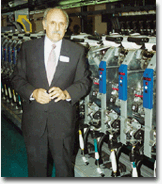
Below: Dott. Rino Morani, president, Savio, stands before the Orion, Savios latest-generation
winder.

August 2000

People August 2000

EcomTextile.com, Fullerton, Calif., a newly formed Internet-based textile exchange, appointed

John C. Adams
CEO. Adams recently retired from his position of chairman, president and CEO, Russell Corp.
He also served as president of the American Textile Manufacturers Institute (ATMI), chairman of the
American Apparel Manufacturers Association (AAMA) and director of the National Cotton Council
(NCC), and on the Executive Committee of the American Textile Partnership.

N.C. State University, Raleigh, N.C., appointed

Dr. A. Blanton Godfrey
dean of the University’s College of Textiles. Godfrey, formerly chairman and CEO of Juran
Institute Inc. and an adjunct professor at the College of Textiles, was also named the Joseph D.
Moore Professor of Textile and Apparel Management Technology.

Cargill Dow, Minnetonka, Minn., appointed

Randy Howard
president of the company. Howard formerly served as director of growth and technology,
polyurethanes, Dow Chemical Co.

Buffalo Color Corp., Buffalo, N.Y., named

Jack Cabrey
president and CEO. Cabrey formerly was president and general manager of Sequa Chemicals
Inc./Sun Chemicals.

Rieter Textile Systems, Germany,
appointed

Uwe Teek
sales and marketing director, Synthetic Fiber Machinery. Teek has been with Rieter for many
years, both in Germany and in the United States.


Teeks_100


Uwe Teek

BASF Corp., Mount Olive, N.J., named

Tilman Krauch
to head its Industrial Fibers Business Unit. Krauch is also group vice president, Fiber
Intermediates, and has been with BASF since 1990.

Gaston County Dyeing Machine Co., Stanley, N.C., announced that

Alex Franco
joined the company as director of international sales for Latin America.

New York City-based Cotton Incorporated named

Kathryn Gordy
Novakovic director, THE COTTONWORKS® Fabric Library.

WestPoint Stevens, West Point, Ga., announced new responsibilities and assignments within
its management team.

Joan Amberg
, senior vice president and president, sales, will add responsibility for the company’s
Canadian and Central/South American sales efforts to her existing domestic responsibilities. She
will also oversee the Product Management Group.

Paxar Corp., White Plains, N.Y., appointed

David Osiecki
vice president and general manager of the company’s Apparel Identifications Systems
Division.


Zellweger Uster Inc., Knoxville,
Tenn., named

Alvin Ellison
director, sales and service, and member of the Executive Committee. Ellison manages the
company’s sales and service activities in the United States and Canada and heads the IntelliGin
Business Unit. He also serves as site manager for the company’s facility in Charlotte, N.C.


Ellison_99


Alvin Ellison

Burlington Industries Inc., Greensboro, N.C., announced that

Delores Sides
was promoted to director of corporate communications.

Avondale Mills Inc., Sylacauga, Ala., announced two appointments at Gregg Plant,
Graniteville, S.C.

Archie Coleman
was named manager, technical quality assurance for piece-dyed fabrics.

Mel Francisco
joined the company as plant production manager.

Alba-Waldensian Inc., Valdese, N.C., named

James Douglas Dickson Jr.
CFO.

William T. Walker
, senior vice president, operations and planning, will oversee the Sourcing organization,
directed by John Cafaro. The Customer Service, Planning and Logistics Group will also report to
Walker’s organization.

Donnie Hodge
was named senior vice president, strategic planning. He will report to David C. Meek,
executive vice president, finance, and CFO.

Scott Maddalene
was appointed vice president and managing director, European operations.

The U.S. Small Business Administration named

Avishai Nevel
, president, Lawson-Hemphill Inc., Central Falls, Rhode Island Falls, R.I., the 2000 Rhode
Island Small Business Exporter of the Year. The company’s international program, initiated in 1982,
accounts for more than 60 percent of its manufacturing revenues.

Johnston Industries Inc., Columbus, Ga., appointed

Ron Wright
senior vice president, sales and marketing, JI Fabrics Division.

Marshall and Williams Products Inc., Greenville, S.C., appointed

Blas A. Miyares
president of the company. Miyares previously was president of Küsters Textile Machinery
Corp.

Culp Inc., High Point, N.C., named

John H. Beason
vice president, specialty fabrics, with responsibility for the company’s sales to the
contract and hospitality markets.


August 2000


Versatility Fuels Nonwovens Growth

High performance drives increased use of polyester and polypropylene nonwovens for filtration
media.
Filtration is divided into two broad classifications gaseous filtration and liquid
filtration. The proper filtering medium must be selected based on the material to be filtered, the
operating environment and the actual operating conditions. There is no universal fiber for
filtration. Neither is there a single fibrous or textile form suitable for every type of
filtration.The food and beverage industry is diverse, offering many opportunities for filtration
products. Filtration is important in dairy, meat, poultry, alcoholic beverages, soft drinks and
bottled water. The largest single application for beverages is beer filtration. Filtration is one
of the key unit operations in the manufacture of most types of basic raw materials and in the
production of most industrial and commercial products. Choosing The Filter MediumFollowing are
some of the major criteria that must be met in selecting the proper filter medium for a specific
application:Which is the most valuable component the filtrate or the filtered streamWhat is the
particle size to be retained by the mediumWhat is the permeability of the clean filtration
mediumWhat is the solids-holding capacity of the filtering medium, and what is the resistance of
the filtering medium to the passage of the filtered streamWhat is the physical state of the
suspension to be filtered, and what is the chemical constitution and temperatureThe choice of a
filter design for a given process depends on some of the following factors:the properties of the
solids to be removed and their concentration;particle size and shape as well as the properties of
the fluid;the quantity of material to be handled;whether the solid or the liquid, or both, are to
be retained after filtration;whether the filtrate must be washed; andwhether the filtration process
should be batch or continuous. Bag Filters For Liquid FiltrationBag filters have become more
popular for liquid filtration for process filtration and for hydraulic and lubricating filtration.
Polypropylene is the favored material for most liquid filtration because of its chemical resistance
and competitive price. Nonwovens For Protecting Membrane FiltersThe use of reverse osmosis is
growing by about 12 percent per year, gas separation types are growing by about 12 percent per
year, and electrodialysis is growing by about 8 percent per year.Polymeric microporous membranes of
cellulose acetate, polysulfone, polyvinylidene fluoride, acrylonitrile polymers and nylon are used
in chemical, pharmaceutical, food processing and waste treatment operations. Submicronic particles
must be removed from fluid process streams in these operations.Membrane filtration is the
separation of the components of a pressurized fluid, effected by polymeric or inorganic membranes.
The pores of the membrane are so small that significant fluid pressure is required to drive the
liquid through them.The pressure required varies inversely with the size of the pores. These
membranes have pores so small that they will plug and blind off instantly unless they are run in
the crossflow mode.Unlike traditional filtration, in membrane filtration, all the influent does not
pass through the media, but instead is split into the permeate (filtrate) and concentrate streams.
The concentrate stream flows parallel to the membrane, hence the term crossflow.The crossflow
membrane is a pressure-driven process in which the semipermeable medium acts as a surface filter to
split the feed stream into two effluents a purified stream and a stream concentrated in solutes too
large to pass through the pores of the particular membrane.Moving from the smallest to the largest
pore sizes, there are four categories of membrane filters.reverse osmosis (RO)nanofiltration
(NF)ultrafiltration (UF)microfiltration (MF)Reverse osmosis effects separation of small solutes,
including salts with ionic radii in the Angstrom ( range. The exact mechanism of rejection in RO is
more complex than in UF and MF.Nanofiltration is a term that was coined in the late 1980s to define
membranes that were already in use and were referred to as loose RO. They have pores close to one
nanometer in diameter (1- and effect partial salt rejection.NF membranes pass a higher percentage
of monovalent salt ions than divalent or trivalent ions. Nanofiltration membranes span the gap
between RO and UF classes of membranes. Ultrafiltration standards have been developed under ASTM
Standard D-1129, but no such official definition yet exists for reverse osmosis or
nanofiltration.Microfiltration is understood as the fine end of particle filtration, with pores
from 0.1 to 1 micron in diameter. MF membranes have pores two to five orders of magnitude larger
than the other classes.MF media are actually membranes and can be run in the crossflow as well as
in the normal flow mode. This can provide longer media life. In order for the membrane filter
systems to work properly, membrane fouling must be prevented.In membrane filtration, nonwovens can
play an important adjunct role. Some of the functions of nonwovens in membrane filtration systems
follow.protection during manufactureprotection and support during testingpleat separation for fluid
distributionpleat support to prevent collapseprefiltrationThe membrane films used are usually thin
and often in the range of 4 to 6 mils in thickness. While many of these membranes have good
chemical resistance and tensile strength, they are susceptible to puncture, damage from abrasion
and fatigue failure from flexing.Also, the membranes must be protected during fabrication into
cartridges and other forms. To protect the membranes during fabrication, they are often sandwiched
between two or more layers of nonwoven material. The nonwovens are typically polypropylene or
polyester.Extruded nettings as well as spunbonds and meltblowns are used extensively as protective
media.Polypropylene is commonly used because of its broad chemical compatibility and low cost.
Polyester provides a better combination when used with nylon membranes because of the higher
melting temperatures of the two materials. Nonwovens made from virgin resins with minimal additives
are required in processes where materials must meet FDA requirements.Care must be taken when using
meltblown nonwovens to prevent shedding of particles, particularly with finer denier meltblowns.
Often meltblowns will be calendered to prevent fiber shedding.

 Downstream Nonwoven LayerA layer of nonwoven material adds structural support to the
folded membrane and must allow the fluid to move out of the pleat. This becomes more important as
differential pressure increases with contaminant buildup, increased fluid velocity or increased
fluid viscosity.Spunbonds are very suitable for the downstream layer because of their higher
strength and freedom from fiber shedding. Extruded nettings are also used, but they are thicker
than spunbonds. Upstream Nonwovens LayerIt is important to maintain proper fluid flow dynamics
above the membrane. The upstream nonwoven layer must keep the flow channels open between adjacent
pleats. Without support from a nonwoven layer, adjacent pleats may pinch together and impede fluid
flow. The upstream layer reduces the particle contaminant load on the final membrane filter. Proper
prefiltration greatly enhances the filtration performance of the membrane filter.The major
objective of the prefilter is to remove large, oversized particles so that the narrow pores of the
membrane filter do not become prematurely clogged. Important parameters for selecting a prefilter
are mean flow, pore size, pore size distribution and bubble point. The mean pore size correlates
well with filter retention efficiency. A narrow pore size is usually preferable. Generally, a
separate prefilter unit with nonwoven media is preferable. A separate prefilter can extend the use
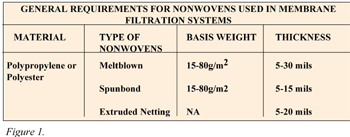
of the final membrane filter by up to two times its normal life.There are some requirements for
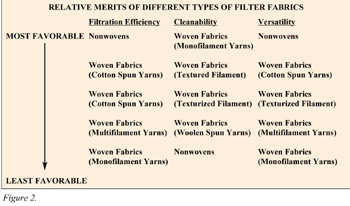
nonwovens used with membrane filtration systems (See Figure 1). Benefit Of
Pre-FiltrationOsmonics SPIRALTEK® rolled filter medium with a spiral-wound design creates a
tangential crossflow motion that sweeps particulate across the medium and traps contaminants in
special nonpermeable sections, rather than in the medium itself. Rolled filters, much like pleated
filters, are made with different types of polymer membrane.Some of the following applications use
prefiltration systems based on the Osmonics SPIRALTEK rolled filter medium:Magnetic Media
Filtration Rolled filters provide the sharp cutoff to separate oversized particles from metal oxide
slurry. They also help to eliminate gel slugs.Specialty Inks Inks used for ink-jet printers,
ballpoint and roller pens and other specialty uses require highly efficient filters that can handle
viscous fluids and achieve the fine separation of contaminants from pigments. Rolled filters work
well in these applications.Biotechnology In processing blood serums, or biological extracts,
removal of unwanted bacteria, protein and other materials is essential. The ability of rolled
filters to hold a large volume of particulate is very beneficial. They also help to increase the
longevity of downstream sterilizing filters.Fermentation Broths In pharmaceutical and beverage
production, enzymes have to be removed once they have completed their work. Rolled filters, because
of their holding capacity, help to improve the efficiency of downstream membrane
filtration. Dry-Gas FiltrationFor many years, woven fabrics were the most typical media, but
during the last 20 years, nonwovens have become the dominant filtration media.A major advantage of
nonwovens is versatility, since almost all major types of nonwovens can be used alone or in
combination in some type of filtration application.For air and hot-gas filtration applications,
there was earlier acceptance of needlepunched nonwovens in Europe than in the United States. This
is no longer the case. Higher-speed needlelooms, improved needles, high-temperature resistant
fibers and specialized fabric finishes have broadened the uses of needlefelts in both dry and wet
filtration. Needlefelts can be engineered to provide varied pressure drops and dirt holding
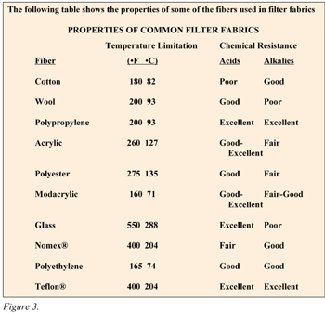
capacity.Polyester fibers are important for dry-gas filtration for use up to 275°F (135°C). Where
higher temperatures are required, fiberglass, DuPonts Nomex®, PPS (polyphenylene sulfide) and
Inspecs P84® polyimide fibers are used.Polypropylene is limited in dry-gas filtration to areas
where only relatively low temperatures are encountered. This excludes its use from baghouse
installations for power generation plants, as well as asphalt-, cement- and metal-processing
installations.However, polypropylene use is growing in applications for clean rooms and hospital
operating rooms, for which polypropylene filter media are available in a wide range of types from
bulky to paper-like structures. Filters For Gaseous FiltrationClass A filters are for coarse
dust and can even retain 60-micron particles. Class A filters are not suitable for filtering
sub-micron particles.Class B filters cover a wide range of efficiencies for removing sub-micron
particles. They are often used in the form of bags supported on a metal framework, or as
cartridges. They are commonly used as filters for air conditioning systems or as prefilters for
Class C filters.Class C or HEPA (High Efficiency Particulate Air) filters are specifically designed
to deal with very fine particles at low loadings. They are typically used in combination with a
Class B filter as a prefilter.Typical applications for Class C filters are electronic and
pharmaceutical clean-room manufacturing and fermentation processing.

 Collection Mechanism In Dry-Gas FiltrationIn dry-gas filtration, particulates are
collected by three mechanisms direct interception, impaction and diffusion.In collection by
impaction, the particles have so much inertia that they cannot follow the streamline around the
fiber; thus they impact on its surface. The mechanism involves a collision of the particle on the
barrier. Another mechanism involves particle interception. In this case, the particles have less
inertia and can barely follow the streamlines around the obstruction. Even if it doesnt actually
touch the fiber, the particle is immersed in the viscous stream around the barrier, which will be
enough to slow it down so it will graze the barrier and stop. When this happens, the porosity of
the filter medium decreases and the true filtering surface begins to form.The third collection
mechanism is important for particles that are below 1 micron in aerodynamic diameter. Diffusion is
considered immaterial for particles with diameters smaller than 0.1 micron, which is in the
Brownian motion range. In this case, the particles are so small that their individual motion can be
affected by a collision on a molecular or atomic level.Other important factors are electrostatic
attraction and gravitational settling. As the particle loading in a filter increases, the
collection efficiency increases, but so does the pressure drop across the filtering unit. The
pressure drop is used to monitor the condition of the filter and to determine when it needs to be
cleaned or replaced. Baghouse FiltrationsOne of the most common uses of baghouses is in the
electric utility industry where coal is used. A baghouse is a large metal box divided into two
functional areas. One area, the dirty-air plenum, may be a part of the baghouse proper, or it may
take the form of a gas-distribution manifold.The function of the dirty-air plenum is to distribute
the incoming gas evenly to the filtering elements or bags. The clean-air plenum is part of the
baghouse where recombination of the air from each of the individual bags takes place. The interface
separating clean-air and dirty-air plenums is the filtering medium or bags. The baghouse hopper is
a receptacle for collected particulate materials and is part of the dirty-air plenum.As discussed
in the previous section, the filter mechanisms involved in removing particles from a fluidized gas
stream are impaction, interception and diffusion. These mechanisms are responsible for the
collision of a particle on a target (the filter fabric) and are of paramount importance when the
baghouse is first brought on-line and the filtering elements are still clean.After a short time,
however, the bags become caked with a layer of flyash, and the dust cake actually becomes the
filtering medium. No matter how vigorously the bags are shaken, collapsed or pulsed, a residual
dust cake is retained after each cleaning, and the bags now act mainly as a matrix to support the
flyash. Classification Of BaghousesBaghouses are characterized and identified by the method
used to remove flyash from the bags. The bags in shaker-type units are suspended from a structural
framework, which is supported in such a way that it is free to oscillate when driven by a small
electric motor. Periodically, a damper isolates a compartment of the baghouse so that no air flows
into it. The bags in that compartment are then shaken for about a minute, during which time the
collected dust cake is dislodged from the bags. The dust falls into the hopper and is later
removed.Reverse-flow baghouses are equipped with an auxiliary fan that forces air through the bags
in an isolated compartment with the airflow in the opposite direction to filtration. The backwash
action collapses the bags and fractures the dust cake. When the bag is reinflated by being brought
back on-line, the fractured dust cake is dislodged into the hopper. If the unit operates under
suction (that is, if the main process fan is located on the clean side of the baghouse), the
reduced pressure in the baghouse may eliminate the need for an auxiliary fan. Some units combine
shaking and reverse-flow cleaning in the same unit.Reverse-pulse baghouses use a short pulse of
compressed air directed from the top to the bottom of the bag. This primary pulse usually lasts
less than a tenth of a second and aspirates secondary air as it passes through a nozzle or venturi.
The resulting air mass expands the bag and casts off the collected flyash. Shaker and reverse flow
units collect flyash on the inside of the bags, while reverse-pulse units collect flyash on the
outside of the bags.Baghouses have some practical limitations. Most bags have rather
low-temperature capabilities, ranging from 180°F to 300°F and above. Thus a practical limitation
exists when using fabrics able to withstand air-preheater outlet temperatures of 300°F and above.
Abrasion is a natural phenomenon that results from contact with flyash-laden gases. Some wear on
the filter bags occurs when flyash strikes a bag tangentially.The destruction of a bag from
chemical attack is generally due to misoperation. Processes that evolve gases at elevated
temperatures frequently produce water vapor and acid radicals, which at the acids dewpoint will
concentrate into a liquid. The acid dewpoint depends on the concentration of the constituents in
the gas, and it is almost impossible to predict.The bags tend to wear out with age. After hundreds
of cleaning cycles, the fabric weakens and will ultimately fail. The better the bag maintenance and
the better the equipment design and materials selection, the longer the bag will last.

 Overall Trends In FiltrationNonwovens will continue to grow in importance. Higher
performance requirements for filtration systems are being driven by industry needs for improved
productivity and by stricter environmental requirements. The ability to engineer nonwoven materials
to meet these more stringent requirements is responsible for the growing use of all major types of
nonwovens in filtration applications. The use of automotive cabin filters is now a growing market
for nonwovens. Greater household use of drinking water filter systems and home air and household
cleaning devices present good growth potential for nonwovens. In wet filtration uses, polypropylene
will continue to be the dominant material because of its superior chemical resistance and
relatively low material cost.Meltblown nonwoven use in filtration is expected to continue to grow
by more than 8 percent per year over the next five years. Meltblown technology providing higher
strength webs is now under development and will further improve its versatility as a filtration
medium. Spunbond nonwovens will also show healthy growth in filtration, both alone and in
combination with meltblown materials. Needlepunch nonwovens continue to improve their performance,
particularly for more demanding dry-gas filtration applications based on improved manufacturing
technology.In wet filtration, needlepunched and meltblown combination fabrics are growing in
importance. Dry-laid nonwovens have lost some market share to spunbonds, but higher carding speeds
and improved thermal bonding techniques will help stabilize their position in filtration
applications.Use of specialty fibers will grow in filtration. Governmental clean air requirements
are boosting the use of high-temperature resistant fiber such as DuPonts Nomex, Inspecs P84, BASFs
Basofil® and PPS for industrial and utility systems. The use of fibers that incorporate additional
functions, such as antistatic and antifungal properties, is growing.There will be greater use of
fabric functional finishes. Use of additives and treatments is growing. The use of materials in the
form of finishes or microporous film laminates of silicone or fluorocarbons, which provide better
cake release properties, will continue to grow. The application of selective absorbents, such as
carbon and zeolite, to filter media is another important trend. The formation of electrets in
filter media to improve efficiency has now been widely commercialized.There will be major areas of
growth for nonwovens in filtration. Reverse osmosis is a growing industrial process for a wide
range of industries including food, pharmaceutical and microelectronics, and it will require
nonwoven filtration media for prefiltration of liquids. There is a growing need for nonwovens of
greater uniformity for use as casting support for membrane filters.Nonwoven use will not only grow
in automotive and household applications, but will become better known to the public because of
these growing uses.

August 2000

Sponsors