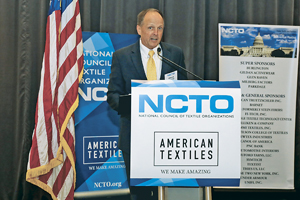
Outgoing NCTO Chairman Chuck Hall outlined the U.S. textile industry’s major challenges and achievements of last year during his “State of the U.S. Textile Industry” address at NCTO’s 22nd annual meeting in Washington.
By Chuck Hall
It is a privilege to stand before you and deliver this year’s State of the Industry address on behalf of the U.S. textile industry — an industry that is not simply part of our manufacturing base, but also a strategic pillar of it.
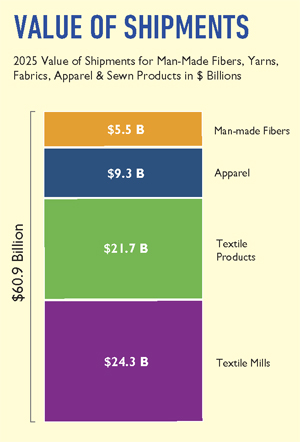
The U.S. textile industry produces components for everything from wearing apparel and automotive interiors to advanced industrial applications; products for our hospitality markets and industrial markets; and our military and defense systems. Our integrated textile and apparel supply chain employs 453,122 American workers and generates $60.9 billion in annual output.
Each year, our industry supplies more than $1.8 billion in uniforms and textile-based equipment to the Department of War. We provide over 8,000 different textile products to our armed forces. From flame-resistant fabrics to advanced ballistic materials, American-made textiles are essential to mission readiness and national security.
A Year Of Historic Wins And Challenges
In 2025, the industry faced significant challenges in response to economic upheavals and rapidly evolving trade policy developments.
Sweeping global tariff increases on nearly every country and imported products also triggered uncertainty and injected unpredictability into global markets.
At the same time, predatory trade practices intensified. Illegal transshipments surged. Customs fraud continued. Logistics breakdowns rippled across supply chains.
And in just two and a half years, more than 40 U.S. textile plants have closed.
Let that sink in.
Forty facilities — many in rural communities where a textile mill is the economic backbone — shut their doors. Families were impacted. Communities were shaken.
NCTO’s Leadership In A Time Of Upheaval
Throughout this unprecedented time, the National Council of Textile Organizations (NCTO) initiated a strategic campaign to confront policy threats and elevate the industry’s strategic importance at the highest levels of government.
I’d like to focus some attention on the role NCTO plays in facilitating access to key policymakers. Access provides opportunities for our industry to impact policy. Without it, there is no way to impact policy.
Thanks to the hard work behind the scenes by NCTO President and CEO Kim Glas, staff and industry leaders, we had access to the most influential administration and White House officials, which helped shape and effect change in this evolving trade environment.
Last year, we had face-to-face meetings with Treasury Secretary Scott Bessent, U.S. Trade Representative, Ambassador Jamieson Greer and Commerce Secretary Howard Lutnick. We also had access to key members of the Department of War and Defense Logistics Agency, and those meetings elevated our industry as a strategic sector and impacted policy. We made national and international news on our de minimis advocacy that closed this disaster once and for all. We played on both the offense and defense. And our voices were heard at the highest levels of the administration and on Capitol Hill. We made a meaningful difference in 2025 and we are positioned well to achieve some of our top priorities in 2026.
Before highlighting NCTO’s key policy wins, I want to quickly share a recap of the key data points from 2025 that highlight our industry’s resilience and staying power.
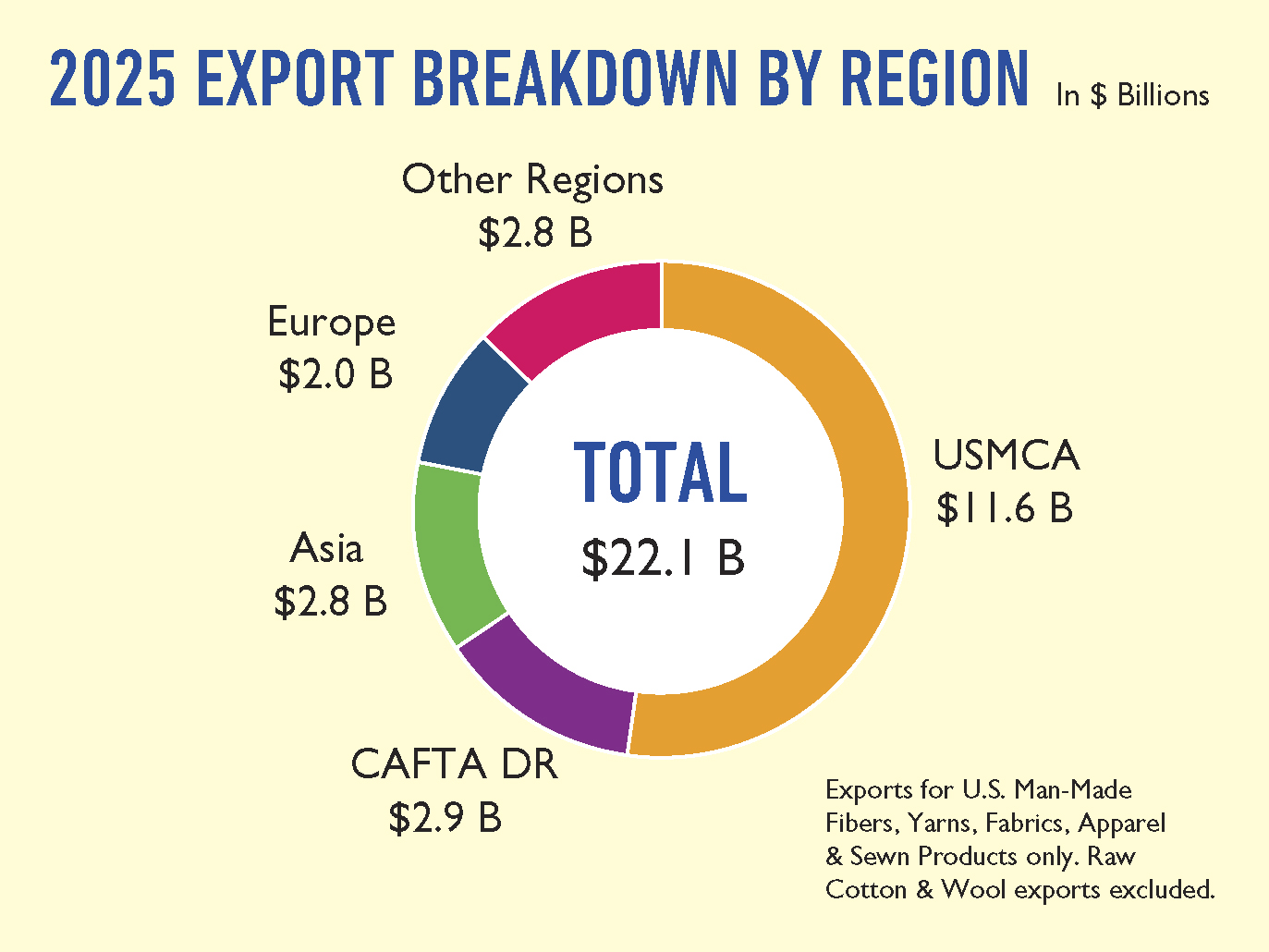
By The Numbers
In 2025, the industry’s key metrics registered slight declines across the board but remained stable relative to major trade and economic disruptions throughout the year. This again underscores the industry’s ability to adapt during challenging times and remain viable even while registering some losses.
Here are a few key industry facts for 2025:
- The estimated total value of U.S. man-made fiber, textile and apparel shipments was $60.9 billion compared with $63.9 billion in shipments in 2024.1
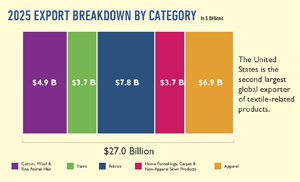
- U.S. exports of fibers, textiles and apparel were $27 billion in 2025 compared with $28 billion in 2024.2
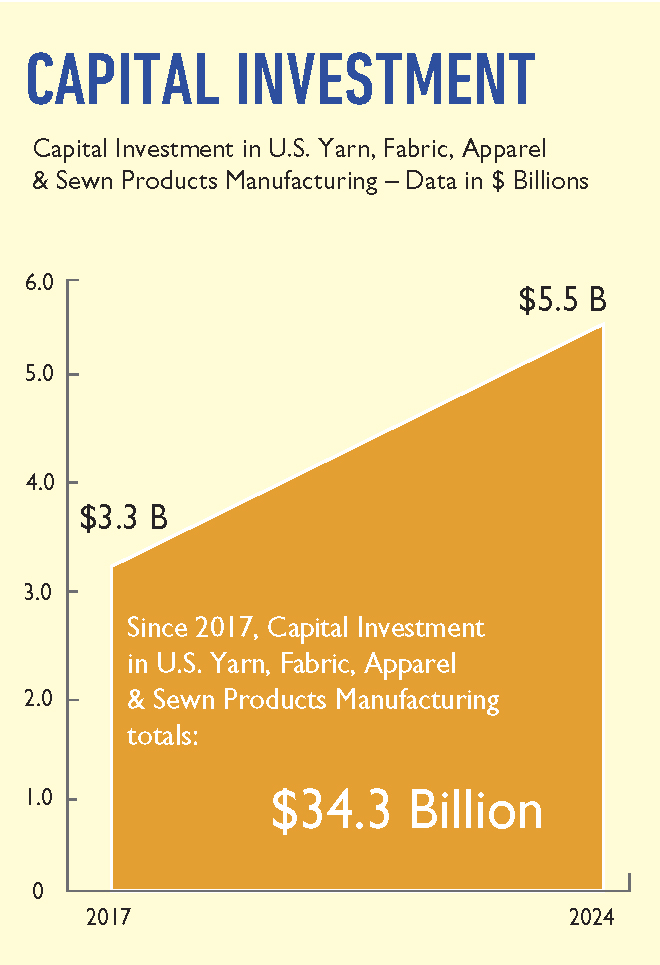
- From 2017 to 2024, our industry invested $34.3 billion in advanced manufacturing here in the United States.3
- The United States remains the second largest individual country exporter of textile-related products in the world.
- The U.S. textile and apparel industry invested $5.5 billion in new plants and equipment in 2024, the last year for which this data is available.4
Despite weakening in some fundamentals, I remain cautiously optimistic that the industry will once again navigate the disruptions and remain resilient this year.
Several policy wins and significant progress in key priority areas will generate more business opportunities for the industry, and thus provide a basis and foundation for optimism in 2026.
Policy Issues
Through high-level meetings, executive fly-ins, direct engagement with Cabinet secretaries and policymakers on Capitol Hill, as well as sustained grassroots advocacy, we secured a series of major policy wins in 2025 and early 2026.
Let me highlight some of the most consequential wins.
Closing The De Minimis Loophole
No issue defined 2025 more than de minimis.
At its peak, the de minimis loophole allowed 1.4 billion duty-free ship-ments — more than 4 million packages per day — to enter the United States unchecked and duty free.
An estimated half of those shipments were textiles and apparel. Many were linked to forced labor, counterfeit goods and fentanyl trafficking. This loophole was the largest backdoor in U.S. trade policy and it was devastating to domestic manufacturers.
NCTO’s sustained advocacy led to a full closure of de minimis for commercial shipments globally through an executive order signed by President Trump, which took effect at the end of August. Our efforts also culminated in the passage of bipartisan legislation codifying the closure of de minimis, effective July 1, 2027.
These actions have led to a dramatic decline in small package shipments to the United States since the loophole has been closed. They also restored a level playing field, enhanced national security and sent a powerful signal that American manufacturing matters.
NCTO will continue engaging with the administration to ensure this loophole remains closed through every available authority.
Securing Western Hemisphere Tariff Exemptions
The administration’s sweeping tariffs in 2025 aimed to rectify unfair trade practices and chronic U.S. trade deficits, and bolster U.S. manufacturing and jobs. While we have long supported the goal of leveling the playing field, there have been unintended consequences associated with these global tariffs.
To address this, NCTO launched a focused campaign outlining refinements to the administration’s trade agenda to ensure it strengthens — not inadvertently weakens — U.S. textile producers.
As I noted, we raised concerns directly with Commerce Secretary Lutnick, Treasury Secretary Bessent and USTR Greer — and our engagement led to concrete and meaningful change, and results for the industry
NCTO’s focused engagement with the administration led to an early achievement: an exemption for qualifying textile and apparel imports from Mexico and Canada under the U.S.-Mexico-Canada Agreement (USMCA).
In November, NCTO notched another significant win in securing an exemption from reciprocal tariffs for qualifying textiles and apparel imports from Guatemala and El Salvador under the Dominican Republic-Central America Free Trade Agreement (CAFTA-DR).
The Supreme Court subsequently invalidated the IEEPA tariffs in a decision handed down in February this year; and the Trump administration imposed a sweeping 10 percent global tariff under Section 122 of the Trade Act of 1974.
NCTO’s advocacy and leadership this year in strong support for maintaining benefits for qualified trade can also be credited for the administration’s decision to exempt USMCA qualified trade and most recently CAFTA-DR qualifying textile and apparel imports from the 10 percent global tariff.
Preserving preferential treatment for qualified trade in the Western Hemisphere, which accounts for 70 percent of the U.S. textile industry’s exports, is absolutely critical to the U.S. textile industry and will provide incentives for more companies to onshore even greater production capacity, giving a boost to American textile manufacturers and their workers.
And we continue to engage at the highest levels to gain exemptions for inputs and machinery we don’t make here. I know NCTO is working on this tirelessly to help our industry get this done.
Protecting The Berry Amendment And Strengthening Defense Procurement
In 2025, we strengthened and expanded defense procurement of American-made uniforms and textiles under the Berry Amendment as we intensified efforts to protect and expand Berry to all federal agencies.
We also fought back efforts by some to erode the Berry Amendment which would have crippled our industry and threatened our national security.
NCTO and more than 30 industry leaders met with the Defense Logistics Agency and the White House Made in America Office in the fall to underscore our strategic importance, and plot together to develop a plan to strengthen contracting procedures and provide certainty to the industry moving ahead. NCTO is in weekly touch with the Department of War to implement a strategic effort to help enable the industry to grow into the future.
In another win earlier this year, NCTO’s dedicated campaign to expand the Berry Amendment to all federal agencies led to the Department of Interior announcing a commitment to prioritize purchasing uniforms and textiles made in the United States.
NCTO is pressing the administration to implement an executive order to extend the Berry Amendment to all agencies that purchase textiles.
In addition, the Fiscal Year 2026 National Defense Authorization Act included robust support for expanding federal investments in the textile industrial base and improving oversight, forecasting and capacity assessments.
Elevating Customs Enforcement Plan
We elevated a customs enforcement plan to combat rampant fraud as a cornerstone of the administration’s trade agenda.
NCTO continued to press all corners of the government to step up enforcement against China’s and other foreign competitors’ unfair trade practices causing damage to U.S. textile producers, from Uyghur Forced Labor Prevention Act (UFLPA) violations, to false origin claims, to abuse of “de minimis” tariff exemptions.
These efforts included meetings with the Department of Homeland Security and Customs and Border Protection (CBP) leadership.
We outlined the essentials of a customs textile enforcement plan for officials, including robust enforcement of free trade agreement rules of origin; stronger penalties for customs fraud; full enforcement of the UFLPA; and a textile-specific enforcement strategy.
NCTO will keep pushing for greater transparency and accountability in CBP’s enforcement activities, including regular publication of textile enforcement statistics and increased information sharing with the industry.
Unfortunately, we don’t have time to delve into all these important issues, but I do want to emphasize that NCTO remains highly engaged on every policy matter that affects the U.S. textile industry with the intent of shaping policies that directly benefit U.S. textile investment, production and employment.
Please also note that industry leadership and involvement is of paramount importance. From contributions to NCTO’s Textile PAC to arranging congressional visits, the industry makes a difference every day in raising awareness about our important contribution to local and state economies, and the U.S. economy overall.
Looking Ahead
We enter 2026 with many challenges ahead.
In 2026, global competition remains fierce. Policy uncertainty remains real. Enforcement gaps remain persistent. But so does our resolve.
The positives are that the administration is focused on a strategy to support domestic manufacturing, and our industry, while showing some cracks, remains incredibly resilient.
The de minimis loophole has been closed, we gained exemptions for qualifying CAFTA-DR and USMCA trade, and we increased our presence in the minds of policy makers.
And we did it together.
These things give us hope that 2026 will see our industry moving forward and becoming healthier.
NCTO’s top advocacy priorities this year include:
- Preserving duty-free treatment for USMCA and CAFTA-DR qualified textile and apparel goods;
- Heighening advocacy aimed at the administration and Congress to secure tariff exemptions for textile manufacturing inputs and machinery not available in the United States;
- Intensifying engagement to protect and expand the Berry Amendment through the National Defense Authorization Act and the House Berry Amendment Caucus;
- Expanding government procurement of American-made textiles and uniforms across all federal agencies; and
- Robust engagement with the administration on customs enforcement to combat rampant fraud.
NCTO and our industry will continue advancing policies that strengthen domestic manufacturing and ensure that the United States remains the global leader in high-performance textiles and advanced manufacturing.
Thank you. This concludes my formal remarks.
References:
- U.S. Census Bureau, Manufacturers’ Shipments, Inventories, and Orders (M3) Survey, and Annual Survey of Manufacturers (ASM), value of shipments for NAICS 313, 314, 315 & 32522. 2021 data used to estimate 2025 NAICS 32522 figure.
- U.S. Department of Commerce data for Export Group 0: Textiles and Apparel.
- Bureau of Economic Analysis, Investment in Private Fixed Assets, Textile Mills and Textile Product Mills/Apparel and Leather and Allied Products.
- Bureau of Economic Analysis, Investment in Private Fixed Assets, Textile Mills and Textile Product Mills/Apparel and Leather and Allied Products.
Editor’s Notes: Information contained in the speech was current as of NCTO’s annual meeting. Chuck Hall is president and CEO of Spartanburg, S.C.-based Barnet. He served as the 2025 NCTO chairman. At the 2026 annual NCTO meeting in Washington, Amy Bircher Bruyn, CEO and founder of Brooklyn, Ohio-based MMI Textiles, succeeded Hall as NCTO chair; and Jay Todd, CEO and managing partner of Laurinburg, N.C.-based Service Thread, was elected vice chairman.
The North American Industry Classification System (NAICS) is the standard used by Federal statistical agencies in classifying business establishments for the purpose of collecting, analyzing, and publishing statistical data related to the U.S. business economy. NAICS Subsector 313 covers Textile Mills, sub-sector 314 covers Textile Product Mills and subsector 315 covers Apparel.
2026 Quarterly Issue II