 AI, automation and robotics help textile manufacturers boost quality, cut waste and deliver customer value.
By Marcio Manique
The textile industry is one of the oldest in the world, dating back to the late 1700s. It has survived centuries of transformation with each new wave of technology and now stands at another inflection point. As AI, automation and robotics reshape production, legacy manufacturers that want to remain competitive must be willing to rethink how they operate.
As customer expectations for quality, performance and lead times continue to evolve, digitalization and AI can no longer be viewed as optional or experimental. Companies that treat data as a core business need — rather than a passing trend — will be the ones best positioned for long-term success.
One of the most common misconceptions about automation is that it exists solely to replace jobs. In reality, the goal of digitalization in the textile industry is to empower teams and deliver enhanced value to customers. By embedding data analytics into operations, manufacturers can accelerate operational feedback loops, make better decisions and deliver better products with significantly less scrap.
In the end, this new era in the textile industry is about unlocking real business value. By strategically integrating AI models, robotics and sensors, manufacturers can elevate product quality, increase asset reliability, enhance workplace safety and empower the next generation of industrial workers.
Elevating Quality And Precision In Production
Maintaining consistent textile product quality has historically been a subjective task. Key processes like fabric inspection, color matching and dye development have relied almost entirely on the human eye. However, relying on the human eye adds some variables, like differences in color perception or visual acuity, which can make an already complicated process even more so. While human judgment is still needed, relying only on manual visual inspection for high-volume production is tiring and can lead to mistakes that waste materials.
To solve this, leading manufacturers are turning to AI to enhance human oversight. During a typical shift, a team member may visually inspect three to five miles of fabric. Today, camera systems paired with AI software can support this work by monitoring fabric in real time. Trained to detect specific defects, AI-supported systems can flag issues automatically and consistently. Unlike the human eye, these systems apply the same level of detection every time, regardless of fatigue or differences in vision. Because the software builds a comprehensive catalogue of defects, it can also help determine the most efficient way to parse out flaws and piece the fabric back together.
Similar technologies can also enhance decision making in color matching and the dye development processes. By digitizing visual inspection and color analysis, facilities can ensure greater specificity and significantly reduce scrap material. Automating these tedious tasks allows manufacturers to move workers to more satisfying roles, which makes the experience better for everyone involved and results in a better product.
Shifting From Reactive To Prescriptive Maintenance
While AI transforms finished goods inspection, it is equally beneficial for maintaining the complex machinery that produces textiles. Asset reliability is critical, especially since unplanned equipment breakdowns can typically cost about three times as much as planned maintenance. Adding to this challenge is the ongoing labor shortage of specialized trades like electricians and maintenance technicians.
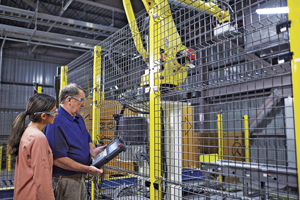
 Prescriptive maintenance programs help address these risks. By equipping machinery with sensors that monitor critical operating data like temperature, pressure and vibration, data can be fed into AI models around the clock. Once a baseline for normal operation is established, the system can quickly detect unusual behavior and flag potential issues well before they escalate into failures.
Instead of reacting to costly breakdowns, plant managers can use AI insights to proactively plan repairs and schedule downtime around limited technical resources. This reduces unplanned disruptions and supports consistent output and overall efficiency.
Redefining Workplace Safety And Ergonomics
As experienced workers retire, the manufacturing sector is undergoing rapid change. By 2033, up to 3.8 million manufacturing jobs are expected to be needed, with as many as 1.9 million potentially going unfilled. As new hires who have never worked in manufacturing enter the industry and learn how to navigate complex, fast-moving environments, safety training and monitoring become increasingly important.
To support this transition, many facilities are using AI to enhance workplace safety. By layering AI software onto existing security camera systems, AI models can be trained to recognize established safety protocols. These tools can identify situations where personnel get too close to moving equipment or are missing required personal protective equipment (PPE), like high-visibility vests.
The goal is not surveillance, but insight. For example, if an AI system detects a spike in missing high-visibility vests in a specific warehouse zone, team leaders may discover that outside delivery drivers are overlooking protocols. Plant leadership can then address the root cause without placing blame on the factory floor.
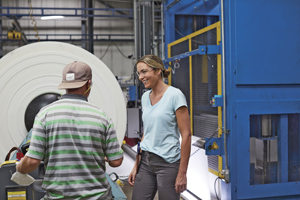 Beyond AI-supported safety monitoring, introducing robotics into material-handling operations reduces ergonomic risks associated with tasks like moving heavy rolls, loading equipment and transporting materials, helping prevent injuries while improving efficiency.
Empowering The Workforce And Weaving The Path Forward
Discussions about robotics in manufacturing often come with underlying assumptions and “automation anxiety.” However, employees who work alongside these technologies quickly see the benefits, including reduced physical strain, improved safety, and more efficient workflows.
By automating repetitive tasks like manual fabric inspections and heavy lifting, textile manufacturers can better address persistent recruiting challenges and redeploy talent to dynamic roles. AI can also help preserve institutional knowledge. Digitizing decades of operational data can help teams quickly search and reference past insights, bridging the gap between retiring experts and the next generation of workers.
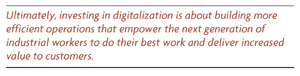
As data costs decrease and technologies continue to advance, textile manufacturers must adopt a practical test-and-learn approach to assessing new technologies. Evaluating tools on a small scale to prove their business value before broad rollouts allows teams to validate business impact and embrace adoption with confidence. Ultimately, investing in digitalization is about building more efficient operations that empower the next generation of industrial workers to do their best work and deliver increased value to customers.
Editor’s Note: Marcio Manique is executive vice president and managing director, apparel, at Milliken & Company.
2026 Quarterly Issue II