Vanity Fair Implements Plan To Improve Profitability

Vanity Fair Corp., Greensboro, N.C., announced a series of actions to position the company to
achieve its long-term earnings growth target of 8 to 10 percent. Now is the time to take a hard
look at our portfolio of businesses and our operations and determine the optimal mix for the
future, said Mackey McDonald, president and CEO.Specifically, the company plans to exit
nonstrategic workwear businesses, implement a new jeans strategy in Japan, consolidate several
distribution centers in both the United States and Europe, reorganize the Latin American jeans
business and restructure its international intimates business to improve the profitability of its
discount store locations.In conjuction with these actions, the company will take a charge to
fourth-quarter earnings of approximately $120 to $140 million, or $0.68 to $0.79 per share. The
cash requirement related to these actions is approximately $40 million.

January 2001

Product Development

 It is not likely that many textile companies have embraced the concept of product development
with more vigor than Sapona Manufacturing Company in Cedar Falls, N.C. But then, perhaps not many
companies have had to endure so much change while finding a way to remain profitable. Sapona has,
over the course of its long history, been a cotton ginning and spinning operation, a weaving
company, a silk spinner and a manufacturer of nylon hosiery yarn. On more than one occasion, the
company has had to suddenly shift gears as the proverbial rug was jerked out from under it.Perhaps
that situation goes a long way toward explaining the companys near obsession with experimentation
today. There are some days, quips Steele Redding, the companys CEO, that I think Im just in the
sample business.A typical day at Sapona finds Redding, President Dean Lail, Vice President of
Manufacturing Johnny Knowles, Plant Manager Joe Kearns, and Research and Development Manager Walt
Sweeney looking at various ways to combine new yarns, blends, textures and techniques to come up
with unusual properties that fit specific needs in the market. To determine the knitting properties
of the new products, particularly in the growing seamless market, Sapona maintains its own Santoni
SM8 circular knitting machine (See New Generations In Seamless And Sliver, ATI, October 2000).

 

Many of the experimentations undertaken by Sapona are the result of specific requests by
customers. Others, though, are for the companys own internal use in the quest to develop new yarns
and combinations.Today, the company could perhaps best be described as a solutions provider for
hosiery, seamless bodywear and other knit and woven applications. Sapona processes mid- to
fine-denier synthetic yarn, including textured nylon and covered spandex. Process options Sapona
makes available to its customers include stretch or set, false-twist texturing, package-dye tube
winding, cone winding, assembly winding, air covering, ring twisting and two-for-one twisting.
Various options of yarn type, ply, twist, air entanglement, finish and dye are
available. Joint Venture With Celanese AcetateAn example of Saponas product development
efforts can be found in the recent announcement of a joint product development effort with Celanese
Acetate. The resulting yarn, called Celanna®, is an unusual combination of cellulose acetate
air-entangled with various other fibers, resulting in enhanced physical properties and fashion
design features, Lail said.Within the Celanna brand concept, according to Lail, initial offerings
will include blends of Celanese acetate and nylon fibers. These blends, he said, will create
aesthetically pleasing knit and woven fabrics that offer comfort and performance; feel smooth
against the skin; and have a luxurious, flattering drape and a soft, fluid hand.In addition, Lail
said, Celanna is breathable and moves moisture well. The addition of nylon to the mix yields a
strong, extensible fiber that is easy to process.For extra stretch, Celanna is offered as an
air-covered yarn with spandex, Lail said. Plus, Celanna blends open new markets for acetate such as
seamless bodywear because they are washable in some constructions. Other end-use markets for
Celanna knits and wovens include softly tailored womens and mens sportswear, dresses and mens
contemporary shirts, sweater knits for men and women, and upholstery.Under agreement with Celanese
Acetate, Sapona will be the sole source for several acetate blends under the Celanna trademark.
Sapona has put forth extensive development effort and capital expenditure to produce new Celanna
quality yarns. Customized SSM high-speed precision winders are employed to air-entangle the various
blends. Sapona and Celanese are teaming up to develop yarns, fabrics and processes that will help
speed up the introduction of a broad range of new knit and woven apparel products.In addition to
the Santoni knitting machine and the SSM winders used for Celanna, Sapona also employs SSM
air-covering machines; Rieter/ICBT autodoffing texturing machines; Rieter/ICBT covering and
air-covering machines; Rieter/ICBT two-for-one twisters; and Barmag texturing and twisting
equipment. Overall, Sapona has spent more than $12 million for new equipment in the past few
years.Despite the intense quest for new products, more than 50 percent of Saponas business remains
in hosiery, and the company goes to considerable lengths to ensure the needs of those customers are
met daily.We know you are supposed to keep as little inventory as possible, Redding said. But we
have established a relationship with our customers in which they have come to rely upon us for
immediate shipment of what they need. So we try to anticipate that demand and always have product
ready. Adds Lail: As a customer-driven operation, Sapona offers same-day or next-day shipment for
stock yarns and immediate action on special orders.Obviously, knitters make up a large portion of
Saponas customer base for its products. Often, knitting mills will approach Sapona with the
opportunity to solve a specific challenge. But the company is also marketing directly to the
designer and retailer.Our objective is to get people closer to the end of the selling cycle excited
about what we are doing here, Lail said. Sapona’s HistoryKeeping people excited has been on
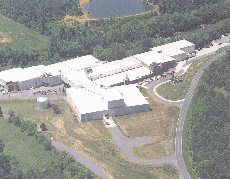
the Sapona agenda for many years. The company was the first textile plant in Randolph County, N.C.,
and among the first in the South. The original company was established by an act of the North
Carolina General Assembly on Feb. 1, 1829. Among the founders was an ancestor of current CEO Steele
Redding.The original plant was built on the north side of the Deep River. Machinery was shipped by
rail to Greensboro and hauled by horse-drawn wagons to Cedar Falls, which is a few miles from
Asheboro. Manufacturing did not begin until 1836. The current plant was completed in 1896. It was
originally a cotton-weaving plant equipped with 100 looms.During the early years, the only power
available was water power from the Deep River, which was diverted into a raceway leading under the
plant to a huge water wheel. The motion of the wheel was conveyed to the plant by a system of ropes
and pulleys that were connected to looms by leather belts.In the 1940s, weaving became unprofitable
for Sapona, and management decided to sell the looms and convert to a silk-throwing operation.
AcmeandMcCrary Hosiery Mills in Asheboro was using large quantities of silk, giving Sapona a ready
market for the new product.  
From 1936 until 1941, the use of silk by AcmeandMcCrary Hosiery increased at a rapid rate,
and the facilities were expanded to meet the growing need. Then, in August of 1941, as World War II
engulfed more and more nations, disaster struck the hosiery industry when an embargo was placed on
the importation of Japanese silk. Thus, the hosiery manufacturers were deprived of their basic raw
material.After World War II, Sapona, thanks in large part to the technical knowledge the company
had gained in nylon processing during the war, was among the first plants in the world to be
selected by DuPont to process nylon. New equipment had been purchased and plans drawn for a large
addition to the mill. This foresight was soon justified because the unique heat-setting properties
of nylon resulted in the gradual replacement of full-fashion stockings with the no-seam variety. In
the 1950s, a nylon thread was devised that was capable of stretching to twice its original length
and, in 1954, a new machine became available that combined several steps into the false-twist
method of producing stretch yarn. Using this method, Sapona developed a customer base of knitters
of socks and tights that has taken the company through to the current day. Throughout its history,
Redding said, Sapona has enjoyed a reputation of superior service and quality. The company was ISO
9002-certified in 1999.We have three specific goals, Redding said. Number one is to provide our
customers with what they need when they need it. Two is to continuously improve quality,
productivity and versatility. Three is to develop and motivate our co-workers.This past year,
Sapona enjoyed an on-time delivery rate to its customers of 99.4 percent. Less than .05 percent of
product was returned as defective.For Sapona, adds Redding, the most important thing is to remain
focused on innovation. This company has been nestled alongside the Deep River since 1836. Weve
maintained that longevity by both anticipating and adapting to the changing needs of the
marketplace. Knitters, designers and retailers can continue to look to Sapona Manufacturing for
innovative solutions that add value to their products. 

CEO Steele Redding, President Dean Lail and Vice President Johnny Knowles examine fabrics
made from new blends developed by Sapona.

January 2001

Western European Nonwovens Production Increases 8 8 Percent

According to figures released by the Belgium-based European Disposables and Nonwovens Association
(EDANA), production of nonwovens in Western Europe grew by 8.8 percent in 1999 to reach 909,800
tons. Nonwovens include unique, engineered fabrics used in such products as baby diapers, wipes,
surgical drapes, filtration, packaging, vehicle headliners, roofing and crop protection.When
measured in square meters, the percentage increase was about 10 percent with 23,238.9 million
square meters produced.In less than 10 years, the output of the Western European nonwovens industry
has doubled. Guy Massenaux, secretary general, EDANA, stated, In 2001, I expect nonwovens
production to grow again sizably.Polypropylene is the most important polymer used in the nonwovens
industry in fiber or granule form, amounting to 492,300 tons of the 909,800-ton total.EDANA
estimates the 1999 turnover in the industry to be about EUR 3600 million, showing no increase
compared with turnover in 1998.

January 2001

BTMA Recieves Award From China State Textile Industry

BTMA Receives Award From China State Textile Industry As part of its preparations prior to Chinas
anticipated accession to the World Trade Organization (WTO), the Chinese State Textile Industry
Bureau (STIB) is taking steps to improve the overall quality of its textile production in
anticipation of greater demand from overseas.As part of these preparations, STIB has extended its
award system to include not only domestic producers, but also overseas organizations that have
played a substantial and long-term part in the development of Chinas textile industry. The British
Textile Machinery Assocation (BTMA) is the first recipient of this award, which was presented to
Eric France, director, BTMA, by Chinese Minister Du Yuzhou during the Grand Meeting of the National
Conference on Textile Development, which recently took place in Shanghai.
January 2001

CeramTec Offers Custom Traverse Guides

CeramTec North America, Laurens, S.C., has introduced its custom traverse guides, which can help
improve quality and consistency in the manufacture of most fiber and yarn types. The guides, which
are made up of a ceramic guide insert molded into a body, enhance performance on most machine types
and at various take-up speeds.The guides are available in a variety of ceramic compositions and
nylon resins, including standard, conductive and toughened aluminas; and zirconias. The diversity
of materials allows frictional characteristics to be controlled through wear properties, surface
texture, hardness, grain size, dimensional tolerances and porosity.Rapid prototyping of traverse
guides is available through CeramTecs Fast Turnaround Prototype Group. The company says it can
deliver small quantities of finished prototypes for testing in as little as three to four weeks.

January 2001

National Textile Center Receives 9 75 Million Federal Grant

WILMINGTON, Del., Jan. 3 /PRNewswire/ — The National Textile Center will receive $9.75 million
from the Department of Commerce. The United States Congress recently appropriated these funds to
support university research in textiles, apparel, fibers and retailing. This is the tenth
consecutive grant to the National Textile Center to continue its mission of enhancing the knowledge
base of the US textile and related industries. The National Textile Center has over 50 active
research projects and is currently developing new projects for the increased level of funding. The
new projects will start May 1, 2001. Current projects are underway at over 20universities across
the USA and around the world. All projects not only address important industry problems, but also
provide the research topics graduate students. The new grant funds will seek to expand the research
basis to a larger number of universities. The Congress has invested over $82 million in the
far-reaching and important effort. The results have been impressive, with over $170 million in new
business and $80 million in new centers of academic. To date over 700graduate students have been
involved in the research, resulting in 134 these and numerous patents. The full research program
will be presented to the industry at the upcoming NTC Forum. The forum will be held in Myrtle
Beach, SC, February11 – 13, 2001. Complete information is available on the web
at:http://www.ntcresearch.org The National Textile Center is a university research consortium owned
and managed by six universities: Auburn University, Clemson University, Georgia Institute of
Technology, North Carolina State University, University of Massachusetts Dartmouth and Philadelphia
University. The institutions sharehuman resources, equipment and facilities. Serving the
USAFiber/Textile/Fabricated Products/Retail Complex, the NTC vision, mission andgoals are realized
through innovate research and links to other institutions. SOURCE The National Textile CenterWeb
Site: http://www.ntcresearch.org Copyright 2001 PR Newswire

ACIMIT Says Machinery Orders Fell During First Half Of Year

ACIMIT SAYS MACHINERY ORDERS FELL DURING FIRST HALF OF YEAROrders for Italian textile machinery fell sharply for a second consecutive six-month period, according to figures released by ACIMIT, the Association of Italian Textile Machinery Producers.The general index for orders has fallen by 18% compared to the same period for the previous year, ending at 87.9 points (base year 1995=100). The drop was mainly in the foreign market, where the index for orders, 83.7 points, fell by 21%. The drop in orders in the internal market was 12% and the relative index 97.5 points.”We are not only dealing with the inevitable natural downturn in the sector,” explains Dr. Alberto M. Sacchi, president of ACIMIT. “Another element which has had a negative influence on the orders received by producers is the difficult economic situation of many economies. The U.S. and Turkey, for example, important markets for Italian textile machinery, are undergoing an economic downturn. The results of this are reductions in investments in the textile industry and reductions in the purchasing of machinery. In Europe, on the other hand, there are countries to which our exports continue to grow (Spain, France, Switzerland) and markets (mainly Germany) where Italian textile machinery is struggling to repeat the successes of last year.”Sacchi says there are considerable worries about the situation in the U.S. market following the recent tragedy there. The American textile industry, already undergoing restructuring, may now be further weakened by the probable drop in consumption, already felt before the terrorist attacks in the U.S.In relation to the competitiveness of the sector, Sacchi also says “ACIMIT will continue to fight for the elimination of all the bureaucratic constraints which block extraordinary operations which can provide real added value to Italian companies in terms of competitiveness. It is increasingly necessary to provide Italian companies with valid instruments so they can compete with the international competitors in all the foreign markets. This must be ensured over the short term because in our age it is rapid change which can ensure leadership in any given market”.However, the speed of change is also subject to constant research and innovation activities. This is why ACIMIT recently signed an agreement with CPI (Consorzio Politecnico di Milano Milan Polytechnic Consortium) to put companies and research centers in contact with each other. “Often, says Sacchi, “there is nobody to bring demand and supply together. The agreement signed with CPI aims to satisfy this basic requirement. The Consortium will identify, within the Milan University field or using third-parties, the skills and know-how required to provide a solution for the technological and scientific problems of textile machinery companies.”November 2001

New Nylstar Plant Aims At NAFTA Markets

FibersBy John W. McCurry, Managing Editor New Nylstar Plant Aims At NAFTA MarketsNylon yarn facility helps boost economy in beleaguered southern Virginia. A joint venture between Rhodia and Snia, Nylstar was looking for a manufacturing platform to serve the NAFTA region when it found Amfibe in Martinsville, Va., in April 2000. A nylon monofilament plant, Amfibe was founded by a group led by manmade fiber veteran Larry McDorman and began operations in 1998.Eager to expand, Nylstar began construction of a plant now known as Amfibe 2 in August 2000 and a year later it began operations. Construction crews and equipment installers worked 16-hr days to bring the new plant online. The opening of the $50 million facility is welcome news to the Martinsville area, which has been hit hard by the closing of Tultex and layoffs in the furniture industry.The plant employs about 100 and Nylstar officials expect it to reach capacity this month. The plant is capable of producing 25 to 30 million lb/yr of nylon yarns depending on the product mix.”I commend Rhodias engineering groups ability to build a nylon facility,” says Larry McDorman, now vice of manufacturing for Nylstars U.S. operations. Products range from 15 to 220 den. The plant also produces POY and FOY 6,6 nylon.

Nylstar yarns are used in a variety of applications, including women’s intimate apparel. Meryl is Nylstars “signature” brand for its yarn products. Meryl includes several sub brands for various niche markets. Yarns made of Nylstars new Elite fiber will also be manufactured in Virginia. Nylstar says Elite gives fabrics “remarkable” hand and drape.” 

The new plant has four 20,000 sq. ft. floors with processes beginning on the top floor. Production processes began with nylon chips supplied by Nylstar facilities in Europe. Three large silos store the chips until ready for transport for extrusion into polymer. Each silo contains different lusters of chips to allow for maximum flexibility. “We can make any product on any machine,” McDorman says.Plant equipment includes the latest Barmag machines. Robotic equipment supplied by Fanuc doffs yarn and transports it to an automatic packing station.”Our customers are happy to see someone investing in new equipment in the U.S.,” McDorman says. 

There is room for expansion at Martinsville. In fact, there are tentative plans for an “Amfibe 3” plant should business conditions warrant.During the plants construction, Nylstar sent 38 production employees and nine supervisors to its European facilities for a month of training. Of the production employees, 22 came from Amfibe 1 and 16 were new hires. These employees trained all new employees.The new plant has been a blessing for some displaced textile workers in the Martinsville area. These include Alice Tucker, who spent 11 years in the cutting and sewing department at Tultex before it closed in December 1999. Tucker, who works in the inspection and packing department, says she has “found a new home at Nylstar.” Yarn produced at Martinsville finds its way into end products ranging from velcro to womens intimate apparel. Customers include weavers, warpknitters and circular knitters. Nylstar also sells POY to texturing companies.”Having a strong presence in North America allows Nylstar to participate in all these markets,” McDorman says. “A lot of our customers are insisting that yarn be NAFTA and CBI approved. We look for niches where we can compete best.”Dina Dunn, Nylstars U.S. vice president, marketing, says the company is seeing a lot of success in a difficult textile and apparel environment. “Were in a startup mode, so its been all growth for us. Weve had lots of positive comments from customers.” Dunn says Nylstar approaches business with a consumer focus, particularly in the intimate apparel and activewear markets. Seamless garments are beginning to catch on with consumers and swimwear and outerwear markets offer much potential, she says.”Were a worldwide player,” Dunn says. “We offer the advantages of sourcing on this continent. While Asia has comparable pricing, we reduce delivery time by three weeks. Mexico is all growth for us now. There is heavy competition on pricing, so we compete where we can.”We have steady business in Canada. In the U.S., brands like the Victoria Secrets and the Vanity Fares drive the business. Theres a lot of promise in all three countries.”A Quick Look At NylstarNylstar formed on Jan. 1, 1994 when French firm Rhone Poulenc (now Rhodia) and Italian company Snia Fibre (now Snia SpA) merged their fiber manufacturing operations. Nylstar produces 270 million lb/yr yarn and employs about 5,000 worldwide.In addition to Martinsville, Va., Nylstar has production facilites in:o Freiburg, Germanyo Neumunster, Germanyo Arras, Franceo Blanes, Spaino Gorzow, Polando Ying Long, Chinao Cesano/Varedo, Italyo Pisticci, ItalyOctober 2001

Great American Knitting Mills To Acquire Certain Ridgeview Assets

NEWTON, N.C., Jan. 25 /PRNewswire/ — On Friday January 19, 2001 Ridgeview entered into a letter of
intent with Great American Knitting Mills to sell certain assets, including the Ridgeview name and
other trademarks. The intent of the proposed transaction is to continue Ridgeview’s sport sock
business inthe sporting goods market and to provide the resources necessary to build thebrand going
forward. The agreement has a closing date of February 1, 2001. Ridgeview continues to operate and
meet its customers’ needs at the present time. Both companiesexpect the transition to be a smooth
one for Ridgeview’s customers. It isun clear at this point exactly what the transaction will mean
to Ridgeview’s operations. Hugh Gaither, President and CEO of Ridgeview, said, “the transaction
provides an opportunity for our Ridgeview sport sock business tocontinue in the market place.” Jim
Williams, President and CEO of Great American Knitting Mills added, “We are excited about this new
business opportunity and very encouraged by informal customer reaction to the business
combination.”SOURCE Ridgeview, Inc.Copyright 2001 PR Newswire

ITMA 2003 News

New eight-day format: Circular knitting machinery WILL be shown The first ITMA of the 21st Century
will set a precedent: it will be staged over 8 days, instead of the traditional 10.Organisers of
ITMA 2003, to be held at The National Exhibition Centre (NEC), Birmingham, England, have announced
that the show will run from October 22 to 29 inclusive. The shorter duration is in response to
feedback from both exhibitors and visitors, who want to cut down on expenditure and reduce the
out-of-office time commitment for key personnel.Another vital boost for ITMA 2003 comes with the
news that the leading circular knitting machinery manufacturers have confirmed that they WILL take
part in ITMA 2003, instead of attending another show being organised at the same time in Italy.
Their decision underlines the appeal of ITMA as the world’s premier textile machinery exhibition
for all sectors of the textile industry.Officials at The NEC venue, which will stage ITMA for the
first time in 2003, say they are delighted with these two positive announcements. Maria Avery,
Exhibition Director of the ITMA 2003 Organising Committee at The NEC stated : “Representatives of
several leading knitting machinery companies have visited The NEC recently, and have been impressed
both with the facilities and the cost-effectiveness of the overall package we can offer.”We are
pleased that this has corrected some of the unfair and unfounded criticism that has been stirred up
in some quarters, and we are delighted to welcome circular knitting machine producers as an
important exhibit group.” The NEC and Cematex – the pan-European machinery body which stages the
four-yearly ITMA shows – are also confident that the switch to the more compact, eight-day format,
will be a winner. This decision, which will apply to all future ITMAs, recognises the changing
business environment and the influence of the internet and e-mail.Maria Avery added:
“Overwhelmingly, feedback has confirmed that a 10-day show is too long. We have acted accordingly
and reduced ITMA 2003 to eight days, ensuring that the popular busy weekend is still embraced.
Significantly, eight days ensures that exhibitors do not have their personnel away from the office
for such a long period, while allowing the visitors plenty of time to see all the equipment they
are interested in. The reduced period also means reduced expenditure for both exhibitors and
visitors.”ITMA 2003 will occupy some 160,000 square metres of stand space, with an expected total
of 1,400 exhibitors from 40 countries attracting around 150,000 visitors from the world’s textile
industries. Further details can be accessed from the main ITMA website : www.itma.com and from the
dedicated hotel website : www.itmahotels.com, as well as a brand new site, www.itmatravel.com,
focusing on all aspects of transport to and at ITMA 2003.For further information contact – The ITMA
2003 Organising CommitteeThe NEC Birmingham B40 1NT England Tel – +44 121 780 2003Fax – +44 121 782
2003 email – info@itma2003.comwww.itma.com

Sponsors