WILMINGTON, Del., Jan. 18 /PRNewswire/ — DuPont Packaging and Industrial Polymers announces a 5
cent per pound increase in the price for all grades of Elvanol(R) polyvinyl alcohol (PVA/PVOH)
effective Feb. 1, 2001. This increase applies to all market segments, worldwide. DuPont cites
continued, unprecedented increases in key petrochemical raw material and energy costs as the reason
for the price increase. DuPont(TM) Elvanol(R) polyvinyl alcohol (PVA/PVOH) is used in a variety of
industries including textiles, paper and adhesives. Elvanol(R) is a registered trademark of
DuPont.SOURCE DuPont Packaging and Industrial Polymers Copyright 2001 PR Newswire
DuPont Announces PVA Price Increase
WestPoint Stevens Completes Purchase Of Chatham
WEST POINT, Ga., Jan. 5 /PR Newswire/ — WestPoint Stevens Inc. (NYSE:
WXS)(http://www.westpointstevens.com announced that it has completed the previously announced
purchase of the assets and business operations of the Chatham Consumer Products division of CMI
Industries, Inc. The closing of the transaction occurred today. “We’re delighted to acquire Chatham
because it strengthens West Point Stevens as a major resource in blankets, which is a key category
in home fashions accessories,” said David C. Meek, Executive Vice President and Chief Financial
Officer for the Company. “For WestPoint, this takes on added importance because of our expanded
licensing agreement with Ralph Lauren and our new licensing agreement with Disney.” The Chatham
Consumer Products division of CMI Industries, located inElkin, North Carolina, is a leading
manufacturer and wholesaler of woven and nonwoven blankets with estimated annual sales of $35
million. Chatham’scustomer base is diversified among mass merchants, department and specialty
stores. The Chatham acquisition is reflective of WestPoint Stevens’ Eight-PointProgram in action.
Major focuses of the program, which the Company announced last June, include continued expansion of
product offerings and extensiveexploration of new licensing opportunities. WestPoint Stevens can be
found on the World Wide Web athttp://www.westpointstevens.com . Safe Harbor Statement: Except for
historical information contained herein, certain matters set forth in this press release are
“forward lookingstatements” within the meaning of the U.S. Private Securities Litigation Reform Act
of 1995. Such forward looking statements involve certain risks anduncertainties that could cause
actual results to differ materially from those in the forward looking statements. Such risks and
uncertainties may beattributable to important factors that include but are not limited to the
following: Product margins may vary from those projected; Raw material pricesmay vary from those
assumed; Additional reserves may be required for bad debts, returns, allowances, governmental
compliance costs, or litigation;There may be changes in the performance of financial markers or
fluctuations in foreign currency exchange rates; Unanticipated natural disasters could havea
material impact upon results of operations; There may be changes in the general economic conditions
that affect customer practices or consumer spending; Competition for retail and wholesale
customers, pricing and transportation of products may vary from time to time due to seasonal
variations or otherwise; Customer preferences for our products can be affected by competition, or
general market demand for domestic or imported goods or the quantity, quality, price or delivery
time of such goods; There could be an unanticipated loss of a material customer or a material
license; The availability and price of raw materials could be affected by weather, disease,energy
costs or other factors. The Company assumes no obligation to update publicly any forward-looking
statements, whether as a result of new information, future events or otherwise. SOURCE WestPoint
Stevens Inc.Web Site: http://www.westpointstevens.com Copyright 2000 PR Newswire
Software Suppliers
Software ShowcaseBy Cosby W. Woodruff, Assistant Editor Software Suppliers Color formulation, Formulation-Master 2001, is an upgrade to Plastic-Master, Paint-Master, Ink-Master and QA-Master 2000 products for color formulation and quality assurances for coating and textiles. Features include on-screen color, networking and multiple math engines. Users can view realistic on-screen color representations, and new networking capabilities give multiple users access to a single set of calibration data and standards. X-Rite.www.x-rite.com Experiment design, Design-Ease, is an entry-level statistical software package that helps experimenters improve products and processes. Package features intuitive interface, expanded help system, variety of designs, flexibility to modify designs, graphics to simplify interpretations and evaluation capabilities. Stat-Ease.info@statease.com Design plug-in, SymmetryWorks, is for use with Adobe Illustrator software. Plug-in modules automate creation of symmetry-based designs for illustrations, wallpaper, fabrics, quilting, tilings, Web pages and other images. Plug-in features integrated live patterns and allows users to edit elements of the seed pattern with Illustrator tools. Artlandia.www.artlandia.com Illustration application, Canvas 8, integrates photo editing, page layout, presentation and Web graphics capabilities. Scripting image allows software to automate functions from downloading files from the Internet to preparing large numbers of files for printing. Software includes image-editing features and filters for textures, vector symbols, hatches and gradients. Available in Windows, Mac OS X and OS 9 versions. Deneba Software.curtis@deneba.com Texture mapping, Vision Easy Map 2.0, gives photo-realistic renderings of designs, colors, surfaces, textures and patterns. Used in Windows platform, software offers upgraded fabric and color editing and higher speeds. Presentation enables viewer to drag and drop color or fabrics onto products without any previous texture mapping experience. NedGraphics.www.idvision.com Image analysis, AxioVision Autofocus, provides documentation of microscopic examinations for material analysis and quality inspection. Software optimizes user microscopes and digital camera settings to take sharp and clear images. Software operates with reflected, transmitted and indirect light. Zeiss.www.zeiss.com/microOctober 2001
OptiMix Automatic Doffing System From San Grato
Italy-based San Grato CMT has introduced the OptiMix automatic doffing system to unload packages
from open-end frames with a minimum of doffer stops.An optimization system at the core of OptiMix
sends commands to the open-end frame to set the number of packages to be unloaded and to unload
them on the assigned chain. OptiMix operates either manually or in automatic, optimized mode.
January 2001
JPS Industries Sells Apparel Division To Private Company
JPS Industries Inc., Greenville, S.C., completed a transaction selling the assets of its apparel
division to JPS Acquisition Corp., a new, privately held company formed by two veteran textile
executives H. Doug Kingsmore and Jerry E. Turner. The sale includes its apparel manufacturing and
administrative facilities located in South Boston, Va.; Greenville, S.C.; and Laurens, S.C.; as
well as sales offices in New York City and Los Angeles.The purchase price of the assets is
approximately $27 million, with future consideration in the form of an earn-out based on earnings
before interest, depreciation and amortization, as defined, for the 24-month period immediately
following the sale.
January 2001
Oxford Industries Increases Share Repurchase Authorization
ATLANTA, Jan. 8 /PRNewswire/ — The Board of Directors of OxfordIndustries, Inc. (NYSE: OXM) today
declared a cash dividend of $.21 per share on Common Stock payable March 3, 2001 to stockholders of
record onFebruary 15, 2001. This is the 163rd consecutive quarterly cash dividendsince Oxford
became publicly-owned in 1960. The Board of Directors also issued a new stock repurchase
authorization for up to 1,000,000 shares of the company’s common stock. In accordance with the
authorization, the company expects to repurchase its shares from time to time in privately
negotiated and open market transactions. As of January 8,2001, the company had 468,227 shares
remaining in its previous 1,000,000 share authorization announced in April, 1999.
Safe Harbor Statement. This press release contains certain forward-looking statements with
respect to anticipated future results, which are subject to risks and uncertainties that could
cause actual results to differ materially from anticipated results. These risks and uncertainties
include,but are not limited to, general economic and apparel business conditions,continued retailer
and consumer acceptance of company products, and global manufacturing costs.SOURCE Oxford
Industries, Inc.Copyright 2001 PR Newswire
Fiberbuys Com Offers New Feature
FIBERBUYS.COM OFFERS NEW FEATUREFiberBuys.com announced it now offers a supplier contact feature for all products facilitating quicker, easier communication between buyers and sellers via e-mail. The feature allows buyers that have a question about a specific product to contact suppliers directly, eliminating time spent making subsequent phone calls and faxes. A clearinghouse for surplus fiber, FiberBuys.com recently partnered with Martin Color-Fi and Wellman, presenting the need to streamline communication between buyers and sellers. To utilize the supplier contact feature, customers simply log on to the FiberBuys.com Web site, click on the envelope-shaped icon adjacent to the specific product and type their question or concern in the text space provided. An e-mail is sent directly to the supplier of the designated product, enabling customers to inquire about quantity, product features and even the price of a particular product.”FiberBuys new supplier contact feature allows us to better serve our customers,” stated Patricia Liskoff, director of operations for FiberBuys.com. “By enhancing our communication capabilities, we are able to facilitate quicker, more complete service with a level of personal attention that often times is a challenge with online transactions. The supplier contact feature gives us the ability to find out what our buyers really want and to get it to them in the most efficient, effective manner.”November 2001
Laminate Faster More Competitive
Chemical TreatmentandFinishingBy William C. Smith, Consulting Editor Laminate Faster, More CompetitiveNew flat-bed laminating system uses special techniques to provide uniform bond strengths at much faster speeds.
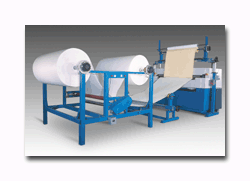
Fabrics bonded to foam have been used for many years for a variety of consumer and industrial applications to achieve bulk, soft hand, sound dampening and the like. A favorite method of bonding such fabrics has been flame laminating whereby polyester foam is passed by a flame, which literally melts the surface of the foam and a fabric immediately laid onto the melted foam and combined by pressure at the laminators nip roll. The melted foam acts as an adhesive for bonding the fabric to the foam for subsequent processing. A second pass may laminate the same or a different material on the opposite side, depending on the needs of the target end use. The process is fast, efficient and doesnt require an oven. But it has major drawbacks: The burning/melting foam produces heavy smoke and toxic fumes such as hydrogen chloride and/or cyanides which must be properly handled with ventilation and incineration or other pollution abatement equipment. Many places have banned or severely restricted further installations of flame laminating, and those in place have been forced to install expensive treatment equipment.Many other laminating systems use solvent-based adhesives, often to create a vinyl or urethane film-fabric-film sandwich, in the case of tarpaulin or signage fabrics, or two fabrics combined with an adhesive in the middle, such as for convertible tops. These solvent systems must also have the abatement equipment to handle the off-gases and by-products. Aqueous systems are available, and are successful for some applications, but for many others, they have inadequate performance properties of the laminates for the specified application or require more expensive processing techniques. New processes have been developed aimed at replacing flame laminating and solvent processing. They include the use of hot-melt adhesives, adhesive films and other non-solvent, environmentally friendly systems. These accomplish the task in many applications, but also have limitations. Slower line speeds are required for most systems, and uniform bond strength is often a problem.A new contender is on the horizon: flat-bed laminatingnot conventional flat-bed laminating, used successfully in many garment applications, but a newly developed flat-bed laminating system using special techniques that provide uniform bond strengths and speeds approaching those of flame laminating. It is more attractive economically than most systems now in use and can be competitive with flame bonding. Using separate heating and cooling chambers and a top and bottom belt transport system, with even pressure and heat through the oven, are some of the techniques that allow production at a comfortable speed of 30 mpm, up to three times the normal speed of in-place flat-bed laminators. Though flame laminating can approach 40 mpm, aside from the pollution problem, there are limitations on the types of foam or other substrates it can use. Among other things, they must be meltable. The new Bondtex flat bed laminating system can use many types of substrates, including the less expensive polyurethane or ether-based foam materials. Glenro Inc., a long-time leading supplier of process heating engineering and equipment, ovens and after-treatment equipment, fume oxidizers and now flat-bed laminating systems, acquired the Bondtex technology in the first quarter of 2001 from Textile SystemsandSupply of Los Angeles. Nick Pourmand, the Bondtex developer, has joined Glenro, designing laminating systems and working with customers on trial runs and developing specific techniques based on the end use.
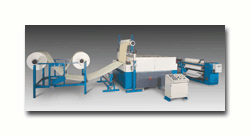
A full-scale demonstration line in Los Angeles enables customers to evaluate the new laminating system first hand.Jim Alimena, Glenro marketing manager, says the acquisition of Bondtex laminating technology provides the company a way to expand its offering to textile companies trying to add value to its products. “Many potential users of this laminating technology are already using (our) infrared and hot-air heat processing equipment. Many laminating lines require an infrared preheater to prepare the fabric for lamination. (We have) been applying infrared to fabric webs for over four decades.”Pourmand tried to work with flat bed laminating 11 years ago, importing a state-of-the-art machine to use powder bonding for textiles, leather and vinyl materials, but found it wonting. The heat and pressure was “just not right,” and he couldnt get the bonding he needed. So the machine was sent back. After 3-4 years more of working with other suppliers and trying to improve the process, he finally “found a solution.” A first step was to improve laminate bonding by heating the materials to be bonded prior to going through the oven in the transport belt. Time through the oven was too short, so he added continuous pressure to the material as it goes through the oven. But uneven heating was a concern. Pourmand found full-width top and bottom belts and multizone heating provided the uniform heating needed. But after heating and bonding, the materials have to be cooled. Most systems use a single transport belt, with a cooling section at the end, but still within the oven, thus, causing the heating and cooling cycles to “fight or compete,” resulting in having to run at slower speeds to properly bond and cool the combined materials. Thus the transport belt is heated then cooled, then heated, etc. The laminate in the Bondtex system is cooled in a separate section with an independent conveyor system. Since the same belt is not used for both heating and cooling, line speeds can be increased because the belt in the heating section does not have to be constantly brought back up to temperature. By placing the cooling unit outside the oven, with its own transport belts, speeds could be increased.Pourmand still needed more heat to further increase speeds. “One cant just increase the length of the heating chamber,” he says. “Its not cost effective.” Using infrared heaters on the substrate(s) before going into the heating was the solution. The flatbed oven doesnt have to do the melting of the adhesive used (web, film or other types) but only bonding. The infrared preheaters soften the adhesives and the two materials being bonded.
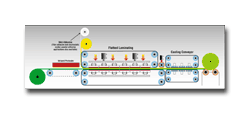
This diagram shows the components of the new flat-bed laminating system.“The primary purpose of the IR,” he says, “is to get the BTUs where you want themin the centerto heat up the surface of the substrates for introduction of adhesives.” A major reason of the success of the system is the unique use of IR technology, a Glenro specialty. Nip rolls are no longer needed in the system. Applying adjustable pressure control to the laminate, in the oven, with pneumatic cylinders on the top belt, is another key to good bonding. Others, says Pourmand, use floating flatbeds. Multizone heaters avoid edge loss. And, of course, extensive computer controls are an important key to accurate and reliable reproducibility. Each products parameters can be programmed into the computer and each run will be “exactly the same” as the previous ones.”Every good technology in the field has previously come from Europe,” says Pourmand. The Bondtex system is the only high-speed, high-end system developed and made in the U.S.Thomas Van Denend, product manager, Lamination, says, “The Bondtex system is high-performance bonding in a compact, clean process.” He points out a host of adhesives can be used, “just about anything” can be bonded. Dry adhesives store in powder, film or web form. There are no liquids involved, few regulatory concerns, little or no clean-up, quick turn-around times and often no venting requirements.Van Denend says Glenro is more solution driven rather than hardware driven. Theres a full-scale demonstration line in Los Angeles for customer evaluation. A small line at Glenros headquarters in Paterson, N.J., is being upgraded so customers can work directly with Glenro on the East Coast to run samples. EMS-Chemie, Sumter, S.C., an adhesives manufacturer, has a small lab type evaluation machine for its own trials as well as use by potential customers for trying their own products in the development process (EMS says they did blind testing and found the Bondtex machine to be the most versatile and superior in many processing areas). Glenro works with several major adhesive manufacturers to develop techniques for using their materials on the Bondtex line. The cost of “about a half million dollars” is competitive with other systems, especially considering no venting, pollution handling, regulatory or special adhesive storage problems are involved. Widths to 87 in. are available.Applications for fabrics from this system include automotive interior materials (long a critical and demanding end use for headliners and trim), medical fabric and film combinations, intimate apparel (fabric-foam-fabric combinations for bra molding, for instance), upholstery, aerospace (panel lamination for interiors of aircraft), moldable laminate panel office partitions and many more. The advantages of the machine drives development for even more demanding applications.Is this the “laminating system of the future” Only time will tell. To be sure, it is not the “do all, end all,” but, for many applications, it is superior to what is out there and may indeed replace flame lamination in many uses.
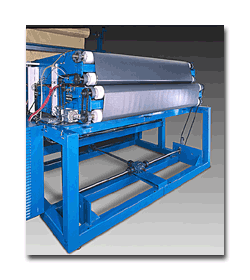
With the covers removed, you can see the inside of the exit end of the new flat-bed laminating system, which can compete with flame laminating systems.November 2001
Cotton Incorporated Reports Strong Third Quarter For Denim Bottomswear
Cotton Incorporated, New York City, reports that third-quarter 2000 unit sales of denim bottomswear
increased 6.3 percent, a 3.2-percent gain compared with the same period last year. According to the
consumer data from the NPD group, this was the strongest third-quarter gain since 1995.Both adult
denim markets were strong, with advances of 9.6 percent in the mens market and 5.6 percent in the
womens market for the quarter. Increases in the childrens markets ranged from 1.5 percent for boys
to 6.9 percent for girls.For the first nine months of the year, unit sales of denim bottomswear
grew by 5.1 percent over 1999. By age and gender, year-over-year gains in denim bottomswear ranged
from 6.3 percent in the girls market to 6.5 percent each in the mens and womens markets. Unit sales
of total bottomswear (denim and nondenim) expanded at a rate of 6.6 percent over the previous year
for the first nine months of 2000. Sales were strong in the adult market, with gains of 7.0 percent
and 7.9 percent posted by the womens and mens markets, respectively.Mass merchants, the major
retail distribution channel for denim jeans, accounted for 41.3 percent of all denim jeans sales
for the first nine months of 2000, an increase of 1.2 points compared with the same year-ago
period. National brands accounted for nearly 57 percent of all unit sales of denim jeans for the
period. By gender, national brands represented a large share; in the mens market at 65 percent and
in the womens at 50 percent.The Cotton Incorporated Lifestyle Monitor confirms that the United
States really is a denim nation owning, on average, a total of seven pairs of jeans each. American
men and women wear jeans, on average, three to four times per week.
January 2001
Shaw Shareholders Approve Acquisition
DALTON, Ga., Jan. 4 /PR Newswire/ — Shaw Industries, Inc. (NYSE: SHX),announced that at a special
meeting of shareholders held today, its shareholders approved the previously announced acquisition
of Shaw Industries,Inc. by an investor group led by Berkshire Hathaway Inc. (NYSE: brKA brKB).The
acquisition is expected to become effective on January 8, 2001. As a result, shareholders of Shaw
Industries, Inc. will receive $19.00 in cash for each share of common stock that they own at the
time of the merger. Beginning on or about January 9, 2001, shareholders of record at the effective
time of the merger will be provided with letters of transmittal for delivery of their stock
certificates to the exchange agent in order to receive the merger consideration.SOURCE Shaw
Industries, Inc.Web Site: http://www.shawinc.com Copyright 2001 PR Newswire