Barmag Wins China Contract

Germany-based Barmag AG has been awarded a contract to provide a new polyester plant in China with
two GVK 85 discharge pumps, two prepolymer pumps and a booster pump. The discharge and prepolymer
pumps are designed for discharge rates of more than 20,000 kilograms per hour. Barmag states the
GVK 85 differs from previous GVK models because it has optimized housing and new gear geometry.

November 2002

Quality Fabric Of The Month: Liquid Assets

The birth of a new product often involves collaboration among various parties in the production chain, from upstream suppliers that develop materials for downstream uses to marketers who recognize coming trends. One such product is Ge-Ray Fabrics Inc.’s Liquidity®, a new knitted fabric line made from microdenier nylon feeder yarn specially developed by BASF Corp. and textured using Unifi Inc.’s Novva™ process.

“Liquidity is a brand-new concept,” said Debra Cobb, merchandising director for Ge-Ray, New York City. “Ge-Ray has developed an entire group of fabrics for sportswear and fashion apparel, swimwear, and intimate apparel. We also see it eventually in activewear, because we are seeing activewear-influenced styling in next Spring’s fashions — silk shorts, for example. The hallmarks of Liquidity are its subtle luster and silky hand (because it is microdenier nylon) — and you can wash it.” According to Ge-Ray, the fabrics also offer affordable sophistication when compared with high-end silk jerseys.

Unifi’s Novva texturing process gives subtle luster to bright nylon or polyester yarns and allows them to remain bright — an unusual feat, according to Kim Lewis, Greensboro, N.C.-based Unifi’s director of marketing.

On first seeing the Novva yarns, Cobb recognized their unique, trendsetting possibilities and began working with Unifi and Charlotte-based BASF to come up with a yarn engineered specifically to meet Ge-Ray’s specifications for use in the new fabric. Development occurred over several months, and Liquidity was launched last spring.
qfom2_2512qfom1_2513
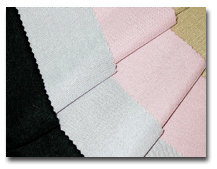
The Liquidity® fabric line includes nylon/Lycra® jerseys and ribbed knits, as well as
100-percent nylon interlock knits.


A Magical Process

Cobb described the Novva process as ”magical,” adding, “We like it on bright nylon because it allows textured brightness without losing the luster. The Novva process enables us to get the dyeing results we are looking for.

“We work closely with yarn spinners to keep up with new developments. Our strength is in taking new products and creating brands,” Cobb continued.

A vertical operation, Ge-Ray purchases the yarn and knits the fabric, then dyes and finishes it. “Ge-Ray does a big business in nylon — we are very familiar with what it can do,” Cobb added.

Cobb said apparel makers are currently sampling Liquidity. Fabrics include jerseys and ribbed knits in a range of weights and containing various amounts of Lycra®, and 100-percent nylon interlock knits. Ge-Ray also will produce fabrics according to customer specifications.


For more information about Liquidity®, contact Debra Cobb (212) 869-3400.


November 2002

Textile Issues Left On Hold

As the 107th Congress goes forward with plans to adjourn this week, it will put off until next year
action on several issues of particular importance to the textile industry. Because Congress has
been unable to act on more than a dozen appropriations bills for next year, it will pass continuing
resolutions that will keep spending for virtually all government agencies at present levels. This
leaves up in the air what the government will spend on the research programs at the National
Textile Center and T2C2. The government programs likely will be continued, but the level will have
to be determined after Congress reconvenes in January.Congress also failed to complete action on a
Miscellaneous Trade and Technical Corrections Bill that provides for suspension or reduction of
duties on four types of textile machinery used by US mills, but that are not available from
domestic sources. The machines are certain ink jet and other textile printing equipment, and some
shuttle and shuttleless power looms.The legislation also would make technical corrections that
would clarify congressional intent regarding coverage of knit-to-shape items under the Caribbean
and Sub-Sahara Africa trade preference programs. Because several senators had problems with some
provisions of the bill, it will die and have to go through the entire legislative process next
year.
November 2002

CCI Encourages Asian Apparel Makers To Use U S Cotton

CCI Encourages AsianApparel Makers To Use U.S. CottonCotton Council International (CCI),
Washington, recently brought 14 Asian apparel manufacturers to the United States to encourage them
to use U.S.-made cotton textiles in apparel produced in their plants in the Caribbean Basin. The
companies located in Korea, Hong Kong, Taiwan, Guatemala and El Salvador visited textile mills,
cotton harvesting and ginning facilities, and Cotton Incorporateds Cary, N.C.-based research
facility.The tour was organized as part of the 2002 Sourcing Caribbean Basin Initiative (CBI)
Program, which is funded by the U.S. Department of Agricultures Section 108 Program, Cotton
Incorporated and participating U.S. textile mills. Participating mills include Ameritex,
AMTEC/Tuscarora, Buhler Quality Yarns, Four Leaf Textiles, Frontier Spinning Mills,
HarrietandHenderson Yarns, National Textiles, Parkdale Mills, Ramtex, Spectrum Dyed Yarns, TNS
Mills and Swift Spinning Mills.The tour went very well, said Vaughn Jordan, CCIs international
program director and director, CBIandMexico. We definitely changed some minds. Asian manufacturers
own a majority of the apparel mills in the Caribbean Basin and have been using Asian materials in
their production. I think now well be seeing more U.S.-made cotton content in the apparel they
produce there.
November 2002

Philadelphia39 S Textile Engineering Receives Accreditation

Philadelphia’s TextileEngineering Receives AccreditationPhiladelphia University, Philadelphia, has
received accreditation for its bachelor of science degree in textile engineering from the
Engineering Accreditation Commission of the Accreditation Board for Engineering and Technology
(ABET).Textile engineering is both personally and professionally rewarding a field of engineering
where one can practice a wide range of activities that benefit society, said David Brookstein,
Sc.D., dean of the universitys School of Textiles and Materials Technology.
November 2002

SheLyn EWarna Establish Strategic Relationship

Through collaboration and pooling of development and sales and marketing resources, Greensboro,
N.C.-based SheLyn Inc. and Malaysia-based eWarna are to develop and offer color control software
solutions.In addition, talks to form a more formal link between the two companies are underway.The
two companies hope to use eWarnas Internet-based color management platform to bring SheLyns shade
sequencing and recipe prediction software to mills and retailers.By combining our strengths and
resources, we can provide our customers with the best color control solutions, said Roland
Connelly, president, SheLyn.

November 2002

Cargill Dow And Fountain Set Announce Collaboration

Fountain Set Advances Development of PLA in Apparel Minneapolis November 4, 2002 Fountain Set and
Cargill Dow have teamed up to introduce more sustainable alternatives into the apparel market. The
companies are working together to offer a line of performance fabrics from PLA fibers renewable
resource-based fibers derived from crops like corn. The companies have signed a letter of intent to
launch the fabrics into the activewear market by first quarter 2003. PLA is a melt-spinnable resin
developed by Cargill Dow. It is created through a process where simple plant sugars can be used to
create a performance fiber product. The products offer a unique blend of performance properties and
a “natural” message. “Fountain Set is dedicated to furthering the development of sustainable
products,” said Mr. C. F. Ha, chairman and managing director for Fountain Set. “With PLA fibers we
will be able to offer the industry a line of fabrics that are more sustainable and offer the
performance expected in apparel.” “Our objectives are to continue expanding our products, without
losing sight of our belief in sustainability,” said Tim Eynon, general manager – fibers for Cargill
Dow. “Our relationship with Fountain Set meets those objectives and allows us to offer the industry
natural-based performance fabrics for apparel.” “Based on our founding principles of diligence,
frugality, sincerity, and integrity we at Fountain Set continue to develop new markets and products
in order to achieve long-term growth. PLA is an ideal addition to our product line,” said Mr. Ha.
Having built a reputation for their dedication to the environment, Fountain Sets systems allow for
more sustainable processing including azo-free dyes and extensive wastewater treatment facilities.
Additionally, Forbes Global Magazine has recognized them as one of the best 200 small companies in
the world in 2002. Fountain Set (Holdings) Limited, a publicly listed company in Hong Kong and
founded in 1969 is one of the leading manufacturers and suppliers of knitted fabrics in the world
with an annual turnover in 2001 of over US$570 million and an annual fabric production capacity of
220 million pounds. The company operates with a high level of vertical integration in
manufacturing, encompassing yarn spinning, fabric knitting, sewing thread, yarn and fabric dyeing,
fabric printing and garment making. Founded in 1997, Cargill Dow LLC is based in Minnetonka, Minn.
It is the first company to offer its customers a family of polymers derived entirely from annually
renewable resources with the cost and performance necessary to compete with packaging materials and
traditional fibers. The company has achieved this breakthrough by applying its unique technology to
the processing of natural plant sugars to create a proprietary polylactide polymer (PLA).

Editor39 S Note

Editor’s NoteEditors Note: In Weaving On The Cutting Edge (October 2002), TW misstated a reference
to engineered nonwovens, rather than to engineered wovens as submitted by Fritz Legler, president,
Sulzer Textile Inc., Spartanburg. Sulzer Textil has made a major commitment to the woven technical
textile sector.
November 2002

Unifi To Use Tuntex Facility As Asian Sourcing Base

Unifi Inc., Greensboro, N.C., has formed a relationship with Thailand-based Tuntex (Thailand)
Public Co. Ltd., whereby Unifi will use the Tuntex facility as a base for sourcing Unifi yarns in
Asia. In return, Unifi will help Tuntex to expand the variety of polyester filament yarns it
currently manufactures and also to refine its textured yarn processes.The two companies will
maintain separate sales and distribution organizations, but they will cooperate to develop business
opportunities and to increase global market sales.The agreements with Tuntex will establish an
effective foothold into the market from which we can distribute high quality textured polyester
yarns, particularly to supply the needs of western companies that have already shifted production
to the region, said Mike Delaney, senior vice president, Unifi.

November 2002

Cinte Techtextil China Posts Large Exhibitor Visitor Gains

Cinte Techtextil China PostsLarge Exhibitor, Visitor GainsCinte Techtextil China 2002 has reported
a significant increase in the number of exhibitors and visitors over the 2000 exhibition.Exhibitors
numbered 214, a 75-percent gain over 2000, and included national pavilions from Austria, Belgium,
France and Germany. Visitors came from 42 countries and regions, and totaled 5,215, up 95 percent
over the previous show. More than 80 percent of the visitors came from China.
November 2002

Sponsors