
NTA Presses BushAdministration To Honor CommitmentsThe newly formed National Textile Association
(NTA), Boston, is weighing in on the issue of fair trade for U.S. textiles. At the organizations
initial annual meeting September 22, NTAs Board of Directors issued a resolution entreating the
Bush administration to fulfill each of the commitments tendered to the U.S. textile industry in
December 2001.
(See Washington Outlook, TW, January 2002.) Noting the difficulties the industry faces as
a result of trade barriers established by China, India, Pakistan, Brazil and other countries, the
resolution further calls upon Congress and the administration to deny any further liberalization of
the U.S. textile and apparel market either through legislation and/or an executive branch
decision.Formed as a result of the merger of the Northern Textile Association and the Knitted
Textile Association, NTA represents more than 200 U.S. textile producers and suppliers
(See News, TW, September 2002).
November 2002
NTA Presses Bush Administration To Honor Commitments
Organic Cotton Featured In Fashion Show Ad Campaign
The Sustainable Cotton Project (SCP), Oroville, Calif., and the San Francisco-based Academy of Art
College (AAC) recently collaborated on the Organic Cotton Collaborative Project, an effort to
educate both students and consumers on organic cotton and conventional cotton cultivation.The
project included a graduate fashion show featuring new designs made using organic cotton, as well
as A Better Feeling, an advertising campaign designed by AAC students to raise consumer awareness
of the benefits of organic cotton.We feel that ecological issues will be an integral part of design
in the future, and that organic cotton is therefore a long-term trend, not a short-term fashion
fad. We have been working with the Sustainable Cotton Project for a number of years to educate our
students about conventional cotton cultivation, but this year we chose to highlight the SCPs work
and take a position with organic cotton ourselves, said Simon Ungless, assistant director for
fashion, AAC.
November 2002
International Shows Take On New York
International Shows Take On New York
European Preview opens door for global textile shows in New York City. Early in 2000,
the organizers of Premiere Vision announced they were planning to launch European Preview, a
capsule version of the Paris apparel fabric show, in New York City. Skeptics questioned their
wisdom; fabric shows in New York had never worked. Held twice a year and now in its fifth
season, not only is European Preview a tremendous success, but it has spawned four other shows, all
happening at the same time. The last European Preview featured lines from 150 exhibitors from nine
European countries. More than 3,000 visitors attended the most recent show, looking for new fabrics
and new resources for the Fall 2003/Winter 2004 season.

More than 3,000 visitors attended the most recent European Preview show, held in July in New
York City. A year after European Preview came to New York, the first I-TexStyle show took
place. It is a joint venture of the Italian Trade Commission, MAGIC International, PratoTrade and
Sistema Moda Italia. All of the 107 exhibitors were Italian.A season ago, Turkish fabric companies
initiated the Turkish Fashion Fabric Exhibition (TFFE), featuring lines from fabric and trim
exporters. It has been organized by Istanbul Textile and Apparel Exporters Association (ITKIB).Also
picking up on the popularity of European Preview, Tencel Inc. presented fabrics from 16 Asian
customers at Innovation Asia. Not to be outdone, Austria-based Lenzing AG hosted Asian Source, an
event for a group of 14 Korean fabric companies. European PreviewThe success of European
Preview is due in part to organization, selectivity and innovation. The organizers are a
not-for-profit group with the single goal of producing a good show. A lot goes into presentation to
give the show a unified look and to aid buyers in locating fabrics and resources. A display of
exhibitors fabrics at the entrance, culled and organized into trends, gives buyers a first look at
the new season.Exhibitors are carefully screened and selected by a peer group. Standards include
quality, creativity and service. One requirement is that the exhibitors show at a major European
textile show. According to Daniel Faure, president of Premiere Vision and European Preview, there
is a waiting list to exhibit at European Preview. Most of our exhibitors have been showing since
the inception there is very little turnover. We did acquire a few spaces when some of our Italian
exhibitors dropped out to go with I-TexStyle, he said.Another requirement is that each exhibitor
must have the ability to service the American market, either via an office in the United States, a
reputable agent or the ability to follow through from its home country.The show is organized by
fabric categories. All of the shirting fabrics are in one area. There are separate sections for
wool, silk, linen, sportswear, denim and corduroy, knits, printed fabrics and laces.Italian mills
still have a major presence at European Preview, with about 35 exhibitors. Many represent the top
end of Italian textiles, such as silk weaver Mantero Seta; Loro Piana and Lanificio Luigi Botto
S.p.A., both woolen producers; Marioboselli Jersey S.p.A. and Jackytex S.p.A. in knitted fabrics;
Crespi I.F.T. S.r.l. in the linen sector; and prints from Miroglio S.p.A. and Cantoni Satilai
S.p.A.Mark Templeton, who handles menswear buying, designing and product development for the Orvis
catalog, commented on the Italian cottons with water-repellent finishes, and Scottish tartans and
twills. We did very well with kilts in our Christmas catalog. Im looking at new patterns and
textures, Templeton said.Pamela Choy, vice president, merchandising and product development, DKNY
City, liked the lightweight textured fabrics at Riopele-Niki Bosch Design, a Portugal-based company
noted for high-tech fabrics. Crinkles and stretch were of special interest.According to Peter
Ackroyd, director, National Wool Textile Export Corp., United Kingdom, there was a 45-percent
increase in visitors to the show the first day. Most of the UK exhibitors fell into the woolen
sector. Here, texture was a strong look. It ran the gamut from Shetland and Donegal tweeds to wool
seersuckers, burn-outs, dobbies and waffle weaves. Washable worsted wool twill suitings and
lighter-weight fabrics also were of note. The most popular colors were somewhat subdued with a
slightly aged look.Sheila Marks of Bill Blass commented on texture: There is so much innovation,
mixing fibers and colors to create novel textures and patterns. Fall 2003 will be a very exciting
season.In the wool sector, a new development is the blend of wool/cotton. Ottavio Crotti S.r.l.,
Italy, showed cashmere/cotton blends in jacket weights. At Ireland-based Ulster Weavers, there were
burn-outs in this blend. Carreman of France presented structured, rustic twills and
herringbones.Knitted fabrics from Austria, France, Germany, Italy, Spain and Switzerland also were
shown. Texture reigns here too, with raised patterns, dimensional effects, lacy knits and embossing
on suede.In sportswear, denim is king. There are a lot of new blends and application treatments,
including metallic patterns, flocking and plastic coating that resembles sequins. Crinkled and
pleated surfaces are another strong trend.There were 17 companies in the printed fabric category.
Romantic florals, paisleys, foulards and patchworks were shown in almost every
line.Weisbrod-Zuerrer AG, Switzerland, showed padded layers combining satin with sheers and quilted
in paisley patterns. At Bucol of France, there were Art Nouveau brocades with lamnd multicolored
embroidery. Texture turned up at Mantero in wool/silk matelass#44; crinkled sheers and uneven
printing effects.The Spring/Summer 2004 edition of European Preview will take place January 22-23,
2003. I-Tex StylePresentation was a draw to the I-TexStyle show. Major directions for the
season were illustrated by Angelo Uslenghi, consultant to Moda In, a twice-yearly show in Milan,
and Andrea DallOlio for Prato Expo. Exhibitors fabrics, organized by trend, centered the show.A lot
of the same themes shown at European Preview turned up. DallOlio mentioned surface effects, tweeds,
hairy surfaces, new denims, metallic flocking, jacquards, paisleys, double cloths, rustic laces,
velvets and cotton for winter. Uslenghi talked about wool/cotton blends, tartan flannel, tweed,
denim, smoky finishes, astro-dyes and tie-dyes, velvet and velour, felting, marls and mnges, coarse
and loose weaves, and rubberized and waxed surfaces.At Lanificio Faliero SartiandFigli S.p.A.-owned
Sartimaglie, texture is subtle in mens suiting fabrics. Blends with mohair or alpaca are woven with
slightly raised patterns. The look is tonal and classic. There are soft flannels, double-faced
brushed twills, subtle touches of sparkle, stretch wools, wool/cotton seersuckers and
cotton/cashmere knits at this firm.Rich vintage wools with luxurious hairy finishes have a warm
touch at Milior S.p.A., which showed basics in blends of cotton/wool/elastane. Picchi S.p.A.
introduced a new division called Filopuro, showing light, clean suitings. At Lanificio Lamberto
S.r.l., there are pleated double-cloths, crinkled jacquards with a vintage look, ropy Chanel-type
tweeds, mohair boucland embroidered fake leathers.Novelty knits at Lanificio Nello Gori drew a lot
of attention. Long-haired shaggy fleeces are newly patterned in swirling designs. Linea Tessile
Italiana S.p.A. showed embroidered and tie-dyed shantung wool gauze. Wool/nylon jacquards with
relief surfaces are heavily brushed. There are stretch crinkles, flocked wools and hairy
bouclhere. Turkish Fashion Fabric ExhibitionThe textile industry in Turkey represents 40
percent of the countrys total industrial production and employs about one-fifth of the total
workforce. Total exports of textiles and yarn in the first three quarters of 2001 were more than $2
billion. Slightly more than 8 percent comes to the United States.TFFE listed fabrics by category,
including knitted fabrics, color woven/shirtings, denim/corduroy, lace and embroidery, wool and
wool types, cotton/blends, linen, prints, sportswear/activewear and silk/silky aspects.Elaine
Flowers, fashion director, Dillards, shopped for fabrics at all three shows. She said the quality
and service from Turkish weavers is outstanding. We did very well with the fabric we purchased for
our private label program at this show last season, she said.Rasha Alomar and Diane Humes of
JCPenney were impressed with the professional setup of the show. There are great offerings here,
said Alomar. The suiting fabrics are of excellent quality at realistic prices, Humes
added.According to Enrico Rosati, an Italian textile consultant, a lot of the Turkish textile
companies have hired Italian stylists. They know how to play the global game, he said. It takes
know-how to make it happen. You dont learn overnight what it has taken others centuries to
achieve.Many of the Turkish exhibitors are into the total package: spinning, weaving, knitting,
dyeing, finishing and garment production. Most have new facilities with the latest state-of-the-art
equipment.Gulle Tekstil San A.S., a 30-year-old company located in Istanbul, produces ring-spun and
open-end yarns for fabrics that it knits, dyes and finishes in-house. Fabrics range from single
knits, interlocks and ribs, to fleeces, velours, terry and plaited loop fabrics.Jack Kasavi,
manager, Fabric Team USA, agent for Italteks Expo Group Tekstil San A.S., said, We think of
ourselves as the Miroglio of Turkey. Italteks is completely vertical, producing yarns through to
finished garments. The fabric range runs from sheer rayon georgette to coated stretch denim. About
15 percent of its production is sold to the United States.Yunisan Wool Industry Corp. produces
woolens and worsteds of 100-percent wool, and blends with Lycra® and man-made fibers. It uses
Australian merino wool ranging from 18.5 microns to 21.5 microns. It has an annual capacity of
about 6 million meters. Its biggest export markets are the United Kingdom, France and Spain. In the
United States, customers include Gap, Banana Republic and private labels for major stores.Francesca
De Vita, agent for Btd, said about 25 percent of its export business comes into the United States.
The mill is fully integrated. Fabrics are geared to sportswear. There are two-faced stretch
corduroys, soft finished twills, washed linens and pigment- and fiber-dyed fabrics. Another
vertical mill, Abaci Tekstil, offers immediate sampling and delivery of any order in one to three
weeks. Abaci sells blended fabrics in pant, jacket and suit weights, both printed and
solid. Tencel And LenzingAt Innovation Asia, a showcase of Asian fabrics featuring Tencel®,
Ellen Flynn, vice president, marketing, Tencel, New York City, said, This is one way we assist our
mill partners. It is an adjunct to our twice-yearly Global Fabric Fair, Denim workshops and other
events in our New York office. All of the fabrics are on view at our fabric library. Flynn said
currently, Tencel is sold up and is bringing on new capacity.

Naomi Campbell models an outfit made from Lenzing fiber.Photographed by Johannes KutzlerMills
featured at the Tencel event are from China, Hong Kong, Taiwan, Japan and Korea. All are set up for
export and produce a variety of knitted and woven fabrics in Tencel and blends for menswear,
womenswear and intimate apparel.Shinnaigai Textile Ltd., Japan, sells knitted and woven fabrics in
blends of Tencel with acrylic, polyester or silk. There are plains, twills and double-faced fabrics
for Fall. Dobby shirtings from Shinjintex Co. Ltd. and basic bottom weights from Pang Rim Co. Ltd.,
both based in Korea, are woven in 100-percent Tencel, and in blends with other natural and man-made
fabrics. Willgold Industrial Co. Ltd., Taiwan, showed Tencel blended with Lycra, linen, wool
and other natural and man-made fibers. Slubbed fabrics, prints, jacquards, denims and a variety of
weights and weaves were displayed. Chonbang Co. Ltd. and G-Vision, both Korea-based, showed at
Tencels Innovation Asia show and at Lenzings Asian Source. Chonbang is a 50-year-old company that
weaves fabrics for a wide range of end-uses. G-Vision knits fabrics for tops and intimate apparel.A
large number of the Lenzing exhibitors showed yarns and fabrics for intimate apparel. Many mills
that exhibited are vertical, and all export a major portion of their production to Europe and the
United States, a lot in garment form.Doer Enterprise Ltd. specializes in blended yarns for socks
and sweaters. Modal® is blended with wool, cashmere, mohair, alpaca and cotton. Tommy Hilfiger is
one of its customers.Victoria Pik, merchandise manager USA, Lenzing Specialty Fibers, said that in
the United States, Lenzings focus is on knitting and fabrics for the home for its fibers, Modal,
Viscose® and Lyocell®. Lenzing maintains a sales and technical services staff in North Carolina.
Lenzing is sold up and adding to its production lines.
November 2002
Trouble With Plastic
T
he consumer has been the one bright spot in the shrinking economy. However, massive
layoffs and dealing with bulging credit card debt are beginning to have their effect. Mills were
producing against orders earlier this summer as a result of retailers replenishing inventories. Low
interest rates helped to spur consumer spending on new cars and homes. However, it seems the
consumer has been tapped out. Data released by the Department of Commerce indicate consumer
spending has taken a downturn. Even Wal-Mart has lowered its sales forecasts for the next quarter.
As a spinner explained, “Our business just hit a wall.” Another sales executive said, “There
is an awful lot of indecision. There is no clarity as to where our business is headed.” This
retreat by the consumer has affected all segments of manufacturing, as reflected by the decline in
the Purchasing Managers’ Index for the month of September.
Margins continue to be squeezed by retailers demanding deep price cuts that are ultimately
passed on to the spinner. As one textile executive said, “The American consumer wants cheap stuff
and they don’t care where it comes from.”
Several spinners reported they were not going to chase unprofitable business and planned to
trim some capacity in this quarter. A return to profitability does not seem to be in the cards
anytime soon for many spinners.
Report Receives Mixed Reviews
Secretary of Commerce Donald Evans just released a 20-page report to the Congressional
Textile Caucus detailing what the Bush administration has been doing to help the industry. The
report outlines efforts in a number of areas including trade agreements, market access and
compliance.
Spinners gave this report very mixed reviews. The CEO of one company said, “They want a pat
on the back for enforcing the rules.” Another spinner complained, “The export markets that have
been closed to us are still closed.” Another contended, “This report is nothing but political — how
many mills have closed since they started the working group?”
Others were more optimistic. A vice president of manufacturing indicated, “At least this is
a beginning.” One executive said, “These commerce officials are meeting with us and listening to us
— a big improvement from past administrations.” One executive said, “This is a work in progress —
if we want to remain a priority, we’ve got to keep the pressure on them.” Good idea!
Politicians Invited To The Party
September and October have been busy months for textile trade and professional association
meetings. A number of these associations have striven to remain nonpolitical in nature. However, a
resounding theme at recent meetings includes inviting key politicians at the state and federal
levels to attend as special guests or featured speakers.
The industry has long recognized that a central cause of job losses and plant closings has
been international trade practices such as currency manipulation and transshipments. The message
seems to be reaching members of the legislature and administration that are in a position to help
the beleaguered industry.
For example, Grant Aldonas, undersecretary of commerce for international trade, was a
speaker at the annual meeting of the American Yarn Spinners Association (AYSA). Aldonas told AYSA
members the media has portrayed the textile industry as being practically dead. He said senior Bush
administration officials were shocked to learn textiles are still the largest employer in
manufacturing. Exposure to the leadership of the industry as a result of this type of meeting has
helped Aldonas and his agency realize the importance of textiles to the economy. Several spinners
in attendance said they were cautiously optimistic about the future support from the Bush
administration as a result of the opportunity to meet with Aldonas.
Many spinners said special attention should be given to members of state legislative
delegations at future textile association meetings. Textile-producing states are facing a severe
budget crisis. As a result, their legislatures will be looking for additional or new sources of
recurring revenue. These politicians must develop legislation to replenish depleted unemployment
insurance funds through additional payroll taxes.
As one spinner put it, “For the industry to be heard, now is the time to invite politicians
to the party!”
November 2002
Nilit Develops New Sensil Yarn
Nilit Ltd., Israel, has launched Sensil Cupelle, the latest addition to its line of specialty,
multi-purpose polyamide microfiber yarns for use in a variety of markets from intimates to
activewear. The new yarn achieves two distinct colors in one regular dyeing process.Sensil Cupelle
was developed to meet customer demand for high-fashion, bicolor products following the success of
the tone-to-tone dye effect from Sensil Colorwise, said Molly Kremidas, merchandising manager.
November 2002
Fibers Du Monde To Represent Fisipe39 S Acrylic Fibers
Portugal-based Fisipe is to introduce its line of acrylic fibers to Canadian and U.S. markets
through its new agent, Fibers du Monde, based in New York City and Charlotte.Fisipe offers a range
of acrylic fibers including Courtelle® specialties for apparel end-uses: Courtelle Flat, Courtelle
Sun, Courtelle with Teflon® and Courtelle Mat as well as Dolanit for technical
applications.Currently, Fisipe has plants in Portugal and Spain, which have a combined annual
capacity of 250 million pounds.
November 2002
USTR Outlines Plans For A Free Trade Area Of The Americas
I
n a move that could have far-reaching implications for the textile industry, U.S. Trade
Representative (USTR) Robert Zoellick has outlined plans to negotiate a Free Trade Area of the
Americas (FTAA) by January 2005. The plan has the guarded support of textile manufacturers and
importers, but they warn that “the devil is in the details.” In letters to members of Congress,
Zoellick laid out the broad outlines of the U.S. negotiating position, which calls for eventual
elimination of tariffs and non-tariff barriers between countries in the Western Hemisphere. The
plan calls for “fully reciprocal access to markets within the hemisphere for textiles and apparel
products.”
Without getting into specifics, the plan is to seek rules of origin that would be designed
to prevent circumvention and transshipments from countries outside the hemisphere. The U.S. textile
industry will seek rules of origin similar to those in the North American Free Trade Agreement
(NAFTA) and the recently enacted Caribbean Basin accord.
Zoellick also said the agreement must safeguard the rights of the United States to invoke
its anti-dumping and countervailing duty laws that are designed to counteract unfair trade
practices. He also said the nations of the hemisphere must seek ways to protect intellectual
property – the designs and patents – of manufacturers.
Zoellick told congressional leaders the administration intends to enter into free trade
negotiations with Morocco and the five nations of Central America, and to pursue the “final stages”
of ongoing free trade negotiations with Singapore and Chile. Trade officials believe the Chilean
pact can be completed by the end of this year.
In announcing his plans, Zoellick said the FTAA negotiations offer the United States “an
opportunity to lead the Americas toward stable and continuing economic growth, improved living
standards, and higher paying jobs in all FTAA countries.”
Administration Slaps Bangladesh For Overshipping Apparel
The Bush administration appears to be living up to its commitment to enforce textile trade
agreements, as it has hit Bangladesh with some pretty harsh trade sanctions for exceeding its
apparel import quota. When Bangladesh overshipped its quota by 175,000 dozen pairs of cotton
trousers last summer, the Customs Service embargoed the goods, and they have been sitting in
warehouses since July 26. Major retailers who had ordered the trousers appealed to the government
to release them in time for Christmas sales, but the U.S. textile industry and its supporters in
Congress insisted that Bangladesh not be rewarded for exceeding its quota.
The U.S. government finally reached a compromise that has made everyone reasonably happy.
The goods will be permitted to enter the country, but next year’s quota for cotton trousers will be
reduced by three times the amount of illegal shipments this year. Eric Autor, the National Retail
Federation’s international trade vice president, said retailers are satisfied with the compromise,
since their main interest was in getting the goods they had been counting on for Christmas. Parks
Shackelford, president of the American Textile Manufacturers Institute (ATMI), said that while
overshipments cannot be tolerated, the compromise is satisfactory under the circumstances.
Government trade officials say this is a one-time deal and it should not set any precedent.
Textile Working Group’s Progress
Textile international trade experts believe the U.S. government is making some progress in
addressing the economic woes of the textile industry, but they feel there still is a long way to
go. It is clear that thanks to the work of the Congressional Textile Caucus, the industry has the
ear and support of Commerce Secretary Donald Evans, and a dedicated and smart worker in James C.
Leonard, assistant secretary of commerce for textiles, apparel and consumer products.
Leonard, a veteran of some 30 years of textile trade wars, told Washington reporters, “This
is the first time I have seen such strong evidence that the government is being responsive to the
needs of the textile industry.” In spite of the commitments, however, many questions remain as to
what actually can be accomplished. Most industry experts feel it is too soon to tell, and they will
continue to press for more results.
A report given to the Congressional Textile Caucus by the interagency Textile Working Group
– established last December to address international trade and economic issues – outlines progress
to date in dealing with such problems as trade agreements, market access, illegal transshipments,
export expansion and trade adjustment assistance for workers who lose their jobs as a result of
imports. The working group said its mission is to “ensure that U.S. textile concerns are reflected
in the administration of our current trade agreements and in negotiations of new agreements,
especially to open foreign markets for our textile and apparel products.”
The working group cited the following accomplishments to date:
• The government has successfully resisted demands in the World Trade
Organization (WTO) by some developing countries to accelerate the removal of textile quotas now
planned by January 2005.
• U.S. Customs has stopped $300 million in illegal trade involving 162
factories that have been closed down.
• Work is underway with 25 countries to get them to follow through on
their commitments to reduce tariffs and non-tariff barriers to trade.
• The Commerce Department has added 11 trade promotion events to its
already existing calendar of trade shows it supports and offers to help U.S. companies participate.
• In ongoing trade negotiations, the U.S. government is resisting efforts
to weaken its ability to enforce anti-dumping and countervailing duty laws.
November 2002
Ciba Introduces Irgasurf Polyolefin Fiber Additive
Switzerland-based Ciba Specialty Chemicals Inc. has developed Irgasurf HL 560, a hydrophilic
additive for polyolefin fibers and nonwovens, as an alternative to a topical finish.When added to
the polymer during extrusion, Irgasurf modifies the surface of the extruded polymer to give a
durable, wettable surface. Such a surface results in a more absorbent fiber, increases antistatic
properties and reduces friction, according to Ciba.
November 2002
The Economy Is Holding Up
C
oncerns about a double-dip recession – and its impact on overall sales and ultimately the
textile industry – seem to be overdone. To be sure, the gross domestic product (GDP) isn’t
advancing at the robust rate of the late 1990s. But it’s important to remember these earlier rates
were unsustainably high.
More important, there’s still an imposing array of plus factors buttressing the economy.
These include: low inflation (less than 2-percent annual rate); rising real incomes (now running
close to 5 percent above a year ago); high home prices (enough to funnel $100 million into buyers’
hands over the past six months); near-record-low interest rates; and still-rising productivity.
Upshot: most business analysts remain quite optimistic. A new survey by the National
Association for Business Economics (NABE) predicts a 3-percent annual growth rate for the last six
months of 2002. And for the next year, NABE forecasters see an even better 3.4-percent overall
advance.
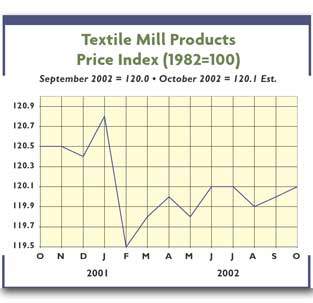
Fabric Markets Look A Bit Firmer
The improving macro picture is beginning to be reflected in some fabric sectors. Textile
purchasing executives are pretty consistently reporting modest gains in new orders and production
schedules. As for more specific trends, corduroy is looking quite buoyant – particularly in light
fabrics and materials going into sportswear.
Indeed, some corduroy people feel their fabric could even make inroads into denim markets.
Elsewhere, the trend towards a tailored look should help fabrics earmarked for suits. And DuPont
hopes to see gains from the introduction of its new, soft, drapey Sorona® stretch fabric. The
company feels this new product has great potential – given its soft hand, stretch-with-recovery and
dyeability qualities. DuPont also sees improvement in nylon going into both flooring and automotive
polymers. Lyocell fibers also are moving a lot better these days.
Productivity Gains Also Help
Some further comments on still-improving textile efficiency also are in order. The
substantial gains racked up here can perhaps best be appreciated by comparing recent changes in
output and employment. Over the past year, mill production has edged ahead about 2 percent. But
mill employment has declined by almost 9 percent. Implications: output per worker is running better
than 10 percent ahead of a year ago.
Even if you knock the number down by a few percentage points because of a longer mill work
week and possible statistical errors, it’s still an impressive increase. It’s a pretty strong
indication mills are succeeding in their efforts to keep labor costs down and hence survive in
today’s increasingly competitive markets.
Profits Look A Bit Better, Too
Latest mill profit reports also suggest cautious optimism. New second-quarter Commerce
Department figures show after-tax profits per dollar of sales coming to 3.6 percent – a lot better
than the 0.2- and 0.7-percent readings of the previous quarter and year earlier, respectively. A
similar picture is seen for profits per dollar of stockholder equity. Here, the second quarter
figure comes to 13.0 percent. That compares to the 0.8- and 2.6-percent levels of the previous
quarter and year earlier. In short, the industry is managing to keep its head above water – with
preliminary indications suggesting these modest after-tax figures will persist for at least the
remainder of the year.
DRI-WEFA, a major economic consulting firm, also sees this trend continuing beyond year-end
– with profits holding near current levels through 2003. Go further out into the future, and the
outlook continues to be fairly bright – with a slow upcreep seen through the rest of the decade.
Indeed, by the year 2011, DRI-WEFA analysts see textile mills’ gross profits rising about 16
percent above this year’s estimated levels.
A Look At Long-Term Sales
DRI-WEFA doesn’t seem all that negative about the textile industry’s long-term sales
outlook, either. In any event, the big drop of recent years seems over. In fact, despite increasing
global competition, textile mill revenues are expected to remain near current levels through the
foreseeable future.
And, if you zero in on the carpet and rug sector, the outlook seems to be quite rosy.
DRI-WEFA is predicting significant advances in sales here – from an estimated $14.5 billion this
year, to more than $18 billion by the end of the decade – a gain of nearly 25 percent. The outlook
for apparel also seems far from disastrous – with only minimal further declines anticipated over
the next five to 10 years.
November 2002
El Salvador Means Business
El Salvador Means Business
El Salvador establishes business-friendly environment and leadership role in Central America
thanks to peace, democracy and pro-development policies. With a population of 6.2 million
and borders with Guatemala, Honduras and the Pacific Ocean, El Salvador is the smallest Central
American country slightly smaller than the state of Massachusetts. A model of democracy and
conflict resolution, El Salvador has held democratic elections since 1989. It resolved 12 years of
civil war in 1992, when the government and leftist rebels achieved peace based on military and
political reforms. In developing a transparent democracy, the president is elected in open popular
elections to a five-year term, with term limits, while the Legislative Assemblys 84 members are
elected to serve three-year terms.Since the first elections in 1989, the Salvadorans have focused
strategically on stabilizing their economy, reforming economic and monetary policy, reorganizing
the regulation and deregulation of critical infrastructure all while reducing poverty, and
increasing education opportunities and health initiatives. On January 1, 2001, El Salvador
dollarized its economy. The U.S. dollar circulates throughout the country along with the Salvadoran
colon. Currently, 60 percent of circulating notes are dollars, and the dollar is the unit of
account throughout the financial system. This step has increased the ease of accounting with direct
investors in El Salvador and reduced interest rates by eliminating currency risks.
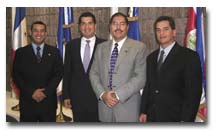
Left to right: Juan Zepeda, senior investment advisor, PROESA; Mauricio Infante, general
director, PROESA; Ing. Luis Arturo Anleu, executive director, Salvadoran Association of Apparel
Manufacturers (ASIC); and Carlos Pola, secretary, ASIC Textile ProspectsIn the minds of
Salvadorans, the opportunities for U.S. textiles are twofold: to increase the flow and availability
of U.S. yarn and fabrics to facilitate Caribbean Basin Trade Partnership Act (CBTPA)-compliant
apparel for export to the United States; and to attract U.S. manufacturers to establish facilities
for yarn, knitting, weaving, dyeing, printing and finishing operations within El Salvador to
support long-term growth. Apparel manufacturing continues to grow and attract investment from
around the world. PROESA, El Salvadors investment promotion agency, headed by the countrys Vice
President Carlos Quintanilla Schmidt, has brought to bear a very aggressive plan that pursues
economic development in five areas: agribusiness; call centers; electronics; manufacturing; and
textiles and apparel.Each of these areas takes advantage of pro-investment laws ranging from free
movement, transfer and repatriation of capital, to free trade zone laws with tax exemptions and no
export taxes. The programs focus on job creation and the productivity of the countrys labor force.
The extensiveness of the plan, and El Salvadors success thus far, provide insight into the
thoughtful, long-term nature of the plan, which has led to the second-largest gross domestic
product (GDP) growth rate in Latin America in the 1990s, while maintaining low interest rates and
low inflation. Hilasal: Value-Added TowelsTextile operations in El Salvador are not new,
explained Ricardo Sagrera, chairman and CEO of Hilasal and Export Salva Free Zone. Hilasal, founded
in 1942, established its boutique approach in 1975. As purportedly the fourth-largest towel
manufacturer in North America, including Hilasals Mexican facility, the company takes a value-added
approach utilizing dyeing, printing and embroidery techniques.Known for vividly printed towels with
near-photographic resolution, the operation manufactures the Hilasal line, promotional products and
licensees production. The Hilasal El Salvador facility features Rieter equipment from opening
through open-end spinning. The weave room uses Sulzer Ruti rapiers. The finishing department
includes a Benninger wash range. Beyond the dyehouse, Johannes Zimmer flat-bed printing is used.
The two vertical manufacturing operations, with 800 employees, start with cotton and take toweling
into the marketplace, generating approximately $90 million in sales and export levels of 98
percent. Five apparel plants, with a sixth opening soon, started with robes and wraps using Hilasal
toweling. The plants now employ 2,000 Salvadorans. Hilasal Apparel Group offers apparel contracting
and full-package services to clients such as Tommy Hilfiger, Calvin Klein, Sara Lee, JCPenney,
Wal-Mart, Sears and Target.Real-estate development also has been part of Sagreras success. His
development of Export Salva Free Zone is one of 16 free trade zones in El Salvador. Beyond real
estate, Sagrera offers legal, labor and management support services to facilitate start-ups and
dedicated plants. St. Jack’s: Vertical AppealThis global work is tough work, remarked Rolando
Jorge Sim#44; president, Industrias St. Jacks S.A. de C.V. Established 28 years ago with 21
employees, St. Jacks today is a vertical operation that knits, dyes, finishes and prints; cuts,
sews and packages; and distributes mens, womens and childrens garments. St. Jacks has its own brand
and a full design staff, and operates 65 retail stores throughout Central America. St. Jacks also
produces garments for brands such as Tommy Hilfiger and Gloria Vanderbilt. A Disney licensee for
almost 20 years, the company has grown dramatically. Simsees the firm as a manufacturer, retailer
and distributor that now employs 2,500 and is poised to grow. Our strength is our weakness, said
Sim#44; referring to the fact that being a vertical company is an important advantage, but a few
years ago it was hard trying to be efficient and competitive in so many different areas. St. Jacks
uses U.S. yarn from notable U.S. firms, recently utilizing GSM 102, a U.S. Department of
Agriculture program that facilitates credit and extends terms of 180 days to approved firms that
purchase U.S. cotton yarn.Simpointed out that St. Jacks even grew during the civil war of the
1980s, doubling sales every three years. In 1996, a big expansion occurred that took the company
from 700 to 1,500 employees. Employees are Sims secret hard-working, smart and good with
technology, he said. Investment in the latest technology has not been shy either. St. Jacks focus
on efficient vertical integration is apparent throughout the operation. High-Value ApparelSome
recent foreign investors in El Salvador have met with frustration finding the right fabrics at the
right price to leverage the valuable time savings of producing in El Salvador versus in Asia. This
situation makes it difficult to take advantage of export agreements with the United States
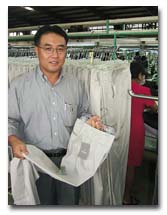
James Kim, managing director, Doall Enterprises, with Liz Claiborne slacksJames Kim, managing
director, Doall Enterprises S.A. de C.V., with offices also in New York City, manufactures high-end
mens and womens suits in El Salvador for the likes of Liz Claiborne. In 1991, Kim was poised to
invest in an alternative Central American country. After making a trip to El Salvador and
consulting with business associates, he launched his new business in El Salvador. Kims first
plant started with 200 people in training and grew to employ 600 after the first month of
operation. His second operation opened one year later, employing another 600 people. In 1993, Kim
opened another factory employing 1,500, focusing that operation on mens suits. Kims New York City
operation keeps him close to the customer. As a full-package producer, he makes the purchasing
decisions and coordinates operations through New York City. Fabrics are selected from sources
around the world, including wools from Italy and the United States. Kim expressed concern over
availability of styles and the sourcing headaches associated with the purchasing decision of using
imported goods versus U.S.-manufactured products. Kim also is managing director of a new free zone
Zona Franca Santa Tecla which will feature 10 industrial buildings with services.On August 15th,
Partex Apparel Group (Partex) inaugurated its state-of-the-art cut-and-sew plant with 500
employees. The plant, located on the outskirts of San Salvador, produces highly embellished
athletic uniforms catering to high-profile licensees of the major professional and collegiate
sports leagues.Juan Zighelboim, CEO and founder, introduced the company to El Salvador back in
1993. For a company that produces 75,000 garments per week using 90 percent U.S. and 10 percent
regionally knitted fabrics, increased access, speed and/or local production of fabrics is
essential. Zighelboim compliments the efforts being made by U.S. textile mills to reduce lead
times. The regions capacities are limited, but he points to a concerted drive to bolster local
output. According to Zighelboim, a better balance of raw materials supplied to CBPTA full-package
makers will enhance the regions ability to compete with Asia. Cutting SolutionsMark Moon,
general manager, Central American Cutting Center S.A. de C.V., located in the Miramar Free Zone,
and member of the Argus Group, stated, Quick response is the answer for [competition with] China.
Consignment goods from the United States, stock and hold in El Salvador the security in El Salvador
supports that. Moon, from Miami, with 18 years of experience in Central America, stated his
selection was largely based on El Salvadors economic atmosphere, supportive government, education
availability, and steady growth, including the dollarization of the country.A tour of the facility
shows a custom-built facility in the shape of an inverted V. The 33,000-square-foot (ft2) left wing
is dedicated to cutting knits and has capacity for more than 200,000 dozen tubular knits per week.
The right wing, also 33,000 ft2, is dedicated to cutting wovens, with capacity for more than
500,000 units per week. Joining the two rooms at the point is a 26,000-ft2 warehouse that handles
the movement of goods in and out of the facility. Leveraging the high level of infrastructure at
Miramar, the company uses Electronic Data Interchange (EDI) with its fabric suppliers, and the
operations information is open to clients so they can determine the location and status of their
orders. Much of the fabric on the floor comes from prominent U.S. suppliers, but Moon expressed
that more is needed and time is of the essence. Currently in the process of relocating the companys
corporate offices from Miami to El Salvador, the Argus Group has made a solid commitment. These are
remarkable people, Moon commented, as he relayed the story that during the time he was establishing
the cutting center, three days after a major earthquake, 95 percent of employees had returned to
work nationwide a remarkable testament to the work ethic and the importance of jobs in the
Salvadoran society. Support ServicesSupport for apparel services is right around the corner in
the Miramar Free Zone, due to the establishment of JUKI Central America S.A. de C.V., a Japanese
manufacturer of sewing machinery. Discussing the selection of El Salvador, Katsumi Nihei,
president, echoed many interviewed, pointing to the ease of establishing and running a facility,
and new benefits such as a unified customs program, by which El Salvador has streamlined customs
clearing in port in Guatemala, so materials can move efficiently across borders. JUKI established
its presence to provide a regional service and distribution center for Central America that
supports the regional growth of the apparel industry. Nihei explained that after the Mexican boom
of 1993, the focus changed in 1997, with Central America dramatically gaining share. Selling
machines, providing technical service, and offering management and factory management seminars have
provided ample opportunities for JUKI to support the growth in Salvadoran apparel production. Nihei
pointed to the Salvadoran government and tax incentives; the lack of currency volatility and ease
of financial reporting using the U.S. dollar; the infrastructure improvements of transportation,
banking and telecommunications; the people; and the foreigner-friendly nature of El Salvador all as
reasons to invest. Support business for apparel manufacturing, such as distribution of thread by
many U.S. brands, and services such as garment printing are growing areas for
entrepreneurs.Josodrez, general manager, Techno Screen, explained the need for support services.
Having printing capacity of more than 560,000 pieces per month and employing 155 people on one
shift, Techno Screen uses an array of automatic screen-printing machines by MHM and Schenk to print
pre-cut garment pieces and finished garments using plastisols and special-effect pigments. Five of
the MHM machines feature 16 stations with 14-color capability. Rodrez explained 98 percent of the
production is for export clients and that the business success is tied to providing a quality
product and having the highest level of regard for working conditions and wage levels. It is
apparent at Techno Screen and at the other locations visited that, in order for the country to grow
as a provider, the work environment in El Salvador must meet or exceed local expectations in order
to ensure the economic development within the country and also to meet the scrutiny of export
clients. Social EffectsEl Salvadors 91,000 textile industry workers only a portion of the
labor force of nearly 3 million have minimum wage levels of 60 cents per hour and a standardized
work week. Industry leaders consistently speak of the work ethic, lack of absenteeism and sense of
community that has been established with new business initiatives. The free zone areas provide
services ranging from health, recreation, banking and retail to population centers in their regions
and also augment local services. From 1980 to 2000, illiteracy has dropped from 31.5 percent to
15.1 percent, and extreme poverty has been reduced from 33.1 percent to 15.8 percent although this
rate is thought to have risen temporarily because of earthquake activity in 2001. Electricity
coverage has increased from 69.6 percent in 1992 to 84.5 percent in 2000. Potable water, 45.8
percent in 1992, reached 66 percent coverage in 2000. Telephones per person have more than tripled,
from 3.5 per 100 people in 1992 to 12 per 100 in 2000.El Salvador continues to meet the challenge
of a changing world by embracing a coherent vision for the growth and prosperity of the nation and
Central America and, on a larger scale, for a healthy relationship with the United States and the
Western Hemisphere. Having a transparent democracy, an ethical business and government culture free
of the conditions for bribes, and established policies of reform as PROESA says El Salvador
works. Free Zones Growing RapidlyIn 1974, the first free zone was established in El Salvador
with 100-percent governmental administration. In 1986, the law was modified to allow private
entities to participate, and in 1991, the first private free zone opened. The last 10 years have
seen considerable growth, with seven zones opening in 2001 alone. Today, there are 16 zones in
total.Under the Industrial and Commercial Free Zone Law, the following incentives are
offered:100-percent income tax exemption;100-percent value-added tax exemption;100-percent
municipal tax exemption;no taxes on capital gains;duty-free import of machinery and equipment, raw
material, and intermediate goods;minimal registration procedures;no limits on foreign capital;full
currency convertibility; andno double taxation.The free zone structure typically creates options
for investors by providing the following:on-site customs office;employee pre-selection;on-site
company clinic and shopping centers;machine and spare-parts vendors;24-hour security;on-site
pension fund managers;managerial consulting;training centers;cafand executive restaurants;
andsports facilities.In addition, many free zone developers build to suit, are invested in the
industry and act as a resource for new tenants. PROESA: Vital Link Among Government, Business
And InvestmentEstablished in 2000 by the Salvadoran government, PROESA is El Salvadors investment
promotion agency, charged with providing potential investors with information and services
necessary for establishing and maintaining successful businesses. Carlos Quintanilla Schmidt, vice
president of El Salvador, serves as the head of PROESA.Mauricio Infante, general director, makes
the message clear, stating that the combination of proactive governmental policies targeted at
reforming, stabilizing and streamlining El Salvadors infrastructure and economy create tremendous
opportunities. Leveraging the countrys economic performance, dedication to free-trade agreements
and infrastructure improvements; focusing on quality jobs, education and training programs;
recognizing El Salvadors strategic location in Central America; and providing progressive fiscal
incentives all differentiate El Salvador from other emerging economies.As one observer commented,
It is said in many countries you need a friend to do business in El Salvador, that friend is
PROESA. The recently created National Investment Office (ONI) has been established as a one-stop
clearing house that allows foreign investors to clear all legal requirements for the establishment
of businesses within seven days down from up to 400 days in the past.The Export Electronic System
(SIEX) was established as an on-line system enabling El Salvador to issue export permits within 45
minutes. El Salvadors 24-hour self-clearing and auto-liquidation process the first customs system
in Latin America to meet ISO 9000 standards clears goods and primary products used for production
in two hours.Consider El Salvador as a place to do business, stated Schmidt regarding textile
investment, and in the end, you will find a government committed to supporting private-sector
companies, good labor, good business climate, and obviously the stability the use of the dollar. We
have done our homework, and El Salvador is ready to produce.
November 2002



