Dornier AirGuide Offers Contact-Free Guidance

Dornier
AirGuide Offers Contact-Free GuidanceLindauer Dornier GmbH, Germany, has developed the AirGuide, a
contact-free solution to guide mechanical elements. The device can be retrofitted on Dorniers
P-type rigid rapier weaving machines. The AirGuide directs air to the rapier rod through a guide
plate that replaces conventional ball bearing guide rollers. A temperature monitor allows for
automatic shutdown of mechanical filling insertion systems in case of heat build-up. The air guide
cools the rod, reducing friction and increasing lubrication intervals, according to the company.
Other benefits include reduced maintenance costs, increased service life, improved efficiency, a
self-cleaning effect that enables weaving of clean fabrics and fail-safe features.Older rapier
machines also can be retrofitted with the AirGuide.
July 2003

Enzyme Could Help Break Down Hydrogen Peroxide

A catalase enzyme recently discovered by scientists at the US Department of Energys National
Engineering and Environmental Laboratory (INEEL), Idaho Falls, Idaho, could reduce the harmful
effects of industrial bleaching process wastewater on the environment. The new enzyme is able to
chemically change hydrogen peroxide often used in industrial bleaching processes into water and
oxygen.Taken from the Thermus brockianus microbe found in a hot springs pool at Yellowstone
National Park, the catalase thrives in a high-pH and high-temperature environment, and so works
well in hot, alkaline process wastewater.High-temperature stability makes this enzyme potentially
viable and economically attractive for industrial applications, said William Apel, INEEL. This new
catalase [lasts] for days, where the typical performance limit of many industrial-use enzymes is a
mere 10 hours.

July 2003

Cotton Incorporated Offers CDs Cosponsors Cotton Days

Cotton Incorporated Offers CDs, Cosponsors Cotton DaysCotton Incorporateds New York City-based
Consumer Marketing Division has launched an interactive series of educational programs covering
knitting, weaving, and dyeing and finishing processes. The five programs, available on CD-ROM, are
funded in part by the Importer Support Program of the Cotton Board.

Cotton Incorporateds The Art of Knitting is part of a series of interactive educational
programs covering textile basics. Developed for sourcing professionals, the series illustrates the
transformation of raw cotton to fabric. Presentations include actual manufacturing operations, 3-D
animations, technical illustrations and a glossary of terms. The first two programs, The Art of
Knitting and The Science of Dyeing and Finishing, are now available. The Art of Weaving, Color
Science and The Art of Printing will be introduced later this year and in early 2004.In other news,
Cotton Incorporated and the Washington-based Cotton Council International (CCI) joined forces to
sponsor Cotton Days, a week of celebrations in Osaka, Japan; Seoul, South Korea; and Taipei,
Taiwan, designed to promote US cotton and Cotton USA licensee textile products in Asia.The event
first took place in 1995 in Japan with support from the Japan Spinners Association. That first
Cotton Day promoted Japanese cotton textiles and celebrated casual Fridays in the corporate
workplace. Cotton Incorporated and CCI later expanded the celebrations, bringing Cotton Day to
Taiwan in 2001 and to Seoul in 2002.
July 2003

Industry Seeks Relief From Chinese Imports

Industry Seeks Relief From Chinese ImportsThe American Manufacturing Trade Action Coalition (AMTAC)
is expected later this week to file a series of new petitions with the US Department of Commerce
seeking relief from Chinese imports by employing the “safeguard mechanism” in the US/China
bilateral textile trade agreement. The announcement will be made on Capitol Hill in order to
demonstrate support for the petitions by the industrys friends in Congress.Under the safeguard
mechanism, a provision in Chinas accession to the World Trade Organization, the US retains its
rights to impose import quotas to address surges in imports from China. The action will be taken in
view of Chinas rising imports that, during the first five months of this year, are 16.6 percent
higher than the comparable period of 2002.Several steps are involved in utilizing the safeguard
mechanism, and it can be a fairly drawn out process. First, industry petitioners must provide the
Committee for the Implementation of Textile Agreements (CITA) with specific information regarding a
claim that Chinese textiles or apparel are resulting in market disruption. Then CITA will seek
public comment on the request. CITA must determine within 60 calendar days of the close of the
comment period whether the claim is valid. If it decides it is, CITA will request “consultations”
with China. If agreement is reached during consultations, quotas may be imposed on a bilateral
basis. If there is no agreement, the US has the right to impose unilateral quotas.Last August, the
American Textile Manufacturers Institute (ATMI) filed a petition with CITA seeking reimposition of
quotas on Chinese products where triple digit growth occurred when quotas were removed, but no
action has been taken. By James A. Morrissey, Washington Correspondent
July 2003

Management Team Acquires National Textiles

Management Team Acquires National TextilesMembers of the management team of National Textiles LLC,
Winston-Salem, N.C., have acquired a majority interest in the company from its financial investors.
Jerry Rowland, president and CEO, and Keith Huskins, chief administrative officer, are leading the
new ownership group.The companys roots go back nearly 45 years to when it was part of Hanes Corp.s
manufacturing operations. In 1979, Hanes was acquired by Consolidated Foods, which was renamed Sara
Lee Corp. in 1985. National Textiles gained its independence in 1997, when Sara Lee spun off most
of its textile manufacturing operations. Rowland and Huskins have been with the company since it
was part of Sara Lee and have held their current positions at National Textiles since its creation.

Jerry Rowland (right) and Keith Huskins head National Textiles new ownership group.Employing
more than 4,000 people in Georgia, North and South Carolina, Tennessee and Virginia, the company is
one of the top US manufacturers of yarn and knit fabrics. It counts Sara Lee as its major customer,
and also sells knit fabric and cut parts to cut-and-sew suppliers and companies such as Gap and
Levi StraussandCo. According to Huskins, much of the downstream production for these companies
takes place in the Caribbean Basin.With management as owners of the company, well have a more
focused group, staying closer to our operations and our customers than have our financial investors
in the past, Huskins said. We plan to continue to grow our share of non-Sara Lee business, while
also continuing to service Sara Lee.
July 2003

Outlook Remains Cloudy


T
he latest batch of textile reports suggests a relatively mixed picture. There’s still no
real sign of any sustained near-term industry recovery. Odds now favor a quickening of consumer
spending for apparel and household furnishings as new tax relief frees up income.

This year’s record wave of mortgage refinancings should also help loosen consumers’ purse
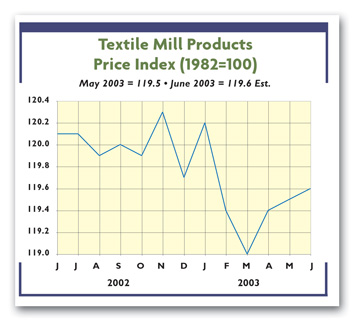
strings. Textile prices continue to disappoint. Government reports do show greige goods edging a
bit higher, but they’re still nearly 3 percent under year-ago levels.

TW
’s overall Textile Price Index, also up fractionally, still lags comparable 2002
readings.

Also worrisome is the continuing weakness in mill production, where totals now run close to 6
percent under a year ago. Profits continue to be squeezed, with the latest evidence being WestPoint
Stevens’ decision to seek Chapter 11 protection. The move follows similar actions over the past few
years by Malden Mills, Guilford Mills and Burlington Industries.

bfindex


Cotton Concerns

Raw cotton fiber tags, after taking an early spring pause, have again turned stronger, thus
adding to the overall textile mill profit pinch. Quotes at last report were in the low 50s —that’s
10 to 15 cents per pound above year-earlier readings.

Behind the fiber’s firming, new US Department of Agriculture estimates suggest both
increasing raw fiber exports and a close-to-5-percent reduction in end-of-crop-year stocks (from
6.2 million bales down to 5.9 million).

Adding to overall cotton buoyancy are reports of disappointing crop conditions. Uncle Sam’s
farm experts now rate 20 percent of the current year’s crop as poor or very poor. Given these
market conditions, cotton prices are likely to remain high, and perhaps will edge up a bit more
over the coming months.

Nor is cotton the only fiber contributing to mill cost pressure. Man-mades, too, continue to
inch up, spurred on by continuing high petrochemical feedstocks. In any event, such bellwether
areas as polyester staple, rayon staple, acrylic staple and textured polyester are now all running
above a year ago. Bottom line: All these cost hikes have to hurt, as the currently prevailing
buyers’ market makes mill pass-throughs increasingly difficult, if not impossible.


Trade Trends Also Bear Watching

There’s still no sign of relief on the import front either. The latest figures show year-to-date
imports of textiles and apparel (square meters equivalent basis) running close to 18 percent above
2002 levels. But there’s now some hope that gains may ease off a bit. For one, there’s weakness in
the dollar, which — other things being equal — tends to make imports more expensive. Then, too, the
recent SARS outbreak and other international problems point to the advantage of having more
reliable close-to-US sources.

The industry is now readying an intense lobbying effort to get Washington to limit Chinese
shipments. Spokesmen cite China’s World Trade Organization membership rules, whereby it is possible
to impose temporary category-by-category limits when Chinese shipments damage the domestic
industry.

Meantime, the weaker dollar also should tend to help exports by making them cheaper to
overseas buyers. Indeed, there are already signs of this. The Institute of Supply Management now
predicts a rise in textile exports over the next six months.


More Statistical Changes

Textile employment and earnings figures have been substantially revised, reflecting updated
benchmark data and changes in seasonal adjustment factors. More significantly, the overall
classification system has been changed — from the old Standard Industrial Classification system
(SIC) to the new North American Industry Classification system (NAICS). The latter involves the
splitting up of the industry into two major segments — textile mills and textile mill products
(carpets and rugs, other home textiles, tire cord and fabrics, canvas and textile bags).

Starting next month,

TW
’s textile barometers table will include data for both of these industry segments.

Preliminary analysis suggests the employment decline has been more precipitous in the textile
mill sector, where the number of jobs fell 7.1 percent over the past 12 months. That’s considerably
more than the 4.1-percent decline noted for mill products. Textile mill worker pay currently runs
more than 8 percent above textile product compensation.


July 2003


Philadelphia Offers Doctoral Program

Philadelphia Offers Doctoral ProgramPhiladelphia University, Philadelphia, will offer its first
doctoral program, a Ph.D. in textile engineering and science, beginning in fall 2003. The program
will center on textile technology as it applies to aerospace, biomedical materials, protective
materials and recreation.Doctoral students will receive advanced classroom instruction, participate
in federally funded research projects, and work with companies and organizations such as the
National Textile Center.With the recent Accreditation Board for Engineering and Technology
accreditation of our B.S. in Textile Engineering program and this new Ph.D. program, we are able to
offer the full spectrum of textile engineering education to our students, said David Brookstein,
Sc.D., dean, School of Textiles and Materials Technology, Philadelphia University. These graduates
will ultimately help fuel the explosive growth of new textile opportunities, and will help guide
the United States textile industry into a high-tech developer and producer of specialty products.
July 2003

International Participation Grows At IMB 2003

IMB 2003, the Cologne, Germany-based triennial fair for apparel production technology and textile
processing, attracted nearly 24,000 visitors. According to a visitor survey, the show’s
international participation grew two-thirds of visitors came from outside of Germany, 56 percent of
whom had decision-making authority. The same survey also revealed that 88 percent of all attendees
had purchasing authority, while 43 percent had decision-making authority. More than 700 exhibitors
from 45 countries showcased new technologies and materials in the fair’s 120,000 square meters of
exhibition space, while buyers from 114 countries an increase over IMB 2000 perused the
aisles.Organized by Germany-based Koelnmesse GmbH and sponsored by the German Engineering
Federation (VDMA), the 2003 edition of IMB included a number of specialized areas. The technical
textiles area, according to the visitor survey, attracted visitors from such varied sectors as
aerospace, automotive, furniture upholstery and medical engineering.Computer and information
technology (IT) were prominent at the fair as well. Exhibitors in these areas, including suppliers
of software and IT solutions for the apparel and technical textiles sectors, offered attendees both
worldwide networking solutions via the Internet and communication solutions for smaller operations.
Visitors interested in computer technology were especially interested in technology solutions that
offered high productivity and flexibility.The theme of the concurrent IMB Forum was “Securing and
Building on Expertise.” Discussions included leadership and knowledge management, as well as
technical textile production for the sportswear market, and IT.A Science and Education Center, and
a Speakers’ Corner also supplemented the fair, offering presentations by universities and research
institutes.This year’s edition of the fair marked the start of Koelnmesse’s long-term cooperation
with the China Sewing Machinery Association an effort to raise the profile of the China
International Sewing MachineryandAccessories Show (CISMA), to take place October 21-24 in Shanghai.
“With our involvement in China, we now offer IMB exhibitors an ideal way to enter the rapidly
growing Chinese market,” said Bernd Aufderheide, executive vice president, Koelnmesse. “At the same
time, we are intensifying our partnership with our customers, and thus further cementing our
business relationship.”

July 2003

Exhibitors Show Innovations At IHE

Exhibitors Show
InnovationsAt IHE
IHE saw the introduction of new developments in yarns and machinery for the hosiery
industry.
Despite fewer visitors and less exhibitor space compared with 2000, the International
Hosiery Exposition and Conference (IHE), held recently in Charlotte, was still a solid show.While
the Italy-based Lonati Group including Lonati, Santoni and Matec led the way in new hosiery
technology, other companies, including Investa and Orizio Paolo, had knitting developments to show.
Fiber and yarn companies had updated products for socks and hosiery. Yarn feeders for knitting
machines also made serious strides forward.Over the past five years, Santoni S.p.A., Italy, along
with its customers and partners, has worked to widen the market for seamless garments. In addition
to machinery, the company displayed a variety of sample products.Currently, Santoni makes 15 models
of seamless knitting machines. At IHE, the company introduced the SM8 EVO4 13-inch machine for
womens outerwear. The company also showed the SM4 Plus3, a 15-inch machine designed to produce
womens undergarments using microfiber and spandex yarns.
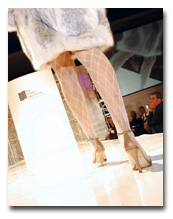
IHE featured a fashion show in celebration of the American hosiery industry, which included
Hue’s faux fishnet hosiery created by Kayser-Roth and Nylstar Seamless Bodywear.Our customers want
reduced maintenance, reduced costs and new opportunities, said Fiorenzo Sandonini, marketing
director, Santoni. The market wants complete service, not just machinery.Matec S.p.A., Italy,
demonstrated its Silver Toe double-cylinder, single-feed machine with electronic control for rib
and links socks with automatic linking toe closing. The machine features a very efficient,
high-quality toe-closing system.Uniplet A.S., Czech Republic (Trustfin USA Inc., Charlotte),
introduced its ANGE 15US with automatic toe closing. This 4-inch, four-feed, single-cylinder
machine has a maximum speed of up to 320 revolutions per minute (rpm) for plain styles. Terry
styles can be produced at speeds of up to 300 rpm.Investa International, Czech Republic, drew quite
a crowd with the NG.Plus six-feed, single-cylinder sock knitting machine with automatic toe
closing. According to knitters who were present, the machines appeal lies in the simple mechanism
used in the patented toe-closing system.Groz-Beckert KG, Germany, stressed its Hofa-Spec needles
with Loop Control®. These needles feature exceptionally narrow product variations, which allow
knitters to avoid panel streaks. Uniform loop structure and the elimination of single needle lines
caused by opened hooks are additional benefits.Italy-based Orizio Paolo S.p.A. introduced its Model
BS seamless machine, a single-knit circular knitting machine designed to produce underwear,
sportswear and swimwear. It has eight feeds with electronic individual needle selection. The
machine also has more than 24 megabytes of storage for garment designs and a maximum speed of 150
rpm.Upgraded Fibers, Updated YarnsThe Fibers Group of Bayer Polymers LLC, Pittsburgh, introduced a
new hosiery waistband technology and unveiled a reduced level of spin finish on its Dorlastan®
spandex.With the help of tension control device manufacturers and hosiery knitters, the Bayer Bushy
Park technical services team in Goose Creek, S.C., has found that it is possible to run Dorlastan
directly from spinning supply packages, eliminating the rewinding process. Although rewound
packages are still available to knitters that do not have accumulator feeders, more and more
knitters are seeing cost and quality benefits from this new hosiery waistband technology.Bayer has
also found that by reducing the amount of lubricant required in production, not only is fabric
preparation made easier, but machine operation is cleaner.Wellman Inc., Charlotte, promoted its new
Holofiber product, a responsive textile that works with the bodys own energy system to increase
oxygen levels, build strength and accelerate muscle recovery
(See Fiber Focus, TW, June 2003). The company also showed its polyester copolymer products
for socks including ComFortrel XP, Sensura® and Spunnaire®.DuPont TextilesandInteriors (DTI),
Wilmington, Del., showcased two new developments energizing socks made with Lycra®, as well as its
T-403 fiber developed specifically for sock constructions.The energizing socks feature a
combination of specially formulated Lycra yarns and new design and knitting techniques that enable
a form of graduated compression to be built into the sock fiber to actively massage legs and
improve blood circulation, according to DTI.The Soft Comfort Lycra yarns in these sock
constructions provide a new, unexpected benefit in a relatively basic product category, said
Margaret Jacob, global marketing director for Legwear, DTI. Unifi Inc., Greensboro, N.C., added new
deniers and filament counts in polyester and nylon to its Mynx collection, a family of yarns with a
soft, cool, natural hand and subdued luster. When combined with the appropriate yarns, Mynx has a
natural drape designed to benefit seamless apparel, intimate apparel, socks, hosiery and swimwear.
Depending on fabric construction, Mynx UV yarns have an ultraviolet protection factor (UPF) rating
from 35 to 50 and provide more protection than typical cotton garments.Italy-based Nylstar
emphasized its Meryl® Mattesse, a unique new collection of innovative micro and super-micro nylon
yarns. These yarns have a super fine, extremely soft hand and a matte finish. This dull finish,
which gives fabrics a more natural look, is due to Nylstars proprietary ingredient and
manufacturing technology, and is unique in the marketplace, according to the company.Israel-based
Nilit Ltd. scored points with IHE attendees by hosting an excellent brunch on the second day of the
show, and using live models to show off garments made with its fibers. The company introduced
Sensil® EverSheer and Sensil Cupelle at the show. Sensil EverSheer is a modified nylon 6,6 yarn for
covering and protecting spandex. Sensil Cupelle integrates two new polymers to achieve two distinct
colors in one regular dye process.
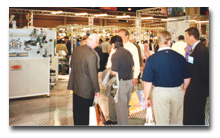
Lonatis booth saw steady traffic at this years IHE.Feeders Go Fast ForwardMemminger-IRO GmbH,
Germany, had a big winner with the new Memminger storage feeder air interlacing (MSF-AI) unit. The
unit air-interlaces yarn on the knitting machine. The company estimates payback at less than one
year. Memminger-IRO also showed its Digi One electronic yarn feeder for yarns and spandex. The unit
boasts a new sensor and is less temperature-sensitive.Italy-based L.G.L. Electronics S.p.A. (Lang
LigonandCo., Greenville) introduced the Primo, which the company says is the first fully automatic
yarn feeder specifically created for knitting. It has positive yarn separation, automatic speed
control and adjustable output tension all in a much smaller package.BTSR International, Italy (PAF
Sales LLC, Greensboro, N.C.), had excellent traffic due to the combination of a Santoni SM8 Top2
seamless machine and BTSRs KTF 100MF microfeeder and KTF 100HP feeder for reciprocated heel and
toe. The company also showed knitters how to eliminate the back creel to gain 25 percent more floor
space.Sock FinishingHeliot International S.A., France, displayed its Sockmodule and Sock.8 boarding
machines. Sockmodule is a modular system for boarding socks and half-hose made from natural fibers,
man-made fibers or blends. The unit has a drying tunnel or heating press and pressurized steaming
shells. An automatic stripper with conveyor is an option. The Sock.8 is a compact boarding and
pressing machine with automatic stripper.Raitech Inc., Charlotte, demonstrated the
QuickConditioner, a tabletop unit that conditions fabric samples using prescribed temperature and
humidity and delivers a dried sample in just 10 minutes.Thomson Research Associates, Toronto,
showed its Ultra-Fresh antimicrobial treatment, which has been used in markets worldwide and in
various applications including gloves, carpets and socks.
Editors Note: Alfred Dockery is editor of The HunTex Report, a newsletter for industrial
textiles. A graduate of North Carolina State Universitys College of Textiles, he has been writing
about the textile industry for 15 years. Dockery is based in Clemmons, N.C.

July 2003

Expofil Changes Dates And Format

Expofil, Paris, announced it will change the dates of its shows to late February and late
September, instead of its current June and December dates. The change will take place with the 50th
anniversary edition in February of next year.February 2004 also will mark the start of a new format
for the international textile yarn and fiber trade fair. Expofil will merge with Fil Event and will
comprise Premiere Vision for woven fabrics, ModAmont for accessories, and Indigo for
design.Discussions also are underway for Expofil and Premiere Vision to merge their legal and
financial activities within the next few months.

July 2003

Sponsors