
Rieter, Spoerry DevelopFine Elastic COM4® Core YarnsRieter Machine Works Ltd., Switzerland, and
Switzerland-based SpoerryandCo. AG have developed very fine elastic compact-core yarns based on
COM4® yarns spun using Rieters ComforSpin® system. Rieter says the ComforSpin systems modular
construction enables flexible adaptation of the compacting elements to specific requirements, while
consistent quality is guaranteed over the entire machine.The fine yarns produced, noted for their
low hairiness, are suitable for circular-knit high-quality underwear, and seamless hosiery and
bodystockings, as well as for warp and weft yarns for stretch woven shirts and womens outerwear.
They are marketed by Spoerry under the Sensual brand name and are distributed globally by
Switzerland-based Nef+Co.
August 2003
Rieter Spoerry Develop Fine Elastic COM4 Core Yarns
Tajima Unveils TFKN New Ribbon Feeding Device
Tajima Industries Ltd., Japan, reports its new TFKN series production embroidery machine for flat
textiles and garments, available through Franklin Lakes, N.J.-based Tajima America Corp., is the
most powerful production machine in its class. The TFKN replaces the TMFD flat production
machine.Twelve-, 15- and 20-head models are available with nine, 12 and 15 needles. Top speed is
850 stitches per minute. An alternate head allows an embroidery field of up to 17.7 inches by 21.6
inches. Continuous embroidery up to 283 inches in length is possible. Other features include
Tajimas rotary tension device, embroidery data management system, satin stitch reduction/expansion,
automatic upper/under thread trimming device, adjustable thread take-up system, take-up lever guard
and large memory capability.Tajima also offers a new automatic ribbon feeding device for its
TEHX-C1501 high-speed single-head embroidery machine that enables additional embroidery
capabilities using up to 15 colors on materials from 0.6 inch to almost 2 inches wide. The device
automatically feeds the ribbon or tape from a roll to be embroidered and then rerolls it.
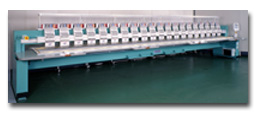
Tajima’s new ribbon feeding device for the TEHX-C1501
August 2003
Yarn Production Stabilizes Stocks Rise Orders Drop
Yarn Production Stabilizes;Stocks Rise, Orders DropThe latest quarterly State of Trade Report from
the International Textile Manufacturers Federation (ITMF), Switzerland, reveals a stabilization of
global yarn production during the first quarter of 2003, with gains in some regions offsetting
lower output in others. North American output rose 9 percent, while South American production was
13.3 percent lower. A European gain of 1.8 percent offset a 0.7-percent Asian decline.Annualized
global yarn output rose 1 percent, reflecting an Asian increased output of 4.6 percent largely due
to increases in Pakistani yarn production. The Asian increase offset reductions of 13 percent in
Brazil, 2.5 percent in Europe and 1.1 percent in the United States.Yarn inventories increased 6.6
percent over the first quarter of 2003 and 2.8 percent on an annual basis. Increases were most
significant in Brazil, with 19.1 percent, and Asia, with 11 percent. European stocks were 6.7
percent lower, and US inventories decreased by 2.4 percent. Yarn orders decreased significantly for
the quarter. Brazilian orders dropped 11.7 percent, and European orders were down by 4.2 percent.
August 2003
KIDS R US Selects EWarna XMatch Solution
Childrens retailer KIDS R US®, Paramus, N.J., has chosen Malaysia-based eWarnas XMatch Web-based
software to speed up its color approval process.XMatch users can access color readings and job
details from one central database, as well as real-time status summaries and reports. Digital lab
dips also may be viewed until an acceptable match is found, and physical swatches may then be
ordered.We look forward to working with KIDS R US to help [it] achieve [its] color management
goals, said John Mackay, eWarna sales executive, the Americas. The market response to XMatch has
been highly positive, validating our commitment to providing solutions that drive time, costs and
errors out of the color process.
August 2003
ACIMIT Despite Challenges Italian Textile Machinery Producers Remain Competitive Globally
ACIMIT:
Despite Challenges, ItalianTextile Machinery Producers RemainCompetitive
GloballyItalian textile machinery manufacturers face challenges in the days ahead, including
fluctuation in demand and increased competitive pressure, according to Association of Italian
Textile Machinery Manufacturers (ACIMIT) Chairman Alberto M. Saacchi. Saachis remarks were included
in his report on industry performance in 2002 to ACIMITs annual general meeting, held recently in
Milan.Turnover in 2002 was 5 percent lower than in 2001 as a result of lower demand both
domestically and from the main export textile markets, particularly the United States and the
European Union (EU). Sales to Asia rose, but were lower than originally predicted.Uncertainties
shroud an anticipated increase in US and EU textile consumption, Saachi said. On top of this, the
higher value of the euro compared to the dollar is penalizing industries like ours that are heavily
dependent on exports, he said.Despite these challenges, recent ACIMIT surveys indicate that Italian
manufacturers remain competitive globally. The surveys cite the industrys dynamism and financial
strength, exemplified by a gain in global market share, from 12 percent to 15 percent, from 1995 to
2001, while Italys main competitors Germany, Japan and Switzerland lost market share.Italian
textile machinery manufacturers have succeeded in implementing policies of differentiation based on
product quality and continuous improvement through constant innovation, Saachi said. Italian
business has also learned to pay more attention to customer service, and this has helped us escape
from the restrictive logic of price-based competition.Innocenzo Cipolletta, Ph.D., also addressed
the meeting, noting that escalating competition from countries with newly developed textile
machinery industries requires that Italian manufacturers increasingly stress technical innovation
as a distinguishing characteristic.
August 2003
VF To Acquire Nautica
VF To Acquire NauticaVF Corp., Greensboro, N.C., has agreed to acquire Nautica Enterprises in order
to obtain new entry into the sportswear market, add to its portfolio of brands, and strengthen its
presence at the department and specialty store level. The acquisition, valued at $585.6 million, is
expected to close in the fourth quarter 2003. Nautica will maintain its New York City-based
headquarters, and distribution center in Martinsville, Va.
August 2003
Textile Chemistry Developments
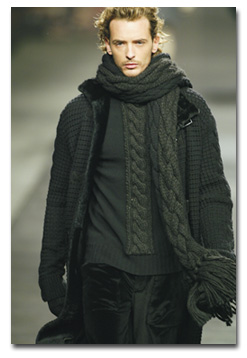
Wool’s current popularity encouraged DyStar to update its wool dyes portfolio and add new dyes
for wool blends.As the American Association of Textile Chemists and Colorists (AATCC) International
Conference and Exhibition (IC&E) approaches (See All Things Color, TW, this issue)
, Textile World takes a look at some of the latest product introductions in the textile
chemistry field.DyStar Continues Its QuestFor Brighter, More Fast DyesFrankfurt-based DyStar
remains committed to the idea of right-first-time dyeings. The company recently updated its wool
dye portfolio to simplify product selection and offer wool processers the economic and reliable
products they need to color modern wool. Wool blends, high-twist yarns and special finishes are
becoming more common, and as blended-fiber fabrics are developed, the dyeing process must be
adapted to obtain solid, reliable shades. This requires the right dyes, as well as an experienced
dyer. In the wool dyes arena, DyStar has added Supralan®, a 1:2 metal-complex and acid dye
available in a broad spectrum of colors. DyStar claims these dyes are suitable for wool in all
makeup forms.The company also has restructured its other wool dyes. Core product offerings include
the Realan®, Diamond and Palatin® families. In certain dyeing applications, these dyes are
supplemented with Isolan® and Telon® dyes.According to DyStar, machine-washable wool is especially
responsive to Realan reactive dyes, which are available in black, navy and brilliant shades. The
dyes are metal-free and capable of meeting high ecological standards.A new three-color combination
has been added to the established Diamond product line, extending it for dyeing loose stock, tops
and piece goods.DyStar sees its Palatin dyes as a perfect complement to the Realan and Diamond dye
families. These 1:1 metal-complex dyes feature good dye penetration and leveling properties on
problematic goods, according to the company.DyStar now groups all 1:2 metal-complex dyes under the
Isolan name, while all acid dyes are sold under the Telon brand name.In other new dye
introductions, DyStar has added a new black dye, Carbon RGB, to its Remazol dye family. This
reactive dye offers excellent build-up properties, so smaller amounts of dye are needed to achieve
deep black shades, according to the company. Remazol Carbon RGB is compatible with cellulosic
fibers and cellulosic fiber blends when used in exhaust or pad-dry, pad-steam applications. DyStar
claims the dye produces a very even, neutral black with only a slight tendency to bronze. Exposure
to perspiration and light is said to result only in on-tone fading. The dye also boasts high wet-
and chlorine-fastness properties and has good wash-off properties.Patented Dyeing ProcessCurrently
undergoing pilot trials, DyStars patented electrochemical dyeing process will be presented at ITMA
2003 in October. The new dyeing process was developed in cooperation with the Institute for Textile
Chemistry and Textile Physics at the University of Innsbruck, Austria, and Germany-based Thies
GmbHandCo. Utilizing an electric current rather than chemical reducing agents, the process offers
shorter, more economical dye cycles, improved reproducibility and lower wastewater costs, according
to DyStar. The process is suitable for Indanthren® vat dyes, indigo dyes and Cassulfon® sulfur
dyes. In addition, DyStar is set to introduce a line of vat dyes developed specifically for this
electrochemical application process. The first available dye in the family is Indanthren Blue E-BC.
Optimized for the process, the company claims the dye offers the same fastness properties as other
Indanthren dyes and is eco-friendly.Bayer Develops Stain Protector For CarpetPittsburgh-based Bayer
Chemicals Corp. has introduced a patent-pending stain-resistant product formulated for use on
commercial and residential rugs and carpets.According to Bayer, Bayprotect SSB offers not only
stain resistance and dry soil resistance, but also outstanding lightfastness properties.St.
Louis-based Solutia Inc. has performed laboratory tests on carpet fibers treated with Bayprotect
SSB and has concluded that the product meets the criteria for carpets bearing its Wear-Dated® fiber
brand name.With our new Bayprotect SSB protective finish, spills are not able to penetrate the
fibers and thus do not leave stains, said Dean Bender, director of marketing, Bayer Chemicals
textile processing chemicals business unit. This minimizes soiling, so carpets and rugs show less
wear and need cleaning less often.Whiter Whites, Fabric Protection From BASFUltraphor® RN Plus
liquid from BASF AG, Germany, makes whites whiter than white, according to the company. The product
is the latest offering in BASFs range of optical brightners for polyester and is an upgraded
version of its Ultraphor RN product. According to BASF, Ultraphor RN Plus has improved fixation
properties and, in most cases, the brightener will prevent shade deviations and yellow areas caused
by non-fixed areas.BASF also has begun to market its ready-to-use Lurapret® C textile coatings. The
water-based coatings are designed to protect cotton, polyester and polyamide fabrics used in
awnings, sunshades, umbrellas and mattresses from the effects of weather and mechanical stresses
including wind, ultraviolet radiation, moisture, and heat and cold. According to BASF, the coatings
also may be used to create washout effects and other decorative designs.Lurapret D coatings,
custom-made acrylate and polyurethane dispersions also are available.Anscott Industries Launches
Safety ProductWayne, N.J.-based Anscott Industries Inc. has developed a water-based flame-resistant
finish that can be applied to almost any fabric, according to the company.FlameFighter® was
evaluated in tests conducted by both the Boston and New York City fire departments. Materials
treated with FlameFighter not only showed a resistance to the spread of fire, but also exhibited
limited after-flame and after-glow.Xiameter Makes Silicones AffordableFor more than a year,
Xiameter, Midland, Mich., has offered textile formulators an alternative purchasing choice for
silicones. For users of large quantities of silicones, Xiameters no-frills business model has
proved effective and affordable, according to Michael Lanham, executive director.Our goal is to
provide our customers with the products they need not only to remain competitive in the
marketplace, but also to consistently add value and meet the needs of their customers, Lanham said.
Lanham hopes within the next year, Xiameters Web-enabled model will be able to support third-party
products.Sunbelt Diversifies, Offers Technical ServicesRock Hill, S.C.-based Sunbelt Corp. started
as a supplier of vat dyes. Over the years, the company has added to its portfolio and now offers
pigment dispersions, solvent dyes, disperse dyes and specialty chemicals. Sunbelts Navinon® vat
dyes are supplied in paste and grain for use in exhaust dyeing, continuous dyeing and printing of
cotton and other cellulosic fiber and polyester/cotton blend fabrics.Navilene® disperse dyes are
suitable for exhaust and continuous dyeing and printing of polyester and polyester-blend fabrics.
These dyes are available in liquid and powder form. Naviprint® pigments are another recent addition
to Sunbelts portfolio. The pigments may be used for print or pad application of cotton or
cotton-blend wovens and knits.Sunbelt also performs audits in customers plants as part of its total
service package. The audits are intended to improve plant efficiency and reduce the cost of
operations.Antimigrants, Softener From Apollo To Be Introduced At The AATCC IC&ESince forming
its strategic alliance with Birmingham, Ala.-based Vulcan Performance Chemicals last year, Apollo
Chemical Corp., Burlington, N.C., has worked to extend its product line. At IC&E, Apollo
Chemical will highlight Apcotherm 4640 and Apcotherm ST-42, and Fluftone® PCS, among other
products. Apcotherm 4640, a man-made antimigrant, and Apcotherm ST-42, a surfactant-type
antimigrant, are designed for use in continuous dyeing operations. Disperse, vat and sulfur dyes
all are controlled effectively with each antimigrant product. Apcotherm 4640 and ST-42 are designed
to eliminate front-to-back shading, white under the neps and white crossovers. Fluftone PCS is a
silicone softener for use on all types of fabrics. It is especially effective on cellulosic and
cellulosic-blend fabrics, according to Apollo. The company recommends applying the product via pad,
but it is designed to be compatible with pigments used in continuous finishing operations. When
used in a no-iron finish, Fluftone PCS will improve needle cutting, abrasion and tear strength,
while improving fabric appearance and hand in pre-cured and post-cured fabrics.
August 2003
Trutzschler Installs Linecommander Simulator
Trutzschler InstallsLinecommander SimulatorGermany-based Trutzschler GmbHandCo. KG has installed a
new Linecommander simulator at its training center. The simulator enables the companys customers to
receive complete training on plant control systems and to test system control software in simulated
conditions prior to delivery.
Staff from UCO Yarns, Belgium, receive training on the Linecommander simulator prior to
delivery of their new system.Trutzschler delivers more than 300 customized plant control systems
annually. In 2002, these deliveries included 280 Linecommander systems, which control the total
Trutzschler production line. The Linecommander simulator automatically configures and simulates
actual units installed in a plant, allowing customers to train on the specific operator interfaces
used in their plants. The company says the simulator also is multilingual, which facilitates
communication during operation and troubleshooting.
August 2003
Nylstar Launches Product Campaign
Nylstar Inc., High Point, N.C., has launched
be extraordinary, a communications campaign that will introduce Nylstar active and
intimate apparel nylon products to US industry leaders bimonthly through the end of 2003.The be
extraordinary campaign is a communication vehicle to engage the entire supply chain from yarn to
retail, said Dina Dunn, vice president, marketing. Each of our new products featured in the
campaign will focus on consumer benefits in order to get everyone thinking about answers before the
consumer asks any questions.Meryl® Skinlife antibacterial yarn is the campaigns featured product
for the month of August. Hind U.S.A., Peabody, Mass., and GeRay Fabrics Inc., Morganville, N.J.,
are both developing Skinlife-enhanced fabrics. Hind plans to introduce Skinlife products to market
in 2004.

Nylstar’s
be extraordinary campaign features apparel, such as the T-shirt left, manufactured with
Meryl® Skinlife antibacterial yarn.
August 2003
NCSU To Offer Polymer And Color Chemistry Program
The Department of Textile Engineering, Chemistry and Science at the Raleigh, N.C.-based North
Carolina State University College of Textiles will begin offering a new polymer and color chemistry
program this fall.The program, an offshoot of the departments textile chemistry program, not only
will focus on polymers, dyeing and finishing, but also will feature new areas such as environmental
science, color science, consumer chemistry, color chemistry and medical textiles.The program is
expected to draw students who have a wider variety of interests, and will afford them a wider range
of study and employment opportunities in the fields of polymer and color chemistry.
August 2003



