US Plans Free Trade Agreements With Three Additional CountriesUS Trade Representative Robert B.
Zoellick has announced plans to negotiate yet another free trade agreement this one with Colombia,
Peru and Panama. This latest announcement is part of a major push by the United States to negotiate
free trade agreements, particularly in the Western Hemisphere, in view of the breakdown of World
Trade Organization trade liberalization talks. This year, free trade agreements have been reached
with Chile and Singapore, and negotiations are underway on a Central America Free Trade Area with
Nicaragua, Guatemala, Costa Rica, El Salvador and Honduras. In addition, the US is pursuing a Free
Trade Area of the Americas, incorporating South American countries; and one with Australia.Todays
announcement was hailed by the American Association of Importers of Textiles and Apparel (ITAA) as
three more steps in the right direction toward a single Free Trade Area of the Americas. ITAA
Executive Director Laura Jones noted that Colombia currently buys considerable raw cotton, yarn and
fabrics from the United States, and speculated that the three countries are good candidates to buy
more US inputs. She said both Colombia and Peru have accomplished textile and apparel industries
and are well located to serve the US market.A spokesman for the American Textile Manufacturers
Institute echoed the textile industrys standing position that free trade agreements must include a
yarn-forward rule of origin, no tariff preference levels that permit non-participating countries to
benefit from the special duty and tariff free treatments, and there must be strict Customs
enforcement of the pacts.By James A. Morrissey, Washington Correspondent
November 2003
US Plans Free Trade Agreements With Three Additional Countries
Calgon Announces New Name For Charcoal Cloth
Pittsburgh-based Calgon Carbon Corp. announced Zorflex as the new brand name for the line of
activated charcoal cloth produced by its Charcoal Cloth International subsidiary. Calgon said the
name was inspired by the absorption and flexibility properties of charcoal cloths.Used in medical,
industrial, conservation and military applications, activated charcoal cloths come in a range of
contaminant- and odor-filtering products, such as nuisance vapor masks; dressings for malodorous
wounds; and nuclear, biological and chemical protection gear; among others.The company explained
that because its activated charcoal cloths are often incorporated into other finished products, the
Zorflex brand will help consumers recognize those products.
November 2003
LCS II LCM Plus Measure Color Of Transparent Liquids
BYK-Gardner USA, Columbia, Md., has introduced two instruments for objective color measurement of
transparent liquids.The LCS II is used to evaluate the color of solvents, resins, mineral oils and
other transparent liquids. It provides spectral measurement of conventional color numbers such as
Gardner, Hazen, Iodine and others; and commonly used color systems such as XYZ and CIELab. It also
performs photometric analyses. Features include menu-guided operation, and automatic cuvette
detection and measurement. Spectral-QC Windows®-based color control software enables advanced
analyses.
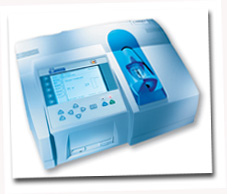
BYK-Gardner’s LCS II color measurement instrumentThe LCM Plus filter color instrument, an
economical alternative for visual color measurement of transparent liquids, determines color
numbers Gardner, Hazen, Iodine, Saybolt and Mineral Oil with one reading and provides automatic
printouts.
November 2003
M Dohmen Burlington Complete Alliance
As part of a recently completed strategic alliance, Greenville-based M. Dohmen USA Inc. has
acquired the assets of Burlington, N.C.-based Burlington Chemical Co. Inc.s dye business. M. Dohmen
also has gained the exclusive marketing rights to Burlingtons line of textile chemical products.
November 2003
ThinStation Designed For Web-Enabled Operations
Cernotec, Greenville, reports its compact, completely self-contained ThinStation terminal for
Web-enabled manufacturers, suppliers, distributors and customers is optimized to serve local, Web,
wireless and legacy-based applications. Providing cost effectiveness, portability and value in a
Windows® XP environment, the ThinStation contains no hard drive, floppy drive or CD-ROM. It can be
configured with a variety of processors, memory, multimedia and peripheral support capabilities
such as operator touch screen, bar code scanning, 802.11b wireless and others.
November 2003
Bayer To Distribute Pilot DPOS
Pilot Chemical Co., Sante Fe Springs, Calif., has selected Pittsburgh-based Bayer Chemicals Corp.
as a distributor of its diphenyl oxide disulfonate (DPOS) dyeing auxiliary to the North American
market. Bayer will market the DPOS auxiliary under the Tanapure® brand name.
November 2003
IRO Debuts IRO-TEC For Projectile Rapier Looms
IRO Debuts IRO-TECFor Projectile, Rapier LoomsSweden-based IRO AB recently introduced the IRO-TEC
controlled-insertion tensioner for projectile and rapier weaving looms. The TEC can be incorporated
into the companys X2 feeder or mounted directly onto the weaving machine. It also can be used in
combination with standard balloon control brushes or IROs Flex-Brake tensioners.Two versions of the
tensioner, both with reaction times of 2.5 milliseconds, provide braking forces of up to 100 or 200
centinewtons, enabling installations to achieve up to 1,200 insertions per minute.The TEC can
handle filament yarn ranging from 40 decitex (dtex) to 2,500 dtex, and spun yarn ranging from 120
Nm to 4 Nm. Automated braking force, timing and duration ensure a high level of yarn tension
control, while a programmable, pneumatic cleaning facility ensures reliable drift, according to the
company.
November 2003
Congress Approves Textile Buy America Legislation
Congress Approves Textile Buy America LegislationCongress has approved a national defense
authorization bill that continues and expands the requirement for defense agencies to buy
American-made textiles and apparel. The action still has to go through the appropriation process,
but the authorization is an important first step that preserves the textile industrys coveted
Berry-Hefner amendment. It mandates the defense department to buy textiles and apparel of
100-percent domestic content wherever possible. There are loopholes that permit some foreign
sourcing, but the act tends to strengthen domestic companies that do business with the military.In
addition to the Berry-Hefner purchasing requirements, this years version of the legislation creates
a Defense Industrial Base Capabilities fund to help develop capabilities for the production of
components that are critical to the operation of military systems. It establishes an incentive
program for US defense contractors to buy US machine tools, and it directs the secretary of defense
to identify all critical components and the capability of manufacturers to produce them. It also
provides for use of a defense department data base to report levels of foreign procurement and
market sectors that are impacted, and it calls for elimination of purchases in foreign countries
that refuse to deliver military products because of US counter intelligence or military
operations..Auggie Tantillo, Washington Coordinator for the American Manufacturing Trade Action
Coalition (AMTAC) said the congressional action is a good first step in ensuring military
preparedness as it helps support a reliable domestic source for essential military goods. He said,
however, that AMTAC will continue to work with Congress on further expansion of the Buy America
act. The industry has been pressing to have those provisions added to Department of Home Security
purchases, but that has not happened.By James A. Morrissey, Washington Correspondent
November 2003
Fleissner Develops Carpet Backing Bonding Process
Fleissner DevelopsCarpet Backing Bonding ProcessGermany-based Fleissner GmbHandCo. has engineered
and patented a bonding process for carpets and other tufted materials based on its AquaJet
technology. The company reports the process produces a quality carpet and also aids recycling
efforts because no latex or chemicals are used.Fleissners process avoids the use of latex by using
spunlacing techniques to apply a nonwoven web to the tufted primary backing. A needling step then
is used to attach the secondary backing to the web. According to Fleissner, the process creates a
carpet with the desired bulk and dimensional stability.Depending on the weight of the secondary
backing, an alternative application method can be employed. For maximum bonding, Fleissner
recommends using a mixture of thermoplastic and non-thermoplastic fibers.
November 2003
Millikens Simply Collection Wins IIDEX-NeoCon Gold
Millikens Simply Collection Wins IIDEX®/NeoCon® GoldLaGrange, Ga.-based Milliken Carpets Simply
modular carpet collection, which comprises 18 designs, won one of nine gold Product Awards given
out at the recent IIDEX®/NeoCon® Canada design exposition. The awards are sponsored by the Interior
Designers of Canada and Merchandise Mart Properties Inc.For designers seeking purity and
understatement in their interiors, the collection delivers clean, minimal and straightforward
definition that has elusive timelessness, said Richard Stoyles, design director, Milliken.
November 2003