Miami Beach: Apparel Focus


T
he seamless integration of three events – Material World, SPESA Expo 2004 and Technology
Solutions – was a hit recently in Miami Beach, Fla., as the Arlington, Va.-based American Apparel
& Footwear Association (AAFA) and the Sewn Products Equipment and Suppliers of the Americas
(SPESA™), Raleigh, N.C., co-hosted the first edition of the co-located triennial event. According
to the organizers, the event attracted more than 10,600 members of the apparel industry, ranging
from mills and contractors to designers, branded apparel companies, private-label retailers and
others. More than 600 companies exhibited.

Material World, an annual and official event of AAFA, is owned and managed by Atlanta-based
Urban Expositions. SPESA Expo, owned and produced by SPESA, is a triennial event focused on sewn
products technology. Technology Solutions, jointly produced by SPESA, AAFA and Urban Expositions,
focuses on information technology as it relates to the sewn products industry.

“SPESA and Urban Expositions decided to co-locate for 2004 in direct response to the
dramatic changes the sewn products industry has experienced over the past few years, as well as to
additional challenges anticipated for 2005 and beyond,” said Tim von Gal, executive vice president,
Urban Expositions.

“We received tremendous feedback from exhibitors and attendees – many pointing out that this
event had the same feel and energy of shows from the early ’90s,” said Benton Gardner, executive
vice president, SPESA.
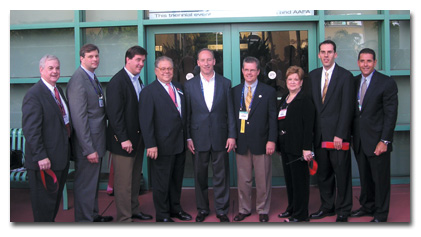
materialworldexecs
Executives gathered at the ribbon-cutting ceremony for Material World, SPESA Expo and
Technology Solutions, co-located at the Miami Beach Convention Center.


Broad Range Of Exhibitors


With a full range of exhibitors present, the event represented both the complexity and
integration of the supply chain. Cotton Incorporated, Cary, N.C., participated in several areas,
most notably with traditional textile manufacturers in the Cotton Pavilion, which featured US mills
partnering with Cotton Incorporated to display their products.

SPESA Expo featured notable exhibitors such as Gerber Technology, Lectra, Juki Union Special
and Pegasus Corp. of America. Melvyn Blore, vice president, sales, Pegasus, said: “The general
impression that we picked up on was that apparel manufacturers, especially in Central America, have
realized there are several factors – close proximity to the US market, quick response with 45-day
lead times, and the ability to take on short production runs – that will keep them competitive with
Asian counterparts after quotas are lifted in 2005. From the number and type of inquiries received
during the show, it’s clear customers have the confidence to invest in new plants and equipment.”

trio
Left to right: Marshall Gordon, industry executive, Retail, Apparel & Footwear, SAP
America; Mahesh D. Amalean, chairman, MAS Holdings (Pvt.) Ltd.; and Vajira De Silva, CEO, Rapier
Consulting (Pvt.) Ltd. at a Technology Solutions presentation


Technology Solutions


The Technology Solutions section of the show floor included such firms as Jomar Softcorp
International, Sunrise Technologies, Porini, New Generation Computing, eWarna and SAP America.
Marshall Gordon, industry executive, Retail, Apparel & Footwear, SAP America, said: “Our
industry has always agreed that servicing the consumer requires a synchronized effort between
design, manufacturing, sourcing and technology. This year, we finally pulled all the vendors, and –
more importantly – the sourcing executives, alongside their CIOs, into a single venue where the
ever-increasing opportunity to leverage technology to reduce cycle times and improve margins
through responsive sourcing was a discussion that I expect will resonate into many companies when
those executives return home.”

Gordon continued: “For the first time ever, we had textile firms stopping by to ask how they
might use SAP to integrate with the apparel-retail supply chains they service. Perhaps the mindset
has shifted and the make-to-order and consumer-centric model is taking hold. This signals to me
that textile vendors are realizing they are servicing a pull-based supply chain, and technology can
help them collaborate and better support their customers. I think many firms resisted this
integrated supply chain model for years. The success of the model in Asia has taught us it can be
equally successful in this hemisphere.”


Looking Ahead


“It is rewarding to be aligned with an event that brings such a depth of business,
networking and educational opportunities to our industry,” said Kevin M. Burke, president and CEO,
AAFA. “We look forward to continued growth and success.”

The new, all-inclusive “Three Great Events,” occurring every three years in the spring, will
return May 8-10, 2007. Material World and Technology Solutions will continue annually with the 2005
edition scheduled for March 16-18.


AAPN: Forging Links


The American Apparel Producers’ Network’s (AAPN’s) continued presence at Material World gave
members the opportunity to meet and work the show floor with full support of the AAPN staff – Sue

C. Strickland, executive director, and Mike Todaro, managing director.

The AAPN Sourcing Executive Reception, this year in its fourth incarnation, continues to
grow in popularity as a casual networking event for AAPN members and leading sourcing executives.
The pre-Material World event, sponsored by Asheboro Elastics Corp., Lion Brothers Co. Inc., Eagle
Global Logistics, American & Efird Inc., Paxar Corp. and Seaboard Marine, attracted more than
270 guests to the Ritz Plaza reception.
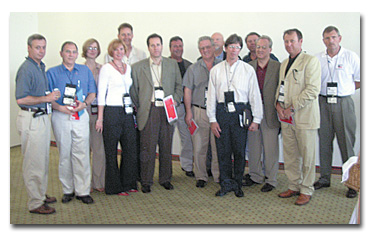
aapnexecs
AAPN honored sourcing executives at its fourth sourcing executive reception.

Prior to the gathering, AAPN hosted a sourcing executives-only roundtable to discuss the
concerns sourcing managers face in today’s marketplace. “We created this party to honor our
customers, the sourcing executives for brands, retailers and manufacturers,” said Todaro, who –
along with AAPN Vice President Kim Krummel, Timberland – facilitated the meeting. “We were pleased
to be able to hear the views of nearly 50 sourcing professionals. The only complaint we received
from sourcing execs was that our roundtable should have been eight hours long instead of two. So,
in Cancun in October, we’ll give them eight hours.”

todaro
AAPN’s Managing Director Mike Todaro (standing) helped facilitate the sourcing
executives-only roundtable.

AAPN, an international, non-profit association focused on networking in the textile and
apparel supply chain, has been a Material World sponsor since it was inaugurated in 2000. This
year, more than 70 of the association’s 220 members participated in the show.

“This is a great environment to really support our members in making new business
relationships,” Todaro said. “With our recent meetings in Guatemala, and gearing up for our meeting
in Cancun, this has been a forum to bring people together and demonstrate the power of networking
in textiles and apparel – something where [AAPN] really excels.”

The AAPN 2004 Fall Meeting is scheduled for Oct. 13-15 at the Fiesta Americana Grand Coral
Beach, Cancun, Mexico. For more information, contact AAPN through its website,
www.USAWear.org.


June 2004
Lenzing Acquires Tencel

Lenzing AG, Austria, producer of Lyocell® and other man-made cellulosic fibers, has acquired
lyocell producer Tencel Ltd. and its entire group of companies from Corsadi BV, The Netherlands.
Financial details of the deal were not disclosed.

Tencel has a total annual lyocell production capacity of 80,000 tons from its Mobile,
Ala.-based plant in the United States and its Grimsby-based plant in England. Lenzing’s annual
lyocell capacity at its plant in Heiligenkreuz, Austria, totals approximately 40,000 tons.

“The acquisition marks a milestone for the Lenzing Group,” said Thomas Fahnemann, chairman of
Lenzing’s Managing Board. “We are tripling our lyocell capacity and thereby reaching the critical
size that is necessary for a sustainable and profitable lyocell operation. With Tencel®, the brand
name, we are taking over a most successful brand, together with its international marketing team.”

“This deal represents a great opportunity for the Tencel organization to see through the
development of lyocell fiber technology into the cellulosic fiber of the 21st century,” said Mike
Proctor, Tencel’s acting CEO. “Our coming together with Lenzing signals a commitment to our core
competence in cellulosic fibers, and it offers our employees, customers and suppliers long-term
confidence in the future.”

According to Lenzing, the acquisition will allow it to be more flexible in using the
available capacities, as well as to optimize its response to market and customer influences.

In addition, Fahnemann said, “We expect major stimuli for our development work from the broad
mutual exchange of experience and technology that has now become possible.”

Earlier this year, Lenzing reorganized its corporate structure into market-oriented business
units, which the company says will facilitate the integration of Tencel with its Lyocell business
.

June 2004

RollAlign™ Laser System Aids Accurate Visual Alignment

Miami-based Ludeca Inc. now offers RollAlign, a laser roll alignment system that facilitates
accurate visual alignment of process rolls during replacement operations. A Laser Emitter unit
mounted to a stationary roll transmits two Class 2 fanned 635-nanometer laser lines to a Reflector
unit positioned on the roll to be moved. The operator then is able to view both the vertical and
horizontal angles and accurately adjust the roll into parallel alignment.

RollAlign is suitable for aligning rolls of most diameters that are spaced 0.5 inch to 10
feet apart. It also can be used to align and measure crowned rolls.

June 2004

Expofil Joins Première Vision


W
ith Expofil joining the Paris Pôle Mode group, there was one-stop shopping in Paris for
buyers looking for yarns, fabrics and surface design. There was initial concern about moving the
Expofil show from December and June to February and September to coincide with the dates of
Première Vision. However, with more retailers and companies that make finished products buying both
fabrics and yarns, holding the shows in adjacent areas at the same time allows design groups to
better coordinate their lines.

The idea was a success. After the February 2004 show, organizing companies Expofil S.A. and
Première Vision Le Salon S.A. announced they would merge and operate under the umbrella
organization Première Vision Le Salon S.A. (to be known as PVE S.A.). Expofil’s parent company, the
French Association for the Promotion of Textile Yarns, also will be incorporated into PVE, while
the Association Première Vision – parent of Première Vision – will become the leading stockholder.

The Board of Directors of PVE includes representatives of weavers and spinners. Daniel
Faure, president, Première Vision, will continue as president and director general, PVE. Expofil’s
Philippe Pasquet will be in charge of development. Within the framework of the decision to move
closer operationally, each show maintains its identity and specificity. They both continue to be
managed by their respective organizational teams.

Première Vision was founded in 1973. At the February show, there were 736 exhibitors
including weavers and knitters of quality apparel fabrics. Expofil, founded in 1979 to showcase
yarns and textile fibers, attracted 141 exhibitors to its latest edition, including spinners of
flat-bed knitting yarns, and circular knitting and weaving yarns.

In addition to Expofil and Première Vision, Paris Pôle Mode includes Indigo, a show of
surface design, and Mod’Amont for accessories. At the most recent events, the focus was on
Spring/Summer 2005. At Expofil, exhibitors of yarns for weaving and circular knitting also showed
Fall/Winter 2005-06 collections. Color and trend information for Fall/Winter 2005-06 was available
at Expofil and at Indigo.

expofil3
At Indigo, most exhibitors showed designs for three seasons. Fall 2005 colors were shown in
four groups.


New Expofil Timing

A Success For Exhibitors


At Christory S.A. of France, Fabrice Motte, commercial director, applauded the timing of the
show. “We’re seeing a lot of new visitors who ordinarily don’t come to Expofil,” he said. One of
the major problems he cited is the current exchange rate between the euro and the US dollar. “For
our US customers, this makes our yarns 30-percent higher in cost.”

Christory offered top-dyed merino wool yarns for weaving, flat-bed and circular knitting,
and socks. Heathers and moulinés were of special interest. Ultra-fine merino wool/silk yarns and
mélange yarns of 100-percent merino wool offered for weaving are stock-supported. Some of the
merino yarns are total-easy-care.

Martin Stuart, United Kingdom-based marketing coordinator, Unifi, said the new timing of the
show was good. Unifi Inc. is working with retailers, brands and garment manufacturers – many of
them come to Première Vision on a regular basis, but don’t always make a second trip to Expofil.
“At home, we work in partnership with our customers to develop fabrics,” Stuart said. Marks &
Spencer

is one customer he mentioned. Merano™, a wool-like yarn blended with Reflexx™ and woven into
a soft stretch fabric, was pointed out. Reflexx has a warm hand and 20-percent stretch, and is
economically priced. Along with new fabrics, conceptual garments on display attracted interest.

expofil1
The most recent Expofil focused on yarns for Fall/Winter 2005-06.


Specialty Yarns


Switzerland-based Hermann Bühler AG introduced SwissCotton Silver®, a blend of 90- to
95-percent cotton and X-Static®, a nylon fiber coated with pure silver. The X-Static silver fiber
delivers antimicrobial, anti-odor, antistatic and therapeutic properties. Its conductive properties
help to regulate temperature. Because it is inherent in the yarn and not a surface treatment, there
is no reduction in these properties through numerous washings. Socks, underwear and athleticwear
are some of the focus areas for apparel. In home textiles, SwissCotton Silver’s ability to ward off
dust mites is a plus for allergy sufferers.

In addition to apparel, SwissCotton Silver has healthcare applications including wound-care
and therapeutic clothing used in the treatment of neurodermatitis and athlete’s foot.

Paul A. Schnepf, managing director, sales, Hermann Bühler, said quality and specialty yarns
are selling well, while commodity yarns are less successful. Fine-count organic cotton is going
into men’s shirts. Most of the company’s organic and long-staple cotton is grown in Arizona,
California and New Mexico.

Germany-based Zimmer AG introduced SeaCell® Active, a lyocell fiber that incorporates
seaweed and silver. It has all of the attributes of Zimmer’s SeaCell fiber, plus antimicrobial and
antifungal properties.

Spoerry & Co. AG, Nef & Co. AG’s Switzerland-based spinning mill, introduced Spoerry
Sensual ultra-fine elastic cotton yarns made with fine American Pima or Egyptian cotton and 15- or
22-decitex Lycra®. The company uses Rieter’s Com4 spinning process to insert a core of Lycra into a
bundle of compacted cotton fibers. The fibers then are carefully twisted around the core, producing
a yarn of unique fineness that has a low level of hair and is easy to weave.

Another Spoerry product that is also based on the Com4 process is Nobletwin®, in which two
rovings are joined, compacted and twisted to form a yarn that is similar to a two-ply yarn.
Nobletwin is even, soft and a little hairy.

At Austria-based Schoeller GmbH & Co. KG, yarns that have functional applications are
selling better than fashion yarns. Cotton/acrylic yarns that offer ultraviolet protection,
Teflon®-treated yarns that repel water and oil, and sanitized antibacterial yarns were pointed out.
S-Shield®, a blend of 92-percent merino wool and 8-percent steel, is antistatic and offers
radiation protection.

Kurabo Industries Ltd., Japan, showed Spinair, a composite yarn made of cotton with
polyvinyl alcohol (PVA) in the core. When the PVA is dissolved, the cotton yarn has a hollow core.
The yarn is warm, soft, light and bulky, has excellent water absorbency and fast-drying properties.
Currently, it is selling primarily to the sweater market.

Kurabo’s Flexfree yarn, aimed at athleticwear markets, is spun from polytrimethylene
terephthalate. It is a stretch yarn described as “fitting the body.” Another Kurabo yarn, spun of
extra-long Supima® cotton, is tightly twisted to give it a linen touch.

Sinterama S.p.A., Italy, introduced Ghost, a phosphorescent polyester yarn 10 times brighter
and longer-lasting than conventional phosphorescent yarns. Target markets are curtains, ribbons and
cinema exit signs.

expofil2
Visitors to Expofil saw yarn collections from 141 exhibitors.


Lenpur™ Is Selling


Italy-based Filati Maclodio S.p.A. reported sales of its Lenpur™ cellulosic yarns are up.
Socks, underwear, shirts, sheets and mattress tickings are major application areas. New yarns and
products are in development.

Shrewsbury, N.J.-based Wellman Inc.’s ComFortrel® is another fiber Filati Maclodio is
working with. Outlast® technology from Boulder, Colo.-based Outlast Technologies Inc. is in the
works for knitting and weaving yarns.

France-based Robert Blondel is selling yarns spun with Lenpur for flat and circular
knitting, and for socks. Yarns of 100-percent Lenpur have an exceptionally soft hand. Other yarns
blend Lenpur with silk. One twisted yarn has one end each of Lenpur, maize and soy. Thermolite®,
Coolmax®, cotton and modal are other fibers offered.

Franzoni Filati S.p.A., Italy, is the largest spinner of compact cotton yarns, which are
sold under the brand name Futura®. Recently, the company introduced Futura Maximizer yarns, which
provide better dimensional stability to fabrics than conventional yarns, are low-pill and have less
hairiness. In addition to cotton, yarns containing Coolmax and Thermolite are available.


Novelty Yarns


R. Belda Llorens S.A., Spain, said colored and finer yarns spun on the cotton system are
selling to its American customers. A dyed yarn called TriMicro, a blend of microdenier
polyester/acrylic/viscose, was pointed out.

Also based in Spain, Hilatura Miel S.L.-Himiesa sells fancy worsted yarns for knitwear,
hosiery, weaving, upholstery and carpets. One of its most successful yarns for Summer is called
Tahiti. The polyester/viscose spun yarn is chunky, twisted and multicolored. A fancy twisted
two-color yarn with irregular slubs in a blend of cotton/acrylic/nylon, and a fancy two-colored
looped yarn in a blend of viscose/acrylic/nylon also are available.

A-Dress, France, has a wide range of fine novelty yarns spun with precious fibers. For
Spring, pure silk and silk blended with linen, cotton, cashmere or soy are available in a range of
yarns including ultra-fine and lustrous looped, nubbed, chunky with a warm touch, chenille and
slubbed. Some of these yarns are going into seamless garments.

Bright colors are selling for Spring at Zultse Wolspinnerij, Belgium. Yellow, turquoise and
pink are the favorites. This firm sells yarns for weaving and knitting. For Fall, thick
acrylic/wool/polyester bouclés and twisted cotton/acrylic yarns were pointed out.

France-based Emile Tardy sells yarns for circular knitting and weaving. For Fall, he
reported there will be a continuation of fine, lightweight fabrics with discrete glitter or sheen.
Crepe yarns in viscose, polyester or blends are among his best sampling items.

Gail W. Strickler, owner and president of Saxon Textile Corp., New York City, commented on
the quality at Expofil. She was happy to see so much American cotton. “There is a crossover between
yarns for apparel and the home,” she said, “and the colors are so wearable.”

Sylvie Tastemain, Expofil’s fashion director, said Fall 2005 fabrics will be luxurious, soft
and fluid. She mentioned rustic tweeds, honeycombs, etamines, chiffons, patterned velvets, laces
and touches of metallic glitter. She showed soft neutral colors with emphasis on browns, jade,
amethyst, petrol blue and faded shades of rosewood. She suggests “insolent” colors for wool in
shades such as paprika, cardinal red and cobalt blue.


Indigo


At Indigo, Fall 2005 colors were shown in four ranges. There are 10 shades in the Clear
group. Between white and black, there are smoky gray, turquoise, acid green, canary yellow, violet,
fuchsia and tomato red. Eight colors in a group called Shifting start with warm, pale beige and end
with black. In the middle are shades of squirrel gray, dark brown, paprika, curry, clove and bright
peacock blue. Tones of autumn are in the Chance range. Colors here include gold, silver, bronze,
amber, willow and gray. The six shades in a category called Blurred are pale and neutral. Soft pink
and orchid are followed by putty, mauve, vanilla and cinnamon.

Many exhibitors at Indigo were selling patterns for three seasons. Italy-based Avantgard
S.r.l. said flowers always sell in the United States. Flat flowers, tropicals, photographic
Hawaiians, enlarged Pucci styles and animal skins are some of its designs.

The Seed, a first-time, Germany-based exhibitor at Indigo, is headed by Thomas Hann, who
refers to the company as a “global creative co-op.” Its network of designers provides service on a
high level, he said. “A lot of work is done over the Internet for fast response.” Along with
designs and colors, the company handles color separation. Current best sellers are rounded shapes
that have a feeling of movement. There are sunbursts, flying saucers, splattered geometrics,
optical designs and abstract flowers.

The looks at Tom Cody Design Inc., a New York City-based studio, are fresh, feminine and
romantic. There are butterflies, brightly colored flowers, scenics that have a destination,
soft-edged graphic flowers and conversationals. Popular in the junior market are Hawaiians and
nauticals. Pirates and buccaneers were pointed out.

Karen Moller sells antique swatches along with original designs. Current favorites include
large-scale retro florals, summer tweeds and checks, figuratives, folklorics, and Art Nouveau- and
Art Deco-inspired patterns.

The next meeting of the Paris Pôle Mode group, showing fabrics, yarns and surface designs
for Fall/Winter 2005-06, will take place in Paris Sept. 21-24, 2004.

June 2004

C & A Chooses Balluff For Carpet Color-Matching

Collins & Aikman Corp. (C & A), a Troy, Mich.-based interior system supplier to the
automotive industry, has selected the BFS 26K color sensor by Florence, Ky.-based Balluff Inc. to
automate its color-matching process.

According to Balluff, the challenge in color-matching carpets is to accurately read and match
color from two different materials. In the final solution, two sensors read the carpet, while up to
four sensors read the vinyl wear pads that are attached to the carpet to increase durability. The
sensors also are programmed to recognize the carpet color regardless of nap/pile orientation. Three
programmable outputs provide flexibility for all color variations.

June 2004

Koch Completes INVISTA™ Acquisition

Wichita, Kan.-based Koch Industries Inc. subsidiaries KED Fiber Ltd. and KED Fiber LLC have
completed their acquisition of INVISTA Inc., the fiber and intermediates subsidiary of Wilmington,
Del.-based DuPont. The deal, worth $4.2 billion, includes the assumption of debt and certain joint
venture and equity interests.Invista will operate out of four business centers: Corporate
management, the Polymers and Resins leadership team, and an Intermediates core team will be based
in Wichita. Apparel, Performance Fibers, research and development, and some functional capabilities
will be located in the Wilmington area. Textile Fibers leadership and some functional capabilities
will be located near Charlotte. The Interiors business will be based near Atlanta.

“The new Invista has many capabilities, recognized brands and an innovative team, and we
believe our long-term outlook is excellent,” said Jeff Walker, CEO, Invista. “Our focus for the
near future is to enhance this business’s ability to create superior value for our global
customers. We believe that this combination of Invistas strengths, primarily in nylon and spandex,
and [Koch subsidiary] KoSa’s polyester capabilities will position us to compete successfully in the
global resins and fibers markets.”

June 2004

German Consortium To Deliver Textile Factory

A group of German companies has agreed to supply a complete textile factory to knit goods
manufacturer Sayhunmedtex, Uzbekistan.

The factory will be furnished with ventilating technology from LTG Air Engineering GmbH &
Co. KG, blowroom and spinning preparation machines from Trützschler GmbH & Co. KG, automatic
cone-winding machines from Schlafhorst, two-for-one twisting machines from Volkmann GmbH and
circular knitting machines from Mayer & Cie. In addition, the consortium will supply bobbin and
package tubes; spinning cans; packing machines; a textile testing laboratory supplied with
equipment from Uster Technologies AG, Switzerland; mechanical work and repair shops; as well as
material handling and moving equipment. Sayhunmedtex plans to begin production with 12,000 ring
spindles by the end of this year.

June 2004

Atlas Instruments Approved For M & S Lightfastness Tests

The Ci3000+ Xenon Arc Weather-Ometer® and Fade-Ometer® testing instruments from Atlas Material
Testing Technology LLC, Chicago, have been approved by England-based retailer Marks & Spencer
(M & S) for lightfastness testing. Manufacturers can use the Ci3000+ a smaller-capacity
instrument featuring state-of-the-art temperature control to establish colorfastness-to-light
qualifications for buttons, fabrics and similar substrates in order to meet M and S quality
standards.

June 2004

June 2004

Material handling equipment supplier

Bushman Equipment Inc.
, Butler, Wis., has launched a new website,
www.bushman.com.


Ioline Corp.
, Woodinville, Wash., has made available its Chinese Control Center — a Chinese-language
interface for use with Ioline 300, 600Ae and SmarTrac™ family plotters. The interface may be
downloaded free of charge at www.ioline.com/tech/wscc_dl_2.html.

Canton, Mass.-based

Interpolymer Corp
. has released a polymer selector guide that details the company’s line of Syntran® and
Megatran® polymers, as well as its technologies and capabilities.

An English edition of the China Textile & Garment Enterprise Directory has been made
available by Montreal-based

Business Data International Inc.
The directory includes a listing of more than 4,000 textile and garment enterprises in
China, as well as a listing of Chinese textile associations and institutes.

Effective May 25,

Omnova Solutions Inc.
, Fairlawn, Ohio, has increased by 2.5 cents per wet pound the price of its glyoxal resin
products.


skcguideSKC Inc.

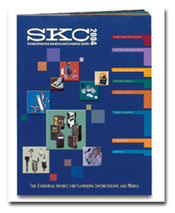
, Eighty Four, Pa., has released its 200-page, full-color 2004 SKC Comprehensive Catalog
and Air Sampling Guide — The Essential Source for Sampling Instruments and Media.

The Consumer Guide to Ultrasonic and Correlation Flowmeters, by Walt Boyes and David W.
Spitzer, P.E., now is available from

Copperhill and Pointer Inc.
, Chestnut Ridge, N.Y.


Exair Corp.
, Cincinnati, has released the Air Nozzles and Jets Blowoff Guide — a 16-page technical
guide to efficient use of compressed air.

Effective May 1,

Dow Reichhold Specialty Latex LLC
, Research Triangle Park, N.C., has increased the price of latex products sold in North
America by 5 cents per dry pound.

Effective May 1,

INVISTA™ Inc.
, Wilmington, Del., has increased the price of its nylon 6,6 air bag fibers by 10 to 12
percent.


Cotton Incorporated
, Cary, N.C., has launched Ask Norma, an interactive feature at the Fabric Smart section
of
www.thefabricofourlives.com. Norma Keyes, director
of fiber quality research, will respond to questions asked by visitors to the site.

Baltimore-based global logistics provider

Samuel Shapiro & Co. Inc.
has launched a new website,
www.shapiro.com.

The Filtration and Separation Division of

Parker Hannifin Corp.
, Haverhill, Mass., has made available a new range of fast loop Balston® sample filters,
a complete line of high-efficiency Balston vacuum pump exhaust filters, and redesigned
full-featured coalescing Balston filters.

balstonfilter


Marietta, Ga.-based

YKK (U.S.A.) Inc.
now offers free of charge its New Zipper Development Kit to those interested in using
zippers in non-standard fastening applications. The kit comes equipped with a fasteners application
guide, material and strength data, and samples showing zipper properties.


Scholl-Then AG
, Switzerland, has redesigned its website,
www.scholl-then.com. Visitors to the site now will find
detailed information about the company’s products, structure and contacts.

The

Specialty Graphic Imaging Association (SGIA)
and the

Digital Printing & Imaging Association (DPI)
, both located in Fairfax, Va., have merged their membership benefits. Annual dues now
include membership in both associations. SGIA corporate members may now designate a digital
contact, who will have access to all DPI on-line members-only areas and association events. DPI
members also have full access to all SGIA on-line members-only areas and association events. SGIA
and DPI now offer Global Memberships to businesses with locations in more than one country. SGIA
also has reduced its dues categories from 13 to six.


June 2004

US Signs Three More Free Trade Agreements

The US government has announced conclusion of free trade agreement negotiations with Australia,
Morocco and Bahrain, and administration officials say they expect Congress to approve the
Australian pact this year. Unlike many of the free trade agreements negotiated earlier, the
Australian agreement appears to have strong support in Congress, and it has been endorsed by
textile manufacturers. Upon final approval, tariffs on more than 90 percent of the trade between
the two countries will be removed immediately.

The Morocco and Bahrain agreements are another story. US Textile manufacturing interests are
opposed to the Morocco agreement, because it provides for what they consider altogether too
generous tariff preference levels that permit use of yarn and fabric from non-participating
countries. While the Bahrain agreement has a rule of origin that requires apparel to contain yarn
and fabric made in the United States or Bahrain, it will permit use of third country inputs during
a not too clearly defined transition period.

US government trade officials hailed the Bahrain agreement as a model for openness in the
Persian Gulf. US Trade Representative Robert B. Zoellick went on to say: This is a high-quality,
comprehensive agreement that will provide American workers, consumers and business unprecedented
economic opportunity in Bahrain. It is a ground-breaking free trade agreement that will benefit
both our peoples. Bahrain will substantially open its services market, streamline digital trade,
protect intellectual property, facilitate government procurement and provide for effective
enforcement of labor and environmental laws.”


June 2004

Sponsors