American Manufacturer Buys Cormatex Machinery

A major US-based manufacturer of nonwoven products has purchased machinery from Italy-based
Cormatex S.r.l. The purchase includes a 15-meter-wide profile crosslapper and an innovative card
feed system that can produce a lap with ± 2-percent uniformity across the width.

August 2004

Warehouse Management Solution Aids TNT Fashion

Atlanta-based Manhattan Associates Inc.’s Warehouse Management Solution recently was selected by
The Netherlands-based TNT Fashion Group – a retail warehousing and distribution services supplier
for companies such as The Netherlands-based childrens- and womenswear provider Oilily – for
implementation at TNT’s distribution center in The Netherlands.

“Our decision to select Manhattan Associates Warehouse Management System has meant we are
able to give Oilily maximum service at minimum cost,” said Kees Meijer, managing director, TNT
Fashion Group. “Integrated with radio frequency technology from Symbol Technologies [New York
City], the solution has given us access to real-time information and allowed us to achieve
extremely high levels of stock and pick accuracy.”

August 2004

Reliance To Acquire Trevira

India-based polyester fiber producer Reliance Industries Ltd. (RIL), the largest private-sector
company in that country, has agreed to acquire Trevira GmbH & Co. KG, a Germany-based
manufacturer of polyester fibers and filament yarns. The acquisition, subject to European Union
regulatory approval, will be RIL’s second international acquisition and its first such in the
polyester sector.

The deal includes four Trevira manufacturing plants in Germany, Denmark and Belgium, which
together have an annual production capacity of 130,000 metric tons as well as Trevira’s research
and development facility. The acquisition, along with RIL’s current expansion in India, will create
the worlds greatest total polyester fiber and yarn capacity more than 1.8 million metric tons
combined. “We expect that the strong commitment of Reliance to the growth of polyester and our
integration into polyester raw materials will help both Trevira and Reliance to serve all our
customers in Europe and other world markets with superior polyester products and even better supply
chain services,” said Subodh Sapra, president, Polyester Sector, RIL.

Bernd Sassenrath, CEO, Trevira, said, “We envisage that this transaction will enable Trevira
not only to benefit from the access to new markets and raw materials sources, but also to leverage
the Trevira brand and contribute our marketing skills and technology in specialty polyester fibers.

August 2004

Thermex 6500


A
Monforts Textilmaschinen GmbH & Co. KG, Germany, has launched a completely new,
modular-design Thermex hotflue system that reduces dyeing times for knitted fabric from hours to
minutes. The Thermex 6500 is an all-new loop dryer with a fabric capacity of up to 51 meters.
Offering previously unknown levels of productivity for knitted fabric dyeing, the machine has a
number of new features including its control system, drive system and indirect gas heating.


In Control


A key feature of the Thermex 6500 is the ergonomically designed control desk. The desk
provides easy access to all the main control and operating functions via a touch screen monitor
located at eye level. A simple menu system guides operators through the setup procedure. This
system is now uniform across the Monforts range, making it even easier for operators to move
between different types of machines.

The Thermex 6500 is available with a choice of two control systems. The standard Qualitex
540 allows important operating parameters including temperature setpoints and fan speeds to be set
and monitored using the touch screen.

The optional Qualitex 740 is a full-scale, programmable logic process controller that
incorporates the Monformatic system. Additional functions offered by the Qualitex 740 include 
setup data storage, batch management and network interfacing. Both the Qualitex 540 and 740 have a
two-loop system for emergency runs and can be connected to Monforts’ remote diagnostics system.
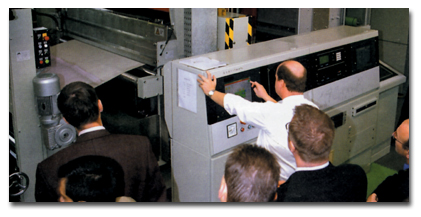
thermexopening


Econtrol™ Knit


Developed for use with the new Thermex 6500 hotflue, Econtrol™ Knit delivers previously
unheard-of productivity levels. A batch that would require between 12 and 24 hours to produce using
a discontinuous process takes just two minutes with Econtrol Knit. Moreover, Econtrol Knit can
reproduce the results time after time, even with large batches. Precise dwell time control ensures
there is no variation in color. Unintentional moiré (rippling) effects are also avoided because the
process puts no mechanical strain on the fabric’s surface. Unlike other processes, Econtrol Knit
dyes cotton/elastane blends without the fabric having to be sewn into a tubular form. An added
benefit is that the fabric is dry after the dyeing process, so the fabric does not have to be
immediately washed out.

Econtrol Knit is suitable for all types of reactive dyestuffs. Although the process requires
no salt or urea, it achieves up to 5- to 8-percent higher yields from dyestuffs than do other
processes. Production costs can be up to 45-percent lower than those for discontinuous methods of
dyeing.

Econtrol Knit was developed in cooperation with Germany-based DyStar Textilfarben GmbH &
Co. Deutschland KG. The machine technology is available exclusively from Monforts. Econtrol Knit is
a trademark of DyStar.


Individual Roller Drives


Standard roller diameter on the Thermex 6500 is 140 millimeters (mm). A 180-mm-diameter
version is available as an option. Manufactured from stainless steel, the rollers in the drying
section are Teflon®-coated, while those in the thermosol section have a highly polished surface
finish.

An AC motor powers each pair of upper rollers. This allows for higher speeds compared to the
single-chain drive used on previous Thermex models. The motors can be controlled using either a
common or an individual frequency converter.
authors
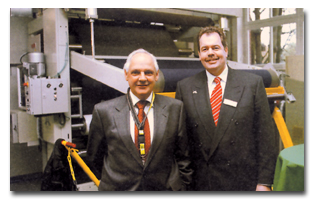
John Hooper (left) and Klaus A. Heinrichs


ST Stabilization Rollers


For fabrics that are prone to waving or creasing during hotflue drying, Monforts has
developed the ST stabilization roller. Featuring a dual-density rubber coating, the ST rollers feed
fabric through the hotflue without leaving marks.


Indirect Gas Heating


The Thermex 6500 is the first Monforts hotflue available with Exxotherm indirect gas
heating. This Monforts-developed system keeps combustion gases separate from the circulation air to
prevent yellowing of elastomer fabrics. It can be used in modern reactive and naphthol dyeing
processes with no neutralization of the alkali.


Editor’s Note: Klaus A. Heinrichs, vice president, marketing, A. Monforts Textilmaschinen; and
John Hooper, JOEM Promotions, an international public relations and publishing company, co-authored
this article.


August 2004

Barmag Expands Portfolio With IWKA Winders

Barmag, a subsidiary of Germany-based Saurer GmbH & Co. KG, has purchased the patents and
rights to IWKA elastomer winder technology from Germany-based Zentes Unitex Textile Machinery GmbH
& Co. KG.

IWKA winders, designed for the production of elastane fibers, can wind up to 16 filaments per
position at speeds of up to 1,300 meters per minute, with a tighter range of between 11 and 120
decitex.

Barmag will market the winders through its Barmag Spinnzwirn subsidiary, and will continue to
produce elastomer winders for the former IWKA program. Zentes Unitex will continue to supply spare
parts for IWKA elastomer and partially oriented yarn winders.

August 2004

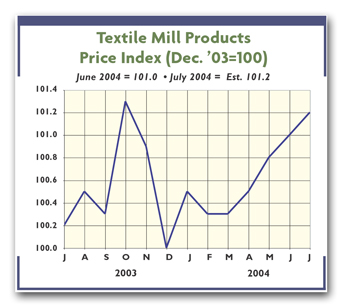
Some Modestly Encouraging News


T
he latest batch of textile statistics doesn’t look all that bad. Indeed, there are even a
few signs of improvement. Thus, at last report, industry activity was actually running better than
1 percent ahead of its recent spring low. Also confirming a bottoming out are shipments of yarns
and fabrics, where the numbers are now running close to 3 percent above those of three months ago.
Inventories of these basic mill products also are in fairly good shape — with industry stocks put
at only a 1.40-months’ supply — down from the relatively high 1.61 reading of a year ago. Also, the
firming price trend continues — with virtually every single subsector continuing to show some
advances. To be sure, these price advances are scattered and small, and hardly signal any
significant recovery. Nevertheless, they represent a refreshing change from the spate of negative
readings of the past few years.


New 2004 Textile Projections

The improving outlook is making for some revisions in the industry’s expected 2004 totals. Thus,
economic forecasting firm Global Insight has upped its projections for all major industry
subsections — basic textile mills, textile products and apparel. On the basic mill level, dollar
revenues now are expected to rise 3.7 percent for the year as a whole. That’s a lot better than the
fractional 0.6-percent increase the firm was calling for three months earlier. Estimates for this
subgroup’s gross operating profit also have been raised for the current year — from $7.6 billion up
to $7.8 billion. And much the same trend is suggested for textile products such as home furnishings
and carpets. This latter sector’s 2004 revenue gain now is likely to approach 10 percent — well
above the 3-percent increase projected three months ago. Global Insight analysts even see the
hard-pressed domestic apparel industry ending up in the plus column — a welcome change from a long
string of negative years. Bottom line: Despite all the recent gloom and doom talk, the textile and
apparel industries are alive and well.

p20_Copy_10


The Foreign Trade Question Mark

But these mills and manufacturers will have to negotiate one looming pitfall — the approaching
end of import quotas, now less than half a year away. To be sure, there’s continuing strong
Congressional pressure to delay the impending phaseout. But, given recent White House comments, any
action on this score seems extremely remote. Clearly, the trade ground rules are about to change in
a way that will almost surely result in further import gains, with China continuing to increase its
market penetration. The big question is, just how much further penetration will occur.

US firms are threatening to file a wave of requests for special quotas on Chinese products
once limits come off next year. The US industry might also move to request heightened duties on
incoming shipments from China and other countries that might benefit from the removal of quotas —
primarily by filing anti-dumping cases. And last but not least, domestic textile and apparel
executives have indicated further shifts towards China will probably be in the form of small,
well-thought-out steps — not great leaps. Reason: Quick response and replacement considerations
dictate that domestic firms keep a significant production base here in the Western Hemisphere.


The Trade Impact On Prices

The end of quotas also should reverse the current bottoming out in apparel prices — as growing
imports from low-cost producers reduce wholesale prices for retailers and other importers by
substantial amounts. Industry spokesman Peter McGrath of the National Retail Federation’s
International Trade Advisory Committee puts the wholesale cost drop at anywhere from 8 percent to
18 percent between 2005 and 2006. This, in turn, is bound to eventually translate into lower
apparel retail prices. How much, of course, depends on competitive pressures. But there are some
ball-park estimates — Frank Badillo, chief economist at consultancy Retail Forward Inc., sees
retail apparel tags falling about 4 percent annually over the next few years. These lower apparel
quotes should also make it increasingly difficult for the basic textile industry to boost its
fiber, yarn and fabric prices, which are expected to show only fractional increases over the next
few years — well under the expected general inflation rate.


August 2004

PFPS Facilitates Product Design

Grass Valley, Calif.-based Autometrix Precision Cutting Systems Inc. reports its Precision Fiber
Placement System (PFPS) automatically guides, cuts, recaptures and positions fibers, facilitating
creativity in the design and manufacture of custom technical fabrics and end-products.

PFPS features user-friendly software and provides precise fiber placement, handling fibers
ranging from Kevlar® to polyester measuring up to 2,250 denier/450 filament. According to
Autometrix, it enables the design of products that traditionally may have required multiple fabric
layers in certain areas, but which could be produced using only one layer, thus reducing production
costs and material inventory. Tables are 63 inches or 73 inches wide, with larger sizes available.
Lengths range from 12 feet to 80 feet or longer.

August 2004

NSC Reports Major Orders

In the months since ITMA 2003, France-based NSC Nonwoven reports it has received several major
orders for equipment. According to the company, manufacturers in the United States are expanding
their investments in ProDyn® needlepunching technology; five new ProDyn lines will be supplied to
companies in Asia; and 12 ProDyn lines and equipment for three spunlace lines have been ordered by
companies in Europe and Turkey.

August 2004

WTO Likely Will Take Up Textile Issues Next Month

Responding to an appeal from US and a group of less-developed-country textile manufacturers, the
World Trade Organization (WTO) is expected next month to take a hard look at what is likely to
happen when all textile and apparel imports quotas are removed in January 2005. The WTO’s Council
for Trade In Goods turned down a request for an emergency meeting, but agreed to take up the issue
at a regularly scheduled meeting in October. While the WTO and others see China and perhaps one or
two other countries dominating trade in a quota-free world, solutions to the problem remain elusive
and highly controversial.

A group of nearly 100 textile and apparel trade associations from 50 countries that comprise
the Global Alliance for Fair Trade recently were joined by the countries of Bangladesh, the
Dominican Republic, Lesotho, Mauritius, Mexico, Nepal, Sri Lanka and Turkey in a request for an
emergency meeting. However, the WTO felt it could not reach a consensus on holding such a meeting
in the face of opposition from China, India, Pakistan, Hong Kong, Brazil, Egypt, Indonesia and
Thailand.

Trade with China is expected to dominate the agenda for the October meeting, and
participating countries will get into the questions of currency manipulation, illegal
transshipments, export subsidies and a rash of other issues. Any extension of import quotas seems
to be out of the question, however, in the face of opposition from the governments of many
countries, including the United States.

August 2004

Spectro’s Application Note Reports Bromine Content

Spectro Analytical Instruments Inc., Marble Falls, Texas, says its new Application Note produces a
cost-effective, simple report of laboratory test results to determine the concentration of bromine
used as a flame retardant in fabrics. The tests are conducted using the company’s Atlas handheld
X-ray fluorescence analyzer, which uses a radioisotope X-ray source; and a rugged proportional
counter detection system.

Sample analysis, accomplished by placing the aperture of the Atlas against the flat fabric
surface and pressing the trigger, is completed in 30 seconds, according to Spectro. Assayed
calibration standards are used to perform laboratory calibrations, and a personal data assistant
attached to the analyzer sends the results via an interface to a desktop computer. The Atlas also
features optical sensors designed to provide reliable and safe analysis.

August 2004

Sponsors