Platinum Equity Finalizes DyStar Purchase

Platinum Equity, Los Angeles, has completed its purchase of Germany-based DyStar Textilfarben GmbH
& Co. KG from its previous owners – BASF AG, Bayer AG and Hoechst AG, all headquartered in
Germany.

“We understand that customer relationships are among the most important assets we acquire in
a business,” said Rob Joubran, COO, Platinum, “and we’re going to do everything we can to make sure
the transition is seamless for DyStars customers.”

Platinum has appointed Clemens Willée; Ph.D., CEO of DyStar.

October 2004

DigiFab Offers New Line Of Heat Presses

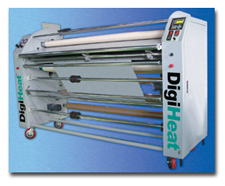
DigiFab Systems Inc., Los Angeles, has launched a new line of heat presses. Available in six models
ranging from 44 to 99 inches in width, the heat presses are suitable for heat-transferring dye
sublimation prints to polyester and polyester-blend fabrics used in applications such as apparel
and home furnishings.

Three-zone heat control across the width of the press ensures consistent heat from left to
right, as well as down the length of material processed. Other features include improved color
accuracy, automatic felt control and cool-down timer, roll-to-roll and sheet-fed options, as well
as adjustable speed and temperature controls.

A 14-inch drum is offered on some models to provide a fast transfer rate of up to 12 feet per
minute, according to DigiFab.

October 2004

Lonati Group Acquires Sangiacomo

The Italy-based Lonati Group has acquired Sangiacomo S.p.A., an Italy-based producer of men’s,
women’s and children’s hosiery machinery and seamless knitting machines.

Sangiacomo will maintain its current business arrangement. Under its new ownership,
Sangiacomo will continue to produce single-cylinder circular knitting machines and new machinery
for seamless garments, with emphasis on sportswear, underwear, casual apparel and bathing suits.

October 2004

Bagir Begins Production In China

Bagir (1961) Ltd., a tailored garment manufacturer based in Israel, has invested $6.1 million in a
new production site in China for men’s tailored suits. The facility employs 700 people and has a
daily capacity of 1,500 suits intended for North American, European and Japanese markets.

October 2004

Pillowtex Brands Get New Lives

Following the liquidation of most of Pillowtex Corp.’s assets earlier this year, the former home
fashions textiles manufacturer’s brand names will soon resurface. Group 3 Design Corp., New York
City, manages the Royal Velvet®, Cannon® and Cannon Royal Family® brands for Official Pillowtex
LLC, formerly GGST LLC – a consortium of companies that acquired the bulk of Pillowtex’s assets
after it closed its doors last year. Earthbound LLC, New York City, manages the Fieldcrest® and
Charisma® brands.

Group 3 has granted global sourcing giant Li & Fung, Hong Kong, global licensing rights
to the Royal Velvet brand for a range of bedding, bath, kitchen and table products and accessories.
Scottsboro, Ala.-based area rug manufacturer Maples Industries has been licensed to produce Royal
Velvet area rugs, including an initial line of tufted, washable bath rugs to complement a line of
bath towels sourced by Li & Fung. The brand will launch in early 2005 at Kohls stores across
the United States.

Li & Fung is in the final stages of negotiations to license the Cannon and Cannon Royal
Family brands for a full range of home fashions textiles and accessories. Rick Darling, president,
Li& Fung USA, said the products will be sourced globally and are expected to launch in late
2005 and early 2006 in the United States, Canada, Europe and Asia.

Earlier this year, mass retailer Target Stores, Minneapolis, received a license to be the
exclusive retailer of the Fieldcrest brand, which will appear on traditional bed and bath products
in early 2005.

October 2004

Screen Printing Versus Ink-Jet Printing


T
he future of textile printing is moving toward digitalization with greater speed, quality
and efficiency. Innovative ink-jet inks have recently been introduced, bringing textile printing
one step closer to becoming completely digitized. Specially formulated water-based ink-jet inks now
make digital ink-jet textile printing possible with simplified fixation equipment. These new inks
are set to revolutionize designing, sampling and short-run textile printing by offering digital
ink-jet print capability on a wide range of fabrics including cotton, cotton/polyester blends,
nylon, rayon and silk.

Pigmented, water-based ink-jet inks are derived from the same pigments as screen-printing
inks in order to perfectly match the color and washfastness of screen-printed products, and to
improve the hand significantly. There are many applications for this new textile technology
including T-shirt proofs, banners, rugs/carpets and furniture coverings, among other applications.

The consistent color, enhanced short run capability, and lower price provided by the latest
generation of ink-jet inks allow designers and low-volume producers to create textile printing that
satisfies a need for faster turnaround, greater efficiency, enhanced customer satisfaction and
overall better designs.

dpfopen
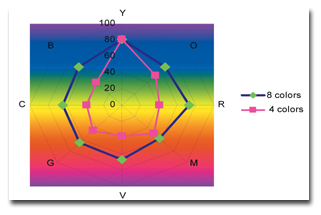
With the latest generation of digital textile ink-jet inks, the addition of orange, purple,
red and blue spot colors to the standard CMYK significantly increases the color gamut, providing
increased print color options.


Compatibility

Pigment-based ink-jet inks are compatible with existing ink-jet equipment and can be adopted
quickly without the need for expensive capital equipment modifications. This allows both large
commercial printers and small mom and pop shops to take advantage of the quality and performance
these new inks provide.

In addition, pigmented inks can be used to print on a wide variety of different fabrics,
reducing the down time between run-cycles.

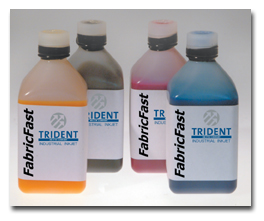
For example, FabricFast™, a new water-based pigmented ink from Trident-ITW, Brookfield,
Conn., can be used in any color textile digital printer using the Epson piezoelectric ink-jet
printhead. These printers  include Mimaki, Roland, Mutoh and Stork
(See ”
Dyeing,
Printing & Finishing News
,”
TW, August 2004)
.

dpfnews_Copy_2
The latest-generation ink-jet inks, such as Trident ITW’s FabricFast™ inks, add to the
capability and flexibility of digital printing.


Color Consistency

New ink-jet ink formulations are bridging the gap between ink-jet and screen printing.
Economically prepped and digitally edited ink-jet proofs now identically match large-scale
production pigment-based screen-printing colors. Accurate color proofing can avoid expensive
production mistakes by ensuring the desired colors and appearance are achieved before screen
printing begins. New inks like FabricFast match screen printing identically.

The full market impact these inks are having is still being felt as manufacturers are
discovering advantages to having two processes that deliver equal color and quality. Additional
short runs are printed on a moment’s notice using ink-jet technology without the preparation time
required for screen printing. Ink-jet printing also allows for seamless variable printing if an
order changes.

Achieving accurate color does not require additional expense, as pigment-based inks are
comparably priced to dye-based inks.


Fabric Hand

Dye-based inks provide a comfortable level of fabric hand beyond what is achieved with
screen printing pigment-based inks, and are used in applications such as apparel printing, where
fabric hand is key. Ink-jet printing pigment-based ink provides better fabric hand than screen
printing, and nearly the same fabric hand as dye-based inks. The engraved templates used for screen
printing typically apply excessive amounts of ink paste to fabrics, causing a significant loss in
fabric hand. This method results in stiff areas in the fabric due to an excessive amount of binder.
An overabundance of ink on fabrics also can chip or flake off as the material flexes – this is
commonly seen with T-shirts and banners. Ink-jet technologies steadily regulate the amount of ink
dispensed onto fabrics for enhanced fabric hand. Ink is applied to textiles in exact regulated
doses for better fabric hand than that provided by screen printing. Ink-jet printers consistently
use ink more efficiently than screen-printing technologies, generating additional cost savings.

Thanks to recent developments in ink-jet technology, the fabric hand on materials printed
with pigmented ink is comparable to that resulting from dye-based print, opening the door for many
applications.


Washfastness

Pigment-based inks exhibit washfastness similar to dye-based inks. This can be achieved
without post-treatments such as steaming, washing and drying that are traditionally required for
dye-based inks. Pigment-based ink-jet formulations deliver excellent washfastness for proofs and
short runs. They have superior lightfastness and won’t fade like dye-based inks. Because
pigment-based inks have significant rubfastness, they last longer over continuous wet/dry cleaning
cycles.


Greater Flexibility For Manufacturers

Manufacturers now can issue new cost analyses for short runs using ink-jet printing, and
deliver the same quality and colors as longer screen-printed runs. This new technology allows
ink-jet printing to deliver the same performance and quality as screen printing, providing
manufacturers with two methods for filling orders – screen printing for long runs, and ink-jet
printing for short runs and replacements.

As ink-jet speed approaches that of screen-printing, manufacturers will produce identical
print quality with ever increasing efficiencies using ink-jet technologies.


Editor’s Note: Deverakonda Sarma, Ph.D., is engineering manager at Trident-ITW.

October 2004

EDANA Considers Symposium A Success

More than 350 delegates from the nonwovens and related industries gathered in Barcelona, Spain, to
attend the European Disposables and Nonwovens Association’s (EDANA’s) 2004 International Symposium.

According to Brussels-based EDANA, participants from 23 European, North American, Asian, and
Middle and Near Eastern countries representing 168 companies attended the event.

The symposium offered a mix of presentations covering nonwovens markets in India, China and
North America; raw materials; process developments; and wet wipes.

October 2004

Exploring The Specialty Fabrics Industry

IFAI Expo 2004 host city Pittsburgh’s West End Bridge spans the Ohio River.


I
FAI Expo 2004 is sponsored by the Industrial Fabrics Association International (IFAI),
Roseville, Minn., a not-for-profit trade association with more than 2,000 member companies. This
year’s edition marks the first time in almost 20 years the show has been held in the Northeast.
Exhibitors, presenters and visitors will converge on the David L. Lawrence Convention Center,
located on the banks of the Allegheny River in Pittsburgh, beginning Monday, Oct. 25, to
participate in pre-conference programs scheduled for Tuesday, Oct. 26 and Wednesday, Oct. 27; and
to view the exhibitions Wednesday through Friday, Oct. 29.

IFAI Expo the largest specialty fabrics event held in the United States also marks yet
another occasion for IFAI to show its members and guests that the specialty fabrics industry today
encompasses not only awnings and marine fabrics, but also a wide variety of fabrics for a prolific
number of specialty end-uses such as air and tension structures, inflatables, tents, vehicle
interiors and filtration, among other products. Military needs also are helping the specialty
fabrics industry expand its product base, according to Steven M. Warner, president, IFAI.


Expo Overview

IFAI Expo was first held in Detroit in 1918, and since then with the exception of 1945 and
1946 the show has run annually for 83 years. Building on the tradition of knowledge of and
experience with the specialty fabrics industry, IFAI Expo 2004 will offer an array of exhibitors
and technical and educational programs. More than 500 exhibitors are expected to showcase products
and services to an anticipated 8,500 visitors; and 15 educational programs are scheduled.


Getting A Head Start

Attendees may choose to take advantage of IFAI Expo 2004 pre-conference programs that will
take place Tuesday and Wednesday. These programs, according to Warner, make this years expo stand
out. They have definitely expanded what we represent as an association and as a tradeshow, he said.

This year, IFAI will offer an extensive program devoted strictly to medical textiles.
Innovations in the healthcare and biomedical textiles industries is the theme of Medical Textiles
2004, organized by IFAI and North Carolina State University (NCSU), Raleigh, N.C. The conference
will kick off with keynote presentations from various industry experts. On Tuesday morning, Richard
OSullivan, assistant director for the Listening Post Project at the Johns Hopkins University
Institute for Policy Studies Center for Civil Society Studies, Baltimore, will present Future
Trends in the Delivery of Medical and Healthcare Services. At a lunchtime meeting on Tuesday,
Blanton Godfrey, Ph.D., dean of NCSU’s College of Textiles, will present Quality Management in the
Healthcare Sector.

The conference will offer seven technical sessions Materials in Medical Applications and
Healthcare, Wound Closure/Suture Materials, Cardiovascular Implants, Orthopedic Devices and
Compression Therapy, Wound Care and Antimicrobials, Protective Medical Textiles and Barrier
Fabrics, and Future Directions and Opportunities for Healthcare Products. The SafetyandProtective
Fabrics Conference, organized by IFAI’s Safety &Protective Products Division, will focus on
developments and opportunities in that sector.

The conference will offer six technical sessions: Human Factors; Thermal;
Biological/Chemical; Protective Medical Textiles and Barrier Fabrics; Ballistic; and Miscellaneous,
including presentations on camouflage for the future warrior, and the physiological function and
wear comfort of protective clothing, among other subjects.In his keynote address Tuesday morning,
Roshan Shishoo, Ph.D., president of Sweden-based Shishoo Consulting, will discuss the opportunities
and challenges of safety and protective fabrics. Attendees of both pre-conference programs will
have the opportunity Wednesday during lunch to hear Elaine Duncan, president, Paladin Medical Inc.,
Stillwater, Minn., present an address focusing on Food and Drug Administration regulatory issues
and international requirements.


army
IFAI Expo 2004 will offer two pre-conference programs Medical Textiles 2004 (left, photo
courtesy of US Navy News Stand) and the 4th International Conference on Safety & Protective
Fabrics (right, photo courtesy of US Department of Defense).


Expo Educational Programs,

Keynote Address

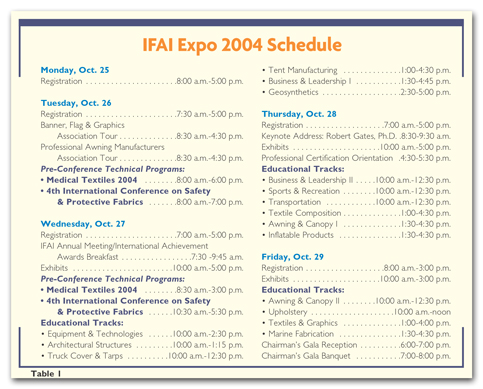
This years educational program has been divided into 14 tracks to be held Wednesday through
Friday
(See Table 1). These tracks will offer attendees the opportunity to learn first-hand about
new developments and techniques in the specialty fabrics industry.In his keynote presentation
Thursday morning, Robert Gates, Ph.D., president, Texas A&M University, College Station, Texas,
and a former director of the Central Intelligence Agency and advisor to six US presidents, will
address the current state of world affairs including political and economic instability.


More To See And Do

Winners of the 57th IFAI International Achievement Awards will be announced Wednesday morning
at the IFAI annual meeting and awards breakfast. Designers and manufacturers will compete in 26
categories, including air and tension structures, awnings and canopies, trade show/exhibit booths,
tents, marine fabrics, other architectural structures, and geosynthetic projects, among other
categories.

Expo attendees will have the chance to attend an IFAI professional certification orientation
session Thursday afternoon. Professional certification testing for Master Fabric Craftsman,
Industrial Fabrics Manager, Certified Project Planner and Certified Craftsman will be available at
the show to candidates who completed and submitted materials for phase one of the process earlier
this year. Certification recipients will be announced during the Chairman’s Gala Friday evening.
According to Julia M. Yach, senior marketing coordinator, IFAI, The Chairman’s Gala provides an
elegant conclusion to a busy and successful show. The gala will include a reception and banquet,
during which a slide show of the 2004 International Achievement Award winners will be shown, new
board members sworn in and retiring board members announced.

IFAI association tours will take place Tuesday, and are an ideal opportunity for expo
attendees to see specialty fabric end-uses in and around Pittsburgh. The Professional Awning
Manufacturers Association will visit the Mount Lebanon Awning & Tent Co., Presto, Pa., and will
have lunch at the Monterey Bay Fish Grotto Restaurant. Tour participants will have the opportunity
to view awnings along Pittsburgh’s waterfront development, station square, and southside works,
among other areas of the city. The Banner, Flag & Graphics Association will have the
opportunity to view a variety of signage during a trolley tour up the Duquesne incline to Mount
Washington, where they will be able to view Pittsburgh’s Golden Triangle. The tour will also
include a visit to Heinz Field and lunch at the Grand Concourse seafood restaurant.

Companions of expo visitors may choose to take advantage of IFAI’s companion programs.
Pittsburgh’s Treasures Tour will take participants on Wednesday to The Carnegies cultural centers,
the Nationality Rooms in the Cathedral of Learning at the University of Pittsburgh and Phipps
Conservatory. A Shopping in Amish Country sightseeing excursion will take place Thursday in nearby
Wilmington.


For more information about IFAI Expo 2004, contact IFAI (651) 222-2508, (800) 225-4324; fax
(651) 631-9334; generalinfo@ifai.com; www.ifaiexpo.info.

October 2004

Rieter Orders Up 14 Percent

Rieter Textile Systems, Switzerland, reports textile machinery orders received during the first
half of 2004 increased to 619.4 million Swiss francs (CHF) 14 percent over the same period in 2003.
Greatest demand came from Asia, and was particularly strong for staple fiber machinery, with orders
coming chiefly from China, Turkey and Pakistan. Man-made fiber processing machinery orders were up
slightly over the first half of 2003.

While orders were up, actual sales for the first six months were down by 5 percent to 582.4
million CHF.

Rieter cited delivery delays related to scarce energy resources at customer sites in China as
contributors to the decline, and expects to clear the backlog in the second half of 2004. Sales to
China represented more than 20 percent of total first-half sales, and deliveries to Asian companies
increased to 70 percent of the total a 9-percent jump.

The company’s operating profit before interest and taxes for the first half of 2004 totaled
58.1 million CHF down from the year-earlier total of 64.4 million CHF. Operating margins were 10.2
percent, compared with 10.9 percent for the first half of 2003.Rieter says its staple fiber
processing customers are increasingly interested in purchasing complete spinning installations
instead of individual machines.

October 2004

WestPoint Stevens Targets Middle Eastern Markets

WestPoint Stevens Inc., West Point, Ga., has signed sales and distribution, and licensing
agreements with American Business Development (ABD), Germany. The agreements will introduce
WestPoint Stevens brands including Martex®, Lady Pepperell®, Utica®, Grand Patrician®, Vellux® and
others into Middle Eastern retail markets, and provide for its bedding and bath products for those
markets to be produced by selected Middle Eastern manufacturers.

“This has been a carefully developed strategy that requires the international expertise of a
partner such as American Business Development,” said Robert B. Bob Dale, president, Bed and Bath
Division, WestPoint Stevens. “ABD has all the skills and appreciation of cultural and geographic
characteristics that are essential to global marketing [and] is also acutely conscious of WestPoint
Stevens commitment to protecting the integrity of our brands and controlling the quality of our
products.”

October 2004

Sponsors